
Tag Archives: ChatGPT

Go. Be Funny.

Once the boss editor gave me an assignment. “Go,” he said. “Be funny,” he said. “Come back in an hour.” We were preparing a calendar with amusing sayings and odd observances on various dates.

Now, most writers would be daunted by this sort of thing. I know I was. But in an hour, there I came, quips in hand. “Is this job too easy for you?” he asked.

Actually, writing funny stuff is not easy. I was just feeling quirky that day. (“Dying is easy. Comedy is hard” is a quotation that’s been attributed to any number of those shuffling off the mortal coil, from actors Edmund Gwenn to Jack Lemmon to Peter O’Toole to Meryl Streep (who, not having died yet, almost certainly didn’t say it on her deathbed). But I digress.)

The geniuses of Monty Python certainly seem as though they created comedy easily. And I know a man who can write a funny song, a la Weird Al, in 15 minutes or less. But for most of the writing world, humor is the hardest form of writing. (Except possibly the sestina. Or the humorous sestina, come to think of it. But I digress again.)

How do you build up your humorous writing muscles to the point where you can flex? I recommend hanging out with silly people, like the aforementioned songwriter. (If you’re tempted to use AI, forget it. I asked ChatGPT to write a joke about a cat. It replied, “Why did the cat sit on the computer? Because it wanted to keep an eye on the mouse!” Asked for a joke about a dog, it said, “Why did the dog sit in the shade? Because he didn’t want to be a hot dog!” Apparently, ChatGPT writes at the level of a five-year-old. And when I asked for a humorous sestina, it created one about a knight named Sir Guffaw and his tap-dancing horse. But I digress yet again.)
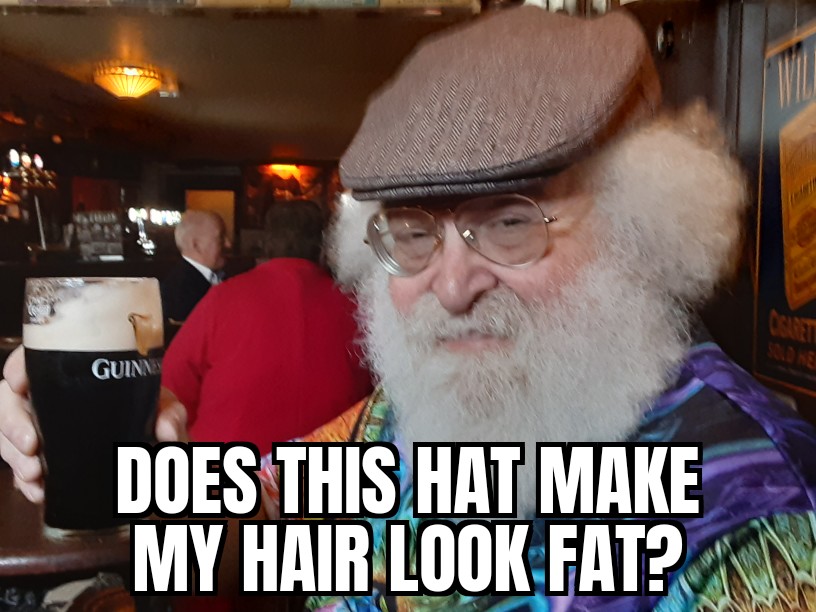
My next piece of advice is to have a cat or a spouse. Cats are not dignified, contrary to their reputations. One of our cats tried to escape from the vet and bonked her head on the glass door to freedom. And my spouse does and says funny things, or prompts them from me. For example, I once took a picture of him in a tweed cap and turned it into a meme (seen here, as you can no doubt tell.)

You can also turn trauma into humor. I once found myself having to get rid of a dead possum, which certainly traumatized me. Another time I almost offed a friend with a bay leaf. Those alarming events worked their way into killer posts, so to speak.

Reading humor can help, too. Think David Sedaris and The Bloggess. For irreverence, there’s Lamb: The Gospel According to Biff, Christ’s Childhood Pal, by Christopher Moore. For vintage humor, there are James Thurber and Erma Bombeck. (Given the example of Thurber and Bombeck, being from Ohio helps too. But I digress some more.)

Then there are humorous movies. Personally, Airplane can still make me LOL. (So can Zero Hour, the film from whence Airplane‘s plot and many lines of dialogue came, only deadly serious. It’s impossible to watch without flashing back (or forward, since Zero Hour is the older movie). But I digress yet again.)

But for myself, I like a good catchphrase that didn’t come from a TV show or movie. It came into being because I wanted to write little asides and put them in as footnotes. But I couldn’t figure out how to make WordPress do that, so I turned to my grammatical friend, the paren. (Not really my favorite mark of punctuation, which is the semicolon. But I digress for the last time this post. I swear it.)


Adventures in Writing: AI

I must admit I’ve had some experience with generative AI writing. I know I should be ashamed of this, but I’m not. Here’s what I learned about this tool or terror.

When ChatGPT was new, I was intrigued. I just had to try it out. I spent a couple of days feeding it some of my favorite topics and styles to see what it could do with them. What it produced was largely crummy.

For example, I asked it to write a haiku on the subject of sex. What it produced was: “Whispers in moonlight/Bodies weave an intimate/Haiku of passion.” Not exactly T.S. Eliot.

I asked it to write other kinds of poems. In almost every one, ChatGPT included the word “poetry” or the name of the style: “The poetry of passsion’s sweet romance” or “O sonnet of the flesh,” “Each line a brushstroke in the poet’s light,” “In every sonnet, life finds sweet peace.”

It also relied heavily on metaphors, many different ones in the same piece. For example, in a poem on writing, it offered “With verses woven like a tapestry. The writer’s heart, an open book” and “how the words, like melodies, entwine, In stanzas, whispers of a silent song.” Now that’s just bad.

It mixed metaphors atrociously: “The enigmatic tapestry…kaleidoscopic hues… orchestrated by unseen forces, paint the canvas of existence… a symphony of discordant notes, each mood a chapter in a cosmic novel.” All those in one paragraph. Another particularly egregious one was “etched into the fabric of one’s existence.”

It also got facts wrong. Recently, hoping that it had improved, I asked it to write a country song about horses in the style of Willie Nelson. “He’s a big ol’ bay with a coat dark as night” was one of the lyrics. (Bay horses are reddish brown.)

Later on, I had a chance to give a workout to a different AI program tasked with writing ten chapters of a novel. Then I was tasked with cleaning it up into human language. It was a lot of work.

AI couldn’t keep track of the characters, for one. It called a little boy Nicky, Billy, and Jamie and another character Henderson and Nelson in different chapters. It chose weird words (“thrummed”) and repeated phrases (“weight of the world”) in nearly every chapter. It forgot that a pivotal scene was supposed to take place in an abandoned warehouse, setting it instead in the woods. Once I had to have it produce a whole new chapter because the first one was so far off. Plot, characters, dialogue, narrative, backstory, continuity—all would be rejected by any competent editor.

AI nonfiction can be just as bad. There’s a tendency to be simply wrong about names, dates, and locations, for example. Flaws like that will seriously mislead readers. AI nonfiction has also been known to get things like herbal remedies drastically and dangerously wrong.

Once I toyed with an AI image generator, which did reasonably well with a human girl (though it couldn’t produce medium-length auburn hair), but couldn’t make a satisfactory alien to meet my criteria. It looked like one of those sad-eyed children in the old paintings.

I understand why special effects professionals hold AI in horror. Entire departments are being canned and replaced by larger, more sophisticated sorts of AI than the Tinkertoy ones I played with. But movies have been using CGI for years, so AI is the next logical extension. I’m not saying that the SpFX companies are right to abandon the people who have done so well for them over the years. Human imagination controlling the tools of creation will—or should—always have a place in the equation.

But generative AI has a long way to go before it can produce prose or poetry that can substitute for human works. I understand that publishers are being assailed with AI-produced novels, but I can’t imagine they can’t tell the difference. Readers of self-published novels, though, should watch out for AI books and avoid them.

Or, if you prefer, avoid all AI writing. I understand why you would.

(Note: Aside from the brief quotes, no AI was used to write this post.)

Me and the PoemBot

The other day I started fooling around with ChatGPT, the AI program that people are using to write things for them. As a writer myself, I wondered if I would be out of a job any time soon. Realistically, I know I won’t, since the ghostwriting firm I write for does not allow us to use AI-created content.

Still, I was curious about what ChatGPT could do with various writing tasks, so I dove in. Here’s what I found.

The program did well on factual queries (Write a paragraph on bipolar disorder) and even had an answer for a philosophical query (What is the meaning of life?). The more criteria I gave it, the worse it did. (Write a practical but amusing paragraph about bipolar disorder.) It showed a definite tendency to throw in every simile and metaphor it could, which definitely ended up mixed.

For blog posts with not-too-specific topics, it did better. I asked it to write a paragraph for a blog post on a self-help topic, and it almost instantly came up with one about positive affirmations. Asked to write a blog-post paragraph on toxic positivity, it did quite a competent job.

But I really wanted to test its talent when it came to poetry, a much more difficult skill. I stuck mostly to sonnets and haikus (I did have it write one villanelle) on assorted topics. All the sonnets it produced were Shakespearean unless I specified a Petrarchan, Miltonic, or Spenserian one. The sonnets were awfully self-reverential. No matter the topic, they tended to include the words sonnet, stanza, or verse. Here’s a sonnet it wrote on the subject of writing, which I suppose gave it an excuse to refer to sonnets within it. But it also referred to a dance, a symphony, brushstrokes, a tapestry, melodies and song, a journey, and dreams.

Now, I haven’t done Lit Crit in many a year, but the result seemed muddled and mediocre to me.

Upon the page, my quill begins its dance/ In ink, the thoughts from depths of mind take flight./A symphony of words, a sweet romance/Each line a brushstroke in the poet’s light.

In solitude, I craft a world unseen/With verses woven like a tapestry./The writer’s heart, an open book, pristine/Unraveling tales of eternity.

Oh, how the words, like melodies, entwine/In stanzas, whispers of a silent song./The poet’s soul, an endless, vast design,/In every verse, a journey to prolong.

Through pen and paper, dreams find their release/In every sonnet, life finds sweet peace.

Then, I tried it on a different topic—sex. I was curious to see how it addressed this most human of activities. Here’s what it wrote:

In whispered shadows where desire’s flame,/Ignites the senses in a sacred dance./Two souls entwined, no need for words to claim,/The poetry of passion’s sweet romance.

Bodies as verses, intimate and bare,/In tangled sheets, a sonnet takes its form./Each touch and kiss, a stanza to declare,/A love that weaves through passion’s vibrant storm.

Ephemeral, the moments that we share,/As pleasure paints the canvas of the night./In silent echoes, echoes of a dare,/Two hearts entangled in this sweet delight.

Oh, sonnet of the flesh, in whispers spun,/In ecstasy, a tale of love is done.

Again with the references to sonnets, dance, poetry, verses, stanzas, and painting a canvas.

The chatbot, in my opinion, did better with haiku. Here’s a haiku on the subject of haiku:

Three lines, concise art,

nature’s essence captured close,

haiku whispers truth.

Here’s what it did with a haiku on bipolar disorder:

Storm in a fragile mind,

sunshine and shadows collide,

bipolar tides shift.

And on the subject of writing in general:

Ink-stained whispers flow,

Words on paper, tales unfold,

Silent stories grow.

But when it came to sex, the haiku was again (in my opinion, needlessly) self-referential:

Whispers in moonlight,

Bodies weave an intimate

Haiku of passion.

So, what did I learn from my experiments? ChatGPT does a decent job with factual topics, though it has a tendency to rely rather heavily on figures of speech. Here’s a paragraph it wrote when I gave it the subject of bipolar disorder in the style of my other blog, Bipolar Me. It wrote a (flattering) description of the blog instead.

Navigating the rollercoaster of emotions that is bipolar disorder is a journey unique to each individual, a theme explored with raw honesty on the pages of the Bipolar Me blog. In the midst of the highs, where creativity flows like a torrential river, and the lows, where the world appears desaturated and heavy, the author skillfully captures the kaleidoscope of emotions that define life with bipolar disorder. With a poignant blend of vulnerability and resilience, the blog illuminates the challenges faced by those grappling with the disorder, dispelling myths and stigma along the way. Through personal narratives and reflections, the Bipolar Me blog serves as a beacon of understanding and connection, reminding its readers that they are not alone in their journey through the intricate landscapes of mood swings and self-discovery.

And here’s what it said about this very blog:

The “But I Digress” blog, much like a meandering conversation with a wise and witty friend, invites readers into a realm where thoughts flow freely, detouring into unexpected intellectual landscapes. With each post, the blog embarks on a delightful exploration of diverse topics, from profound philosophical musings to lighthearted anecdotes, weaving a narrative that reflects the author’s curious mind. It’s a virtual salon where ideas intermingle, and the unexpected tangents become the heart of the discourse. Whether dissecting the nuances of contemporary culture, diving into the intricacies of literature, or reflecting on the quirks of everyday life, “But I Digress” captivates its audience with a blend of insightful commentary, humor, and a touch of intellectual whimsy, creating a space where readers can both ponder the profound and enjoy the pleasures of intellectual meandering.

I’ll take it. Thanks, ChatGPT.