Category Archives: health

Gravity, Like Karma, Is a Bitch

Gravity and I have quite a history. We’re not friends, to say the least.

Some of our disagreements resulted in little more than damage to my dignity. (Not that I have much of that to begin with.) I land on my amply padded ass and sustain no physical injuries.

My head, however, is not so lucky. When I was a kid, I liked to hang upside down on the monkey bars by my feet. (Yes, by my feet.) As you might guess, my feet slipped, and I succumbed to gravity, landing on my head. I remember thinking falling wasn’t so bad, but that was before I hit the ground. (This was back in the day when playground supervision was less rigorous, and playground surfacing meant asphalt. I didn’t even get rushed to the emergency room afterward. But I digress.)

Over the years, from childhood to my adult years, I have honed my falling skills and my disagreements with gravity to a fine point. I have fallen off a horse and off cross-country skis. I have fallen out of car doors and tripped into a chair I was carrying. (Gravity snickered at that one and gave me a fat lip the day before my ballet recital. The ballet was supposed to make me more graceful. That worked well. My parents should have gotten their money back. But I digress again.)

It was almost exactly one year ago that I went “under the knife” and got a bionic knee, or at least a snazzy chrome one. My adaptation to new ways of standing, sitting, balancing, and walking took rather a long time. At six weeks, when my friends who’d also had their knees replaced were ready to get their other knee done, I was still falling down. A lot. Eventually, I admitted I needed help, and the emergency squad took me to the ER, where they did imaging to make sure the robo-knee was still firmly in place. (It was.)

One of my gravity fails, however, was spectacular enough that I broke the two little bones that stick out on either side of the ankle. (That day, I learned a lot about controlled substances. The EMTs gave me fentanyl to get me to the ER, and the ER personnel gave me ketamine to “reduce” the fracture (put the bones roughly into place before pins and plates were inserted to keep them there). But I digress some more.)

I don’t remember any untoward effects of the fentanyl. (The EMTs and I joked about prices for it in various parking lots around town.) The ketamine had definite psychedelic effects. Everything began to look like various colored blocks and cubes, as if I were in the Minecraft movie. Everything returned to normal fairly quickly, and I was whisked off to surgery to get my new hardware.

Let me tell you, if you’ve ever thought wearing an arm sling was awkward and annoying, it’s nothing compared to using a walker with a knee sling, if you’re not allowed to put any weight on the damaged foot. It involves flinging yourself up from a chair onto your one good foot and lurching with your other knee towards a piece of fabric. Even ballerinas would find it lacks grace.

Right now, I’m at an awkward, in-between stage when it comes to walking. Travel requires a good deal of planning and switching among mobility aids. Until this past week, to go out, I needed to take a wheelchair down a ramp to get out of the house and to the car, and a walker to get from the car to the destination’s door. Now, the wheelchair and the ramp are gone, but I need a cane to negotiate the front steps and then the walker to get to the car. And I can’t carry one while using the other. I’m trying to figure out how to manage the process on my own so I can travel independently. It’s frustrating.

But by now my motto is the old saying: Fall down seven times. Get up eight. And gravity can go to hell.

Hebrew Pill Caddies and Other Low-Tech Med-Tech

My husband is going to the eye specialist on Monday to have a consultation on his cataracts. There, I assume they will show him a little film (if he can see it) about the latest in cataract surgery, which will presumably feature lasers and maybe robots or some other high-tech med tools. Doppler radar, maybe, or AI scalpels.

Over the past year, my experience with med-tech has been decidedly low-tech, other than my bionic knee and my Frankenstein ankle. Everything else I’ve had to deal with has been a bit more, shall we say, basic?

The Transfer Board

This is exactly what it says—a board you use to transfer from one surface to another, like from a wheelchair to a bed or from a bed to a chair. By board, they mean heavy-duty plastic, like a huge cutting board. I learned about this amazing invention during a stay in a post-acute rehab facility that offered five-times-a-week physical and occupational therapy, necessitated by the bionic knee and Frankenstein ankle.

You sit on the board and slide, or rather lift your butt somewhat while leaning forward and scootching. (I’ve seen wooden ones in catalogs, polyurethaned to avoid the heartbreak of splinters. Even ones with butt-shaped seats that go down a track from end to end, so you don’t have to scootch. Too bougie for me, though. I’ve stuck to the plastic variety, sometimes literally. But I digress.)

Transfer boards are reversible and even upside-down-able. They’re easy to clean, should you be wearing a hospital gown and shart as you scootch. And now that’s a thing you know.

The Knee Sling

A knee sling is like an arm sling, only even more annoying and cumbersome. It’s a piece of cloth, sometimes with a metal frame, that is attached to a walker. It’s what you use to practice walking on one foot when you’re not allowed to put weight on the other one.

The procedure goes thus:

  1. From a sitting position, fling yourself to standing on one leg within the confines of the walker. (In my case, it was not just a fling, but a massive push-off and a lurch. I was having enough trouble standing up already, but doing it one-legged was well-nigh impossible. (Un)fortunately, I got lots of practice. But I digress again.)
  2. Bend the other leg (the one that can’t bear weight) into a 90-degree angle as you stand, without kicking the chair you were sitting on.
  3. Try to guide the bent leg into the sling without letting go of the walker, which will be essential at this point. Good luck.
  4. Ambulate (hop), using your one “good” leg and the walker for balance. (I found a decided tendency for the steering (me) to pull to the left, as my right leg was not involved in pushing off. But I digress some more.)
  5. Continue doing this until the “bad” leg can once again bear weight. I think this is meant to teach patience, an OT skill, at the same time.

The Pill Caddy

Not directly tied to the rehab stays. In the rehab, the nurses brought my meds and injections twice daily, plus one extra pill visit three hours before wake-up time so I could digest it before breakfast.

Once I was home, though, I had to leave town for three days. I threw my bag-o’-drugs (literally a Meijer bag full of pill bottles) in our duffel bag and off we went. The drive back from Florida to Ohio meant we had to stay in a hotel (with an ADA-accessible room) halfway home.

When we got home, however, the bag-o’-drugs was nowhere to be found—not in the duffel, not in the car. I called the hotel management, who, after several days, admitted that the cleaning staff said it simply wasn’t there.

The people who had to refill all those scripts said I should fill out a police report or they couldn’t do it, as there were controlled substances involved. (No opioids, though.) I can just picture calling the police about it.

(Hello, Georgia police? I probably left my bag-o’-drugs in hotel room 109. No, I can’t come in to fill out a report. I’m 400 miles away. You’ll send me a report form, and I should fill it out and return it? Then you’ll process it and investigate the hotel? And get back to me sometime after that? And leave me unmedicated the whole time? Just no. But I digress still more.)

I finally got the scripts refilled after a doctor visit and three days of phone calls (none of them to the police). I owned my idiocy and went shopping online for a pill caddy.

I never knew there were so many kinds available—one set of pills per day, four sets of pills per day, one-week, two-week, monthly, easy-open buttons, vertical dispensers, and more. I settled on a no-frills model without the turbo-charged carburetor. One-week, twice-a-day.

I was all set to click “order” when I realized something. The caddy I had chosen was embossed with the days of the week, but they were backward. The names of the days were not mirror writing, of course, but the days of the week went from left to right: “Sunday, Saturday, Friday, Thursday, Wednesday, Tuesday, Monday,” so you’d end up taking your pills from the right to the left, like Hebrew writing. I searched again and found multiple products labeled that way.

I ordered one with orderly days. It should arrive today. Filling it each week will be tedious, but not nearly so tedious as calling the Georgia police and getting transferred from department to department until I reach the department of clueless packers.

PT Can Be Fun. No, Really.

If, like me, you’ve had to recover from an operation or injury, you’ve probably been introduced to professional physical therapy. Many people in a rehab facility refuse to participate. I felt it was an unwelcome chore that I had to push myself to do. But I did learn that PT can be entertaining as well as strenuous.

One of the most common exercise machines is the bike or reclining stepper. While working out on this can seem dull and repetitive, there are ways to make it more interesting. I worked out on one that had a small screen in front of it. (Did it provide videos of scenic places you’d like to cycle? It did not. But I digress.)

It was like a video game. On the screen were representations of a road and assorted cars and trucks, which scrolled downward into your path as you pedalled. The idea was to avoid the cars by shifting the pressure you exerted with each leg to steer your own car from lane to lane. Your score was based on the number of cars you managed to avoid.

The first time I tried it, I wasn’t very successful. All along the way, I crashed into cars rather than going around them.

Then I realized that when you crashed, the machine produced an appropriate noise of rending metal (Not the screams of any imaginary drivers or passengers. But I digress again.).

Instead of trying to avoid the cars, I made it my personal quest to hit as many as I could. (The PT staff were amused by all the crashing noises and my chortles of glee when I smashed yet another vehicle. But I digress some more.) The last time I used the machine, my score was 45 crashes, with only one car avoided. I couldn’t have smashed that one. It was two lanes over, and I couldn’t make the machine do a Tokyo Drift.

I also liked the bouncy ball exercise. I parked my walker a few feet in front of what looked like an exercise trampoline tipped up at about 40 degrees, so it was impossible to jump up and down on. (At least I never figured out a way, not being up to parkour, even before my injuries. But I digress even more.)

Instead, I was given a ball about the size of a softball. I threw the ball at the trampoline, and somehow the ball bounced back to me, and I caught it. At least that was the idea. It was meant to improve my balance, as I was standing within my walker and leaning in various directions to snag the ball.

Sometimes, however, I would miss the catch. When that happened, I would exclaim, “Ack!” and the therapist had to chase the ball. (I won’t say I missed on purpose, but it was amusing to see her scramble. But I digress yet again.) I also saw some of my fellow therapees using a balloon-sized ball to play a game like volleyball without a net, with roughly the same results—catch or punch the ball so it returned to the therapist, or didn’t.

There were a number of other devices I used. Handles that hung from the top of a door for me to raise and lower alternately, to build up my arms, though all my injuries were below the waist. Jigsaw puzzles to solve or pegboards to fill. (There was nothing wrong with my hands. These activities were for distraction. The therapist timed me to see how long I could stand without tiring. Again, the balance thing. But I digress even again.)

In the rehab facility, I did PT every weekday. Alas, now I’m home and have outpatient therapy only once a week. They have boring equipment. No car crashes. No bouncy balls. No jigsaw puzzles. Only parallel bars and laps around the gym with my walker. PT may now help me grow stronger, but it’s not exercising my sense of humor.

Melvyn vs. Multiple Myeloma

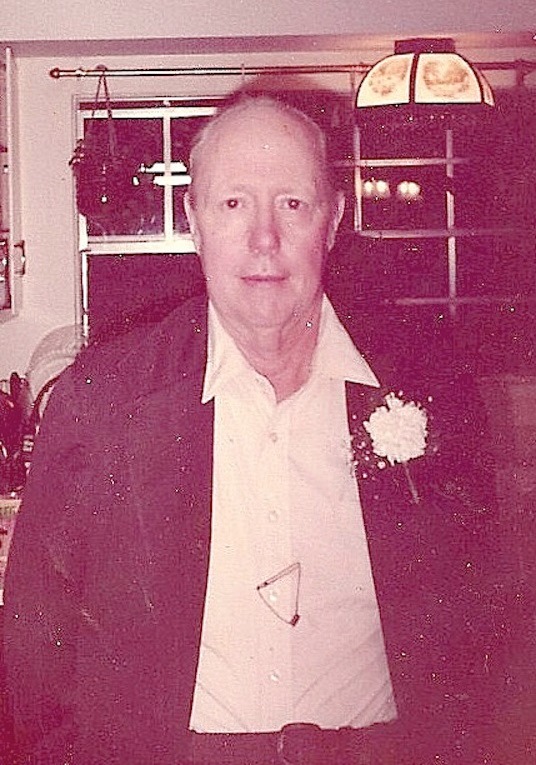
This is my father. His name was James Robert, or Jim, or Jim-Bob in his native Kentucky. My friends and I all called him Melvyn. It was based on a line from a comedy show that none of us remembers.

This picture was taken at my wedding reception, after he had dispensed with his tie. It looked unnatural on him anyway, although I must say that all through my childhood, he worked a government job that required a suit. I remember the scents of Aqua Velva and Vitalis, and the shine on his black shoes.

Then, when I was a teenager, he took medical disability because he had multiple myeloma.

When that happened, he went back to his Jim-Bob roots. He wore sneakers, flannel shirts, and a cowboy hat. He spent his time rediscovering hobbies like reloading bullets. When he was bedridden, family friend and library worker Beth McCarty brought him sacks of Zane Grey and Louise L’Amour westerns. It was quite a surprise to me to see him reading.

The disease spread to his bones as well as his blood. His pancreas failed and had to be removed, so he needed drugs to replace its function. He had an operation to take a piece of bone from his hip and use it to support his neck.

He had chemo and radiation. He didn’t really have much hair to lose at that point, but he threw up a lot. The doctors gave him only a couple of years to live. But he beat them by a significant number of years—10, I think. I really don’t remember the exact total; I wasn’t counting then, just hoping it would last.

One thing he didn’t do was go to group therapy. The local hospital had one group for cancer patients called Make Today Count or some similarly upbeat name. He flatly refused to go. My guess is that he had that Kentucky take-care-of-your-own-problems, keep-it-in-the-family mindset. It’s unlikely that they could have given him something more than he found within his own resources. Melvyn was stubborn, which in his case, he could substitute for positivity.

My mother was his caregiver, and she went it alone, too, except one time when she asked me if she was doing a good job. She knew down deep she was; she just needed to hear it from someone else. But, like Melvyn, she kept it in the family.

Recently, however, the New York Times reported a story, “From No Hope to a Potential Cure for a Deadly Blood Cancer.” It was about multiple myeloma and how new therapies are extending life for people who have been given a death sentence. People like Melvyn.

It’s a new kind of immunotherapy, which wasn’t possible, or maybe even thought of, all those years ago. The study, the Times said, was a “last-ditch effort.”

And, somehow, it worked, at least better than expected. “A third responded so well that they got what seems to be an astonishing reprieve—to have made their cancer disappear.” And after five years, it still hadn’t returned in those patients — a result never before seen in multiple myeloma.

No doubt, before the human test, there were studies on rats. (Melvyn always said he hated being compared to a rat.) The immunotherapy isn’t cheap. One dose is all that’s needed, but it costs $555,310. Our family couldn’t have afforded that, even with government insurance.

The scientists hope that if they diagnose the disease early enough and give the treatment then, it could be a cure. As it is, immunotherapy still isn’t a cure, but the treatment “increased median survival from two years to 10.”

That was something Melvyn accomplished on his own.

Walkin’ the Walk

Babies learn to walk by stumbling around with a Frankenstein gait and frequently falling on their padded butts. And people think it’s cute.

Me, not so much. (It’s true that I have an amply padded butt, but it’s not sufficient to cushion a fall from my height to the floor. Which has happened to me fairly frequently since I had my knee replacement in late April. But I digress.)

The reason this all occurs to me is that I have had to learn to walk all over again. And I don’t look cute as I waddle and toddle and go boom. The going boom part has necessitated stays in the hospital and the post-acute rehab facility (aka nursing home). At least there was someone there to pick me up when I did go boom.

(Dan did fairly well when I boomed at home. (Yes, we’re both boomers. Like that was any secret. But I digress parenthetically.) But he has to work and wasn’t available for eight hours a day, which made us both very nervous. Fortunately, he was home when I fell and broke one ankle in two places. But I digress some more.)

But everything has changed—or is, at least, back to what passes for normal here. I’m at home, doing PT on an outpatient basis, and getting around the house with the walker and a PT technique I learned called “stand and pivot.” (Sounds like a square dance move to me. Perhaps I should curtsy to the walker. But I digress yet again.)

Square dancing isn’t in my immediate (or, most likely, long-term) future. Nor are ballet, polka, and can-can. (Waltz, perhaps. It was probably invented by someone who could do the stand and pivot. But I digress even more.)

Regular walking, though—that may not be beyond my power. At PT last week, I walked 97 feet, and yesterday I walked 250 steps. Both with the walker, of course.

Dan is urging me to try trickier forms of ambulation—climbing stairs and walking up and down a ramp that we installed for my wheelchair. My PT people insist that I need better balance and stamina first. And I don’t want to do anything that involves going boom. Chair-dancing—that I can handle.

Hungry Children: A One-Act Play

Sharing food with the needy

[Setting: The Halls of Power]

Guy in Suit: The media keep saying that there are hungry children in America.

Other Guy in Suit: Let them eat dinner.

Bleeding-Heart: That’s the problem. They don’t have dinner to eat. Or even breakfast sometimes.

GIS: We already give them lunch at school. That’s five days a week.

B-H: Unless they’re absent or on vacation or a snow day. Or if they can’t pay for it.

OGIS: Then it’s the parents’ problem.

GIS: Why do schoolchildren have so many vacations, anyway? We don’t get all those vacations.

B-H: Uh, yes you do.

GIS: Oh. Well, never mind that now. We were talking about tax cuts…uh, job creators…uh, feeding children. That was it.

OGIS: Suppose the media are right?

GIS: The media are never right unless we tell them what to say.

OGIS: Well, just suppose. For a minute. OK? The problem I see is that it looks good for us to feed poor, hungry, starving American children. By the way, are they as pitiful-looking as poor, starving foreign children?

GIS: Probably not. You were saying?

OGIS: If there are hungry children, and we do need to feed them, how are we supposed to do that without feeding the lousy, lazy, good-for-nothing moochers at the same time?

GIS: Ah, yes, the parents. If we give the parents anything, it should be one bag of rice and one bag of beans. And — hey — they could feed their kids that too.

B-H: But children need good nutrition — fruits and vegetables and vitamins and minerals, and enough to keep them full and healthy.

OGIS: Hey, we have plenty of minerals left over after fracking. Won’t those do?

B-H: No.

GIS: But if we give kids all that fancy food, what’s to keep the parents from eating it?

OGIS: Or selling it for booze or cigarettes or drugs?

GIS: Think about that! The drug dealers would be getting all the good nutrition. Then they could run faster from the police.

OGIS: We can’t have that, now can we?

B-H: But…the hungry children? Remember? Eating at most one meal a day, five days a week, when school is in session?

GIS: That’s plenty. I heard American children are obese, anyway. They could stand to lose a little weight.

[Curtain]

This post, which I wrote a number of years ago, became relevant again. I wish it would stop being relevant.

Foot Plus Mouth Equals Disaster!

In the comic strip “Peanuts,” Linus says that one should never discuss “politics, religion, or the Great Pumpkin.” That’s good advice, as far as it goes, but the list of things you shouldn’t discuss in public goes much further. In fact, erase that bit about “in public.” They’re dangerous to discuss among friends and family, too.

These days, politics is strictly off the table. You never know who has a concealed carry license. And Linus was certainly right that it’s best to avoid religion. When someone says, “Bless you,” the right answer is “thank you,” even if you’re not a believer. After all, they meant the religious equivalent of “Have a nice day.” (Or “gesundheit,” maybe. By the way, “Bless your heart” should be used with caution when you’re in the South. It can be a verbal middle finger. But I digress some more.)

Another topic to avoid is any that leads to a near-death experience. My husband, Dan, has blundered that way more than a few times. For example, when we were preparing for a party, I washed my hair, blow-dried it, used a curling iron, moussed, and sprayed. As I came down the stairs, Dan asked, “Are you going to do anything with your hair?”

And stay far, far away from talk of pregnancy. Suggesting that a woman is pregnant based on her weight, her clothes, or the way she waddles can be deeply offensive, particularly if she isn’t. In fact, one expert advises that you not comment on a woman’s potential pregnancy unless you actually see a baby emerging from her vagina at that moment. Better safe than hopelessly embarrassed. (I was a victim of this faux pas when I walked into an office looking for a job, wearing a loose denim jumper and a nice blouse. Admittedly, it may not have been the best choice for filling out an application, but the receptionist didn’t have to ask how far along I was. Later, she repeated the story as an amusing anecdote, not realizing that I was in the room and was embarrassed all over again. But I continue digressing.)

Everyone knows by now not to comment on a woman’s anatomy on pain of getting fired or a punch in the mouth. Not even when you’re trying to make a joke. I once told an acquaintance that I wasn’t at a party “because I was home nursing a sick cat.” “Didn’t you get scratched about the breast?” he asked. He almost got scratched about the face.

Then there was the time a guy had two girlfriends and was invited to a wedding. I don’t think he clearly understood the concept of a plus-one. He suggested taking one lady to the ceremony and the other to the reception. He somehow survived the occasion with at least one of the relationships intact. How? I don’t know.

Speaking of weddings, one of Dan’s bigger faux pas was when he suggested that, since his family lived in Pennsylvania and mine lived in Ohio, we should have our wedding on the state line, to inconvenience both families equally. (He was serious. But I digress for the final time. I promise.)

Because you’re bound to offend or insult someone, somewhere, sometime, my best advice, no matter what you are about to blurt out, is to remember your mouth has a zipper. Use it!

The Comeback of Bullying

TW: suicide, violence

Some people have suggested lately that bullying is a good thing. This flies in the face of most people’s understanding of the effects of bullying and years of anti-bullying campaigns in schools.

We all think we know what bullying is, or at least that we know it when we see it. But what is bullying, really?

Bullying can be physical, verbal, or psychological, just like other forms of abuse. It can happen face-to-face or online. Online bullying is increasingly common and more difficult to deal with because much of it happens after school hours and because of the speed and vast reach of bullying speech or images.

Joanna Schroeder, a media critic and author, says that “the word ‘bullying’ often stands in for plain old bigotry or discrimination.” She notes that a slur for people with intellectual disabilities (the “R-word”) has been making a comeback.

The Anti-Bullying Alliance provides a succinct definition. Bullying, they say, consists of four characteristics:

• the hurting of one person or group by another person or group

• repetitive hurtful speech or behavior

• intentional behavior

• a real or perceived imbalance of power.

So, bullying is hurtful, repeated, and intentional behavior. That’s easy enough to understand. Let’s examine the last characteristic, the imbalance of power.

An imbalance of power in the workplace of a superior and a subordinate is a clear example. In schools, principals and teachers would be one example, and teachers and students would be another. But how does this play out in terms of student versus student? Where’s the power and the imbalance?

The imbalance of power can be obvious, such as that between the quarterback of the football team and the other players or the imbalance between a senior and a first-year student. A perceived imbalance can exist because of students who are larger in size, more athletic, neurotypical, physically unimpaired, or belonging to a majority racial or ethnic proportion of a school. They are perceived as having more power than those children who do not possess those qualities. And a clique of “mean girls” or a group of “rich kids” has the perceived superior power of popularity. Any of these imbalances can play into bullying. The Centers for Disease Control and Prevention has reported that higher rates of bullying are directed at girls, LGBTQ students, and teenagers with developmental disabilities.

In the case against bullying, we have seen accounts that some children who die by suicide have been subjected to extreme bullying and others who perpetrate mass shootings have, too. (There are often other factors that contribute to their deadly actions. Bullying is rarely the whole answer.) Deaths have occurred during incidents of college hazing of pledges or recruits by the senior members of organizations. Mental health professionals view bullying as too serious a problem to be considered a character-building exercise.

So, if it’s so harmful, why is bullying losing its bad reputation? Some people think that society has gone too far in “coddling” children and that they need to toughen up or be less sensitive. The world they will live in is often harsh, and children must grow into adults who are aware of that and able to handle it. In this increasingly popular view, sensitivity is for the weak, and only the tough will succeed. There is anecdotal evidence to support this view. We can all think of bullies who have succeeded in politics, business, entertainment, or the media.

“If I’d never got bullied, I don’t think I’d be where I am today,” said one TikTok influencer. “I don’t think I would have the motivation to prove people wrong.” He believes that bullying “is not as bad as it is made out to be.” He has said, however, that it’s “never OK to turn to physical violence or pick on people based on their race, religion or disabilities.” But he maintains that at least some kinds of bullying are not as harmful. One wonders what his definition of bullying is and what the Anti-Bullying Alliance would say about it.

Just as the self-esteem programs of the 1980s, so popular at first, drew increasing criticism as leading to “participation trophies” and the devaluing of personal accomplishment, the idea of bullying may be undergoing a redefinition as a response to “wokeness” being seen as “weak.” It remains to be seen if this opinion will spread to society at large rather than just the bullies we already have.

Quotations in this post first appeared in the Oct. 6, 2025 edition of the New York Times in an article by Callie Holtermann.

Life With Furniture

I’ve never had what I’d call a profound relationship with a piece of furniture. (Except for my bed. It’s an example of Amish woodworking, some kind of hybrid of a sleigh bed and a mission bed. Our relationship was shattered when we bought a mattress that came with an alarm. Unfortunately, the salesman neglected to tell us what tune it played. When we woke the next morning to the cheerful computerized strains of “It’s a Small World,” we swore a solemn oath to rip out both the alarm mechanism and the salesman’s larynx. But I digress.)

All that changed when I broke my ankle in two places. (I should specify. Two bones in my ankle were broken. I broke them in one place, my study, at the same time. But I digress again.) Since then, I have been living in my study and bonding with the recliner.

The thing is, I have to wear a giant black boot on my right leg. Despite the fact that the injury was to my ankle, the boot starts just below my knee. It features a plastic skeleton and exoskeleton, a foam liner, and far too much Velcro. It weighs, by my estimation, about eight pounds. I walk with a limp, not because of the broken ankle (well, not just because of that), but because I have no shoe (singular) with a sole as thick as the boot’s to wear on my left foot. And the recliner is the only furniture that can truly accommodate my needs.

Our house has a second floor, where the bed lives. But I can’t climb the stairs. Climbing them was iffy even when I used a cane (before the ankle accident but after the knee replacement). I’m living in the first-floor study that was the scene of my injury, and giving daily thanks that there’s a bathroom on both floors.

Dan brought a recliner down from upstairs. It doesn’t match the “decor,” and it doesn’t recline all the way. I can extend the footrest to horizontal, but reclining the back and headrest requires a maneuver that I’m physically unable to accomplish. It involves throwing your entire body weight against the backrest. (I have plenty of body weight, but not the strength to fling it with sufficient force. But I digress some more.)

I can at least sleep with my head supported and my legs straight rather than dangling. I sit in the recliner with my legs elevated to read, watch TV, and use my phone. To get to my real computer, I have to sit in my desk chair, where my legs dangle. (Evidently, dangling allows fluid to accumulate in my legs. It happened once. My thighs looked like Christmas hams. My cankles and the tops of my feet looked like puff pastry. My toes looked like Vienna sausages. But I digress even more.)

I see my surgeon on the 8th, and hope to graduate from the boot to something less confining. I was so happy to get the boot in the first place, as it allowed my foot at last to bear weight. (Ever tried using a walker with a knee sling? Don’t.) Now I can’t wait to get rid of the most recent torture device.

I’ll take the boot and the recliner, though, for as long as necessary. One benefit to the arrangement is that our cat Toby loves to lie on my lap as I recline and sleep there to his heart’s content. It makes my recliner extra-cozy and comfy, even if I can’t sleep lying all the way down.

Roommate Roulette

When I spent time in a skilled nursing facility recently, I quickly learned that one didn’t find a compatible roommate. The choice was up to the whims of the powers that be. It could turn out either good or less-than-good. (My insurance company would only spring for a double room, so there was no chance of a private one, except on the occasion when my roommate happened to move out. But I digress.)

All-in-all, my experiences varied from okay to excellent. My first roommate was Norma, who was quiet and inoffensive, but unfortunately addicted to the TV show Gunsmoke, which she watched all day long. I suppose I could have raised an objection, but I was determined to keep the peace and, after all, I could hardly inflict on her eight-plus hours of cooking shows and Star Trek reruns. Norma was released to go home, however, and I had the room all to myself, my chefs, and my aliens.

The next time I returned to the facility, my roommate was Brenda, a woman with a large family who created quite a commotion when they all visited at once, though that was not often. When it happened, I retreated to Pandora and my earbuds (a must for any stay in such a facility).

I was moved to another room when Brenda developed an infection and had to be isolated. (Since we were then across the hall from each other, our Physical Therapist arranged for us to have weight-lifting sessions in our doorways so we could see each other and chat. Sometimes, Shirley, the lady next door to Brenda, joined in as well, and we all chatted while doing curls. But I digress again.)

My best roommate, however, was my third one, Darlene. She didn’t care for TV and had only a few visitors. Among her other ailments, she had PTSD, so she preferred to keep the curtain between us pulled and wouldn’t be distracted by comings and goings in the hall.

The curtain proved no impediment to our growing friendship, however. We started bonding over our shared love of murder mysteries and true crime books. Naturally, the subject of Jack the Ripper came up. (As it does.)

“When we were in England, my husband and I took the Jack the Ripper walking tour,” I shared.

“Oh!” Darlene exclaimed. “I’ve always wanted to go on that.”

“It was a foggy, drizzly evening—very atmospheric. And we booked our walk when Donald Rumbelow was guiding it.”

She recognized the name immediately. “Donald Rumbelow! I’ve read his book on Jack the Ripper! He’s the best!”

“That’s why we chose a tour when he was leading. We also went to 221B Baker St. and saw the Sherlock Holmes Museum. It was a small, narrow building sandwiched between two others. Every floor had displays related to his famous cases. The top floor held a toilet with a blue Delft-like design in the bowl. It looked much too pretty to use. Even if you could make it up all six flights to get there.”

“You’ve been to the places I’ve always wanted to go and done the things I’ve dreamed of doing! Tell me more!” We were off and running on travelers’ tales.

After that, we dissected our favorite mystery series and recommended them to each other. We talked about holidays and favorite foods and family and pets. We spoke of exes and jobs and rated the nurses and aides. We cheered each other on about the distance we’d walked during physical therapy.

And we talked politics. I had been reluctant to share my political views with anyone at the facility, knowing how divisive, not to say explosive, such talk can be. But once again, Darlene and I were completely in sync. We despaired of the state our country is in and blamed the same people for it. When neither one of us could sleep, we talked well into the wee hours of the morning.

Darlene had a birthday while we were both residents, and she shared it with me. Literally. We each ate half of the yummy carrot cake with cream cheese frosting that her family brought her. She reveled vicariously in the little anniversary dinner that Dan arranged for me, which featured sushi, electric candlelight, mood music, and ginger ale in champagne glasses. Dan brought Darlene a case of Diet Cokes and a box of plasticware that her arthritic hands could manage at mealtime. (The aides often forgot.) She let me watch Practical Magic on her DVD player and I ordered her a copy of Fletch when she told me how much she liked it.

I’m out of the facility now, but Darlene is in for the long term. Today, we’re going to stop by and surprise her with a box of the cheese-and-peanut-butter crackers she can’t resist. I can’t wait to see her face light up.