Monthly Archives: December 2022

Dan’s Upgrade

My husband has at last entered the 21st century! After literally decades of resistance, he has moved up from the flip-phone to the smartphone.

Of course, when we first got cell phones, all of them were flip-phones. And we thought we might be the last people on earth to get even those. A few misunderstandings that led to shouting and accusations of discourtesy meant that we needed to enter the digital age. After one particularly loud and angry … discussion, we decided to take the plunge. Dan in particular was reluctant to get a mobile device, since he didn’t want to be “tied to his phone” and perpetually available. But he had to admit that cell phones had their uses.

His compromise with his own Luddite leanings was never to figure out how to use the thing. While he eventually figured out how to record a voicemail message and even to leave a message on my phone, he never learned how to retrieve voicemail left for him. Instead, he let it pile up until the phone always reported that his voicemail was full, making it useless. (I recently deleted his voicemail and the messages there were all from January of a year ago, and most of them were from his mother. But I digress.)

Once smartphones became available, I opted for one when my flip-phone crapped out. Dan kept replacing his with another flip-phone when it was out of order or he lost it so thoroughly that it was likely in a different state, or maybe another country. I thought it might be because he wanted a phone that was most like a Star Trek communicator.

But when I got a smartphone (not that I was among the first to do so either), he looked askance at it. “I don’t want a phone that’s smarter than I am,” he said, which I suppose was meant as a joke, though I really couldn’t tell. I tried to convince him that the added features – the easy availability of news and weather and GPS, for example – made it worthwhile, but still he resisted. He said he didn’t want to be one of “those people” who had their eyes perpetually glued to a screen. (He once asked me what people did before they could stare at their cellphones. “Read books,” I said. “Not while they’re walking,” he replied. I had to tell him that when I was in high school I did indeed read books while walking from one class to the next. But I digress again.)

Then I started getting apps on my phone that I knew Dan or I would want or need. The prize among them was PictureThis, an app that let you take pictures of plants, then would identify them and provide other useful and interesting information about them, such as whether your plant looked sick or whether that species had been mentioned in a poem. It even provided the poem for you. This led to Dan dashing into the house, shouting, “Give me your phone,” and bringing it back with dirty smudges on it. When Dan got a tablet, I downloaded this app for him so he wouldn’t have to borrow my phone. I also downloaded some music and video apps onto the tablet when he was going to be visiting his mother. He hates her taste in TV.

Dan’s entry into the modern era was a consequence of a different app, though. Where he works, people clocked in and out using their smartphones. Dan couldn’t, and that meant he had to walk farther to do so. In a sense, it was laziness that turned the tide.

Of course, it wasn’t as easy as that. The way his coworkers scanned in was using a QR code. Dan didn’t know what those were. So I had to download him a QR reader and show him how to use it. I don’t think he’s actually used it yet, but at least now he has the option when he’s too tired to make the long trudge.

I know he still mourns the death of his flip-phone, but even he had to admit that our phone provider didn’t really support them anymore. And the first night he had the smartphone I caught him with his nose pointed at the screen, watching YouTube videos.

He doesn’t love it yet, but I figure it’s just a matter of time. He’s no longer comparing its intelligence to his.

Tip Jar

Choose an amount

¤2.50
¤5.00
¤10.00

Or enter a custom amount

¤

Your contribution is appreciated.

Donate

Crocheted Christmas

Many people have traditions regarding their Christmas trees. There are live (real) Christmas trees or artificial ones which at least don’t shed needles and don’t require the death of a live tree. Then there are the lights – multicolored, all white, or all blue. (My mother didn’t care for these, as they always made her think of families in mourning. But I digress.)

There’s also the question of what goes on top – star and angel are the most popular choices. Ornaments vary from old, family ones that represent children’s ages or antiques passed down; modern ornaments that all have the same look; or handmade ones, often made by children. (Our old friend John used to add modeled clay ornaments, including naked fertility goddesses, to celebrate the pagan origins of the holiday tree. But I digress again.) To tinsel or not to tinsel is another choice. If a pet gets into it, tinsel can cause intestinal blockages or festive poop.

My mother’s tradition certainly included handmade ornaments of a specific style – crocheted. Mom (for some unknown reason, my friends and family called her Muzz) had the needlework gene passed down from her mother, who knitted.

Her specialty was snowflakes. They allowed for creativity, as no two snowflakes are said to be the same. (I don’t know how that could be tested, aside from examining every snowflake that ever fell. More digression.) Muzz had a special process to ensure non-floppiness of the snowflakes – she laid them out flat and dosed them with Elmer’s glue. When it dried, she had snowflakes that stood up to anything and never melted.

Muzz and her tree, complete with angel topper.

The rest of her ornaments were multicultural gifts. She had a fair number of foreign penpals that she connected with through crochet magazines. They shared patterns and sometimes completed ornaments that represented their skill or their culture. Muzz even sent a friend in India a large bottle of Elmer’s for her crocheted items. Other people – friends, neighbors, and church ladies – gifted Muzz with ornaments they collected on their travels. Many of them were Santas. There is a stunning number of Santas in various poses available.

For the topper, her tradition was one that owed its origin to my dad. He always insisted that it should be an old, dilapidated angel every year. It had a little smudge on its face. It reminded him of the 1938 film Angels With Dirty Faces – not strictly speaking a Christmas movie, but one he always liked, notably the title. (It had a hella cast, too.) After my father died, Muzz kept up the tradition.

Muzz was not one of those who liked plastic trees or put them up right after Thanksgiving. (We have a friend who kept her artificial tree up well into the spring. She decked it with suitable ornaments for Valentine’s Day and Easter. Yet more digression.) In early to mid-December, we would take her out to a tree lot and help her pick one out. Later, when she had less mobility, Dan and I would choose one, discussing what she would like best. It couldn’t be too tall, since she wasn’t able to stand on a step stool to place the angel. She always seemed pleased with what we brought home.

Alas, some of those traditions have now lapsed, owing to the fact that Dan and I no longer get a tree. It seems like too much for just the two of us, not to mention that we have cats. (Digressions continue. A friend of mine used to hang soft, felt ornaments on the lower branches specifically for her cat to steal and leave in various places around their house. She kept count of the thefts every year.)

I don’t know. Maybe it would be worth it to hang a garland on our balcony railing, just to hang my mother’s ornaments on it.

What are your holiday traditions?

Tip Jar

Choose an amount

¤2.50
¤5.00
¤10.00

Or enter a custom amount

¤

Your contribution is appreciated.

Donate

Unpuzzling Words

I’ve always said that, if there is a crossword gene, I inherited it from my maternal grandmother. Of course, it skipped a generation. My mother had no interest in crosswords. (I also inherited from my grandma a love of mystery novels. Not the red hair, though. That I had to acquire later. But I digress, already.) Here’s a look at some of my favorite puzzles and some of my favorite “puzzle-hacks.”

Yes, I was one of those obnoxious people who worked the New York Times crossword puzzle in ink. Now that the puzzle is online, that’s moot. But I haven’t been doing it lately, despite the fact that I pay for a subscription. NYT has other puzzles that I find more intriguing.

One of them is not Wordle. I never gave in to this trend, but I wrote about it (https://butidigress.blog/2022/02/06/what-the-cool-kids-do/). I have no objection to Wordle, really. I can just scroll past all the posts people put up about their daily scores. And once I helped a friend determine the target word (“prism”). I just don’t need a daily addiction.

No, what I really like are the acrostics, though they’re only featured every other week. Acrostics, for those not in the know, involve solving clues like crosswords do, but not crossing the answers. The letters transpose into a quotation and author’s name. (This is way better on the computer than it was when I did them on paper.) When I look at the quotation with some letters filled in, I can often guess a few words. The word “people” is in a lot of them, and the pattern of “it is” and “I think” (and other “th” words) are pretty easy to recognize. Those letters then bounce into the clue answers. Lather, rinse, repeat. I can solve one in about 20 minutes, which is a nice break from work.

Anagrams can be fun, too. These are easier to solve if you have a set of Scrabble tiles on hand so you can rearrange them. Working with paper and pencil is much more difficult, though it can be done. I never have Scrabble tiles because my husband refuses to play with me, so I work on paper. I start by alphabetizing the letters so I can see better what I have to work with.

I like cryptograms, too. They are simple substitution codes, usually a quotation or a group of words under a heading. Here, the way to start is to look for which letter is used most often. It’s probably “e.” In a phrase or quote, there’s usually “the” more than once, which is a pattern that gives you two more letters. If there’s a heading or topic, you can guess words and look for word patterns that might fit them.

Cryptic crosswords are British-style puzzles, which means that they don’t cross the same way that American ones do. Instead, they cross at only two or three letters per word. And the clues are – well, cryptic. They contain anagrams, but also words within words, backward words, and other sly tricks. “Capital of Egypt” might only mean the letter “E,” for example. My friend Leslie and I used to work them together, so we could fill in the blanks for each other, but occasionally we would have to leave a word unsolved. Sometimes, we still didn’t understand it even when we looked at the answers.

Back when I worked in an office, I used to take “puzzle breaks,” on the theory that I didn’t take smoke breaks, and I could take them without having to go outside. Unfortunately, my bosses didn’t see it that way. I can’t say that’s why I left that job, but I can say that now that I work for myself at home I can take breaks for whatever I want, whenever I want hahahahaha!

Life is good. Puzzles are good. Even work is good!

Tip Jar

Choose an amount

¤2.50
¤5.00
¤10.00

Or enter a custom amount

¤

Your contribution is appreciated.

Donate
Puzzling Numbers

Words are my life. Numbers, not so much.

I’ve never been a math-phobe. All throughout school, I combined reading and writing with the proverbial ‘rithmetic. Set theory, quadratic equations, whatever – no problem. Then I hit what my high school called “enriched” geometry. It was the first D I had ever gotten in my school career. It soured me on math.

I didn’t feel I deserved it, either. What was “enriched” about the geometry was the fact that it required three-column proofs instead of two-column proofs. (It was later that I learned about 151 proofs.)

Three-column proofs, as I recall, required you to state which theorem or corollary you were using to solve the problem. I had a philosophical disagreement with this system. I contended that if you ever needed to know whether it was corollary C or theorem 17, you could look up the name of it. It was knowing how to use it that was important. So I never put in the third column and I got a D.

(I think this actually helped me when I went to college. At the Ivy League institution I attended, there were many students who had never received a grade lower than an A. When they suddenly had to compete at a higher level and got a C or even a B, they were devastated. But I digress.)

Later in life, I found that I did indeed understand geometry when a manager at my job was hanging pictures. “I can hang these four pictures in a square, but the hard one will be hanging the one in the center,” he said. I took two pieces of string and ran one from the nail in the lower left to the one in the upper right, and the other from the lower right to the upper left. I put the fifth nail where the two strings crossed. So much for theorems and corollaries.

But that’s not what I wanted to write about this week. That’s right, that entire section was a big digression. What I meant to talk about was puzzles.

Word puzzles are probably better known (and I’ll be writing about them next week), but there are number and math puzzles as well.

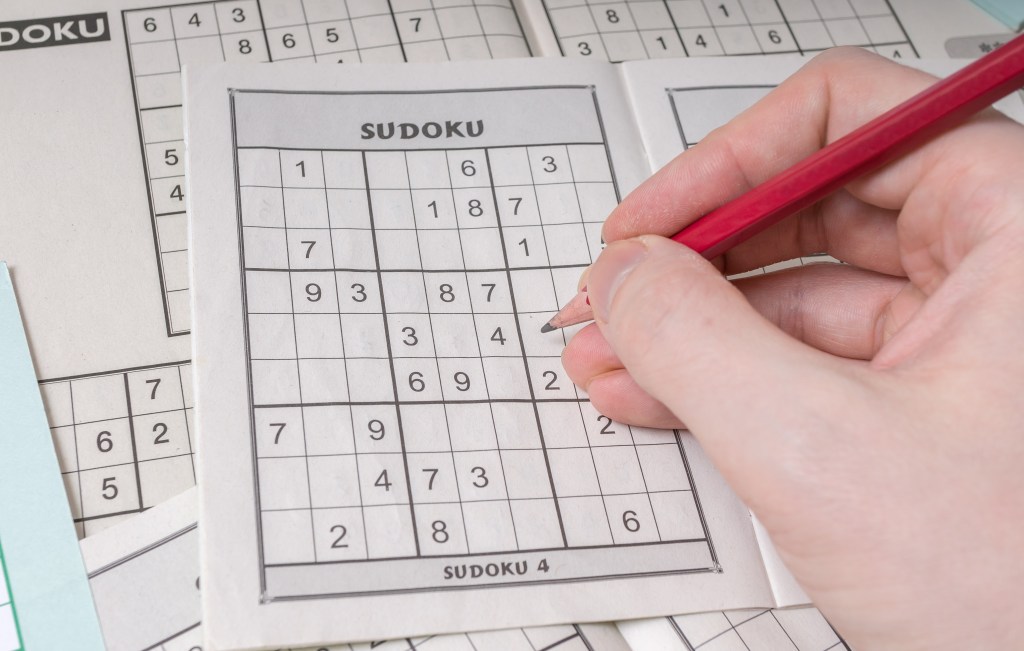
Sudoku (which means “single number” in Japanese) hit the big time in the US in 2004. It made an appearance in puzzle books earlier, in 1979, when it was called “Number Place.” But it really took off when a computer program was developed that created the puzzles.

(On first learning of Sudoku puzzles, and hearing that they were supposed to stave off senility, my husband decided to give them a try, though he had no interest in crossword puzzles. He was heard to say, “I may not be able to spell, but damn it, I can count to nine!” But I digress. Again.)

But plain sudoku didn’t satisfy me. Being something of a masochist, I soon found myself wanting something more. What I found was jigsaw sudoku. Instead of living in nice, neat square boxes, the numbers were scattered throughout shapes that looked like gerrymandered congressional districts. The rest of the rules were the same. Each shape had to be filled in with the numbers 1–9, with no duplicates in any box or row.

I stopped solving sudoku when I stopped buying the little books in the grocery store or pharmacy. Recently, though, I found a site online that offers a daily jigsaw sudoku. I had to try it. I selected the medium difficulty setting.

On my first try, I scored -520. I figure that was the equivalent of getting a D. Maybe I should go back to the NYT crossword, where at least they don’t give you a grade.

Tip Jar

Choose an amount

¤2.50
¤5.00
¤10.00

Or enter a custom amount

¤

Your contribution is appreciated.

Donate