Monthly Archives: October 2024

Fraidy Cat

I’ve read that if you surreptitiously place a cucumber or zucchini behind your cat, when the cat notices the vegetable, it will jump straight up in alarm (the cat, not the cucumber). I’ve never tested this out because I’ve also read that the cat thinks the cucumber is some kind of fat, short, immobile but threatening green snake and is genuinely terrified. Some people thought it was cruel to put a cat through this unexpected terror. (Though no one seems to care that the whole red dot thing puts a cat through unrelenting frustration. We think it’s funny, so that’s okay. Actually, the whole cucumber thing was supposed to be amusing, too. Go figure. But I digress.)

I’ve never tried the cucumber trick on any of our cats. They have enough things that they’re afraid of already.

Knowing that I’m a cat lover, my friends often give me cat-related gifts—cookie jars, Christmas ornaments, earrings, mugs, and so forth. One year, someone got me a pair of cat house slippers. They were very lifelike, a pair of puffy, furry, black-and-white cats with little pink noses. Basically, they were adorbz. (Yes, I know that “adorbz” is years old and probably as horse-and-buggy as “horse-and-buggy.” But I like it, so it stays. It’s not like a piece of slang that no one can figure out what it means without context (or maybe even with) like “rizz.” But I digress again.)

At any rate, the first time I walked down the hall wearing them, our cat Shaker (who was also black and white) saw the pair of mirror-image cats shuffling toward her, she turned tail and ran. (The same thing happened when Dan “walked” a 3 1/2-foot-tall plush rabbit down the hall. (Dan won the rabbit at a carnival. He had fun driving home from Pennsylvania with it. He strapped it in the passenger seat and enjoyed seeing children waving at it. It didn’t go with what we graciously call our “decor,” so we gave it to a friend with a young child. The child appreciated it, but the mother didn’t. Didn’t go with her decor either. But I digress some more. (Embedded. Are you impressed?)))

Another cat we had shared with most other cats a love of plastic bags. (We once met a cat in Dubrovnik who tried to climb into our souvenir bag and come home with us. But I digress even more.) Anyway, Jasper, who was a little skittish anyway, got tangled in a plastic grocery sack, which was enough to alarm him. What he didn’t realize, however, was that the bag contained a CD in its case (CD = a horse-and-buggy item). Startled, Jasper tried to get away from the thing by running upstairs. But the bag was caught on his leg and chased him, thump, thump, thump, all the way up. He couldn’t get away from it. Unlike a cucumber, it wasn’t stationary. Like a cucumber, it terrified him.

Our current cat, Toby, is afraid of water. No, not his water dish. Not rain. Not even the water in the shower (he likes to sit on the shower seat, though not while the water’s running). No, he’s afraid of bottled water. The fizzy kind, anyway. If I crack open a bottle and it makes the fizzy sound (which it always does), Toby does that cat thing where he levitates three feet off the ground like he’s spring-loaded. I don’t know, maybe fizzy water sounds like another cat hissing.

I suppose it’s wrong of me to laugh at the fraidy cats. They don’t laugh at me when I run screaming from bees and wasps. Or at least I don’t hear them. (Maybe they’re polite enough to snicker behind my back.)

The Purple Leash

What does a woman do when she’s suffering domestic abuse but has a beloved pet she doesn’t want to leave? She may stay and endure the abuse because there is no shelter that will accept her pet as well. Her choice is to abandon her pet and go to a shelter alone or to remain in an abusive household. For many women, it’s an impossible choice, with no good answer.

Purina is working on the problem. They, along with Greater Good Charities and RedRover, have instituted what they call the Purple Leash Project. It’s a call to action for domestic violence shelters to have facilities where women can bring their pets with them when they have to go there. (Purple is the ribbon color for Domestic Violence Awareness Month.)

In most places, there are very few shelters for women that are also shelters for their pets. And, sad as it is, lack of shelter for dogs and cats can lead abused women to stay in dangerous situations rather than seeking help. They may treasure their pets as they would children. Or they may worry that their abuser would abuse the animal too for revenge because they left. Some even know that their abuser is prone to violence against animals, having witnessed it.

As one woman put it, “I endured domestic violence for many, many years and due to the fact that I could not leave my dog behind and our local shelter does not accept pets, I stayed. I stayed for over a year and a half.”

Another anonymous woman said, “I cannot thank you enough for taking this issue seriously. I actually cried when I watched your video as no one to date has taken this subject seriously. We have no shelters that allow pets in my area. Please continue to fight for what is right. For some of us, our dogs are everything.”

A woman named Angie added, “I wasn’t expecting I wouldn’t be able to bring Princess. And that was heartbreaking, especially for the kids. I feel proud just knowing other families will be able to keep their pets…that’s just awesome. Because, for us, Princess was everything.”  

This October, in support of Domestic Violence Awareness Month, Purina is offering a Purple Leash Project digital coupon and will donate 50¢ to RedRover for each coupon redeemed through October 31, up to $300,000. I know it’s late in October, but there’s still time to take advantage.

Purina has also joined forces with renowned artist Kristen Visbal to create statues of a woman and a dog, titled Courageous Together. They’ll be making their way around the country in 2024 to raise awareness of why pets are a crucial part of the conversation around domestic violence.

Serving Society

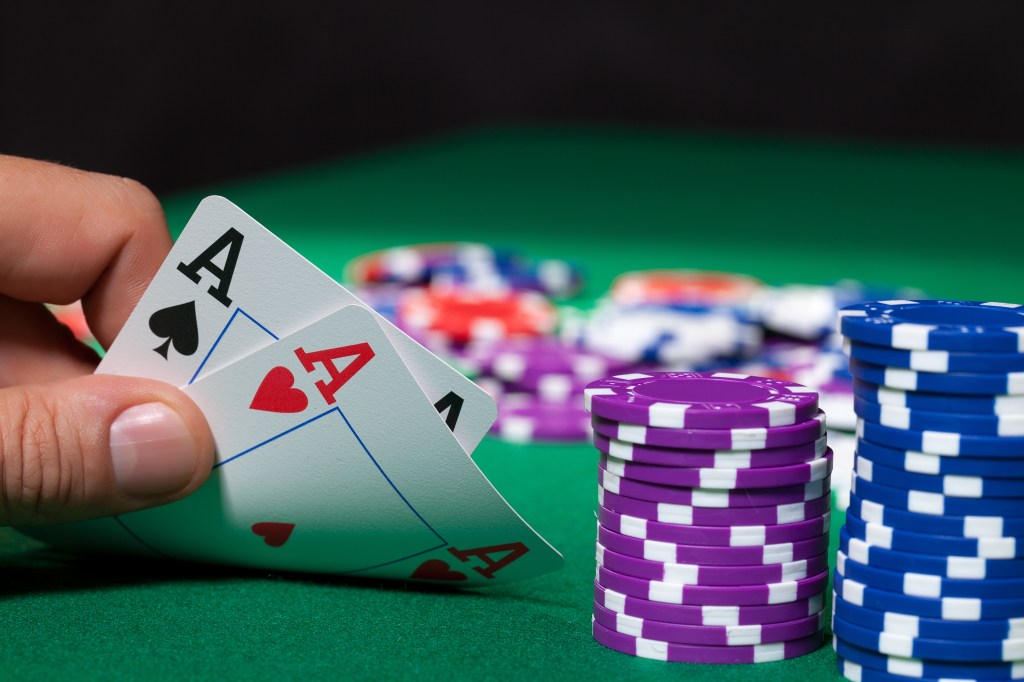
It all started with a game of Texas Hold’Em held in a bookstore to raise money for charity. I had pocket aces (as shown), a very strong hand. I should have slow-played them and let others raise the pot, but I was a newbie and all excited, so I didn’t make the most of the opportunity. Shortly thereafter, I left the game.

(Texas Hold’Em became trendy and popular in 2004 with the publication of Jim McManus’s Positively Fifth Street. It led to such oddities as the World Series of Poker (yes, there is one) being televised. The title of the book came from the arcane but intriguing insider terminology used to describe the various parts of the game, such as the flop, the turn, and the river (aka Fifth Street), which refer to when the communal cards are exposed. Naturally, I was drawn to a game that had its own language. But I digress.)

After I left the poker table, I was drawn into a conversation with a woman who was watching the game. She wanted to know whether I did anything besides play poker. (Yes, there are professional poker players.) When I told her that I was in educational publishing, she relaxed. Her point was that professional poker playing served society not at all, but educational publishing filled a valuable niche in service to education, a worthy goal.

That got me thinking. Who exactly serves society and in what capacity?

I think we all agree on some of the basics: teachers, medical personnel, police, religious figures, volunteer workers, and firefighters. But are they the only ones who perform worthwhile services?

Politicians are not held in high regard these days, and neither are lawyers. But when they act on principles (if they ever do), they serve society by making laws and administering justice.

I’m less open to the idea that entertainers serve society by entertaining us. Of course, some entertainers (and I’m including professional athletes in that) donate large sums of money to assorted worthy causes or start charities or foundations that serve some segments of society, usually the underserved. But those people, it seems to me, are philanthropists (good-deed-doers) who also entertain.

(Speaking of entertainers, I can’t abide most reality shows, particularly the kind that might be called “Famous for Being Famous” (I’m looking at you, Kardashians) or “Rich People Behaving Badly” (I’m looking at you, Real Housewives). I do like the ones where fairly normal people actually make or do something like cooking or baking, designing clothes, forging knives, and so on. I can’t say whether they technically serve society, but at least they’re creative. But I digress again.)

But what (to get back to my much-neglected point) about sanitation and maintenance workers? Without them, our streets would be awash in litter and worse. Our offices would be grubby and perhaps disease-ridden. Our school corridors would be besmirched by vomit. I think taking care of all these problems serves society in a very real way. (And there are never reality shows featuring them. Probably something to do with the vomit. But I digress some more.)

I’ll admit that poker players don’t do anything to serve society, but I think we have a limited view of those who do. Public servants are held up as examples, and they should be. But farmers don’t get mentioned, and they feed us all. Train engineers and truck drivers serve society by delivering that food, as we learned during the pandemic. Psychiatrists and therapists serve members of the public who have mental illnesses. Meteorologists serve society when storms happen. Anyone from architects to bus drivers, yoga instructors to zookeepers. Even burger flippers and pizza delivery people serve society or at least individual members of it.

Let’s expand our definitions of who serves society. There are a lot of people who don’t get recognition and should.

That Hoodoo That You Do

Having the in-laws visit is a situation that is fraught with peril. There’s the frantic pre-cleaning cleaning, the cleaning, the post-cleaning cleaning, and the tidying up. There’s the delicate balance over what foods to stock up on and whether or not to go out for a meal or meals, and other aspects of potential entertaining. And, for those of us who don’t have the luxury of a guest room, there are the sleeping arrangements.

But the particular challenge that I want to discuss is when my MIL visited us.

We cleaned, of course, though perhaps not up to her standards. We loaded the pantry and the fridge with the mineral water, breakfast items, and snacks she preferred, plus more than our usual supply of staples, meat, vegetables, bread, fruit, and beverages.

No guest rooms chez nous, but at the time, we had a pull-out sofa bed. Being at least aware of one or two of the social norms, Dan and I would take the sofa, giving up the bed to Mom. We made sure there were clean sheets, blankets, towels, and such.

But upon seeing the sleeping arrangements, Mom announced, “I won’t sleep in that bed!”

“What’s the matter?” we asked, puzzled.

“That … thing. The one hanging over the bed. It’s a hoodoo. I can’t sleep under that.”

Now, Dan has been to Africa, where he encountered some shamans, and I have been to Jamaica, where I failed to encounter any voodoo priests, but in all our travels, neither one of us had ever acquired a hoodoo. (I did encounter lepers in Jamaica once (or persons living with Hansen’s Disease, as we would say now). (I was there reporting on charity work.) The residents’ cases were no longer active, but they lived apart in their own establishment (aka “leper colony”). They liked singing religious and folk songs, and when I asked if there was anything they needed, one man asked for new guitar strings. But I digress.)

At any rate, no hoodoos were acquired from anywhere.

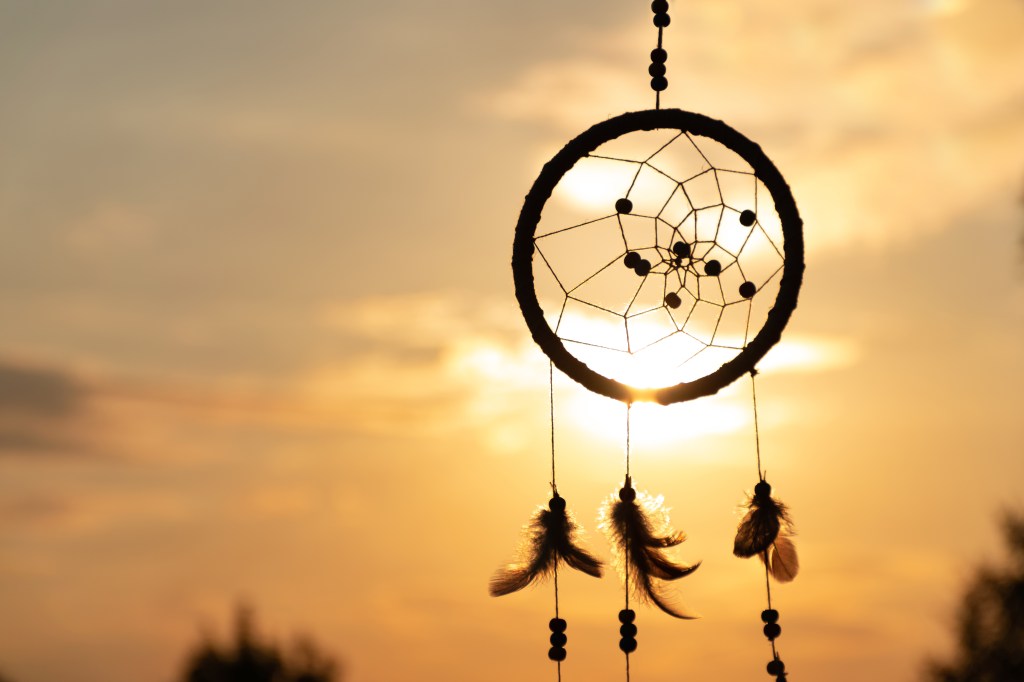
The suspected hoodoo was a small wicker circle with various objects attached: a piece of red yarn, a bean from the castor plant, a cat whisker, a small bag of polished stone chips. It hung over my side of the bed.

What it was, of course, was a dream catcher.

I have nightmares from time to time. (I also have the usual anxiety dreams about being lost in a hotel, missing a plane, and not being able to find a clean toilet. Now that I think about it, as much as I love it, travel makes me anxious. But I digress again.) During one particularly bad spell, Dan made me the dream catcher. The items attached to it were ones that had special significance to me. The red yarn was a scrap from my mother’s crocheting. The stones were for my love of the semiprecious variety. The cat whisker—well, do I have to explain that one? (No, I never tried to kill anyone with a castor bean. It was a plot point in a mystery novel I was writing, though. But I digress yet again.)

It was a whimsical, tender memento that held no special power but that showed how much concern Dan had for me and how much he wanted to relieve my distress.

What it was not, was a hoodoo. (I’ve never seen an actual hoodoo, so I don’t know what they look like. I guess I can see how a dream catcher could be mistaken for one by someone who has no idea what a dream catcher is but is well up on hoodoos. But I digress some more.)

Our choice was obvious—remove the hoodoo or banish Mom to the sofa bed. It was a tough decision, but we removed the offending object (the dream catcher, that is) and Mom agreed to sleep in the bed. The dream catcher went right back up after the visit ended.

No sense wasting a perfectly good hoodoo.