Category Archives: family

A Window, Biscuits, a Butter Churn, and a Mule

It was an ordinary farmhouse, located outside Beattyville, Kentucky. But there was a secret inside that we kids loved. The kitchen, of course, was the best room to be in. But getting there was even more fun. The kitchen was obviously an add-on to the house, and the entry points to it included not just a door but a window, leading from one of the bedrooms to the kitchen. Of course, we never used the door like the grownups did.

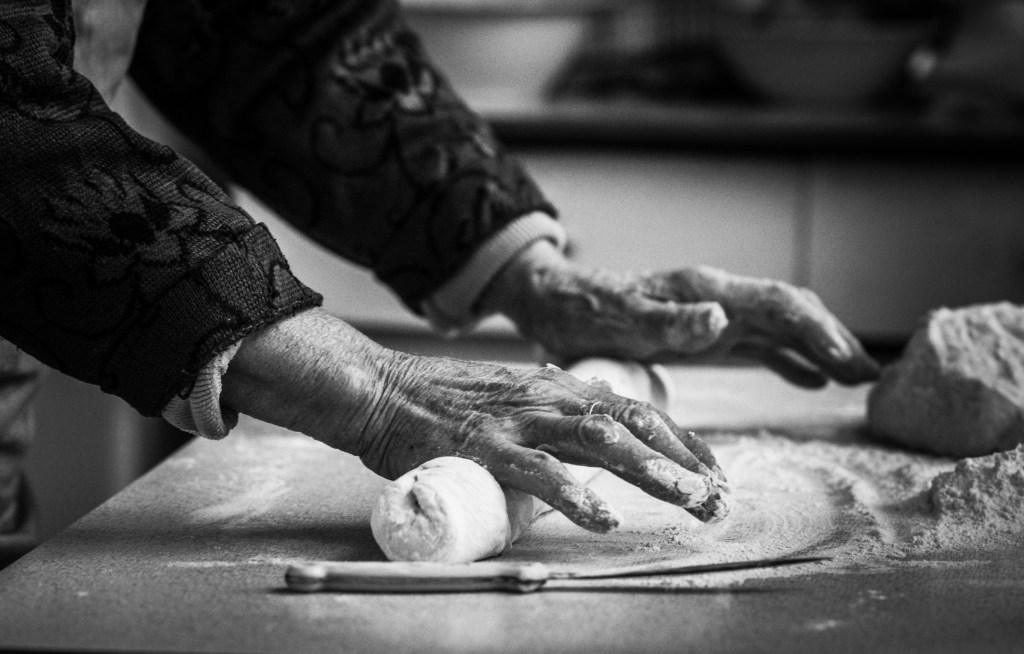
The house belonged to our Cousins Addie and Jim Mainous. They were old even when we used to visit them during the summers. But every day, Cousin Addie hand-made biscuits and sawmill gravy. (Sawmill gravy is different from redeye gravy. Sawmill gravy uses milk. Redeye gravy uses coffee. But I digress.) The kitchen was painted black, but there was lots of sunshine coming in the windows and the back door. It wasn’t at all gloomy. It was warm and cozy and smelled like the biscuits that were rolled out with a drinking glass and cut to size using the mouth of the same glass.

Addie was a thin woman with a big laugh, who almost never wore her dentures. All I remember ever seeing her wear were dark cotton dresses and white aprons. Cousin Jim always seemed to be sitting at the kitchen table, not talking but drinking coffee and eating biscuits and gravy. We kids used to make butter in the authentic churn, which would now be an expensive antique.

In the living room, we found old paper or cardboard fans that were printed with the names of churches and funeral homes. The beds we slept in were much taller than those we were used to, which made climbing into them a workout. Just beside the house was a kitchen garden, which was endlessly diverting. We pulled up carrots and potatoes (which were usually not full-grown yet).

A little ways from the house was a barn, and it was the site of many adventures. There was a hayloft that contained bales of straw (not hay), but we were too young and timid to jump from it, as kids always do in the movies. There was also a fascinating old iron machine that took the kernels off the cobs of dried corn. We loved using it, though it turned out later that the corn cobs were meant to be left whole. There was also a mule, which I once got to ride bareback. Here’s some advice: Never ride a mule bareback. Their spines are very bony.

Across the road from the farmhouse was a hill that led to an ancient family cemetery. It made a nice walk to swing on the gate across the path and trek up there. I don’t know for sure, but I like to think of Addie and Jim being buried there and not in some huge cemetery far from their home.

Just a ways down the road, there was a drive-in theater, which we could see from the screened-in back porch. It was fun to watch the movies, especially the cartoons, even with no sound. Another nearby attraction was Natural Bridge State Park. There was an impressive lodge that we never stayed in, but where we could buy that sugary white candy that seems mostly made of air and dissolves in your mouth. We took pictures of each other standing under the bridge, though I don’t have them anymore.

If Beattyville had a town center, we never saw it. Down the road from the farm was a small gas station owned by Ollie Dooley, a more distant relative, but you couldn’t really say it was in a populated area. The areas we got to see were in the hill country of Kentucky, which we called “the mountains,” though they were nothing like the mountains they have out west. These were sometimes steep, rolling mountains, grassy and rocky, full of minerals.

Fracking didn’t exist back then, and I am glad. I’m sure the old farmhouse and barn are gone now. They were old when we visited them, and they can’t have survived or been rebuilt. And no one today would want a house with a black kitchen that you could enter through a window from the bedroom.

More Kentucky Folks

Last week I wrote about Kentucky relatives on my father’s side of the family. This week’s reminiscences are of Kentucky folks on my mother’s side.

Our Uncle Sam (yes, I had an actual Uncle Sam, and an Aunt Jemima whom I never met) and Aunt June lived on a farm outside of Campton, Kentucky. We took the Bluegrass Parkway, which was then a toll road, to get there. Every summer, we vacationed there for a week or two, along with visiting other relatives in the area.

We often stayed a night in Campton, where my Aunt Thelma ran a small hotel (Roses’ Hotel) and general store right across from the town diner, which had much to recommend it, including jukebox access at every table, and a pinball machine. (Note: I have no idea whether Uncle Sam, Aunt June, and Aunt Thelma were actually my aunts and uncles. They could well have been second grand-uncles and great-grand-aunts twice removed, for all I know. The only titles we used for any relatives other than Granny (Coburn) and Grandma (Rose) were aunt, uncle, and cousin. But I digress.)

The general store was notable to us kids for having a wide assortment of penny candy where we could get root beer barrels, red hots, and Sugar Daddy pops. There were clothing and tools in the back, but we never made it farther than the candy counter.

Uncle Sam, down the road a ways, was a sharecropper. He owned the land where the house was, on one side of the road, and farmed the other side of the road for some other owner. He had cows and chickens and a horse. When I brought my then-fiance Dan to visit, he and Uncle Sam went off to bring in the cows. Dan, having no experience with cows, wandered along behind them with a stick, while Uncle Sam made polite conversation by pointing at various plants and asking, “Do they have those where you come from, Mr. Reily?”

Sam’s wife, Aunt June, was a round, comfy woman with bright, black eyes, who was at least part Native American. She was famous for her biscuits. Dan won her heart when, just before we left, he stuffed his pockets full of them.

We had, I would say, a strained relationship with the chickens. We would try to gather eggs for breakfast, but were never assertive enough to reach under the squawking and pecking fowl and collect the eggs. An adult had to be summoned for that. I was also mildly traumatized when I saw Aunt June wring a chicken’s neck for that night’s dinner, and I learned what the saying “like a chicken with its head cut off” really meant. I still ate the fried chicken, though.

The horse was another matter. We loved to ride it, but once when I was on its back, one of the farm dogs came yipping at its heels and the horse took off at what seemed to me great speed toward the barn door. The closed barn door. I bailed off sideways into the cornfield and the horse sensibly stopped when it got to the barn door. But for a moment, it was terrifying.

There was lots to do at Uncle Sam and Aunt June’s. There was a fishing pond. The path to the pond was lined with blackberry bushes and if we visited at the right time of year, we picked the berries on our way to the pond. I don’t remember catching any bluegills longer than about three inches, of which we enormously proud, but which were fed to the barn cats.

Another notable feature of the house was the plumbing, or the lack thereof. There was running water in the house for washing or cooking, but there was no inside toilet. Instead, we had to make do with the outhouse or, at night, with the “slop jar” under the bed. The bed was cozy with handmade quilts and it seemed a shame to leave their warmth to grab a flashlight to trudge to the outhouse.

Living along with Sam and June were our cousins, C.B. (Benny) and Betty Sue. C.B. was kind of a hellraiser and too old to be interested in young cousins, but Betty Sue, although among the shyest persons I’ve ever met, liked to hang around with us. Later in life, she became an attendant in a senior care facility.

The farm was a special place, with a traditional porch and rocking chairs. If it wasn’t too hot – and it often wasn’t, this being in the Kentucky hill country – we would sit and rock and drink lemonade from Mason jars.

Perhaps my memories of these idylls are why Dan and I choose to spend weekend getaways at a bed and breakfast called The Farm, where we get a small cabin with a porch and rocking chairs, beds with patchwork quilts, chickens and goats and rabbits that have the run of the barn and the yard, and huge country breakfasts. We’re going again this August, and I can’t wait.

Kentucky Folks

Not a lot of people know it, but I was born in Kentucky and lived there for the first four years of my life. My father, who was very attached to his mother, took us to visit on school or government long weekends, and sometimes even regular weekends. Summer vacation invariably involved a trip to see Granny, Pete, and Willie; Uncle Sam and Aunt June and their kids, C.B. and Betty Sue; and Cousin Addie.

One object of all this travel and family bonding was to make sure we kids didn’t pick up “Northern” accents, which I did anyway through speech and debate classes and watching Walter Cronkite on the evening news. I could still pull out a Kentucky accent when needed, such as when trying to appall my sorority sisters in college.

I suppose I should start with Granny, Pete, and Willie, who lived in a small house in Lexington. Granny was my father’s mother, and Pete and Willie were dad’s siblings. Pete was actually named Edna Mae. As far as I know, the origins of the name Pete are lost in the mists of time, and no one ever called her Edna Mae unless they were mad at her.

She was, frankly, a homely woman with thick ankles, but we loved her dearly. She had a good heart and a sly sense of humor that seldom showed itself, except when we kids did something goofy, like when I go-go danced for Granny to “Winchester Cathedral.” Every year for Christmas she gave me and my sister identical presents, differing only in color. The gifts always included an Avon roll-on perfume and a box of stationery.

Granny’s house was wonderful. There was a magnolia tree and a peach tree in front, and a black walnut in back. There were touch-me-nots growing all along the front porch and we loved to pop the fuzzy little pods and scatter the seeds everywhere.

We kids had the run of the house and Granny would frequently open her coin purse and give us spare change so we could go down the street to the store to buy penny candy. Next door was a parking lot that connected to the back door of a laundromat. We would often take the shortcut to get to the Woolworth quicker for comic books and sundaes.

Granny had long, white hair – I doubt if she had ever cut it. I still remember her sitting in a chair, with her hair flowing down the back, and Pete brushing and braiding it for her, then wrapping it in a neat coil at the nape of her neck.

We kids loved the coal fire grates that heated the house for the longest time – they were replaced later with gas heaters, which weren’t nearly as much fun. Pete had one of those old popcorn poppers that was a rectangular basket with a sliding lid. We held it over the coal fire and shook it until it was full of popped corn, then emptied it into a bowl and start over.

Names are different in Kentucky. My dad, James Robert, was invariably known as Jim Bob. All names ending in A were pronounced “ie. I was surprised when I went on an ancestry site and found my grandmother listed there as Calla. We all knew her as Callie. There was also a Callie Jo in the family, who smoked cigarettes and had a questionable reputation. Naturally, I found her fascinating, as she was the only “bad girl” I had ever met up until that time.

When Pete died, I was chosen to represent the Ohio branch of the family as my father was bed-ridden with cancer at the time. When I returned, I described the funeral to him, including the car that followed the hearse and was filled with flowers. “A truck,” he insisted. I knew he was talking about what she deserved rather than my account of what actually happened. Apart from relatives, most of the people there were from the Greyhound Bus company, where she had worked all her life.

There’s lots more to tell about my other Kentucky relatives, but I think I’ll save that for another time.

That Fateful Day

When people ask how my husband and I met, I tell them the Reader’s Digest Condensed (clean) version: At the Philadelphia Folk Festival, introduced by mutual friends. Which is true, as far as it goes. But it fails to capture the essence of the experience.

I’ll never forget my first sight of Dan. He was wearing a t-shirt that said Dr. Demento (which his coworkers at the psychiatric hospital had given him) and a patch over one eye. The patch was to cover a missing glasses lens, but it gave him a certain piratical air, and I’m known to have a weakness for pirates.

We were introduced by mutual friends, who had come with Dan to the Festival. We were all in front of the Alferd G. Packer Memorial Food Tent. (If that reference isn’t familiar to you, Packer was the leader of the Donner Party of explorers, who got lost and made a meal of one another. But I digress.)

Dan and I were on committees to help us pay our way, but we were on different ones. He was on the grounds committee, which had access to any part of the festival area and helped construct stages, booths, and the like. By the time the festival started, they had done their work and were free to enjoy themselves.

I was on the camping committee, which patrolled the tented area and its borders, making sure that no one set their tents on fire by letting their campfires burn out of control. (There was also a security committee, a tickets committee, a medical committee, and there must have been a food committee who set up the food tent, but I don’t want to think about that too much.)

I was also at the Festival with a group of friends, including Uncle Phil, my soon-to-be-ex-boyfriend Rex, and a good friend from college. Uncle Phil was the catalyst for all that ensued, as he was the person that nearly everyone in both groups knew. We and several other friends and acquaintances had tents around a shared, large campfire, where at night we talked, drank, made music, and sang.

That night at the campfire, Dan purposely sat next to me, though I didn’t think anything of it at the time. Later, when he had to excuse himself for a moment, he leaned over and kissed me. I clearly remember thinking, “Why is this man kissing me?” (I was a little slow, or maybe both fast and slow.)

That evening Dan invited me to take a walk with him, and his all-access Grounds pass got us into Dulcimer Grove, a small, isolated venue where small, intimate concerts and workshops were given. This time when Dan kissed me I had some idea of why. We were there a long time before we rejoined the campfire.

After that, Dan and I were inseparable (which mightily pissed off a number of the friends that we were there with). Dan even got me into the Grounds Committee compound, which had the marvelous amenity of a shower. An outdoor shower, but still. It was a luxury that existed nowhere else on the Festival site, to my knowledge. Of course, since he was so nice as to offer, I availed myself of it.

By the time the Festival was over, Dan and I were a couple. My by-then-ex boyfriend left for New Jersey with my college friend. I borrowed money from everyone I knew to get busfare back to Ithaca. Dan drove me to the bus station and gave me two gifts: an enameled necklace and a bag of banana chips. I don’t know what happened to the two people Dan had been there with, except that one of them eventually forgave us.

Dan and I saw each other again the next weekend. I had invited him to a large house party. Neither one of us attended it, which, believe me, was the better choice. Most of the same people from Philly were there, and it seemed best not to stir the pot. We had to make ourselves a little party of two, occupying a friend’s attic while the friend went to the house party.

Then we went our separate ways, he to Philly and me, soon after, back to Ohio to live. We maintained our long-distance relationship with letters, phone calls, and the occasional visit. (This was in the days before cellphones and texting.) Eventually, Dan moved out to Ohio (as I knew he would) and after a spell of actual dating, we married.

We have since been back to the Philly Folk Festival a few times, most notably on our honeymoon, but we have never made it back on any of our anniversaries, as jobs and such made it impossible to get away at the right time. Maybe for our 40th anniversary, next August.

Bonus Post: Three Dads, One Person

My father had three names. No, I’m not talking about the three names that most people have, though he had those too: James Robert Coburn. But the names he went by were sometimes different.

He was born in Kentucky, the youngest son, so of course everyone referred to him as Jim-Bob. His relatives always called him that. In fact, when I went to his funeral service in Kentucky (he had one in Ohio, too), I had to remember to introduce myself to various mourners as “Jim-Bob’s daughter.”

When he went to work at a government job, people called him simply Jim or James. I still remember that when he went off to work, he wore a tie and shiny black shoes and smelled of Vitalis and Aqua Velva. This is the mental picture I still have of him when I was a child. When he drove us anywhere, my mother would say, “Home, James,” as if he were our chauffeur. (And since my mother didn’t drive, I guess he was.)

His straight-laced, government-approved persona changed when he retired on a medical disability. He struggled against multiple myeloma for nearly 15 years before he died. (I hope there are better treatments now.) He went back to his roots then, again taking on his Jim-Bob persona, though none of his relations were around to call him that. He started wearing jeans, plaid shirts, sneakers or boots, and often a cowboy hat. He wouldn’t shave for several days at a time. I think his spirit felt better then, even though his body kept on betraying him.

When I was in my teens, he acquired his third name, and it was my doing. There was one room in our house called “the sewing room,” where my mother kept her sewing machine, piles of fabric, and jars of buttons. I suppose these days it would be called a “craft room,” as my father often set up a card table there and went about his hobby, reloading spent brass, using a hand-operated device to resize the cartridges and seat the lead and primer. I think he enjoyed the process more than the idea of being thrifty. (He made the bullets himself by melting lead and squeezing them in a mold. My mother made him do that part outside. But I digress.)

Those were the days when a house had only one telephone, and ours was located in the sewing room. This provided little privacy when I was talking on the phone with one of my friends, as teens are wont to do. My father would often kibitz, making little remarks based on the one side of the conversation that he could hear. Every so often, I would say, “Melvin, you keep out of this,” which was an oft-repeated phrase on some TV show or other.

The name stuck among me and my friends. I introduced him that way so often, some people were surprised when they learned he was ever called anything else. (I suppose this was part of my maturing process, when I wanted something to call my parents other than Dad and Mom. My mother acquired the nickname Muzz, for equally obscure reasons.)

Far from getting upset or claiming we were disrespectful, he embraced the name Melvin. (Once he had a leather keychain made, and the name was forever after spelled Melvyn.) It was even included (in parentheses) in his obituary just so my friends could figure out who died. This mightily pissed off my sister, who never acknowledged the nickname.

There were a lot of things I didn’t know about my father, especially his service in the Army in WWII, but this I do know: His Melvyn persona was the one I liked best, the one with which I was able to connect more deeply, and the version I carry with me to this day.

(The picture that heads this post isn’t a very good one, but it’s as good a way as any to remember him. It was taken at my wedding reception, after he had shed his much-loathed tie, which at least he wore for the actual wedding ceremony.)

My Next Tattoo

I know I’m not the tattoo “type,” being neither a biker nor a chef, but I already have two tattoos and am now considering a third.

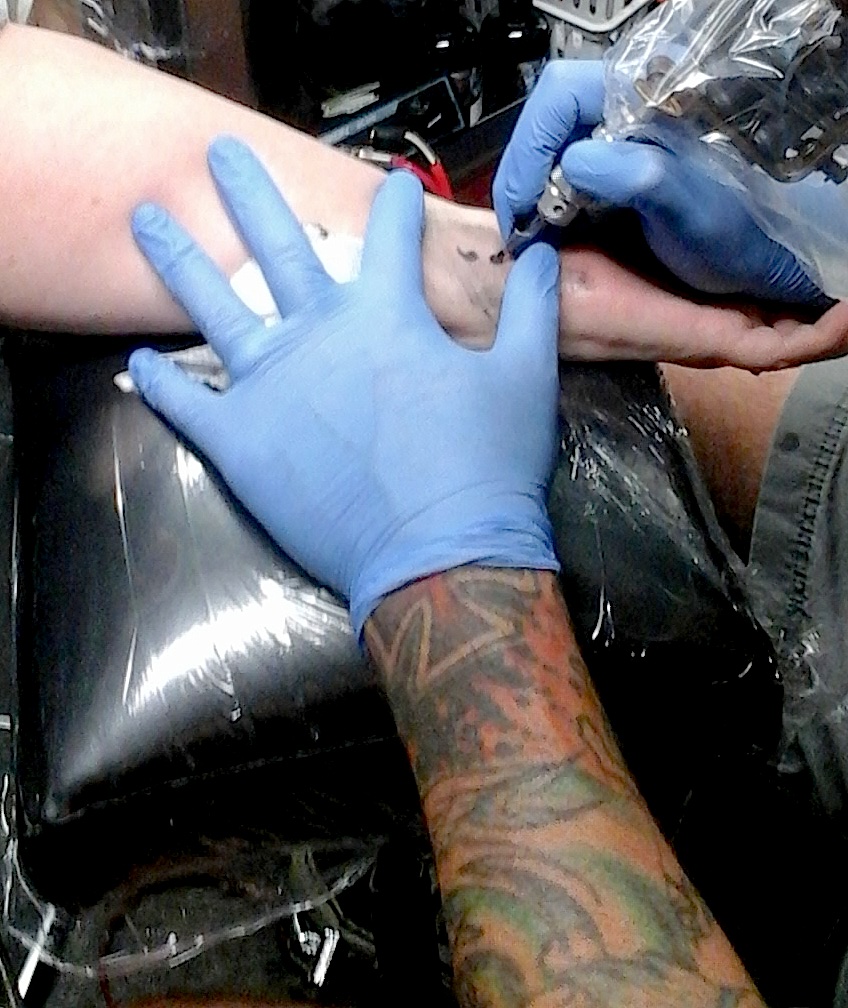
My first two tattoos were mental health tattoos. The one I’m getting in the photo is a semicolon. (Okay, I’m also a punctuation freak. The semicolon is my favorite.) It stands for the point in a sentence where a writer could have put a period and ended it there. If there’s a semicolon there instead, the sentence continues. As a metaphor, it means “My story isn’t over” and as a mental health symbol, it represents suicide awareness and prevention.

My second tattoo was a colon followed by half a parentheses followed by another colon, like this :):

In emoji terms, this would be happy face/frowny face. In a mental health context, it stands for bipolar disorder, which I have. (Bipolar used to be called manic depression, and it’s a lot more than wide mood swings.)

Determined to try something a little different – and more colorful – this time, I began contemplating options that would be meaningful, at least to me.

Compass rose. A compass rose is the little design at the bottom of a map that orients you to north, south, east, and west. For me, it symbolizes travel, which is a thing I love to do and have done often, both domestically and abroad, with my mother or my husband or by myself.

I also thought of having a compass rose with a yellow rose, perhaps in the center, in honor of my mother. She loved to travel too, and the yellow rose was her favorite flower. But that might be a lot to cram into a small tattoo. (I want something subtle, not showy.) Maybe I can get a yellow rose separately later.

Books. Reading, as all my friends know, is a passion of mine, one I’ve been indulging since I was four years old. I’ve read under the covers when I was a kid, in the hallway between classes when I was a teen, and practically anywhere and anytime now. (I have three e-readers so I can recharge them and still have at least one to read from. But I digress. I’m not getting a Nook tattoo.)

I’ve been wavering between an open book, maybe with a pen, to signify writing books; an open book laid flat; or a small stack of books. I think the stack of books offers an opportunity for some color, so I’ve been leaning towards that.

Orion. The constellation Orion is my favorite. (Is it weird to have a favorite constellation as well as a favorite mark of punctuation?) I love when it appears every autumn, with its belt and sword of stars, and the big red star Betelgeuse at the left shoulder and the bright blue-white Rigel at the right knee, creating a hunter figure from Greek mythology. (Most people pronounce Betelgeuse as “Beetlejuice,” but I’ve heard other pronunciations as well. Isn’t this educational?)

Astronomy is and has long been one of my special interests. I belonged to an astronomy club in high school. I subscribed to Sky and Telescope magazine for a while. I watched Carl Sagan’s TV show Cosmos avidly, then took his astronomy class in college.

Rather than have the stars as black dots connected by lines or superimposed over the figure of a hunter, I would like the tattoo to have a watercolor background, like a nebula.

I’ve been toying with these ideas for some time, but have been feeling motivated to get on with it recently (perhaps because I’ve been binge-watching Ink Master.) This week I got in touch with one of the artists at Monkey Bones Tattoos, a local studio. Mike, who did the punctuation tattoos, wasn’t available, so I selected another tattooist named Viktoria.

She and I then emailed back and forth about ideas and schedules. The earliest opening she had was in August. (Evidently there is pent-up demand for tattoos, owing to the shop being closed during the pandemic.) I sent her pictures of tattoos that looked something like what I wanted. We discussed the merits of each, as well as how my vision might differ from the “reference” I sent.

So, now it’s official. In August I’m getting a tattoo of a stack of books on one of my wrists. I’ve even put down a deposit for the appointment, so I can’t change my mind. When it’s done, I’ll post a picture of it. But I’m still not becoming a biker or a chef.

A Gift for Mom

I remember what Mother’s Day was like when I was a kid. My sister and I always gave my mother perfume. Well, my dad bought it and my sister and I gave it to her. (We didn’t get much of an allowance back then.) We always got the same kind, a scent called Tigris. I rather think we got that one because it came in a cool bottle with a tiger-striped fuzzy cap. Now I don’t know if she liked it or even if she wore it much.

I wanted to learn about other people’s memories of Mother’s Day, so I asked my friends on Facebook what they gave their mothers. I also asked moms among my friends what were the best gifts they had ever received. I didn’t get many responses, but enough to establish a pattern.

In 1992, Dr. Gary Chapman wrote a book about The Five Languages of Love, five ways that people can share love with one another. The book was originally intended for spouses or those in romantic relationships, but I thought I’d apply it to Mother’s Day.

The five “languages” are

• words of affirmation

• quality time

• physical touch

• acts of service

• gifts

In relationships, problems arise when two people don’t speak the same “language.” For example, one person would like quality time together, but the other thinks giving gifts is the way to express love. Or someone who would like words of affirmation but receives only physical touch.

What surprised me from my unscientific poll is that the persons who gave gifts were mostly children. Usually they had no money, or not enough to buy anything nice, so they relied on arts and crafts. Many a mother has received the venerable gift of a loomed potholder or the neighbor’s flowers. But many of the answers I received showed real thought and imagination.

One guy, for example, said, “I started sewing as a youngster. I once made an apron, though she didn’t wear them as a rule.” One mother particularly remembered – and still has – an acrostic poem that her child wrote and illustrated for her. (For those of you not familiar with it, an acrostic poem is one in which the first letter of each line spells out a word, in this case “MOTHER.”)

Many of the other gifts fell under the heading of quality time or acts of service. For quality time, the clear winner was the mom who remembered, “For me it was my daughter surprising me and showing up at my church plus spending the day with me. We’ve also gone to movies or gotten massages/pedicures together. Mostly just time spent together.”

One response spoke of both affirmation and a gift. This mom remembers, “It was the first Mother’s Day after my son moved to England. Honestly, I don’t remember what the gift was, but the fact that he remembered the day (it is on a different day in England) meant a lot to me.” She added, “Last year, he took the time, from England, to arrange for a delivery of Brock Masterson’s Mother’s Day quiche meal for me. That was above and beyond, I think.”

The categories of food and service overlapped at times. One former child remembers, “I made her breakfast in bed. Usually burnt crap.” I’m sure mom appreciated the thought, at any rate. Another idea was given by a guy who, as a teen, did “some extra chores so she could have a day off.” Another person responded, “We took her out to eat,” which if you think about it, combines quality time, act of service, and gift.

The most comprehensive, and most touching, came from a mom who said that the best Mothers Day gift she received was “All of them because they honored me in so many ways.”

No one mentioned expensive gifts, like jewelry. Gifts of touch were also seldom mentioned, though I suppose the mani/pedi would qualify. And I’m sure a lot of the gifts and remembrances were delivered with hugs and kisses.

This is not to say that moms settle for little, but that the little things are the most fondly remembered.

What Do You Do With Your Winnings?

You suddenly receive a chunk of money. What will you do with it? That’s a question that I have heard often. Not directed to me. I have no prospects of landing more than pocket change, unless my mystery gets published, hits the bestseller lists, and gets picked up for a television series.

But I watch a fair number of competition shows on TV, primarily on Food Network or The History Channel. I enter giveaways occasionally, when HGTV is offering a fabulous house in Rhode Island as a prize. But I never even buy lottery tickets, to which I have a philosophical objection. (I believe that they are a tool used by the upper classes to make money by fooling people into believing that they can magically join the upper classes. But I digress.)

The prizes offered in the shows I watch are seldom life-changing, usually starting at $10,000, which seems nice, but I have seen them go up to $100,000, which actually could be life-changing, if not a key into the leisure class.

What the contestant would spend the money on if he or she won is a question that invariably gets asked. I have noticed a pattern in the responses. There are a few major categories.

Travel. Contestants’ dreams of travel seem pretty realistic to me. It’s what I would spend my winnings on.

The usual fantasy trips are to take the family on a great vacation, to have a honeymoon that somehow never happened, or to visit a part of the world from which ancestors came. In the food competitions, there is also a tendency to wish for funds to travel the world (or at least part of it) sampling and learning how to cook different kinds of cuisine.

(Since we were on the subject of honeymoons (or at least I was), I also hear contestants who want to spend their prize on an engagement ring or a wedding. I know the price of diamonds and of weddings have not gone down in recent years, but $10,000 or $25,000 seems a bit high for regular folks, the ones who never appear on “Say Yes to the Dress.” An engagement ring for $25,000? I mean, come on!)

Home. I’ve heard a number of contestants say they would like to put a down payment on a new home. This time the figure seems a bit too low. But what do I know? Maybe the couple has already saved toward a house and this would put them over the roof, so to speak.

Other winners say they would renovate their kitchen (on the food shows) or their workshop (on craft- or building-type shows). This I can understand. Remodeling a kitchen or a workshop could easily eat up that kind of money, especially if new appliances or tools are required.

Business. Again, as with houses, the prizes offered don’t really seem magnanimous enough to start a business, but again, most of these lucky winners may have a fair amount put aside already. Or their dreams are more modest – to get a storefront instead of an internet bakery (a concept I’m not altogether clear on), or a food truck (I’m assuming this would also be a down payment, given that a food truck would have to cost more than a car, which you can hardly get for $10,000 anymore anyway) or the ability to turn a part-time hobby into a full-time business, which seems to me like a pipe dream, but I suppose there are people who could make it work.

Charity. Some of the potential winners have loftier goals. I’ve heard chefs say that they would start a variety of cooking programs for troubled youth. I’ve heard winners say that they would give part, or even all, their winnings, to a charity that provides funds for researching a disease or condition that a family member suffers from. Others want to donate to a church or other religious cause. Once I even saw a kid (on “Kids’ Baking Championship”) who wanted to help out a teacher who had fallen on hard times.

Me, I’d be off like a flash to Ireland with my husband. (I’ve been twice, but he’s never been). If there’s some left over, we’ll just have to arm wrestle for it. Maybe Benson, Arizona, where we once enjoyed one of our best vacations ever. Or, more likely, only as far as the IRS office.


There’s a Redbud in My Shower!

I love plants and flowers. I really do. As long as they stay outdoors, where they belong, as nature intended. Or sit politely on windowsills, if indoors.

What I object to are plants and flowers that refuse to know their place.

I really shouldn’t blame the botanical specimens for this. What I object to is my husband putting them where they don’t belong. My husband brings home rescue plants.

(Both of us believe in adopting rescue animals. Adopt, don’t shop is our motto. We have adopted dogs and cats (mostly cats), all the way from Dumpster divers to pets that adopted us. But I digress.)

Dan gets these wayward plant specimens from work. No, he doesn’t work at a nursery, but a big box store. They do have a gardening section, though, and in it they have plants. And when the plants look the least bit discouraged or haven’t bloomed in a while, that’s when my husband swoops in and carries them off. Occasionally they make him pay a buck or two, but usually they were destined for the Dumpster (making Dan a Dumpster diver, too, I guess).

Sometimes the plants he brings home have little ceramic pots – often chipped or cracked. Other times, he brings home plants with tiny bare roots or ones with potting soil clinging to them. Fortunately, Dan has a robust collection of dark green plastic containers that he uses for the pot-less orphans.

It’s not the actual plants I object to. Dan has brought home some truly gorgeous ones – orchids and African violets and night-blooming jasmine and leafy green things that threaten to take over wherever they’re planted.

And unfortunately, where they’re planted is often the bathroom. When we had a regular tub, Dan used it as a potting table (or trough, really). He thereby acquired the chore of scrubbing out the tub.

Now, however, we have walk-in showers with lots of little ledges designed to hold soaps and shampoos and exfoliants and loofahs and such. They are instead filled – you guessed it – with plants, from the flourishing to the bedraggled to the defunct. (He claims he was experimenting to see whether plants would grow under the bathroom’s LED lighting. They won’t.) He waters them by the simple expedient of showering with them. (We have two walk-in showers, and so far the greenery hasn’t invaded the second one.)

They also show up in other places – in the sink or hanging from the towel bar, for instance. I swear I once almost wiped my ass with a philodendron leaf from a plant that was completely obscuring the toilet paper roll.

Nor has Dan stopped with taking over the shower and the windowsills. (I grudgingly allowed him to place one small, easily-cared-for plant on the windowsill in my study.) A number of his botanical friends seem to have taken root on the coffee table. Well, not taken root, actually, but you get the idea. This is his temporary repotting station. He claims he’s going to set up a real one in the basement. (I’ll believe it when I see it and I haven’t seen it yet.)

I shouldn’t complain too much about the rescue plants, I suppose. The seed catalogs have started to arrive and Dan will most assuredly negotiate his orders with me.

Can I spend $200?

Can you keep it down to $75?

$150?

$75 now and $25 more when we get paid again?

At least those will mostly be planted outside, unless he has to store them in the refrigerator till the ground unfreezes. Or unless they need potting in the aforementioned shower, sink, or living room. Then it’s time to offer up fervent prayers for no more freezes.

Freeze is also an issue in the fall, when Dan needs to bring in the potted plants that adorn the front stoop. I gather daily weather reports and hold the door open for him as he brings in banana trees and other large specimens, being vigilant about our rescue cat door-darter. (At least the foliage doesn’t have that bad habit.)

I must admit that the plants and flowers add a certain ambience to the house. Just not to the bathroom.


New Year’s Sweaters I Have Known

Christmas sweaters, both ugly and pretty, have come and gone for this year. But for me, sweaters are inevitably evocative of New Year’s. Let me explain.

Once upon a time, I worked in an office that didn’t go in for Christmas sweaters. The telemarketing department wore Christmas sweatshirts, mostly handcrafted. My department, fortunately, left the exercise to them. I’m not at my best with hot glue, sequins, and ribbon. Not to say I end up wearing the appliques, but let’s just say they adhere to something other than the sweatshirt.

Later, I did work in an office where Christmas sweaters were a Thing. (Ugly sweaters were not a Thing. Yet.) Everyone, it seemed had a closet- or drawer-full of festive holiday wear.

I had exactly one handed-down-from-a-friend Christmas vest. That was fine, as far as it went, but it didn’t go very far. Everyone else had complete wardrobes of Christmas sweaters, perhaps not one for each of the 12 Days of Christmas, but enough for the entire week before. I had a hard enough time fitting in with the work crowd, so I decided I would play the sweater game too.

Being frugal (that is to say cheap), I saw no point in paying good money for a sweater or multiple sweaters that I could wear only once a year. I had a dilemma. The answer soon came to me. I would shop on New Year’s Day, when the Christmas sweaters had all been put on the clearance sale table. I scooped up about five, including one I particularly liked. Instead of being red or green, it was dark blue, a night scene with Santa and his sleigh flying over rooftops and across the moon. I tucked them away in a drawer, anticipating how I would wow the office the next year.

Inevitably, and given my luck, I was let go before the next Christmas season. I went freelance, which meant that my usual work clothes were pajamas. My beautiful sweaters languished in a drawer and so did my snowflake and wrapped presents earrings (I picked up some of those too at the sales). One year I tried to be festive and dressed up for Christmas, but no one at the Chinese restaurant was impressed.

I did have one other adventure involving New Year’s sweaters. One year, some of my friends and I were determined to crash a fancy party in a local hotel. I did have a black sweater with gold and silver beading around the yoke. (I forget why. Maybe my friend, she of the Christmas vest, gave it to me.) At any rate, it was simple enough to buy some shiny gold fabric and ask my mother to sew it into a simple skirt. My friend had a similar outfit, and the guy accompanying us rented a tux, which I thought was overkill. But it was fun to stand next to him in my white faux fur coat and shed all over him.

We had it planned just right. We wandered into the hotel ballroom precisely at 11:30 p.m., when no one else was expected to arrive, and mingled. (We knew one of the band members and decided to claim we were with him if challenged.) Then we indulged in the open bar (this was many years ago, when I sometimes indulged in dodgy behavior) and I spent part of the evening necking with one of the waiters. (He was trying to convince me to take a hotel room. I declined.)

Afterward, we went to a nearby diner in our finery and sobered up on coffee and waffles. We tried to hold down our obnoxious glee, but I suspect we failed. 

This year for Christmas, my husband presented me with an assortment of sweaters – the kind meant to keep one warm. Not a sequin or reindeer in sight. He did also give me a pair of Christmas earrings (cats in stockings), which I made sure to wear when we went to the store to pick up a bottle of champagne for our New Year’s celebration. Maybe next year I can get him to dress up as a waiter.