Tag Archives: games

Finally, I Gave In

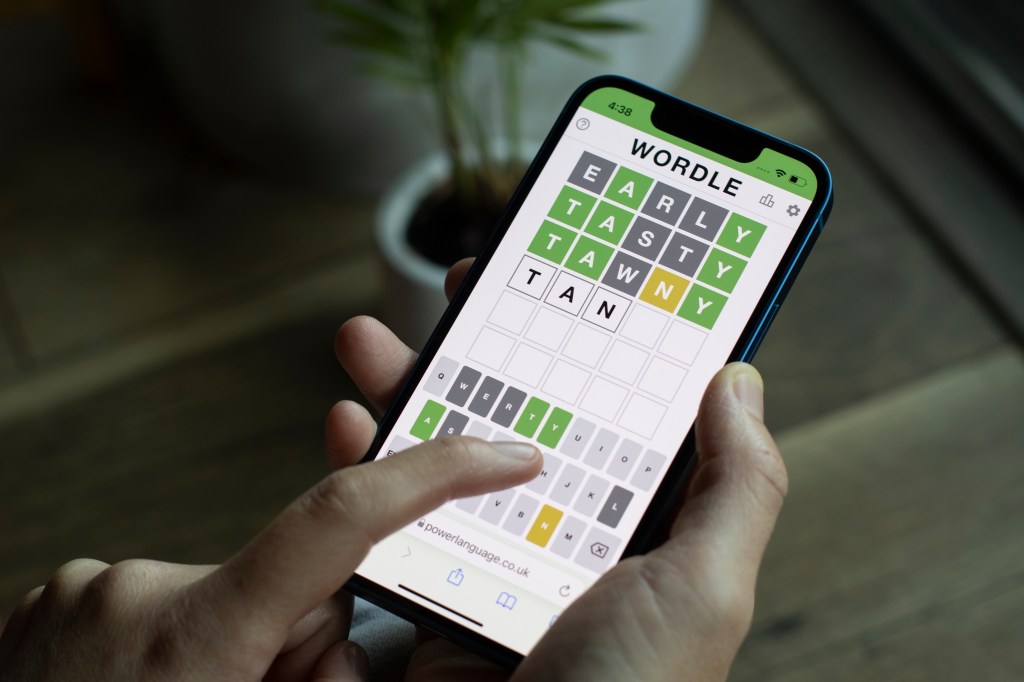
All right. I admit it. At last I’m doing what the cool kids do. I’m playing Wordle daily.

I resisted for as long as I could. I even wrote a blog post about how I was not going to succumb. I found it annoying when every day I saw people posting on Facebook what their scores were. That trend seems to have stopped, or at least pulled back. Now, most people only share their results when they get the word in two or three guesses.

My first brush with Wordle came when I was visiting friends in Michigan. Leslie was playing Wordle while someone else drove. She was having a hard time with one particular word and was down to her last try. I looked over her shoulder at the puzzle and said, “Prism.”

“That could work.”

It did.

“You’re good at this. You should be playing it.”

But I resisted. I’ve long been a fan of crossword puzzles and anacrostics. I’ve also done a lot of sudoku and right now I’m obsessed with jigsaw sudoku. (This is an insidious form of the puzzle in which, instead of neat little square blocks, each area is some other shape. A “U” or a snake or some unidentifiable blob. The rules are the same. Each shape contains nine little squares, which must contain the numbers from one to nine. Each row and column must also contain one through nine. But I digress.) (My husband’s famous quote regarding sudoku is, “I may not be able to spell, but goddamit, I can count to nine!” But I digress some more.)

Then one day, one of my writing buddies, Mary Jo, sang the praises of Wordle. “You should try it,” she said. “It takes less than five minutes a day.” (Jigsaw sudoku takes longer than that.)

So, okay. If Mary Jo recommended it, I decided I would try it. I’ve played it every day since, so it’s all her fault.

I have my routine. My first and second words are always the same. They give me all the vowels (including Y) and at least three of the most common consonants. I’ve solved it in three tries more times than six, but four is my usual. I’ve learned to hate words that have several possible choices for the missing letter, like STEA—it could be STEAM, STEAK, STEAD, or STEAL, and if I run out of guesses, I’m screwed. Then there was the time the word was PENNE. Two double letters. Only one letter was revealed by my first two guesses. But I got it!

When I reached a streak of 30 consecutive completions, I told Mary Jo. She admitted, faux-modestly, that her record was 390 days. (I’m sure it’s even more by now.)

Then I found out her secret: She cheats.

(Okay, technically, I guess you can’t call it cheating. She has Wordle buddies that consult with her daily and give each other hints. (I’m not one of them, [sob!].) She refers to the complete list of words that have been Wordle solutions, so that she won’t get hung up on STEA if STEAM has already been used. I didn’t even know the list existed until recently. But I digress again.)

I won’t say I’m addicted to Wordle, but if I’m up after midnight, I do go directly to the Wordle page on the NYT site and try my brain. I tell my husband my score daily. (I don’t do so well on Spelling Bee. Sometimes I can guess at least one word just by looking at it. Other times, I simply can’t, no matter how long I study it. So I don’t. But I digress some more.)

Anyway, I now expect my friends to laugh and point (insofar as you can point online). Especially Mary Jo.
Puzzling Numbers

Words are my life. Numbers, not so much.

I’ve never been a math-phobe. All throughout school, I combined reading and writing with the proverbial ‘rithmetic. Set theory, quadratic equations, whatever – no problem. Then I hit what my high school called “enriched” geometry. It was the first D I had ever gotten in my school career. It soured me on math.

I didn’t feel I deserved it, either. What was “enriched” about the geometry was the fact that it required three-column proofs instead of two-column proofs. (It was later that I learned about 151 proofs.)

Three-column proofs, as I recall, required you to state which theorem or corollary you were using to solve the problem. I had a philosophical disagreement with this system. I contended that if you ever needed to know whether it was corollary C or theorem 17, you could look up the name of it. It was knowing how to use it that was important. So I never put in the third column and I got a D.

(I think this actually helped me when I went to college. At the Ivy League institution I attended, there were many students who had never received a grade lower than an A. When they suddenly had to compete at a higher level and got a C or even a B, they were devastated. But I digress.)

Later in life, I found that I did indeed understand geometry when a manager at my job was hanging pictures. “I can hang these four pictures in a square, but the hard one will be hanging the one in the center,” he said. I took two pieces of string and ran one from the nail in the lower left to the one in the upper right, and the other from the lower right to the upper left. I put the fifth nail where the two strings crossed. So much for theorems and corollaries.

But that’s not what I wanted to write about this week. That’s right, that entire section was a big digression. What I meant to talk about was puzzles.

Word puzzles are probably better known (and I’ll be writing about them next week), but there are number and math puzzles as well.

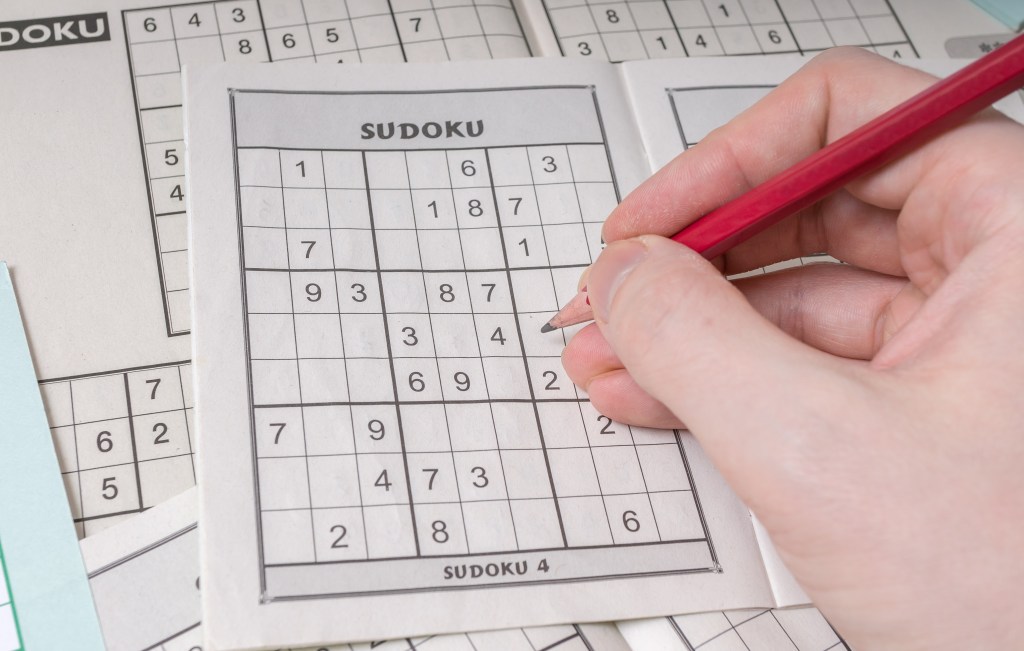
Sudoku (which means “single number” in Japanese) hit the big time in the US in 2004. It made an appearance in puzzle books earlier, in 1979, when it was called “Number Place.” But it really took off when a computer program was developed that created the puzzles.

(On first learning of Sudoku puzzles, and hearing that they were supposed to stave off senility, my husband decided to give them a try, though he had no interest in crossword puzzles. He was heard to say, “I may not be able to spell, but damn it, I can count to nine!” But I digress. Again.)

But plain sudoku didn’t satisfy me. Being something of a masochist, I soon found myself wanting something more. What I found was jigsaw sudoku. Instead of living in nice, neat square boxes, the numbers were scattered throughout shapes that looked like gerrymandered congressional districts. The rest of the rules were the same. Each shape had to be filled in with the numbers 1–9, with no duplicates in any box or row.

I stopped solving sudoku when I stopped buying the little books in the grocery store or pharmacy. Recently, though, I found a site online that offers a daily jigsaw sudoku. I had to try it. I selected the medium difficulty setting.

On my first try, I scored -520. I figure that was the equivalent of getting a D. Maybe I should go back to the NYT crossword, where at least they don’t give you a grade.

Tip Jar

Choose an amount

¤2.50
¤5.00
¤10.00

Or enter a custom amount

¤

Your contribution is appreciated.

Donate