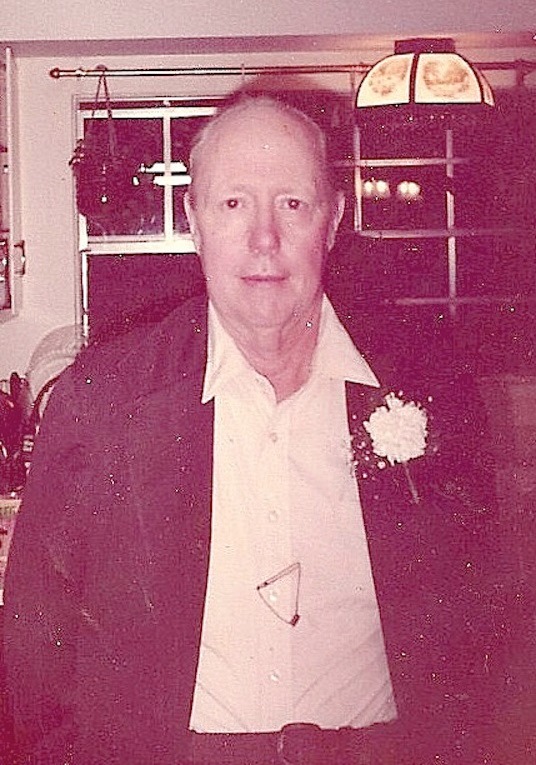
This is my father. His name was James Robert, or Jim, or Jim-Bob in his native Kentucky. My friends and I all called him Melvyn. It was based on a line from a comedy show that none of us remembers.
This picture was taken at my wedding reception, after he had dispensed with his tie. It looked unnatural on him anyway, although I must say that all through my childhood, he worked a government job that required a suit. I remember the scents of Aqua Velva and Vitalis, and the shine on his black shoes.
Then, when I was a teenager, he took medical disability because he had multiple myeloma.
When that happened, he went back to his Jim-Bob roots. He wore sneakers, flannel shirts, and a cowboy hat. He spent his time rediscovering hobbies like reloading bullets. When he was bedridden, family friend and library worker Beth McCarty brought him sacks of Zane Grey and Louise L’Amour westerns. It was quite a surprise to me to see him reading.
The disease spread to his bones as well as his blood. His pancreas failed and had to be removed, so he needed drugs to replace its function. He had an operation to take a piece of bone from his hip and use it to support his neck.
He had chemo and radiation. He didn’t really have much hair to lose at that point, but he threw up a lot. The doctors gave him only a couple of years to live. But he beat them by a significant number of years—10, I think. I really don’t remember the exact total; I wasn’t counting then, just hoping it would last.
One thing he didn’t do was go to group therapy. The local hospital had one group for cancer patients called Make Today Count or some similarly upbeat name. He flatly refused to go. My guess is that he had that Kentucky take-care-of-your-own-problems, keep-it-in-the-family mindset. It’s unlikely that they could have given him something more than he found within his own resources. Melvyn was stubborn, which in his case, he could substitute for positivity.
My mother was his caregiver, and she went it alone, too, except one time when she asked me if she was doing a good job. She knew down deep she was; she just needed to hear it from someone else. But, like Melvyn, she kept it in the family.
Recently, however, the New York Times reported a story, “From No Hope to a Potential Cure for a Deadly Blood Cancer.” It was about multiple myeloma and how new therapies are extending life for people who have been given a death sentence. People like Melvyn.
It’s a new kind of immunotherapy, which wasn’t possible, or maybe even thought of, all those years ago. The study, the Times said, was a “last-ditch effort.”
And, somehow, it worked, at least better than expected. “A third responded so well that they got what seems to be an astonishing reprieve—to have made their cancer disappear.” And after five years, it still hadn’t returned in those patients — a result never before seen in multiple myeloma.
No doubt, before the human test, there were studies on rats. (Melvyn always said he hated being compared to a rat.) The immunotherapy isn’t cheap. One dose is all that’s needed, but it costs $555,310. Our family couldn’t have afforded that, even with government insurance.
The scientists hope that if they diagnose the disease early enough and give the treatment then, it could be a cure. As it is, immunotherapy still isn’t a cure, but the treatment “increased median survival from two years to 10.”
That was something Melvyn accomplished on his own.
 But I Digress . . .