Monthly Archives: January 2021

Dressing for Work

Of course, since I now work at home, I wear pajamas. Or maybe scrubs, as my latest pair of pjs looks like I could walk into any doctor’s office and riffle through their files. I wouldn’t be caught unless someone noticed that the cute sheep in hats and scarves were saying Baaa Humbug.

But that’s not what I’m here to write about today. Once (or twice) I worked in a regular office where I wore regular clothes – skirts, blouses, sweaters, slacks. If I was lucky or awake that day, they even matched. I was also fond of drop-waist dresses. I had at least four, in solid colors and florals.

But that’s not what I’m here to write about today either. Once I was assigned to interview a woman for a temporary job. She answered my questions shyly and monosyllabically. Desperate, I asked her a version of one of my go-to questions, “If you could dress up as anything at all for Halloween, what would you be, and why?”

(This was a version of a question I always swore I’d ask an official giving a press conference. Once I was able to ask my remedial English students to write a paragraph on the topic, and they all wanted to be birds of prey or cats of prey. Once I asked Jenny Lawson this question and she said “a tapeworm,” because she wouldn’t have to walk around and people would feed her, which I guess shows you how her mind works. But I digress. Again.)

Back to the drab woman I was interviewing. When I asked her my Halloween costume question, she instantly lit up. “Oh, Cinderella,” she said with sparkling eyes. “The ball gown and the shoes and the carriage and the whole thing.” She waxed rhapsodic for several minutes. She didn’t get the job, but I learned that it’s sometimes the goofy question that can unlock a person’s personality.

Our office did dress up for Halloween, though. One memorable year, the accounting department wore white sweatsuits with black spots. Then they each put a newspaper outside their doors, colored part of it yellow with highlighter, and deposited a tootsie roll on each one. The 101 Dalmations cosplay was cute, if disgusting.

My costumes were a bit esoteric and usually no one “got them.” One year my mother had made me a floor-length nightgown in a camo pattern (my mother could be whimsical). I asked her to make a matching nightcap, powdered my hair, and went as Rambo’s Granny. No one guessed what I was. I had other notable non-successes. Once I dressed as a pirate and the office guessed I was a motorcycle mama.

One year they understood what I was, but all stepped away from me and didn’t make eye contact. I was “Indiana Jan,” complete with bullwhip. If anyone was brave enough to ask me about the bullwhip, I replied, “Oh, this old thing? We just had it around the house,” which did not detract a bit from my reputation for oddity.

Then, every Halloween, rain or shine, we had a march around the outside of the building, led by an employee who called herself the “Grand Poo-Pah.” I didn’t have the heart to tell her that it should have been “Grand Poo-Bah.” Those were the days!

Now, of course, I shun Halloween and all its trappings (https://wp.me/p4e9wS-Yu). This year, if I answer the door at all, I’ll probably wear the Baaa Humbug scrubs.


Mysteries I Love and Hate

Cozy mysteries are a thing, and I do not like them. As all my friends know, I am a mystery lover – I’ve even written one, which is now making the rounds of agents.
But cozy mysteries have gone too far. These are the kinds of mysteries that take place in bed and breakfasts or bookstores, that have chefs or weather forecasters as their sleuths, and exhibit little to no blood, despite the crimes. They are called cozies, I suppose because you can cuddle up with a cup of tea and read them, safe in the knowledge that nothing really bad will happen.

And the titles! Most of them are puns – usually lame – based on whatever setting they have. I just can’t bring myself to read something called Chilled to the Cone (bakeshop), Premeditated Mortar (fixer-upper), Absence of Alice (garage sales), or The Malt in Our Stars (literary pub). The “detectives” are never real police officers, obviously. And most often the (supposed) humor and (artificial) quaintness fall flat.

I must admit to reading several cozy series many years ago. These were usually ones that had a setting I was interested in or characters that were well-rounded and well-drawn, or contained cats (sometimes as the sleuth). Susan Wittig Albert did a series based on an herbalist. Diane Mott Davidson did a cooking series, complete with recipes that I never tried. There was a series, the Amanda Pepper mysteries, that was set in a Philadelphia prep school, and the Kate Fansler series, set in the English Department of a college.

One that I used to read devotedly, but finally gave up on in disgust, was Lillian Jackson Braun’s The Cat Who mysteries starring retired newspaperman Jim Qwilleran and his two cats, Koko and Yum Yum. (I also like Mikado references.) The first three came out in the 60s, but there was an extensive hiatus until 1987, when the series reappeared and continued yearly until 2008, with The Cat Who Had 60 Whiskers. I gave up in 1991, with The Cat Who Moved a Mountain, a dreary, supposedly amusing book set in the Potato Mountains, concerning a conflict between two clans known as the Spuds and the Taters. It was just too cozy for words.

Some writers are able to switch gears and write both cozies and grittier novels. Linda Barnes, for example, started with the Michael Spraggue mysteries set backstage at a theater but switched to the much more robust Carlotta Carlisle series when, as she said, Spraggue ran out of friends and relatives to be killed off. Carlisle, a former police officer, drives a cab in her off-hours but encounters plenty of hardened criminals and deaths. These I read whenever Barnes writes a new one.

The other cozy mysteries I read are the Mrs. Pollifax series by Dorothy Gilman. They are typical in that when you read them you know that nothing terrible will happen to any of the main or even subordinate characters (who are colorful, if unbelievable). The thing that attracts me about the Mrs. Pollifax books, other than the goofy premise that she is a grandmother who works for the CIA, is the extensive travelogues of wherever her handler sends her: Mexico, Albania, Turkey, China, Zambia, Hong Kong, etc. I find her novels soothing rather than irritating, the sort of thing I read when I’m stuck in bed with a really nasty flu.

Cozy mysteries no doubt have their place in the pantheon of mystery novels. They’re certainly popular, at least. But for the most part, I’ll take Sue Grafton’s Kinsey Milhone or Sara Paretsky’s V. I. Warshawski over Reel Murder any day. I want believable plots; well-drawn, interesting characters; crimes that make you care what happens; and real danger. Give me early Robert Parker (before he started phoning them in) or John Sandford or Laura Lippman or even the original Nero Wolfe series, for when I want vintage mystery fiction.

Of course, I read other kinds of fiction (Gregory Maguire and Handmaid’s Tale come to mind), but mystery novels hold a special place in my to-be-read list. Let’s not mess up the genre with The Good, the Bad, and the Lemon Tart.


The Bride Wore Boots

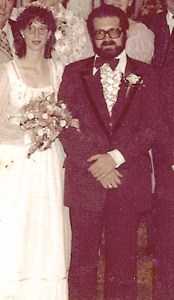
When my husband and I married, it was at an unusual time in both our lives. We were both out of work and on food stamps. We did not spend thousands of dollars on our wedding, as everyone on TV seems to do. Back then, weddings did not have themes, though they did have color palettes. Ours was off-white, rose, and rust. (The off-white was so that no one would snicker.) Back in the day, gentleman were able to wear tuxes of colors other than black, and such were available at tuxedo shops. As you can see from the photo, Dan wore a rust-colored tux with a ruffled shirt and a matching tie. He looked like a riverboat gambler, but he did fit in with the color scheme.

We married in August, so my dress was a leftover from prom season. (Not my prom, you understand. I didn’t go to that. It was just a prom dress that didn’t sell.) It had long sleeves, but they were made of lace, so I thought there was a chance I wouldn’t roast to death. Defying tradition, I brought Dan along to help pick it out. There was a dress I liked better, actually. It was low cut, but the minister was going to stand a step above us, and Dan didn’t think his view down my cleavage would set the proper tone for the ceremony.

I refused to wear a traditional veil, just a circlet of flowers in my hair with some lace trailing down the back a ways, since I didn’t like the traditional symbolism. I didn’t have my father give me away either. I was giving myself away, as it were, and I thought that I could find the way from the back of the church to the front all by myself.

I did have my hair, makeup, and nails “done.” I still remember that the color of the nail polish was called “pepperoni,” which was a dreadful name, but fit in with the rust in the palette. I also remember the frantic calls to the tux shop afterward, where I learned that Dan had not yet picked up his tux. He didn’t have a good track record of showing up on time for other people’s weddings, so it made me nervous. He did show up at the appropriate time, though with his tie askew.

And the boots? They were a pair of off-white cowboy boots that I just happened to have and that matched the dress. They showed up well in the garter pictures, though people were unlikely to notice. I was wearing the garter several inches above my knee. If I couldn’t have a low neckline, at least I could have fun with the garter tradition.

Our reception was a potluck held at a friend’s house, which they were kind enough to let us use. We had had many fabulous parties there over the years, so the vibe was just right.

Our wedding cake was a spice cake with off-white buttercream and rust-colored flowers on it. (That was what we bought with our food stamps.) The top tier rested on three upside-down borrowed champagne glasses (martini glasses, really, as flutes hadn’t been invented yet.) At some point during or after the festivities, one of the glasses was broken, but I was able to replace it exactly, in time to return to the owner, my matron of honor. (She never reads Facebook, so I’m safe. But I digress.)

The only other untoward moment occurred as Dan and I left the church. I heard his mother screaming. Fortunately, she was not screaming in horror at me, or the fact that her darling son was married. No, it was because the pastor from Dan’s church back in Pennsylvania had driven all the way to Ohio to attend. He had just shown up a little late. There’s a picture of me somewhere, exiting the church and looking confused. 

Our honeymoon consisted of a night in a local no-tell motel, since we didn’t want to drive far after partying so heary. They gave us a bottle of champagne, I assume because they had never had a married (to each other) couple stay there before. The next day, we were off for a whirlwind honeymoon of camping, sleeping in a treehouse, whitewater rafting, and a visit to the Philly Folk Festival, where we had met.

Our wedding may not have been technically traditional, but it worked its magic nonetheless. We have stayed married for over 35 years.


1,000 Books

It goes everywhere with me. It carries over 1,000 of my books. It hands me the one I want at a moment’s notice. It keeps track of what page I’m on without a sticky note. It defines words I don’t know and tells me how to pronounce unfamiliar words. It allows me to sort my books onto different shelves for convenience’s sake and easily find books that I own or that are available in the bookstore. It’s my most faithful companion (aside from my husband) and the best tool that I own.

It’s my ereader, in my case a Nook from Barnes & Noble, though I’m sure Amazon’s Kindle and other devices do much the same things. I’ve gone through several iterations of the Nook device over the years and downloaded the Nook reading app to my iPad. When one gets low on juice, I simply switch to another while it’s recharging.

(Of course, I will need a way to convert all those ebooks to Kindle when the time comes and Barnes & Noble either collapses or stops supporting their own devices. I have a Kindle reading app on one of the readers because there was a book I dearly loved, Rift by Liza Cody, which B&N didn’t offer. But I digress.)

I usually keep two books going at once – one fiction and one nonfiction – and switch back and forth when a chapter or essay ends, or really, whenever the mood strikes me. I have a TBR stack as long as my arm, literally, but it will never collapse on me and kill me. I take my reading addiction wherever I go, never having to resort to reading the labels on ketchup bottles to satisfy my jones.

The iPad with the Nook reading app may be my favorite of all my ereaders, because it allows me to switch to other apps, check my email, messages, and Facebook timeline easily. And it has a snazzy purple case. My second favorite is my Nook tablet, which allows me to do many of the same things and also has a nifty keyboard should I ever want to answer messages, though to tell the truth, I seldom use it. I got that feature so I could blog on the go, but the WordPress app seems unable to accommodate me. The tablet has a spiffy black cover with a magnet to hold it open or closed, and a hinge so I can set it upright should I ever decide to use the keyboard. My third ereader is a basic Nook that fits in my purse.

My husband insisted I get him an ereader too, though he hardly ever uses it. He got one that fits in his back pocket and is linked to my account so he can read any of my thousand books as well. I make sure to buy ones that he enjoys, like Slaughterhouse-Five, A Canticle for Leibowitz, and Fanny Hill, and I introduce him to new ones, like Let’s Pretend This Never Happened.

My one complaint about my ereader is that it does not do pictures well. Once I had a subscription to Barnes & Noble’s version of  National Geographic. The photographs that appeared there were less than impressive. You expect impressive photos from National Geographic. Even the pictures in Miss Peregrine’s Home for Peculiar Children did not reproduce well. And the hand-written letters – I basically had to skip them, even though they contributed a lot to the plot.

Still, I am willing to overlook those flaws. As I get older and my eyes get worse (doc says I’m in line to develop cataracts), I’m going to need my ereader, where I can bump up the point sizes, more than ever. And purses large enough to contain them. Maybe I should carry a needlepoint tote like all the craft ladies I know – containing no yarn. Just 1000 books.


Your Writing Brain

Re-writing – also known as content editing – is a necessity at some stage of preparing your manuscript. However, there are pitfalls.

Suppose you are writing a novel, and one day it comes to you – the exquisite bit of detail that will make a scene pop or reveal something important about your protagonist’s inner life. You go to your manuscript and insert it just where you think it will do the most good. Then you read a little further and find that your perfect addition was already added one or two drafts ago. Yes, you had a brilliant thought, but you had it before, and yes, you knew where to put it, but with a few paragraph’s difference. Then you have the option of deciding which is the better place for that exquisite piece of prose to go, but it’s still kind of demoralizing.

Or – as just happened to me – you get a great idea for a blog post. You even start drafting it. But something niggles at the back of your brain. It all sounds very familiar. So, you go back to your file of posts and discover that you wrote almost exactly the same post, using almost exactly the same language, two years before. It was good enough that it doesn’t need rewriting, and you’re not so desperate that you re-post previous writing when ideas are thin on the ground. What do you do then?

Obviously, as I have done, you take the situation as a jumping-off point for a new post about re-writing that covers different territory than the old post. And you check your files again to make sure that this one is not a rewrite as well. It may even be a good idea to read over at least the titles on your old blog posts before you begin a new one.

Or you set out in a different direction entirely, one you’ve never explored before. Never write about politics? This may be the time to start. Start a short story instead of a blog post. Begin plotting the sequel to the novel that you’ve been sending around to agents, on the theory that agents and editors love series rather than stand-alone novels. Or try poetry, which you haven’t written since college. Think of it as a way to flex your writing muscles and blow the cobwebs off your brain.

You can also engage in prewriting (which, unfortunately, resembles lying on the couch and staring off into space). Toss ideas around in your head. Brainstorm, without analyzing whether your ideas are spectacular or not. You can even jot down a few of the ones that strike you as most fruitful, but really the exercise is just to get your brain moving. Re-read favorite books and pay attention to why you love them and how the authors made you love them.

Writing prompts and contests are also ways to get your creative juices flowing. Many writing websites feature assorted prompts. Or a question asked or situation described on Facebook may cause you to think, “What would I do in that situation?” or “Gee, that answer stank. Here’s what I would say.” A short story contest might give a list of possible topics. For example, I saw a story contest that proposed a topic of “Write about a new technology that changes a person’s life for good or ill.” I got a story out of it and an honorable mention.

And don’t be afraid if your new idea isn’t something earthshaking or written for the ages. Remember that William Carlos Williams wrote about plums in the icebox and Pablo Neruda wrote “Ode to My Socks.” Both of these are considered classic poems today.

You can also get ideas from the best. What if you had written “Ode to My Socks”? How would it go? What would it reveal? What if you took the premise of Isaac Asimov’s “Nightfall” and ran with it? What alternate ending could you invent? At this point, it doesn’t matter if what you write isn’t better than Neruda or Asimov. It’s enough that you’re stretching your brain and your creativity.

Whether you write about something familiar that you may have overlooked, try a new style or genre, or just play with words until some of them magically come together, you are performing exercises in writing. And that’s a good thing.