Monthly Archives: June 2023

How to Get Rid of a Possum

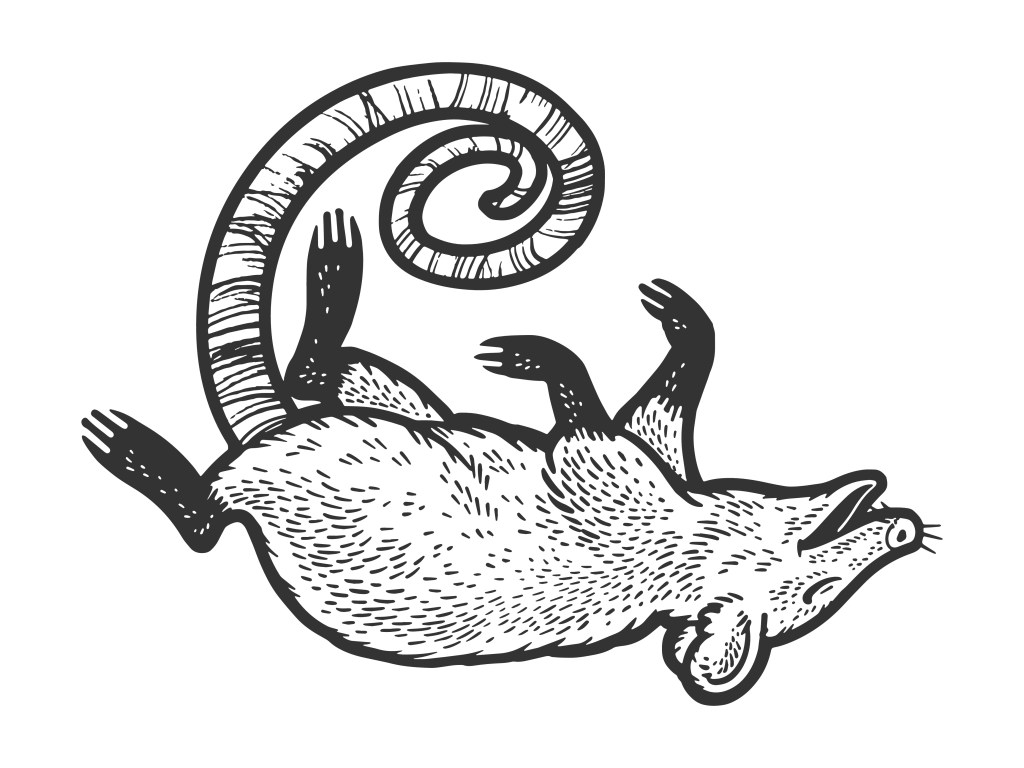
You’d think that getting rid of a possum would not be that difficult, given that the possum was already dead. Really most sincerely dead. Not just playing possum, so to speak. (Or playing opossum. But where I am from it was spelled possum and pronounced possum. Thus Kentucky heritage wins over Ivy League education, at least for once. But I digress.)

If the possum had still been alive, I could have called an exterminator or one of those more humane types with live traps, who let possums go in the wild, there, presumably, to frolic with like-minded possums, or whatever it is they do for fun.

Exterminators, it seems, want to exterminate things, which requires that they be animate. Animal control people likewise need a live subject. Controlling a dead possum isn’t much of a challenge. I would have thought that a dead possum would provide a nice break from cranky squirrels or sewer alligators, but then what do I know about it?

Not much, and that’s a fact.

I certainly wasn’t going to bury the thing, an honor reserved for pet cats. There was no way I was going to cook it, however popular roadkill cuisine was getting.

Truthfully, it didn’t seem to be roadkill at all. It was lying at the bottom of the back steps, on a concrete pad, near the garage, which is where I assumed it had been hanging out before its demise.

My main goal was to get rid of the thing without actually touching it. I suppose I could have left it until my husband got home, but the mental image of the unlovely rodent becoming even unlovelier in the sun was simply too awful to contemplate.

I pondered a while. My first bright idea was to call the natural history museum. They had a small exhibit of local live fauna and, I thought, surely must occasionally deal with dead fauna.

They were less than helpful. There was nothing they could do, the gentleman said.

“I’m concerned that it could be a health hazard,” I said.

“Don’t worry,” he replied. “The possum is a very primitive species. It isn’t likely to have anything that’s contagious to humans.”

“That wasn’t my concern,” I retorted. “I assume that rotting meat, of however primitive a species, is a health hazard.”

He said he was sorry and hung up.

I pondered some more.

I tried animal control. Here was this animal, and I was beginning to lose control.

Turns out they only deal with live animals. Possums are barely live animals even on their most animated days. No go.

Still with the pondering. 

Then I had a bright idea. There are guys (and, presumably, gals) whose job it is to remove roadkill from our streets and highways. Dead Animal Pick-Up Specialists or something like that. One place was called Critter Control. I guess that means if it’s alive it’s an animal, but if it’s dead, it’s a critter. (I didn’t see a listing for Varmint Control, but that’s probably because I’m not in Kentucky anymore. But I digress again.)

But Critter Control had standards, it seemed. The kind lady who answered the phone informed me that the dead animal in question had to be actually in the street. Or at least by the curb.

“Are you telling me,” I asked, “that my dead animal will not be picked up unless I put it by the curb? Are you telling me that I should pick up this dead possum, place it by the curb, and then call back?”

Uncomfortably, she replied, “Well, no. I’m not exactly telling you that….”

But we both knew that she was unofficially handing me the answer to my problem. I was going to have to face my fears, or at least my nausea, and move the possum.

The only way I could do this without actually touching the possum (one of my life goals) was to pick it up with a shovel and cautiously make my way to the curb, hoping that the possum didn’t slip off the shovel and none of the neighbors saw me. I dumped it rather unceremoniously over the edge of the curb and tipped it into the street proper.

Then I called the same lady as before and reported A Dead Possum in the Street in Front of My House. Before the end of the day, the Dead Critter Wranglers (or whoever) made it vanish.

I was happy.

Except for one thing. Now I had a shovel contaminated with essence of dead possum. The only solution I could come up with was to douse the shovel with lighter fluid and give it a quick whoosh with a match. Germs dead. Mission accomplished. No messy evidence.

So that is what I did. Then I went inside and raised a toast to the valiant city workers who deal with this sort of thing every day. Better them than me.

The Bird Who Spoke Cat

My husband and I were strolling through the mall after having a lovely fish dinner with a glass of wine. Well, a couple of glasses, really. We ended up at a Woolworth’s, which back then you could find in a mall. (Woolworth’s is what was known as a five-and-ten-cent store. Kind of like a Dollar Store that mated with a Target store, only cheaper, though nothing there actually cost five or ten cents. Except maybe candy. But I digress.) Once we were there, we browsed our way to the pet department, which five-and-dimes had back then. Mostly fish, turtles, and birds.

We stopped in front of the parakeet cage and gazed admiringly at the tiny flock. “Let’s get one,” Dan said.

“You’re forgetting that we have four cats,” I replied. “A parakeet would hardly be a snack for them.”

“We’ll hang its cage from a hook in the ceiling.” There was at that time no hook. Dan loves even the tiniest home improvement projects.

“I want the blue one,” I said. “I’ve always wanted a blue parakeet. We could name him ‘Blue Boy.'”

“He could be a she. How would we know?”

“If he talks, he’s a boy,” I said confidently. “Mostly the males talk.” (I wasn’t totally sure about this, but I was betting on the fact that Dan didn’t know either.)

“I’d rather get the yellow one.”

“Blue.”

“Yellow.”

“Blue. How are we going to decide?”

Then we made one of our famous deals.

“Let me pick the bird, and you can name him,” said Dan.

“Anything I want?” I asked.

“Anything? Even J. Alfred Prufrock?”

“Yes. Even that.” (Well, really, we were pretty sloshed. I don’t recommend buying a pet while drunk, but this turned out okay. But I digress again.)

So J. Alfred came home with us and lived safely in his cage near the ceiling. One of the cats, Maggie, made an ambitious climb up the drapes after him, but couldn’t figure out how to get from drape to cage and had to be rescued.

We tried to teach the bird to talk. “Hi. I’m Alfie,” we’d repeat to him. “Alfie-bird.”

We were also talking to the cats. Not that we expected them to repeat what we said, but we had interesting conversations nonetheless.

“Shaker, what’s a kitty do?” (Shaker was another of the four cats.)

“R-roww.”

“Yes, that’s right.” (We weren’t always drunk. Sometimes we were just silly. Still are.)

Eventually, Alfie started talking. But bird of very little brain that he was, he got a little mixed up. First, he changed his name.

“Ralphie-bird,” he said. “Hi. I’m Ralphie.”

What could we do at that point? We changed his name to Ralph Waldo Emerson.

But that wasn’t the end of it. Oh, no.

Pretty soon he was saying, “Shaker-bird” and “R-roww.” 

Great. We had a parakeet with an identity crisis. And a cat that was hearing voices from above. From her natural prey, no less. (I was going to write that Ralphie also said, “Here, kitty, kitty,” but he didn’t. Also, it’s a very old, very bad joke. But I digress some more.)

I could just imagine the little conversations Ralphie and Shaker could have.

Ralphie: “R-roww.”

Shaker: “R-roww.”

Ralphie: “R-roww.”

Shaker: “R-roww.”

Pointless, boring conversations, but what can you expect from animals that will never master sign language like gorillas do? Sometimes Dan and I don’t do much better when it comes to conversation. After all, we were the ones who had pointless dialogues with the cat for the parakeet to overhear.

Come to think of it, I don’t really know if their conversations were pointless. They may have been plotting against us. But the cat was cool and never said a mumblin’ word. (H/t Hoyt Axton.)

Fun With Dictionaries. No, Really.

When I was a kid, I had one of those small, plastic record players that came with small, plastic records of children’s songs. One yellow plastic disk had a song on it about dictionaries. I still remember it.

“Oh, the dic-dic-dictionary/is very necessary./Any word that you can cook up/you can look up./Pick the book up.” It also included a verse exhorting children to look up the words “dromedary” and “estuary.” Or maybe “actuary.” The sound reproduction was not that great. Neither word is one that I needed to know until much later in life, but I went through childhood with them stuck in my brain.  For that matter, they still are.

Also stuck in my brain is a dictionary adventure from slightly later in my childhood. Like many – perhaps most – of you, I ventured to the fount of all knowledge to look up “dirty” words. I didn’t find them all (I didn’t know them all at that point), but I found one that made a distinct impression on me. To this day, I can quote the definition of “fart” word for word: “an anal emission of intestinal gasses, especially when audible.” In other words, what was called a “poot” in our household, though that was not listed as a synonym.

There was one dictionary in history that caused quite an uproar, and it was largely (though not exclusively) caused by a different four-letter word: ain’t. Webster’s Third was not the first to include “ain’t” – even Webster’s Second did that. But Web3, notorious for downgrading (or I guess upgrading) usage labels, no longer listed the word as “illiterate” or “substandard,” but merely “colloquial,” or usable in regular conversation, though not in formal speech.

Headlines abounded: “Ain’t Ain’t Wrong, Says Webster’s.” Lexicographers were incensed and language mavens had the vapors. Not to mention the grammarians, who really got their undies in a bundle. The only people not freaking out were the linguists, who considered “ain’t” “nonstandard,” which was what they called a word that others called “substandard.”

(Lexicographers, linguists, and grammarians are different species, whose nether garments bunch at different sorts of things. Let me know if you want to know the difference. I’m lots of fun at parties. But I digress.)

Speaking of parties, there is a nifty party game that can be played with a dictionary, if you’re trapped at a party with no drinks, food, or music. It’s called Fictionary and bears no relation to Pictionary, which at least can get raucous.

For Fictionary, one person, acting as moderator, wields the Webster’s and selects a suitably obscure word. Each participant writes an imaginary definition on a slip of paper, while the moderator writes out the actual definition. The papers are then collected and read aloud. Participants vote on which is the correct definition. If a bogus definition wins out over the real one, that player gets a point. Hilarity ensues.

(The secret to winning a point is to start your fake definition with “of or pertaining to.”)

And speaking of word games, there’s Scrabble (aka Words with Friends if you’re among the techno-literate, which if you’re playing Fictionary you’re probably not).

A fascinating book (for those like me who are fascinated by such things) is Word Freak – not my autobiography, but instead a searing look into the dark underbelly of competitive Scrabble. For those who never thought competitive Scrabble was a thing or that it had a dark underbelly, it is and it does.

Now, of course, dictionaries have been replaced by the computer and particularly the internet. Among the most useful and colorful sites is the Urban Dictionary, where you can find the definition of words like “yeet,” though not its past tense, “yote.” (“Yeeted” seems to have become the past tense, though I’ll stick by “yote.” I still don’t know what the past participle is. “Yoten” is what I recommend, though I’ve never written or spoken a sentence where it was needed. But I digress again.)

The Urban Dictionary proved useful to me once when a character on House, M.D. (okay, it was House himself) used the term “squish mitten.” I pretty much got the meaning from context but felt a need to verify it, just for accuracy’s sake.

Actually, the internet is a good place to get your lexicography. The language changes constantly and rapidly, so the only place you can really keep up with it is online. Although I think it’s fair to say that “fart” hasn’t changed much, is still spelled and pronounced the same way, and still has the definition that made such an impression on me as a kid.

The Ultimate Fashionista – Not Me!

I guess you’d call me a victim of fashion. Or actually, a victim of no fashion. No fashion sense, at least. Fashion nonsensical, maybe.

I’ve always been this way. Being the second child, I always had hand-me-downs, which is probably why I never learned to pick out my own clothes. Also, my mother chose my clothes, which I was okay with until junior high, when I was mortified to see myself on videotape wearing saddle shoes and anklet socks. Quel faux pas!

It was at about that time that people started taking me in hand and trying to fix me up, sartorially at least. (Apparently, the other kind of fixing up was not even an option until I was properly decked out.) My first fashion consultant was a friend who told me that the main thing I should invest in was a pleated plaid skirt with a large gold safety pin. I did not, and thereby missed my chance to be stylish.

When I did develop my own sense of style, it was based entirely around Banana Republic. Khaki and olive drab were my color palette. I lived for the day each month when the new catalog came out with all its exotic descriptions of the clothes and tidbits of travel writing.

Only once did I ever shop in an actual Banana Republic store, in La Jolla. I hyperventilated, which is something I ordinarily do only when shopping for amber jewelry. I made several purchases and used the leopard print wrapping paper as a background on my bulletin board at work. (A co-worker once brought me an empty Banana Republic bag as a gift. “Won’t she be offended?” someone asked her. “She’ll love it,” Marie replied.  And I did. But I digress.)

Later I learned that Banana Republic had an outlet store about 45 miles from my house. Of course, I had to go. This was before outlet malls became a Thing. The BR outlet was in Erlanger, KY, a few miles from the Cincinnati airport (which is in Kentucky, for some reason). Keeping with either the travel theme or the airport theme, the outlet store was housed in a large, hangar-like warehouse, where I could make a proper expedition of shopping. I was crushed when BR stopped publishing their catalogs and again when they were bought out by The Gap. The outlet store was just no fun anymore.

Still, I wore my khaki and O.D., with occasional accents of camouflage. (This was also before camo became a Thing for anyone other than soldiers and hunters.) My mother, perhaps in atonement for all the hand-me-downs, sewed me spiffy camo vests and scarves. Once she even found some camo flannel and made me a floor-length granny-style camo nightgown, which I adored. (She also made me a forest green cape and Robin Hood hat, which I wore to my college archery classes. But I digress again.)

Another friend took me in hand and tried to eliminate the jungle look from my wardrobe. She introduced me to colors outside the neutral spectrum and accompanied me on shopping trips where she picked out my clothes and dressed me up like a Barbie doll. Well, not like a Barbie, really. I didn’t have the figure for it and my feet aren’t permanently shaped for heels. At least I looked respectable enough for work and dressy enough for social occasions, which for some reason I hardly ever got invited to. When she was no longer able to go shopping with me, she thoughtfully kept me supplied with more hand-me-downs from her own extensive and colorful wardrobe.

Gradually, I developed enough color sense to boss my husband around. (“Let me try on the teal jacket. No, the teal jacket! Not the navy blue! Lady, can you show him which is the teal jacket?” “Of course I can’t wear the knit sweater that I wore to the last business meeting! It’s long-sleeved and it’s August. Oh, and it’s not white; it’s cream. Which goes nicely with the coffee stain on it.”)

Now, of course, I’ve abandoned all attempts at fashion. I work at home in my pajamas and keep a year-round wardrobe of nightwear ranging from sleep shorts to men’s flannel pajamas. I buy them on sale out of season. This nabs me cutesy designs (“Feline Sleepy” “It’s Meow or Never”) and nightshirts that look like hospital johnnies. But no one except my husband sees me anyway, so it hardly matters.

And if I do have to go outside, I’ve developed my own special signature collection of clothing in my own style. I call it “Retro Boho Hobo,” and it suits me fine.