Monthly Archives: October 2023

The Mystic Rules of Life

I don’t have a corner on wisdom. Indeed, I barely have a corner on learning, around the corner and down the dusty path from wisdom.

I have, however, lived mumble-murfle years, and in that time, I have learned a thing or two. Maybe three, tops. Nonetheless, I have formulated what I like to call The Mystic Rules of Life. (Actually, I didn’t so much formulate them as accumulate them. I can’t claim that any of them had their origin with me. I sort of found them under the bed, communing with the dust bunnies, and claimed them for my own. But I digress.)

Anyway, for what it’s worth, here they are.

Everything should come with too much cheese. The corollary to this is that there is no such thing as too much cheese. My husband and I are the sort who, when we’re in an Italian restaurant and a server with a Parmesan cheese grater shows up and says, “Tell me when” reply, “Just crank that thing until your arm falls off.”

This rule applies to our own cooking. I’ve known us to use Parmesan, Asiago, and five cheese Italian blend in the same recipe. (Yes, I know cheese is binding. We have prunes for dessert. Or prunes and Metamucil. But I digress again.) Speaking of five cheese blend, that’s my favorite kind of pizza, although I also like pepperoni and mushrooms. I never get it, though, as Dan insists on all the meats and veggies the crust will hold. Five cheeses would probably cause catastrophic structural failure.

(By the way, this mystic rule applies to gravy, too. With mashed potatoes, not pizza. Pizza with gravy would be messy as well as unappealing. Until someone invents a mashed potato pizza, that is. I suppose this is another digression.)

It’s easier to ask for forgiveness than permission. You may not get permission if you ask first. Of course, there’s no guarantee that you’ll get forgiveness after you do whatever-it-is, and that means the whatever-it-is will be an even bigger deal. But, as Kris Kristofferson noted, “I’d rather be sorry for something I’ve done than for something that I didn’t do.” (It’s amazing how often Kris is right about things. “Freedom’s just another word for nothing left to lose.” “The going up was worth the coming down.” “Jesus was a Capricorn.” “Everybody’s got to have somebody to look down on.” “If you don’t like Hank Williams, you can kiss my ass.” (A musical digression.))

Pee first. No matter what the next thing is, pee first. Going to bed? Pee first. Running an errand? Pee first. Seeing a movie? Pee first. Taking a shower? Pee first. Walking the dog? Pee first. It’s always best to pee before you commit yourself to any other action. You may end up in a place where peeing is difficult or, worse, impossible. Or one where you simply don’t want to pee. I have those dreams all the time where I’m looking for a bathroom but can’t find one, or at least not one I can use. It’s disgustingly filthy, has no doors, or is just a pipe in the floor without even an outhouse around it. (I usually wake up having to pee, but (so far) I haven’t woken up to find that I’ve wet the bed. I suppose that’s one circumstance when it isn’t better to pee first. Get out of bed? Pee after. But I digress some more.)

Gravity is not our friend. Sure, gravity keeps us firmly attached to the Earth. But when you consider the many ways gravity makes us fall down, it becomes more of a hindrance than a help. And I’ve experienced most of them. This Mystic Rule only applies on Earth, however. If you can make it to the moon, the gravity is only one-sixth that of Earth. That’s a lot more friendly. (Speaking of friendly, author Mary Roach once said, “Gravitation is the lust of the cosmos.” I have nothing against lust, but really, gravitation is the vacuum cleaner of the cosmos. Last digression for this week.)

You’d think that as I get older and (supposedly) wiser, I’d encounter more Mystic Rules of Life, but I haven’t found any lately. Guess I should look under the bed again, but I suspect that the dust bunnies (or, more likely by now, dust gorillas) have rules of their own that don’t apply to people.


The Latest Book Trends

(I shall begin with a digression. Actually, I can’t guarantee that these are actually the very latest book trends. I buy a lot of my ebooks based on newsletters from FreeBooksy and BookBub because they promote heavily discounted books, not all of which are, technically speaking, new. But most of them cost under $3 and, at the rate I buy books, I need to economize somewhere.)

That said, I have noticed what seem to be trends.

The first one is not a book trend, per se. It’s a trend in book covers. What’s hot right now (apparently) is book covers that don’t show faces. I’ve written about how men on the covers of romance novels are cut off at the neck (so to speak) or lost in the shadow of a cowboy hat, but these books feature mostly women on the covers. And they don’t have faces either.

The most common reason for this is that the woman or women are walking away from the person viewing the cover. (Bonus points awarded if the woman is wearing a red coat.) I don’t know why this trend has come to the fore, but I suspect it’s because the cover designers don’t like to draw faces or don’t want to read enough of the book to learn what the main character looks like. Or maybe the women are supposed to be all mysterious. Or the reader is supposed to imagine the woman having their own face. Like I said, I don’t know.

(A while back I noticed that there was a book cover that featured a man in a top hat walking through the rain, in the night, beside a wrought iron fence. In fact, there were two different books that had exactly the same cover. Both were terribly atmospheric mysteries or dark Victorian tales. I guess someone made the cover for one and an unimaginative art director tried to get away with using it twice. I noticed, however. But I digress again.)

Now, as to the contents of the books, I’ve noticed trends as well. When it comes to cozy mysteries, cats are perennially favorite characters or even sleuths. And Rita Mae Brown credits her cat, Sneaky Pie Brown, as co-author of her mystery series. Cats are as popular as ever, or more so. Every self-respecting woman in a modern romance novel has a cat.

Many of those romances take place in libraries and bookstores. The trope of the young woman who moves to a small town to restart her life, taking up the job of librarian or bookstore owner and meeting the love of her life, after suitable conflicts and misunderstandings, is a common plot. (Librarians are no longer portrayed as lonely spinsters—mostly. There can be an older librarian as a mentor and confidante, at least regarding the book aspects of the story. But I digress more.)

You can easily see what’s coming. The romantic heroine has both a bookstore and a cat. And the covers of the books reflect that. In fact, sometimes the cat and the books are all that appear on the cover. The woman herself is missing in (romantic) action.

One other trend that I’ve noticed in romance novels (I don’t actually read them, you understand—I learn about them through reading blurbs) is that, although traditionally the stories involve reckless, passionate, consequence-free sex (the “zipless bleep” that Erica Jong made so popular in Fear of Flying), is that increasingly, pregnancy results from the sex. (No, I’m not saying that romance novels are getting more realistic. They still involve royalty and billionaires, after all. And men from Scotland apparently are popular now, as in the book titled Too Scot to Handle. But I digress still more.) The pregnancy adds an extra layer of potential complications, such as the impending parenthood needing to be kept a secret.

If you’ve noticed any other book trends, feel free to share ’em. In the meantime, I’ll keep looking for a book that features a man in a red kilt walking through the door of a bookstore with a pregnant cat in the window.

Deep Sighs and Facepalms

My husband and I have any number of catchphrases that we use frequently. Some of them come from movies (Have fun storming the castle! Your mother was a hamster and your father smelt of elderberries!), TV shows (I can’t promise I’ll try, but I’ll try to try. [humming the Jeopardy music]), songs (On the road again. Timing brought me to you.), and even books (Time is an illusion—lunchtime, doubly so.).

But not all our catchphrases are quotations. One of our traditions is that when one of us heaves a deep sigh, the other will say, “The Serenity Prayer.” (Not the whole prayer, just the phrase.) This started many years ago.

You may already know that the Serenity Prayer (“God grant me the serenity to accept what cannot be changed, the courage to change what can be changed, and the wisdom to know the difference.”), which has been attributed to St. Francis of Assisi but was actually written by theologian Reinhold Niebuhr, has been a mantra of Alcoholics Anonymous and other 12-step groups. They recite it at their meetings and remind each other of it in order to ground themselves.

(Totally irrelevant digression. Once when I was a waitress, a customer complained that the coffee tasted like mud. I replied, “That’s because it was ground this morning, and then we added water.” They didn’t get it. Just looked at me funny.)

(Slightly more relevant digression. St. Francis also didn’t write the “Lord, make me an instrument of your peace” prayer, as is commonly believed. It was written in 1912, long after the saint left this earthly plane.)

Anyway, Dan once worked in a facility where he had to engage with many addicts and alcoholics (no, that’s not where we met). One of them noticed that every now and then, Dan would sigh dramatically. “Why do you do that?” they asked. Dan thought quickly and replied, “It’s the Serenity Prayer. The short form.” That just seemed so apt that it has entered our own metaphoric vocabulary. We regularly say things that elicit a deep sigh from each other, so we use it all the time. We use it a lot since both of us are frequently exasperating.

Another common response to exasperation is not a quote, but a gesture: the facepalm. You see it in memes in which someone tells a really bad joke and the other one (usually Captain Picard or Commander Riker) places a hand over his face. One assumes that they also heave a great sigh at the same time, but don’t recite the Serenity Prayer, though they could, I suppose.

It isn’t only a response to a particularly appalling joke, however. There’s an AI image of the Statue of Liberty facepalming that comes around in response to some dire piece of political stupidity. You also see memes that say something to the effect that the poster’s guardian angel looks like this: [insert image of an angel, saint, or God facepalming].

Personally, I sometimes think of Jesus facepalming. The apostles said so many dopey things. Not the “Increase our faith” stuff, but at times such as when Jesus was transfigured and appeared in a vision with Elijah and Moses. “Shouldn’t we go put up three tents for the three of you?” the apostles James, John, and Peter asked, despite the unlikelihood of the long-dead Old Testament figures needing tents to rest in. That was worth a facepalm.

Then there’s the time when Jesus raised Lazarus from the dead. As the account goes, Jesus delayed going to Lazarus’s house, although everyone knew he was dying. He then told the disciples that Lazarus was asleep. The apostles, puzzled, replied that if Lazarus was asleep, he would awaken. Just the time for a Jesus facepalm. The apostles just didn’t get it.

(If you think this last part of the post is blasphemous, so be it. You can take it as just another of my many digressions gone wrong. I know a sense of humor is a dangerous thing to display when it comes to religion. My sister even objects to jokes regarding someone arriving at the pearly gates and bantering with St. Peter. If you have any complaints to make, I’ll be over here, hiding under this rock.)

-Punk, -Core, and Portmanteaus

So you thought punk was something that had its vogue years ago and has disappeared since. Or maybe you just hope it has.

It’s true that you don’t hear much about punk music anymore, but punk is alive and well in the fictional world. As long as it’s combined with something else, that is. There is, as far as I know, no strictly punk genre of stories and books. But there are cyberpunk, steampunk, and even stonepunk and solarpunk.

(All of these are “portmanteau words,” squished-together words or sounds that combine two meanings to create a new one. Think smog, webinar, bromance, brunch, or spork (which I still call a runcible spoon). Or, given the time of year, spooktacular. But I digress.)

These varieties of fiction share the sensibilities of punk such as rebellion, individualism, social inequality, and unconventional thinking. (Less screaming, feedback, and safety pin piercings, though. Thank goodness.)

Most people’s introduction to the hyphenpunk world was a 1984 (appropriately) science fiction novel, Neuromancer, by William Gibson. It presented a dark, gritty, dystopian society in which a killer AI invaded people’s brains. At the time it served as a warning, which apparently we have not heeded. (Since then, almost all -punk fiction has been sci-fi or fantasy. At least I haven’t seen any romancepunk or mysterypunk. Again, thank goodness. But I digress again.)

Cyberpunk didn’t start any fashion trends the way punk music did (using the word “fashion” loosely). But another iteration of -punk has: steampunk. Steampunk combines Victorian-era technology and problems with a sense of adventure and invention and owes a lot to the writing of Jules Verne. You’ll find air battles between pirates in blimps, steam-powered robots pieced together from spare parts, and plots involving gaslighting (the streetlamp kind, not the manipulative kind). It’s a celebration of innovation, progress, and developing technology combined with nostalgia for a time when science was exciting, not threatening, and possibilities for advancement seemed limitless. Steampunk, unlike cyberpunk, is uplifting.

Nowadays, you can see steampunk aficionados at clubs and sci-fi conventions dressing in Victorian garb, embellished with brass gears, gauges, and wheels. One trendy accessory is the top hat with welding goggles as a hatband. Women can dress as aviators (aviatrixes? aviatrices?) with, obviously, aviator goggles. One would assume that the expected reaction from those not in the know is goggling at them. (Sorry, not sorry.)

(And that stonepunk and solarpunk I mentioned? Those refer to fiction that immerses the reader in a Flintstones-like past and a back-to-the-land agrarian setting respectively, with technology based on those eras. But I digress still more.)

Now on to -core, another element used in portmanteau words related to the music scene, rather than fiction. As you might guess, the word “hardcore” is the origin of the term. But instead of referring to pornography, -core applies to an extreme expression of any kind of music. Skacore. Thrashcore. Even emocore, unlikely as that sounds. (Theoretically, you could have punkcore music, but I’ve never heard that term used. Nor punkpunk fiction, for that matter. There is a subset of country music called cowpunk, so I guess you could have cowpunkcore. But I digress even more.)

Historical note: Lewis Carroll, author of Alice’s Adventures in Wonderland and Through the Looking Glass pioneered the creation of portmanteau words. (A portmanteau is “a case or bag to carry clothing in while traveling, especially a leather trunk or suitcase that opens into two halves.” So portmanteau, when it comes to words, is actually a metaphor.) Carroll’s epic poem “Jabberwocky” contained several. Slithy (as in “the slithy toves did gyre and gimble in the wabe”) is, he said, a combination of lithe and slimy; frumious, a mashing-together of furious and fuming; and chortle, a portmanteau of chuckle and snort that is still used today.

(Less historical note: Thanks to the book The Annotated Alice (annotations by Martin Gardner), which I highly recommend, I learned how to recite the first verse of “Jabberwocky” in French, a skill with no practical applications whatsoever. But I digress. My last digression for this post. I promise.)

(Just kidding. Bonus digression. Back to -punk and -core. There exists a series of books that combines steampunk, thriller, and fantasy. (A Study in Silks (The Baskerville Affair)). Steampunk-Holmes-demoncore, I guess you’d call it.)

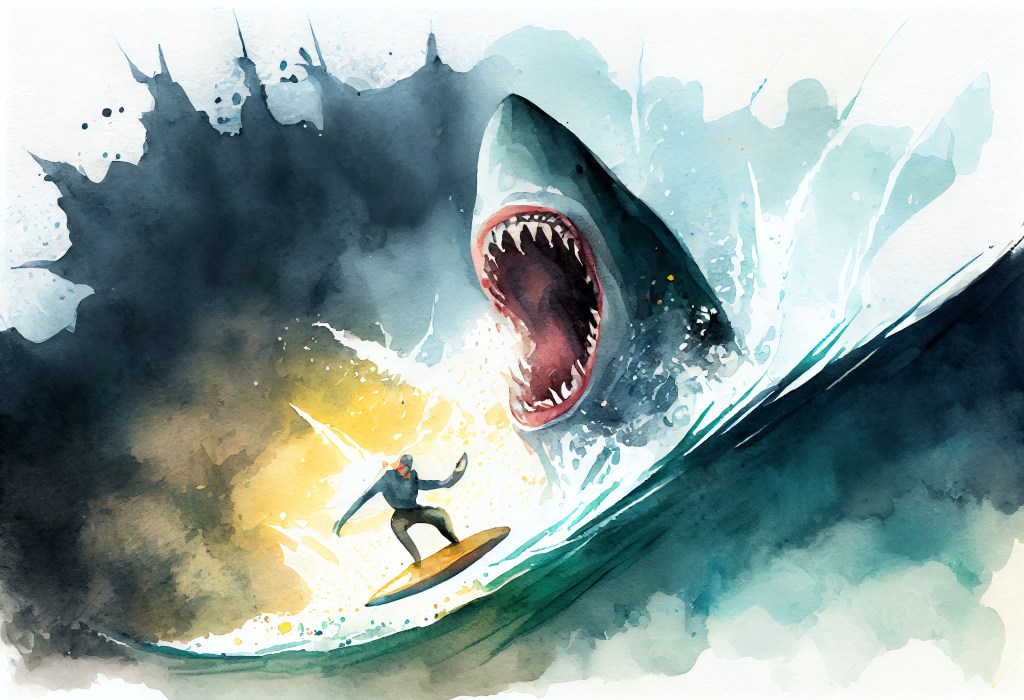
Surfing With Sharks

Okay, first a disclaimer. I don’t actually surf, which may come as a surprise to those of you who don’t really know me. Aside from my lack of athleticism, the fact that I live in Ohio and there isn’t any surfing that I know of on Lake Erie keeps me firmly grounded, so to speak. But I do surf the Interwebs. And I keep running into sharks there.

The sharks online don’t chew off body parts. Instead, they’re scammers and spammers. (Do sharks eat spam? Or do they hate it as much as we all hate the electronic kind? There’s no one who likes it (except for the spammers themselves). But I digress.)

Spam isn’t the only hazard to life online. (Yes, I live online. I work online. I read online. I communicate online. The only things I don’t do online are eat and poo. But I digress again.) Some online phenomena I hate, while others just puzzle me, like the memes and pass-alongs that say, “Share if you hate cancer/child abuse/nuclear war.” Who likes them? They’re just trying to boost their “shared” numbers. Similar to this is the passive-aggressive “I bet you won’t share/repost this.” You’re right. I won’t.

Boosting share numbers is a form of like-farming. This bucolic-sounding practice is often engaged in by businesses like radio stations. They post an intriguing question or celebrity photo, then wait for the “likes” and “loves” to roll in. This proves that the business has lots of “reach” or generates “impressions,” which means they can charge more, get more advertisers, or do something else that’s good for the business.

Social media is a hotbed of lies and deceptions, some harmless and some less so. In the “less so” category, there are pass-alongs that rise to the level of urban legends. Facebook is either going to start charging or has access to all your photos for their own nefarious purposes. You can address holiday cards to “Any Soldier” at Walter Reed Hospital. People are using various ruses to lure or incapacitate women for sex trafficking. Apple is practically giving away computers if you post something, forward something, or send $5. Check out such dubious claims on Snopes.com and you’ll find out the truth.

People have learned to be wary of Nigerian princes and many other lures. But online deceptions become dangerous when underhanded users find other ways to capture your personal information. One of the come-ons most often used is seemingly harmless questions that entice users to reveal sensitive information. Less blatant than merely asking for your bank card and PIN number, these questions may ask, “Do you remember your first-grade teacher’s name?” “What kind of car did you drive in high school?” or even “Your stripper name is your first pet’s name and the street you grew up on.” It’s no coincidence that the answers reveal info commonly used for security questions on bank accounts and the like.

Another ploy makes use of the “cute factor” or the “sympathy post.” There will be a post about someone who has eight adorable puppies or kittens and needs to find homes for them. Or one that shows an injured dog that’s been found and needs an owner to claim it. One of the giveaways that this isn’t legit is that the poster is really a business or wants you to respond via DM or “bump this post.” If you do that, you’re leaving yourself open to having your identity stolen, your account spoofed, or being bombarded by ads for the business.

If you want to protect yourself online, you need shark-repellent. The delete, unfriend, and unsubscribe buttons are good weapons. Clicking on the poster to see who’s really behind the message is another. Pay attention to the source. There are publications that are known for their inaccuracy or sensationalization (New York Post and Daily Mail, I’m looking at you). And, as mentioned, Snopes.com is valuable for checking lots of rumors and scare tactics. (I understand that some people feel that Snopes has a political agenda. I doubt it (I think that’s an urban legend), but even if they do, debunking urban legends isn’t what I’d call political. Is this another digression? Yes. Yes, it is.)

I don’t know how to stop the ads that appear anytime you Google something. If you do, please tell me. Google is a shark I haven’t been able to dodge. I’ve been bitten more than once.