All posts by Janet Coburn

The Care and Feeding of a Writer

So you’ve got a writer in the family – and, like many or even most writers, they act peculiar. They can bite your head off one day and be clingy the next, go for days without eating or sleeping, or zoom back and forth between elation and depression. What’s a family member to do? Is there anything you can do that won’t get your head bitten off?

I’m here to tell you that, although you’ll likely never change a writer’s behavior unless they give up writing, there are ways you can live successfully together. It won’t be happily all the time – I can’t guarantee that. Just think of your writer as you would a tropical fish. They need a certain amount of care and attention, food, and a filter, but they can be a focal point for a room. (If you keep the door closed, that is. Writers are notoriously cranky, and guests and young children maybe shouldn’t be exposed to that. And not having a filter is a problem (not just for writers, but for people in general). So perhaps they’re not like tropical fish at all, except for maybe a triggerfish or a lionfish. But I digress.)

Care and Attention

There are times when a writer doesn’t need attention – or even interaction. There is a stage of writing called “prewriting.” It looks an awful lot like lying on the couch, doing nothing. The creative brain is churning nonetheless and doesn’t take kindly to being interrupted. This is especially true if the writer doesn’t have a room of their own, which many don’t. The corner of a room is more likely to be the writer’s habitat. But a door that will open and close is a definite asset if you expect your writer to actually produce anything.

In fact, a writer will need a fair amount of alone time. When they’re actively writing (as opposed to prewriting), they won’t want to be interrupted – short of fire or death. Death (other than the death of the writer) may even be ignored and so will any fire not directly threatening the writer’s computer.

Feeding

When the writer is on a roll, they won’t want to stop to eat. At the most, they will pause for long enough to down a yogurt. If you realize they haven’t eaten in quite a while, you can offer a sandwich, but it’s best to poke it through the door with a stick, the way you would offer food to a large bear. (Personally, I’m lucky. I have a small refrigerator in my writing room, stocked with easy edibles like cheddar and American cheese, yogurt, applesauce, and things that are spreadable on crackers (cream cheese, apple butter, peanut butter). But I digress again.)

Rejection

This is a fact of life for writers, at least if they write for publication and not for the desk drawer or computer desktop folder. If they’re new at putting their work out there into the wild, this can cause distress, desolation, or just generally hopelessness. There is not much you can really do about this, except a generous application of “there, there,” which doesn’t actually help but sounds sympathetic. You can try reminding them of famous writers like J.K. Rowling whose works were rejected multiple times before they were published. This will either rev your writer up with dreams of becoming a multimillionaire (which are, let’s face it, bound to be dashed) or make them feel worse because of the likelihood of having to endure the many, many rejections.

Unless you yourself are a professional editor (which you probably aren’t, or shouldn’t have married a writer if you are), don’t offer suggestions unless asked for them. Even then, you should probably bow out more or less gracefully – “I don’t know. You’re the writer. I could never presume to give you advice.” Most writers won’t even listen to suggestions from their writers’ group or editor, should they be so lucky as to find one.

You and Your Writer

Maybe you married or live with a writer knowing what you were getting into. Maybe it came as a surprise later, when they announced a desire to express themselves in writing. Whatever your situation, rest assured that living with a writer is possible. You just have to have unfailing patience and supportiveness – and a job to bring in income if they’re a “full-time writer.”

Does it seem like you have to sacrifice a lot (and then listen to the writer in your life complain about the sacrifices they make for their art)? I won’t deny it. Just ask my husband. He lives with a writer. And I appreciate it – every time he pokes a sandwich through the door and then I close it, or when I zone out while we’re watching TV and can’t catch him up on the plot if he leaves the room for a moment. I live a writer’s life – and I couldn’t do it without my husband. I try to remember that. He puts up with a lot in the process of caring for and feeding me.

Tip Jar

Choose an amount

¤2.50
¤5.00
¤10.00

Or enter a custom amount

¤

Your contribution is appreciated.

Donate
Hooray for Horror!

What is it about the horror genre that gives us both shivers and thrills? I’m not talking about the excessively gory kind of horror, though that has a place and a fandom. Instead, I mean the more pop-culture renditions (sorry not sorry) of horror beasties and things that go bump in the night. Zombies are a big thing on TV, in the movies, and in books right now. So are vampires and werewolves. Anything creepy that humans can turn into, really.

Let’s take a look at these creatures and their evolution.

Here Come the Zombies

Zombies are a staple of modern horror. The Walking Dead, Fear the Walking Dead, and more have brought zombies out of George Romero movies and into the mainstream. My favorite version of the zombie pandemic is Feed and its sequels by Mira Grant (aka Seanan McGuire). It rises above the body (sorry not sorry) of the typical shambling, brains-eating stereotype by being caused by a literal pandemic, despite the fact that it came out in 2010, back when few of us feared a pandemic, zombie or otherwise. It also adds meaning and interest because it addresses other pertinent topics such as media, conspiracies, and politics.

(Seanan-Mira has also plumbed the depths (sorry not sorry) of horror by writing a novel, Into the Drowning Deep, about killer mermaids, which is a lot more horrifying than that description makes it sound. But I digress.) 

Bite This!

Vampires seem passe now. They’ve been done to death (sorry not sorry). The craze, I think, really took off in 1976 with Anne Rice’s novel Interview with the Vampire, which later became a movie (now remade, I understand) and a TV series. I personally thought the novel was overwritten and too long, but that didn’t stop it from becoming a runaway bestseller. More recent but still old (from 1997) was Buffy the Vampire Slayer, still my favorite of the vampire-themed media sensations. It was based on an older movie, about which the less said the better.

The Twilight books and movies proved extremely popular as well, though I haven’t succumbed to any desire (I have none) to read or view them. What’s interesting about them is that they pitted vampires against werewolves, not as killing machines but as romantic rivals. It’s kind of disturbing that heartless killers are presented as love objects and sexual partners.

None of these modern iterations have anything to do with Bram Stoker’s original Dracula, which has been committed to film many times. Nor is this an all-inclusive list, which would take more space than I allow myself in this blog. I will, however, recommend Those Who Hunt the Night by Barbara Hambly as my favorite vampire novel. (Although the first time I read it I thought one character was the main character (or MC, as we writers say). A rereading revealed to me that she was a supporting player. But I digress again.)

Loup-Garou

(Okay, I’m showing off. “Loup-Garou” is French for “werewolf.” But I digress some more.)

Werewolves became as fashionable as vampires during the heyday of the Twilight series. Fans divided into Team Vampire and Team Werewolf based on who they thought should get the girl and I don’t mean as a snack.

It should be noted that not just werewolves, but all kinds of shapeshifters have become popular. There have been were-bears as far back as Beorn in Tolkien’s The Hobbit and other shapes to be shifted into, including crows, hawks, and leopards, among other beings. I guess you’d have to think about Zeus, too, who appeared to various women as a swan, a bull, a shower of gold coins, and a goddess, to hide his extramarital exploits from his wife. While Zeus’s transformations were hardly what you’d call romantic, shapeshifters in modern fiction are often presented in those terms. It’s called the “dark fantasy” or “fantasy romance” novel.

Welcome to Hogwarts

And of course, we couldn’t catalogue otherworldly beings without including witches and wizards. Although most of the witches and wizards in Harry Potter are positive characters, that’s not the case in many other books in the genre. Evil wizards and malevolent witches abound. In more subtle books, there are those with mixed motivations – for example, a low-powered witch who eventually turns into a dragon and back (making her both a witch and a shapeshifter, I guess) in Barbara Hambly’s excellent Dragonsbane. (It’s a book that I recommend to others just so we can discuss it later. That’s how I was introduced to it. But I digress even more.)

Why do we love horror so much? I think it’s because we know that, however disturbing the beings are, they can’t really get to us. The COVID pandemic, though, made pandemics all too real, except for the fact that people turned into vectors, not zombies. Perhaps the glut (sorry not sorry) of zombies will soon recede and we’ll go back to ghost stories, the classical alternative that hardly ever gets written or filmed these days. Even the movie Ghost‘s most memorable scene featured pottery, not haunting. It’s a form of horror bait-and-switch.

If only they would find a new creature to menace the humans – like the bunyip, an Australian water monster. But I guess “Attack of the Bunyip” just sounds like something warm and fuzzy. What we need are fresh kinds of horror, something that will scare a whole new generation.

Tip Jar

Choose an amount

¤2.50
¤5.00
¤10.00

Or enter a custom amount

¤

Your contribution is appreciated.

Donate

You Deserve a Treat

Once I was visiting Joel, an old friend who had two young sons. After dinner and homework were done, he said they deserved a treat and asked what they wanted. He expected them to say ice cream or something similar.

Instead, they asked for a fire in the fireplace that evening. Joel was taken aback. He listed all the reasons that the treat they asked for was not a good idea – the fireplace would get dirty, they would only have it for a short time before bedtime, and so on. But the kids were adamant. Despite all their father’s protests, what they really wanted as a treat was a glowing, flickering fireplace. Joel gave in. They had their fire and then their usual story time once they were in bed.

Then there’s Teddy Hobbs, the British four-year-old with an IQ of 139 who became the youngest MENSA member ever. He can read at a Harry Potter level, though his parents try to steer him to books more at his emotional age level. “Teddy has done all of this himself,” his mother says. “When we go out and give him an option of a treat, he wants a book rather than chocolate.”

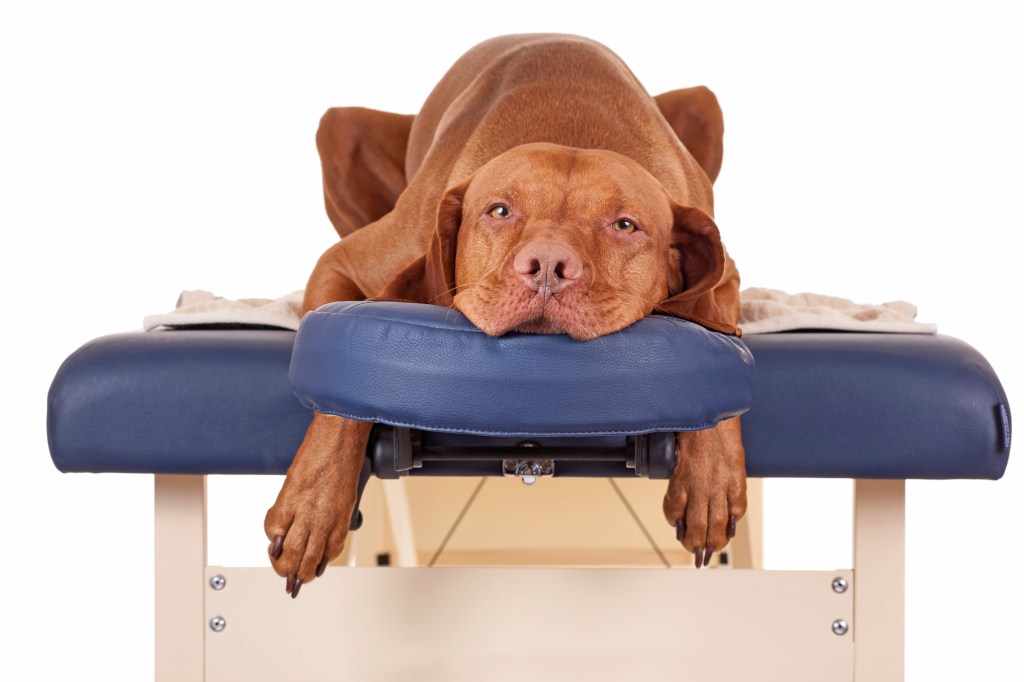
I’m on the kids’ side. While I love a good apple crisp, baking one with my husband is the real treat. When I get paid for finishing my writing, I treat myself to a new pair of jeans, lunch out, or a few books. (I sometimes do like a traditional treat for dessert when I eat out.) A treat for my husband is a hike in the woods or a day off to garden. A major treat for both of us is the couple’s massage I booked for later this month.

Perhaps the best kind of treat is giving a treat to someone else. From time to time, Dan and I spring for a box of donuts or cookies for his breakroom at work. Once I invited a mostly housebound friend to join us at a Vietnamese restaurant for lunch. We could tell it was an absolute treat for her to eat out and renew our friendship – even more so when we added on a bargain shopping spree after lunch. Another time, one of Dan’s friends in another state surprised us with a pizza he ordered from one of our local restaurants and had delivered.

I think we need to expand our definition of treats beyond the standard cake or candy. Anything that you love or find joy in but don’t often get can be a treat. Maybe you haven’t had coffee with a friend in far too long. That can be a treat – for both of you. (Even more of a treat if it’s Irish coffee.) Perhaps you haven’t found time to work on a hobby like painting or needlework for a while. Renew yourself by allowing yourself a treat of relaxation and creativity.

Treats for others are often the kind that a person would really like but never buy for themselves. Again, it doesn’t have to be a major, expensive purchase. My husband brings me little treats all the time – it helps that he works at Meijer. Right now I have five plushies on my desk that he brought me at various times (two bunnies, an elephant, a giraffe, and a fox). He also brings me plants for my desk in the spring and summer. They give me a lift whenever I look at them. I find songs online that he remembers only a few words of and give him a lift by playing the videos for him.

So no matter what you’ve accomplished – or just when you’re feeling blue – treat yourself or someone else. Either way, it really makes you feel better. Even if you feel you don’t deserve a treat, take it from me – you do!

Tip Jar

Choose an amount

¤2.50
¤5.00
¤10.00

Or enter a custom amount

¤

Your contribution is appreciated.

Donate

Winter: A Revelation

I’ve never been that fond of winter. For one thing, it’s cold. For another, I once lived where it occasionally got down to -30. I lived through the winter storms of 1978. One winter there was so much snow that my car was in the shop for five extra days because the body shop was snowed in. (The damage was caused when someone slid into my car in a parking lot.)

My husband and I occasionally travel in the winter, mostly for visits to relatives. (This led to my worst birthday ever, when my husband swore he’d get home for my birthday. In the evening of that day, my husband called from the middle of nowhere, from a hospital (he wasn’t actually hurt), saying that he had crashed his car. I had to drive to West Virginia to pick him up. Once we traveled to Illinois on Thanksgiving weekend, and the car’s heater went out on the trip back. We had to stop along the way to buy gloves and blankets. But I digress. At length.)

Our travels abroad have included Mexico in the sweltering season and Ireland in the rainy season (insofar as they actually have a separate season for rain). And when we went to Croatia, we went in the off-season, but not one that promised bad weather.

We had figured without the Dinaric Alps. Our tour included a national park known as Plitvice Lakes. The further our bus went up in the mountains, the colder it became. It began snowing by the time we got there. It was wet snow, the kind that sticks to everything. It looks very pretty when you’re inside and warm and don’t have to go out in it. It’s probably the very best snow for building snowpeople and snow forts – not that I do either anymore.

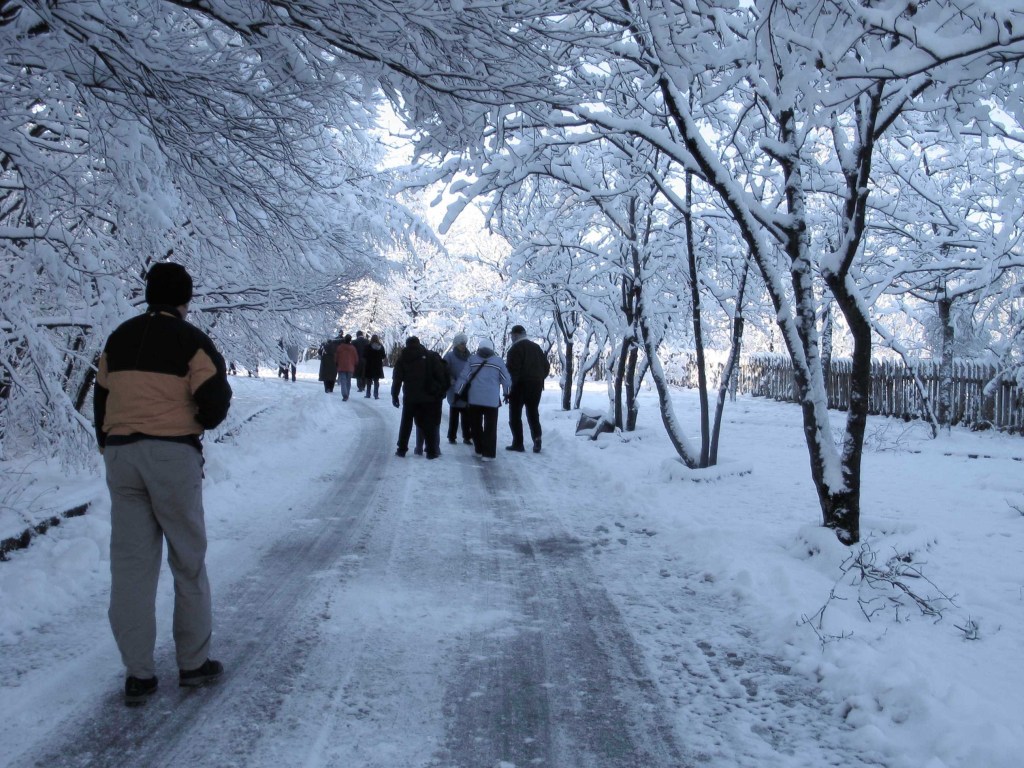
This photo shows what it was like when our guide took us out to the lakes. That is to say, it was cold. Most of us hadn’t figured on this weather and were bundled up in sweaters and light jackets. Our guide knew better. We followed him to the lakes. Actually, we had two guides. The other one was a small black cat who went ahead of us, trot-trot- trot, all the way to the lakes. (The guide who didn’t have four legs had a habit of saying “Once upon a time” when he talked about the history of the country, which I found charming. But I digress again.)

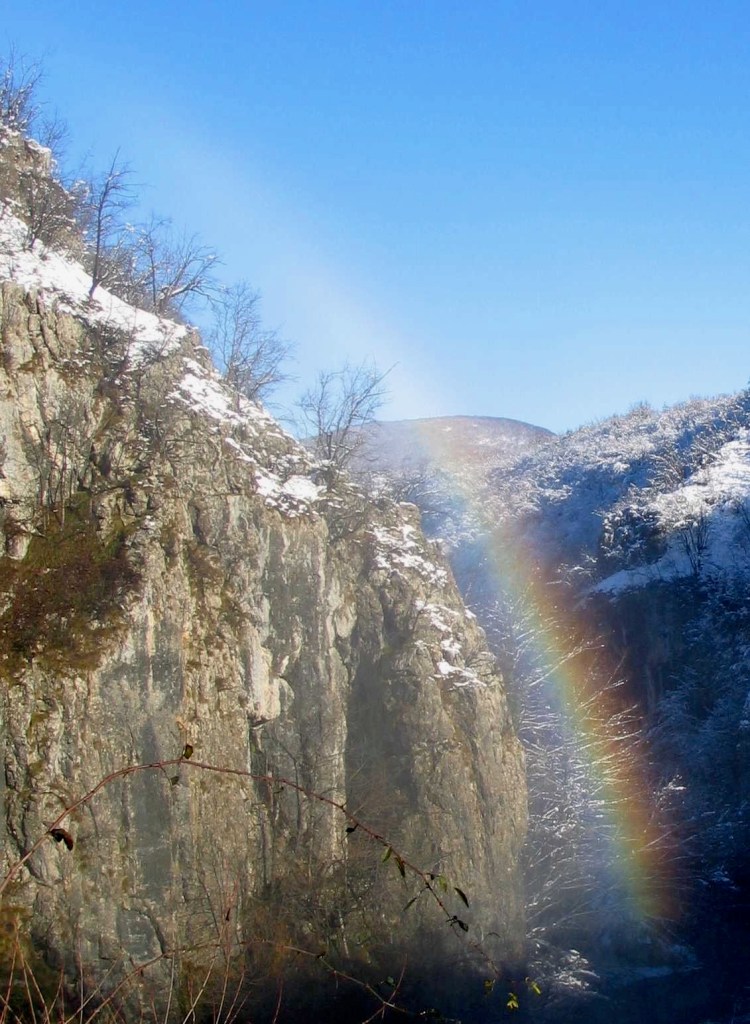
When we got to the lakes, it was magical. The snow enhanced it, and we forgot about how cold it was. Plitvice Lakes is an interconnected network of lakes, separated by rocky waterfalls. We were just at the right point in the season when the snow was all around, but the waterfalls were rushing with snowmelt. The glistening snow and the tumbling waterfalls were insanely beautiful. The waterfalls were flowing so strongly that some of the wooden walkways between the lakes were not usable and we had to take detours – cautiously. The guide didn’t want to lose any of us and managed not to.

The photo at the left shows one of the areas that the little black cat led us to.

Our visit to Croatia (and Venice, Slovenia, and Montenegro) was wonderfully memorable. (We had a banana split in Split, then split Split before we split our pants. But I digress yet again.) A small black kitten tried to climb into our souvenir bag in Dubrovnik, obviously begging to come home with us. Our stop in Montenegro impressed us so much that we’ve actually discussed retiring there.

I still don’t like winter. All of the things I said about it are still true. But I learned that winter has a beauty all its own.

It took Plitvice Lakes to convince me.

Tip Jar

Choose an amount

¤2.50
¤5.00
¤10.00

Or enter a custom amount

¤

Your contribution is appreciated.

Donate

Dr. Demento and Me

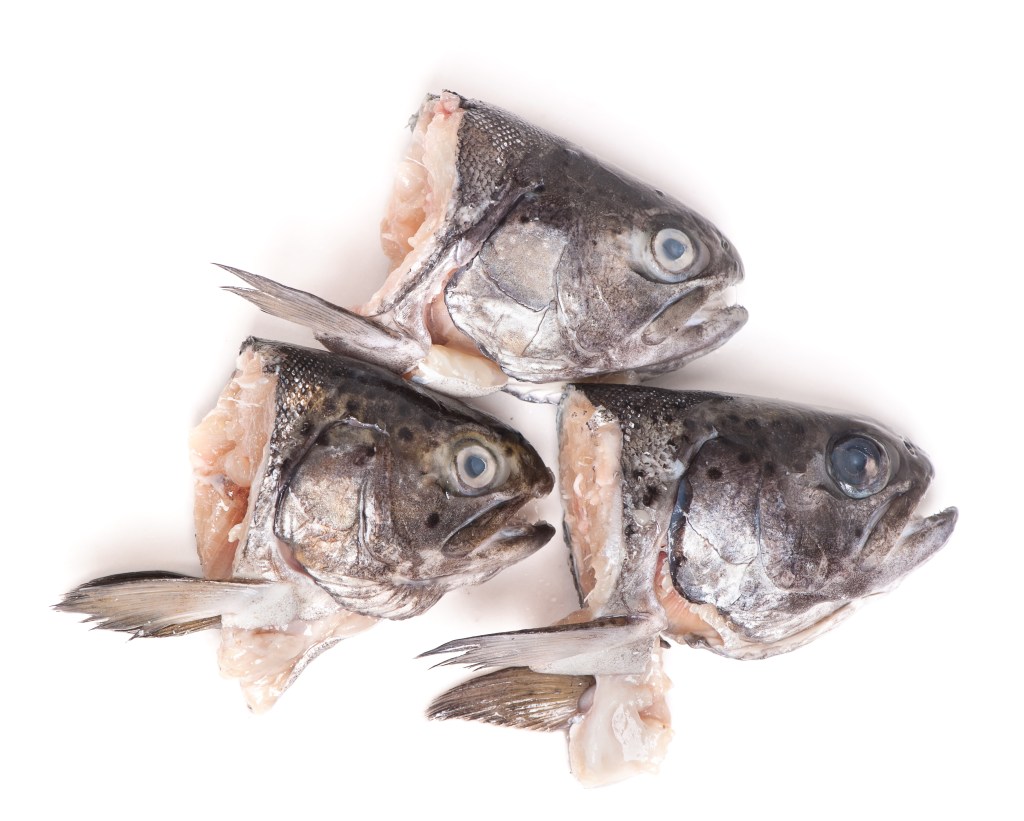
There was a radio host back in the day (he now streams his program on the internet) who went by the name Dr. Demento (real name Barry Hansen). He played demented music – novelty songs and comedy riffs, the screwier the better. (The photo here references one of the most popular songs, which goes “Fish heads, fish heads. Roly-poly fish heads. Fish heads, fish heads. Eat ’em up, yum” by a group called Barnes & Barnes. But I digress.)

Dr. Demento’s show was where Weird Al Yankovic launched his stellar career. The show got a tremendous boost from the recent “biopic” of Weird Al, which featured the good Dr. as a major character.

What does all this have to do with me? (Aside from the fact that the day I met my husband, he was wearing a t-shirt that said Dr. Demento. It didn’t refer to the radio show, however, but was given to him by coworkers on the psych unit. (He was also wearing a patch over one eye. How could I possibly resist a demented pirate? It was true love, though we didn’t know it at the time.) But I digress again.)

All my life I’ve been attracted to demented music, from Johnny Cash’s “The One on the Right Is on the Left” (a political ditty) to Kinky Friedman’s “Ballad of Charles Whitman” (which couldn’t be played these days because of current events) to John Prine’s “Dear Abby” to campfire classics like “Be Kind to Your Web-Footed Friends.” There’s something that appeals to me about songs that don’t take themselves too seriously.

Then I started going to science fiction conventions, where I heard still more demented songs during what are called filk sings (typo for “folk” that stuck). These included songs like “I Spent My Last Ten Dollars on Birth Control and Beer” and “Have Some Madeira, M’Dear.” Why are these played at science fiction conventions? I don’t really know, except that many SF fans are Dr. D. aficionados.

Lots of the filkers wrote their own songs, and many wrote demented ones. Barry Hansen was even a Guest of Honor at one of the conventions, which is where I met him.

Among the demented singer/songwriters are several who became my friends. They’ve had songs played on the radio show. Tom Smith’s “Return of the King, Uh-huh” is a mash-up of Lord of the Rings and Elvis, and “307 Ale” is about a beer brewed in a tesseract. Michael (Moonwulf) Longcor’s “Silver Bullet Blues” is about a werewolf. More demented still is his “Bob’s Dog Obedience School and Taxidermy Shop.” Leslie Fish’s “Carmen Miranda’s Ghost Is Haunting Space Station Three” is self-explanatory.

There’s a Facebook page for Dr. Demento and his fans, too, where they post the aforementioned “Fish Heads” and other videos. I’m a member and have posted some of my favorites there. Recently I shared a video of “Hand Me Down That Can O’ Beans,” which Dan was walking around singing because he was making nachos. (It’s a song from the musical Paint Your Wagon, possibly the worst musical ever made. Who thought of having a musical with Clint Eastwood and Lee Marvin singing? It’s principally noted for introducing the lovely “They Call the Wind Mariah.” But I digress yet again.) The post occasioned quite a conversation.

Most of the responses castigated me for being so down on the movie. Apparently, it has a lot of fans out there. There were all kinds of reasons cited that Lee Marvin’s voice was perfect for the songs, despite being notably flat. One even accused me of being envious that my “Uncle James” didn’t get the role. (My father’s name actually was James. When we were young, we always applauded when a “Daddy movie” came out. Another digression.) Someone even pointed out that The Simpsons once did a parody of Paint Your Wagon, which I had forgotten about.

I was delighted that over 175 people reacted to my post and nearly 75 commented on it. I feel special. Maybe Mr. Hansen will notice (he does read his own fan site) and feature the beans song on his show. That would really validate my membership in the group.

Without a little blue checkmark, either.

Tip Jar

Choose an amount

¤2.50
¤5.00
¤10.00

Or enter a custom amount

¤

Your contribution is appreciated.

Donate

He or She? They?

Of all the things that are controversial these days, pronouns seem like the least likely. But we’ll get back to that in a minute. What I want to talk about right now is the “singular they.”

After a long time, I have finally given in to the singular they. It goes against my prescriptivist history, but it fits in with my newer, more descriptivist views. (Prescriptivists say how language ought to be. Descriptivists say how language is actually used. I studied linguistics in college, where descriptivism reigns. I don’t know why it’s taken me so long to get on board. Probably my deep-seated need to be pedantic. But I digress.)

A not-so-brief, pedantic rant about the singular they. Traditionally, a singular subject goes with a singular verb, singular adjective, and singular object, like this: She likes her new house. John thinks for himself. They went to the beach with their cousins. Pretty simple, right?

Feminists pointed out the problem. Being a staunch feminist, I wanted to acknowledge women with equal pronouns. (That doesn’t sound right, somehow.) For far too long, we were told that “the masculine includes the feminine.” That is, you constructed sentences like this: Everyone preferred his own chili recipe. We were told that the “everyone” and the “his” in that sentence included women as well as men. The problem is even enshrined in our most important documents: “All men are created equal.” That was said to be equivalent to “All people are created equal” or, if the person was of the very liberal persuasion, “All men and women are created equal.”

Well, many women (including me) didn’t feel very included. Everyone didn’t specify gender, but his sure did. All men was pretty gender-specific. (And women were not afforded all the protections of the founding documents until relatively recently. There are still protections that are missing, IMNSHO. But there I go, digressing again.)

(I also had trouble with the word “gender.” I come from far enough back in the mists of time that “sex” was used for people and “gender” was used for linguistic purposes – nouns and adjectives, not just pronouns, had gender: El armadillo amarillo es sobre la mesa. El and amarillo indicate not that the armadillo was a male armadillo, but that the word armadillo was masculine linguistically. A feminine word would end in -a, like la mesa does. The table is (obviously) sexless, but the language gave it a feminine gender. But I digress at length.)

The feminist alternative was to use “his or her” (or “his/her”). This was also problematic in feminist terms. His always came first. For a long time, I (and other writers) used she/he or she throughout one paragraph and he throughout the next, if the gender wasn’t relevant. This was clumsy, took the reader out of the reading experience, and left out one sex in each paragraph. Besides, you ended up with ugly sentences like this: Everyone should bring his or her notebook because he or she will need to make notes that he or she can study.

And since the plural pronouns don’t have gender, someone came up with the bright idea of using they, them, and their instead of he, him, and his or she, her, and her. Like this: Each team member (singular) can use their (plural) own bowling shoes. You’re using a plural pronoun where before you would use a singular pronoun.

Substituting a plural pronoun for a singular one just sounds wrong to a prescriptivist. It grates on the ear. It gives them one more reason to correct people and sound like an insufferable know-it-all. That was me.

Then I started writing full-length books (ghostwriting, really). It sounded really awful to keep saying his or her multiple times in a manuscript. And alternating between she and he still left out half of the people half of the time.

Enter the singular they. (I knew I’d get around to it sooner or later.) It was met with scorn and derision by the prescriptivists. They was plural and that was that.

But descriptivists embraced they. Descriptivists insist that one can use language the way the general public actually uses it. They viewed it as correct based on the evolution of language and common usage. Besides, they argued that the singular they had a long and noble history. Even Shakespeare used it. And, at last, I got on the proverbial bandwagon. They, their, and them have now made their way into my prose. And I’m not going to apologize for it. Call me a descriptivist convert (a deadly insult among prescriptivists).

Now, on to the subject of preferred pronouns for nonbinary people. I say we should use whichever pronouns they choose to use. After all, we call people the names they prefer – first name, middle name, or nickname. Why shouldn’t people be able to use their own pronouns? It seems to me to be only polite. (I have trouble getting used to the recently created pronouns such as xe and hir. I never know how to make a sentence using them as subjects, objects, and possessives. But I digress one last time.)

Those of you among my readers who are also writers know just what I mean by all this. So do any linguists that are lurking here. I admit that it may be a bit obscure for many.

But it’s fascinating to people who are fascinated by this kind of thing. And that includes me. Nothing like a good pedantic rant to stimulate my brain cells, I always say.

Tip Jar

Choose an amount

¤2.50
¤5.00
¤10.00

Or enter a custom amount

¤

Your contribution is appreciated.

Donate

Chillin’ at the Waffle Ho

The Waffle House restaurant chain doesn’t get a lot of love from many people, particularly foodies.

I beg to differ. There are lots of reasons to like Waffle Ho. (We call it that because of a sign with three letters that weren’t illuminated. But I digress.)

First is the so-called Waffle House Index, a measure that FEMA uses to help determine disaster response. Basically, the idea is that if the Waffle House in a given location is closed due to weather, then a disaster is dire indeed. It’s unofficial, but there’s some truth to it. Waffle House is noted for remaining open 24/7/365, and for one of the restaurants to close, there has to be something significantly wrong. During lesser disasters, Waffle House may provide only a limited menu and call in backup staff, but it will by-God remain open.

(I once worked at a Frisch’s, which is not quite as ubiquitous as Waffle House nor as iconic. When the power went out, we kept serving food that didn’t require cooking, like salads or ham and cheese sandwiches, or that would last a while through residual heat, like coffee. Any weather more severe than that and we were outa there. But I digress again.)

Then there’s the food. Say what you will about diner food, but there is a place for it, and that place is the Waffle Ho. Sure, they’re deficient when it comes to desserts (there are several varieties of waffles, naturally), but when it comes to breakfast and lunch (and dinner – there’s steak), they have everything a diner diner could want. (They have eliminated omelets from their menu, but not from their repertoire. You can still get them if you ask, which I do – mushroom and cheese for me; fiesta for Dan. More digression.) But if you believe that the four food groups are salt, fat, carbs, and caffeine, you’re in luck. They don’t have a breakfast buffet like some places, but if you prefer to chow down rather than graze, Waffle Ho is the best bet.

Dan and I also love the Waffle Ho because of that whole 24/7 thing. Our work schedules (and our sleep schedules) have been, well, irregular over the years. Waffle Ho is always there when we need them. Sometimes, if we wake up at 2:00 a.m., we’ll say, “Let’s go to the Waffle Ho,” and stay there until we’re ready to try once again to sleep. Waffle House is also a lifesaver when the heating or cooling is out. Many a time we’ve gone there in searing summers to cool off with endless iced tea when it’s too hot to sleep.

It’s also fun to order hash browns. You have to know the lingo. First, you should order them “scattered,” if you don’t want hash browns that look like a squashed bird nest. Then you specify what else you want in or on them – diced (tomato), capped (mushrooms), smothered (onions), melted (American cheese), chunked (smoked ham), peppered (jalapenos), topped (chili), and country (sausage gravy). I don’t feel like doing the math, but the combinations, if not endless, are at least extensive.

The only places in the US with no Waffle Houses are Vermont, Nebraska, Michigan, Utah, Iowa, the District of Columbia, Wyoming, and American Samoa.

I pity them, along with those who disdain the chain. It’s convenient, unpretentious, and predictable (in the comforting way), which is more than you can say for more upscale places. Cheaper, too.

Tip Jar

Choose an amount

¤2.50
¤5.00
¤10.00

Or enter a custom amount

¤

Your contribution is appreciated.

Donate
Monthly, Forever

It’s not that I’m a stranger to subscriptions. I started getting magazine subscriptions when I was a teen and began receiving them for Christmas presents when our family finances were impacted by my father’s illness. I chose astronomy and science fiction magazines. My parents didn’t subscribe to magazines much, except for Reader’s Digest and their condensed books.

I also dabbled in record subscriptions, back in the day when they sent actual vinyl records that had every chance of arriving with scratches and warps. (I don’t know if music subscriptions went to tapes, 8-tracks, CDs, or downloads after that. I do have a couple of subscriptions on Patreon and at least one of them supplies me with music every month, but otherwise, I get all my music via the internet. Not that I download much. I already have nearly 670 albums stored on my music app (formerly called iTunes). But I digress.)

Later on, once I was married, I found a pet store in town that offered a “Fish of the Month” club. (For some unknown reason, we referred to it as “Fish ala Month,” although they weren’t, of course, edible. Another digression.) Dan had a fish tank at the time and enjoyed going to the store every month to see what new species of fish was on offer that month. I kept up the subscription until the pet store went out of business. This was back in the days when there were still locally owned pet shops.

Since that time, the idea of subscriptions has blossomed. You can now get blossoms that arrive every month and can be given as gifts. Not just flowers, either. I once gave my therapist a small succulent as a gift and have ever after been pursued to upgrade to a succulent subscription.

Nor are plants the only subscriptions on offer. You can get quarterly subscriptions to goods from Ireland, including food, snacks, and jewelry. You can subscribe to puzzles, either jigsaws or more elaborate ones that require solving a mystery. Other “surprise” subscriptions where you don’t know what you’re getting are for children’s toys (or dog toys), foods from different regions of the country, rare coffees, discount wines, Asian snacks, cocktail mixers (and liquor, if you choose that option), cheese of the month or charcuterie kits (including vegan and gluten-free), cookie dough, pasta, spices or hot sauces, candy, tea, beauty items or perfumes, detox products, vacation souvenirs, earrings or necklaces, socks-of-the-month, replicas of historical documents, dried flower arrangements, candles, and pet foods and supplies.

Some of the subscriptions available leave me befuddled. One is underwear. I buy new bras and panties when my old ones are no longer serviceable. But I don’t subscribe. I go to Jockey, Fruit of the Loom, or another source and order what I need. I can’t imagine avidly anticipating the arrival of three new panties or bra-and-panties sets every month. (Besides, I never wear matching bras and panties. Every victim of a serial killer you see on TV shows is wearing matching lacy undergarments. I figure I’m a lot safer if I were a purple-polka-dot bra and simple green panties. But I digress some more.)

Other subscriptions I don’t understand are oysters-of-the-month (ick!) and monthly sex toys and books (although if they’re delivered in plain brown wrappers, they will spare you embarrassment and make a visit to the local sex shop unnecessary).

The really strange subscription I came across during my research for this post was playable musical postcards, something previously unimaginable to me. Evidently, the postcards from different lands are made of vinyl and can be played on a turntable. (There is an option to receive only a postcard and an online download of a song if you don’t possess a turntable.) The tunes are from indie artists, so you don’t need to worry about getting Mariah Carey in your December mail.

Will I get another subscription to something-or-other? I think not. I already have subscriptions to TV streaming channels. I have Patreon subscriptions to support my friends’ art. I have subscriptions to Archaeology and Smithsonian magazines (offline versions) for my husband. I subscribe to the New York Times crossword puzzles. I probably have a few other subscriptions that I’ve forgotten about and ought to cancel.

But I am tempted by the solve-a-mystery and cheese-of-the-month subscription, though only if I can specify cheeses that don’t advertise the fact that they’re made of mold. I figure that anything the postal workers can smell is a bad idea, even if it’s only once a month.

Tip Jar

Choose an amount

¤2.50
¤5.00
¤10.00

Or enter a custom amount

¤

Your contribution is appreciated.

Donate
Dan’s Upgrade

My husband has at last entered the 21st century! After literally decades of resistance, he has moved up from the flip-phone to the smartphone.

Of course, when we first got cell phones, all of them were flip-phones. And we thought we might be the last people on earth to get even those. A few misunderstandings that led to shouting and accusations of discourtesy meant that we needed to enter the digital age. After one particularly loud and angry … discussion, we decided to take the plunge. Dan in particular was reluctant to get a mobile device, since he didn’t want to be “tied to his phone” and perpetually available. But he had to admit that cell phones had their uses.

His compromise with his own Luddite leanings was never to figure out how to use the thing. While he eventually figured out how to record a voicemail message and even to leave a message on my phone, he never learned how to retrieve voicemail left for him. Instead, he let it pile up until the phone always reported that his voicemail was full, making it useless. (I recently deleted his voicemail and the messages there were all from January of a year ago, and most of them were from his mother. But I digress.)

Once smartphones became available, I opted for one when my flip-phone crapped out. Dan kept replacing his with another flip-phone when it was out of order or he lost it so thoroughly that it was likely in a different state, or maybe another country. I thought it might be because he wanted a phone that was most like a Star Trek communicator.

But when I got a smartphone (not that I was among the first to do so either), he looked askance at it. “I don’t want a phone that’s smarter than I am,” he said, which I suppose was meant as a joke, though I really couldn’t tell. I tried to convince him that the added features – the easy availability of news and weather and GPS, for example – made it worthwhile, but still he resisted. He said he didn’t want to be one of “those people” who had their eyes perpetually glued to a screen. (He once asked me what people did before they could stare at their cellphones. “Read books,” I said. “Not while they’re walking,” he replied. I had to tell him that when I was in high school I did indeed read books while walking from one class to the next. But I digress again.)

Then I started getting apps on my phone that I knew Dan or I would want or need. The prize among them was PictureThis, an app that let you take pictures of plants, then would identify them and provide other useful and interesting information about them, such as whether your plant looked sick or whether that species had been mentioned in a poem. It even provided the poem for you. This led to Dan dashing into the house, shouting, “Give me your phone,” and bringing it back with dirty smudges on it. When Dan got a tablet, I downloaded this app for him so he wouldn’t have to borrow my phone. I also downloaded some music and video apps onto the tablet when he was going to be visiting his mother. He hates her taste in TV.

Dan’s entry into the modern era was a consequence of a different app, though. Where he works, people clocked in and out using their smartphones. Dan couldn’t, and that meant he had to walk farther to do so. In a sense, it was laziness that turned the tide.

Of course, it wasn’t as easy as that. The way his coworkers scanned in was using a QR code. Dan didn’t know what those were. So I had to download him a QR reader and show him how to use it. I don’t think he’s actually used it yet, but at least now he has the option when he’s too tired to make the long trudge.

I know he still mourns the death of his flip-phone, but even he had to admit that our phone provider didn’t really support them anymore. And the first night he had the smartphone I caught him with his nose pointed at the screen, watching YouTube videos.

He doesn’t love it yet, but I figure it’s just a matter of time. He’s no longer comparing its intelligence to his.

Tip Jar

Choose an amount

¤2.50
¤5.00
¤10.00

Or enter a custom amount

¤

Your contribution is appreciated.

Donate
Crocheted Christmas

Many people have traditions regarding their Christmas trees. There are live (real) Christmas trees or artificial ones which at least don’t shed needles and don’t require the death of a live tree. Then there are the lights – multicolored, all white, or all blue. (My mother didn’t care for these, as they always made her think of families in mourning. But I digress.)

There’s also the question of what goes on top – star and angel are the most popular choices. Ornaments vary from old, family ones that represent children’s ages or antiques passed down; modern ornaments that all have the same look; or handmade ones, often made by children. (Our old friend John used to add modeled clay ornaments, including naked fertility goddesses, to celebrate the pagan origins of the holiday tree. But I digress again.) To tinsel or not to tinsel is another choice. If a pet gets into it, tinsel can cause intestinal blockages or festive poop.

My mother’s tradition certainly included handmade ornaments of a specific style – crocheted. Mom (for some unknown reason, my friends and family called her Muzz) had the needlework gene passed down from her mother, who knitted.

Her specialty was snowflakes. They allowed for creativity, as no two snowflakes are said to be the same. (I don’t know how that could be tested, aside from examining every snowflake that ever fell. More digression.) Muzz had a special process to ensure non-floppiness of the snowflakes – she laid them out flat and dosed them with Elmer’s glue. When it dried, she had snowflakes that stood up to anything and never melted.

Muzz and her tree, complete with angel topper.

The rest of her ornaments were multicultural gifts. She had a fair number of foreign penpals that she connected with through crochet magazines. They shared patterns and sometimes completed ornaments that represented their skill or their culture. Muzz even sent a friend in India a large bottle of Elmer’s for her crocheted items. Other people – friends, neighbors, and church ladies – gifted Muzz with ornaments they collected on their travels. Many of them were Santas. There is a stunning number of Santas in various poses available.

For the topper, her tradition was one that owed its origin to my dad. He always insisted that it should be an old, dilapidated angel every year. It had a little smudge on its face. It reminded him of the 1938 film Angels With Dirty Faces – not strictly speaking a Christmas movie, but one he always liked, notably the title. (It had a hella cast, too.) After my father died, Muzz kept up the tradition.

Muzz was not one of those who liked plastic trees or put them up right after Thanksgiving. (We have a friend who kept her artificial tree up well into the spring. She decked it with suitable ornaments for Valentine’s Day and Easter. Yet more digression.) In early to mid-December, we would take her out to a tree lot and help her pick one out. Later, when she had less mobility, Dan and I would choose one, discussing what she would like best. It couldn’t be too tall, since she wasn’t able to stand on a step stool to place the angel. She always seemed pleased with what we brought home.

Alas, some of those traditions have now lapsed, owing to the fact that Dan and I no longer get a tree. It seems like too much for just the two of us, not to mention that we have cats. (Digressions continue. A friend of mine used to hang soft, felt ornaments on the lower branches specifically for her cat to steal and leave in various places around their house. She kept count of the thefts every year.)

I don’t know. Maybe it would be worth it to hang a garland on our balcony railing, just to hang my mother’s ornaments on it.

What are your holiday traditions?

Tip Jar

Choose an amount

¤2.50
¤5.00
¤10.00

Or enter a custom amount

¤

Your contribution is appreciated.

Donate