 It all started with my sister. Once she and my mother and I were driving around and talking about Thanksgiving. She was waxing rhapsodic about how it would be wonderful to give our cats little bites of turkey.
“Actually,” I said, “we’re having lasagna.”
The gasp from the back seat was audible.
“It’s going to have ground turkey in it. Does that count?”
Apparently, it didn’t.
Since that time, we have avoided turkey every year (except the one time Dan’s work was handing them out), just to piss off my sister, the uber-traditionalist.
Fortunately, we now have our own traditions.
Entertainment
This is really the heart and soul of our Thanksgiving. Every year we watch the “Turkeys Away” episode of WKRP in Cincinnati (thank goodness for the internet!) and listen to Arlo Guthrie’s “Alice’s Restaurant,” singing – or rather reciting – along. One year we also had a DVD of a cozy fire in a fireplace. It was so realistic that, in the middle of it, someone from offstage came in and put another log on the fire.
Skype
One year Dan and his mother were particularly lonely, as they lived in different states. We taught her how to Skype – no easy task from hundreds of miles away – then set up our feast on a utility table in my study. At least we were able to have conversation and watch each other eat. (I think that was the turkey year, or at least the turkey breast year.) For an approximation of the Skype problem, go here to listen to my friend Tom Smith’s song (https://www.youtube.com/watch?v=v5XfjUPqj9M).
Food
The lasagna we had has not been our only departure from traditional holiday fare. One year we had spaghetti; another, salmon poached in orange juice. Our most memorable non-turkey meal, though, was the year we had ratatouille. It has been immortalized on my blog in an older post (https://wp.me/p4e9wS-2z), but here’s the gist of it.
Dan was visiting his mother that year, so Thanksgiving luncheon would be only me, my mother, and Dan’s best friend John. Doing a whole turkey for three people seemed excessive, and I wanted to make another nontraditional dish, so I settled on ratatouille, with the addition of some sausage for John, a carnivore.
Imagine our surprise when, after taking just one bite, John choked and couldn’t breathe. The rest of the afternoon was a flurry of Heimlichs, emergency equipment, the emergency room, several doctors, and an x-ray. Turns out John had swallowed the bay leaf, which I had neglected to remove, and it had lodged on top of his vocal cords. The highly technical medical procedure required to remove it was a very hard cough. We then went back to my mother’s house for ice cream.
Read the whole thing, if you have time.
Pandemic Thanksgiving
This year, the year of the pandemic, we didn’t have anyone over for Thanksgiving. Not only did we think it was safer, but both my mother and John have passed on. And not from any encounters with rogue bay leaves. I learned my lesson and now use a bouquet garni.
What we did this year combined the traditional and the nontraditional. We didn’t try to teach Mom Reily to Zoom this year. It would take longer to do that than to roast a full-sized turkey.
No, Dan and I continued our nontraditional tradition and at the same time supported a local small business by patronizing them. This year, we had a jolly feast of take-out sushi and Kirin beer. Arlo and Les Nessman were invited, of course. We have to keep up some traditions.
 I recently interviewed Harvard professor Dr. Michael Rich (M.D.), founder and leader of the Center of Media and Child Health. Here’s what he told me about young people and social media.
 I read a story a long time ago. A woman received a call from her child’s school’s PTA, telling her that they needed two dozen cupcakes (or something similar) from her for their upcoming fundraiser.
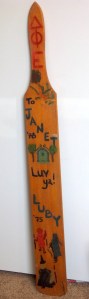 This is a picture of the pledge paddle that my sorority “Big Sister” decorated for me. (For you kinksters, these were symbolic only and never used for hazing. And for you bros, we never had pillow fights in our shortie pajamas. But I digress.) The paddles were decorated to reflect the interests of the “Little Sisters” and mine was painted with a Lord of the Rings theme, which was somewhat trendy as a book trilogy before it ever became mega-trendy as a movie trilogy. (That’s Gandalf and two hobbits at the bottom and the Doors of Moria in the middle. Luby was my Big Sister’s nickname.)
 This is something my college friends and I used to say when we noticed that we spoke with different prepositions or other idioms. Who said “stand in line” and who said “stand on line”? Who said “change for a quarter” versus “change of a quarter”? Is the thing you push in a supermarket a “cart,” “a buggy,” or a “wagon”? Was “wash” pronounced the way it looks, or had a pesky “r” sneaked in to make it sound like “warsh”? For that matter, why do some people say “My hair needs washed,” while others say, “My hair needs to be washed” or “my hair needs washing”? Why does one person say “ink pen” when that’s the only kind of pen there is?
 So, we bought a house, a couple of decades ago. It had three bedrooms, which seems a lot, since there’s only my husband and myself. We seldom had overnight guests, and when we did there was a pull-out sofa bed.
 Then along came the tornado that destroyed our house. It gave me the opportunity to start all over with my study, make it into my refuge as well as my writing space, and decorate it from the ground up – literally.
 My study is far from finished. I still don’t know how to disguise or hide the powerstrips. Some of the artwork needed restoring, and much of it still needs hanging. My bookshelf is new (to me) and needs to be filled. Somewhere in the basement, I have a decorative wall-hanging brass shelf that I haven’t quite figured out where to put.
 I’ve been looking back through my Facebook “memories” lately, and if there’s one thing I learned, it’s that I now live much more in the meme than I did before.
 Almost universally, parents experience the ritual of teaching children to say the “magic words”: please and thank you. Many children get the idea that there is only one magic word: “please-and-thank-you.” It’s considered a triumph when children begin to use the words spontaneously.
 In the last 15 months, I have lived in five different places: a Red Cross shelter, a budget motel, a hotel suite, a rented house, and a one-bedroom apartment. A couple of weeks ago, we moved back into our home again.
 Seventeen. That’s what the nurse said.
 But I Digress . . .