All posts by Janet Coburn

Social Life on Social Media

Nothing can beat a cup of tea and an intimate chat with a close friend. Or a warm hug from someone dear. Certainly not technology.

Except that my husband, my mother-in-law in Pennsylvania, and I have koffee klatches every Sunday. A friend and her granddaughter in Colorado Skype games of charades. I belong to support groups with members in Germany and Australia.

Before you say that pre-smart telephones could be used for most of these connections, think about the lack of video on old-fashioned phones, the difficulties of multi-person teleconferences, and the lack of ways to share photos and videos across the country, or even across continents. Mail can’t provide the immediacy; landlines can’t provide the visuals. Only computers and the Internet can put together the complete package.

Without the Internet, I wouldn’t have heard about my Girl Scout friend’s brain surgery until after it happened. We only recently got back in touch, but she posted daily updates. I couldn’t have expected daily phone calls.

Without Facebook, I wouldn’t have seen my great-nephews having breakfast with their father or shared awful jokes with my husband’s niece. Think of the phone bills I would have if I passed a joke along to all my other friends!

Without instant messages, I wouldn’t have been able to give a a dear old friend confidential news and personal advice that wouldn’t be overheard.

Sure, there’s a special quality to a face-to-face conversation. No electronic gizmo can replace the intimacy of a hug. You can’t dry someone’s tears over a cable modem. But there are times when you need to cry without letting the other person know you’re weeping, to listen to a confidence without showing that you’re shocked, to share a family moment without admitting that you’re alone.

Without computer technology, it would be much more difficult – if not impossible – to keep up with my friends in Philadelphia, Ann Arbor, Ventura, Newcastle, and Mumbai. For that matter, it would be an almost prohibitive hassle to telecommute with a company 75 miles from my home.

I know that the good old telephone and U.S. mail are still available when I need them. They let me arrange an evening with a high school friend who’s still in town. They let me send presents at birthdays, or Christmas, or just because.

But, to tell the truth, most of those gifts are selected, paid for, and scheduled for delivery with electrons and pixels. The songs I share are mp3s, the pictures jpegs, the personally designed cards ordered from who-knows-where.

I’m closer to the people I want to be close to, even if we’re physically far apart.

Perhaps we only share coffee virtually, but still we share.

A Little Means a Lot

You know those pictures you see of a celebrity presenting an oversized novelty check to some person or organization? Well, I had that experience once – as the giver, not the givee.

At the time I was the editor of a magazine called Early Childhood News, which was for child care center owners and operators. It included articles on legal issues, safety and hygiene, playgrounds, food, self-esteem, volunteers, and more – polls on interesting topics and annual toy awards, to name two.

It was a small magazine (in terms of circulation), so our author payments were not extravagant.

Once I asked a person who was quite well known in the field to write an article, and asked whether I should send his check to his home or university office.

When I told him how much (or rather, little) it was, he said, “Just donate it to a Head Start program.”

So I called the Dayton Head Start program and told them that I had a $200 donation for them, courtesy of the professor.

To say they were flabbergasted would be an understatement. When I came to present the check (a normal-sized one), they figuratively rolled out the red carpet for me. I toured the facility, I met all the administrators and teachers. I had my picture taken presenting the check. (I was glad that I had worn my good green dress that day.)

Until that moment I never realized how such a relatively small sum could have such a big effect. It meant they could buy supplies without caregivers having to dip into their own meager funds. Or provide a special treat or party for the kids. Or purchase books that would enrich children’s minds for years to come.

To me it was modest compensation for what was an ordinary transaction in my business. For the professor, it was an amount too small to bother with. For Head Start it was a windfall.

I think we sometimes fail to realize what even our smallest good deeds – or ordinary actions – can mean to people and groups that struggle. I still had a lot to learn.

That fact was again brought home to me again when I heard someone tell a story about an educational conference she attended. When the topic turned to snow days, she said to the teachers, “I bet you really look forward to those.”

She was met with a profound, awkward silence.

Finally, someone explained it to her: “On snow days, we know that some of our students won’t get a good, nutritious breakfast or a hot lunch. They’ll go hungry.”

It’s a bit embarrassing to think about. To most of us, a snow day means relaxing with hot cocoa, staying in bed an extra hour, or baking cookies with the kids. To teachers and the children they serve, it may mean something a lot less heart-warming.

I’ll admit that I hadn’t thought of that effect of snow days either. Like the woman at the conference, I thought of snow days the way they had been for me in my childhood – a break, virtually a vacation. Because that was all I saw, I thought that was the norm. And for well-off suburban kids like me, it was.

A free or reduced-price school lunch program, or a local food pantry, can mean the difference between hunger and a full tummy to a child. A small donation can help a nonprofit service fulfill its mission to improve children’s lives. In this time of talk about budget cuts for social programs and safety nets that become “hammocks” of dependency (as Paul Ryan believes), let’s spare a thought – or even a small check – for people, especially children, to whom hot, nutritious food; safe and loving care; and enrichment for the mind are luxuries.

It’s something we often think about during the Christmas season, but need is year-round.

The Power of the Purr

My father hated cats – until he cared for Bijou.

His feelings toward cats had their roots in his childhood. Once his mother was bitten by a stray cat that she was trying to help. For that, my father held a grudge. Bijou changed his mind.

Bijou was a smallish tortoiseshell calico, my very first cat. I picked her out of a roomful of cats at the shelter because of her gentle demeanor and because her quiet ways didn’t seem to garner a lot of attention from the other prospective pet owners. Over the years she became a cuddlesome kitty who slept curled up in one of the curves of my body, behind my knees or snuggled by my waist, safe and cozy and sharing warmth.

When my husband and I went on our honeymoon, I asked my parents to look after Bijou. I knew my dad’s feelings about cats, but I felt sure he could at least give her food and water, if not warm up to and love on her as she liked.

My father had cancer – multiple myeloma – a particularly vicious form of bone cancer. It was hard for him to move about, so when he went to our house, he usually ensconced himself in the barrel-backed chair while my mother did the honors filling food and water bowls.

But then Bijou jumped up on his lap.

And purred.

She had been avoiding us a bit before we left, preferring to take up residence under the bed or behind the sofa. We thought it was just a normal reaction to all the confusion and chaos surrounding a wedding.

Actually, she had feline leukemia. She was isolating, as cats often do when they don’t feel well. Maybe the stress of the wedding preparations caused her disease to become active. Maybe it was just her time.

Whatever it was, it touched my father. He had never been one for cancer support groups with names like “Make Today Count.” But one small cat, purring her way through pain and illness that would ultimately defeat her reached him the way nothing else could.

Maybe he saw in her the tenacity in the face of suffering that he too would need. Maybe he read her purr as acceptance of her lot in life. Maybe he saw a cat with every reason to strike out at someone choosing instead to jump up and purr.

However she did it, Bijou changed his mind about cats.

Finding Balance – Literally

We always hear about finding balance – between work and home, family and career, mind and body, heart and head.

My struggle for balance is more literal. My struggle for balance is about not finding myself on the floor with new bruises on my tush.

A number of factors influence my struggle for balance. Various parts of my body are in quiet or open rebellion.

I often joke that I have rocks in my head, but really they are in my ears. Otoliths (literally, “ear rocks”) are tiny calcium crystals that live in the inner ear and bump up against the little hair cells that send information to the brain about gravity and balance – which way the head and body are moving.

Unfortunately, if the little bits of calcium start rattling around loose in the “vestibular organs” (balance centers) of the ear, the brain senses movement when there isn’t any. The result: dizziness, vertigo, loss of balance. Technically, this is called Benign Paroxysmal Positional Vertigo (BPPV).

Practically, what it means is that moving my head in certain directions – such as tilting my head backward, especially with my eyes closed – makes me wobbly and prone to falling. This makes showering and shampooing tricky, even without the slippery surfaces, water, and suds.

(An extreme version of this, particularly when there is a sinus or ear infection, is called “labyrinthitis,” which I have also experienced. It’s unpleasantly like being drunk. The room spins. Then you crawl to the toilet and throw up. Repeatedly. The usual treatment is antihistamines such as Antivert or Benadryl.)

Then there are my back and my toes. The two are not as far apart as you might think. What connects them are nerves. And my nerves are frayed.

That’s not just figurative. I have bulging disks between the vertebrae in my back. A number of years ago, some of the bone in my lower back deteriorated and the combination caused a pinched nerve. I had pain in my back, of course, but also in various areas of my legs that were served by that particular nerve. An operation relieved the pain, but there was some residual damage to the nerve.

Now I have no feeling in the three smallest toes on my left foot. You’d be surprised at how much those baby toes have to do with balance. I was. The nerves have healed all they’re going to, so this is it.

How do I achieve balance?

Sometimes I walk with a cane. I try to avoid uneven ground, which pretty much means anything that isn’t paved or as flat as a golf green. I stand with my feet farther apart than most people. I don’t stand on my toes, largely because I can’t, or stand on one foot or with my eyes closed. I would absolutely fail any drunk-driving test that involves those skills.

Indoors, I do something that I’ve learned is called “wall-walking” (which is different than climbing the walls, something I do quite well figuratively). In my own home, where I don’t usually use my cane, I try to keep a light, finger-tip touch on the wall, a door, a bookshelf, or anything else handy. I don’t lean my weight on it. It simply gives me a solid, unmoving point of reference. It’s sort of like when tightrope walkers use a long pole to help keep their balance, or when a gentleman extends a hand to help a lady step down from her carriage. (Depending on whether you’re at the circus or in a romance novel.)

So. I know what you’re thinking. You think I am a decrepit old lady and should just get over it.

But what if I told you I am only 25?

In truth, I am not 25. I am at the age when one begins to worry about aging.

But I was 25 when I started getting labyrinthitis. And even younger the first time I damaged my lower back.

The point is, mobility and balance issues are not limited to the elderly. Back operations and pinched nerves can happen at any age – for example, after a car accident. Some neurological conditions strike young adults.

Finding balance can be hard at any age.


Cat Myths Debunked

Cats as a species have a reputation for being graceful, clean, aloof, inscrutable, finicky, and sneaky.

I’m here to tell you that none of that’s true. Cats just have a really good PR agency.

Here’s the truth of the matter.

Cats are graceful. Cats certainly look all graceful when they stretch or make elegant arches, but any action more complicated than that can go seriously awry. Among the things that I have seen cats do are run head-first into a clear glass door (to be fair, I’ve done that too), climb the curtains and get stuck at the top, put a paw in the water bowl and upend it, and run furiously up the stairs dragging a plastic bag tangled around one foot. A few cats may aspire to or pretend a certain amount of dignity, but it is a thin veneer, easily dispelled by one misjudged leap. If you watch closely you can even catch the cat give an “I hope nobody was looking” look.

Cats are clean. They may try to be, but any animal whose idea of grooming is licking themselves all over is never going to be truly clean. Think about it. For one thing, all that grooming leads to hairballs, which are like huge dust bunnies, only gooey and therefore worse to step on in bare feet.

Many cats are also prone to sticking their heads right under the cat food can as you try to put food in their dishes. Therefore, many cats have small blobs of cat food on their heads, ears, and/or whiskers. You try walking around with food on your head all day and see how clean you feel.

Also, some cats are, shall we say, less than champion groomers. The long-haired ones in particular need some help. Without it they are prone to what blogger Jim Wright refers to as “ass-fur turds.” They’re no fun to remove, for either you or the cat. Hint: The cat won’t do it, so you have to.

Cats are aloof. Supposedly standoffish, cats can instantly sense who in the room most dislikes cats and will spend considerable time rubbing themselves all over that person. Even a cat with a reputation for being shy and gentle has been known to get up in a person’s face and deliver nose touches, head bonks, and the occasional sneeze or nip. (See above, cleanliness.) They may also demonstrate their affection by obsessively licking a person’s face, or indeed any exposed skin. If that’s aloof, we definitely have different definitions of the concept.

Cats are inscrutable. On the contrary, they’re almost entirely scrutable. If you don’t know what a cat is thinking, it’s generally “Is it almost time for food?” or “I’ll stare at nothing until these people think they have ghosts.” Cats also make their opinions pretty clear. They use, or rather not use, the litter box as a platform for delivering smelly messages, all of which translate as “You annoy me, human, now cut it out or you pay.”

They can also express emotions in transparently clear body language. One cat I knew, when offended, could snub like you have never been snubbed. She would ostentatiously turn her back, then give little peeks back over her shoulder just to make sure you knew you were being well and truly snubbed and were properly contrite.

Cats are finicky. Not the cats I’ve known. Various cats of my acquaintance have had dietary preferences for corn, pumpkin, bread, vegetable soup, Cheerios, Vaseline, donuts, and Milky Way bars. (Don’t bother telling me that chocolate is bad for cats. I know it’s supposed to be, but I can only report that the cat that ate the Milky Way bar continued alive and well for a good many years.)

Occasionally a cat will pretend to be finicky just to confuse and distress you. They will shun a flavor of cat food that yesterday they inhaled, then do the same with whatever variety you replace it with. This is just a little game that cats play. Humans fall for it every time. Trust me, they aren’t going to starve, no matter how pitiful they may try to look. (Note: All cats are capable of that Puss-in-Boots pathetic, sorrowful unloved kitten look.)

Cats are sneaky. They are reputed to commit violence on smaller animals and then try to hide the evidence. This may be partly true. I have known cats to hide their kills, though really I think they are just saving them for later – especially the cat who stored dead mice in the sofa springs, his own personal pantry. But most cats willingly share mice, birds, moles, snakes, and anything else they catch with their humans. They don’t sneak around about it. They leave the carcasses where are you are sure to find them, or simply drop them at your feet. If they’re polite, they’ll leave a half-mouse in the bathtub, where it’s easy to clean up.

Now you have the facts. If you’re thinking of allowing a cat to own you, you’ll know what you’re getting into – a relationship with the worst roommate ever. Who will fascinate, entertain, and love you, even while decimating your house, belongings, nerves, and poise. In my life, that’s considered a good trade.

The Ups and Downs of Positivity

The only thing making you unhappy are your own thoughts. Change them. 

When it rains, it pours…but soon, the sun shines again. Stay positive.

I see lots of posts and pass-alongs like these on Facebook: memes claiming that all our problems are in our heads and that we have the ability to change our circumstances by changing our thoughts.

With apologies to Norman Vincent Peale and Joel Osteen, I have trouble with the whole positive thinking movement. My back pain makes me unhappy. My brain chemistry won’t let me control my thoughts (I’m bipolar). Thinking about being rich does not attract money to me. Ordinarily I view positive thinking as wishful thinking.

But I know many people believe in positive thinking and its ability to change their lives. So I set up a little hypothetical dialogue. On one side is Barbara Ehrenreich, author of Bright-Sided: How Positive Thinking Is Undermining America. I have selected quotations from her book, particularly those dealing with health, and juxtaposed them with comments from Leslie Larkins, who embraces positive thinking.

Larkins, a former scientist, has always been extremely rational, so it surprised me that her outlook is informed by positive thinking. And she has plenty that she could be negative about. Larkins has been diagnosed with multiple sclerosis (MS), and had a bout with breast cancer and a surgical mistake that (if not caught) would have subjected her to a completely unnecessary mastectomy. At various times in her life, she has also been treated for depression.

Larkins says that her embrace of positivity came with her MS diagnosis: “When I realized that the problems I had been having at work – trouble with focus, forgetting things – had an actual cause and I accepted that I couldn’t continue to do my job, it was actually a little bit of a relief because I had been feeling out of control for a year or so and couldn’t understand why….I did a lot of research on MS and realized that I could end up in a wheelchair any time, so if I wanted to do something in my life, I shouldn’t put it off. That thought was actually quite empowering to me.”

Ehrenreich, in the first part of Bright-Sided, focuses on the breast cancer movement, particularly the pink-ribbon side of things: “Positive thinking seems to be mandatory in the breast cancer world, to the point that unhappiness requires a kind of apology….The cheerfulness of breast cancer culture goes beyond mere absence of anger to what looks, all too often, like a positive embrace of the disease….[I]t requires the denial of understandable feelings of anger and fear, all of which must be buried under a cosmetic layer of cheer.”

She quotes Cindy Cherry, who stated in The Washington Post: “If I had to do it over, would I want breast cancer? Absolutely. I’m not the same person I was, and I’m glad I’m not. Money doesn’t matter anymore. I’ve met the most phenomenal people in my life through this. Your friends and family are what matter now.”

Larkins responds: “Thankfully I did not have to have the ‘full cancer experience’ because I didn’t have chemo and therefore didn’t lose my hair, so I was kind of a stealth cancer patient and could only tell people who I wanted to know. I wasn’t forced into ‘breast cancer culture.’ I also was in a place where I could handle the emotional issues myself, so I didn’t encounter the support groups and such. I think the ‘Cheer up, it’s good for you’ comes from people who don’t know what to do or say, trying to help when they have no idea what’s going on.”

She adds, “I definitely would not want cancer and I would not want MS, but I do really understand this one. I sometimes joke that being diagnosed with MS was the best thing that ever happened to me. It forced/allowed me to focus on the present, not the sins of the past and not the possible mistakes or failed plans of the future. Once I started doing that and it became a habit, it became much less likely that I would fall into the despair of those worries. It was definitely a paradigm shift for my outlook.”

Larkins’s scientific rationality may have helped her as much as or more than the positive thinking movement. At least it gave her a logical base for embracing positivity. “I think having the medical background and a good handle on statistics and human psychological reactions to probability helped me think clearly about all of it, rather than letting it bury me in despair,” she says. “I think it mostly allowed me to stand back and see what I was doing in my head from an objective view.”

Larkins and Ehrenreich also disagree on the benefits of psychology and support groups. According to Ehrenreich, “Psychotherapy and support groups might improve one’s mood, but they did nothing to overcome [my] cancer.” Indeed, a claim that a psychological uplift can cause a remission in cancer seems (to me, at least) both unwarranted and unprovable.

Larkins, however, swears by Cognitive Behavioral Therapy, not for its cancer-killing results (if any), but for its influence on her ability to deal with her various diagnoses. She does see a distinction between “positive thinking” and CBT (don’t Google the acronym, she warns).

“Positive thinking can be a result of CBT,” she says, “but if you just say ‘I’m going to think positive thoughts’ you will end up frustrated. CBT is the method for changing how your brain functions, and it does, indeed, change your brain physically.”

She explains the process: “The more you think about something – an event or a problem – the stronger the neural connections that make up that memory become. My analogy is that it’s like carving a groove or rut in a path by going over and over it again and again …. As the groove gets deeper, it’s easier to fall into it any time you get close to it. By consciously stopping yourself from treading that same neural path, and actively carving another one that has more positive, pleasurable feelings associated with it, you allow that groove to smooth out and the new, positive one to take its place ….

“It’s not that I never fall into a repeating loop of self-recrimination, but if I catch myself there, I consciously tell myself to go down another path, one that I’ve predetermined so as to have it ready and at hand when I need it. It has gotten much easier with practice….”

Back over to Ehrenreich: “Breast cancer… gave me, if you want to call this a ‘gift,’ …  a very personal, agonizing encounter with an ideological force in American culture that I had not been aware of before – one that encourages us to deny reality, submit cheerfully to misfortune, and blame only ourselves for our fate.”

“[I]f you’re denying feelings, you’re doing psychotherapy wrong,” Larkins insists. “You’re also doing meditation and CBT wrong. It’s not about denying, it’s about experiencing them, evaluating them and deciding consciously if they are doing you good or harm.”

Nor is positive thinking the only method Larkins used for alleviating her depression. “Medication definitely helped!” she says. “When I’ve gone off the SSRIs [antidepressants] entirely, I found myself getting weepy and feeling out of control, even though I could see, objectively, that I was OK and even reasonably happy. The meds allow me to control my brain enough to take control of my brain, if that makes sense.”

What about other areas of life? Positive thinking has been touted as an answer for everything from poverty to relationship issues. Ehrenreich explains, “People who had been laid off from their jobs and were spiraling down toward poverty were told to see their condition as an ‘opportunity’ to be embraced, just as breast cancer is often depicted as a ‘gift.’…In fact, there is no kind of problem or obstacle for which positive thinking or a positive attitude has not been proposed as a cure.”

“This,” says Larkins, “I see as a struggle to make sense of and control an uncontrollable world. The same way that religious people call everything ‘God’s will’ or less religious folks say ‘[E]verything happens for a reason’ as a way to feel better about bad things….I think a lot of the ‘positive thinking’ rhetoric is more [a way] of actively distracting yourself from dwelling on the bad things. If you’re not predisposed to depression, that may be a workable method. If you already have malfunctioning brain chemistry, it’s not likely to help, but concentrated cognitive therapy can.”

As for me, I try to notice positive things in the world (which means not watching very much news); I try to add positivity to the world by thanking servers, clerks, cashiers, my husband – anyone who helps me in the course of a day; I appreciate things that make me laugh; I try to find some little thing I can agree with, even if I disagree with most of what a person says. I give myself permission to feel rotten when I feel rotten, but know that it won’t last forever. I do the best I can.
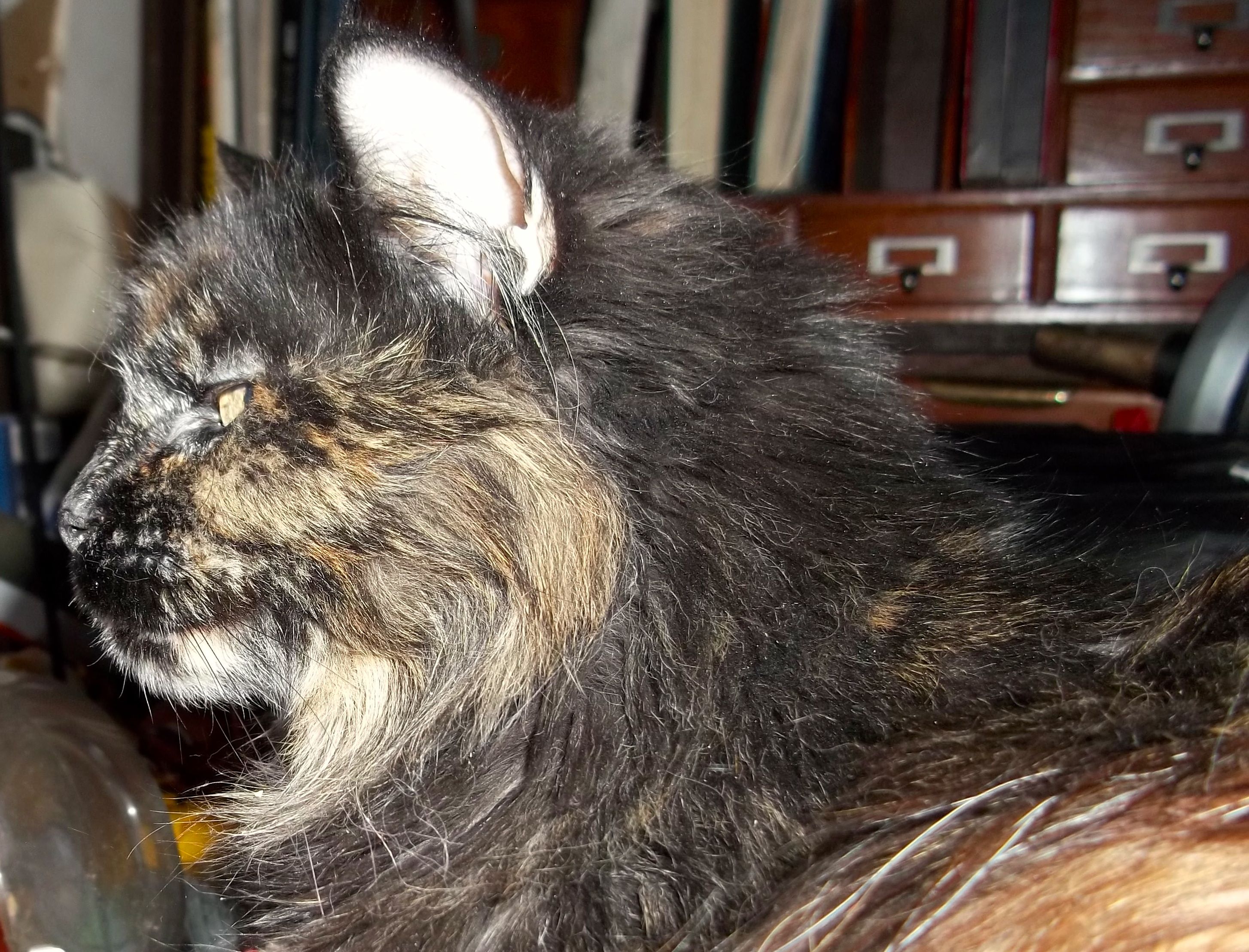
 

Louise Is Almost 20…

…and she’ll be gone soon.

It is inevitable,

yet it cripples my heart.

We brought her home,

tiny and helpless,

bright-eyed and sweet-tempered.

I held and kissed her,

stroked her head and tummy

until she fell asleep.

Then she sighed

in deep contentment

and my heart sighed too.


She still has good days.

But she is unsteady,

barely eats.

At night she wants me near her.

I watch her sleep

and she still sighs.

So does my heart,

knowing the day will come

and soon

I will lose the one

who loves me best,

without reserve.

Forever.

Louise, The Queen of Everything
Louise

The Other Bipolar Disorder

I have bipolar disorder type 2. This is my story.

First, some background. Bipolar disorder used to be called manic-depressive illness, and many people still know and refer to it that way. The term “bipolar” reflects the concept that there are two extremes to the continuum of mood disorders, and some people swing dramatically from one to the other. According to this definition, clinical depression by itself is “unipolar” – occupying only one end of the spectrum.

Depression is to ordinary grief or sadness as a broken leg is to a splinter. Depression sucks the life from a person, mutes all emotions except misery, denies any possibility of joy or even contentment, makes life seem meaningless or impossible. This is hell.

Mania is to ordinary happiness as diving off a cliff is to diving off a diving board. Mania brings exhilaration, ambition, confidence, abandon, and invincibility, with no brakes. It is hell on wheels.

Oscillating between the two extremes – that’s bipolar disorder, type 1. It is a very serious illness. Left untreated, it can cause destruction of families, careers, and more. It can lead to psychosis or suicide.

The treatments for it are no picnic either. Bipolar disorder that severe often requires hospitalization. If the symptoms can be controlled with medication such as lithium or newer formulations, the patients must have frequent blood tests to assure that the drug is present in the right quantity. Electroshock is also a possibility, especially for deep, drug-resistant depression.

When I was (incorrectly) diagnosed with unipolar depression, I used to wish that I were bipolar, on the theory that at least then I could accomplish something. Boy, was I wrong about that. Plans made in mania never come to fruition. They are started, rethought, abandoned, exchanged for something grander, and ultimately fizzle out when the mania wears off.

My diagnosis actually made some sense at the time, as I never experienced anything like the manic highs. All I got were depressive lows.

This leads us at last to bipolar disorder, type 2. Some people think of bipolar 2 as “Bipolar Lite.” The mood swings are not as extreme, the lows less debilitating, the highs less overwhelming. The person with bipolar 2 stays closer to a baseline of normal mood, but still experiences swings back and forth.

Technically the mini-lows are called dysthymia and the mini-highs are called hypomania. In my case, the lows were just as low as in unipolar depression, but I never got the mini-jags of buoyancy that accompany hypomania. Instead, these feelings, came out sideways – as anxiety.

My brain was still racing with little control but in a different direction. Instead of elation and purpose, I was beset by in worries, fears, and catastrophizing.

One of the difficulties with treating bipolar disorder of either type is trying to find a medication or a combination of medications that will level out the person’s moods. Usually this requires more than one drug, and finding the right mix or cocktail of chemicals takes usually requires more than one drug. It takes a great deal of trial and error. In the meantime, the mood swings continue.

At this point, my bipolar 2 disorder is fairly well controlled on medication. I still have spells of depression, but now they last at most a week, and sometimes just a day or two. Untreated, they could last months or years. I still have anxiety too, but I have the medication I take for that, so that I don’t feel like I’m about to jump out of my own skin.

Most of the time I’m fairly high-functioning. I can write, work, earn a living. I have a great marriage and a number of friends, including some who are closer than family to me. I have never been hospitalized, nor have I had electroshock (though that was a near thing). Before I got my proper diagnosis and treatment, I would have not believed this to be possible. My goal in life was simply to stay out of a psychiatric hospital as long as I could, or at least until I qualified for Social Security Disability.

I’m sharing these experiences with you today because I believe that mental disorders should not be hidden or viewed with shame and horror, as they have been in the past and sometimes still are.

It’s undeniable that there is a stigma associated with having mental illness. Going public with it entails a risk. I’ve seen the fixed-smile-back-away-slowly reaction. I’ve seen sudden turn-arounds in my work performance evaluations. But I’ve also seen the “Me too!” response. There is strength in numbers. As more of us who live with psychiatric conditions talk about it, and share our stories, the more we build understanding and perhaps encourage those who are roller-coastering to seek treatment.

So that’s the nuts and bolts of it: Bipolar disorder type 2 is a mental illness. I have it and live with it every day. I do not go around shooting people or trying to jump off buildings. I take medication for it and know that I will likely have to for the rest of my life. And I’m okay with that. I hope that eventually the rest of the world will be too.


Poetry Keeps Knocking

When I was a kid I was sure I was going to be a poet. Or a bus driver. Or an FBI agent. Or a stewardess. Some of those ambitions faded away and others were squelched by reality.

Whenever I take one of those right brain/left brain test I always come out in the middle. Half my brain is scientific and half is artistic.

Mostly, the artistic side has expressed itself over the years. As far back as grade school I remember writing poems. As I got older my poetry tended toward the free verse and the depressing. As many teenagers do, I let my angst, fueled by undiagnosed bipolar disorder, take over. I studied creative writing in high school and took poetry classes as in college.

I even came in second in a poetry contest run by the local newspaper after I graduated. My poems were printed in the paper along with an interview in which I snarked at Helen Steiner Rice and Rod McKuen. I still have some of those poems – somewhere – and I still think some of them are pretty good.

But as life went on my writing changed. The more I wrote in free verse – without rhyme or meter (which Robert Frost famously called “playing tennis without a net”), the more my poetry came to resemble prose. Eventually I gave up on poetry and simply wrote prose instead.

This natural evolution of my writing proved to be a good thing, since everyone knows no one makes any money at poetry unless you’re Helen Steiner Rice or Rod McKuen. Prose has served me well. I have written for many magazines (including Catechist and Black Belt) and for textbooks and now for blogs. For some of these I’ve even gotten paid.

Also I have occasionally made attempts at longer pieces of writing – books. I wrote a mystery novel in which I killed off my Rotten Ex-Boyfriend Who Almost Ruined My Life. I had a proposal going around for a nonfiction book about Lisa Simpson. I have not given up the ambition of writing a book. I am currently 25,000 words into a mystery that involves no one I have ever known, and a memoir which includes the person I know best.

I find, however, that my desire to write poetry has not completely disappeared. Sometimes I find myself playing around with various poetic forms, usually in my blogs. Some of them are the kind of free verse poetry I used to write, but I have learned that I need structure in my life and now it seems I need structure in my poetry too.

I started out simply with a group of haikus – not that haikus are really simple. Later I had a go at a sonnet. I would love to write a sestina but I am afraid to jump into anything that large. I would love to write a villanelle but I am afraid to jump into anything that tightly crafted. And once you’ve read “Do Not Go Gentle Into That Good Night” everything else seems – is – inferior. So I continue with my blogs and my editing and my book proposals and my novel and memoir, but poetry lurks at the back of my brain and now and then threatens to break free.

I think that’s the way of poetry. If you suppress it too long, it finds some way to knock on your brain until you answer.

What’s So Funny About Ohio?

If you’re a 3rd grader the funny thing about Ohio is that it’s the state that’s round on both ends and high in the middle.

If you’re near Columbus the funny thing about Ohio is the field of concrete corn that stands majestically by the roadside.

"CornhengeDublinOhio". Licensed under CC BY-SA 3.0 via Wikipedia - https://en.wikipedia.org/wiki/File:CornhengeDublinOhio.jpg#/media/File:CornhengeDublinOhio.jpg
“CornhengeDublinOhio”. Licensed under CC BY-SA 3.0 via Wikipedia

If you’re in Cincinnati the funny thing about Ohio is the Flying Pig statues, marathon, and assorted paraphernalia.

If you’re near Hamilton, Ohio, the funny thing about Ohio is the statue formerly known as Big Butter Jesus. (1)

King of Kings (aka Big Butter Jesus)

King of Kings (aka Big Butter Jesus)
Photo by Cindy Funk

There are undoubtedly other oddities and roadside attractions in Ohio that can be found in various books and websites about the peculiar and amusing sites to be found in various states.

The really funny thing about Ohio, however, is that the state has produced some of the best humor writers ever.

The one that all Ohioans study in school is James Thurber. I was surprised to learn that outside of Ohio he is not as well known. At the very least, Ohio students read “The Night the Bed Fell” and “The Catbird Seat.” (2) His loopy, scrawling cartoons of men, women, and dogs are classics not so much for their artistic merit but for the captions. My favorite is a man and woman in a lobby and the man says, “You wait here and I’ll bring the etchings down.” For some reason that always slays me.

Thurber managed to be funny despite his failing eyesight and rampant misanthropy.(3) He also wrote a series of essays on grammar – a parody of H.W. Fowler’s Modern English Usage – that is enormously amusing to those of us who are amused by that kind of thing. In particular his piece on the subjunctive and sex is worth the price of admission. (4)

The high points of Thurber’s work have been collected in an anthology called The Thurber Carnival. I highly recommend it.

The other native Ohioan who has made her mark in humorous writing is Erma Bombeck.(5) Beginning as a writer for the Dayton Daily News, Bombeck turned her suburban trials and tribulations into comic fodder for such national bestsellers as If Life Is a Bowl of Cherries, What Am I Doing in the Pits?

She is much more widely known than Thurber because of the near-universal appeal of her books and the fact that nobody makes schoolchildren read her.

Every two years there is an Erma Bombeck Writing Workshop held in her memory at the University of Dayton. Attendees work on humor writing, memoirs, and other forms of expression. There are events called “Pitchapalooza” and “Speed Dating for Writers,”(6) a writing contest, and even a showcase for stand-up comedians.

This year the faculty includes Jenny Lawson, the Bloggess; Kathy Kinney, “Mimi” from The Drew Carey Show; multi-talented writer Sharon Short; as well as other authors, speakers, agents, and literary mavens.

I will be there too, as an attendee.(7)  I hope that after this experience, which occurs at the beginning of April, I can use the knowledge, practice, and advice I receive to improve this blog.

Erma Bombeck and James Thurber set a high standard, but those of us who aspire to write need people of outstanding talent to inspire and instruct us. As well as flying pigs and rows of concrete corn to entertain us.


(1) Also known as “Touchdown Jesus.” I always called it “Kris Kristofferson Jesus.” Unfortunately that statue was hit by lightning and replaced by another statue of Jesus made from exactly the same materials. And that’s pretty funny too. I call it “Jesus-Needs-a-Hug Jesus.”

"Lux Mundi"
“Lux Mundi”

(2)”The Secret Life of Walter Mitty” is another well-known work. But the Danny Kaye movie of it has too much Kaye and not enough Thurber.

(3) Often mistaken for misogyny. But by the end of his life, he couldn’t stand anyone.

(4) You can find it online at http://grammar.about.com/od/classicessays/a/whichthurber.htm, but hardly anywhere else.

(5) After whom my armadillo purse, Erma (duh), is named.

(6) Not actually a venue for making dates, this consists of time-limited one-on-ones for aspiring authors to ask questions of pros.

(7) I was lucky to register in time – the workshop sold out in under six hours from the time registration opened. There is a FB page and the website is humorwriters.org.