The Whisker Jar

Cat whiskers are wonderful things. They’re early warning sensory apparatus that let cats know what’s close by. They sense vibrations that indicate changes in air currents, revealing the size, shape, location, and motion of objects or creatures in the cat’s immediate environment. Other sensory organs at the base of the whiskers keep the cat aware of where its body is in space and what’s around it. They supplement the cat’s eyesight. They help keep small particles away from their eyes as well. And their length corresponds to the cat’s shoulders, indicating the width of spaces that cats can get through.

But we know what’s really important. Cat whiskers are adorable. (So are cat eyebrows. Not as prominent as the whiskers by the nose, the eyebrow hairs are wispier. Their function is probably to help protect the eyes but also to give the cat a variety of darling facial expressions. But I digress. I was talking about whiskers.)

Our cat Toby has brittle whiskers. Just when the white appendages start getting long and magnificent like a respectable cat’s, they simply break off, leaving little inch-long stumps. They do grow back, but for a while, he looks like a pincushion instead of a mighty hunter. I guess Toby is just a little less than respectable. (It wouldn’t surprise me. The little dickens.)

We have had cats with properly impressive whiskers. Shaker, a tuxedo cat, accessorized with thick, long vibrissae (to be correct and pedantic). She was very proud of them and clearly thought they were one of her finest assets. They didn’t break off the way Toby’s do, but every now and then, she’d shed one, leaving a fine, thick, easy-to-spot whisker lying on the carpet. Ordinarily, we’d pick up the whisker and store it in a little ceramic pot we called the Whisker Jar. (No, I don’t know quite why we did this. We didn’t do anything with them, like voodoo spells. They just seemed too magnificent to dispose of, and we wanted to see how many we could accumulate. But I digress again.)

Once, however, we decided to have a little fun with one of the whiskers she had shed. We took one of them from the whisker jar and placed it on her head. It stood straight up, protruding from her sleek, black head like an alien antenna. Inspired, we started making boop-boop noises.

Shaker was deeply offended. She was a cat with a great sense of dignity. (Except when she rolled over and showed her fluffy white belly, inviting a belly rub. Then she looked like a chubby black-and-white kitten, which I suppose she used to be. (We got her as a full-grown cat. But I digress some more.)

Anyway, Shaker clearly objected to having her aplomb assaulted in this fashion. She sensed that we were making fun of her (we were) and she expressed her displeasure—and not by leaving an unpleasant deposit somewhere for us to find unexpectedly when we were barefoot. Instead, she used the power of her remaining whiskers. They turned down in a disapproving manner, rendering her face a veritable mask of scorn.

Then we laughed uproariously, compounding the offense. Shaker retreated in high dudgeon, shaking her head indignantly and dislodging the whisker as she went.

We picked it up and put it back in the Whisker Jar. You never know when you might need another belly laugh.

DPF&P

“DBF&P” is one of the mantras that Dan and I have, and we have to use it often. As you may have guessed from the visual, it’s a football term. (Not that either one of us is a football fan. Dan isn’t any kind of sports fan (he asks me regularly if I mind that he isn’t) and I only ever watch Olympic gymnastics. But I digress.)

So, what does DBF&P mean? It’s a saying we use when everything seems to be going wrong. What are we going to do? Drop back five and punt.

It’s useful in so many situations. Don’t have enough money to pay a certain bill? Drop back five and punt. Don’t have any side dishes to go with the pork loin? Drop back five and punt. Don’t know what to tell Dan’s mom about our politics? Drop back five and punt. Can’t get transportation to a doctor’s appointment? Drop back five and punt. (In those situations, DBF&P might mean moving money around; finding the can of sliced new potatoes we bought once upon a time; discussing the weather and the cats; or calling Lyft. But I digress some more.)

Now, as to how we came up with this useful locution, I’d have to say its origins are shrouded in the mists of time. I don’t remember a time when we didn’t use it. And now I pass it along to you. Feel free to use it whenever you don’t know what to do.

What other sports phrases might you use when you don’t know what to do? Pick up the spare? Fake left and juke right? Bite their ear off? Play out the clock? Bob and weave? Take a shot? Tuck? Duck? Bunt? (That one’s actually pretty good.)

But we don’t stop there. Dan and I have other mantras, too. One of my favorites is “Sufficient unto the day is the evil thereof.” (Dan’s usual response to that is, “I knew you were going to say that.”) There’s also, “The cat did it,” “Ow, Toby!” and “I can’t get up. There’s a cat on me.”

We have separate mantras when one or the other of us loses something like our keys or wallet, sayings inherited from our fathers. Mine used to say, “I’m going to tie it on a string and hang it around your neck.” Dan’s father, who was sometimes more colorful, would say, “If it was up your ass, you’d know where it was.” Undeniable words to live by.

I suppose these aren’t really mantras since we don’t sit and meditate on them. Probably not affirmations, either, which have to be more inspiring. Generally, they’re preludes to action (except the one about the cat on the lap). Maybe they’re mottos. Catchphrases, perhaps?

One catchphrase we have is borrowed from a TV series. We always use it when we start singing a lyric and forget the next line. (We do this a lot. Both of us tend to sing somewhat-appropriate songs as part of conversation. If he says that we’re going to clean up the entire kitchen, I’ll burst into “To Dream the Impossible Dream.” If I say I’m going to get around to cleaning the kitchen, he’ll start singing “I Get Around.” But I digress again.) Anyway, when we draw a blank on the next line, we use Homer Simpson’s classic “D’oh!” (Homer himself once used it this way, when he was singing a song about what to do in case of fire. He ended it, “There is something you should learn. Something, something. D’oh!” But I digress yet again.)

I suppose we ought to pay The Simpsons royalties every time we say “D’oh!” I don’t know who to pay for DBF&P.

Mom’s Kitchen

My parents were totally not foodies. My father was a meat-and-potatoes eater, and my mother was a meat-and-potatoes cook. This was a marriage made in culinary heaven.

My mother’s porkchop, however, looked nothing like this picture. Well, the mashed potatoes did, though the gravy was her amazing sawmill gravy, a version that was popular among all our relatives. (Once when we were visiting Cousin Addie and Cousin Jim (actually ancient relatives who may have been cousins to our grandmother (or even great-grandmother. We were pretty lax about genealogy), Cousin Jim looked up from his biscuits and asked, “Who made the gravy?” “Why?” asked Cousin Addie, fearing it displeased him. “It’s good, he said. “Thicker than usual.” My mother had made it. But I digress.)

However, Mom’s plate of pork chops would have looked quite a bit different. The pork chop would be thin, simply floured, and fried until it was tough. (The pork fat would go in a coffee can on the back of the stove to use instead of butter or oil when cooking eggs. But I digress again.)

The zucchini would never have appeared on the plate, not even during the season when neighbors leave orphan zucchini on each other’s doorsteps like oblong green babies.

The asparagus would have come in a can. All vegetables did, except soup beans, which I ate with ketchup. (I thought I hated asparagus. I’d only had the slimy, canned variety, though. When a boyfriend made me fresh asparagus, I changed my mind. But I digress some more.)

She also made dishes that my schoolmates likely never had, such as pressure-cooked tongue, boiled chicken hearts and gizzards, and cornbread with no sugar (baked in a cast iron mold that looked like ears of corn). It’s considered “white trash” cooking now, but at the time it was just supper.

Lunches were grilled cheese sandwiches—Velveeta on white bread— or bologna and cheese on white bread. Subs were made of lunch meat, no lettuce, tomato, olive oil, or mayo. We got them from school fund-raising drives.

Chinese food came from those two stacked cans. Pizzas came in box mixes, a special treat. Desserts were from box mixes, too, or the slice-and-bake variety. The only exception was Mom’s lemon meringue pie, my father’s favorite, homemade, and always magnificent.

One thing I can say about my mother’s cooking is that there was always plenty of it, and leftovers as well. I was shocked when I had dinner at a friend’s house once, a family of six, and saw how fast they ate to be sure of getting enough and how they fought over the last dinner roll.

I was perfectly happy with my mother’s cooking at the time. It wasn’t until much later that I was exposed to a wider culinary spectrum and experienced beef stroganoff (which my father once described as “slop”), egg drop soup, and anything sautéd. (When I finally encountered these foods, it would be said that I had “got above my raising.” But I digress yet again.)

So, yeah, I may have become fond of sushi, calamari, hot-and-sour soup, whole wheat bread, Havarti and gouda cheese, enchiladas, and tiramisu.

But I still love grilled American cheese on white bread. My husband tries to make it for me as a special treat. But it’s not the same when anyone makes it besides Mom.

Hidden Tattoos

My husband and I are, if not addicted to, at least fond of tattoos. (I’m one of those people that no one, including me, thought would ever be likely to get a tattoo. But I digress already.) For me, it started with small tattoos: punctuation that had nonobvious psychological meanings, and a stack of books (guess why).

My first major tattoo was a tribute to my mother: A yellow rose on a compass rose (that thingy on a map that points N, S, E, and W). My mother and I traveled together a lot, to Rio, England, and many places in the US, and her favorite flower was a yellow rose. I thought it was appropriate. It’s on my left shoulder.

Dan’s first tattoo was a bear paw on his right shoulder. He identifies with bears, perhaps because he looks like one, especially when naked (no photos available). I’d say it was his spirit animal, and it did appear to him in a dream once, but I know that’s an appropriation of an indigenous philosophy. (I explained that to him, but he got the tattoo anyway, and it suits him. But I digress again.)

We had ideas for future tattoos all lined up too. Dan wants a tat on his inner forearm (one of the only places he’s deficient in hair) of a musical note, a heart, and a dove—for music, love, and peace, of course. (He’s an old hippie. What can I say?) My idea is to get a tattoo of Orion with the phrase “We are made of star-stuff” underneath on my right shoulder. (Orion is my favorite constellation, and I took Carl Sagan’s class when I was in college. He’s one of my all-time heroes. I’m not sure how it would look, but my tattoo artist has done Orion before, so that’s a good thing. But I digress some more.)

Then it came to me—the tattoo we both should get: tattoos of hearts over our hearts. We saved up our money and waited until the tattoo artist had an opening. A little research showed that it was a traditional tattoo: a heart-shaped locket with a keyhole in the middle of it. I also saw ones that included a key, like the one in the illustration for this post.

We had some difficulty communicating our idea to the tattooist. Her original sketch had the locket colored gold instead of red. Gold isn’t a great color for a tattoo. It tends to fade quickly. (My yellow rose could use a touch-up.) But she soon fixed it and made it red. And she came up with a great idea—keys underneath the hearts with little labels attached to them. Mine would say “Dan” and his “Jan.” (I agreed to Jan rather than Janet because that would have made the lettering impossibly small. But I digress yet again.)

I know that people say you should never get a tattoo featuring the name of a boyfriend or girlfriend because of the possibility of breaking up. But Dan and I have been married for more than 43 years, so that seems unlikely.

This is the first tattoo either of us has gotten on a place on our bodies that’s unlikely to be seen by others unless we wear bathing suits, which we don’t. (Or skinny dip.) But that’s okay. It’s a private, personal thing, which is why I didn’t include actual photos of the tattoos here. It’s enough for us to know they’re there.

Adventures in Writing: AI

I must admit I’ve had some experience with generative AI writing. I know I should be ashamed of this, but I’m not. Here’s what I learned about this tool or terror.

When ChatGPT was new, I was intrigued. I just had to try it out. I spent a couple of days feeding it some of my favorite topics and styles to see what it could do with them. What it produced was largely crummy.

For example, I asked it to write a haiku on the subject of sex. What it produced was: “Whispers in moonlight/Bodies weave an intimate/Haiku of passion.” Not exactly T.S. Eliot.

I asked it to write other kinds of poems. In almost every one, ChatGPT included the word “poetry” or the name of the style: “The poetry of passsion’s sweet romance” or “O sonnet of the flesh,” “Each line a brushstroke in the poet’s light,” “In every sonnet, life finds sweet peace.”

It also relied heavily on metaphors, many different ones in the same piece. For example, in a poem on writing, it offered “With verses woven like a tapestry. The writer’s heart, an open book” and “how the words, like melodies, entwine, In stanzas, whispers of a silent song.” Now that’s just bad.

It mixed metaphors atrociously: “The enigmatic tapestry…kaleidoscopic hues… orchestrated by unseen forces, paint the canvas of existence… a symphony of discordant notes, each mood a chapter in a cosmic novel.” All those in one paragraph. Another particularly egregious one was “etched into the fabric of one’s existence.”

It also got facts wrong. Recently, hoping that it had improved, I asked it to write a country song about horses in the style of Willie Nelson. “He’s a big ol’ bay with a coat dark as night” was one of the lyrics. (Bay horses are reddish brown.)

Later on, I had a chance to give a workout to a different AI program tasked with writing ten chapters of a novel. Then I was tasked with cleaning it up into human language. It was a lot of work.

AI couldn’t keep track of the characters, for one. It called a little boy Nicky, Billy, and Jamie and another character Henderson and Nelson in different chapters. It chose weird words (“thrummed”) and repeated phrases (“weight of the world”) in nearly every chapter. It forgot that a pivotal scene was supposed to take place in an abandoned warehouse, setting it instead in the woods. Once I had to have it produce a whole new chapter because the first one was so far off. Plot, characters, dialogue, narrative, backstory, continuity—all would be rejected by any competent editor.

AI nonfiction can be just as bad. There’s a tendency to be simply wrong about names, dates, and locations, for example. Flaws like that will seriously mislead readers. AI nonfiction has also been known to get things like herbal remedies drastically and dangerously wrong.

Once I toyed with an AI image generator, which did reasonably well with a human girl (though it couldn’t produce medium-length auburn hair), but couldn’t make a satisfactory alien to meet my criteria. It looked like one of those sad-eyed children in the old paintings.

I understand why special effects professionals hold AI in horror. Entire departments are being canned and replaced by larger, more sophisticated sorts of AI than the Tinkertoy ones I played with. But movies have been using CGI for years, so AI is the next logical extension. I’m not saying that the SpFX companies are right to abandon the people who have done so well for them over the years. Human imagination controlling the tools of creation will—or should—always have a place in the equation.

But generative AI has a long way to go before it can produce prose or poetry that can substitute for human works. I understand that publishers are being assailed with AI-produced novels, but I can’t imagine they can’t tell the difference. Readers of self-published novels, though, should watch out for AI books and avoid them.

Or, if you prefer, avoid all AI writing. I understand why you would.

(Note: Aside from the brief quotes, no AI was used to write this post.)

Let Your Freak Flag Fly

To those of us who were hippies back in the 60s and 70s (and are now in our 60s and 70s), letting your freak flag fly meant something special. If I had to define it in two words, it meant Weird Pride. The straight world viewed us as weirdos, and, rather than being insulted, we embraced the title.

A lot of the controversy had to do with hair—specifically, long hair on men. I know it’s hard to believe now, in a time when anyone can do anything with their hair and not have anyone bat an eye, but back then it was a form of rebellion and a cause for discrimination. (There was a time when long hair was considered a job-killer. Beards too. Now about the only job-killer appearance I can think of is face tattoos. But I digress.)

It’s hard to let your freak flag fly anymore. There don’t seem to be any more freak flags. Not even hairstyles. Mohawks are passé. Shaved and partially shaved heads are accepted, even for women. Grandmothers are dying their hair green, pink, and blue—and not the kind of blue that used to be called a blue rinse. (Though many old ladies called it a blue wrench. I’m not sure why. But I digress again.)

It seems like the only way left to have a freak flag is based on your clothing. Even then it’s hard to do. I’m not talking about tie-dye, either. That can be worn by anyone, not just Deadheads. Mismatched, colorful socks won’t do it, and (unless you move in Martha Stewart’s orbit (which I don’t, needless to say) neither will wearing plaids with polka dots. (If you’re wearing a suit, the mismatched striped socks thing might work, but anything unusual worn with a suit would count as a freak flag (except an AR-15 pin, and maybe not even that in some surprising circles). Business suits are still an indicator of a non-freak. But I digress some more.)

Even non-clothing freak flags are getting more permissible. Psychedelic music is now on the oldies stations. Rowan and Martin’s Laugh-In hasn’t worn well, even though you can find it on a streaming channel. Marijuana is legal in many states (does anyone still say weed, pot, Mary Jane, blunts, roaches, etc.?) and used for relief from physical pain and illnesses. Psychedelic and party drugs are being used for psychiatric illnesses.

Protest songs don’t even exist anymore, though they’re sorely needed, if you ask me. Vulgar and obscene t-shirt sayings barely rate a blink. There are places to go if you’re a nudist, gay, or kinky that don’t get raided. Bare feet are about the only things that can get you tossed out of restaurants.

There are no freak cars anymore either. People don’t paint their VWs with flowers. A VW bus is more likely to belong to a soccer mom than a commune. And when it comes to travel, no one has to go to Canada to evade the draft. There are no draft cards to burn. Teenagers don’t even know what the draft was, and Vietnam vets are old men and women.

Now I’m not saying these new sensibilities are bad things, not at all. It’s probably a good thing that more styles are not only acceptable but non-controversial. It’s great that people can express themselves more freely. Whenever my husband wears his Jerry Garcia t-shirt, people think it’s far out. (I know people don’t say “far-out” anymore. Or “groovy.” I can’t keep track of what they do say. Plus, my husband’s t-shirt usually draw remarks that he looks like the picture. But I digress yet again.)

Basically, if you can find a way to let your freak flag fly, do it!

Fraidy Cat

I’ve read that if you surreptitiously place a cucumber or zucchini behind your cat, when the cat notices the vegetable, it will jump straight up in alarm (the cat, not the cucumber). I’ve never tested this out because I’ve also read that the cat thinks the cucumber is some kind of fat, short, immobile but threatening green snake and is genuinely terrified. Some people thought it was cruel to put a cat through this unexpected terror. (Though no one seems to care that the whole red dot thing puts a cat through unrelenting frustration. We think it’s funny, so that’s okay. Actually, the whole cucumber thing was supposed to be amusing, too. Go figure. But I digress.)

I’ve never tried the cucumber trick on any of our cats. They have enough things that they’re afraid of already.

Knowing that I’m a cat lover, my friends often give me cat-related gifts—cookie jars, Christmas ornaments, earrings, mugs, and so forth. One year, someone got me a pair of cat house slippers. They were very lifelike, a pair of puffy, furry, black-and-white cats with little pink noses. Basically, they were adorbz. (Yes, I know that “adorbz” is years old and probably as horse-and-buggy as “horse-and-buggy.” But I like it, so it stays. It’s not like a piece of slang that no one can figure out what it means without context (or maybe even with) like “rizz.” But I digress again.)

At any rate, the first time I walked down the hall wearing them, our cat Shaker (who was also black and white) saw the pair of mirror-image cats shuffling toward her, she turned tail and ran. (The same thing happened when Dan “walked” a 3 1/2-foot-tall plush rabbit down the hall. (Dan won the rabbit at a carnival. He had fun driving home from Pennsylvania with it. He strapped it in the passenger seat and enjoyed seeing children waving at it. It didn’t go with what we graciously call our “decor,” so we gave it to a friend with a young child. The child appreciated it, but the mother didn’t. Didn’t go with her decor either. But I digress some more. (Embedded. Are you impressed?)))

Another cat we had shared with most other cats a love of plastic bags. (We once met a cat in Dubrovnik who tried to climb into our souvenir bag and come home with us. But I digress even more.) Anyway, Jasper, who was a little skittish anyway, got tangled in a plastic grocery sack, which was enough to alarm him. What he didn’t realize, however, was that the bag contained a CD in its case (CD = a horse-and-buggy item). Startled, Jasper tried to get away from the thing by running upstairs. But the bag was caught on his leg and chased him, thump, thump, thump, all the way up. He couldn’t get away from it. Unlike a cucumber, it wasn’t stationary. Like a cucumber, it terrified him.

Our current cat, Toby, is afraid of water. No, not his water dish. Not rain. Not even the water in the shower (he likes to sit on the shower seat, though not while the water’s running). No, he’s afraid of bottled water. The fizzy kind, anyway. If I crack open a bottle and it makes the fizzy sound (which it always does), Toby does that cat thing where he levitates three feet off the ground like he’s spring-loaded. I don’t know, maybe fizzy water sounds like another cat hissing.

I suppose it’s wrong of me to laugh at the fraidy cats. They don’t laugh at me when I run screaming from bees and wasps. Or at least I don’t hear them. (Maybe they’re polite enough to snicker behind my back.)

The Purple Leash

What does a woman do when she’s suffering domestic abuse but has a beloved pet she doesn’t want to leave? She may stay and endure the abuse because there is no shelter that will accept her pet as well. Her choice is to abandon her pet and go to a shelter alone or to remain in an abusive household. For many women, it’s an impossible choice, with no good answer.

Purina is working on the problem. They, along with Greater Good Charities and RedRover, have instituted what they call the Purple Leash Project. It’s a call to action for domestic violence shelters to have facilities where women can bring their pets with them when they have to go there. (Purple is the ribbon color for Domestic Violence Awareness Month.)

In most places, there are very few shelters for women that are also shelters for their pets. And, sad as it is, lack of shelter for dogs and cats can lead abused women to stay in dangerous situations rather than seeking help. They may treasure their pets as they would children. Or they may worry that their abuser would abuse the animal too for revenge because they left. Some even know that their abuser is prone to violence against animals, having witnessed it.

As one woman put it, “I endured domestic violence for many, many years and due to the fact that I could not leave my dog behind and our local shelter does not accept pets, I stayed. I stayed for over a year and a half.”

Another anonymous woman said, “I cannot thank you enough for taking this issue seriously. I actually cried when I watched your video as no one to date has taken this subject seriously. We have no shelters that allow pets in my area. Please continue to fight for what is right. For some of us, our dogs are everything.”

A woman named Angie added, “I wasn’t expecting I wouldn’t be able to bring Princess. And that was heartbreaking, especially for the kids. I feel proud just knowing other families will be able to keep their pets…that’s just awesome. Because, for us, Princess was everything.”  

This October, in support of Domestic Violence Awareness Month, Purina is offering a Purple Leash Project digital coupon and will donate 50¢ to RedRover for each coupon redeemed through October 31, up to $300,000. I know it’s late in October, but there’s still time to take advantage.

Purina has also joined forces with renowned artist Kristen Visbal to create statues of a woman and a dog, titled Courageous Together. They’ll be making their way around the country in 2024 to raise awareness of why pets are a crucial part of the conversation around domestic violence.

Serving Society

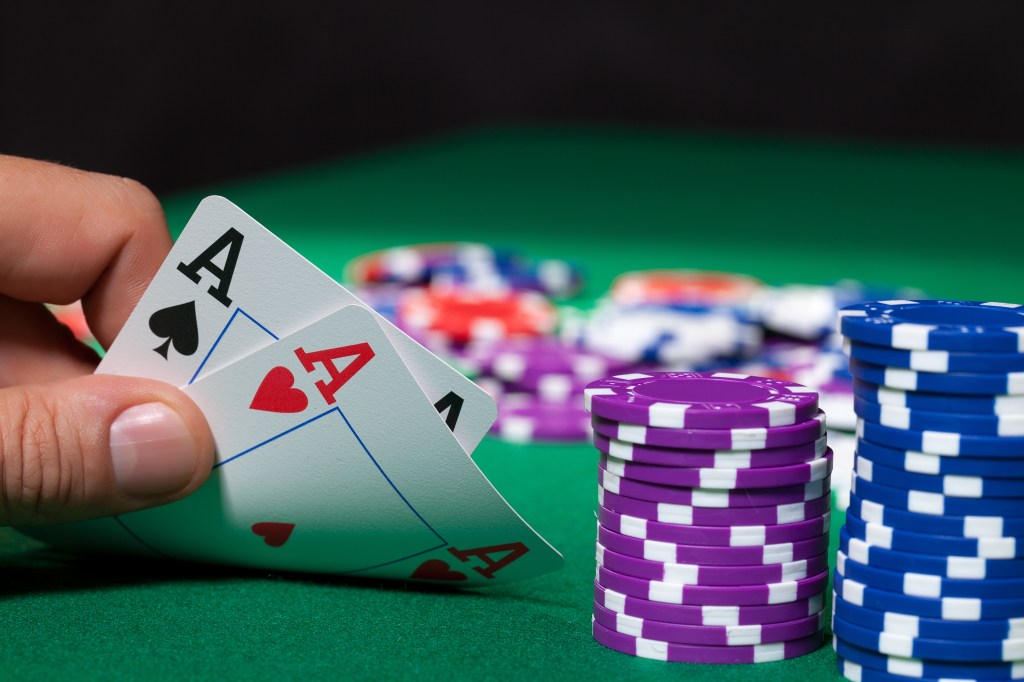
It all started with a game of Texas Hold’Em held in a bookstore to raise money for charity. I had pocket aces (as shown), a very strong hand. I should have slow-played them and let others raise the pot, but I was a newbie and all excited, so I didn’t make the most of the opportunity. Shortly thereafter, I left the game.

(Texas Hold’Em became trendy and popular in 2004 with the publication of Jim McManus’s Positively Fifth Street. It led to such oddities as the World Series of Poker (yes, there is one) being televised. The title of the book came from the arcane but intriguing insider terminology used to describe the various parts of the game, such as the flop, the turn, and the river (aka Fifth Street), which refer to when the communal cards are exposed. Naturally, I was drawn to a game that had its own language. But I digress.)

After I left the poker table, I was drawn into a conversation with a woman who was watching the game. She wanted to know whether I did anything besides play poker. (Yes, there are professional poker players.) When I told her that I was in educational publishing, she relaxed. Her point was that professional poker playing served society not at all, but educational publishing filled a valuable niche in service to education, a worthy goal.

That got me thinking. Who exactly serves society and in what capacity?

I think we all agree on some of the basics: teachers, medical personnel, police, religious figures, volunteer workers, and firefighters. But are they the only ones who perform worthwhile services?

Politicians are not held in high regard these days, and neither are lawyers. But when they act on principles (if they ever do), they serve society by making laws and administering justice.

I’m less open to the idea that entertainers serve society by entertaining us. Of course, some entertainers (and I’m including professional athletes in that) donate large sums of money to assorted worthy causes or start charities or foundations that serve some segments of society, usually the underserved. But those people, it seems to me, are philanthropists (good-deed-doers) who also entertain.

(Speaking of entertainers, I can’t abide most reality shows, particularly the kind that might be called “Famous for Being Famous” (I’m looking at you, Kardashians) or “Rich People Behaving Badly” (I’m looking at you, Real Housewives). I do like the ones where fairly normal people actually make or do something like cooking or baking, designing clothes, forging knives, and so on. I can’t say whether they technically serve society, but at least they’re creative. But I digress again.)

But what (to get back to my much-neglected point) about sanitation and maintenance workers? Without them, our streets would be awash in litter and worse. Our offices would be grubby and perhaps disease-ridden. Our school corridors would be besmirched by vomit. I think taking care of all these problems serves society in a very real way. (And there are never reality shows featuring them. Probably something to do with the vomit. But I digress some more.)

I’ll admit that poker players don’t do anything to serve society, but I think we have a limited view of those who do. Public servants are held up as examples, and they should be. But farmers don’t get mentioned, and they feed us all. Train engineers and truck drivers serve society by delivering that food, as we learned during the pandemic. Psychiatrists and therapists serve members of the public who have mental illnesses. Meteorologists serve society when storms happen. Anyone from architects to bus drivers, yoga instructors to zookeepers. Even burger flippers and pizza delivery people serve society or at least individual members of it.

Let’s expand our definitions of who serves society. There are a lot of people who don’t get recognition and should.

That Hoodoo That You Do

Having the in-laws visit is a situation that is fraught with peril. There’s the frantic pre-cleaning cleaning, the cleaning, the post-cleaning cleaning, and the tidying up. There’s the delicate balance over what foods to stock up on and whether or not to go out for a meal or meals, and other aspects of potential entertaining. And, for those of us who don’t have the luxury of a guest room, there are the sleeping arrangements.

But the particular challenge that I want to discuss is when my MIL visited us.

We cleaned, of course, though perhaps not up to her standards. We loaded the pantry and the fridge with the mineral water, breakfast items, and snacks she preferred, plus more than our usual supply of staples, meat, vegetables, bread, fruit, and beverages.

No guest rooms chez nous, but at the time, we had a pull-out sofa bed. Being at least aware of one or two of the social norms, Dan and I would take the sofa, giving up the bed to Mom. We made sure there were clean sheets, blankets, towels, and such.

But upon seeing the sleeping arrangements, Mom announced, “I won’t sleep in that bed!”

“What’s the matter?” we asked, puzzled.

“That … thing. The one hanging over the bed. It’s a hoodoo. I can’t sleep under that.”

Now, Dan has been to Africa, where he encountered some shamans, and I have been to Jamaica, where I failed to encounter any voodoo priests, but in all our travels, neither one of us had ever acquired a hoodoo. (I did encounter lepers in Jamaica once (or persons living with Hansen’s Disease, as we would say now). (I was there reporting on charity work.) The residents’ cases were no longer active, but they lived apart in their own establishment (aka “leper colony”). They liked singing religious and folk songs, and when I asked if there was anything they needed, one man asked for new guitar strings. But I digress.)

At any rate, no hoodoos were acquired from anywhere.

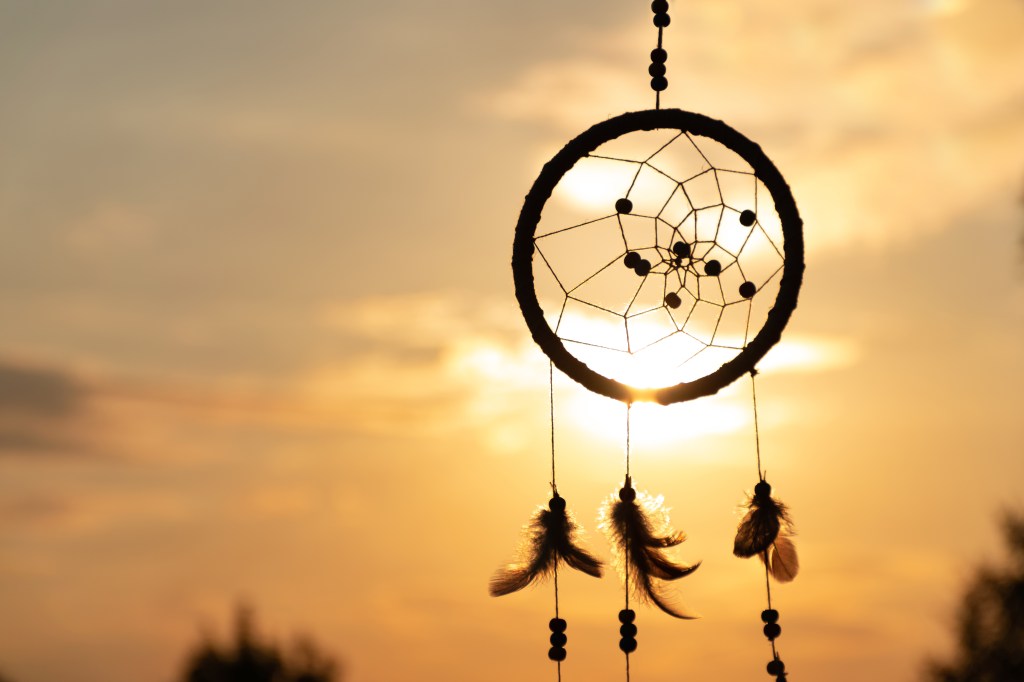
The suspected hoodoo was a small wicker circle with various objects attached: a piece of red yarn, a bean from the castor plant, a cat whisker, a small bag of polished stone chips. It hung over my side of the bed.

What it was, of course, was a dream catcher.

I have nightmares from time to time. (I also have the usual anxiety dreams about being lost in a hotel, missing a plane, and not being able to find a clean toilet. Now that I think about it, as much as I love it, travel makes me anxious. But I digress again.) During one particularly bad spell, Dan made me the dream catcher. The items attached to it were ones that had special significance to me. The red yarn was a scrap from my mother’s crocheting. The stones were for my love of the semiprecious variety. The cat whisker—well, do I have to explain that one? (No, I never tried to kill anyone with a castor bean. It was a plot point in a mystery novel I was writing, though. But I digress yet again.)

It was a whimsical, tender memento that held no special power but that showed how much concern Dan had for me and how much he wanted to relieve my distress.

What it was not, was a hoodoo. (I’ve never seen an actual hoodoo, so I don’t know what they look like. I guess I can see how a dream catcher could be mistaken for one by someone who has no idea what a dream catcher is but is well up on hoodoos. But I digress some more.)

Our choice was obvious—remove the hoodoo or banish Mom to the sofa bed. It was a tough decision, but we removed the offending object (the dream catcher, that is) and Mom agreed to sleep in the bed. The dream catcher went right back up after the visit ended.

No sense wasting a perfectly good hoodoo.