Finally, I Gave In

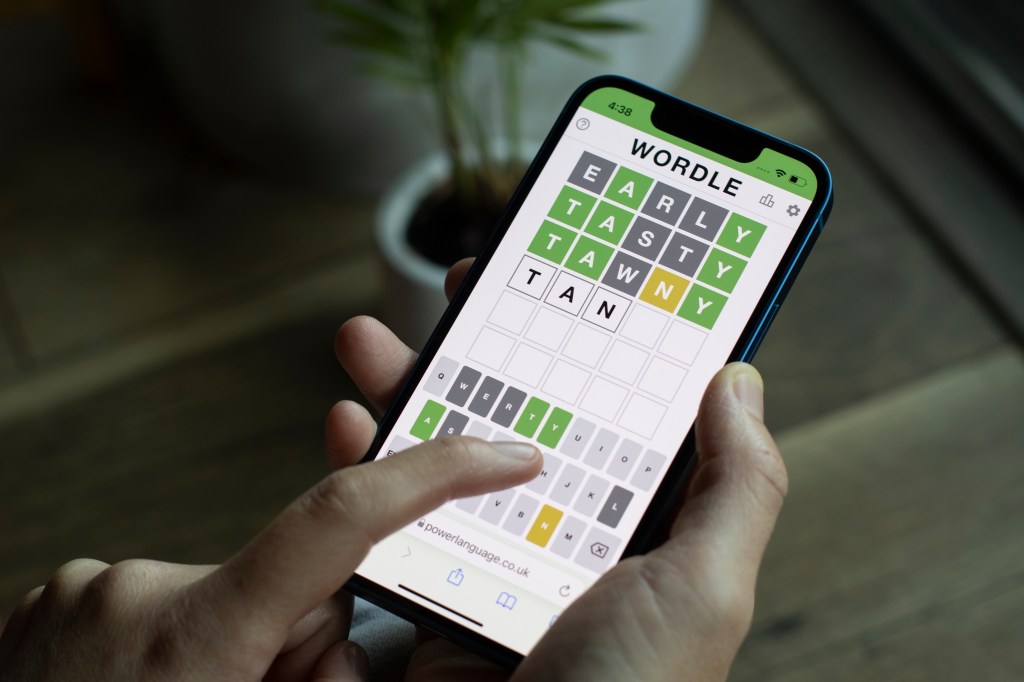
All right. I admit it. At last I’m doing what the cool kids do. I’m playing Wordle daily.

I resisted for as long as I could. I even wrote a blog post about how I was not going to succumb. I found it annoying when every day I saw people posting on Facebook what their scores were. That trend seems to have stopped, or at least pulled back. Now, most people only share their results when they get the word in two or three guesses.

My first brush with Wordle came when I was visiting friends in Michigan. Leslie was playing Wordle while someone else drove. She was having a hard time with one particular word and was down to her last try. I looked over her shoulder at the puzzle and said, “Prism.”

“That could work.”

It did.

“You’re good at this. You should be playing it.”

But I resisted. I’ve long been a fan of crossword puzzles and anacrostics. I’ve also done a lot of sudoku and right now I’m obsessed with jigsaw sudoku. (This is an insidious form of the puzzle in which, instead of neat little square blocks, each area is some other shape. A “U” or a snake or some unidentifiable blob. The rules are the same. Each shape contains nine little squares, which must contain the numbers from one to nine. Each row and column must also contain one through nine. But I digress.) (My husband’s famous quote regarding sudoku is, “I may not be able to spell, but goddamit, I can count to nine!” But I digress some more.)

Then one day, one of my writing buddies, Mary Jo, sang the praises of Wordle. “You should try it,” she said. “It takes less than five minutes a day.” (Jigsaw sudoku takes longer than that.)

So, okay. If Mary Jo recommended it, I decided I would try it. I’ve played it every day since, so it’s all her fault.

I have my routine. My first and second words are always the same. They give me all the vowels (including Y) and at least three of the most common consonants. I’ve solved it in three tries more times than six, but four is my usual. I’ve learned to hate words that have several possible choices for the missing letter, like STEA—it could be STEAM, STEAK, STEAD, or STEAL, and if I run out of guesses, I’m screwed. Then there was the time the word was PENNE. Two double letters. Only one letter was revealed by my first two guesses. But I got it!

When I reached a streak of 30 consecutive completions, I told Mary Jo. She admitted, faux-modestly, that her record was 390 days. (I’m sure it’s even more by now.)

Then I found out her secret: She cheats.

(Okay, technically, I guess you can’t call it cheating. She has Wordle buddies that consult with her daily and give each other hints. (I’m not one of them, [sob!].) She refers to the complete list of words that have been Wordle solutions, so that she won’t get hung up on STEA if STEAM has already been used. I didn’t even know the list existed until recently. But I digress again.)

I won’t say I’m addicted to Wordle, but if I’m up after midnight, I do go directly to the Wordle page on the NYT site and try my brain. I tell my husband my score daily. (I don’t do so well on Spelling Bee. Sometimes I can guess at least one word just by looking at it. Other times, I simply can’t, no matter how long I study it. So I don’t. But I digress some more.)

Anyway, I now expect my friends to laugh and point (insofar as you can point online). Especially Mary Jo.

Don’t Harsh My Buzz

Haters gonna hate. But I wish they wouldn’t, at least when it comes to personal preferences.

At this time of year, there is one major group of haters: those who hate pumpkin spice, who think it ought to be abolished. Who make fun of the people who enjoy a nice pumpkin spice latte.

I don’t get it. I love cinnamon, ginger, nutmeg, allspice, and cloves. I’m especially fond of cinnamon and ginger. In fact, I love them so much that I believe all pumpkin pies should be made with more of the spices than are called for in the recipe so as not to be overwhelmed by the pumpkin, which is, after all, not all that flavorful.

And yet some people hate on pumpkin spice “everything.” I don’t often drink coffee and never lattes, so I don’t know exactly how a pumpkin spice latte tastes. But my bet is that it doesn’t contain any actual pumpkin flavor. It’s got to be doctored with only the spices. I don’t see anything wrong with that. Obviously, there’s a market for it, or Starbucks et al. wouldn’t be offering it. And offering it in September is totally legitimate. September is the gateway to fall.

(Except this year, of course. September is meant to herald the onset of sweater weather. This year, it’s still the month of boob sweat rash. But I digress.)

There are lots of other things made with pumpkin spice that are delightful as well. There are cakes and cookies, candy and cereal, bread and pancakes, soup and cheesecakes, muffins and doughnuts, macarons and popcorn, protein shakes and yogurt. But if you hate pumpkin pie spice, you can simply not buy them. You don’t have to declare how much you dislike them. As some of my friends say, “Don’t yuck my yum.” (We old hippies say “Don’t harsh my buzz,” hence the title of this post. Other formulations include “Don’t harsh my mellow,” and “Don’t be a buzzkill.” But I digress again.)

There are other things that people hate on. Country music. Rap music. Superhero movies. Horror movies. Romance novels. Science fiction novels. Et endless cetera.

Some of these impinge on me personally. I love country music (at least classic country and what they call Americana these days). Yet when a person says that they love country, people assume they’re an ignorant, racist redneck. I love science fiction, but I’m not a teenage, basement-dwelling geek. Those are stereotypes. Like most stereotypes, there’s a reason they exist. And also like stereotypes, they don’t apply to everyone.

Basically, I think all this hate would lessen if more people understood Sturgeon’s Law, which says, “90 percent of everything is crap.” (Sturgeon is Theodore Sturgeon, a science fiction author. One of the Big Names, at least of the old guard. But I digress some more.)

What Sturgeon meant is that 90 percent of anything you’d care to name is crap: 90 percent of country music is crap; 90 percent of rap music is crap; 90 percent of science fiction is crap; 90 percent of romance novels are crap; and so on. And 90 percent of coffee drinks are crap, I suppose.

That leaves 10 percent of everything that isn’t crap—indeed, it may be extraordinary. But the catch is that you have to wade through the 90 percent of crap to get to the 10 percent of great. And most people aren’t willing to wade through the crap to get to the non-crap. It’s much easier just to dismiss the whole 100 percent as crap.

All I’m really asking is that you leave the pumpkin spice lovers alone. Don’t yuck their yum. If you don’t like country music, you don’t have to go through the 90 percent to get to the 10 percent that I love. Don’t harsh my buzz.

Life would be a lot more pleasant if everyone would simply refrain from yucking yums and harshing buzzes.

Is that too much to ask?

How to Start a Conversation

I never used to be any good at small talk. I would stand there, tongue-tied, while conversation went on around me. I was afraid I had turned invisible.

Then I met Erma the Armadillo, pictured here. She’s a purse that my mother bought for me from a catalog called, appropriately, What on Earth. This was back in the 90s, and I don’t think she spent more than $25 on the purse. When it came time to scare up a photo to go with this post, I found that today Erma is considered “vintage” and sells for as much as $140, used.

(I have a thing about armadillos. I fell in love with them when I learned that their main defensive technique is to jump straight up two feet, and their main natural predator is the automobile bumper. My defense mechanisms are like that, too. But I digress.)

Erma was actually a lousy purse. She was stuffed with cotton and had only a small zippered slot that would barely hold a driver’s license and a little cash. I had to carry anything else in my pockets. But what she was good at was starting conversations. Not that she spoke, but when other people saw her, they did.

People were fascinated. They always remarked on what an unusual purse Erma was. I would point out that she even had little tiny toenails printed on her stubby little feet. They’d ask where I’d gotten her. They’d ask why I wanted an armadillo purse. They’d ask more questions and share about other purses they’d seen or owned. Children were especially captivated by Erma. They couldn’t get over the fact that she wasn’t a toy and that she had handles. They always wanted to touch her, and I always let them.

When it comes to starting conversations with strangers, I always recommend accessories. My jewelry collection has some peculiar specimens. I have a sushi necklace that my friend Leslie made for me from air-dry clay. I also have a pair of bacon earrings, though I never mix cuisines in an outfit. Another set of earrings that people found amusing were the ones that looked like the planet Earth, complete with continents. (When I wore them, I liked to shake my head violently and shout, “Earthquake!” But I digress again.)

Conversation goes both ways, of course. “That’s an awesome (fill in the blank). Where did you get it?” is a good start on a good chat. People love to tell stories about their possessions, gifts, travels, etc. From there, conversation is an easy two-way street.

(It can fall flat from time to time. I once shared an elevator with a woman who had itsy-bitsy feet. I felt like I might have been staring at them. So I cleverly said, “Those are great boots! They make your feet look really small!” She replied, “They are really small.” After that, the conversation, and the elevator ride, ended. But I digress some more.)

I don’t know how people who don’t have unusual accessories start conversations. “Is that a good book you’re reading?” is one ploy, but it hardly ever works. Most people don’t read books in public, and if they do, they don’t like to be interrupted. And when I read books in public (which I do), I read them on my e-reader or phone, so the general public just thinks I’m doom-scrolling (which I don’t do).

Erma is no longer with me. Her handles wore out and Dan was unsuccessful at replacing them, which he tried to do. I don’t go out much anymore but when I do, I miss her. And the conversations.

Let’s Talk Boogers

That’s what my writing friend Denise and I were doing the other day. She had seen a “hillbilly” truck with a bumper sticker on it that referenced boogers. She marveled at the grammar and punctuation, which was all correct, considering that the truck owner was clearly a hillbilly who used the term “booger.”

“What do non-hillbillies call boogers?” I asked. I thought it was a valid question. Offhand, I couldn’t think of any synonyms.

Denise admitted that I had a point.

“Snot,” someone else suggested.

“Doesn’t work for me. Snot is more liquid-ish. Boogers are a bit more solid-ish.” We left it at that.

(There is one bodily substance that can appear as any of the three common states of matter—gaseous, fluid, and solid. (We’re not going to discuss plasma or non-Newtonian fluids or other such foolishness here. If there are bodily substances like that, I don’t know about them and don’t want to.) I leave the identification of the aforementioned bodily substance as an exercise for the student. But I digress.)

Another encounter with the word “booger” occurred when I was wanting to know what the little crusty bits that accumulate at the corners of your eyes are called. Most of my friends called them “eye boogers.” (Even my eye doctor did.) But I refused to get on board with that. I had been calling them “eye crunchies,” but, while it usually got the meaning across, it seemed too casual.

Thanks to Mr. Google, I found that the technical term is “gound,” though the little buggers are also known as “dried rheum.” Neither of those is useful for general conversation. (I can just picture myself remarking, “I had a lot of gound when I woke up this morning.” The response, of course, would be “Huh?” and probably a sad headshake. But I digress again.) I guess I have to stick with “eye crunchies.”

Speaking of boogers, one of my odder friends wrote a song called “Rhinotillexomania.” This is Latin, from the words for “nose,” “pick,” and “obsession.” You see where this is going. It was a sprightly little ditty that became a sing-along. (It contained the memorable line, “When it comes to filthy habits of the solitary sort/Rhinotillexomania is my second favorite sport.” But I digress some more.)

I was sorely tempted to call in sick to work one day and say that I was suffering from rhinotillexomania, but I worked in an office of intellectuals, most of whom had at least a smattering of Latin, so that was a no-go.

Speaking of boogers and illness, my husband recently alerted me to a study that says rhinotillexomania can be a contributing factor to Alzheimer’s disease. The theory is that you introduce bacteria and other unfriendlies into your nose that make their way to the brain and cause inflammation. It’s just a theory at this point. (There haven’t been any human studies yet. I imagine it would be hard to recruit test subjects who admit to obsessive nose-picking.)

Did I ever think I would be writing a blog post about boogers and nose-picking? I can’t say that I have. On the other hand, I wouldn’t have ruled it out. (Well, it’s evident that I didn’t.)

Name That Tune

No one complains about Musak (aka elevator music) anymore. That’s because there is not, strictly speaking, any more Musak. Nowadays, elevators, stores, bars, and restaurants get their background music from a variety of services, which allow them to choose a specific type of music—smooth jazz, for example. Many locales choose oldies, which to me doesn’t mean the 2000s.

Recently, my husband and I went to a chain restaurant for lunch. We were there early, which means it wasn’t noisy yet, so we could actually hear the ambient music. When we walked in, we immediately heard Clapton’s “Lay Down, Sally,” and took this as a good omen for agreeable music.

Indeed it was. While we were there we heard some Whitney Houston (the early, pre-drug years), Sinatra singing “My Way,” and a bit of Fleetwood Mac, all of which were just fine. Then a song came on that puzzled us at first—Coolio’s “Gangster’s Paradise.” Or maybe it was “Gangsta’s Paradise.” At any rate, I eventually recognized the song, though Dan didn’t. I told him it was by Coolio. (“Kool and the Gang?” he said. That’s how stuck in the past he is. But I digress.)

Even more puzzling was an instrumental piece that came through the speakers. There were rhythmic trumpets and drums. At last I recognized it. “That’s the Imperial March. From Star Wars.”

“No,” Dan exclaimed. “It can’t be.” But it was. And the longer it played, the easier it was to recognize. It couldn’t have been any more recognizable unless it was the theme from Raiders of the Lost Ark. (Actually, that’s what I wanted for our wedding recessional. After all, we were embarking on an adventure, though it has seldom involved snakes. (Except for the time we were driving through Arizona and thought we saw a shed snakeskin on the side of the road. On closer inspection, it turned out to be a weathered piece of duct tape.) At any rate, the church organist balked and substituted the Love Theme from the movie Superman, which he probably figured was more appropriate but still a movie theme, though one that had no personal meaning for us. He was probably weirded out enough that I insisted on “Wildwood Flower” for the processional. But I digress at length.)

Returning to the aforementioned Coolio song, the reason I recognized it was that I knew the tune from Weird Al’s “Amish Paradise” and that it was Coolio because at the time there was confusion over whether he had given Al permission to use it.

Song parodies have sometimes proved even more confusing. I have friends who write song parodies, and sometimes the only way I know a tune is from their songs. My friend Tom Smith, for example, wrote a parody of “The Colors of the Wind” called “The Curlers of Delenn,” a Babylon 5 reference. I heard the original one day in a supermarket and wondered why they were playing a Tom Smith song. (I missed the Pocahontas movie.) Tom’s parody of The Proclaimers’s “500 Miles,” “500 Hats,” a Dr. Seuss tribute song, has affected me the same way.

(I have other friends who write parodies, too. Michael Longcor is one. He wrote a parody of the old folk tune “Lorena,” except about Lorena Bobbit, and one of Buck Owens’s “Act Naturally” called “Write Romantically.” He even wrote a parody of one of his own songs, a beautiful, tender love ballad called “Eternity’s Waltz.” He made it into “Eternity’s Polka.” But I digress some more.)

Of course, it’s not likely that I’ll hear “The Curlers of Delenn” or “Eternity’s Polka” as soothing background music anytime soon. But I like to imagine the kind of restaurant that would have them. I’m pretty sure there’d be a life-sized cardboard cutout of Weird Al right next to the hostess stand.

El Ka-Bong!

Once again, it all started with a cat, of course. I innocently walked downstairs on my commute to my office, and there he was. Toby. For the purposes of this story, aka Mr. Underfoot.

As you may have guessed by now, he was underfoot. I tripped over the wretched little beast and I tested gravity, landing on my ample, padded ass. (There used to be a photo of me on a zipline titled “My Giant Flying Ass,” due to the fact that the photographer was on the ground beneath me. The photo was quickly deleted. But I digress.) My fall would have been inconsequential, if mildly embarrassing.

Alas, there was a chair interrupting my trajectory. Not a nice, soft, comfy chair, either. A solid wood one. And I didn’t hit it ass-first. No, It intersected my fall on the back of my head. I shouted, and Toby took off.

I didn’t quite see little tweeting birdies fluttering around my brow, but I rapidly acquired one of their eggs on the back of my head. (Hence the title of this post. Extra points if you get the reference without Googling. But I digress again.) (Back in the day we used to call this a pump-knot rather than a goose egg. Why? I don’t know. No pumps seemed to be involved. Added digression.)

Now, the problem with being flat on your back at my age and level of decrepitude is that there isn’t a good way to re-achieve vertical status. In point of fact, there isn’t one.

Added to this indignity is the fact that my phone was in my study. (There was no pocket in my nightshirt. I habitually spend the night without a phone within reach. Weird, I know. But I digress yet again.) In order to summon help, I had to make it to my desk.

What to do? I managed to locomote by a crab-like method, scooting along on the aforementioned ass and hoisting myself as much as possible with my arms. Hoist, scoot, repeat. (With occasional pauses for much-needed rest.) There were obstacles along the way—a coffee table, for example, which didn’t provide enough leverage to get me off the ground, damn it. I maneuvered past the comfy chair, which likewise wasn’t any help at that point.

I made it to my desk and nabbed the phone. Did I call 9-1-1? I did not. I called my husband, who works just a mile and a half away. Even though it wasn’t time for his break, he came for me. And helped maneuver me into the comfy chair, where I caught my breath.

“You’re going to the ER,” he announced. I wasn’t inclined to argue. I exchanged my slippers for sturdy shoes and, leaning on Dan, made it to the car. (It seemed ridiculous to call an ambulance. The hospital is also about 1.5 miles from home. But I digress some more.)

At the hospital, I told my tale of woe, leaving out the part about my ass. They solemnly wrote, “tripped over cat” in my chart and wheeled me off for a CT scan (formerly known, ironically, as a CAT scan). Back in my cubicle, waiting for results, the nurse noticed my nightshirt. “How many cats do you have?” she asked.

“Just the one,” I said. “That’s enough.”

“I thought the 12 pictures of cats on your nightshirt might be your own cats. And you’ve got paw prints on your sneakers. You must love cats.”

Not so much at the moment, I thought.

When the CT results came back, they revealed no internal bleeding and only mild scrambling of my white and gray matter, plus some strain on my neck. I hopped into a wheelchair (well, tottered to one) and was on my way home, where I slept for the next 12 hours. Dan poked me regularly to make sure I was still breathing.

So, what did I learn from this experience? First, that maybe I should consider keeping my phone with me at all times. (I suppose I could wear it in a little pouch on a string around my neck. Or convince women’s PJ manufacturers to offer pockets. But I digress for the last time today.) Second, that we ought to move that chair out of the line of passage between the stairs and my study. And finally, that we need to change Toby’s nickname so that maybe it will decrease the time he spends underfoot.

Yeah, right. That’ll work.

I’m Melting!

We don’t have any AC, which has been a problem for some time. So of course my response was to buy a laptop computer.

Why? (I hear you ask.) Well, we spent all our money on fixing our car and our truck, which chose to break down simultaneously. A Pitman arm (whatever that is) and brakes, pads, and rotors later, we had moderately functional cars—until the Pitman arm vehicle blew a ball joint (whatever that is). Dan had to take a Lyft to our mechanic to pick up the car with the new brakes, another expense we hadn’t counted on. The one with no ball joint is still sitting in our driveway, inert. (The other one runs moderately well, except now the power steering has gone out and I can’t make turns with my frail, little bunny arms, so Dan is the only one who can drive it. But I digress.)

Back to the AC. My brave husband tried some potential fixes. Breakers. Turning it off and back on. Poking around the basement and outside where the compressor sits in hopes of finding something that looked like an inexpensive way to resurrect it.

No luck. No money to fix it.

Back to the laptop. Best Buy was having a sale on Apple computers, so I went shopping there. I found a refurbished laptop. (I must admit I accessorized with a mouse, a carrying case, and a subscription to Microsoft Office. The carrying case comes into play later in this story. But I digress some more.) Where did I get the money? We have a Best Buy credit card. It paid for a laptop but not a ball joint or a mechanic, which is a shame.

Again, why a laptop? I have a desktop computer, but it’s unluggable.

My plan was to put the laptop into the case with the mouse and head off to Panera if the day got scorching. (Panera has electrical outlets, wifi, and USB ports, which cannot be said for Waffle House, my original choice. Mcdonald’s was my other choice. They don’t have USB ports and electrical outlets, but they do have wifi, and I may still go there as their iced tea is cheaper than Panera’s. I figure I ought to buy something if I go to a restaurant, and keeping hydrated is important. But I digress yet again.)

This strategy would be inconvenient. With only one car operational, I’d have to take my husband to work at 5:30 a.m., go to Panera’s (or wherever) (if it’s open at that hour), and pick Dan up after work.

The next development was that I came into a little money from my ghostwriting, enough to buy a small window air conditioner, which was enough to keep my study—and my desktop computer—cool. We both now spend most of our time in my study.

But I discovered that I wanted to keep the laptop (was there ever any doubt?), so I used the rest of the money to make an extra payment on the credit card. I can use the laptop if I want to work in bed or when we go out of town. Or if I want to go to Panera or McDonald’s anyway. The laptop, though refurbished, has an operating system several generations newer than my desktop. It might also come in handy if the desktop computer goes the way of the car and the truck. (I don’t know whether computers have Pitman arms or ball joints. Digressing again.)

So, to recap, we now have a laptop, an air conditioner which enables us to live in one room of the house, and one car that works. (For the moment. It’s a 2001. The ball joint-deficient truck is a 1995. I don’t know how much longer its last legs will last. But I digress even more.) I have a writing assignment that should wrap up in September, and I can use that money to pay down the credit card some more.

It’s complicated, but at least we have options. We like options. Especially when we need to drop back five and punt. Or when we’re stranded in my study and I’m melting.

An Investment in the Future

My investments are not stocks and bonds and they’re not biological, but they affect the future anyway.

I don’t have any children—I’m the proverbial cat lady—and because of that some people are saying that I’m not contributing to the future of our country or that I shouldn’t get an equal say in how our country is run. And I think that’s just plain wrong.

Some families have no children because they can’t have any. Others don’t want children, for whatever reason. But making the most fundamental right of our society dependent on whether a person has a child is a profound violation of the foundations of our democratic society. Even if you’re a strict constitutional constructionist, there’s absolutely nothing in there about voting being contingent on offspring. (That voting was originally limited to white male property owners is another issue that hasn’t yet been brought up.)

This proposal is billed as “pro-family,” but it’s nothing of the kind. It defines family as only one kind of family and denies rights—not privileges—to the rest. Granting those privileges to children, to be exercised by their parents, contradicts the basic principle of one person, one vote. When those children turn 18, they are welcome, even encouraged, to cast their votes for themselves. But allowing parents extra votes per child is nonsensical.

I wonder how long it will be before the definition of a family is a two-parent (heterosexual) couple with children. Will single mothers get to vote more than once, considering their children? Single fathers? If a family doesn’t include two parents living together, does the voting right automatically go to the mother? The father? These matters are far from clear. And unless I’m mistaken, they would require a constitutional amendment to go into effect. In other words, it’s grandstanding.

But leaving that political nonsense aside, what are the rights that childless people have, or should have, regarding children?

Well, first of all, our taxes pay for schools, parks, lunch programs, Head Start, child tax credits, nutrition programs, Social Security survivors and dependents, Social Security Disability, Medicaid and health insurance, and of course schools, among others. I’m paying into those whether I have children or not.

I don’t resent that. I think such programs are necessary and I’m glad to help fund them. The children and families they help impact me directly and indirectly. They will be my congressional representatives, my nursing home aides, the inventors of devices that will improve my life—every slot that must be filled to make society run, if not smoothly, then at least adequately.

Of course, not all children have the same start in life or pursue noble or necessary functions. I would like to help them do so. The way I can do this is to vote. These issues and functions affect me in very real ways that I have the right and the privilege to vote for.

And I do vote.

Now, let’s talk about schools. Because I don’t have children, many people think I should have no say in what happens in schools. I disagree. What happens in the schools affects me too. I want doctors who have a firm grounding in accepted science. I want bankers who have a keen grasp on economics. And I want government people who have a thorough understanding of civics. That means I have an investment in what goes on in schools and what children learn.

I’ll never be on a school board or even a member of the PTA, but I do get to vote for who’s on the school board and I pay attention to what they do. Now, I’ve got no problem if people want to homeschool their children or send them to private schools, as long as my tax dollars go to the public schools. Public money, public schools.

But don’t try to take away my rights as a citizen or come up with some hare-brained scheme to make my vote count for less. You can say the children are our future all you want.

But they’re my future too. Whether I’ve given birth to any or not.

Kneecapped!

It began with a cat, of course. No, it didn’t. It started with an Arabian horse. Either way, it was the beginning of the end for my body.

(Technically, it started with a bucket of wood. At one time, I annoyed my back by carrying the wood up two flights of stairs, the other option being freezing to death. But what I didn’t realize at the time is that an annoyed back will never allow you to forget. But I digress.)

Anyway, there I was at the vet with a sick cat. I bent forward maybe 15 degrees to put the cat on the examining table. And my back did more than complain. It stabbed. (“How big was the cat?” asked everyone who heard the story. It was a normal, eight-pound cat. But I digress some more.)

That led to my first experience with back surgery. After trying unsuccessfully to ignore the pain and treat it with drugs, I had what was called a micro-laminectomy. Basically, they delved into the small of my back and scooped out little bits of bone from between the discs, or maybe bits of disc from between the bones. It helped.

Enter the Arabian horse. A friend owned it and offered to let me ride it. Bareback. I knew it was a dicey proposition with my back’s former lack of cooperation, but it was an Arabian horse, so I took a chance. Shortly thereafter came another round of stabbing and another micro-laminectomy. I was pronounced good to go, until, the surgeon said, I wanted a metal rod up my spine. I didn’t. (Favorite quote: “Bone on bone.”) So I gave up on horses, however Arabian they might be.

(Dan and I were talking the other night. He said, “There comes a time when you try to do something and realize, no, I can’t do that anymore.” I replied that I hadn’t had to try turning a cartwheel to realize I could no longer do it. “Not since the Arabian horse,” I said. He admitted that I had a point. But I digress again.)

But all that’s in the past. What I have to deal with now owes nothing to carrying wood, escorting cats to the vet, horseback riding, or back surgery. Now I’ve found that I’ve been kneecapped. And not by a Mafioso. By my own knees, which apparently I’ve had for far too many years.

A few years back, I told my doctor that my knees made crackling sounds when I climbed stairs. “Come back when they hurt,” he said. They did, and I did. After a little while fooling around with Tylenol and ointments, he decided I should have steroid shots in my knees. With a huge syringe and a long needle. (It actually didn’t hurt that much. There was just a weird sense of pressure inside my knees.)

I got a referral to another doctor who gave the steroid shots more frequently. (Favorite quote: “Bone on bone.”) “When they don’t work anymore, we’ll talk knee replacement,” he said. I think he meant the shots not working. Maybe he meant my knees.

I don’t particularly want to get bionic knees, but I also don’t want to keep limping and stumbling. Never mind a “Good Hair Day.” I’m satisfied when I have a “Good Knee Day.”

My Emotional Support Ambient Noise

I need lots of emotional support. I get it from my husband. I get it from my cat. I get it from my bed, my pillow, and my blankets. I get it from my computer and my writing. I get it from music.

But I also get it from my television.

I need noise—some kind of noise—to keep me functioning until I go to bed. After that, I need no noise at all. Even the fans bother me. (Once I had to tell my husband, “Please don’t use power tools after I’ve gone to bed.” It was something I never thought I’d have to say, but there you are. Or there I was. But I digress.)

You’d think that television would produce the kind of noise that wouldn’t let me write. This is true of music, except for instrumental music. Music with vocals is just too distracting. Half the time I want to sing along. The rest of the time, the vocals are just too intrusive. (My theory, supported by neuroscience, is that my brain uses two areas when I hear vocal music—the part that recognizes language and the part that processes music. Combine the two and I have no brain left over for writing. But I digress again. Pedantically.)

Television, however, provides vocals but not much music, at least not the kind that invades my brain. And I don’t even really listen to the voices either, which I turn down not quite to a subliminal level.

How can I avoid hearing the voices? I put on programs I’ve watched a million times before, like Buffy the Vampire Slayer, Inkmaster, Chopped, Mystery Diagnosis, or Forensic Files. They rattle around in the background, but not in my brain. (Occasionally, I glance over at the screen if something really interesting is going on such as the critiques on the episode of Inkmaster when everyone was supposed to tattoo someone’s ass and they all tattooed the flank/hip area. “Doesn’t anyone know where the ass is?” asked Dave Navarro. But I digress some more.)

This may be genetic (the need for ambient noise, not the location of the ass, though come to think of it, that’s genetic too). Anyway, my mother used to crochet a lot, and she often had a baseball game on in the background with the sound turned low. She didn’t even like baseball. I can only assume that it provided her with the kind of comforting background noise that I like. I imagine that football would be too raucous and basketball would be too frenetic. She could have chosen golf, I suppose, but baseball it was, at least during the season.

Anyway, I spend most of my time at home, alone in my study trying to write or edit. When Dan comes home, there’s plenty of noise and it’s attention-grabbing, not ambient. If I’m still writing, he’s quiet, except when he goes in the living room and watches TV there, usually the Screaming and Explosions Channel.

So, why do I think of my programs as emotional support? The house is pretty quiet when I’m alone here, except for the faint clicking of my keyboard and the cat, who pussy-foots and busy-noses when he’s not asleep. Ambient noise keeps me from feeling lonely and imagining that any tiny sound is an impending disaster. Loud sounds made by the cat signal actual disasters. My ambient noise grounds me and marks the passage of time. And it’s a whole lot more soothing than power tools.