Tag Archives: books

New Features Coming!

What are the new features?

Books, etc. and Cats, etc.

Where do I find them?

Right here on this blog, Et Cetera, etc.

When will they appear?

Whenever I feel like it or have something to say on either topic.

Can you describe them?

Yes.

Okay, smart-ass, describe them.

Books, etc., will contain book reviews, books I’m reading now or have loved in the past, musings on trends in fiction and nonfiction, the writing life. Etc.

Cats, etc., will contain true tales about my life with cats, plus occasional posts on cat care, health, behavior, and cats in the news. And cat pictures. Yours, too, if you want to send them.

Why are you qualified to write these features?

I read a lot, write some, and edit more. I have a B.A. in English from Cornell and an M.A. in English from University of Dayton.

I have been owned by at least a dozen cats (no, not all at once) and lived with more. They have all been shelter cats or ones that found us. No purebreds, so you’ll have to go somewhere else if that’s what you want.

But what about the posts, stories, and general crankiness we’ve grown to know and love?

They’ll still be here. Books and Cats will be post titles, followed by subtitles.

Can you give us examples?

Well, sure! Blog: Et Cetera, etc. (same old address); Books, etc.: Why Haven’t I Heard of Melanie Benjamin before?; Cats, etc.: Stupid Cat Tricks.

Can we suggest topics?

Absolutely. Go right ahead. I might even write about them.

When will these new features start?

See above, where I said, “Whenever I feel like it or have something to say.”

How often will they appear?

See above, where I said, see above, where I said, “Whenever I feel like it or have something to say.”

When do you…?

Don’t make me say it again.
How I Became an Amazon Martian. Martian Amazon. Whatev.

It’s all Jason’s fault, really.

First, some background.

My friend Jason Porath was a special effects animator at DreamWorks (perhaps everygeek’s dream job), until he quit to pursue his own projects. One of those projects went public on a Wednesday, had HUGE Internet buzz on Thursday, and is now being prepared for publication as a book. (You would cry if you knew how soon agents were flocking to him.)

What, you may well ask, is this Internet phenomenon (if you haven’t heard about it already). It’s called Rejected Princesses (subtitle: Women too awesome, awful, or offbeat for kids’ movies). Every Wednesday he posts an animated movie-heroine style illustration (think Ariel or Cinderella) and an astoundingly thoroughly researched biography, written in, let’s say, distinctive, memorable, and colorful language, complete with opinions on which sources were probably biased, a list of the sources used, and art notes on the period costumes and settings.

It’s also a riot.

So where do the Amazons and Martians come in, you may ask?

One week recently, Jason discovered an article about a Greek vase that was decorated with pictures of Amazon warriors and recently deciphered captions giving their battle names – such as Battle-Cry, Worthy of Armor, and (interestingly) Hot Flanks.

Occupied with the book project, Jason opened up rejectedprincesses.com to followers’ submissions of their own suggested Amazon names and illustrations. Here’s what he said: No restrictions. Do whatever art style you want. Genderbend. I don’t care if your personal Amazon is a pony or a piece of bread or a 7th-dimensional math equation.

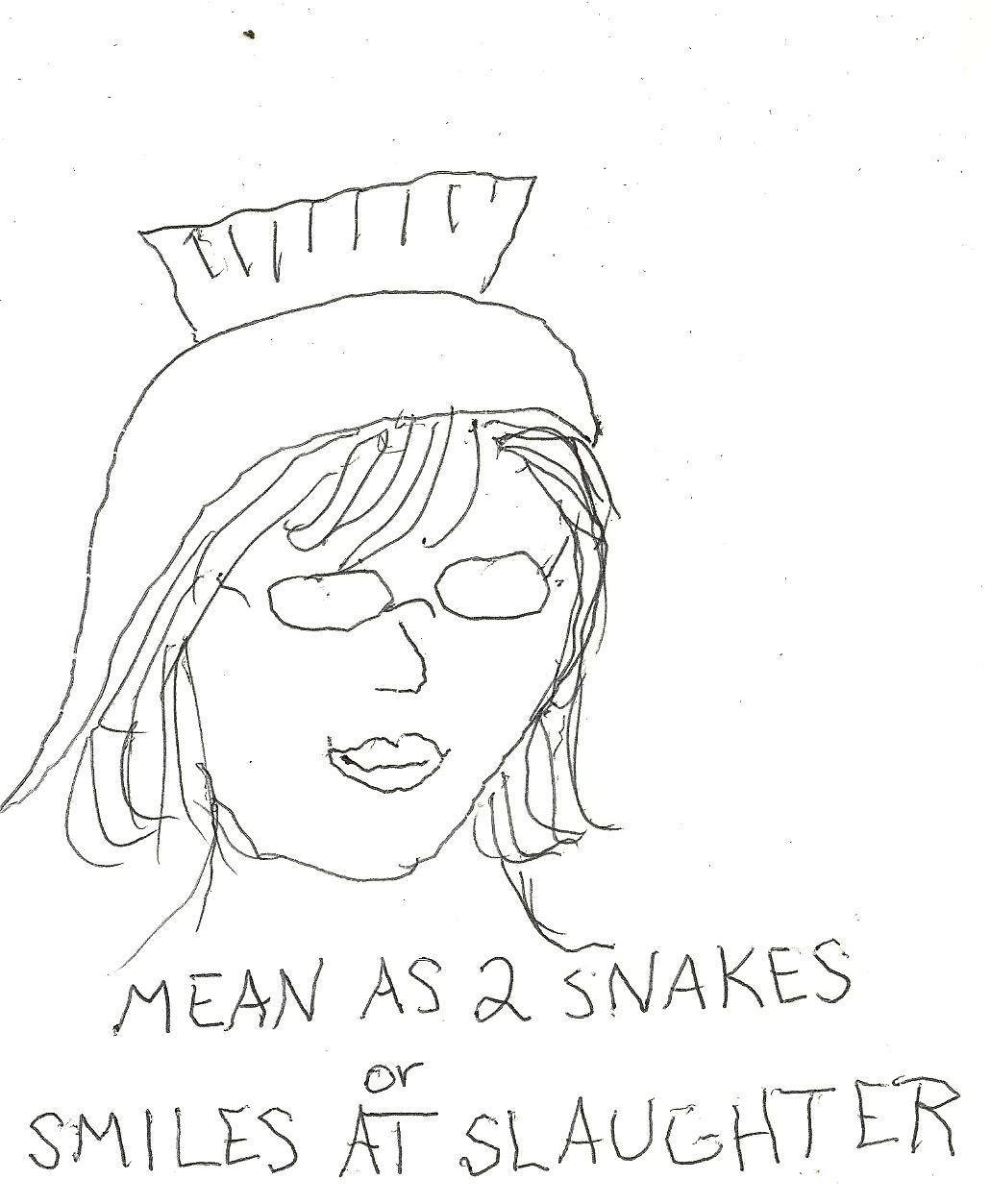
Well, says I, I could probably draw a piece of bread. If I had to. And I like thinking up warrior names. So I sent a submission, along with this note:

I can’t draw worth crap (obviously). And my hands shake, so that makes my drawing even worse. I also can’t download a stock Amazon warrior and paste my face on it (less obviously, but I tried it). But I wanted to play too, mostly so I could think up names. So here is a drawing of me in some sort of helmet. You’re allowed to laugh at it because we’re friends, but I would really rather you didn’t post it on the site unless you have to. I guess if you do, the credit should be by “Word, Not Art, Person (Obviously)” or “Portrait of the Artist as an Amazon, in the style of a Third-Grader, or Maybe James Thurber.”

And here it is:
amazon-1

Later on I figured out that the helmet was actually Marvin the Martian’s.

So that’s the story, and now you’ve had a good laugh.

But watch out. I really am Mean as 2 Snakes.

What’s in a Name?

I’m an obsessive, insatiable reader, and have been since I was four years old. But lately, there’s a trend in books that annoys me mightily.

It’s the names.

I understand that authors want their books to stand out, but I want characters that are memorable for their dialogue, actions, and thoughts. Not a bunch of stupid names.

I’ve got a little list. (And they’d surely not be missed.)

First, let me say that I’m not including science fiction and fantasy books in this rant. Those authors can make up names all day long. (Though the wizard named Alanon made it impossible for me to read that series.)

Digression: Has anyone else noticed that new prescription names sound like alien overlords? Xeljanz. Vioxx. Or damsels in distress? Lunesta. Levitra.

Romance novels may be the worst offenders, though off-putting names can occur in any genre. I think the worst I’ve seen was a couple whose names were Ben Heat and Rebecca Sweet. Ick. Just ick.

Then there was a couple named Faith and Royal. (Royal’s last name was Baxter. I couldn’t help myself. I kept thinking Royal Bastard.)

Last names that are meant to define character are irritating too: Knight, Savage. Another notable was Lexy Baker who was, well, a baker. Like the readers couldn’t figure that out.

First names too: Taffeta (nickname: Taffy), Bliss.

The ones that really annoy me are the cross-gender names. I know this is a trend in real life, not just in books, and we’ll just have to live with little girls named Taylor and Jordan and Madison. Thank you so much, Splash!

But this is getting ridiculous. Here are some actual names of female characters I’ve seen:

Clyde

Josiah

Noa

Dallas

Sloane

I don’t know why those characters aren’t in therapy.

And while we’re on the subject, puns for book titles have gone over the top. I mean, Maui Widow Waltz? Come on. Really?


Why I Won’t See the Hobbit Movies

People who have known me since I was a teenager would be shocked to hear me say that. I was/have been/still am one of the most devoted Tolkien fans ever – since back in the 1970s when the first wave of Hobbit hysteria hit.

I loved the Lord of the Rings movies. I sat in the theater reciting my favorite lines along with the actors. I curled up in my seat in a fetal position and sobbed when the characters left to sail West. These were my friends and they were leaving.

I knew that Peter Jackson had to make some choices in order to film three books. He could not possibly put in everything. Indeed, some fans were upset that favorite scenes didn’t make it in (Tom Bombadil, for example). I was upset by what they put in that wasn’t in the books (the whole Arwen-is-dying nonsense).

Which brings me back to The Hobbit. At first I fully expected to see it. Then I started hearing things that made me doubtful.

It was going to another trilogy. You make a trilogy of films from a trilogy of books; that’s fine. You make a trilogy of films out of a single book and a short one at that, no good can come of it. You will have to add and pad and then Gad! Stuff that Tolkien never wrote – lots of stuff.

It was another dramatic epic struggle between Supreme Good and Primal Evil. The Hobbit was a children’s story, for crying out loud, that Tolkien wrote for his young son. A simple quest story – There and Back Again.  The Lord of the Rings came later, featured more complex and grown-up themes, including sweeping battle scenes with thousands of extras. The Hobbit was not a “prequel.” It was a stand-alone book. But The Lord of the Rings, which was and needed to be a sweeping dramatic epic struggle between powerful, apocalyptic forces, made money and lots of it. So let’s do it again, whether that’s what the first book was about or not.

The characterizations and tone had been changed to make the films more dramatic and serious. My husband was watching it in another room, and I asked him what was up with all the screaming and yelling and battles. He said, “I was watching The Hobbit.” My jaw dropped.

Conflict, sure. Danger, sure. But so much yelling and screaming that I thought it had to be a war film (or Robocop without the guns)? Much of the book was sweetly comic, with just enough threat, suspense, and fighting to keep its intended readers – children – interested. Millions of us as teens and young adults loved the book as it was. We recognized the value of children’s literature, and still do. The Harry Potter books and films had a massive following that included me and my friends in our 40s and 50s and beyond. We don’t need the works revised for “mature audiences.”

The last straw for me, though, was Radagast the Brown, a brother wizard of Gandalf’s. He was mentioned ONE TIME in The Hobbit and had only a tiny role in The Lord of the Rings. He was essential to no plot, subplot, or theme. He was, as they say in opera, a spear-carrier. Or in this case a staff-carrier.

At first I shrugged. More padding. So what? Then I heard what they did with the character.

They PUT A BIRD’S NEST ON HIS HEAD and had him drive a SLEIGH PULLED BY BUNNIES.

There is no excuse for that sort of thing and I am not paying money to see it. I’ll stay home and re-re-re-re-re-re-re-read the book.

Sleigh-bunnies. Feh.

A Book Is a Book Is a Book

One would think that, considering my life-long status as an ardent bibliophile, I would have been one of the first to get my knickers in a twist at the rise of the (shudder) e-book.

But no.

I do admit that books are a wonderful, magical invention and that the solidity and heft of a printed book are a comfort. And the smell of them! When I was a kid I used to haunt Dennis Used Books and the moment I walked in, I was overwhelmed with the scent of paper, dust, ink, spices, pipe smoke, and the warm space heater.

I used to go to the library and come home with glorious stacks of books, each awaiting my avid reading. And rereading. And rereading. My mother would insist that I get at least one book I hadn’t read before.

Even as I write this (on a computer, not with a quill pen and a pot of ink), I am surrounded by shelves of books, stacks of books, piles of books, toppling towers of books, bags of books, autographed books, even a couple of first editions.

I wanted a book within reach everywhere. I had a bedside book, a purse book, a bathroom book, a car book, lest I be stranded somewhere with only a ketchup bottle for company. Hell, I used to buy purses based on how many paperbacks they would hold.  (I would try to make each book a different genre so that I could switch back and forth among them without losing track.)

The thing is, many of my bibliophile friends complain of the insubstantiality of electronic editions. And admittedly, they do not offer the same sensory delights as “dead-tree” editions.

But.

The content of a book is still the same content, no matter how it’s delivered. If each new technology had been rejected for its difference and novelty, I would be sitting here surrounded by scrolls of papyrus and creating these words with a pointed stick and a slab of clay.

Printed books were easier to make and distribute than hand-copied ones. Saint Gutenberg brought inexpensive, widely available reading to the masses. Anyone could own a Bible, a biography, a newspaper, a novel. And bibliophiles were born and said, “It is good.”

E-books have made the written word even more accessible. You don’t even have to go out in the snow. Just press a few buttons and you have a new book – or even a very old one – instantly available.

The e-book functions very much like a printed book. It may not replicate the heft or scent, but it remembers where you stopped reading and goes there promptly. It allows you to look up an unfamiliar word without first hunting down a dictionary. It lets you read in bed without disturbing anyone who is sharing that space.

There are some types of content that are not suited to e-books – picture- or photo-heavy texts, for example. (Though I read National Geographic quite happily on my tablet.) But otherwise, the content of a book is still the content of that book, whether it’s ink on a page or pixels on a screen.

And for me, the e-book holds one overwhelming advantage – the very insubstantiality that others dislike. I now can carry with me, wherever I go, 300+ books. Even 3000, if I want to. To a person with a bad back, this is a godsend.