Tag Archives: humor

Seven Reasons I Hate The Bloggess

jennymeFirst, let me say that I read The Bloggess’s (Jenny Lawson’s) blog all the time. I have her books and I read them all the time too. But secretly I hate her, and here’s why.

1. She had a weirder childhood than I did. She lived in a small Texas town full of farm critters and wild animals, and weird characters, including her father the taxidermist, and has interesting poverty stories, like the one about the bread-sack shoes. I lived in a nondescript middle-class suburb with a stay-at-home mom and a dad that went to work every day smelling of Vitalis and Aqua Velva, rather than deer blood.

(This was also the problem I had trying to write country songs. You can’t get very far with “I was born an industrial engineering technician’s daughter/in the Central Baptist Hospital of Lexington, KY.” But I digress.)

2. She had more interesting pets, with more interesting names than I did. She had a raccoon named Rambo that wore Jams and a delinquent turkey named Jenkins. Later she had a dog named Barnaby Jones Pickles and now has one named Dorothy Barker. Her cats are named Ferris Mewler and Hunter S. Thomcat. We had dogs named Blackie and Bootsie and rabbits named Christina and Mittens. Our recent dogs have been Karma and Bridget, and the only eccentric cat names we’ve bestowed have been Django and Dushenka.

(Ordinarily, I don’t like cat names like Baryshnikat and F. Cat Fitzgerald. I think cat names should be something you wouldn’t be embarrassed to yell out the door if one of them wanders off, like Louise or Garcia. I suppose the Bloggess’s neighbors are by now used to anything. But I digress again.)

3. She has more interesting disorders than I do. I have bad knees and bipolar disorder type 2 (and a blog about it, www.bipolarme.blog). The Bloggess has generalized anxiety disorder, anti-phospholipid syndrome, rheumatoid arthritis, depression, and, apparently, an obsession with chupacabras and vaginas. This gives her much more to write about. Although I do have two blogs. Two! In your face, Bloggess!

4. She’s less inhibited than I am. The Bloggess would have ended that last paragraph, “In your face, motherfucker!” I didn’t learn to cuss till I was in my 20s and no one I meet ever believes I swear until I do. Then they’re shocked. Also, I swear all the time, except in my blogs, where I’m afraid I’ll offend readers, all of whom I assume have tender sensibilities. The Bloggess knows her readers better than that.

5. She has way more readers than I do. And she’s published books and has another coming out. I have some followers, but I think most of them want to sell me books on how to publicize my blog. I should probably study a book like that, but I’d rather read ones about emerging viruses, cloud cities on Venus, and mostly true memoirs. On the other hand, I have the distinction of being the only writer ever to have articles in both Catechist and Black Belt magazines. So take that, moth . . . Bloggess!

6. She and her husband have more interesting arguments than my husband and I do. We never even talk quietly about whether Jesus was a zombie.

7. She has a stronger voice than I do. I mean her writing voice. I had no idea what her speaking voice was like until I saw a video clip of her on the web, talking about vaginas. But when I’m going to write in my blogs, I have to lay off reading her for a day or two, because her voice takes over my weak, tiny mind and it wants to sound like her. I wish I could write like that. Or at least as well as that.

But, like the Bloggess, I am a strangeling. And that’s a start.

The Future of Sex and Cleaning

Forget about all the robot assembly and manufacturing machines that are out to steal our jobs. As far as I can see, the only occupations  chores activities that are likely to be overrun by robotic thieves are sex and cleaning.

Let’s start with everyone’s favorite – cleaning. (I mean favorite in terms of one thing we’d like to have taken off our to-do lists  hands plates – including cleaning the plates.)

Of course everyone knows by now about the Roomba and its cousins, those vacuuming wizards and automatic cat transports. And although they’re not the Jetsons’ Rosie the Robot Maid, they’re fine. As far as they go. Which supposedly is around corners and table legs, over shag carpets and pet stains, and through any detritus (other than Legos, which have overcome every attempt to remove them from floors so that they don’t attack unwary feet. But I digress.).

But do you have any idea what other household chores have been usurped by mechanical minions?

A quick tour around the Internet reveals the possibilities. As of this writing, there are, in addition to mechanized, self-propelled vacuums, robotic:

window-washers

barbecue grill-cleaners

gutter-cleaners

pool-cleaners

dustpans (I can’t make this stuff up)

baby-rockers

plant- and lawn-waterers

and lawnmowers. (At $2100 per, a bit pricey compared to the kid down the street or your own reluctant teenagers. But I digress again.)

It would be nice if there were one robot that would satisfy all our needs  do all that, but unfortunately, every chore needs its own robot. So we humans still have to multitask, even though our machines don’t.

But, speaking of multi-tasking, there is the RealDoll (Abyss Creations), apparently the be-all and end-all  epitome (for now) of sex dolls. They’re easy, but  not cheap. And they’re marketed to men. (Do I need to say that? The sexbots-for-women industry is tiny  minuscule  nearly invisible  not yet growing  unimpressive.) Starting at about what you’d pay for a robotic lawnmower, but rising rapidly  at increasing price points or more, you can have a “plastic pal who’s fun to be with.” (Apologies to Douglas Adams. Couldn’t resist.)

Make no mistake, for that price you’re getting more than your standard blow-up doll. Or blow-up sheep (which I’ve actually seen). More than “just silicone orifices,” according to one writer, the sexbots are jointed, with synthetic skin, and customizations tailored to the customer’s preferences  desires specifications as far as hair color, skin tone, eyes, clothing, booty jiggliness, and genitalia go.

(That customizable genitalia feature has me perplexed. According to the specs, that can mean “removable, exchangeable, flaccid, or hard.” I don’t quite get why someone would want a sexbot with flaccid genitalia. And if you know, don’t tell me. Removable kind of gives me the creeps too. But I digress yet again.)

For those of you not in touch with  an aficionado of  deeply into conversant with the world of artificial intelligence, any number of quandaries are brought into being by the creation of sexbots. You (well, not you) pay for them, so are they prostitutes? What happens when a company decides to make a robo-sex-sheep (and you know they will)? Will a sexbot that can fulfill antisocial desires make it more or less likely that users will act out criminal lusts IRL (as the saying goes)?

Sexbot visionaries have lots of plans for the future: camera eyes for facial recognition, multiple downloadable personalities, etc. The goal is to have either a sexbot that can pass the Turing Test (being indistinguishable from a human being in conversation, the gold standard of AI) or one that you can fall in love with.

Long before then, however, we’re going to need a sexbot-cleaning cleaning robot. ‘Cause otherwise, ew.

How I Faced My Fear … And Failed

This is my idea of hell:

A semitruck rolled early Friday, spilling a load of honeybees on the Interstate 5 median at the Interstate 405 interchange near Lynnwood….As temperatures warmed and the bees became more agitated, firefighters sprayed a mixture of foam and water on the hives to slow down or kill some of the bees. Television reporters swatted at swarms of the insects surrounding their cameras and clumps of bee carcasses littered the roadway.

Yes, I am an apiphobe, also known as a melissophobe. (No, I don’t fear apes. That would be pithecophobia. No, not fear of people named Melissa, either. Seriously? Apis mellifera is the scientific name of the bee. But I digress.)

In actuality, I’ve only been stung by a bee once. I was in my early teens and given to going barefoot whenever possible. While walking through someone’s yard, I happened to step sideways and the outside of my baby toe brushed up against the backside of a bee.

I know the bee had no intention of stinging me. It was an accidental encounter on both our parts. A little baking soda and a bandaid and I was fine. Physically. My lack of reaction to the sting proved that I was not allergic – except in my own mind. Although I hadn’t panicked during the actual stinging, now panic is my instant reaction to the approach of any bees, wasps, or other stinging insect. (Ticks, too. Anything that impinges on my bodily boundaries. It’s a wonder I’m able to have sex at all. But I digress. Again.)

I tried to overcome this fear. I really did.

During my college years, I had a relationship (Mistake!) with a man who intended to keep bees. Somehow I thought that if I studied beekeeping, it might be beneficial to the relationship. (Mistake!) As it happened, the college I was attending had on its faculty Roger Morse, one of the world’s most noted authorities on bees. He did mostly research, but also taught two courses, Anatomy of the Honeybee (which was highly technical) and Beekeeping 101.

I signed up for the beekeeping course – this despite the fact that I was an English Major in the College of Arts and Sciences and the courses on bees were in the College of Agriculture. The university insisted we broaden our minds by enrolling in several classes unrelated to our majors. The beekeeping class consisted of lectures and a lab component. Lectures were sort of nice, and quite interesting. We passed around samples of honeycomb and honey made from the pollen of various flowers and plants – buckwheat honey, orange blossom, and the like. Since then I’ve also had lavender honey, which has to be my favorite.

Lab was something else again. I was OK when we were dissecting honey bees. (When I got to the bee’s wee intestine, I learned that bee poop is bright orange-yellow, which makes sense, because pollen. Everyone poops, and that’s how bees do. But I digress, yet again.) But when we got to tending beehives and interacting with live bees, my old fears came to the fore.

At first, we were given netted helmets, heavy gloves, and smokers, which were supposed to calm the bees. (I still don’t get why spraying smoke into their homes would calm them. It would panic almost any other animal. Although capnophobia, fear of smoke, seems to mean only cigarette smoke. But I digress. As if you haven’t noticed.) The rest of the class gradually got away from using these crutches, but I clung to them the entire time, along with a dose of Valium before lab. I would even eat almond cookies before lab, because I had heard that bees don’t like the scent of almonds. (Which presents the question: Why do they like the scent of almond flowers, but not the nuts? But I digress some more.)

I managed to pass the course, but failed at the relationship and at conquering my fear. To this day, when a stinging insect appears anywhere in my vicinity, even if it is paying no attention whatsoever to me, I freeze, try my best not to scream, and wait in terror for someone braver to shoo the thing away. My husband always tries to convince me that it was not a bee, but a dragonfly or a hummingbird. This does not fool me for a second, but I suppose he’s trying to be helpful.

And now, National Geographic tells us that bee enthusiasts and scientists are trying to create artisanal bees (artisanal honey, okay. But artisanal bees?), in what they call “The Quest for a Superbee.”

Great. Now I get to be a superapiphobe.

Sir Boinks-a-Lot

All our cats have nicknames. Some more than one.

Louise was The Queen of Everything.

Garcia was Mr. Underfoot.

Dushenka is Ms. Crazy Eyes.

(Everyone was Baby-Cat except Louise. Other memorable cats have been Matches (Badness, Checkers), Chelsea (Chips), Shaker (What-a-Pie), Maggie (Gelfling, Gertzie-Girl), Laurel (Keet), Joliet (The Silly Pet), and Bijou (Angel Kitty). But I digress.)

Then there was Django. (He was named after guitarist Django Reinhardt. I figured if Dan could have a cat named after a guitarist, so could I. But I digress again.) A robust gray-and-white male, he was the one we called Sir Boinks-a-Lot.

Would you like to guess how he got his name? Hint: It wasn’t because he boinked a lot.

No, he just tried to boink a lot.

Gender didn’t matter. He would go after either boy-cats or girl-cats – neither with any degree of success. He was neutered. His intended didn’t even have to be another cat. Or even animate. We once caught him trying to mount a feather duster.

But the escapade that earned him his nickname was when he tried to have carnal knowledge of my husband’s elbow. Never mind that there was no orifice. Sir Boinks-a-Lot was determined to make one. He kept drilling and drilling, but he never struck pussy (so to speak).

Dan’s theory was that when he worked on his computer, his forearm resembled the shape of an aroused female cat. His hand and wrist were the head, his arm the body, and his raised elbow the…er…target zone. Or it could be that Django was near-sighted with no sense of smell.

My theory was just that he was a horny bastard. (Django, I mean. We will not discuss how pets come to resemble their owners. But I digress yet again.)

He was also camera shy, which is why there’s a stand-in for him here, but then again, who wants their sexual peculiarities displayed all over the Internet? No, wait. Don’t answer that.

Alas, Sir Boinks-a-Lot is no longer with us, though he proved as determined about fighting cancer as he was about finding someone or something that welcomed his advances. We still miss him terribly.

I think even Dan’s elbow misses him a little. Although it’s tough to tell with an elbow.

A Marriage Made in the Kitchen

Flour, eggs and LoveI think it all started with the naked Julia Child impressions. We were newly married and everything was fun. We weren’t entirely naked while cooking, of course – aprons were a requirement and oven mitts (worn strategically) were allowed. There were other rules, too – no deep-frying, for example, for obvious reasons. Using plummy, authoritative voices we would do a fictitious play-by-play of dinner preparation: “Place the turkey in the oven for 350 minutes at 120 degrees. Oopsie! [take slug of wine].”

Of course, at that stage it wasn’t really a turkey. We were the newly married poor and subsisted on mac-n-cheese, frozen burritos, and anything else that cost $.27 or less. Cooking was simple, fun, and entertaining. Not that we could afford to entertain. All of our friends should be grateful for that.

We didn’t get serious about cooking until years later when friends of ours came up with a recipe they called “Experimental Chicken.” It was wonderful and was wonderfully different every time they cooked it. “By God,” I said, “if Tom and Leslie can cook, so can we!”

At the time, we weren’t foodies. Either they didn’t exist yet or hadn’t made their presence known to the likes of us. Our early attempts at cooking were really “modifying” existing products. We’d take Hamburger Helper “Beef Stroganoff,” substitute stew meat for hamburger, and use real sour cream instead of the packaged powder that was supposed to morph somehow into a sauce. It may not have been actual cooking, but it was an improvement over the boxed version. We also improved mac-n-cheese by adding tuna and peas to it. Protein and veggies! What a great idea!

Then we branched out into original one-pot meals. (We still prefer one-pot meals. Both of us hate to do dishes.) “Cowboy beans” was one of our specialties: ground beef, pork-n-beans, and cheese. Call it minimalist cooking if you want to be kind. As we became more adventurous we began to add ingredients like refried beans, tomatoes, chiles, green peppers, onions, and assorted spices, then serve them with tortillas and salsa for do-it-yourself burritos. We never went back to the $.27 frozen ones.

At last the Food Network came into our lives. Stuck at the time in severe depression, I watched the shows endlessly for the calm voices and helpful tips. I finally learned the term “flavor profiles.” Our cooking life was revitalized. I became the chef and my husband was the sous-chef.

We seldom used recipes. The experimental nature of the original chicken inspiration had stuck with us. We belonged to the look-in-the-fridge-and-pantry-and-go from-there school. “Cut that chicken into bite-sized pieces,” I would say. “No, my bite-sized, not yours. Now pass me the paprika, please. The smoky paprika. Now, everyone into the pool! Mixy-mixy!” We developed our food repertoire to include a killer ratatouille and something that resembled a quiche.

Then came a bigger change – my back wouldn’t allow me to stand at the stove and the tremor in my hands made me dangerous with a knife. So Dan took over as head chef, and I became the food consultant. His first attempts were a little sad. “A casserole needs some moisture in it – milk, stock, or something – to hold it together, especially if there’s rice or noodles involved,” I would gently suggest.

Gradually Dan came into his own. I only had to answer questions about whether I wanted my fish baked or broiled, or whether sage or lemon pepper was needed. Once I explained them, he instantly caught on to shepherd’s pie and frittata. They’re now his signature dishes, so lovely that we could post pictures on the Internet if we were into food porn, and tastier than many a restaurant meal.

I still fondly remember those days of naked Julia Child impressions, though I have no particular desire to recreate them. But since then, our cooking partnership has evolved just as our marriage has – for richer, for poorer, in sickness and in health, with laughter and spice, and a willingness to let each other take the lead at different times. All in all, a tasty recipe for two.

Fish Tales From the Midwest

It’s not as hard as it used to be to find sushi here in the Midwest. It can be hard finding good sushi. Fortunately, I live in a community that contains an Air Force base and a university with programs such as bioengineering that draw a diverse and sophisticated population. It is no longer impossible to find good sushi. The variety may be less than what’s available on either coast or in bigger cities, but someone (like me) with a taste for the Japanese delicacy can find satisfaction, along with sashimi, sunomono, and low-sodium soy sauce.

But it hasn’t always been easy. Here are some fish tales from my journey from doubter to aficionado.

___

The first time I tried sushi was in one of those social situations where it is simply impossible to refuse. (Not unlike the time I first ate egg salad, which I loathe, at my sister’s mother-in-law’s. Since then, I’ve come to tolerate my husband’s version of egg salad. But I digress.)

I belonged to a martial arts club, and one weekend we were invited to the sensei’s house to help answer mail and do some other dojo-related paperwork chores. His wife, a lovely Japanese lady, served up a plate of sushi. That she had made by hand. Using seaweed from her family’s farm in Japan. Short of a deadly fish allergy, there is no conceivable way to refuse such an offer. So we all gulped a little and then gulped a little.

I don’t know what everyone else thought, but I found it odd yet somewhat pleasant. I believe I acquitted myself well. And I decided that if the opportunity ever came up again, I would certainly indulge.

___

That opportunity came on our fifth wedding anniversary. We got dressed up and went to a tony Japanese restaurant about 45 minutes away. (Sushi had not yet penetrated the local market. Now it’s available in the local supermarket and we have a standing order for Wednesdays. But I digress again.)

We ordered a sushi appetizer and tempura entrees. I informed my husband that under no circumstances was he allowed to ask for a knife and fork. The sushi portion of the meal went swimmingly until Dan noticed the little pile of green paste on his plate and scooped up a healthy mouthful. Of course, it was wasabi, and of course, the top of his head blew off. A fan of horseradish in all its forms, he still likes wasabi, but now in more judicious quantities. The pickled ginger is much more forgiving.

(Later in the dinner I complimented him on how well he was doing with the chopsticks, despite his lack of practice. He replied, “Honey, I’m a compulsive overeater. I’d eat with my elbows if I had to.” But I digress some more.)

___

Not everyone is enthusiastic about their first encounter with sushi, or compelled by circumstance to try it. But sometimes another person can be convincing and compelling.

I once dined with a husband and wife at a Japanese restaurant. The wife passed on the sushi.

The husband turned to her and said:

“Do you really want me to tell the children that you wouldn’t even try it?”

Bam! Emotional judo for the win. She had no response possible, aside from the most profound of dirty looks and a small bite of the sushi.

___

I have no problem with people who actually don’t care for sushi – once they’ve tried it. My friend Tom was a case in point. We were dining at an excellent sushi bar and he expressed a desire to give it a try.

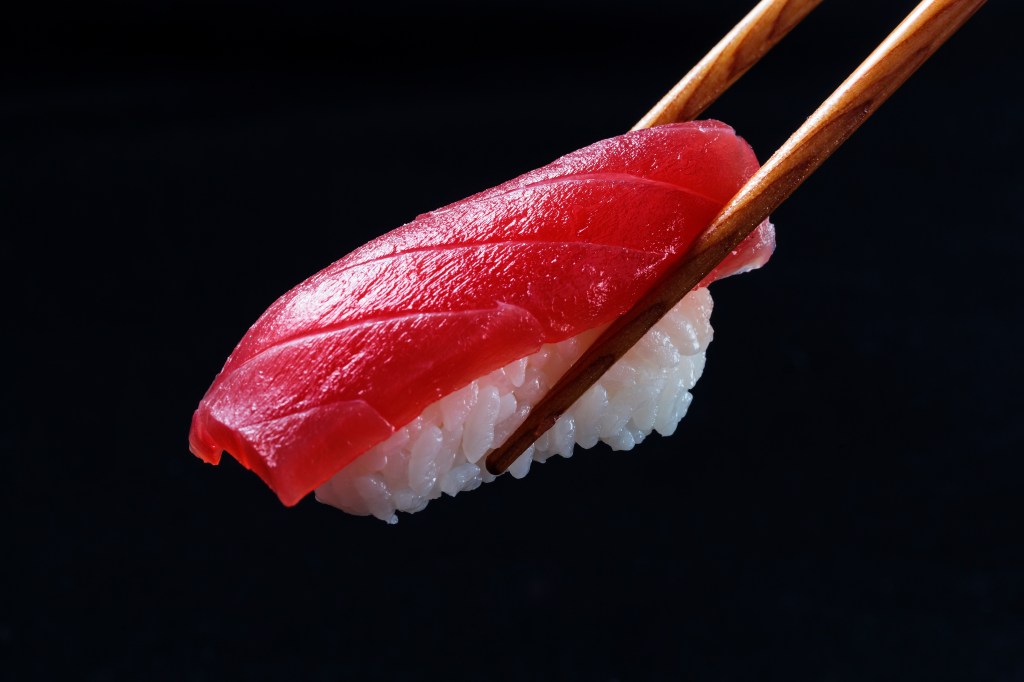
It was beautiful sushi. Gloriously dark red tuna reposed on a pillow of sticky rice. Of course, when Tom asked to try a piece, I had to say yes. If he was ever going to like sushi, this was the piece he would like (aside from oshinko or other non-raw-fish varieties, of course).

And he didn’t like it. But I was so proud of him for trying. Without even the threat of disappointed kids.

___

My husband’s coworkers were not so brave. They had a tradition on birthdays of letting the celebrant choose the restaurant. Dan chose a local sushi bar and had to put up with the disgusted faces and the gagging noises they made as he ate his way through a platter of assorted delights.

Of course, when sushi became trendy a few years later, all the fellows were bragging about how much they loved it. Dan refrained from reminding them that they were raving over what they had once considered – and derided – as bait.

___

And what of fugu fish, the potentially deadly blowfish that, unless properly prepared, can kill with an insidious neurotoxin? Am I brave enough to try that?

Fortunately, I don’t have to answer. There are, to the best of my knowledge, no properly qualified fugu masters in our area and so no fugu on the menu anywhere around.

But suppose I ever get into a social situation where eating fugu is the only possible option. In that case, I like to think I would smile, say, “Domo arigato gozaimasu,” and dig in. It might be the last thing I ever did, but I would die politely.

Romancing the Body

Romance novels have changed since I used to read them. (Yes, I am here publically admitting that I did once read what I called “tempestuous” novels because the cover blurbs always started, “The tempestuous saga of an innocent young woman and the pirate she couldn’t live without.” Hey, I was 16. But I digress.)

The covers of the novels, which were also called “bodice-rippers” back then, usually featured a picture of a man and a woman, with him ripping open her bodice (duh). The man always looked like the king of book covers, Fabio (a famous cover model) or a fair imitation, with lovely flowing locks, a square chin, an intent gaze, and an irresistible (apparently) sneer. The woman was slim, beautiful, and wearing a dress with a bodice (again, duh). She could be soft and yielding or, more often, fiery and tempestuous. If you knew about such things, you could sometimes guess the era in which the tempest played out by the details of the clothing, but usually not. An open, puffy-sleeved shirt and a ripped bodice don’t really convey that much information.

The point is, the cover art generally featured two figures, a man and a woman, with some indication of conflict and/or passion between them.

Not anymore.

I’ve noticed that these days, romance novels tend to have cover art that features a man only.

And not just any sort of man. He will have the physique of a bodybuilder, a hairless chest, no shirt (or one that exposes the entire torso), tight jeans, and not much else. He could be a bodybuilder or a cowboy or a firefighter or a musician or (I suppose) a beach bum, or even, since Fifty Shades, a business tycoon on his day off.

But he has no face.

Where a face should be, there is a shadow or a hat. Or the picture is simply cropped so that the cover doesn’t involve even a hint of a face.

What does this say about women and the men they are attracted to?

In sexual politics, there is a thing called “the male gaze.” It refers to how television and movies and advertising and just about everything else present females that will be pleasing to a man who is looking at them. How women react to the images doesn’t matter. (This can also be called “heteronormative,” but you didn’t come here for a sociology lesson.) The “male gaze” reinforces the idea that stereotypical males value women only for what’s between their neck and their navel, as the saying goes. (Or their neck and their knees, to be more accurate.)

Now, on the covers of romance novels, we have images that are meant to appeal to the female gaze. And what do they show? Besides torsos, I mean?

They show that publishers – or at least their marketing departments – are trying to appeal to the “female gaze.” And they think that gaze rests on the same areas as men’s gazes – neck to knees. To appeal to the romance reader, they think, men should be manscaped and body-sculpted, physical as all get-out. And anonymous.

It may be true that some women do long for anonymous sex these days and that romance novels increasingly sell sex. And it may be that the female gaze is as superficial and body-conscious as the male gaze. Maybe that’s the way it is for women who read romance novels. Maybe the publishers know their audience.

As for me, the things I look for in a man are all above the neck – bright, witty, creative men with facial hair. (In fact, three of those qualities are not just above the neck, but above the eyebrows. And I’ll disregard a guy’s lack of facial hair if the other three qualities are strong. But I digress again.)

That’s what’s romantic as far as I’m concerned. And sexy. But I suppose it doesn’t sell books.

The Bird Who Spoke Cat

My husband and I were strolling through the mall after having a lovely fish dinner with a glass of wine. Well, a couple of glasses, really. We ended up at a Woolworth’s, which back then you could find in a mall. (Woolworth’s is what was known as a five-and-ten-cent store. Kind of like a Dollar Store that mated with a Target store, only cheaper, though nothing there actually cost five or ten cents. Except maybe candy. But I digress.) Once we were there, we browsed our way to the pet department, which five-and-dimes had back then. Mostly fish, turtles, and birds.

We stopped in front of the parakeet cage and gazed admiringly at the tiny flock. “Let’s get one,” Dan said.

“You’re forgetting that we have four cats,” I replied. “A parakeet would hardly be a snack for them.”

“We’ll hang its cage from a hook in the ceiling.” There was at that time no hook. Dan loves even the tiniest home improvement projects.

“I want the blue one,” I said. “I’ve always wanted a blue parakeet. We could name him ‘Blue Boy.'”

“He could be a she. How would we know?”

“If he talks, he’s a boy,” I said confidently. “Mostly the males talk.” (I wasn’t totally sure about this, but I was betting on the fact that Dan didn’t know either.)

“I’d rather get the yellow one.”

“Blue.”

“Yellow.”

“Blue. How are we going to decide?”

Then we made one of our famous deals.

“Let me pick the bird, and you can name him,” said Dan.

“Anything I want?” I asked.

“Anything? Even J. Alfred Prufrock?”

“Yes. Even that.” (Well, really, we were pretty sloshed. I don’t recommend buying a pet while drunk, but this turned out okay. But I digress again.)

So J. Alfred came home with us and lived safely in his cage near the ceiling. One of the cats, Maggie, made an ambitious climb up the drapes after him, but couldn’t figure out how to get from drape to cage and had to be rescued.

We tried to teach the bird to talk. “Hi. I’m Alfie,” we’d repeat to him. “Alfie-bird.”

We were also talking to the cats. Not that we expected them to repeat what we said, but we had interesting conversations nonetheless.

“Shaker, what’s a kitty do?” (Shaker was another of the four cats.)

“R-roww.”

“Yes, that’s right.” (We weren’t always drunk. Sometimes we were just silly. Still are.)

Eventually, Alfie started talking. But bird of very little brain that he was, he got a little mixed up. First, he changed his name.

“Ralphie-bird,” he said. “Hi. I’m Ralphie.”

What could we do at that point? We changed his name to Ralph Waldo Emerson.

But that wasn’t the end of it. Oh, no.

Pretty soon he was saying, “Shaker-bird” and “R-roww.” 

Great. We had a parakeet with an identity crisis. And a cat that was hearing voices from above. From her natural prey, no less. (I was going to write that Ralphie also said, “Here, kitty, kitty,” but he didn’t. Also, it’s a very old, very bad joke. But I digress some more.)

I could just imagine the little conversations Ralphie and Shaker could have.

Ralphie: “R-roww.”

Shaker: “R-roww.”

Ralphie: “R-roww.”

Shaker: “R-roww.”

Pointless, boring conversations, but what can you expect from animals that will never master sign language like gorillas do? Sometimes Dan and I don’t do much better when it comes to conversation. After all, we were the ones who had pointless dialogues with the cat for the parakeet to overhear.

Come to think of it, I don’t really know if their conversations were pointless. They may have been plotting against us. But the cat was cool and never said a mumblin’ word. (H/t Hoyt Axton.)

Fun With Dictionaries. No, Really.

When I was a kid, I had one of those small, plastic record players that came with small, plastic records of children’s songs. One yellow plastic disk had a song on it about dictionaries. I still remember it.

“Oh, the dic-dic-dictionary/is very necessary./Any word that you can cook up/you can look up./Pick the book up.” It also included a verse exhorting children to look up the words “dromedary” and “estuary.” Or maybe “actuary.” The sound reproduction was not that great. Neither word is one that I needed to know until much later in life, but I went through childhood with them stuck in my brain.  For that matter, they still are.

Also stuck in my brain is a dictionary adventure from slightly later in my childhood. Like many – perhaps most – of you, I ventured to the fount of all knowledge to look up “dirty” words. I didn’t find them all (I didn’t know them all at that point), but I found one that made a distinct impression on me. To this day, I can quote the definition of “fart” word for word: “an anal emission of intestinal gasses, especially when audible.” In other words, what was called a “poot” in our household, though that was not listed as a synonym.

There was one dictionary in history that caused quite an uproar, and it was largely (though not exclusively) caused by a different four-letter word: ain’t. Webster’s Third was not the first to include “ain’t” – even Webster’s Second did that. But Web3, notorious for downgrading (or I guess upgrading) usage labels, no longer listed the word as “illiterate” or “substandard,” but merely “colloquial,” or usable in regular conversation, though not in formal speech.

Headlines abounded: “Ain’t Ain’t Wrong, Says Webster’s.” Lexicographers were incensed and language mavens had the vapors. Not to mention the grammarians, who really got their undies in a bundle. The only people not freaking out were the linguists, who considered “ain’t” “nonstandard,” which was what they called a word that others called “substandard.”

(Lexicographers, linguists, and grammarians are different species, whose nether garments bunch at different sorts of things. Let me know if you want to know the difference. I’m lots of fun at parties. But I digress.)

Speaking of parties, there is a nifty party game that can be played with a dictionary, if you’re trapped at a party with no drinks, food, or music. It’s called Fictionary and bears no relation to Pictionary, which at least can get raucous.

For Fictionary, one person, acting as moderator, wields the Webster’s and selects a suitably obscure word. Each participant writes an imaginary definition on a slip of paper, while the moderator writes out the actual definition. The papers are then collected and read aloud. Participants vote on which is the correct definition. If a bogus definition wins out over the real one, that player gets a point. Hilarity ensues.

(The secret to winning a point is to start your fake definition with “of or pertaining to.”)

And speaking of word games, there’s Scrabble (aka Words with Friends if you’re among the techno-literate, which if you’re playing Fictionary you’re probably not).

A fascinating book (for those like me who are fascinated by such things) is Word Freak – not my autobiography, but instead a searing look into the dark underbelly of competitive Scrabble. For those who never thought competitive Scrabble was a thing or that it had a dark underbelly, it is and it does.

Now, of course, dictionaries have been replaced by the computer and particularly the internet. Among the most useful and colorful sites is the Urban Dictionary, where you can find the definition of words like “yeet,” though not its past tense, “yote.” (“Yeeted” seems to have become the past tense, though I’ll stick by “yote.” I still don’t know what the past participle is. “Yoten” is what I recommend, though I’ve never written or spoken a sentence where it was needed. But I digress again.)

The Urban Dictionary proved useful to me once when a character on House, M.D. (okay, it was House himself) used the term “squish mitten.” I pretty much got the meaning from context but felt a need to verify it, just for accuracy’s sake.

Actually, the internet is a good place to get your lexicography. The language changes constantly and rapidly, so the only place you can really keep up with it is online. Although I think it’s fair to say that “fart” hasn’t changed much, is still spelled and pronounced the same way, and still has the definition that made such an impression on me as a kid.

The Ultimate Fashionista – Not Me!

I guess you’d call me a victim of fashion. Or actually, a victim of no fashion. No fashion sense, at least. Fashion nonsensical, maybe.

I’ve always been this way. Being the second child, I always had hand-me-downs, which is probably why I never learned to pick out my own clothes. Also, my mother chose my clothes, which I was okay with until junior high, when I was mortified to see myself on videotape wearing saddle shoes and anklet socks. Quel faux pas!

It was at about that time that people started taking me in hand and trying to fix me up, sartorially at least. (Apparently, the other kind of fixing up was not even an option until I was properly decked out.) My first fashion consultant was a friend who told me that the main thing I should invest in was a pleated plaid skirt with a large gold safety pin. I did not, and thereby missed my chance to be stylish.

When I did develop my own sense of style, it was based entirely around Banana Republic. Khaki and olive drab were my color palette. I lived for the day each month when the new catalog came out with all its exotic descriptions of the clothes and tidbits of travel writing.

Only once did I ever shop in an actual Banana Republic store, in La Jolla. I hyperventilated, which is something I ordinarily do only when shopping for amber jewelry. I made several purchases and used the leopard print wrapping paper as a background on my bulletin board at work. (A co-worker once brought me an empty Banana Republic bag as a gift. “Won’t she be offended?” someone asked her. “She’ll love it,” Marie replied.  And I did. But I digress.)

Later I learned that Banana Republic had an outlet store about 45 miles from my house. Of course, I had to go. This was before outlet malls became a Thing. The BR outlet was in Erlanger, KY, a few miles from the Cincinnati airport (which is in Kentucky, for some reason). Keeping with either the travel theme or the airport theme, the outlet store was housed in a large, hangar-like warehouse, where I could make a proper expedition of shopping. I was crushed when BR stopped publishing their catalogs and again when they were bought out by The Gap. The outlet store was just no fun anymore.

Still, I wore my khaki and O.D., with occasional accents of camouflage. (This was also before camo became a Thing for anyone other than soldiers and hunters.) My mother, perhaps in atonement for all the hand-me-downs, sewed me spiffy camo vests and scarves. Once she even found some camo flannel and made me a floor-length granny-style camo nightgown, which I adored. (She also made me a forest green cape and Robin Hood hat, which I wore to my college archery classes. But I digress again.)

Another friend took me in hand and tried to eliminate the jungle look from my wardrobe. She introduced me to colors outside the neutral spectrum and accompanied me on shopping trips where she picked out my clothes and dressed me up like a Barbie doll. Well, not like a Barbie, really. I didn’t have the figure for it and my feet aren’t permanently shaped for heels. At least I looked respectable enough for work and dressy enough for social occasions, which for some reason I hardly ever got invited to. When she was no longer able to go shopping with me, she thoughtfully kept me supplied with more hand-me-downs from her own extensive and colorful wardrobe.

Gradually, I developed enough color sense to boss my husband around. (“Let me try on the teal jacket. No, the teal jacket! Not the navy blue! Lady, can you show him which is the teal jacket?” “Of course I can’t wear the knit sweater that I wore to the last business meeting! It’s long-sleeved and it’s August. Oh, and it’s not white; it’s cream. Which goes nicely with the coffee stain on it.”)

Now, of course, I’ve abandoned all attempts at fashion. I work at home in my pajamas and keep a year-round wardrobe of nightwear ranging from sleep shorts to men’s flannel pajamas. I buy them on sale out of season. This nabs me cutesy designs (“Feline Sleepy” “It’s Meow or Never”) and nightshirts that look like hospital johnnies. But no one except my husband sees me anyway, so it hardly matters.

And if I do have to go outside, I’ve developed my own special signature collection of clothing in my own style. I call it “Retro Boho Hobo,” and it suits me fine.