Tag Archives: mental illness

Review: Furiously Happy

Buy this book!

Jenny Lawson, aka The Bloggess

Now I’ll tell you why.

First, despite what I wrote a previous post, Seven Reasons I Hate the Bloggess (http://wp.me/p4e9wS-56), I really respect and admire her and her writing.

Second, Furiously Happy is every bit as funny as Let’s Pretend This Never Happened, Lawson’s first book. It’s as raucous and uninhibited as her wildly popular blog.

Third, it’s something more.

Oh, there’s still plenty of weird taxidermy, ridiculous fights with her husband Victor, and even a bizarre travelogue of her trip to Australia. (She was not allowed to cuddle a koala, even when she dressed in a full-body koala suit, but consoled herself with the knowledge that koalas have chlamydia.)

But threaded through  her comic, idiosyncratic prose is a serious message about mental health: that we should speak up about it; acknowledge our struggles; and be determinedly, exuberantly, furiously happy when we can, in defiance of our illnesses.

Furiously Happy is a book for the millions of Americans – one in four – who struggle with mental illness, and for the millions more of their families, loved ones, and friends. It entertains and educates and defies the stigma that surrounds mental illness, without being preachy or mired in statistics.

Lawson has heard from people who have made it only as far as the parking lot of her signings because they too have severe anxiety disorders. Others have driven as much as five hours to attend one of her appearances. In her blog (thebloggess.com) and her new book, she lets people know that we are “alone together,” that even if we’re broken, we still have the capacity for magic.

At a recent book signing, Lawson was visibly nervous when she read two chapters aloud. One of these chapters was the one in which she and her mother discuss what is crazy and whether Jenny is. During the Q&A session at the signing, she took care to make the point that mental illness need not prevent people from being, as she says, furiously happy – if they keep on struggling, fighting, and trying, and especially if they have people around who understand and help.

After that she signed her book and anything else the audience brought until the entire group – which was quite large – was satisfied. No one was turned away from the signing line.

Lawson’s writing is not for everyone. Some people will be turned off by her use of profanity, and perhaps others may not appreciate the serious message that this second book contains. However, if you are looking for more rollicking, uninhibited, and unlikely (though largely true) stories, you will certainly find them here. But if that’s all you want, you may prefer to skip the serious chapters.

On the other hand, if you want to learn about mental illness with its attendant difficulties, and why it is so important to bring these topics out of the closet, as it were, then you may find the storytelling ridiculous, irreverent, or distracting. Personally, I enjoy the whole package, and it’s clear that many others do too.

Actually, the book hardly needs my endorsement. It’s been on the New York Times bestseller list for weeks now, and her book tour is drawing large and enthusiastic crowds. But I’ll recommend it anyway. You can start with her first book and find yourself drawn into the other. Or vice-versa.

You should also check out her blog, both for the content and the commenters, many of whom have found in Jenny an inspiration and in the other commenters a like-minded group of self-admitted weirdos, social outcasts, and yes, the mentally ill. That’s really been Lawson’s message all along. She just states it a little more directly in Furiously Happy.
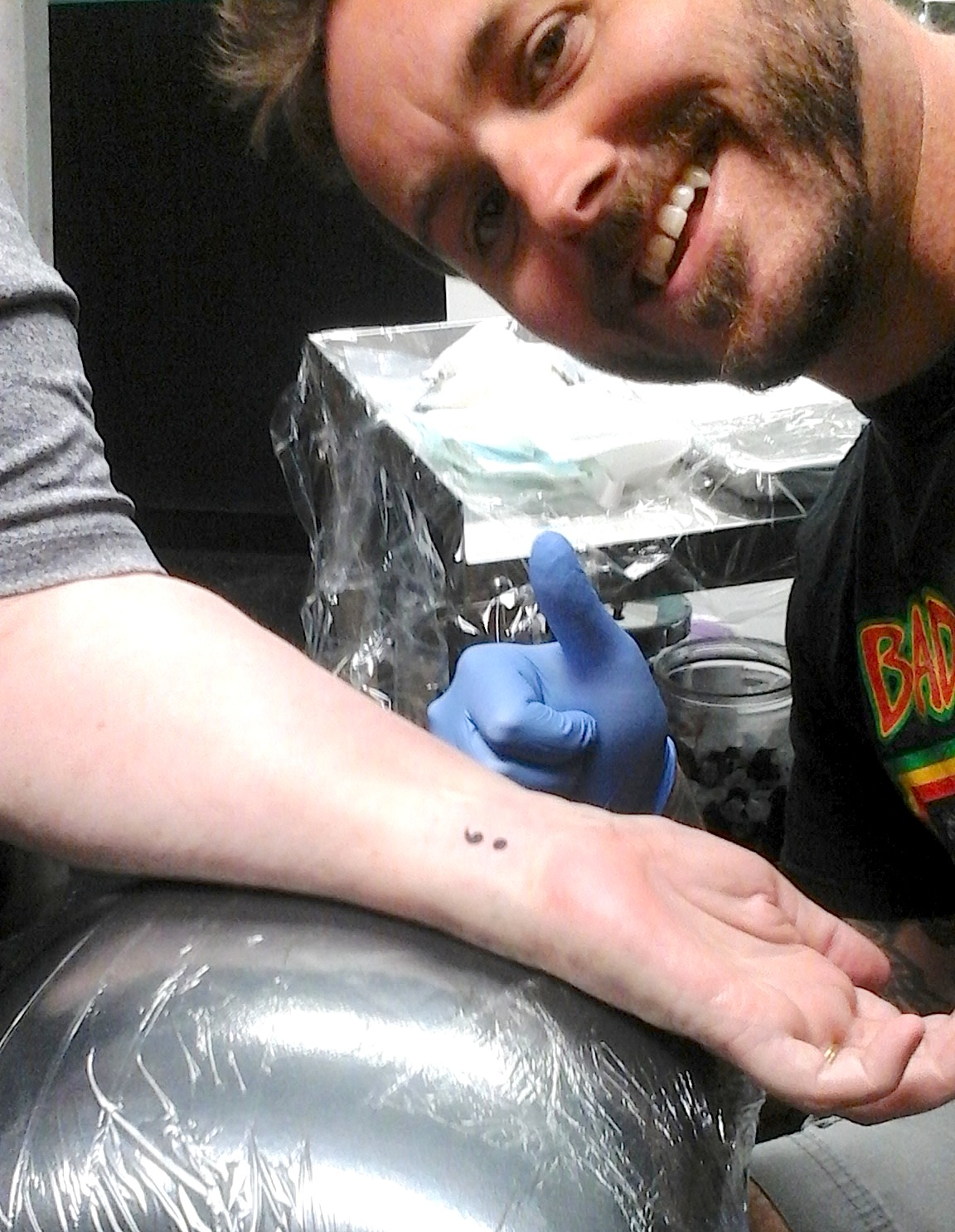
My In-Law and My Ink

I expected a total freak out. I really did. So I tried to work it into a phone conversation as naturally as I could.

“Say Mom, did Dan tell you I got a tattoo?”

Instead of the expected shriek, I got a fairly calm query.(1) “Where?”(2)

If I were being a smart ass I would have said “At Monkey Bones Tattoos.” But I took the sensible route for a change and said, “On the inside of my left wrist.”

Then she asked, “What did you get?”

Again, any number of possible responses crossed my mind. But I decided to play it straight and told her the truth: “I got a semi-colon.”(3)

The next obvious question was, “Why?”

I could have said because I’m a huge grammar nerd, which would have been the truth about me, but not about the tattoo.

I explained as best I could. The semi-colon tattoo is a symbol of mental health awareness and suicide prevention. I rushed through the grammatical part of the explanation: In writing a semi-colon is a place where the writer could have stopped, but chose to go on. The idea is that someone will see the tattoo (4) and ask about it. Then you can explain the symbolism and how you are trying to combat the stigma of talking about mental illness. Like I just did.

I wrote about this on my other blog, Bipolar Me (https://bipolarjan.wordpress.com/2015/08/09/a-tattoo-is-for-life/) when I first got the tattoo, so if you saw it there, I apologize for the repetition.

Actually, no I don’t. The message is one that bears repeating, as often as we can and in as many ways as we can. You know someone with a mental illness(5) and that person is afraid to talk about it because of the stigma that still exists around the subject. I have bipolar disorder, type 2, and I talk about it all the time on my Bipolar Me blog.

Talking about mental illness is risky. You often get one of the standard reactions: a fixed, awkward smile; unwelcome advice about cinnamon or apple cider vinegar; outright disbelief; a decrease in contact with that person; sudden bad reviews at work. Perhaps worst of all, you get, “Isn’t that what the guy who just shot up the shopping mall had?”

Ordinarily, I post to my blog on Sunday. But this is National Suicide Prevention Week, so I wanted to post now. You can find out more about the tattoos at http://www.projectsemicolon.com/.

As Mom R. said about my tattoo, “It’s for a good cause.”


(1) My father-in-law was a Navy man and sported a few of the more common nautical tattoos, so I guess Mom R. had had a while to get used to the idea. Anyway, at least she didn’t go all, “The body is the Temple of God” on me.

(2) Apparently this is the first required question if someone announces a tattoo. Unless it’s on your face, neck or other readily observable spot. I suspect that everyone who asks imagines that it is located some place at least mildly kinky.

(3) Monkey Bones is locally known for extreme, large, and disturbing tattoos, like zombie cows. (I’m not kidding, either.) I think they must have been so embarrassed at being asked to do a pitiful mark of punctuation that they hustled me in and out in ten minutes.

(4) And if we had been Skyping, Mom R. would have, but Skype has been glitchy lately since I changed browsers. So we have our weekly coffee chats over speakerphone. This prevents a lot of Dan handing me the phone and saying, “Here. Say hello to Mom.” Especially when I’m not prepared with any tidbits of conversation, like a new tattoo. Here’s a picture, if you’re curious:

finished
I guess Mike at Monkey Bones isn’t embarrassed after all.

(5) Depression, anxiety, OCD, ASD, whatever. I guarantee it. Someone you know is struggling, and may or may not be getting help for it. A semi-colon tattoo would show you care.

Mental Illness in the News: Some Questions

One of the notable headlines last week that wasn’t about a celebrity celebrity, ridiculous politician, or even the passing of a great and inspiring actor, concerned mental disorders and how society treats those who have them. Those of us who have or care about people with mental disorders may have noticed this story online:

http://www.rawstory.com/rs/2015/02/truly-barbaric-florida-deputy-drags-mentally-ill-woman-through-courthouse-by-shackled-feet/#.VOyTNKh2Gbc.facebook

For those of you who haven’t read it or seen the video, here’s the gist. A woman, Ms. Rios, was declared mentally incompetent at a hearing for a minor offense and not allowed to say goodbye to her mother. She wanted to sit on a bench and cry for a bit. When she did not go promptly with the officer, he dragged her through the courthouse by her shackled feet. A video was taken on a cellphone camera by a lawyer who happened to be present, but had nothing to do with Ms. Rios’s case. If you watch the video clip you can see and hear her distress.

As the headline says, this was barbaric.

But there’s lots neither the headline nor the story says. I have questions.

What is the woman’s mental illness? Or why is she mentally incompetent? The stories vary, usually calling her “mentally ill,” which is shorter for the headline writers, but so far I have seen nothing more specific. One could get the impression that in the mind of the media – and therefore their readers – that the two terms mean the same thing. Was she medicated or unmedicated or off her prescribed meds? Does she have a developmental disability? An autism spectrum disorder? An emotional or behavioral disorder? We don’t know. But does whatever label make her automatically suspected of potential violence? The woman did not behave like an animal even when she was treated like one.

I think we all know people who have mental disorders but are still mentally competent to conduct their own affairs, up to and including court proceedings. In fact, I know you know one – me. I have bipolar disorder, type 2. But who among us, even the sanest and most stable of the general public, wouldn’t have needed to sit on a bench and cry before going to wherever the officer thought we should go? Who wouldn’t yell and protest and try to hold on to a table if we were dragged anywhere by our shackled feet?

Is that the way to calm someone who’s upset?

No?

Why is the officer’s action called “truly barbaric”? I’m not saying it wasn’t barbaric. But how was it more barbaric than other things routinely done to the incarcerated mentally ill (or incompetent)? Could it be “truly” barbaric instead of just regularly barbaric because the officer’s actions were caught on tape? How many everyday barbaric actions aren’t? And putting aside simple human compassion (which he did), didn’t the officer’s actions create a larger, potentially more dangerous disturbance with someone being dragged and thrashing about?

Why did the other officers present do nothing? You can see them on the video. They are spectators. No one says, “Hey, do you have to do that?” or “Give her a minute to calm down” or “Here, let me take care of this” or “You know, there are other ways to handle this” or even “Are you sure you want to do that with the camera rolling?” Nothing. Nada. Zippety. Doo-dah.

Why weren’t the officers and other courthouse personnel trained to handle situations like that? They obviously happen occasionally. Officers are (supposedly) trained to handle situations involving dangerous felons (which Ms. Rios wasn’t), domestic violence, and how to restrain suspects properly. Some even get sensitivity training on race, sexual orientation, and ethnicity. Where’s the training for interacting with the mentally ill (or mentally incompetent)? For de-escalating a situation instead of throwing gas on the fire? How about anger management before incidents like this one happen instead of after? Shouldn’t every law enforcement official be able to control or channel his or her anger and not take it out on the public?

Why the hell aren’t police officers required to wear body cameras – and have someone whose job it is to, oh, I don’t know, review the tapes occasionally? Certainly when there’s been a complaint, but spot checks might also do some good. Why are civilians subject to increasing surveillance, while law enforcement personnel – who are also civilians, by the way – perform their jobs with minimal oversight.

And why is the Golden Rule suspended when the “others” have a mental disturbance? I’d really like to know.

We Don’t Do That Any More, Do We?

Here’s a story that caught my eye recently.

http://www.cnn.com/2014/03/08/us/mississippi-unmarked-graves/index.html?hpt=hp_bn1

It’s long, but worth reading. But for you busy people, I’ll summarize.

Two thousand unmarked graves were found on the grounds of an old hospital. Whose could they be? Civil war dead? Victims of an epidemic?

No. That section of the old hospital was an asylum, and the bodies were those of inmates. The insane. The developmentally delayed. The rebellious. Anyone the family wanted to hide and forget.

Of course, we don’t do that any more. No more locked, back wards. No more Snake Pits. No more Cuckoo’s Nests.

No, the asylums (pardon me, behavioral health residential facilities) have largely been closed and the inmates (pardon me, clients or residents or patients) released.

After their 30 days of insurance coverage run out.

To a group home that has a waiting list longer than the Mississippi.

To outpatient centers that hand out meds that may or may not have an effect or even be taken.

To the streets.

To a society that hates and fears them, lumps them all together as eyesores and NIMBYs, panhandlers, homeless and jobless, and spree killers.

Of course there are mentally ill people who are able to function in society on some level or another. They’re the ones who have likely never been in a locked ward. Those with understanding families, good insurance, nearby therapists, and a support system of friends. People who can hold a job. The ones who hardly ever shoot other people.

Still, the functional mental patients, your coworkers and neighbors and even family members are afraid to “come out” as needing help or getting help. They won’t even admit to taking Prozac, despite it’s being one of the most prescribed drugs in America.

Why is that? Because even if the asylums are gone, largely closed by lack of funding rather than obsolescence, the stigma remains. As a society, we have the impression that all people with mental disorders are psychotics or schizophrenics, lurking nearby just waiting for the chance to get their names in the papers and on TV.

We don’t lock up mental patients much any more. Now we’re humane. We give them apathy, invisibility, fear, and maybe a few drugs.

And the same old stigma.