Tag Archives: reading

Life With Furniture

I’ve never had what I’d call a profound relationship with a piece of furniture. (Except for my bed. It’s an example of Amish woodworking, some kind of hybrid of a sleigh bed and a mission bed. Our relationship was shattered when we bought a mattress that came with an alarm. Unfortunately, the salesman neglected to tell us what tune it played. When we woke the next morning to the cheerful computerized strains of “It’s a Small World,” we swore a solemn oath to rip out both the alarm mechanism and the salesman’s larynx. But I digress.)

All that changed when I broke my ankle in two places. (I should specify. Two bones in my ankle were broken. I broke them in one place, my study, at the same time. But I digress again.) Since then, I have been living in my study and bonding with the recliner.

The thing is, I have to wear a giant black boot on my right leg. Despite the fact that the injury was to my ankle, the boot starts just below my knee. It features a plastic skeleton and exoskeleton, a foam liner, and far too much Velcro. It weighs, by my estimation, about eight pounds. I walk with a limp, not because of the broken ankle (well, not just because of that), but because I have no shoe (singular) with a sole as thick as the boot’s to wear on my left foot. And the recliner is the only furniture that can truly accommodate my needs.

Our house has a second floor, where the bed lives. But I can’t climb the stairs. Climbing them was iffy even when I used a cane (before the ankle accident but after the knee replacement). I’m living in the first-floor study that was the scene of my injury, and giving daily thanks that there’s a bathroom on both floors.

Dan brought a recliner down from upstairs. It doesn’t match the “decor,” and it doesn’t recline all the way. I can extend the footrest to horizontal, but reclining the back and headrest requires a maneuver that I’m physically unable to accomplish. It involves throwing your entire body weight against the backrest. (I have plenty of body weight, but not the strength to fling it with sufficient force. But I digress some more.)

I can at least sleep with my head supported and my legs straight rather than dangling. I sit in the recliner with my legs elevated to read, watch TV, and use my phone. To get to my real computer, I have to sit in my desk chair, where my legs dangle. (Evidently, dangling allows fluid to accumulate in my legs. It happened once. My thighs looked like Christmas hams. My cankles and the tops of my feet looked like puff pastry. My toes looked like Vienna sausages. But I digress even more.)

I see my surgeon on the 8th, and hope to graduate from the boot to something less confining. I was so happy to get the boot in the first place, as it allowed my foot at last to bear weight. (Ever tried using a walker with a knee sling? Don’t.) Now I can’t wait to get rid of the most recent torture device.

I’ll take the boot and the recliner, though, for as long as necessary. One benefit to the arrangement is that our cat Toby loves to lie on my lap as I recline and sleep there to his heart’s content. It makes my recliner extra-cozy and comfy, even if I can’t sleep lying all the way down.

Down the Rabbit Hole

Almost five years ago, I wrote a post about how memories from my (and likely your) childhood were being repurposed for political statements and propaganda.

This time I’m writing about a classic piece of literature being rewritten for other purposes. (Largely unobjectionable ones, it’s true, but it’s the principle of the thing. But I digress.)

The work in question is Alice’s Adventures in Wonderland (more often known as Alice in Wonderland). It’s one of my favorite pieces of literature and I have returned to it many times since I first read it (murfle) decades ago.

(I have a friend who despises Alice. He finds it to be nonsense (which it obviously is) and incomprehensible. This despite the fact that he has returned to it frequently to see if it makes any more sense. (He ought to like at least part of it because he’s a mathematician, like the author, Lewis Carroll. I recommended The Annotated Alice (edited by Martin Gardner), which explains the jokes, Briticisms, and outdated expressions. (It also includes “Jabberwocky” in French, German, and IIRC, Latin.) But I digress, pedantically and at length.)

The “quotations” in question are not political but psychological or philosophical. I’m not saying they’re invalid—merely that they are misquoted, misattributed, or completely made up.

One of the most common misquotes is attributed to the Cheshire Cat:

“You’re mad, bonkers, off your head. But I’ll tell you a secret. All the best people are.”

What the Cheshire Cat actually really said is much more complex. Here’s the context:

“But I don’t want to go among mad people’” Alice remarked.

“Oh, you can’t help that,” said the Cat: “we’re all mad here. I’m mad. You’re mad.” 

“How do you know I’m mad?” said Alice.

“You must be,” said the Cat, “or you wouldn’t have come here.” 

One quotation supposedly from the Mad Hatter is:

The secret, Alice, is to surround yourself with people who make your heart smile. It’s then, only then, that you’ll find Wonderland.

Unobjectionable if sappy, but not from the book. The same with this one:

But, said Alice, if the world has absolutely no sense, who’s stopping us from inventing one?

The most annoying fake dialogue is this one, between Alice and the White Rabbit.

“Do you love me?” Alice asked.

“No, I don’t love you!” replied the White Rabbit.

Alice frowned and clasped her hands together as she did whenever she felt hurt.

“See?” replied the White Rabbit. “Now you’re going to start asking yourself what makes you so imperfect and what did you do wrong so that I can’t love you at least a little. You know, that’s why I can’t love you. You will not always be loved Alice, there will be days when others will be tired and bored with life, will have their heads in the clouds, and will hurt you. Because people are like that, they somehow always end up hurting each other’s feelings, whether through carelessness, misunderstanding, or conflicts with themselves. If you don’t love yourself, at least a little, if you don’t create an armor of self-love and happiness around your heart, the feeble annoyances caused by others will become lethal and will destroy you. The first time I saw you I made a pact with myself: ‘I will avoid loving you until you learn to love yourself.’”

The White Rabbit was late to play croquet with the Queen of Hearts. He wouldn’t have had time to discourse on self-love.

Alice has been in the public domain since 1907, so one can misquote or invent all they want. (The Disney movie version only came out in 1951, The book was in the public domain, but the movie isn’t. I think we can expect a live-action film. I hope they lose the repellent pink-and-purple Cheshire Cat, though I doubt they will. But I digress again.)

Surely no one would do this kind of thing to The Wizard of Oz…or would they? [squints suspiciously]

Go. Be Funny.

Once the boss editor gave me an assignment. “Go,” he said. “Be funny,” he said. “Come back in an hour.” We were preparing a calendar with amusing sayings and odd observances on various dates.

Now, most writers would be daunted by this sort of thing. I know I was. But in an hour, there I came, quips in hand. “Is this job too easy for you?” he asked.

Actually, writing funny stuff is not easy. I was just feeling quirky that day. (“Dying is easy. Comedy is hard” is a quotation that’s been attributed to any number of those shuffling off the mortal coil, from actors Edmund Gwenn to Jack Lemmon to Peter O’Toole to Meryl Streep (who, not having died yet, almost certainly didn’t say it on her deathbed). But I digress.)

The geniuses of Monty Python certainly seem as though they created comedy easily. And I know a man who can write a funny song, a la Weird Al, in 15 minutes or less. But for most of the writing world, humor is the hardest form of writing. (Except possibly the sestina. Or the humorous sestina, come to think of it. But I digress again.)

How do you build up your humorous writing muscles to the point where you can flex? I recommend hanging out with silly people, like the aforementioned songwriter. (If you’re tempted to use AI, forget it. I asked ChatGPT to write a joke about a cat. It replied, “Why did the cat sit on the computer? Because it wanted to keep an eye on the mouse!” Asked for a joke about a dog, it said, “Why did the dog sit in the shade? Because he didn’t want to be a hot dog!” Apparently, ChatGPT writes at the level of a five-year-old. And when I asked for a humorous sestina, it created one about a knight named Sir Guffaw and his tap-dancing horse. But I digress yet again.)

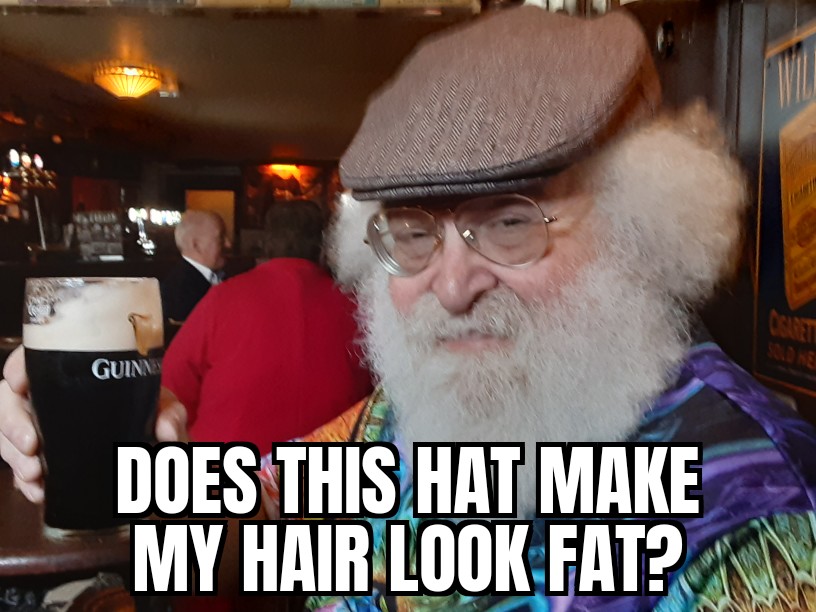
My next piece of advice is to have a cat or a spouse. Cats are not dignified, contrary to their reputations. One of our cats tried to escape from the vet and bonked her head on the glass door to freedom. And my spouse does and says funny things, or prompts them from me. For example, I once took a picture of him in a tweed cap and turned it into a meme (seen here, as you can no doubt tell.)

You can also turn trauma into humor. I once found myself having to get rid of a dead possum, which certainly traumatized me. Another time I almost offed a friend with a bay leaf. Those alarming events worked their way into killer posts, so to speak.

Reading humor can help, too. Think David Sedaris and The Bloggess. For irreverence, there’s Lamb: The Gospel According to Biff, Christ’s Childhood Pal, by Christopher Moore. For vintage humor, there are James Thurber and Erma Bombeck. (Given the example of Thurber and Bombeck, being from Ohio helps too. But I digress some more.)

Then there are humorous movies. Personally, Airplane can still make me LOL. (So can Zero Hour, the film from whence Airplane‘s plot and many lines of dialogue came, only deadly serious. It’s impossible to watch without flashing back (or forward, since Zero Hour is the older movie). But I digress yet again.)

But for myself, I like a good catchphrase that didn’t come from a TV show or movie. It came into being because I wanted to write little asides and put them in as footnotes. But I couldn’t figure out how to make WordPress do that, so I turned to my grammatical friend, the paren. (Not really my favorite mark of punctuation, which is the semicolon. But I digress for the last time this post. I swear it.)

How to Start a Conversation

I never used to be any good at small talk. I would stand there, tongue-tied, while conversation went on around me. I was afraid I had turned invisible.

Then I met Erma the Armadillo, pictured here. She’s a purse that my mother bought for me from a catalog called, appropriately, What on Earth. This was back in the 90s, and I don’t think she spent more than $25 on the purse. When it came time to scare up a photo to go with this post, I found that today Erma is considered “vintage” and sells for as much as $140, used.

(I have a thing about armadillos. I fell in love with them when I learned that their main defensive technique is to jump straight up two feet, and their main natural predator is the automobile bumper. My defense mechanisms are like that, too. But I digress.)

Erma was actually a lousy purse. She was stuffed with cotton and had only a small zippered slot that would barely hold a driver’s license and a little cash. I had to carry anything else in my pockets. But what she was good at was starting conversations. Not that she spoke, but when other people saw her, they did.

People were fascinated. They always remarked on what an unusual purse Erma was. I would point out that she even had little tiny toenails printed on her stubby little feet. They’d ask where I’d gotten her. They’d ask why I wanted an armadillo purse. They’d ask more questions and share about other purses they’d seen or owned. Children were especially captivated by Erma. They couldn’t get over the fact that she wasn’t a toy and that she had handles. They always wanted to touch her, and I always let them.

When it comes to starting conversations with strangers, I always recommend accessories. My jewelry collection has some peculiar specimens. I have a sushi necklace that my friend Leslie made for me from air-dry clay. I also have a pair of bacon earrings, though I never mix cuisines in an outfit. Another set of earrings that people found amusing were the ones that looked like the planet Earth, complete with continents. (When I wore them, I liked to shake my head violently and shout, “Earthquake!” But I digress again.)

Conversation goes both ways, of course. “That’s an awesome (fill in the blank). Where did you get it?” is a good start on a good chat. People love to tell stories about their possessions, gifts, travels, etc. From there, conversation is an easy two-way street.

(It can fall flat from time to time. I once shared an elevator with a woman who had itsy-bitsy feet. I felt like I might have been staring at them. So I cleverly said, “Those are great boots! They make your feet look really small!” She replied, “They are really small.” After that, the conversation, and the elevator ride, ended. But I digress some more.)

I don’t know how people who don’t have unusual accessories start conversations. “Is that a good book you’re reading?” is one ploy, but it hardly ever works. Most people don’t read books in public, and if they do, they don’t like to be interrupted. And when I read books in public (which I do), I read them on my e-reader or phone, so the general public just thinks I’m doom-scrolling (which I don’t do).

Erma is no longer with me. Her handles wore out and Dan was unsuccessful at replacing them, which he tried to do. I don’t go out much anymore but when I do, I miss her. And the conversations.

I Can’t Commit

Of course, that’s not completely true. There are things I can commit to—my husband, for example. We’ve been married for 41 years, which I think is proof aplenty.

What I can’t commit to are things that go on too long. (The marriage does not fit into that category.)

Let me explain.

Movies

In the evenings, when my husband and I have finished dinner, he often wants to watch a movie, but I don’t often agree to it. I hate leaving a movie in the middle, but I also hate staying up past my bedtime to finish one. It’s a delicate balance.

For example, after the recent eclipse, we decided on Ladyhawke, which was relevant, but I couldn’t make it all the way through. We had to watch the second half the next day and that upset my internal clock, not to mention my sense of continuity. If a movie starts at 8:00, it’s pretty much out of the running for me. I’m a little old lady and don’t like staying up past 9:00. (And you can get off my lawn. If I had one, I mean. Dan is aiming for a pollinator garden. But I digress.)

TV Series

When it comes to TV, I hate to start a series because I realize I’ll never keep up with it every week. This doesn’t apply to series that have already finished. Often, old episodes of House, Buffy the Vampire Slayer, Castle, Inkmaster, Chopped, or Bones are shown for several hours a day, and those I can tolerate multiple episodes of. (That may sound counterintuitive. The difference seems to be that I don’t have to pay attention to them. I usually have them on when I’m doing something else like writing. They’re just my emotional support background noise. But I digress again.)

Books

I used to be able to tolerate series of books. I devoured The Lord of the Rings, Asimov’s Foundation trilogy, Lloyd Alexander’s Prydain series, Sue Grafton’s Alphabet books, and other long-running written endeavors. Not anymore. I buy many of my e-books from discount sites for $1.99 or $2.99 (because I’m cheap). Many of them, as you might suppose, are not exactly scintillating. Some of them are so dreadful I give up on them well before I reach the denouement.

(One of the first ones I ever committed libris interruptus on was a horror novel that started by introducing the protagonists. They were perfect. Perfect looks. Perfect jobs. Perfect house. Perfect marriage. Perfect kids. By the end of the first chapter, I was rooting for the monster, which hadn’t even shown its tentacles, fangs, slime, or whatever. But I digress some more.)

I recently discovered that even book series I love can be too much of a commitment. I recently reread the three volumes of The Lord of the Rings, but couldn’t jump right into The Silmarillion. I love Lois McMaster Bujold’s Vorkosigan series and set out to reread them all, but pooped out after book ten. I needed a break (a la Friends) and haven’t come back to finish the other four. Yet. I have a feeling that after 600 pages of Midnight in Chernobyl, my current good read, I’ll be ready. (I hate the phrase “a good read.” It sounds too much like saying someone is a “good lay.” But I digress yet again.)

I haven’t even reread my own books (Bipolar Me and Bipolar Us). They don’t constitute much of a series and would make a terrible movie. But that’s not the reason. There’s a terrible typo in the first one, and I’m afraid I’ll find one in the second as well. If I weren’t depressed about the slim sales, that would do it.

The Latest Book Trends

(I shall begin with a digression. Actually, I can’t guarantee that these are actually the very latest book trends. I buy a lot of my ebooks based on newsletters from FreeBooksy and BookBub because they promote heavily discounted books, not all of which are, technically speaking, new. But most of them cost under $3 and, at the rate I buy books, I need to economize somewhere.)

That said, I have noticed what seem to be trends.

The first one is not a book trend, per se. It’s a trend in book covers. What’s hot right now (apparently) is book covers that don’t show faces. I’ve written about how men on the covers of romance novels are cut off at the neck (so to speak) or lost in the shadow of a cowboy hat, but these books feature mostly women on the covers. And they don’t have faces either.

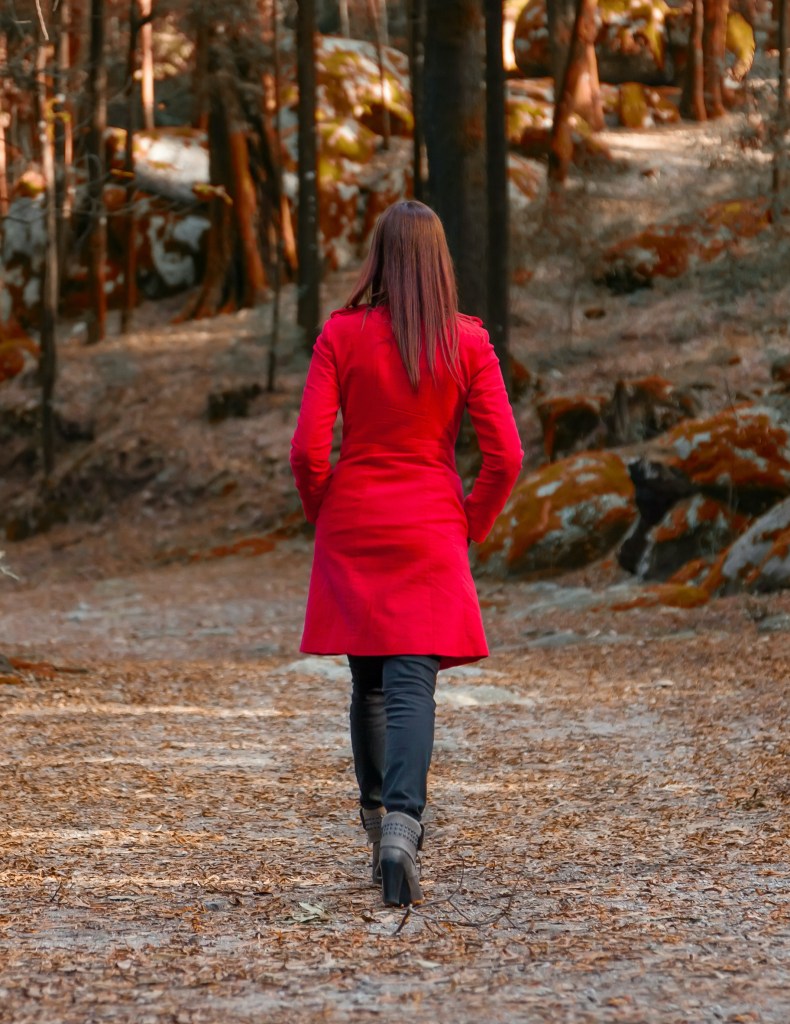
The most common reason for this is that the woman or women are walking away from the person viewing the cover. (Bonus points awarded if the woman is wearing a red coat.) I don’t know why this trend has come to the fore, but I suspect it’s because the cover designers don’t like to draw faces or don’t want to read enough of the book to learn what the main character looks like. Or maybe the women are supposed to be all mysterious. Or the reader is supposed to imagine the woman having their own face. Like I said, I don’t know.

(A while back I noticed that there was a book cover that featured a man in a top hat walking through the rain, in the night, beside a wrought iron fence. In fact, there were two different books that had exactly the same cover. Both were terribly atmospheric mysteries or dark Victorian tales. I guess someone made the cover for one and an unimaginative art director tried to get away with using it twice. I noticed, however. But I digress again.)

Now, as to the contents of the books, I’ve noticed trends as well. When it comes to cozy mysteries, cats are perennially favorite characters or even sleuths. And Rita Mae Brown credits her cat, Sneaky Pie Brown, as co-author of her mystery series. Cats are as popular as ever, or more so. Every self-respecting woman in a modern romance novel has a cat.

Many of those romances take place in libraries and bookstores. The trope of the young woman who moves to a small town to restart her life, taking up the job of librarian or bookstore owner and meeting the love of her life, after suitable conflicts and misunderstandings, is a common plot. (Librarians are no longer portrayed as lonely spinsters—mostly. There can be an older librarian as a mentor and confidante, at least regarding the book aspects of the story. But I digress more.)

You can easily see what’s coming. The romantic heroine has both a bookstore and a cat. And the covers of the books reflect that. In fact, sometimes the cat and the books are all that appear on the cover. The woman herself is missing in (romantic) action.

One other trend that I’ve noticed in romance novels (I don’t actually read them, you understand—I learn about them through reading blurbs) is that, although traditionally the stories involve reckless, passionate, consequence-free sex (the “zipless bleep” that Erica Jong made so popular in Fear of Flying), is that increasingly, pregnancy results from the sex. (No, I’m not saying that romance novels are getting more realistic. They still involve royalty and billionaires, after all. And men from Scotland apparently are popular now, as in the book titled Too Scot to Handle. But I digress still more.) The pregnancy adds an extra layer of potential complications, such as the impending parenthood needing to be kept a secret.

If you’ve noticed any other book trends, feel free to share ’em. In the meantime, I’ll keep looking for a book that features a man in a red kilt walking through the door of a bookstore with a pregnant cat in the window.

Seven Reasons I Hate The Bloggess

jennymeFirst, let me say that I read The Bloggess’s (Jenny Lawson’s) blog all the time. I have her books and I read them all the time too. But secretly I hate her, and here’s why.

1. She had a weirder childhood than I did. She lived in a small Texas town full of farm critters and wild animals, and weird characters, including her father the taxidermist, and has interesting poverty stories, like the one about the bread-sack shoes. I lived in a nondescript middle-class suburb with a stay-at-home mom and a dad that went to work every day smelling of Vitalis and Aqua Velva, rather than deer blood.

(This was also the problem I had trying to write country songs. You can’t get very far with “I was born an industrial engineering technician’s daughter/in the Central Baptist Hospital of Lexington, KY.” But I digress.)

2. She had more interesting pets, with more interesting names than I did. She had a raccoon named Rambo that wore Jams and a delinquent turkey named Jenkins. Later she had a dog named Barnaby Jones Pickles and now has one named Dorothy Barker. Her cats are named Ferris Mewler and Hunter S. Thomcat. We had dogs named Blackie and Bootsie and rabbits named Christina and Mittens. Our recent dogs have been Karma and Bridget, and the only eccentric cat names we’ve bestowed have been Django and Dushenka.

(Ordinarily, I don’t like cat names like Baryshnikat and F. Cat Fitzgerald. I think cat names should be something you wouldn’t be embarrassed to yell out the door if one of them wanders off, like Louise or Garcia. I suppose the Bloggess’s neighbors are by now used to anything. But I digress again.)

3. She has more interesting disorders than I do. I have bad knees and bipolar disorder type 2 (and a blog about it, www.bipolarme.blog). The Bloggess has generalized anxiety disorder, anti-phospholipid syndrome, rheumatoid arthritis, depression, and, apparently, an obsession with chupacabras and vaginas. This gives her much more to write about. Although I do have two blogs. Two! In your face, Bloggess!

4. She’s less inhibited than I am. The Bloggess would have ended that last paragraph, “In your face, motherfucker!” I didn’t learn to cuss till I was in my 20s and no one I meet ever believes I swear until I do. Then they’re shocked. Also, I swear all the time, except in my blogs, where I’m afraid I’ll offend readers, all of whom I assume have tender sensibilities. The Bloggess knows her readers better than that.

5. She has way more readers than I do. And she’s published books and has another coming out. I have some followers, but I think most of them want to sell me books on how to publicize my blog. I should probably study a book like that, but I’d rather read ones about emerging viruses, cloud cities on Venus, and mostly true memoirs. On the other hand, I have the distinction of being the only writer ever to have articles in both Catechist and Black Belt magazines. So take that, moth . . . Bloggess!

6. She and her husband have more interesting arguments than my husband and I do. We never even talk quietly about whether Jesus was a zombie.

7. She has a stronger voice than I do. I mean her writing voice. I had no idea what her speaking voice was like until I saw a video clip of her on the web, talking about vaginas. But when I’m going to write in my blogs, I have to lay off reading her for a day or two, because her voice takes over my weak, tiny mind and it wants to sound like her. I wish I could write like that. Or at least as well as that.

But, like the Bloggess, I am a strangeling. And that’s a start.

Romancing the Body

Romance novels have changed since I used to read them. (Yes, I am here publically admitting that I did once read what I called “tempestuous” novels because the cover blurbs always started, “The tempestuous saga of an innocent young woman and the pirate she couldn’t live without.” Hey, I was 16. But I digress.)

The covers of the novels, which were also called “bodice-rippers” back then, usually featured a picture of a man and a woman, with him ripping open her bodice (duh). The man always looked like the king of book covers, Fabio (a famous cover model) or a fair imitation, with lovely flowing locks, a square chin, an intent gaze, and an irresistible (apparently) sneer. The woman was slim, beautiful, and wearing a dress with a bodice (again, duh). She could be soft and yielding or, more often, fiery and tempestuous. If you knew about such things, you could sometimes guess the era in which the tempest played out by the details of the clothing, but usually not. An open, puffy-sleeved shirt and a ripped bodice don’t really convey that much information.

The point is, the cover art generally featured two figures, a man and a woman, with some indication of conflict and/or passion between them.

Not anymore.

I’ve noticed that these days, romance novels tend to have cover art that features a man only.

And not just any sort of man. He will have the physique of a bodybuilder, a hairless chest, no shirt (or one that exposes the entire torso), tight jeans, and not much else. He could be a bodybuilder or a cowboy or a firefighter or a musician or (I suppose) a beach bum, or even, since Fifty Shades, a business tycoon on his day off.

But he has no face.

Where a face should be, there is a shadow or a hat. Or the picture is simply cropped so that the cover doesn’t involve even a hint of a face.

What does this say about women and the men they are attracted to?

In sexual politics, there is a thing called “the male gaze.” It refers to how television and movies and advertising and just about everything else present females that will be pleasing to a man who is looking at them. How women react to the images doesn’t matter. (This can also be called “heteronormative,” but you didn’t come here for a sociology lesson.) The “male gaze” reinforces the idea that stereotypical males value women only for what’s between their neck and their navel, as the saying goes. (Or their neck and their knees, to be more accurate.)

Now, on the covers of romance novels, we have images that are meant to appeal to the female gaze. And what do they show? Besides torsos, I mean?

They show that publishers – or at least their marketing departments – are trying to appeal to the “female gaze.” And they think that gaze rests on the same areas as men’s gazes – neck to knees. To appeal to the romance reader, they think, men should be manscaped and body-sculpted, physical as all get-out. And anonymous.

It may be true that some women do long for anonymous sex these days and that romance novels increasingly sell sex. And it may be that the female gaze is as superficial and body-conscious as the male gaze. Maybe that’s the way it is for women who read romance novels. Maybe the publishers know their audience.

As for me, the things I look for in a man are all above the neck – bright, witty, creative men with facial hair. (In fact, three of those qualities are not just above the neck, but above the eyebrows. And I’ll disregard a guy’s lack of facial hair if the other three qualities are strong. But I digress again.)

That’s what’s romantic as far as I’m concerned. And sexy. But I suppose it doesn’t sell books.

Oh, Boy! Day Off!

Days off are great! Most people get two days off a week and fill them up with a number of things, from picnics in the park to errands they couldn’t take care of during the week. Mostly, that occurs on weekends, which are eagerly awaited and finished with reluctance.

My husband and I have different attitudes regarding days off. This was recently brought home to me when we each had a chance to explore what days off meant to us.

Dan actually had five days off in a row. Before you gasp in amazement, he didn’t actually take five days off work. He took three vacation days and smushed them together with his normal two days off to make a solid week.

I had one day off this week. I do project-based work rather than a regular 9-to-5. When my previous project was over, I scheduled one day off before I started my next one. (I’m not a total masochist. Since I don’t work 9-to-5, I can fill up those hours however I like. I generally work for a few hours in the morning and longer in the afternoon. In between, besides lunch, I make phone calls and deal with bills, banking, appointments, and other “housekeeping” issues. (Non-housekeeping housekeeping, if you get my drift.) But I digress.)

So, what did we do with our respective days off? Dan slaved. I relaxed.

Dan had been anticipating his days off for literally months. He did have to request them off at work since they were technically vacation days. But most of the planning consisted of ordering plants from online nurseries, staking out local nurseries for sales, and scheduling deliveries of literal truckloads of compost and mulch.

So, Dan spent a lot of his time off planting everything that had been delivered and a few more of the plants he picked up locally. He decorated his garden bed with large rocks. He watered and rototilled nearly every day. (I once knew a man who rototilled naked. He was very brave. (The first Saturday in May is Naked Gardening Day, in case you didn’t know. Dan does not celebrate it, much to our neighbors’ relief.) But I digress again.)

After five days of this, what did Dan have at the end of it? A lovely, large flowerbed (with no thistles) and a flourishing vegetable garden. And a ton more plans that would require even more truckloads of mulch and compost, pounds of micro clover seeds, and still more flowers, shrubs, and trees. And probably more big rocks. All of which – except, presumably, the rocks – will cost hundreds of dollars more than he spent last week.

In addition to that, he had serious muscular pains, grubby everything, and a severe case of Gardener’s Butt Burn. (That happens when his shirt rides up as he’s planting and exposes to the blazing sun a strip of flesh between his shirt and pants. Fortunately, it’s hidden when he goes back to regular work and wears his uniform shirt. Yet more digression.)

And what did I do on my one day off? I was much less ambitious. I checked my email and timeline, as usual. Generally farted around on the computer. Petted the cats. Watched a little food competition TV, as usual. Then came the time when I usually start my work, and I was at a loss.

I settled in my comfy chair and picked up a book. Ordinarily, I only get to read for about a half hour when I go to bed. This was special. With a cold drink on my little table and an actual paperback novel in my hand, I dove in. I read until I couldn’t anymore – that is, until I got sleepy. Then I retired for a three-hour nap. (I have a third-degree black belt in napping.) When I awoke, I went back to my book, and by the time I was done reading, I had finished half the book. (It’s proving somewhat interesting, except the characters’ names got on my nerves. Maximus Bluster. Solless Cinderheart. Snidely Krewler. Jo Naberly. I mean, this was a middle-grade book (I think), but honestly!)

Then, in the evening, I did some actual housekeeping. Except for that, it was a beautiful, relaxing day. At the end of it, what did I have? A day much like my usual, except for not doing all the writing. A marginally cleaner study. But, oh, the nap and the reading! They fed my head, rested my body, and soothed my soul. That’s my idea of a day off!

Frankly, though, I don’t know if I could do it five days in a row. But early next month, if I work a little harder now, I’ll have the chance to find out!

Life (Not Death) by TBR

By now, everyone’s seen that cartoon where a grieving widow and a coroner are looking at the squashed husband, saying, “It was his TBR pile.” There are even those who say that will be my fate – to be smashed into a literary pancake by all the books I mean to read someday.

That could certainly be true if all my books were dead-tree editions. But slowly (more quickly since the tornado) I’ve been replacing my books with ebooks. (To those who say ebooks aren’t real books, I say phooey! They each have their good and bad points. Ebooks don’t have that delicious new-book smell, but ebooks allow for dwindling eyesight without having to resort to the 50 or so books in the LARGE PRINT section of the library. They both do, however, convey the same information or story. But I digress.)

I usually read two books at a time, one with each eye. (Not really. I wish.) I switch back and forth between a book of fiction and one of nonfiction. If I read two of the same sort, they can get muddled in my easily-muddlable brain.

Right now, my two books are Artemis, a science fiction novel by Andy Weir, the guy who wrote The Martian. Artemis is a city on the moon, and our MC (Main Character, for those of you not up on the jargon) is a shady delivery person who gets in far over her head. If it were a movie, it would be a caper film. The nonfiction book is The Suspect. (It has the impossibly long subtitle An Olympic Bombing, the FBI, the Media, and Richard Jewell, the Man Caught in the Middle, which at least tells you what the book is about without me having to. But I digress again.)

But what’s next? I have over 1,000 choices (another of the benefits of ebooks – they can all exist on my bed table without the threat of pancaking me). There are a few front-runners.

Fiction:

The Calculating Stars, by Mary Robinette Kowal. About women astronauts.

Calypso, by David Sedaris. (I mean, if it counts as fiction, which I can’t always tell.) I hope it’s as good as his early works.

While Justice Sleeps, by Stacey Abrams. Just to see if she can really write as well as legislate.

Battle of the Linguist Mages, by Scotto Moore. Because, duh.

Any of Dick Francis’s oeuvre, which I’ve been making my way through a little at a time.

Nonfiction:

The Better Angels of Our Nature: Why Violence Has Declined, by Steven Pinker, because I’d like to see him prove that.

Live Forever: The Songwriting Legacy of Billy Joe Shaver, by Courtney S. Lennon, because I love his music, if not his voice.

To the Stars: The Autobiography of George Takei, Star Trek’s Mr. Sulu, by George Takei. Oh, Myyy!

Prison Writings: My Life Is My Sun Dance, by Leonard Peltier. I’ve read about the case from a law enforcement perspective. Now I want the man’s own story.

Killing Rasputin: The Murder That Ended the Russian Empire, by Margarita Nelipa. Because I love Russian history.

Of course, that’s just a sampling. I have hundreds more to choose from. I tend to read the books that I’ve bought most recently, since they caught my eye for one reason or another. Almost none of the books on my Nook are popular, current bestsellers. With as many books as I buy, I try not to pay more than $3.99 per. Of course, that means I buy a few that are real clunkers. I read a chapter or two and then mosey along.

(To those who are curious, I generally read on a Nook or an iPad with Nook software. (I can also read on my phone or iPod, if I’m willing to read a paragraph or less at a time. Sometimes it becomes necessary.) Recently, I acquired a Kindle Fire (it was given to me) and I have at least a few books on it, including Rift, by Liza Cody, which I’ve never been able to find for Nook, for some reason. My problem will come when B&N (and my Nook) finally turn belly up and I have to find a way to convert the 1000+ books to Kindle. Or find someone who knows how to do it for me. But I digress again. At length.)

And for those who remember that I used to be a full-time literary maven, rest assured that I do have serious works on my Nook as well – the complete Shakespeare, James Joyce, Cervantes, Emily Dickinson, to name but a few. But I read them all, back in grad school (100 years ago), so they’re not high on my TBR list. They’re weighty tomes, to be sure – but not anything likely to topple on my head. Hold the maple syrup.

Tip Jar

Choose an amount

¤2.50
¤5.00
¤10.00

Or enter a custom amount

¤

Your contribution is appreciated.

Donate