Category Archives: books

What’s So Funny About Ohio?

If you’re a 3rd grader the funny thing about Ohio is that it’s the state that’s round on both ends and high in the middle.

If you’re near Columbus the funny thing about Ohio is the field of concrete corn that stands majestically by the roadside.

"CornhengeDublinOhio". Licensed under CC BY-SA 3.0 via Wikipedia - https://en.wikipedia.org/wiki/File:CornhengeDublinOhio.jpg#/media/File:CornhengeDublinOhio.jpg
“CornhengeDublinOhio”. Licensed under CC BY-SA 3.0 via Wikipedia

If you’re in Cincinnati the funny thing about Ohio is the Flying Pig statues, marathon, and assorted paraphernalia.

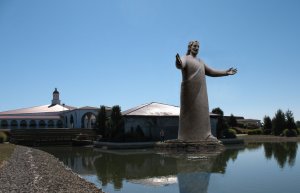
If you’re near Hamilton, Ohio, the funny thing about Ohio is the statue formerly known as Big Butter Jesus. (1)

King of Kings (aka Big Butter Jesus)

King of Kings (aka Big Butter Jesus)
Photo by Cindy Funk

There are undoubtedly other oddities and roadside attractions in Ohio that can be found in various books and websites about the peculiar and amusing sites to be found in various states.

The really funny thing about Ohio, however, is that the state has produced some of the best humor writers ever.

The one that all Ohioans study in school is James Thurber. I was surprised to learn that outside of Ohio he is not as well known. At the very least, Ohio students read “The Night the Bed Fell” and “The Catbird Seat.” (2) His loopy, scrawling cartoons of men, women, and dogs are classics not so much for their artistic merit but for the captions. My favorite is a man and woman in a lobby and the man says, “You wait here and I’ll bring the etchings down.” For some reason that always slays me.

Thurber managed to be funny despite his failing eyesight and rampant misanthropy.(3) He also wrote a series of essays on grammar – a parody of H.W. Fowler’s Modern English Usage – that is enormously amusing to those of us who are amused by that kind of thing. In particular his piece on the subjunctive and sex is worth the price of admission. (4)

The high points of Thurber’s work have been collected in an anthology called The Thurber Carnival. I highly recommend it.

The other native Ohioan who has made her mark in humorous writing is Erma Bombeck.(5) Beginning as a writer for the Dayton Daily News, Bombeck turned her suburban trials and tribulations into comic fodder for such national bestsellers as If Life Is a Bowl of Cherries, What Am I Doing in the Pits?

She is much more widely known than Thurber because of the near-universal appeal of her books and the fact that nobody makes schoolchildren read her.

Every two years there is an Erma Bombeck Writing Workshop held in her memory at the University of Dayton. Attendees work on humor writing, memoirs, and other forms of expression. There are events called “Pitchapalooza” and “Speed Dating for Writers,”(6) a writing contest, and even a showcase for stand-up comedians.

This year the faculty includes Jenny Lawson, the Bloggess; Kathy Kinney, “Mimi” from The Drew Carey Show; multi-talented writer Sharon Short; as well as other authors, speakers, agents, and literary mavens.

I will be there too, as an attendee.(7)  I hope that after this experience, which occurs at the beginning of April, I can use the knowledge, practice, and advice I receive to improve this blog.

Erma Bombeck and James Thurber set a high standard, but those of us who aspire to write need people of outstanding talent to inspire and instruct us. As well as flying pigs and rows of concrete corn to entertain us.


(1) Also known as “Touchdown Jesus.” I always called it “Kris Kristofferson Jesus.” Unfortunately that statue was hit by lightning and replaced by another statue of Jesus made from exactly the same materials. And that’s pretty funny too. I call it “Jesus-Needs-a-Hug Jesus.”
"Lux Mundi"
“Lux Mundi”

(2)”The Secret Life of Walter Mitty” is another well-known work. But the Danny Kaye movie of it has too much Kaye and not enough Thurber.

(3) Often mistaken for misogyny. But by the end of his life, he couldn’t stand anyone.

(4) You can find it online at http://grammar.about.com/od/classicessays/a/whichthurber.htm, but hardly anywhere else.

(5) After whom my armadillo purse, Erma (duh), is named.

(6) Not actually a venue for making dates, this consists of time-limited one-on-ones for aspiring authors to ask questions of pros.

(7) I was lucky to register in time – the workshop sold out in under six hours from the time registration opened. There is a FB page and the website is humorwriters.org.

Review: Furiously Happy

Buy this book!

Jenny Lawson, aka The Bloggess

Now I’ll tell you why.

First, despite what I wrote a previous post, Seven Reasons I Hate the Bloggess (http://wp.me/p4e9wS-56), I really respect and admire her and her writing.

Second, Furiously Happy is every bit as funny as Let’s Pretend This Never Happened, Lawson’s first book. It’s as raucous and uninhibited as her wildly popular blog.

Third, it’s something more.

Oh, there’s still plenty of weird taxidermy, ridiculous fights with her husband Victor, and even a bizarre travelogue of her trip to Australia. (She was not allowed to cuddle a koala, even when she dressed in a full-body koala suit, but consoled herself with the knowledge that koalas have chlamydia.)

But threaded through  her comic, idiosyncratic prose is a serious message about mental health: that we should speak up about it; acknowledge our struggles; and be determinedly, exuberantly, furiously happy when we can, in defiance of our illnesses.

Furiously Happy is a book for the millions of Americans – one in four – who struggle with mental illness, and for the millions more of their families, loved ones, and friends. It entertains and educates and defies the stigma that surrounds mental illness, without being preachy or mired in statistics.

Lawson has heard from people who have made it only as far as the parking lot of her signings because they too have severe anxiety disorders. Others have driven as much as five hours to attend one of her appearances. In her blog (thebloggess.com) and her new book, she lets people know that we are “alone together,” that even if we’re broken, we still have the capacity for magic.

At a recent book signing, Lawson was visibly nervous when she read two chapters aloud. One of these chapters was the one in which she and her mother discuss what is crazy and whether Jenny is. During the Q&A session at the signing, she took care to make the point that mental illness need not prevent people from being, as she says, furiously happy – if they keep on struggling, fighting, and trying, and especially if they have people around who understand and help.

After that she signed her book and anything else the audience brought until the entire group – which was quite large – was satisfied. No one was turned away from the signing line.

Lawson’s writing is not for everyone. Some people will be turned off by her use of profanity, and perhaps others may not appreciate the serious message that this second book contains. However, if you are looking for more rollicking, uninhibited, and unlikely (though largely true) stories, you will certainly find them here. But if that’s all you want, you may prefer to skip the serious chapters.

On the other hand, if you want to learn about mental illness with its attendant difficulties, and why it is so important to bring these topics out of the closet, as it were, then you may find the storytelling ridiculous, irreverent, or distracting. Personally, I enjoy the whole package, and it’s clear that many others do too.

Actually, the book hardly needs my endorsement. It’s been on the New York Times bestseller list for weeks now, and her book tour is drawing large and enthusiastic crowds. But I’ll recommend it anyway. You can start with her first book and find yourself drawn into the other. Or vice-versa.

You should also check out her blog, both for the content and the commenters, many of whom have found in Jenny an inspiration and in the other commenters a like-minded group of self-admitted weirdos, social outcasts, and yes, the mentally ill. That’s really been Lawson’s message all along. She just states it a little more directly in Furiously Happy.

Should Kids Be Taught to Read?

For years now, the debate has raged: How should children be taught to read? Some people are saying that the real question is whether children be taught to read.

What do we actually know about learning to read? How do children learn to read? The answer is a bit fuzzy at this point. Phonics, whole language, and natural reading all have their proponents.

But with brain imaging improving seemingly every day, neuroscience is starting to clue us in on how the brain processes language, in both speech and reading.  “A study in the Journal of Neuroscience,” testube tells us, “found that the area in the brain that reads words is right next to the part of the visual cortex that recognizes faces. So just as one area of the brain can quickly identify a face, another can quickly read a word.”

Not that that really helps solve the problem of reading instruction. It will likely be quite a while until info from brain imaging makes its way to the classroom.

The common wisdom is that speaking is a natural process that children learn automatically, for the most part. Reading, however, is another story. Learning to recognize meaning in squiggly marks on paper or a computer screen is much less intuitive. Not all children accomplish it. Not all adults have either. The Department of Education reports that 32 million American adults can’t read.

Naturally, not all children learn to read at the same rate. Some pick it up by age four and others not until the later elementary grades. Teachers suggest that students only really begin to read for meaning in about the 5th grade. Until then, the work of decoding words, sounding them out, or memorizing them has simply taken too much of the brain’s attention.

Still, everyone agrees that reading is important. Children who learn to read have distinct advantages over those who don’t, and adults who can’t read are at a real disadvantage in society.

Surprisingly, perhaps, the advantages of reading are not what you might expect. While reading certainly develops the vocabulary and entertains children with imaginative stories, some have suggested that reading offers other benefits as well. An article in Bustle says, “According to a the British Cohort Study, kids who read for pleasure at a young age tend to test better than their peers in all sorts of subjects… yes, including math.”

Other benefits include greater understanding and empathy for people of other lands, cultures, races, and so forth. If children read books or articles about people and cultures different from themselves, they have a better basis for openness and tolerance.

Now, however, some people are saying that children do not have to be taught to read: that they “pick it up” on their own. One name for this is the “unschooling” movement. Interesting articles on the subject, particularly by Dr. Peter Gray of Freedom to Learn, have appeared in Psychology Today‘s blogs.

As Gray describes it, “precocious readers appear to be children who grow up in a literate home and, for some unknown reason (unlike even their siblings in the same home), develop an intense early interest in reading.  Interest, not unusual brain development, is what distinguishes them from others.”

According to the theory, learning to read can best be done in a mixed age group where children can see the benefits that older students get from reading, get some informal help from those older students, and at some point discover that they need to read on their own in order to accomplish something they want to do.

Another of his suggestions is that, far from being detriments to reading, electronic devices and practices such as texting and emailing give children lots of practice and lots of motivation to develop their reading skills.

Most important is allowing children to learn to read at their own pace, in their own good time – not to push them. If a child likes phonics word games – great! If she doesn’t, find another way to make reading enjoyable and necessary, or, better yet, let her discover her own.

Admittedly, this version of learning to read does not fit in well with the current educational system. It is mostly being tried by homeschoolers and alternative schools. It is possible that it could work in today’s classrooms, but not without significantly modifying them.

Lots of various kinds of reading material – preferably high- interest – should be readily available and most likely chosen by the students rather than assigned. This would of course play hell with the teacher’s role, standardized textbooks with stories carefully calculated to introduce only certain letters or words at a time, and high-stakes testing for reading ability.

Given that, it’s unlikely that this new style of reading education will spread very far very fast. But schools are still turning out many adults – graduates or drop-outs – who are functionally illiterate. Until more is known, teaching reading may well remain guesswork in large part. but if you worry that your child is not learning to read quickly enough to suit you or the school system, the usual teaching methods may not be the answer.

Some children seem to need to follow their hearts and their interests when they are ready and have a need to read. This is not likely to be the solution for all children, just as phonics and whole language are not. If children are going to read as adults, for fun, for business, or just for daily life, they must develop the idea that reading is a worthwhile activity and not a chore.

And maybe formal teaching isn’t always the best way to do that.

References:

https://testtube.com/dnews/how-does-your-brain-learn-to-read/?

http://www.bustle.com/articles/111990-9-ways-people-who-read-as-kids-have-an-advantage-over-everyone-else

https://www.psychologytoday.com/blog/freedom-learn/201002/children-teach-themselves-read

https://www.psychologytoday.com/blog/freedom-learn/201311/the-reading-wars-why-natural-learning-fails-in-classrooms


The Education Argument

When any system grows too big, it begins to break down. This is evidenced all around us. The education system, various systems of religion, the healthcare system, the justice system, the banking system, the insurance system – all are too big to operate efficiently or effectively. Entropy and inertia win.

Let’s take the education system, because it’s the one I know best. I have taught at the college level, worked on magazines for teachers at all levels, and written and edited scripts for training videos intended to help school staff members from grades K through college.

Where to begin? Let’s start with curriculum. There is currently a great debate about what America’s children will learn. The pressure on textbook publishers to deliver something that can be approved by one or more states increases every day. Texas and California, the largest textbook buyers, have an outsized influence on what the rest of the nation’s school children will learn.

One major problem is that no one can agree on what the nation’s children should learn. Any attempt to standardize curriculum is shouted down from various directions. (Can you say “Common Core”?) Should we present a positive history of our country or one that discusses its missteps and flaws? Should we teach the facts of science or “teach the controversy.” (Or both?) Should we teach using whole language or phonics? Should we teach computer programming to everyone or just a few? Should we teach civics at all and if so from what perspective – left, center, middle, all of the above? (When I was in high school I took a course called Comparative Political Isms. Such a course could likely not be taught today in an American high school, but if it were at least citizens would understand the difference between fascism and socialism.)

Various attempts have been made to rectify these problems, but all they seem to lead to are more and more standardized tests. The teachers of necessity teach children what will appear on the test – what answers they should fill into the little bubbles and how to construct a three-paragraph essay.

Other subjects are much harder to test. Reading comprehension is nearly impossible when stories must be so bland that any student anywhere with any background can understand every word of the story. Try writing a story like that (I have) and you’ll end up with nonsense – and not the good, Lewis Carroll kind.

While larger systems are seldom the answer – indeed they are usually the problem – there is a lot to be said for standardized curriculum rather than standardized tests. In order for students to enter higher education and even business on a level playing field, it helps if all the graduates have a grasp of the same basic information. Since every state seems to have its own take on history, health, civics – even math and science – students are coming out of high school with wildly different ideas and significant gaps in their learning. When they get to college there’s no telling whether they will have an understanding of geology or American history or how to spot fallacies in an argument.

If states and local communities want to add to a basic curriculum, by exploring the history of their particular state or community, that’s just fine. Although with the way people move around from job to job these days, it seems a little odd that a child must learn about the history of Ohio when he or she is going to be living in Alaska.

Another worrying aspect of today’s schools is their switch from the agricultural model to the business model. It has for quite a while been evident that the agricultural model is no longer effective for schools. The business model is better in the respect as it allows for year-round schools and longer school days to mimic the environment that students will enter after they leave school.

However, there is more to life than business. Along the way art, music, physical education, and such frivolous amenities have been neglected dropped or ignored. Even recess for elementary students has become a casualty of the work ethic.

Entrepreneurship classes and STEM teaching are all very well, but not all students are going to become business and scientific leaders. The country also needs janitors, fry cooks, receptionists, and convalescent home caregivers who can balance a checkbook, read a newspaper, and understand our system of government. And where will we find the artists, the poets, the musicians, the writers, sculptors, woodworkers, and the craftspeople who provide us unique and spirit-uplifting experiences that can be found in no cubicle farm?

At this point you may well ask whether I have any solutions to offer. I have a few.

  1. Read Jonathan Kozol’s Savage Inequalities. It’s every bit as true today as it was in 1991, when it was written. Then after you’ve read it, work to change the ridiculous system of funding K-12 education.
  2. Have a little faith in teachers. English teachers do not assign readings in hopes of changing a child’s religion or traumatizing them with challenging topics. Teachers cannot be expected to give everyone As. They are not the problem. Bad teachers are often the result of a flawed system and good teachers often leave the field, frustrated and disheartened. And they don’t make great money, despite what you may have heard.
  3. Remember that athletics, while important, are not the reason schools exist. Getting into a power-house college with an exceptional sports record is not the best preparation for life. Even pro athletes need to be able to do something else after their sports careers are over.
  4. Spend money on school infrastructure, including computers, up-to-date textbooks, and adequate supplies. No money? See point 1, above.
  5. Make sure children are ready to learn. Educational preschool programs and affordable or free breakfasts and lunches will go a long way. No money? See point 1, above.

Our present system of education is too complicated, with every state, county, district, and city having a say about funding, curriculum, expenditures, and more. Simplify governance, establish a basic curriculum, and revamp the funding system and you will still have a large system, but a streamlined one better able to meet the needs of students.

Even if you don’t agree with one – or all – of the above points, please take them as intended: food for thought and debate. After all, thought and debate are important skills, too.

Dodging Nosy Questions

“So, when are you and Janet going to give your mother grandchildren?”

“Why spend $300 per hour on a shrink when it’s not going to do any good anyway?

“Why do you always eat junk food when you know you have high blood pressure?”

“Are those boobs real?”

Questions you can’t answer. Questions you don’t want to answer. Questions you want to slap a person for asking. Questions that are just begging to start a fight. We all hear them, sometimes from our nearest and dearest, and sometimes from total strangers.

There is an answer – other than “Shut up and leave me alone,” which may indeed be your initial reaction, but usually isn’t the best solution. (Except maybe to the boobs question.)

Noted linguist and author of The Gentle Art of Verbal Self-Defense Suzette Haden Elgin recommended a technique called the “Boring Baroque Response.” It’s not a skill everyone has at the ready, but with a little practice, you can expand your ability to deflect the nosy and the belligerent.

The essence of the Boring Baroque Response (or BBR) is storytelling. No matter the question, you stare off into space and launch into the longest, most rambling story you can. Here’s an example:

Idiot: “Why do you always eat junk food when you know you have high blood pressure?”

You: “That’s interesting you should ask. It reminds me of when my parents and I were visiting Cousin Jim and Cousin Addie – you know, the ones that lived near Natural Bridge and had that kitchen that was painted all black. And whenever we visited my sister and I played in the hayloft. But it didn’t have hay, it was really bales of straw. Dried-out corn cobs, too, which they fed to the animals, like the mule. I rode that mule once, bareback, and you wouldn’t believe how bony its backbone was! Anyway, Cousin Addie was making biscuits and gravy – sawmill gravy with milk, not red-eye gravy with coffee – and Cousin Jim always said….”

Keep going as long as necessary until the questioner gives up and goes away. As Elgin noted, “A response like this delivers the following message: ‘I notice that you’re here to pick a fight. Do that if you like, but it’s not going to be much fun for you, because I won’t play that game.'”

According to Elgin, the secret of the BBR is to deliver it with a straight face and a thoughtful, reminiscing tone. Sounding sarcastic or snotty will give away the game. And although the example was (vaguely) related to food, as the question was, it doesn’t have to be. The story can be about your sister and how she wanted to be a veterinarian, which she would have really been terrible at because….Well, you get the idea.

My husband had a version of the BBR that he used when he worked in community-based corrections. He would regale the “clients” with stories full of analogies – “You know when they make steel how they forge it first in really high heat and then plunge it into cold water. Well, that’s kind of like….” He could rarely get out more than a sentence before the listener would edge away, saying, “No stories, please, Mr. R. I’ll behave. I’ll be good. Just no story!”

I don’t know if Elgin ever heard it, but the best BBR I know is the monologue that Grampa Simpson produced when asked to break up a union meeting:

“We can’t bust heads like we used to. But we have our ways…. Like the time I caught the ferry to Shelbyville. I needed a new heel for m’shoe. So I decided to go to Morganville, which is what they called Shelbyville in those days. So I tied an onion to my belt, which was the style at the time. Now, to take the ferry cost a nickel, and in those days, nickels had pictures of bumblebees on ’em. ‘Gimme five bees for a quarter,’ you’d say. Now where were we… oh yeah. The important thing was that I had an onion on my belt, which was the style at the time. I didn’t have any white onions, because of the war. The only thing you could get was those big yellow ones….”

Now that’s classic TV! Just like the episode of WKRP when Mr. Carlson had an idea for a promotion and Les was supposed to report on it live from the shopping center, but the one store didn’t want him standing in front of it because customers couldn’t get in, so then….


Books, etc.: Creating a Lifelong Reader

The other day I saw an article on the web, “Raise Lifelong Readers With These Handy Tips.” (http://blog.theliteracysite.com/raising-readers/?utm_source=social&utm_medium=trnfan&utm_campaign=raising-readers&utm_term=20150713)

It was a good article, and I had to admire the author’s pseudonym, Paige Turner. She (or he) said:

Booklovers are not born. An interest in reading and a delight for stories found within the pages of a book is something that has to be carefully fostered.

For kids who learn an early appreciation for reading, the benefits can be extraordinary … readers have a huge advantage from early on!


The advice in the article was all good: Read to your children, take them to libraries, be a role model, etc.

My mother didn’t know how to teach reading. But she read to me and my sister, as far as I can recall, every day, one on each side of her, nestled on the sofa. We went on frequent trips to the “bookmobile,” a library outreach trailer, and on special occasions to the library itself – even the big one downtown. This ample supply of reading material was supplemented with trips to a favorite used book store. We grew up surrounded by print.

Paige offered good advice, as far as it went, but it omitted one important point, in my opinion:

Love of reading starts before a child can read.

If you wait for your child to learn to read before you share reading experiences with him or her, it may be too late. It takes reading together to make a non-reading child into a reader.

I honestly can’t remember a time when I was a non-reader. Despite Paige Turner’s statement, I was very nearly a born booklover.

My mother didn’t follow all Paige’s good advice. I never remember either her or my father reading for pleasure. (My father did, much later, when he was ill with bone cancer and couldn’t get out of bed. Again the library outreach stepped in, and a dear friend who worked for them, brought him stacks of Zane Grey and Louis L’Amour.)

To me, print is important. Picture books are good, but I think one thing (among many) that my mother did right, was to expose us to print at an early age. Even though we couldn’t read the black marks on the white paper, she read them for us. One thing this promoted was consistency. The story was the same every time, and that lead to the idea that the little black letters had something to do with how the story went.

Without being told, we were learning what reading was, even if we weren’t yet being taught how to do it. The words stood for something – something familiar and delightful, a magic so enticing I couldn’t wait to learn how to create it myself. So I didn’t wait.

Many years later I worked in a bookstore. Often a parent would come in and ask, “How can I get my child to read?”

“How old is the child?” I would ask.

If the child was a teenager, I would offer some suggestions, but inwardly shake my head. For most of them, I knew, it was too late.

That’s one of the reasons I adore the Harry Potter books, flawed as they are – they made reading cool, provided an experience so enthralling that even non-readers, pre-teen, teen, or even adult, would make the effort for a chance to experience the wonder.

(It’s also why I’m glad that the movies didn’t come out until years after the books began their epic sweep.)

Alas, reading is growing more difficult for me. I’ve had eyeglasses since the age of three and my eyes are now on a definite downswing. All the books I collected when my vision was more reliable are becoming blurs to me now.

I certainly need new glasses, and as soon as I can afford them, I will get some. (That’s another thing my parents did right that Paige didn’t mention – regular vision checkups and new glasses as needed.) And I’m intensely grateful that e-readers let you change the type size all the way up to humongous.

But if I’m truly going to be a lifelong reader, I probably ought to start learning braille now.


Books, etc.: Revisiting the Old School

Sarah Seltzer recently wrote on Flavorwire that, as the title of her article says, “We re-read our favorite books as kids and why do we stop as adults?” (http://flavorwire.com/518840/why-do-we-re-read-our-favorite-books-as-kids-and-why-do-we-stop-when-we-get-older)

She says, “[A]ll the reading I do is for a different homework — the social kind. Even popular series like The Hunger Games and the Sookie Stackhouse series make my reading list at least partly to keep me ‘up on the conversation.’”

My experience has been different.

Reading is never homework for me, and really wasn’t when I was a child either. If a friend has read a book that I haven’t, I simply ask what it’s about and what they thought of it. Voilà – conversation.

I certainly did re-read more as a child than as a grown-up. My mother had to insist that when I went to the library, I take out something new in addition to Green Eggs and Ham.

But I – and many of my adult friends – continue to re-read books. Sometimes it’s books we loved as children, and other times it’s children’s literature we’ve just discovered, and still others it’s books we’ve recently encountered. Without even a book group to keep us up to date, my friends and I pass around recommendations. Right now I’m reading Libriomancer on a friend’s advice. Do I care if it’s less trendy than Grey? I do not. Will it make my re-reading list? I won’t know until I finish it.

A while back, I wrote in this blog about “comfort books” – books we return to again and again, for familiarity, for memories, for new insights, for reminders, for nostalgia, or for just plain fun.

We each have our own list of comfort books. My friend Leslie and I both go back to anything by Lois McMaster Bujold (at least yearly) and Catherynne Valente’s Fairyland series. I go back to Mira Grant’s Newsflesh trilogy and Jenny Lawson’s Let’s Pretend This Never Happened, and David Sedaris, and even nonfiction like The Hot Zone and Angela’s Ashes None of these are beloved books from my childhood, but touchstones of my adult life. (Some of them don’t fit the usual definition of “comfort,” but it is, in a way, comforting to me that they retain that spark of awe when revisited.)

When my tastes change (as they have over the years), my re-reading list changes too, though my old favorites remain there for me. Recently I’ve grown tired of the mediocre memoirs and formulaic novels that sell for $1.99 on B&N, and gone looking for books that fill me with wonder when I first read them and are worth a second – or third or fifth – reading. And I’ve found some. Life of Pi (which I just re-read). The Book Thief. Egg and Spoon.

(Do you have any suggestions for books of similar quality? Please, please leave them in the comments section.)

Not that revisiting one’s childhood reading is a bad thing, for as Seltzer notes, there lurk new insights and a mature appreciation of the author’s craft.

Two books from my earlier reading days recently crossed my path again. These are books that endured multiple readings in my teen years – To Sir, With Love and Up the Down Staircase – both tributes to my enduring interest in education (as I would now say) or (at the time) my desire to become a teacher.

Neither book was a waste of time to re-read, and neither, although familiar, spoke to me in the same way it did all those years ago. Re-reading them was both comforting and newly challenging. They stood up to their repeat performances.

Both startled me by their references to high school students as “children.” I suppose to the school system they may be, but I think of many if not most of them as young adults, or at least kids or teens. (I also was taken aback by the word “pupil.” Is that still used in some parts of the country? To me, they are students.)

Some aspects were new to me. As a teen (raised in a lily-white suburb and attending a lily-white school), I noticed but missed the depth of the comments on race in To Sir, With Love. While I understood that Up the Down Staircase highlighted the bureaucracy of the education system in a large city high school, I was clueless about the application of that to all schools, even mine.

“Re-reading offers something that few other cultural experiences do, really: a mix of gentle stability and sharp new insight,” Seltzer says. “Taking the time to re-experience the art we loved best in our past can be a way of spending time with ourselves, and though its rewards are mostly unseen, that may make them all the more important to seek out.”

Now that I can’t argue with.

But I would add that my re-read list keeps growing longer as I grow older. It’s not just childhood favorites that are worth re-reading, but any book that has become beloved to me. And falling in love with a book is definitely not something I’ve left behind. New love can happen at any age.

Now where did I put my copy of Green Eggs and Ham? Ah, there it is – right next to the Lois Bujold.

Books, Etc.: But Where’s the Wonder?

It Hurts When I Poop!(1) That is the actual title of an actual children’s book, though not, I’m sorry to say, the sequel to the classic Everyone Poops.(2)

No, it is an instructive children’s book meant to help youngsters through the trauma of – I don’t know – toilet training? Constipation? Hemorrhoids? At any rate, some kind of fundamental difficulty.

This seems to be the way of children’s books these days. Take a look at your local bookstore (if you still have one) or the wares at Amazon. Book after book in the children’s section are of a genre “How to Get Through the Difficulty of X.” X can be nearly anything.

In particular, The Berenstain Bears seem to have a lot of difficulties. Their books include The Berenstain Bears…
…and the Bully
…Visit the Dentist
…Learn About Strangers
…and Too Much TV
…and Too Much Junk Food
…and Too Much Teasing
…and The Bad Dream
…and the Bad Habit

…to name but a few.

And while the Bears have a bad habit of eating too much junk food and then dread visiting the dentist, other children and anthropomorphized animals cope with still other plights:
Maggie Goes on a Diet
Wilma Jean the Worry Machine
Hooway for Wodney Wat (3)
Mean Jean Recess Queen
Lacey Walker, Non Stop Talker
Olivia Acts Out (4)
The Owl Who Was Afraid of the Dark

Still other books seem problematic. I haven’t read Don’t Squeal Unless it’s a Big Deal, but I wonder how they expect children to differentiate. What’s a “big deal” to a kid and to a grown-up can be quite far apart on the scale of secrets.

Then there are the really problematic books. Awful Library Books (5) has singled these out for their questionable topics and premises, unpleasant underlying assumptions, and creepy illustrations:

Don’t Make Me Go Back, Mommy: A child’s book about satanic ritual abuse (6)
For Your Own Good (foster care)
I Know The World’s Worst Secret (alcoholic mother)
Please Come Home: A child’s book about divorce (7)

These are not issues that can be made “all better” with a quick “real-life” scenario and a flimsy moral.

Granted, issue-oriented children’s books have important uses, but they’re not kid lit. Parents choose them because they think the lessons will be helpful. But such books lack the essential qualities of literature: engaging, complex characters; adventurous or truly touching plot lines; satisfying stories. In a word – imagination. Good children’s literature is fun.

Think about the Harry Potter books, for example. They contain underlying messages about friendship, loyalty, and bravery, as well as standing up to bullies, dealing with disappointment and grief, and defying prejudice. All without titles like Harry Potter and the Dead Godfather.

Children clamored for these books, obsessed about them, mentally dwelt in them. When was the last time you heard a child say, “Oh, Mommy, please, please, please buy me Olivia Acts Out“? How long a waiting list does the library have for Don’t Make Me Go Back, Mommy?

Think about Green Eggs and Ham – a simple book with a simple story that does not explicitly say, “Kids, try new foods. You might like them.” It does not portray an ordinary kid-just-like-you dealing with a problem. It captures the imagination with silliness, propels the minimalist plot along with kid-friendly repetition and rhyme, and reaches a satisfying conclusion. No wonder I checked it out at the bookmobile every single time I went.(8)

There is plenty of good children’s literature for all ages, from the classics (Treasure Island, Charlotte’s Web, Where the Wild Things Are) to more modern tales (Harold and the Purple Crayon, Cloudy With a Chance of Meatballs, Gregor the Overlander).

Michael Longcor said it in his song “Imagination”:

“Imagination is a friend to help you through a friendless land.
Imagination can take you to the stars and back again.
Imagination can make you more than what you thought you’d be.
It can raise a world from ashes. It can set the spirit free.” (9)

Children’s literature crafted with imagination can free the spirit in adults as well as children. It’s something we all need.

(1) No, it doesn’t, I’m glad to say.
(2) A book I always give to new parents of my acquaintance, along with Shel Silverstein’s Uncle Shelby’s ABZ Book.
(3) A book about rhotacism. Think Bawwy Kwipke. Or Rodney Rat. Now you’ve learned a new word. You’re welcome.
(4) Is it just me, or do a lot of these problem children seem to be girls?
(5) awfullibrarybooks.net
(6) No, really. awfullibrarybooks.net/satan-for-kids/
(7) Described by Awful Library Books as “Daddy left because you were bad.”
(8) It’s still my all-time favorite book. Ever.
(9) Michael Longcor http://en.wikipedia.org/wiki/Michael_Longcor, “Imagination,” Kitchen Junk Drawer. Available at http://www.firebirdarts.com/product_info.php?products_id=147

Books, etc.: Quitter

Don’t get me wrong. I can’t stop reading, even if I wanted to, which I don’t. I’ve read while walking down halls. I’ve read while getting blood drawn.(1) I’ve read under the blankets while sleeping on a sofa and nearly melted the Naugahyde. I’ve read when there was nothing to read but the label on a ketchup bottle.

I have always read books straight through to the end, too, no matter what. It seems wrong somehow not to finish a book that I’ve started.

Then came The Horror Novel.(2) The set-up started okay – it didn’t jump right into gore and heads in the microwave. It introduced the characters, like a good novel should. They were a couple, an architect and a stockbroker. They were extremely good-looking, seriously wealthy, and lived in a fine house with all the amenities. You were supposed to feel good about them and – well, horrified – when creepy things started happening to them.(3) Instead, I was rooting for the monster, whatever it was, to slaughter this ridiculous Ken and Barbie. And prevent them from reproducing, if at all possible. And tear down their marvelous house and set the rubble on fire.

I stopped reading, knowing that, in the end, the monster would be vanquished and I would be disappointed – nay, angry.

Now if a book makes me want to throw it against the wall, I abandon it.(4) I feel just a teensy bit guilty when I do, but I’m getting older and my time is limited. I can’t squander it on mediocre fiction or dry-as-dirt nonfiction.(5) There are so many books in the world that I’ll never get through all the ones I want to read.

Nowadays my to-read stack reaches the virtual ceiling and rivals my three floor-to-ceiling bookcases, plus the stacks in my closets, where most women keep shoes.

But at least now I can carry them around in my purse.

(1) I think they struck ink.
(2) Never my favorite genre anyway, unless it’s by Mira Grant.
(3) The first creepy thing was that they came home to an exquisite candlelight dinner that neither one of them had fixed. Oooh, yeah. Make me shudder.
(4) And not just because I use an e-reader and would be destroying my entire collection.
(5) Though I did keep around a biography of Prince Albert – the most boring book ever about the most boring man ever – in case I should run out of Ambien.

Books, etc.: Remembering Suzette Haden Elgin

A few days ago a friend informed me that Suzette Haden Elgin had died. This was not unexpected. She was almost 80, and had been in ill health for a while, and suffering with dementia, along with other disabilities.

I never met her, except through her work, but I mourn her passing.

Suzette was a trained linguist, a language maven, and a writer. She is perhaps best known for her books in the Gentle Art of Verbal Self-Defense series. Though not as well-known as Deborah Tannen’s or John Gray’s works, Suzette’s are practical, straightforward, and supremely useful.

She was interested in many aspects of language. She thought and wrote about language and religion, language and politics (especially framing), language and women’s issues, language and perception, language and culture, and more.

For many years she kept up a Live Journal and two newsletters. Under the LJ name Ozarque, she stimulated thought and discussion of her many fields of interest. These were lively, educational, interactive, and fascinating forums in the way that Live Journal blogs are meant to be and seldom are.

She was a writer of science fiction novels, stories, and poetry. I was astounded by her Native Tongue series. (Who besides me could possibly be interested in feminist linguistic science fiction? Many people, it turns out.)

In the Native Tongue series, Suzette described a newly created “women’s language” called Láadan. She and others pursued the idea and constructed a grammar, a dictionary, and lessons available online – way before anyone tried to do the same with Klingon.

She worked on new fiction until the dementia descended. In her LJ, she would sometimes post poems and songs (particularly Christmas carols) and solicit feedback from her audience, sometimes incorporating their suggestions into the piece. The Science Fiction Poetry Association’s Elgin Awards are given in her memory.

She attended science fiction conventions, where she could meet and interact with her readers. One she often attended was WisCon in Madison, WI, the premier feminist science fiction convention, and in 1986 was one of their Guests of Honor.

On a more personal note, she once took the time to give me feedback on a piece I was writing about bullying, also a concern of hers.

She was a kind, humane, quirky, quick-witted, creative, varied, engaged, humorous, brave lady and a brilliant scholar and writer. I will miss her and her work. The world is poorer for her passing, but richer for her legacy.