
Art Is Love. Art Is Work. Art Is Football.
I’ve never had the “sex talk” that all people – both parents and children – seem to dread. I’m not a parent and when I was a child I received my technical understanding of reproduction from a health class film, which left a lot to the imagination, and the book Everything You Always Wanted to Know About Sex But Were Afraid to Ask, which filled in a lot of gaps that the health film skipped right over. (The film referred to a menstrual period as “the weeping of a disappointed uterus.” Ick.)
 But that’s not the sex talk I mean. This is the sex talk for consenting adults that hardly anyone has but everyone needs to. It’s divided into two sections: The Health Chat and the Pleasure Chat. It’s best to conduct these conversations when everyone is still clothed and not engaged in heavy breathing. I would recommend choosing a time and place not conducive to sex – a park, for example. Both parties need time to consider the discussion before deciding whether to proceed.
The Health Chat
The easier part of the health chat is discussing birth control/safe sex. What method does each partner typically use or prefer? Barrier methods? Hormonal? Does either person have an allergy to latex? These are things it’s better to know beforehand.
So far the health chat has been fairly smooth and non-threatening. Next comes the part that too many people skip because it’s just so uncomfortable to talk about: STDs. Herpes and HIV infections are the most serious, as there is no cure for either, and both carry enormous stigma. But those are the very reasons potential partners must talk about them. They’re not just potential surprises but possibly life-changing ones.
STDs can be a deal-breaker. Talking about them in advance can eliminate the possibility of a revelation at an inopportune moment and give the other person a chance to consider the risks, the seriousness, the forms of protection, do research, or even discuss the subject with a physician.
How do you do this delicate dance? Be forthright, but not panicky. “I know we’re both thinking about having sex, but I need to tell you something. I have a herpes infection.” Explain what you’re doing about it. “I’ve been on anti-virals for over a year and haven’t had an outbreak in that time. I always use condoms, even when I’m not having an outbreak.” Then back off. “I’m sure you’ll want to think about this, maybe learn some more about it, before we decide whether to go further. And that’s okay. If you decide not to, I respect your decision.” There, that takes what? Two minutes? Three? (Working yourself up to having the conversation may take a tad bit longer.) But ethically, it’s something you need to do.
It’s also legitimate to ask if your prospective partner habitually practices safe sex. “I didn’t use condoms with my last girlfriend, but she was a very nice woman” is not a good enough answer. That nice person’s last partner might at some point have had sex with a diseased goat. The point is, you just don’t know. The safe option then is for you both to get tested. I once advised a friend who was in this situation of what his hero Ronald Reagan said: “Trust, but verify.”
The Pleasure Chat
It can be best to check out with your partner what activities he or she finds enjoyable. This may seem like a no-brainer, but it can be very important. Again, it’s something you might want to discuss before you’re close to getting it on, to prevent knee-jerk reactions that might spoil an otherwise good time.
If both of you enjoy mainstream, middle-of-the road sex, that’s fine. But one or both of you may also like the more kinky side of things. Better to talk about it than be surprised when someone approaches an unexpected orifice or brings out an unfamiliar sex toy.
One saying in the kink community is that sex should be safe, sane, and consensual. It’s better to discuss the safety and sanity, and get the consent, before proceeding.
Also, discussing these matters beforehand gives you a chance to think seriously about what your boundaries are – what things you absolutely don’t want to do, what you might try once as an experiment, and what you’ve never done but have no objection to. You can also take time to ask yourself whether you are reacting automatically or have actually thought about the questions raised. Your instant instinct might be “Ew,” but on further reflection you might say, “I’ve never thought I’d like that, but if it gives my partner pleasure, maybe I could try it and see.” From these reflections can grow more varied – and more fulfilling – sex lives.
Talking about sex can be scary, or erotic, or sensible, or just plain necessary. One thing’s for sure. If you can’t have a sex talk with someone, you shouldn’t be having sex with that person.
(This is for my friend John and others who informed my thinking on these issues.)
My theory is that at least 80 percent of people who go to college spend time as waiters or waitresses. The rest have rich parents.
 I took a year off college after my freshman year to think things over and to earn money. I spend that year as a server (as they’re called now) and a cashier at a chain family restaurant notable for having large statues of juvenile males holding up hamburgers while wearing checkered overalls.
I learned a lot while I was there, both from my own experience and that of my fellow waitresses. (There were no fellow waiters at that time and place.) These lessons may not apply to fast food places or fine dining establishments, but for middle-of-the-road places I think they’re pretty typical.
The truth about tips.
Church groups can be annoying.
Miscellaneous
Bottom line: Waitressing was hard, silly, frustrating, fun, colorful, exhausting and weird, sometimes all on the same day. I’m glad I had the experience; it builds empathy for other service workers.
But, God willing, I’ll never do it again.
“Bye, honey!” My husband is leaving on a vacation. “When will you be back? I need to schedule the dancing boys!”
OK. Not really. I mean, I don’t really invite male strippers in when my husband is away. But I really do say that.
You see, we’re totally on board with the idea of separate vacations, and we feel comfortable making jokes about nonexistent indiscretions. Once Dan sent me flowers and signed the card “Raoul,” my imaginary lover/pool boy. (Didn’t that stir them up at the office!)
We take plenty of vacations together, when we can, but that doesn’t always work out. One of us can get time off, but the other can’t. He has to go do home repairs for his mother and I need to cat-sit for a honeymooning couple.
“You mean he’s going to let you go?” a coworker asked on learning that I was going to Florida for a week without my husband. I ignored the “let you go” part, which would have taken a long explanation that would probably have confused her anyway. I tackled the other assumption instead.
“If I were going to cheat on him, I wouldn’t have to go to Florida to do it. I could do it much more conveniently right here in town.” At least I think that was the assumption she was making. Perhaps she simply thought that a woman alone in Florida should fear for her safety and that my husband would worry if he weren’t there to protect me. (Oh, well, there went my reputation again!)
While I do think that separate vacations are Good Things, it’s not for the usual reasons. Most separate vacationers rhapsodize about the freedom of being alone and the sweetness of coming back together afterwards.
No one ever mentions that a couple may have very different vacation styles. I’m not talking here about when one person wants to lounge on the beach sipping tropical drinks with little umbrellas to keep the drinks dry, while the other hankers for rugged adventure with primitive sanitary facilities and the thrill of potentially being eaten by bears.
What I’m talking about is the way two people can go with each other to the same place and still be on separate planets. Take me and my husband, for example. Before we leave, I like to do research (yes, I am just a wee bit compulsive). I like to know what the attractions in the area are, when they’re open, how much they cost, and the best way to get there. Dan likes to wing it.
Once we’re there, though (wherever “there” is), he likes to schedule each day. And sometimes over-schedule, a practice that a friend refers to as The Bataan Fun March. I like to plan what we do based on the weather, how tired we are, and which are our individual must-see trade-offs.
Then there are souvenirs. Dan likes to buy something at each place we visit, even if it’s something he’ll likely never use, like a cowboy hat. I prefer to purchase that one perfect item that reminds me of our whole trip. Although I will admit a weakness for shot glasses with the names of cities and scenic places on them. But I use those.
Packing is another issue. He underpacks, and I overpack. (Though not to the extent of stereotype woman-with four-suitcases-and-two-trunks.) I just like to have clothes for any type of weather and shoes for any type of terrain we may encounter. Dan packs as little as possible to leave room for the aforementioned souvenirs.
In short, we can easily make each other crazy. Stroll through the airport or run to the gate and then sit for hours? Visit museums or go on walking tours? Take a day off to relax in the hotel pool or squeeze in more sightseeing? A together-vacation is fraught with potential pitfalls.
So what do I recommend? A judicious blend of together and separate. After all, vacations are about variety, aren’t they? A different environment, different experiences, different destinations? We spend most of our lives together. A week apart can be a refreshing change!
My husband and I were vacationing in Arizona when we encountered a ghost town.
It wasn’t the ordinary sort of ghost town, neither the kind with re-created western storefronts and actors playing at gunfights and saloons that serve sarsaparilla nor the kind that are abandoned towns of the 1930s or 50s that sport completely empty streets, dilapidated houses, decrepit main streets, and sand-filled parks and parking lots.
This was something else again.
We were in Arizona for the silliest of reasons. We had decided to visit the small town of Benson, based entirely on the name of the theme song of the little-known sci-fi movie Dark Star. It’s a charming little country-and-western number on the topic of special relativity. Here’s the best recording of it I could find: https://www.youtube.com/watch?v=W2F0dHVZAm8
It turned out to be a swell vacation. Very relaxing. The nearest city of any size was Tucson, Benson was surrounded by scenic mountains, there were an excellent restaurant and a great diner (also a noted barbecue joint, but it was closed because the chef had cut himself), and not a great deal else.
But Benson was a good jumping-off point for assorted day trips. One of the best was to Kartchner Cavern (http://azstateparks.com/Parks/KACA/), which was the most accessible and best-preserved cave I’ve ever seen, but also a delight because the tour guide actually used the word “adit,” which is usually encountered only in crossword puzzles.
On this particular day we were visiting the copper-mining town of Bisbee. Noted for its historical significance and its artist-colony vibe, Bisbee was a delightful town to explore. There was a bicycle race going through town that day, which provided some very intriguing sights of the buff-guys-in-skintight-shorts variety. I also indulged my fondness for semiprecious stones. They are available all over the southeastern Arizona area, but Bisbee’s shops provided some of the most attractive examples. I bought an iolite bracelet at one. (A little bluer than amethyst, iolite is lovely set in silver http://www.minerals.net/gemstone/iolite_gemstone.aspx.)
At some point during our ramble around Bisbee, I had picked up a real estate paper, and read in it about a restaurant/bar/orchard for sale, complete with liquor, as the owners had abandoned it. It sounded unusual and interesting, and on the way out of town we passed what had to be the same property.
It inspired us. We started daydreaming about how we could buy the property with our friends Sandy and Hugh. Sandy and I could run the bar while Dan and Hugh tended the pecan orchard and baked pies. Or Dan and I could run the restaurant while Hugh and Sandy set up stables for boarding horses. Or we could all drink up the liquor and abandon the place as the previous owners had.
Our next destination that day was Chiricahua National Monument, a place of spectacular formations that looked like God had played Jenga with rocks. We were chatting and driving merrily along when I noticed the gas gauge. It was at zero. Not near zero. Not approaching zero. The needle was actually on the red line.
We looked at our map. Nothing. No thing. Not a thing between us and Chiricahua. Not even a symbol that indicated food, gas, and lodging.
Actually, there was something between us and Chiricahua. Miles and miles of nothing.
It’s pretty well known that when the needle hits the red line, there is still actually some small amount of gas left in the car. The thing is, you never know how much or how far it will take you. In our case, it looked like the rental car might take us just a little closer to Absolutely Nothing.
As couples will, Dan and I began to bicker. Who should have reminded whom to get gas on the way out of Bisbee? Would driving faster or slower conserve more fuel? Could we arrange to run out of gas on a downhill slope so the car would be easier to push? What were the odds of getting a cell phone signal? Why were we so stupid, and unlucky, and screwed?
Then, ahead in the not-too-distant distance, a smudge appeared on the horizon. As we crept nearer, the smudge resolved into a few lonely buildings. We both started humming the Twilight Zone theme.
It was a town. Not much of a town and not on the map, which still indicated that we were nowhere. But it was there, and it was a town with two buildings.
And one of them was a gas station. (The other was a post office, which I can’t imagine was very busy.) So we got gas and a couple of cold drinks and didn’t have to die of heatstroke walking forward to Chiricahua or back to Bisbee. We thanked the attendant (who was not Rod Serling) kindly and went on our way, letting the smudge of a town disappear in our rearview mirror.
I suppose I should have asked the clerk’s name, or the town’s name, but it never occurred to me to do so. We were simply awed and grateful and more than a little amazed.
And we decided that the moral of the story was this: It’s better to be smart, but if you can’t do that, it’s even better to be lucky.
Have you noticed that no one has teeth anymore? Or money, for that matter.
 No, in ads for toothpastes, dentistry, and even breath-fresheners, teeth are seldom mentioned. Only “smiles.” Maybe I’m nit-picking, but those of us who are gloomy, depressed, or upset want nice teeth too.
The same with money. We used to manage our money. Then there was “financial” management. Now there is “wealth management.” I know this is supposed to make us all feel that we are rich and need such services, but even money management is out of reach for me. When your savings have lint from living in your pocket, you don’t need someone else to manage it, and it’s definitely not wealth.
I used to work in advertising, so I feel entitled to criticize. Of course, we handled mostly small, local accounts. And even the political ones were pretty dreary. We did have to come up with some promos for a candidate named Hickey once, but all the joy was sucked out of that when he vetoed the slogan “Give Ohio a Hickey!” Spoilsport.
I was fairly low on the organizational chart in that office. (Who am I kidding? There were four people and I was number four.) So most of my assignments were, shall we say, low-budget. I was allowed to write blurbs for a client, describing their tables for ads that would appear in trade magazines (Tables Today!, Popular Living Room Furniture, or Things to Put Other Things On, if I remember correctly).
The challenge there was to come up with adjectives. I would stare at photos of each new model and make notes. Distinctive. Intriguing. Innovative. Any euphemisms for ugly, weird, and useless.
But that job was small potatoes as advertising goes. National advertising agencies get the big bucks for ruining the music that Baby Boomers loved (see http://wp.me/p4e9wS-7I) and inventing ridiculous portmanteau words.
What are those? (I hear you cry). Why, portmanteaus are when someone slams two words together that have no business touching each other: your inner “kidult,” “funtastic,” “sale-a-bration,” anything ending with “-thon” or “-licious.” They’re everywhere nowadays, like bedbugs, which are apparently now a Thing more to be feared than standard termites and roaches.
And, speaking of things “funtastic,” since when does everything have to be fun? And not just for kids, who might actually be sucked into the idea of brushing your teeth being fun. (It isn’t.) Now adults are supposed to find everything fun, including taking a dump. “Enjoy the go,” my ass! (Literally.)
My husband objects to cannibalism in commercials. No, not ads for Soylent Green, though those can’t be too far away. Pigs that advertise products that are made from others of their species. Pieces of cereal that eat other pieces of cereal. Toaster pastries that lure other pastries into toasters. He feels it’s just wrong, somehow, though the animal world is full of examples of creatures eating creatures of their own species. Probably not pigs, though, and they don’t advertise it if they do.
We both hate ads that claim to be scientifically accurate by inventing an imaginary research lab. The Ponds Institute, for example. If there is such a thing, it’s one room in a windowless corner of the building where one guy in a lab coat smears cold cream on armadillo skin and accidentally softens himself to death. (Except that “cold cream” hasn’t existed since my maiden aunt used it in the 50s.)
And I know that the drum for patriotism has been thumping loudly for the last 15 years, but the relentless brandishing of flags has now crossed over the line when a car advertisement features a song that touts “a full tank of freedom.” It’s even more gag-inducing than “Love is what makes a Subaru a Subaru.” Steel. Fiberglass. Rubber, Chrome. A little metal symbol on the hood. That’s what makes a Subaru.
Are there any ads that I do like? A few. There’s the one for paint that uses paint chips to make a stunning animation of underwater, hang-gliding, and other scenes. And Patrick Stewart’s ads for hard cider. And of course the one where the cat jumps up to the balcony for treats.
Anything but Flo. Those insurance commercials are like “You Light Up My Life” – okay the first time, but after the thousandth, they start to wear on you. After the millionth, you just want her to retire, already. I’m sure she’s got the money by now. After all, she can save big money on her insurance.
And the same goes for that damn gecko.
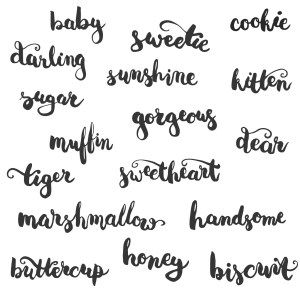
My family has an appalling habit: appalling nicknames.
When I was a kid, I had some nicknames that I didn’t mind so much. One was “Cubby,” after the little guy in the Mouseketeers.(1) As I got older and my character and personal traits became more evident, I acquired another one.
SuperKlutz.
I’m not saying the nickname was unwarranted. I was, after all, the child who gave myself a fat lip (2) the day before a ballet recital where we were all supposed to wear red lipstick.(3) I was the teen who managed, while trying to get out of the back seat of a four-door car, managed to land stretched out on the pavement with both feet still in the car.(4)
These things happened in the days before self-esteem was invented, of course. No one would refer to a child as “SuperKlutz” or “Stinkpot” nowadays. I hope.
The odd thing was, my entire family had appalling nicknames. My father habitually called my mother “Old Squaw,” which at the time was not considered politically incorrect. (5) And she didn’t mind. I don’t know what she called my father in private, but I bet it was appalling as well. My sister was “Fuss-budget.” Our family also contained an “Uncle Spud” and an “Aunt Pete.” (6)
So, whom do you think I married? A man whose usual nickname for me is “Old Boot.” I’m not even sure how that one got started. We also have incomprehensible-to-others nicknames for each other, such as “Doodle,” “Ler,” and “Thing.”(7) His family included “One-Eyed Uncle Francis,” who of course, had two eyes. No explanation was ever given for that, either.
Of course, we make fun of “normal” nicknames, calling each other “honey-kissie-lambie-pie” or “sugar-cake-darling-dumpling” until everyone around gags and needs a quick hit of insulin.
The thing is, I think that most families have their own private languages that no one outside understands. They may include nicknames for foods (10), cars (11), exes (12), friends (13), acquaintances (14), restaurants (15), body parts (16), and probably technology, TV shows, and toys, for all I know.
Most of our nicknames don’t get used outside the family. The fact that Dan calls me “Bunny” has until now been as big a secret as that I once belonged to a sorority. (17) Let’s keep it just between us, shall we?
(1) My sister was “Buddy.” I couldn’t help thinking that my father really wanted boys. Or wasn’t restrained by gender norms. Or both, I guess.
(2) By bonking a chair I was carrying into a screen door. Geez, did you think I punched myself?
(3) The ballet lessons were supposed to make me more graceful. See how well that worked?
(4) No seatbelt involved, either, in case you were wondering.
(5) For any number of reasons.
(6) The reasons for Pete’s nickname are lost in the mists of time. Her real name was Edna Mae, which, come to think of it, may have been the reason.
(7) He also calls me Bunny, Rabbit, Rabbi, Baby Orange (which he also calls one of the cats) (8), Scooter, Boomameter (9) and, in a throwback to our younger days, Old Mesa Knees.
(8) I’ve written before about our cats’ nicknames (http://wp.me/p4e9wS-8A). Some of them aren’t too flattering either, like Horrible Mr. Horrible Face.
(9) No. I have no idea what that means either. When asked, Dan says it is “something that measures boomas.”
(10) I had a recipe for a sweet baked good involving pastry crust, eggs, cream cheese, sugar, and optional fruit topping. My husband kept calling it “flan.” I told him that wasn’t the thing’s name. “What is it then?” he demanded. I was stumped. “Well, not flan!” I replied. “Not-flan” it has been ever since. After I thought it over, “Way-Too-Big Cheese Danish” would have been more accurate. But by then it was too late.
(11) “The Washing Machine” or “The Demon-Possessed Ventura.”
(12) “The Rotten Ex-Boyfriend Who Almost Ruined My Life,” to give a printable example.
(13) “Nearly Normal Beth,” “Jerk Boy,” “Michigan Dude.”
(14) “Fish-Face,” “Binky.”
(15) “Chateau Blanc,” “La Frisch,” “Waffle Ho.”
(16) General, like “wing-wing” or “gazongas,” or specific, like “throbbing purple-headed warrior” or “quivering love pudding.”
(17) I also used to go by Dusty. But never Dust Bunny, thank God.
 What a long way we’ve come from the days of flying toasters! Now instead of using a prefab screensaver or lock screen, it’s easy to create one of your own – one that has a special meaning for you.
My husband is a talented amateur photographer, specializing in nature photos. He didn’t have confidence in himself, however,  and I wanted to do something that would let him know how much I appreciate his talent and how much I love the results.
When he started taking photos I had assisted by cropping and color-correcting them. But after he stopped using his camera phone and got a small,  inexpensive, but fairly good quality digital camera, the most his photos needed was a tiny tweak or crop. There was nothing else I could do to the photos that would improve them.
Without telling him, I arranged a dozen or so of his photos into a  slideshow with Ken Burns dissolves and used that as my screensaver. Then I invited him into my study and made conversation until the screensaver
kicked in. “Hey!” he said, “Those are my photos!” He was really touched that I had liked them enough to use them. 
Later that year I selected a number of the photos and had them made into a calendar as a surprise for him and Christmas gifts for our friends and family. It was my way of showing how much I thought of his photography and how much I love him. I don’t think I will ever find a better screensaver, though I may add slides to it as he continues to snap his way through nature.
Photos by Dan Reily
The year 2016 has been a tough one for the music world. We have lost so many of our heroes, icons, and shining stars to death – across all styles of music.
Many of these have been exceptional singers – David Bowie, Prince, Glenn Frey, Paul Kantner – but the ones I will miss most will be the songwriters, including Merle Haggard and especially Guy Clark.
 Singers give to their audiences, but songwriters do that and give to other singers too. While we often say that no one can perform a song as well as the original songwriter, that isn’t always true. Songwriters’ voices – the indefinable soul that inhabits their songs – can never be duplicated, but singers with smoother or more powerful voices or more skillful instrumentality or arrangements can be technically far superior. Think Patsy Cline’s rendition of “Crazy,” which was written by Willie Nelson.
Songwriters have informed and shaped my musical tastes. Say what you will about John Denver, but his albums introduced me to phenomenal songwriters. His Aerie album alone contained songs by Buddy Holly, Kris Kristofferson, Steve Goodman, and John Prine. Other Denver albums introduced me to songwriters including Bryan Bowers, Hoyt Axton, Jerry Jeff Walker, and Tom Paxton. That’s quite a widening of the musical horizons for a young teen. Without that introduction, I would never have heard “Paradise” or “Sam Stone,” or dozens of other songs that are now living in my head and my memories. I would never have known who wrote the hits “Joy to the World” or “(God Damn) The Pusher,” either.
I noticed the songwriters and actively sought out more of their work. Perhaps I noticed the words first, being an aspiring poet myself, but later I learned how the skillful blending of lyrics and music make for a truly great song.
Songwriters tend not to get as much attention as singers. Audiences frequently don’t notice which songs their idols wrote themselves and which are “covers” of other songwriters’ works. Awards and Hall of Fame inductions for songwriters are vastly outnumbered by those for performers.
Because of the musical idiom I grew up in – country, folk, and what is now called “Americana” – the two recent deaths that have affected me most have been Merle Haggard’s and Guy Clark’s.
Haggard was well known for “Okie From Muskogee,” but he wrote much better songs than that – “Mama Tried,” “Workin’ Man Blues,” “If We Make It Through December,” and “Today I Started Loving You Again,” to name just a few.
Guy Clark was never as famous with the public as Haggard, but in songwriters’ circles, he was a hero. His songs became hits for others – often for multiple artists. “Desperados Waiting for a Train,” “L.A. Freeway,” and “The Last Gunfighter Ballad” were among his most-recorded. Perhaps surprisingly, they are all about everyday subjects – memories of a beloved relative, leaving a home, and an aging man’s delusions. Clark even wrote a song about home-grown tomatoes.
Every time I hear of another celebrity death, I fear for my remaining heroes. Many – including Willie Nelson and Kris Kristofferson – are in their 80s or nearly so. Billy Joe Shaver has cancelled nearly three weeks of performances for medical reasons. And, let’s face it, all have abused their bodies in various ways over the years. They can’t last forever, however much we might wish it. No matter when they go, they will be gone too soon.
I grew up reading mysteries. I still remember a book of short mystery stories for children. One was set at a circus and involved a missing snake. After looking in baskets and anywhere a coiled snake might be, the children notice that an acrobat’s pole falls to the ground with a dull thud instead of a metallic clang. Suddenly they realize that the missing snake is stretched out full-length inside the pole! Ta-da! (I also remember that the book was missing a few pages, which made one of the stories even more mysterious,)
That of course lead to Nancy Drew, the go-to mysteries for tween girls at the time. So they were written decades before. So the characters were unbelievable stereotypes. They were mysteries and I read them anyway. And collected them relentlessly, out of order because I usually got them in used book stores.

I got my first taste of the real thing at my grandmother’s house in Florida, when I was 11. DisneyWorld didn’t exist yet (yes, I’m old), and the attractions near Orlando were limited. There was the zoo in Kissimmee, St. Augustine, Busch Gardens, and an alligator farm. Not much else. In between road trips to the attractions, I discovered Grandma Rose’s shelf of real, grown-up murder mysteries. Agatha Christie and Rex Stout provided my introduction into the world of real mystery literature. (Recently I’ve reread a few Nero Wolfe classics like Some Buried Caesar. They still take me back.)
Over the years that followed, I came up with several categories of mystery authors – those whose books I would borrow from the library or buy used, those I would buy in paperback, and those rare, special authors whose work I would buy in hardback. Authors sometimes moved from one category to another, depending on whether the quality of the books stayed high.
Robert Parker, for example, started out as a paperback author, moved to hardback, then back to paperback when it seemed like he was only phoning them in – for example, when he spent too much time detailing what color athletic shoes and their swooshes Spenser and Hawk had on. When he branched out into other series with other lead characters, I stopped reading him altogether.
Since the advent of ebooks, I no longer buy hardbacks or paperbacks, but the categories still exist in terms of price. Sue Grafton is on my buy-immediately, read-immediately list. Sara Paretsky used to be, but I found the last two of her novels unsatisfying because of the endings – which involved silly stunts to trap the villain.
I’ve mostly given up on cozy mysteries, too. For a while I did read Diane Mott Davidson, Charlotte MacLeod, Rita Mae Brown, and a few others, but somehow I lost interest. Now I understand there is debate in the cozy mystery world over whether cat characters should talk or not. I prefer not to get involved.
I find that I am reading fewer mysteries these days, because many of them seem excessively formulaic – lead character is pursuing a serial killer who has targeted said character’s friends or relatives. Cozy mysteries have been really reaching for odd occupations for the detective character – librarians, innkeepers, golfers, crossword puzzle enthusiasts (are there really that many murderers who leave crossword clues?), and many, many cooks. It used to be interesting to get an inside peek at the workings of professions, but the thrill is gone.
I still like books in other genres that have mystery elements. One of these is the October Daye series by Seanan McGuire. Her lead character, who is part fairy, pursues quests usually involving stolen children or murdered fairies (or various other supernatural species).
Since I have cut back on reading mysteries and have been finding them less satisfactory lately, I’ve decided that what I need to do is write the kind of mystery that I want to read. I have begun to do so. I have 15,000 words already, plus a rough and fluid outline, which sometimes changes when my characters don’t do or say what I thought they would. (I’ve heard writers describe this phenomenon many times, but it’s interesting to see it happening in my own work.)
My working title is Cold as Stone. Wish me luck. Perhaps someday I will make it into someone else’s borrow, paperback, or hardback categories.
 But I Digress . . .