Category Archives: family

Frog Hair, Gunga Din, and an Old Cow

My father had his own peculiar way of speaking.

It wasn’t just his Kentucky accent, which can actually be found throughout most of southern Ohio where we lived, and even up into Michigan.(1)

Because we lived in Ohio since I was three, my dad was concerned that I might start “talking like a Yankee.” When we would go back to Kentucky (which we did frequently) he called it “getting elocution lessons.”(2)  I ended up able to speak what was known as “Network Standard,” and also to lapse back into a Kentucky accent when it would annoy my sorority sisters.(3)

So my father was not alone in his manner of speech, but he did have his own peculiar vocabulary. I suppose that somewhere amid the hills and hollers there are people who still speak like this, but in suburban Ohio, he was near-incomprehensible.(4)

Here are some of my father’s favorite expressions and what a normal person would say in the same circumstances.

“Finer’n frog hair split four ways” = “I’m great, thanks, and you?”

“Hangin’ in like Gunga Din”= “I’m great, thanks, and you?”(5)

“Like an old cow pissing on a flat rock” = “My, it’s raining hard.”(6)

“A real frog strangler” = “My, it’s raining hard.”

“Give me a box of Band-aids and a bottle of Mercurochrome and I’ll have this cow back up on her feet and giving milk in ten minutes” = “Gosh, this steak is too rare.”

“If he had another nickel, he’d have bought a red car.” = “My goodness, that car is certainly bright red.”(7)

Most of my father’s odd expressions came from his upbringing in rural Kentucky, but some of them he borrowed from the Old West. This habit only increased when he retired from civil service on a disability and went back to his roots. He started wearing flannel shirts, cowboy hat and boots, or sometimes sneakers. He abandoned the Vitalis and Aqua Velva for chewing tobacco and small, disgusting cans of pemmican he ordered through the mail.

Young children were fascinated by his cowboy persona. Once while in a restaurant wearing his Wild West get-up, and crutches owing to his disability, a young lad asked whether he had been shot by an Indian, much to the embarrassment of his mother. My dad loved it. On another occasion, he addressed a young boy as “little pard,” (short for “partner,”) only to have the child respond indignantly, “I am NOT a little fart.”

My mother was tolerant of his idiosyncrasies.(8)  She had to be. His pet name for her was “Old Squaw,” which these days, of course, would be politically incorrect for oh-so-many reasons.(9)

All in all, my father’s language was in some way reassuring. It was a family thing. It didn’t matter if the rest of the world understood him. We did.

(1) This is a result of the southern migration up I-75, also known as the “Hillbilly Highway.” Thousands left the southern states for industrial jobs in Ohio and Michigan car plants.

(2) My high school speech and debate teachers disagreed with him on the necessity of this, or at least his definition of same.

(3) My college membership in Delta Phi Epsilon is one of my darkest secrets and I hesitated to reveal it. In fact, just pretend you never read this footnote.

(4) Once at a party he fell into conversation with a shy, soft-spoken young lady. The next day we learned that each had thought the other must be from a foreign country.

(5) Very few people know where this expression comes from. You may recognize “Gunga Din” as the title of a poem by Rudyard Kipling, but that’s not where my father got it. Early rock and roller and country superstar Jerry Lee (“The Killer”) Lewis used to use the phrase in some of his songs. No one knew what he meant by it then, and no one knew what my father meant by it either.

(6) People often ask, but there is no real reason that it has to be an old cow. It just is.

(7) I occasionally use this one myself, once totally confusing a friend’s Puerto Rican boyfriend.

(8) Though once in a while even she didn’t get what he was talking about. Once, when getting ready for a trip, he told her, “Pack and tie,” which had something to do with loading a covered wagon (I think). She thought he said, “Pack a tie,” and she did, though she had no idea why he wanted one.

(9) Some say girls marry their fathers. I don’t know about that, but I did marry a man whose term of endearment for me is “Old Boot.” Not usually in public, though.

Review: Furiously Happy

Buy this book!

Jenny Lawson, aka The Bloggess

Now I’ll tell you why.

First, despite what I wrote a previous post, Seven Reasons I Hate the Bloggess (http://wp.me/p4e9wS-56), I really respect and admire her and her writing.

Second, Furiously Happy is every bit as funny as Let’s Pretend This Never Happened, Lawson’s first book. It’s as raucous and uninhibited as her wildly popular blog.

Third, it’s something more.

Oh, there’s still plenty of weird taxidermy, ridiculous fights with her husband Victor, and even a bizarre travelogue of her trip to Australia. (She was not allowed to cuddle a koala, even when she dressed in a full-body koala suit, but consoled herself with the knowledge that koalas have chlamydia.)

But threaded through  her comic, idiosyncratic prose is a serious message about mental health: that we should speak up about it; acknowledge our struggles; and be determinedly, exuberantly, furiously happy when we can, in defiance of our illnesses.

Furiously Happy is a book for the millions of Americans – one in four – who struggle with mental illness, and for the millions more of their families, loved ones, and friends. It entertains and educates and defies the stigma that surrounds mental illness, without being preachy or mired in statistics.

Lawson has heard from people who have made it only as far as the parking lot of her signings because they too have severe anxiety disorders. Others have driven as much as five hours to attend one of her appearances. In her blog (thebloggess.com) and her new book, she lets people know that we are “alone together,” that even if we’re broken, we still have the capacity for magic.

At a recent book signing, Lawson was visibly nervous when she read two chapters aloud. One of these chapters was the one in which she and her mother discuss what is crazy and whether Jenny is. During the Q&A session at the signing, she took care to make the point that mental illness need not prevent people from being, as she says, furiously happy – if they keep on struggling, fighting, and trying, and especially if they have people around who understand and help.

After that she signed her book and anything else the audience brought until the entire group – which was quite large – was satisfied. No one was turned away from the signing line.

Lawson’s writing is not for everyone. Some people will be turned off by her use of profanity, and perhaps others may not appreciate the serious message that this second book contains. However, if you are looking for more rollicking, uninhibited, and unlikely (though largely true) stories, you will certainly find them here. But if that’s all you want, you may prefer to skip the serious chapters.

On the other hand, if you want to learn about mental illness with its attendant difficulties, and why it is so important to bring these topics out of the closet, as it were, then you may find the storytelling ridiculous, irreverent, or distracting. Personally, I enjoy the whole package, and it’s clear that many others do too.

Actually, the book hardly needs my endorsement. It’s been on the New York Times bestseller list for weeks now, and her book tour is drawing large and enthusiastic crowds. But I’ll recommend it anyway. You can start with her first book and find yourself drawn into the other. Or vice-versa.

You should also check out her blog, both for the content and the commenters, many of whom have found in Jenny an inspiration and in the other commenters a like-minded group of self-admitted weirdos, social outcasts, and yes, the mentally ill. That’s really been Lawson’s message all along. She just states it a little more directly in Furiously Happy.

My In-Law and My Ink

I expected a total freak out. I really did. So I tried to work it into a phone conversation as naturally as I could.

“Say Mom, did Dan tell you I got a tattoo?”

Instead of the expected shriek, I got a fairly calm query.(1) “Where?”(2)

If I were being a smart ass I would have said “At Monkey Bones Tattoos.” But I took the sensible route for a change and said, “On the inside of my left wrist.”

Then she asked, “What did you get?”

Again, any number of possible responses crossed my mind. But I decided to play it straight and told her the truth: “I got a semi-colon.”(3)

The next obvious question was, “Why?”

I could have said because I’m a huge grammar nerd, which would have been the truth about me, but not about the tattoo.

I explained as best I could. The semi-colon tattoo is a symbol of mental health awareness and suicide prevention. I rushed through the grammatical part of the explanation: In writing a semi-colon is a place where the writer could have stopped, but chose to go on. The idea is that someone will see the tattoo (4) and ask about it. Then you can explain the symbolism and how you are trying to combat the stigma of talking about mental illness. Like I just did.

I wrote about this on my other blog, Bipolar Me (https://bipolarjan.wordpress.com/2015/08/09/a-tattoo-is-for-life/) when I first got the tattoo, so if you saw it there, I apologize for the repetition.

Actually, no I don’t. The message is one that bears repeating, as often as we can and in as many ways as we can. You know someone with a mental illness(5) and that person is afraid to talk about it because of the stigma that still exists around the subject. I have bipolar disorder, type 2, and I talk about it all the time on my Bipolar Me blog.

Talking about mental illness is risky. You often get one of the standard reactions: a fixed, awkward smile; unwelcome advice about cinnamon or apple cider vinegar; outright disbelief; a decrease in contact with that person; sudden bad reviews at work. Perhaps worst of all, you get, “Isn’t that what the guy who just shot up the shopping mall had?”

Ordinarily, I post to my blog on Sunday. But this is National Suicide Prevention Week, so I wanted to post now. You can find out more about the tattoos at http://www.projectsemicolon.com/.

As Mom R. said about my tattoo, “It’s for a good cause.”


(1) My father-in-law was a Navy man and sported a few of the more common nautical tattoos, so I guess Mom R. had had a while to get used to the idea. Anyway, at least she didn’t go all, “The body is the Temple of God” on me.

(2) Apparently this is the first required question if someone announces a tattoo. Unless it’s on your face, neck or other readily observable spot. I suspect that everyone who asks imagines that it is located some place at least mildly kinky.

(3) Monkey Bones is locally known for extreme, large, and disturbing tattoos, like zombie cows. (I’m not kidding, either.) I think they must have been so embarrassed at being asked to do a pitiful mark of punctuation that they hustled me in and out in ten minutes.

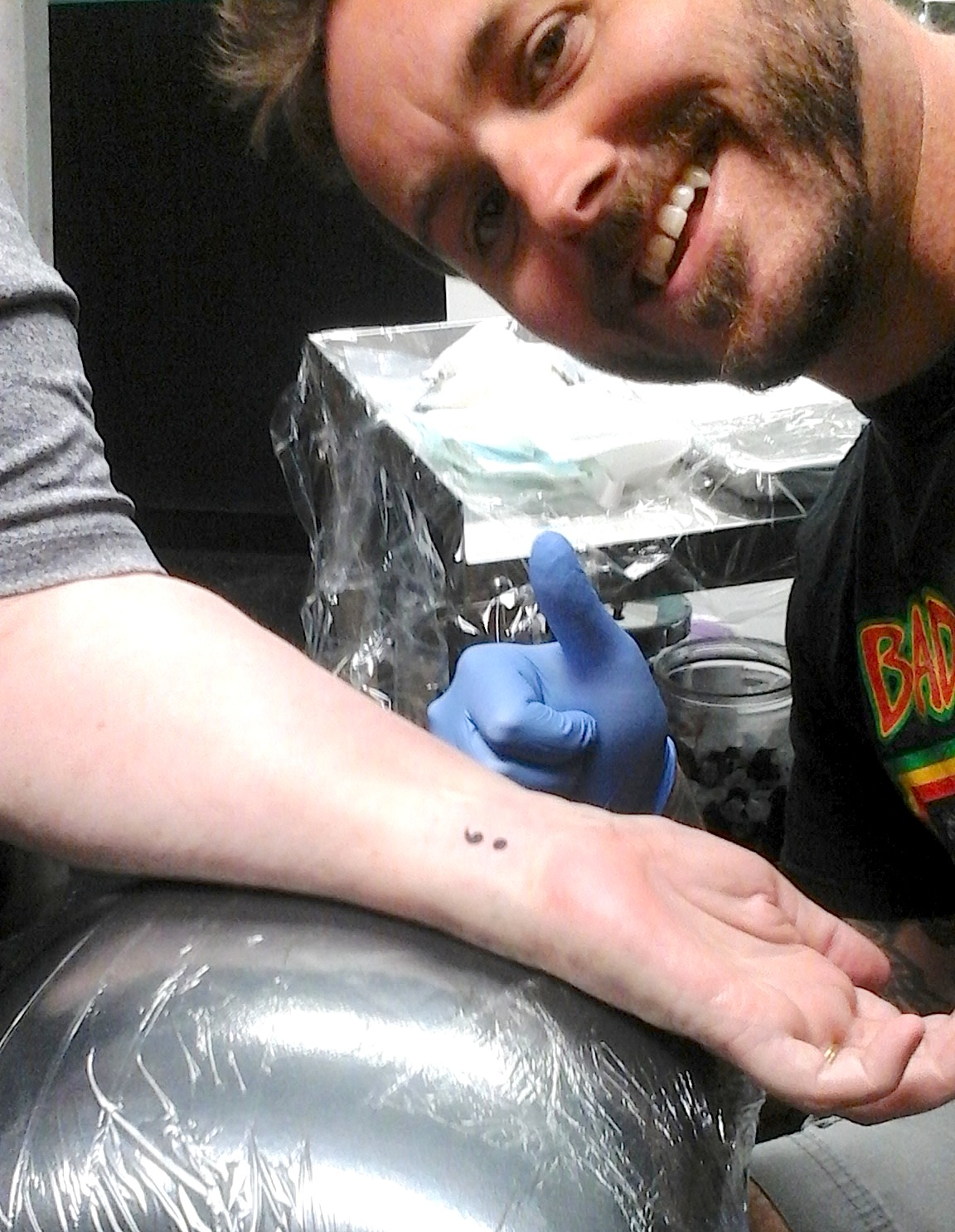
(4) And if we had been Skyping, Mom R. would have, but Skype has been glitchy lately since I changed browsers. So we have our weekly coffee chats over speakerphone. This prevents a lot of Dan handing me the phone and saying, “Here. Say hello to Mom.” Especially when I’m not prepared with any tidbits of conversation, like a new tattoo. Here’s a picture, if you’re curious:

finished
I guess Mike at Monkey Bones isn’t embarrassed after all.

(5) Depression, anxiety, OCD, ASD, whatever. I guarantee it. Someone you know is struggling, and may or may not be getting help for it. A semi-colon tattoo would show you care.

Dodging Nosy Questions

“So, when are you and Janet going to give your mother grandchildren?”

“Why spend $300 per hour on a shrink when it’s not going to do any good anyway?

“Why do you always eat junk food when you know you have high blood pressure?”

“Are those boobs real?”

Questions you can’t answer. Questions you don’t want to answer. Questions you want to slap a person for asking. Questions that are just begging to start a fight. We all hear them, sometimes from our nearest and dearest, and sometimes from total strangers.

There is an answer – other than “Shut up and leave me alone,” which may indeed be your initial reaction, but usually isn’t the best solution. (Except maybe to the boobs question.)

Noted linguist and author of The Gentle Art of Verbal Self-Defense Suzette Haden Elgin recommended a technique called the “Boring Baroque Response.” It’s not a skill everyone has at the ready, but with a little practice, you can expand your ability to deflect the nosy and the belligerent.

The essence of the Boring Baroque Response (or BBR) is storytelling. No matter the question, you stare off into space and launch into the longest, most rambling story you can. Here’s an example:

Idiot: “Why do you always eat junk food when you know you have high blood pressure?”

You: “That’s interesting you should ask. It reminds me of when my parents and I were visiting Cousin Jim and Cousin Addie – you know, the ones that lived near Natural Bridge and had that kitchen that was painted all black. And whenever we visited my sister and I played in the hayloft. But it didn’t have hay, it was really bales of straw. Dried-out corn cobs, too, which they fed to the animals, like the mule. I rode that mule once, bareback, and you wouldn’t believe how bony its backbone was! Anyway, Cousin Addie was making biscuits and gravy – sawmill gravy with milk, not red-eye gravy with coffee – and Cousin Jim always said….”

Keep going as long as necessary until the questioner gives up and goes away. As Elgin noted, “A response like this delivers the following message: ‘I notice that you’re here to pick a fight. Do that if you like, but it’s not going to be much fun for you, because I won’t play that game.'”

According to Elgin, the secret of the BBR is to deliver it with a straight face and a thoughtful, reminiscing tone. Sounding sarcastic or snotty will give away the game. And although the example was (vaguely) related to food, as the question was, it doesn’t have to be. The story can be about your sister and how she wanted to be a veterinarian, which she would have really been terrible at because….Well, you get the idea.

My husband had a version of the BBR that he used when he worked in community-based corrections. He would regale the “clients” with stories full of analogies – “You know when they make steel how they forge it first in really high heat and then plunge it into cold water. Well, that’s kind of like….” He could rarely get out more than a sentence before the listener would edge away, saying, “No stories, please, Mr. R. I’ll behave. I’ll be good. Just no story!”

I don’t know if Elgin ever heard it, but the best BBR I know is the monologue that Grampa Simpson produced when asked to break up a union meeting:

“We can’t bust heads like we used to. But we have our ways…. Like the time I caught the ferry to Shelbyville. I needed a new heel for m’shoe. So I decided to go to Morganville, which is what they called Shelbyville in those days. So I tied an onion to my belt, which was the style at the time. Now, to take the ferry cost a nickel, and in those days, nickels had pictures of bumblebees on ’em. ‘Gimme five bees for a quarter,’ you’d say. Now where were we… oh yeah. The important thing was that I had an onion on my belt, which was the style at the time. I didn’t have any white onions, because of the war. The only thing you could get was those big yellow ones….”

Now that’s classic TV! Just like the episode of WKRP when Mr. Carlson had an idea for a promotion and Les was supposed to report on it live from the shopping center, but the one store didn’t want him standing in front of it because customers couldn’t get in, so then….


Books, etc.: Creating a Lifelong Reader

The other day I saw an article on the web, “Raise Lifelong Readers With These Handy Tips.” (http://blog.theliteracysite.com/raising-readers/?utm_source=social&utm_medium=trnfan&utm_campaign=raising-readers&utm_term=20150713)

It was a good article, and I had to admire the author’s pseudonym, Paige Turner. She (or he) said:

Booklovers are not born. An interest in reading and a delight for stories found within the pages of a book is something that has to be carefully fostered.

For kids who learn an early appreciation for reading, the benefits can be extraordinary … readers have a huge advantage from early on!


The advice in the article was all good: Read to your children, take them to libraries, be a role model, etc.

My mother didn’t know how to teach reading. But she read to me and my sister, as far as I can recall, every day, one on each side of her, nestled on the sofa. We went on frequent trips to the “bookmobile,” a library outreach trailer, and on special occasions to the library itself – even the big one downtown. This ample supply of reading material was supplemented with trips to a favorite used book store. We grew up surrounded by print.

Paige offered good advice, as far as it went, but it omitted one important point, in my opinion:

Love of reading starts before a child can read.

If you wait for your child to learn to read before you share reading experiences with him or her, it may be too late. It takes reading together to make a non-reading child into a reader.

I honestly can’t remember a time when I was a non-reader. Despite Paige Turner’s statement, I was very nearly a born booklover.

My mother didn’t follow all Paige’s good advice. I never remember either her or my father reading for pleasure. (My father did, much later, when he was ill with bone cancer and couldn’t get out of bed. Again the library outreach stepped in, and a dear friend who worked for them, brought him stacks of Zane Grey and Louis L’Amour.)

To me, print is important. Picture books are good, but I think one thing (among many) that my mother did right, was to expose us to print at an early age. Even though we couldn’t read the black marks on the white paper, she read them for us. One thing this promoted was consistency. The story was the same every time, and that lead to the idea that the little black letters had something to do with how the story went.

Without being told, we were learning what reading was, even if we weren’t yet being taught how to do it. The words stood for something – something familiar and delightful, a magic so enticing I couldn’t wait to learn how to create it myself. So I didn’t wait.

Many years later I worked in a bookstore. Often a parent would come in and ask, “How can I get my child to read?”

“How old is the child?” I would ask.

If the child was a teenager, I would offer some suggestions, but inwardly shake my head. For most of them, I knew, it was too late.

That’s one of the reasons I adore the Harry Potter books, flawed as they are – they made reading cool, provided an experience so enthralling that even non-readers, pre-teen, teen, or even adult, would make the effort for a chance to experience the wonder.

(It’s also why I’m glad that the movies didn’t come out until years after the books began their epic sweep.)

Alas, reading is growing more difficult for me. I’ve had eyeglasses since the age of three and my eyes are now on a definite downswing. All the books I collected when my vision was more reliable are becoming blurs to me now.

I certainly need new glasses, and as soon as I can afford them, I will get some. (That’s another thing my parents did right that Paige didn’t mention – regular vision checkups and new glasses as needed.) And I’m intensely grateful that e-readers let you change the type size all the way up to humongous.

But if I’m truly going to be a lifelong reader, I probably ought to start learning braille now.


Cats, etc.: The Grooming Salon

I do so love to watch cats grooming themselves. I find it hypnotic and soothing – the smooth play of muscles as they twist and stretch, the sensual splayed toes, the darting little pink tongue, the occasional glimpse of the cat’s nethers.

My husband does not find it nearly so soothing. That’s because Dushenka takes a pause (1) from grooming herself, she starts grooming him. This could keep her busy all day, since he has a lot to groom.

She usually starts with a brief lick to the nose, which I assume is to let him know what’s coming. Then she starts in on his beard.(2) When she’s had her fill of that, she moves on to his eyebrows, though she occasionally misses and grooms his forehead.

Whenever Dan’s shirtless, which is usual in summer and not unknown even in winter, she goes for his prodigious chest hair.(3) I have never seen her miss and accidentally lick his nipple, though I’m pretty sure if she did, he wouldn’t tell me. And I won’t even speculate about her grooming his nethers.(4) They may engage in these pursuits when I’m not around, for which I’m mostly thankful, but about which I’m perversely curious.

I remember a Robin Williams routine in which he said, “If you think cats are so clean, you go eat a can of tuna fish and lick yourself all over.” By that theory, my husband is coated with a thin layer of Super Supper and cat spit, which I must block from my mind when I hug him.

Dushenka occasionally gives my nose a lick, but that’s as far as she goes.(5) Cats in general find no pleasure in grooming me, although I once had a cat, Julia, who was irresistably drawn to roll on my head whenever I had my hair done at a salon. I think she was enamored of the coconut-scented mousse my stylist used, though I know of no of no other cat attracted to coconut.(6)

I also once knew a cat who, when I was sitting on a sofa, was drawn to my curly-permed ponytail.(7) But she did not slurp. She pounced, apparently believing that my ‘do was some sort of rodent or other cat toy.

The only time I experienced a lengthy cat-grooming attempt was when Dan rubbed catnip on my leg. (Thankfully, I was wearing jeans.) Lick, lick, slurp, slurp ensued, until I had a round, damp spot on my thigh.(8)

But ultimately, this post is not about cat spit, or tongue-prints, or even pants-licking. The take-away from this is: Cats groom their kittens. My husband’s mother, therefore, is the cat Dushenka, and he is her child. Please don’t tell the woman who birthed and raised him. Her claim has been challenged. And we all know what happens when you engage in a war of wills with a cat.

The cat wins.

Mama Dushenka and Her Baby

(1) Yep. I went there. Tell me you’re surprised.
(2) Here’s a probably-not-real study that is nevertheless awesome.
“Cats were exposed to photographs of bearded men. The beards were of various sizes, shapes, and styles. The cats’ responses were recorded and analyzed […] 214 cats participated in the study. Three cats died during the study, due to causes unrelated to the bearded men. Fifteen cats gave birth while viewing the photographs.”
For the full story, see: http://www.shinyshiny.tv/2011/01/useful_scientific_research_cats_reacting_to_bearded_men.html
(3) I recently blogged about men’s chest hair, including Dan’s. See: https://janetcobur.wordpress.com/2015/06/14/what-belongs-o…st-if-anything/
(4) Except I just did, didn’t I?
(5) Of course my hair situation is unlike Dan’s. Thank goodness.
(6) Pumpkin, yes. And corn. Neither of which is usually featured in hair products.
(7) Hey. It was the 80s.
(8) Incidentally, I understand that cats’ tongue-prints are as unique as humans’ fingerprints. I don’t know if that’s true, but I do know that if you leave the butter out, you will find tiny but disgusting furrows in it from kitty’s tastebuds. I guess you could scrape off the affected area of butter, if you’re frugal, but I think most people would prefer to replace it. Especially if there are also little tell-tale hairs clinging to it.

Pets, etc.: Alternatives to Cats

I write a lot about cats. They are the most entertaining of animals, with the most befuddling actions, the most expressive facial and body language, and the most comforting presence. But we’ve had experiences with other sorts of pets too. They’re not as endlessly fascinating as cats, especially our new little guy, Toby, but here are a few stories so they (well, their owners, really)(1) don’t feel left out.

My husband is a cat person (and a dog person too), but he’s really responsible for most of the other kinds of pets who’ve lived with us. When we got married, he came with a set of hermit crabs that lived in a terrarium. They were a little disconcerting because they made odd clicking and scrabbling noises at night. Dan claimed they were constructing a secret missile base, and I can’t prove he was wrong.

That’s about all there is to say about hermit crabs. They’re really not all that interesting as pets go, though if they ever completed that missile base, I would have liked a tour.

Another terrarium-based acquisition was a hedgehog which he named Codger for his sparkling personality.(2) I believed Dan got him to punish me for taking a vacation to Michigan without inviting him along.(3)

On the internet hedgehogs are cute and wear adorable hats or curl up in muffin tins.(4) Codger was not adorable. He was a surly little bastard. His entire repertoire consisted of growling, snarling, and rearranging the furniture. He had a little hedgehog house and a ball to amuse himself with, but all he seemed to do was push them around.

Dan claimed that his spiky pet was so unlovable because he had not raised Codger from a baby. Apparently hedgehogs do better if you socialize them to humans when they’re young. I suggested that Dan try to interact with him, but Dan’s idea of interaction was poking him with a plastic fork. Dan explained that Codger had poked him enough times, so it was only fair.

Once our family included the hedgehog it became more difficult to find someone who would care for the animals if we went away for a few days. It’s relatively easy to find someone to feed and water and play with cats and dogs. It’s a little tougher to find someone who will feed a surly bastard live worms and clean out his habitat while threatened with poking.(5)

And now for the other most popular pet in America – dogs. Perhaps surprisingly, Dan and I both had dogs while growing up. Ours was really the family dog, not anyone’s personal dog. First there was Blackie, and then there was Bootsie.(6) They lived in the garage, exercised on a chain attached to the garage, and ate Gainesburgers. They saw the vet once a year for a rabies vaccination.

I know that nowadays this would be considered animal abuse.(7)

Dan and I once had a dog named Karma, a stray German shepherd mix.(8) We decided it would be karma if his owners found him and karma if they didn’t and we kept him. Hence the name.

Two of my favorite memories of Karma are the time he needed to go to the vet and we needed to provide a urine sample. Dan, always inventive, attached a glass jar to the end of a long stick and walked the dog, strategically placing the jar under Karma’s pizzle at the apropos moment. It worked beautifully.(9) My mother said that she would have paid to see that.

Karma’s other notable behavior was burying bones. You might think this is quite an ordinary thing for dogs to do, but Karma buried rawhide bones straight up and down, with one knobby end sticking up out of the ground, presumably so he could find it later. Our back yard looked like a rawhide graveyard full of tomb-bones.(10)

Our next, and current, dog is Bridget. She was a feral stray puppy that Dan rescued from his workplace when she was trapped and scheduled for extermination. We always tell people that her mother was a golden retriever and her father was a traveling salesman.

She never quite got over being feral. She prefers to live on our deck, where she can see into the house, but not have to interact with anyone inside.(11) (She has a dogloo with cozy blankets, a sun awning and a basement condo, which she hates, for icy weather.)

Dan tried walking her once, but when she saw another dog, she cowered and peed all over Dan’s shoe. We are the only people who can get near her.(12) Bridget once came within sniffing distance of Dan’s friend John, who was a master of the Zen technique of standing on the deck, smoking a cigarette, and Pretending There Is No Dog.

Bridget is getting old now, and has already had one operation for cancer.(13) When she goes, I don’t think we’ll get another dog, though of course that’s up to the universe. Karma, if you will.

What other pets might we have someday? I guess if I take another solo trip to Michigan, I’ll find out.

(1) Don’t get me started on whether we own our pets or they own us or they are family members or we are pet parents with fur babies and similar semantics. I would probably vote with Jackson Galaxy (https://en.wikipedia.org/wiki/Jackson_Galaxy) that we are “pet guardians,” though I have been known to address various felines, even full-grown ones, as “Baby-cat.” Just not around people who have human children, unless I know them well.
(2) I would put a footnote here about pets resembling their owners – uh, guardians – but Dan wouldn’t appreciate it.
(3) I don’t quite know why I think a hedgehog is punishment for a solo vacation, but there you have it. I never said my thinking was always rational.
(4) It may or may not surprise you to learn that baked hedgehog was considered a delicacy by noted jazz guitarist Django Reinhardt. We did not try this with Codger.
(5) In point of fact, Dan’s friend John was the only volunteer ever. I think they had snarling contests, or maybe decorating competitions. We had to supply the live worms, which I always liked to claim we got at the bugstore.
(6) Hey, we were kids at the time. Think of all the cats there are named Miss Kitty. I got better at naming later.
(7) Although I think the pendulum has swung a little too far the other way, now that we have refrigerated gourmet pet food and Kitty Caps toe covers.
(8) Mixed breeds now are just getting silly. “Labradoodle” is a funny word, but there is no earthly reason for a shih tzu-poodle cross, except someone wanted to call it a shitz-poo. (Which is actually pretty great when I think about it.)
(9) Okay. “Beautifully” isn’t quite the right word. Maybe “effectively.”
(10) Sorry. (Not really.)
(11) When the deck door is open a bit, she and the cats will play a round or two of “I’ve Got Your Ear.”
(12) Her ferocious-sounding bark scares off meter-readers, but if they come into the yard, she hides under the deck.
(13) We did have another pet once, a parakeet named J. Alfred Prufrock (see “The Bird Who Spoke Cat.” https://janetcobur.wordpress.com/2015/01/11/the-bird-who-spoke-cat/) We once got an operation for him when he was sick. Try to find a vet that will do that. There aren’t many.

When Life Gives You Daughters…

Dad wanted sons, it’s clear in hindsight. What he got was me and Lucy.(1)

Being a good dad, he never said – at least within my hearing – that he really wanted sons. He never said it to my mother within my hearing either.

But there were subtle signs. He gave us boys’ nicknames, for example. Lucy was Buddy and I was Cubby, after the cute little boy Mouseketeer.(2)

Dad would roughhouse with us. He took us to the rifle range and taught us to shoot. He wanted me to grow up to be an engineer. Lucy was determined to be either a jockey or a veterinarian neither of which was a realistic goal, but he left her to her fantasies and decided that I should follow in his footsteps.(3) My mother finally convinced him not to try talking me out of my goal of being a teacher, but by the time she succeeded I had already given it up.(4)

Dad was no feminist though.(5) He just wanted children that he could engage in his guy pursuits with. He wasn’t a sports fan, but he encouraged – no, positively enabled – any interests or hobbies I had that were even quasi-military.(6) I liked archery, fencing, and martial arts. He would buy me all the equipment or accessories I needed. One Christmas he even gave me a Black Widow model slingshot. It had a spiffy wrist brace so that you could get a steady aim and a stronger pull. I don’t think I ever used it, but if I had wanted to I could have put a ball bearing through the side of the garage.

Lucy and I were what they called tomboys back then – me more than Lucy.(7) My mother still got a chance to indulge girlier whims. Every Easter would find us dressed in ruffled pink organdy with frills and itchy headbands adorned with fruit or flowers. Little white patent leather shoes and little white ankle socks were also required, as was the taking of pictures in front of the house.(8)

Despite the occasional attempt at girliness, Lucy and I were not indoctrinated into the prevailing feminine ideals. For example, neither of my parents ever even hinted that I should hide my brains so as not to scare off the boys. In fact, they encouraged me to show off my smarts in some fairly obnoxious ways. I always knew college was my destiny, but I never got the impression that marriage and motherhood were also expected. It came as a surprise to everyone – most of all me – when I did acquire a husband.

Perhaps not surprisingly, that husband turned out to have a combination of male and female traits himself. He bonded with my father by replacing his shocks and with my mother by gardening. He has a background in private-duty nursing and has often had women for bosses.(9) I don’t know that much about his upbringing, but I do know it left him flexible and understanding about the limits of gender roles. I know even less about Lucy’s husband, but I think it’s probably significant that he drives for Meals on Wheels, another sort of caretaking.

In a way I feel sorry for the girls I see who are raised to be princesses in pink. It’s so limiting. We were raised not as girls, not as boys, not as girly boys or boyish girls, but as children (10), who came from male and female, and carried bits of both inside us. And I can’t speak for Lucy, but I think the experience has served me well.

(1) That’s not her real name, but I may occasionally say unflattering things about her and want to cover my bets. And my ass.
(2) Admittedly these were better than the nicknames one guy on a reality show gave his little daughters – Truck and Tank. But ours were still just a wee bit butch.
(3) He was an industrial engineering technician, and since I was destined for college, that made me the obvious choice. I suppose I could have become an engineer, but I would have been a very unhappy one.
(4) There were much more exciting things to be, like a bus driver, a chemist, an FBI agent, or a poet.
(5) When I decided to keep my own name – well, his name, really – after marriage, he quoted that bit to me about the man is head of the woman as Christ is head of the Church (Ephesians 5:23).
(6) He considered “The Caissons Go Rolling Along” to be a fun, catchy children’s song.
(7) I don’t know what they call tomboys now. Just girls, I think. Or maybe children with non-conforming gender identity norms. If you’re a sociologist, I mean.
(8) Some of these pictures may still exist, but you’re not going to see them here.
(9) Not to imply I’m bossy or anything.
(10) It could have been worse. When we were out and about in the neighborhood Dad would whistle to call us back home. I suppose we could have turned out to be dogs.

Cats, etc.: Love to Eat Them Mousies

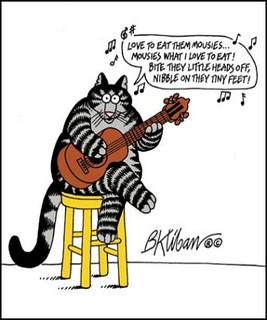
Kliban cat singing "Love to eat them mousies"
Copyright B. Kliban, 1975

Yes, they do. It’s nature’s way.

Apparently, it’s also nature’s way to give half a mouse to the one you love.(1) The cats, however, seem unable to decide which half is the good half.

Our cats have always been in favor of eating the back half and proudly presenting the front half. A neighbor’s cat did just the opposite, leaving a regimented little line of mouse butts in front of the garage door, a veritable mouse-ass buffet for . . . well, someone.

Many people’s reaction to this love offering is to scream, which must be mightily confusing to the cats. My husband tries to interrupt the process while it’s still at the gee-this-is-fun-to-play-with stage (2) and escort the erstwhile victim outside.(3)

The usual drill, though, (after the semi-obligatory scream) is to praise kitty as a mighty hunter, then quietly clean up the carcass (4) while the cat isn’t looking. She may expect you to eat the proffered half-mouse. Whether you do depends on how devoted you are to your cat and how much you like rodent tartare.

Justine Alford has a different theory on why you receive half-mice from your cat: “Given that female cats are most likely to bring back animal presents, the most likely explanation for this behavior is that they are trying to teach you the hunting skills that you clearly lack.”

This means that the cat is your mama and you are her baby. And she is thinking, “Come on, dimwit. Give it a try. I can catch these and I don’t even have opposable thumbs. How about you catch mice and give them to me for a change? Honestly, I don’t know how you manage to feed yourself!”

We may need the training after all, when we retire and live under the Third Street Bridge. But don’t tell the cats that. They’re smug enough already.

(1) Remember this tip when Sweetest Day rolls around. And isn’t Mother’s Day coming up?
(2) As opposed to the “aw-this-is-no-fun-since-it-quit-moving” stage.
(3) My husband also gets to escort spiders, snakes, moles, bats, birds, and other still-living catfood outside. He has definite Buddhist tendencies when it comes to home invaders of the non-human sort. Wasps that make it inside I insist that he kill. Stink bugs get trapped in pill bottles, batted under furniture by the cats, and forgotten.
(4) Our cat Django used to take his intended victims into the bathtub, where they had less room to maneuver. The crime scenes were also easier to clean up.

What’s a Family? Not This.

blood family

I believe this is true, but it’s not what I want to rant about today.

There are several types of families, depending on whom you ask. There are blood family, extended family, chosen family, and the family-that-dare-not-speak-its-name (at least in some circles). You can have quite a jolly time debating which exist and which are better than the others. I say family is as family does and leave it at that.

The one kind of family that I believe does not exist is the corporate family. It is a big, fat, self-serving, pants-on-fire lie. But it’s still very popular and swallowed whole by many.

It’s when a company or business tries to convince employees that it is really like a family.

They do this to create warm, fuzzy feelings and make the workers think that management has their back. While that may be true of some (mostly smaller) businesses, the majority of businesses simply want to make money for the minority; that is, for the owners, upper management, and shareholders.

Is that the way families work? Mom and Dad cutting the kids’ allowances and assigning more chores so that the parents can get a bonus or a vacation?

I didn’t think so.

And speaking of family types, the business-as-family model is almost invariably paternal and authoritarian. Papa knows best and issues the orders. Everyone else carries them out. Do real families like that exist? Of course. But it’s hardly a model that promotes self-esteem in anyone but the father. Imagine whst it does to minimum-wage workers.

We all know by now that, legally, officially, corporations are people, so it almost makes sense to say that a business can be a family. But think about it. Do you really want Father Wal-Mart or, God help us, Mother Koch, or even Cousin Trojan?

I have a very good family, thank you, made up of relatives, friends, loved ones, animals, and people who care for me and each other, with reciprocal having of each other’s back.

I don’t need another one.

Especially not a corporation that pretends to be a family.