Right now, I am snuggled up in a blue woobie. What’s that, you say? I’ll digress at length on the subject.
There’s a role-reversal comedy movie from 1983 starring Michael Keaton, Teri Garr, Martin Mull, and Ann Jillian. The plot is very ’80s: worker at an auto plant loses his job; his wife gets one at an advertising agency; and he becomes Mr. Mom. So far, so standard.
But the movie is genuinely funny and worth a look. Yes, it covers a lot of the cliches regarding rising business star vs. stay-at-home dad. But the ensemble cast and the comic timing make it a film that really ought to be better appreciated. (This whole section of my post has been a digression.)
In the movie, one of the children has a security blanket, which he refers to as his “woobie.” (Psychologists call it a “comfort object,” but my husband and I like “woobie” better. But I digress again.) Wiktionary defines “woobie” as “any object, typically a blanket, garment, or stuffed animal, that is used simply for its comforting characteristics; a security blanket.”
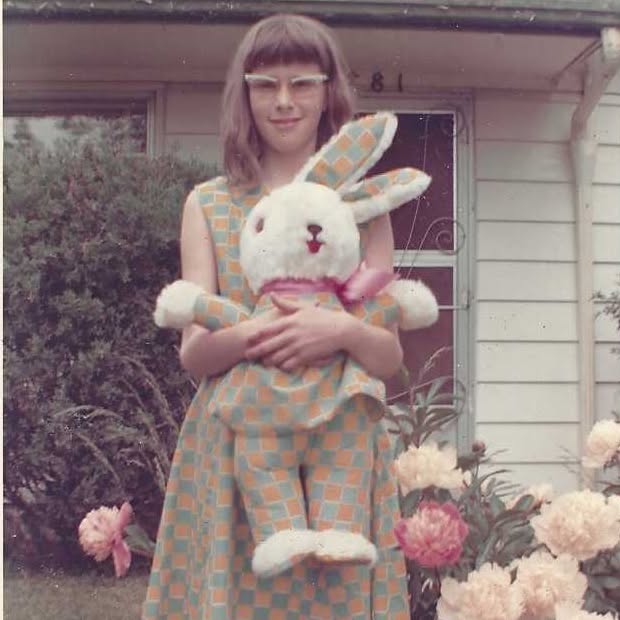
Elizabeth, the fashion influencer
(Apparently, “woobie” also describes a military “Liner, Wet Weather Poncho.” Soldiers call it a “woobie” because it’s their essential comfort blanket in the field. Maybe so. I would like anyone with expertise in the area of wet-weather poncho liners to verify this. But I digress yet again.)
My sister and I each had a woobie when we were children. Hers was a square of soft but sturdy woven fabric named “Tag.” Mine was a flannel sheet I called “Fluffy.” I think Fluffy was the better security blanket because I could—and did—wrap myself entirely in it and, essentially, hide when I needed to.
Lots of my grown-up friends have comfort objects, although they don’t refer to them as “woobies,” as far as I know. Dan’s only friend John had a small plush rabbit that he took to his sleep study. I did the same because they wouldn’t let me bring a live cat.
Sometimes plushies get names even weirder than “woobie.” I have one that I call “Pandacoon” because I’m not sure whether it’s meant to be a panda or a raccoon. A friend has a plushie that he can’t identify as either a yak or a buffalo. He calls it “Dr. Yakalo, Psychic Travel Agent.” (No, I don’t know how it got that job.) Another indefinable plushie is “Huskie Bear,” which might be either a dog or a teddy bear.
Most of the woobies I’ve had over the years have been bunnies. It was a tradition in our family that Easter baskets came with a plush rabbit as well as candy. Above (right) is a woobie rabbit that I won in an Easter raffle. I named her Elizabeth (she wasn’t psychic). My mother found fabric that exactly matched Elizabeth’s outfit and made me a dress to match.
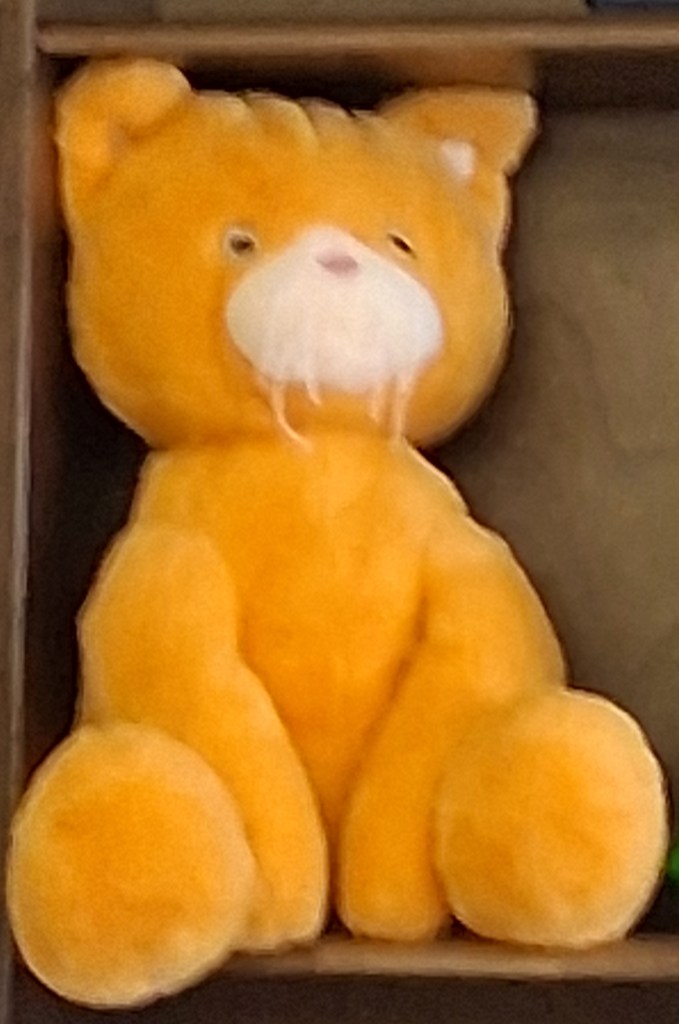
Antonio (not the surgeon)
I do have one cat woobie (at left). My husband got it for me on the occasion of having my knee replaced, and I named it Antonio, after my surgeon. He (the woobie, not the surgeon) was too large to cuddle with at night in the single bed at the post-acute facility, so he lived on the shelf across the room. Most people never noticed him, big and orange though he was, but I could see him clearly from my bed and was quite pleased to have him watching over me.
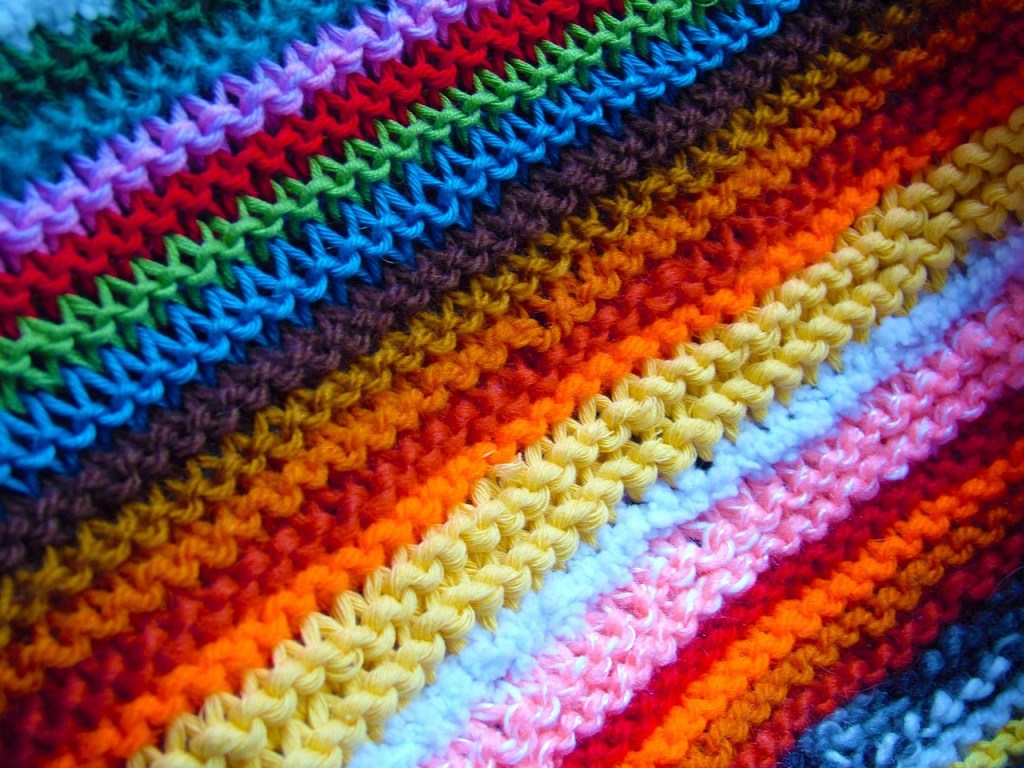
I once received a mystery woobie. At Christmas, a friend presented me a box which, when I opened it, contained a few strands of differently colored wool. She gave me no hint of what it would be and told me that I would receive the actual present at a later date. Then (I later learned) she spent the next few months knitting and, sometime in April, presented me with a lovely, multicolored blanket woobie. It wasn’t Linus’s security blanket, but it made me just as happy.
The Wicked Witch used to be a villain. She tried to kill Dorothy and her companions. She enslaved flying monkeys. She wanted revenge for her sister’s accidental death.
Now she has her own musical and movie.
The elevation of villains is a thing now. Personally, I blame Star Wars. I was once visiting some friends who had a young son. He held up his Darth Vader action figure and said, “This is my friend.” (This was in the days before the proliferation of Star Wars movies culminated in Vader’s redemption at the last possible second. But I digress.)
My theory is that villains have power but few limits. It’s no wonder youngsters view them as positive influences. When Darth Vader is your friend and protector, you share in his power. You fear nothing.
Maybe this rise of the villain started with the rise of the anti-hero. Let me explain. And let me use Buffy the Vampire Slayer (one of my favorite TV classics) as my vehicle. (Actually, I’m going to do it whether you let me or not. So there. But I digress some more.)
Here’s the backstory, for those not familiar with the Buffyverse. Buffy’s first love was the vampire-with-a-soul Angel, and he was a Byronic hero, a type that became popular when Byron (duh) was writing poetry. Byronic heroes are tortured souls who waft around in black clothes and clouds of pain. They’re never cheerful. They don’t crack jokes. They suffer from existential angst. They have troubled pasts and isolate themselves from society. (Other Byronic heroes include Batman holed up in his Batcave, grieving over his dead parents. The Brontes knew their Byronic heroes, too. Mr. Rochester and Heathcliff are classics. But I digress yet again.)
In opposition to the Byronic hero, we have the anti-hero. They don’t behave according to the heroic model. They’re “bad boys” who manage to dominate the plot and achieve their goals despite being misunderstood or refusing to follow convention. Think Han Solo, Captain Jack Sparrow, or in the case of Buffy, Spike. He’s never going to be Buffy’s Great Love, but he has his uses in her world. (Deadpool and Robin Hood are two other examples who would never have a beer together but occupy similar literary spaces. I suppose Dexter would be the ultimate anti-hero. Still more digression.)
No, wait. Satan is the ultimate anti-hero. Take a look at Milton’s Paradise Lost. Lucifer has agency and is the more interesting character. At some level, the reader roots for him. They know God’s going to win. That’s a given. But Satan’s quest, while reprehensible, is also on some level noble. (I’m talking literary characters here, not theology. But I digress again. And as Jean Kerr said, in reference to the story of Adam and Eve, the snake has all the lines. But I continue digressing.)
So, what makes the bad guys more interesting guys? For one thing, they’re deeply misunderstood. They’ve often been victims of bullies or of an uncaring, unfair society. They touch the darkness, the “shadow self” that lives within each of us. We recognize ourselves in them, identify with them in ways we simply don’t with standard heroes. We’d like to identify with heroes, but we know they’re better than we are.
Standard heroes require supervillains to make them at all interesting. Without Lex Luthor, Superman just flies around foiling ordinary bank robbers. Without Moriarty, Sherlock Holmes is simply Columbo. (I could say that without elusive diagnoses and the looming specter of death, House is basically Doogie Howser, but I won’t. That would be ridiculous. There’s also misanthropy. But I digress some more.)
Personally, I respond more to anti-heroes than Byronic heroes. Pure villains don’t interest me, but neither do sanctimonious heroes like Galahad (“My strength is as the strength of ten because my heart is pure.”). But when it comes to the villains and heroes in the wrestling ring, I don’t give a fig for any of them. Besides, they change places so often that you need a scorecard to tell which is which. (Don’t assume that this means I watch “pro” wrestling. I learned about their ethical switches from the New York Times. Go figure. But I have finished digressing. For this week.)
Of course, that’s not completely true. There are things I can commit to—my husband, for example. We’ve been married for 41 years, which I think is proof aplenty.
What I can’t commit to are things that go on too long. (The marriage does not fit into that category.)
Let me explain.
Movies
In the evenings, when my husband and I have finished dinner, he often wants to watch a movie, but I don’t often agree to it. I hate leaving a movie in the middle, but I also hate staying up past my bedtime to finish one. It’s a delicate balance.
For example, after the recent eclipse, we decided on Ladyhawke, which was relevant, but I couldn’t make it all the way through. We had to watch the second half the next day and that upset my internal clock, not to mention my sense of continuity. If a movie starts at 8:00, it’s pretty much out of the running for me. I’m a little old lady and don’t like staying up past 9:00. (And you can get off my lawn. If I had one, I mean. Dan is aiming for a pollinator garden. But I digress.)
TV Series
When it comes to TV, I hate to start a series because I realize I’ll never keep up with it every week. This doesn’t apply to series that have already finished. Often, old episodes of House, Buffy the Vampire Slayer, Castle, Inkmaster, Chopped, or Bones are shown for several hours a day, and those I can tolerate multiple episodes of. (That may sound counterintuitive. The difference seems to be that I don’t have to pay attention to them. I usually have them on when I’m doing something else like writing. They’re just my emotional support background noise. But I digress again.)
Books
I used to be able to tolerate series of books. I devoured The Lord of the Rings, Asimov’s Foundation trilogy, Lloyd Alexander’s Prydain series, Sue Grafton’s Alphabet books, and other long-running written endeavors. Not anymore. I buy many of my e-books from discount sites for $1.99 or $2.99 (because I’m cheap). Many of them, as you might suppose, are not exactly scintillating. Some of them are so dreadful I give up on them well before I reach the denouement.
(One of the first ones I ever committed libris interruptus on was a horror novel that started by introducing the protagonists. They were perfect. Perfect looks. Perfect jobs. Perfect house. Perfect marriage. Perfect kids. By the end of the first chapter, I was rooting for the monster, which hadn’t even shown its tentacles, fangs, slime, or whatever. But I digress some more.)
I recently discovered that even book series I love can be too much of a commitment. I recently reread the three volumes of The Lord of the Rings, but couldn’t jump right into The Silmarillion. I love Lois McMaster Bujold’s Vorkosigan series and set out to reread them all, but pooped out after book ten. I needed a break (a la Friends) and haven’t come back to finish the other four. Yet. I have a feeling that after 600 pages of Midnight in Chernobyl, my current good read, I’ll be ready. (I hate the phrase “a good read.” It sounds too much like saying someone is a “good lay.” But I digress yet again.)
I haven’t even reread my own books (Bipolar Me and Bipolar Us). They don’t constitute much of a series and would make a terrible movie. But that’s not the reason. There’s a terrible typo in the first one, and I’m afraid I’ll find one in the second as well. If I weren’t depressed about the slim sales, that would do it.
What is it about the horror genre that gives us both shivers and thrills? I’m not talking about the excessively gory kind of horror, though that has a place and a fandom. Instead, I mean the more pop-culture renditions (sorry not sorry) of horror beasties and things that go bump in the night. Zombies are a big thing on TV, in the movies, and in books right now. So are vampires and werewolves. Anything creepy that humans can turn into, really.
Let’s take a look at these creatures and their evolution.
Here Come the Zombies
Zombies are a staple of modern horror. The Walking Dead, Fear the Walking Dead, and more have brought zombies out of George Romero movies and into the mainstream. My favorite version of the zombie pandemic is Feed and its sequels by Mira Grant (aka Seanan McGuire). It rises above the body (sorry not sorry) of the typical shambling, brains-eating stereotype by being caused by a literal pandemic, despite the fact that it came out in 2010, back when few of us feared a pandemic, zombie or otherwise. It also adds meaning and interest because it addresses other pertinent topics such as media, conspiracies, and politics.
(Seanan-Mira has also plumbed the depths (sorry not sorry) of horror by writing a novel, Into the Drowning Deep, about killer mermaids, which is a lot more horrifying than that description makes it sound. But I digress.)
Bite This!
Vampires seem passe now. They’ve been done to death (sorry not sorry). The craze, I think, really took off in 1976 with Anne Rice’s novel Interview with the Vampire, which later became a movie (now remade, I understand) and a TV series. I personally thought the novel was overwritten and too long, but that didn’t stop it from becoming a runaway bestseller. More recent but still old (from 1997) was Buffy the Vampire Slayer, still my favorite of the vampire-themed media sensations. It was based on an older movie, about which the less said the better.
The Twilight books and movies proved extremely popular as well, though I haven’t succumbed to any desire (I have none) to read or view them. What’s interesting about them is that they pitted vampires against werewolves, not as killing machines but as romantic rivals. It’s kind of disturbing that heartless killers are presented as love objects and sexual partners.
None of these modern iterations have anything to do with Bram Stoker’s original Dracula, which has been committed to film many times. Nor is this an all-inclusive list, which would take more space than I allow myself in this blog. I will, however, recommend Those Who Hunt the Night by Barbara Hambly as my favorite vampire novel. (Although the first time I read it I thought one character was the main character (or MC, as we writers say). A rereading revealed to me that she was a supporting player. But I digress again.)
Loup-Garou
(Okay, I’m showing off. “Loup-Garou” is French for “werewolf.” But I digress some more.)
Werewolves became as fashionable as vampires during the heyday of the Twilight series. Fans divided into Team Vampire and Team Werewolf based on who they thought should get the girl and I don’t mean as a snack.
It should be noted that not just werewolves, but all kinds of shapeshifters have become popular. There have been were-bears as far back as Beorn in Tolkien’s The Hobbit and other shapes to be shifted into, including crows, hawks, and leopards, among other beings. I guess you’d have to think about Zeus, too, who appeared to various women as a swan, a bull, a shower of gold coins, and a goddess, to hide his extramarital exploits from his wife. While Zeus’s transformations were hardly what you’d call romantic, shapeshifters in modern fiction are often presented in those terms. It’s called the “dark fantasy” or “fantasy romance” novel.
Welcome to Hogwarts
And of course, we couldn’t catalogue otherworldly beings without including witches and wizards. Although most of the witches and wizards in Harry Potter are positive characters, that’s not the case in many other books in the genre. Evil wizards and malevolent witches abound. In more subtle books, there are those with mixed motivations – for example, a low-powered witch who eventually turns into a dragon and back (making her both a witch and a shapeshifter, I guess) in Barbara Hambly’s excellent Dragonsbane. (It’s a book that I recommend to others just so we can discuss it later. That’s how I was introduced to it. But I digress even more.)
Why do we love horror so much? I think it’s because we know that, however disturbing the beings are, they can’t really get to us. The COVID pandemic, though, made pandemics all too real, except for the fact that people turned into vectors, not zombies. Perhaps the glut (sorry not sorry) of zombies will soon recede and we’ll go back to ghost stories, the classical alternative that hardly ever gets written or filmed these days. Even the movie Ghost‘s most memorable scene featured pottery, not haunting. It’s a form of horror bait-and-switch.
If only they would find a new creature to menace the humans – like the bunyip, an Australian water monster. But I guess “Attack of the Bunyip” just sounds like something warm and fuzzy. What we need are fresh kinds of horror, something that will scare a whole new generation.
Those of you who follow my blog know of my enduring love for cats – and not just my own. Last week my blog post was about cats in mysteries (https://butidigress.blog/2022/08/21/mysterious-cats/), so this week I’m going to tackle cats in another genre – science fiction and fantasy. Because science fiction books aren’t as predominant as they once were, I’ve expanded my source material to include various other media.
Let’s start with books, though. The most famous cat in a work of fantasy fiction is undoubtedly the Cheshire Cat in Alice’s Adventures in Wonderland (who shared the stage for a brief appearance of Alice’s cat Dinah). Notable for appearing suddenly then disappearing slowly starting at its tail until only its grin was left, the Cheshire Cat is sometimes considered a guiding spirit for Alice, directing her to various destinations around Wonderland.
(The Cheshire Cat is prominently featured on t-shirts and other Alice memorabilia, including a coffee mug that pictures the cat’s scene with Alice. When a hot liquid is poured into the mug, the cat vanishes, leaving only its grin. This is, I think, much more entertaining than the mugs that feature ladies who shed their clothes under the same circumstances. But I digress.)
Superstar writer and opinionated curmudgeon Robert A. Heinlein had a soft spot for cats, which appeared in a number of his works. A cat named Pete appeared in his novel A Door Into Summer, which was inspired by an actual cat that Heinlein once owned. (Or that owned him. Sometimes it’s hard to tell.) Another book, The Cat Who Walks Through Walls (shades of Lilian Jackson Braun!) featured a cat named Pixel that mysteriously appeared wherever the narrator happened to be. Cats played minor roles in some of his other books, including one named Mr. Underfoot, which I have been known to call all my cats at various times.
Perhaps best known to modern readers are Hermione’s ginger cat Crookshanks and Argus Filch’s cat Mrs. Norris in the Harry Potter series of books. Mrs. Norris was somehow able to detect student misbehavior at Hogwarts School, which happened a lot. Crookshanks comes to no harm, but Mrs. Norris is temporarily frozen by the gaze of the basilisk in Chamber of Secrets, though she first appeared in Sorceror’s Stone. (She gets unfrozen and suffers no permanent harm.) In the book, Mrs. Norris is described as bony and dust-colored, but in the films she was portrayed by three much more impressive Maine Coons.
Seanan McGuire’s October Daye series of fantasy books features a feline character, Tybalt, King of Cats, a fairy (Cait Sidhe, technically) who can transform from cat to human size and shape, in which form he woos and weds October after an on-again-off-again semi-adversarial relationship. (The character Tybalt in Romeo and Juliet is referred to as “prince of cats” for his sleek and violent nature. But I digress again.)
When it comes to cats in SF&F film and TV, we have Ripley’s cat Jonesy, who along with her manages to survive in Alien. There is Pyewacket in Bell, Book, and Candle, a film about witches that ought to be a Halloween movie but is instead a Christmas film, much the way Die Hard is, because it takes place during the winter holiday. And then there is Orion, the cat in Men in Black, whose collar proves to contain an important plot point.
The overwhelming winner for cats in media, however, is Star Trek. In the original series (or The Original Series as it’s now known), there are two different episodes that feature cats. One is “Assignment Earth,” which features a cat named Isis who may or may not be a human being, and “Catspaw,” featuring Sylvia, a woman who may or may not be a cat.
There are two other Star Trek cats of note. One is Data’s cat Spot in the TV series The Next Generation and the movies Star Trek Generations and Star Trek Nemesis. Spot is an orange tabby, but that’s about all the continuity it has. It has been portrayed as a Somali cat and as an American shorthair. It (I use the term advisedly) has been identified as male or female on different episodes, though I think we have to settle on female, as Spot gets pregnant at one point. In one episode, Data writes and recites an “Ode to Spot,” the first stanza of which is:
“Felis catus is your taxonomic nomenclature, an endothermic quadruped, carnivorous by nature. Your visual, olfactory, and auditory senses, contribute to your hunting skills, and natural defenses.”
In the series Star Trek: Discovery, the character Booker has a Maine Coon cat named Grudge, which was meant to make a one-episode guest appearance but became a more featured player in a number of episodes. We know Booker has left the ship for good when he leaves Grudge with Captain Burnham. Grudge is described by various characters as “fat,” possibly due to a thyroid condition, but more likely attributable to the fact that Grudge is portrayed by two Maine Coons that are, at 18 pounds, at the top end of the range for that breed.
There’s more that could be said about cats in science fiction and fantasy, from the Tom & Jerry movie Blast Off to Mars to one Simpsons hyper-violent “Itchy and Scratchy” cartoon called “Flay Me to the Moon.” (Scratchy is the cat. I always have trouble remembering that.)
I’m sure there are others I’ve missed, and I’m equally sure that outraged cat-fen will point this out to me. My husband wanted me to include the 1935 cartoon “Dancing on the Moon,” which featured a number of animal pairs including two cats. And now I have.
In some circles, either answer will result in heated rebuttals, not to say ostracism. I don’t want to get in the middle of those who adore Star Trek and those who are captivated by Star Wars. I will not even get into the tempest over who was the better captain, Kirk or Picard. I will say, though it may seem like sacrilege to both sides, that both have their flaws and their triumphs. And they have some distinct similarities.
I was introduced to Star Trek in 1966, when it first came out. (Yes, I’m that old.) I watched it avidly, even in reruns at 2:00 a.m. I became a Trekkie, accumulating such Star Trek merchandise as was available at the time. (There wasn’t much back then. I did get Spock’s medallion, the IDIC, which stood for “Infinite Diversity in Infinite Combinations,” a concept I hold by to this day. And of course, I had my mother make tribbles. But I digress.)
The first time I saw Star Wars was on the big screen, in the summer of 1977, when it first came out. I saw the film numerous times, dragging friends who had not yet seen it to the theater. I didn’t get t-shirts or pins or anything like that. At the time, there wasn’t much Star Wars merch available either. That really revved up later, including Lego versions of everything.
Both television and film franchises have similar themes – good versus evil. Star Trek addressed these, because of its origin on episodic television, in a way that featured increments toward a vision of a more hopeful, more just society. Star Wars was a more traditional battle between big-g Good and big-e Evil, with little to no middle ground. (Once someone asked me why I liked Star Wars so much despite its lack of literary depth and nuance. I replied that it does have a deeper message: “Let the Wookie win.” I was being only half-facetious. But I digress again.)
I gradually lost interest in both of them after being exposed to a number of incarnations of them. I liked Star Trek: Next Generation and the first series of movies (or at least the even-numbered ones). I liked the first three Star Wars movies, the other six much less so, until I finally got to where I was disinterested in the last, most recent trilogy. I’m heartily sick of all the various continuations of both of them on TV and most of the movies. I used to watch Star Trek: Discovery and Picard weekly, but have lately fallen away. And I never got into the many spinoffs of Star Wars, featuring many lower-interest characters such as Boba Fett and baby Yoda. I know the franchises are huge money-makers, but I think they’ve reached past the point where it continues to be worthwhile for viewers, or at least for me.
Along that line, there have been some real clunkers in both series. The original Star Trek was uneven in the quality of the episodes, both from a production and writing standpoint. The lowest point came with an episode called “Spock’s Brain.” With a title like that, one can envision any number of truly compelling scenarios, but no. They may have gone for comedy, but ended up with unpalatable farce. And Next Generation had an episode that I can never remember the title of, but should have been called “The Nintendo That Ate Their Brains.”
Star Wars had its low points as well, the primary one being the introduction of the character Jar Jar Binks, a buffoon with a speech pattern that was by turns irritating and insulting. He appeared in the first movie of the second trilogy that was made, which is the first trilogy in terms of the plot line, if you can follow that, but by the end of it, rather inexplicably, he became a Senator.
There was a significant backlash to one Star Trek character as well – Wesley Crusher, a teenager working his way up to greater responsibility on the Enterprise. I thought his character was what every fanboy’s dreams were made of. But I was informed that he was just too goody-goody for some people’s liking. There were even bulletin boards devoted to “Ways to Kill Off Wesley Crusher.” (This was painful to Wil Wheaton, the teenage actor who played Wesley. Later he revealed his bouts with depression and abuse at the hands of his stage-managing parents. That he is still acting and doing well is a credit to his perseverance. But I digress yet again.)
So, when it comes right down to it, which do I prefer – Star Trek or Star Wars? I guess I would have to say Star Trek, based on how often I watch reruns of it, as opposed to how often I watch reruns of Star Wars. But for different reasons, both still hold places in my heart. Now if we could only rein in all the franchises and develop some new science fiction shows with good, original ideas, characters, and plots, that would make me truly happy. In the meantime, I’ll keep jonesing for new episodes of The Orville and Resident Alien.
Last week I wrote about our trials and tribulations getting to and from Ireland. This week, I’m going into the more enjoyable parts of the vacation. And there were many.
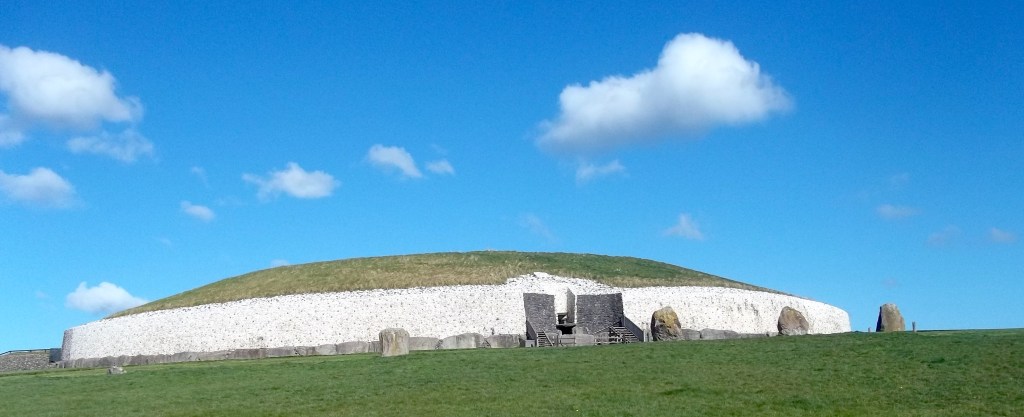
Newgrange. We saw the outside, but not the inside.
In the Boyne Valley, we wanted to see Newgrange and Knowth, two ancient stone tombs. We had booked a tour in advance. Unfortunately, we got lost on the way there and missed our appointed time. Dan was able to get a picture of the Newgrange monument from the road. When we go back to Ireland (whenever that may be), we want to spend several days just in the Boyne Valley so we can see everything at our leisure. We could also take a bus into Dublin to see the Book of Kells and other historic sights and sites.
Here’s a picture of the Giant’s Causeway, which we didn’t actually get to see. This is a stock photo.
(We also never made it to the Giant’s Causeway for the same reason. We had a drive into Northern Ireland, though, where they take pounds and pence instead of euros. Someone told us it wasn’t all that great or interesting anyway. I would have liked to see for myself. The pictures of it are pretty spectacular. But I digress.)
After the Boyne Valley, we stayed at Brook Lodge in Donegal, probably my favorite of the hotels and bed-and-breakfasts that we were booked into by our travel company. It was a very homey place, where we could sit at the dining table and watch the host make us an Irish breakfast while she and Dan discussed gardening.
Off to Arranmore Island.
One of our excursions while we were staying in Donegal was to Arranmore Island. We drove to Burtonport and took the ferry over. Once we were on the island, I wanted to find a pub and get lunch, but Dan insisted that he wanted to see something, such as the lighthouse on the island. We got thoroughly lost again. What we saw were sheep, one of which ran ahead of our car down a one-lane, rocky road. (In addition to sheep and lambs, many of them apparently newborn, we saw cows and some horses in fields throughout the country. We also saw a lot of wind farms, which makes sense because Ireland is usually windy and rainy, though we had excellent weather for the first six days or so of our trip. Even the locals remarked on it. But I digress again.)
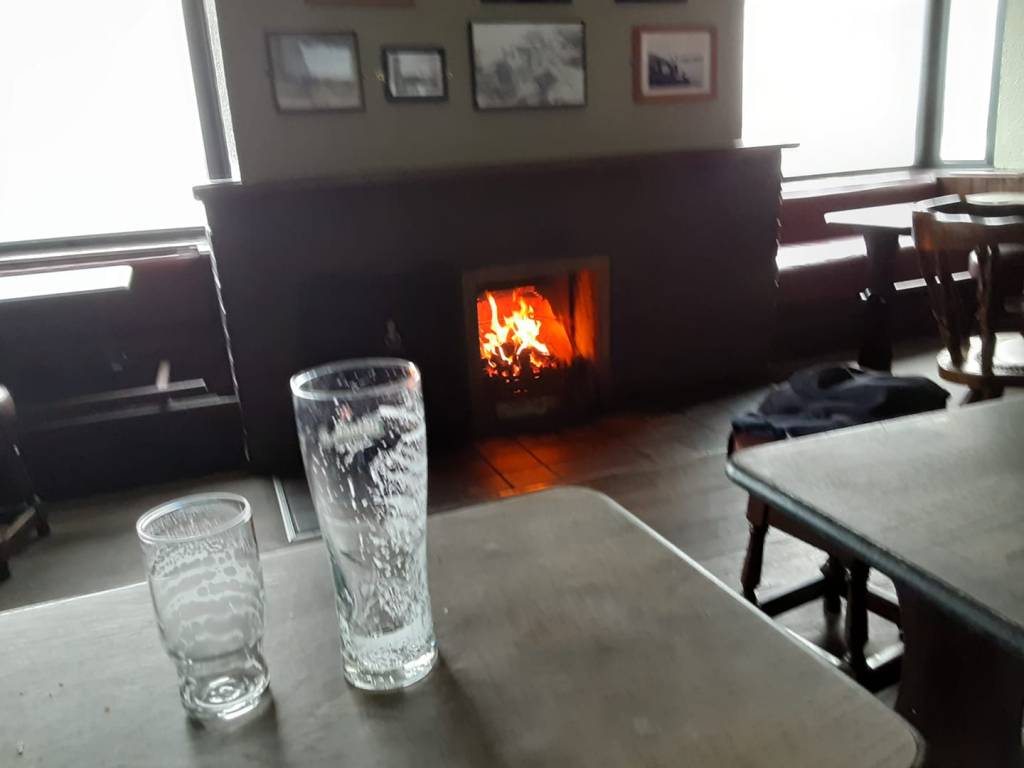
In a welcoming pub on Arranmore Island.
We never did find the lighthouse that allegedly existed on Arranmore Island, but we did find our way back to the landing in time to have a drink and a snack in a pub and catch the last ferry back to the mainland. I considered the jaunt a success for those reasons, lighthouse or no.
Our next stop, on the way to Galway, was in the small town of Cong. You may never have heard of it, but it was the place where the John Wayne-Maureen O’Hara movie The Quiet Man was filmed. That’s one of my husband’s favorite movies, so I made sure we would have time to see the place, and on his birthday too. Dan tramped around the town and took pictures of the commemorative statue. While I checked out a local inn, he went shopping. He had sworn that while in Ireland he was going to buy a walking stick and a clock.
Scene from The Quiet Man, immortalized.
(Dan has a history of buying clocks while abroad and managing to pack them well enough in dirty clothes to get them safely back to the States. He brought a clock back from England once. But I digress some more.) He found his walking stick in Cong, and a nice tweed Irish cap. (Getting the walking stick out of the country was another matter. It had to be inspected for insect life at the airport and stowed in the overhead compartments on the planes, which was a challenge. But I digress yet again.)
Dan busking at the Cliffs of Moher. (The real busker is observing him.)
The Cliffs of Moher, about an hour from our b-n-b in Galway, was one of the scenic locations we didn’t get too lost to see. It’s a spectacular set of cliffs with a great view of the Atlantic Ocean. (It was a foggy day, so we didn’t get good pics. We bought t-shirts and mugs instead.) Being somewhat mobility-challenged, we were able to get a ride to the viewing area in a golf cart type of vehicle, cunningly called “The Lift of Moher.” Our guide told us that scenes from one of the Harry Potter and the Deathly Hallows movies were filmed at a cave at the base of the Cliffs and that the Cliffs themselves were featured as the “Cliffs of Insanity” in The Princess Bride.
Next we stopped in Shannon, about half a mile from Bunratty Castle and Folk Park. We had booked the Medieval Banquet at the castle and saw part of the park while on our way to that. It featured replicas of thatched-roof cottages and other relics of Irish ways of life in the olden days.
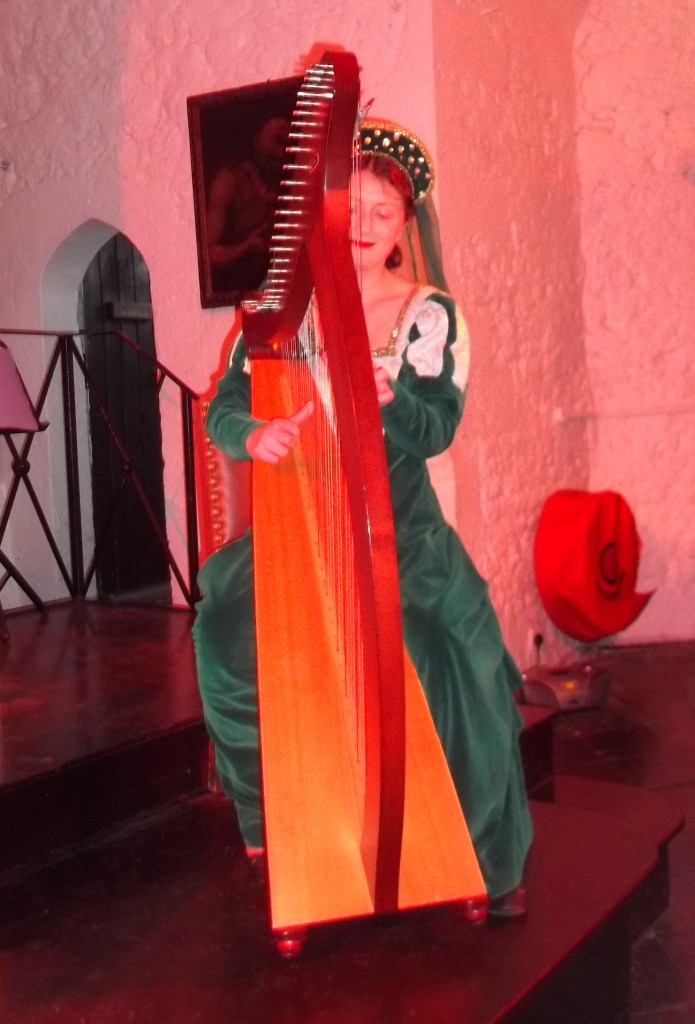
At Bunratty.
I knew the banquet was sort of hokey and definitely touristy, but I had been to it on a previous trip to Ireland and also knew that it was a lot of fun. They welcome you with a cup of mead (honey wine) and present you with a lavish dinner that you have to eat with only a knife and your fingers. And one of the dishes was ribs. (They did let us have actual utensils for the dessert, but it was apple cobbler, so they kind of had to.)
Dingle’s harbor.
Our visit to Ireland wouldn’t have been complete without a stay in Dingle, thought by many to be the most beautiful place in Ireland, or maybe in the world, according to National Geographic Traveler. Dingle is another seaside town and had some of the best seafood we had in Ireland. There was a little hole-in-the-wall looking place across from the plaza in this photo, but I had an enormous bowl of amazing mussels there. Actually, the seafood was terrific all through Ireland, which makes sense given that it’s an island. Fish and chips were served at nearly every restaurant and you could have smoked salmon every morning for breakfast if you wanted to (which we sometimes did).
Uragh Stone Circle on a misty day.
We also went to see the Uragh Stone Circle, which we had high hopes for. But it turned out to be not nearly as impressive as Stonehenge, which we saw on our trip to England a number of years back. The stone circle was only eight feet in diameter and the standing stone only ten feet tall. Still, we had an enjoyable day tooling around the countryside and chatting with a couple who were collecting stones and shells in Dingle. We didn’t do the entire Ring of Kerry because it takes five hours, plus stops for photos, and by that time we weren’t enthusiastic about driving for five more hours, no matter how scenic the trip.
The view from the window of our last swanky hotel room in Athlone.
Then it was on to Athlone, not a well-known city, but one I remembered from a previous trip. We were put up there in another swanky hotel. The view out our window of Lough Ree was spectacular. There was a small island that contained a stone said to mark the exact center of Ireland. Athlone gave us access to some of the most beautiful ruins, one of my must-see stops, and one of the most historic establishments in all Ireland. It was a perfect way to round out our trip.
Graveyard at Clonmacnoise.
Clonmacnoise is one of those sites where churches, monasteries, and other sacred buildings were erected, attacked, destroyed, rebuilt, raided, destroyed again (and again). Because of that, there are a number of impressive ruins. There is also a great museum with examples of imposing Celtic crosses and stone carvings, and the history of Clonmacnoise. I waited there while Dan tramped around the site because the day was very cold and windy and I hadn’t worn enough warm or waterproof clothes. We also toured Athlone Castle, another historic site.
Near Athlone was one of the destinations I most wanted to visit – the town of Tullamore. It has historic connections with a canal that linked the town to the rest of Ireland in the 1700s. It was also the site of perhaps the first aviation disaster, when a hot air balloon crashed and started a fire that resulted in 130 houses burning down.
The distillery where my favorite whiskey is made. We took the tasting tour. (Of course we did!)
But what really made me want to go to Tullamore was the fact that it’s the location of the distillery of my favorite whiskey – Tullamore Dew. (Sorry, Jack Daniels. For some reason, Tully is the preferred spirit of many attendees at science fiction conventions, which is where I learned to appreciate it. Yet another digression.)
Of course we took the tasting tour. They welcomed us with an Irish coffee made with the local tipple, and then it was on to view the fermentation tanks and the aging barrels. Along the way, there were more tasting sessions, including one of the various styles of the whiskey that I never even knew existed. The gift shop was also impressive. I now have a Tullamore Dew t-shirt and a Tully shot glass. Dan bought a ceramic crock of Tully, which he also managed to pack and transport safely to the US, and which we’re saving for a special occasion, or maybe another science fiction convention.
Sean’s Bar and the antiques shop. You can tell which one impressed Dan the most.
Also in Athlone is Sean’s Bar, which bears the title of the oldest continuously operating pub in all of Ireland. I had a pint of lager while Dan went to the antiques shop next door. There he purchased his clock for the trip, a really lovely Art Deco piece which also made it home safely. (I was dragged over to the shop to see it and to help Dan bargain down the price.)
That was our last real stop in Ireland if you don’t count the Dublin airport and a Dublin airport hotel, which I don’t.
When couples drive somewhere, usually the man drives. When families watch TV (assuming that they have only one TV), the father or the kids control the remote.
My husband and I subscribe to the first paradigm unless we are driving a long way, when we switch off on the driving chore.
But when it comes to the TV remote, the battle is on. I try to get him to get the snacks so I can get first crack at the remote. Sometimes I think my husband hides the remote in his side of the sofa just so he can get to it first. Our TV actually requires the use of two remotes. That’s when things can get ugly.
The problem is our different taste in viewing. We do have things in common – neither of us likes sports, or news, or celebrities behaving badly. But Dan likes classic films of all sorts – Jimmy Stewart and Judy Holliday and The Thin Man and John Wayne and Topper – as well as action and science fiction films full of mindless, high-tech violence.
I, on the other hand, am addicted to cooking shows and crime shows. I never make any of the recipes (or commit any of the crimes), but I find them soothing. Cooking is an everyday activity that involves creativity and pays off with a lovely meal. Crime, alas, is also an everyday activity that only occasionally involves creativity and pays off with just desserts. The closest thing we’ve figured out to a film that will satisfy both of us is Arsenic and Old Lace (the best movie about serial killers that I know).
So there Dan is, reaching for the remote to turn on Turner Classic Movies or SyFy, while I am grasping, trying to get first dibs for The Food Channel or OWN. What to do?
Of course, we could take turns, which is no doubt what a mythical mom would suggest. Or we could just watch whatever the faster person finds, which is what we usually do. Or we can change the channel when the other person goes to the bathroom. (Innocently: Oh, were you watching that?)
I do admit that it can be tedious to watch 11 or 12 cooking shows in a row, or four or five gruesome murders. But I get twitchy when I have to devote two uninterrupted hours on a movie with screaming and explosions or (possibly) women with irritable, high-pitched voices arguing with big lugs. And when there’s a festival with an actor that he particularly likes and I never heard of, well, then I go to my computer and blog, which he considers antisocial (although it is probably the most social activity I engage in).
Part of what saves our marriage is that we have vastly differing schedules. Dan works third shift and watches The Fifth Element when he gets home and I’m still asleep. I watch Forensic Files while he’s fast asleep in the afternoons. It works fine, as long as he doesn’t turn on the Screaming and Explosions Channel when I’m trying to have a nap.
But (I hear you ask) aren’t there any programs that you both enjoy, that you can watch together? Or is your entire life a tale of remotes that pass in the night (or, well, the afternoon)?
Sometimes we can agree on a movie or turn to our collection of DVDs for something like Chicken Run that we both enjoy. (Yes, we’re serious intellectuals. Can’t you tell?) And there’s always House or Star Trek. But we have found one show that we get together for every Wednesday evening.
Forged in Fire.
For those not in the know, Forged in Fire is a competition show in which smiths make knives and swords, often with unexpected challenges thrown in (no power tools or rusty tools as source materials). Eventually, the final two contestants are sent home to make some elaborate blade, which is then tested in some fairly gruesome manners, until one of them wins $10,000 and bragging rights.
I’m sure you can see how this resembles Chopped, say, or Snapped. Forged in Fire satisfies my need for competition and creation, with a little gore thrown in for good measure. It gives Dan the old-timey pursuits that he loves, with men he can identify with whacking things with hard objects or sharp edges.
It may not be what marriage counselors recommend at couples bonding sessions, but it works for us.
We all have things we love. We all have things we hate. Where the trouble comes in is when we love something that others hate and they feel compelled to tell us we’re wrong. I’m not talking here about huge social or religious dilemmas or political differences. I mean the stuff that shouldn’t matter, but people get all exercised about.
Like pineapple on pizza. There are those who love it and those who hate it. But for some reason, the haters attack the lovers as though they’ve committed a mortal sin by allowing fruit to touch their Italian dish, which we all love. (Technically, tomato is a fruit too and nobody minds having tomato sauce on pizza. Don’t ask me what that kiwi’s doing there in the photo. I have no strong opinions about kiwi. But I digress.)
Now I admit to liking Hawaiian-style pizza on occasion, the kind that comes with (for some unknown, peculiar, multicultural reason) Canadian bacon and pineapple. It isn’t my very favorite – that’s pepperoni and extra mushrooms. But once in a while, I order pineapple.
This hurts no one. So don’t harsh my buzz. Be like John. I invited John over once and served him pizza. It had pineapple on it. Without making a fuss, John picked the chunks of pineapple off his slices, ate the pizza, then ate the pineapple separately, as a sort of dessert, I suppose. That is what I call a mature, polite approach to pineapple pizza. That’s how I would approach a pizza with kiwi, if I tried it (I would) and didn’t like it. Hell, I even tried anchovies once, just to see.
I find that some people like to harsh other people’s buzzes over a variety of topics. Once, when I posted something about Star Trek, a new Facebook friend replied, “You do know you’re too old for this.” Well, phooey on that. I loved Star Trek when it first came out and I still do.
Yet it seems that loving Star Trek is not enough for some people. I need to love the right kind of Star Trek. These days, Star Trek: The Next Generation gets beat up a lot for its storytelling, plot lines – everything except Patrick Stewart, who everyone admits is pretty great, except when he says, “Engage!” or “Make it so!”
But damnit, I like NextGen (as it’s called, when it’s not called ST:TNG). In some ways, I like it better than the original series (ST:TOS). Don’t ask me to defend why I like it. I shouldn’t have to.
Or take Cats (the movie). Okay, it wasn’t great cinematic art for the ages and it didn’t have much of a plot – which is understandable if you know that the source material is a series of poems. But it had fine singing, incredible dancing, and amazing costumes. It had cats and T.S. Eliot. Why wouldn’t I love it? Even my husband said it was “astonishing.”
Country music is another area that I love that people are determined to knock. It all sounds the same, or it’s the music of racists, or everyone sings through their nose, or some other objection. Or I should spend my time listening to something good (however that’s defined).
This really harshes my buzz. I grew up with country music and, despite it being my parents’ favorite music, I never disowned it, not even when I was in my teens and the Beatles hit it big. I enjoyed both Willie Nelson and Elton John. I even enjoyed John Denver. (There, I said it!)
I don’t know. Maybe it would have been different if I had lived in Texas, but in suburban Ohio at the time, I met with only scorn among my peers. And, I’m sorry to say, that scorn continues to this day. And I can see how easy it is for that scorn to develop. I never listen to modern country music. I’m still stuck at the Willie Nelson, Kris Kristofferson, and Emmylou Harris stage. (And don’t harsh my buzz about Kris Kristofferson movies, either. I still like them, except the one he made with Sylvester Stallone, whose movies I’ve taken a vow never to see. But if you like him, fine. I won’t hassle you about it.)
I’m hoping that now that Ken Burns has turned his documentary lens on it, country music will regain its status as something that it’s okay to like. In fact, I may listen to Waylon Jennings while eating pineapple pizza, and then relax with a little NextGen.
Don’t get me wrong. I love Dr. Seuss. But I think the latest adaptation of the Grinch makes two too many.
I used to check out his works from the Bookmobile until my mother insisted that I get at least one book by another author at every visit. Although my all-time favorite was Green Eggs and Ham, I had a soft spot in my heart for How the Grinch Stole Christmas.
I was young enough to be thrilled when the book was made into a cartoon that was shown every Christmas from 1966 on. Who could possibly be better than Boris Karloff to narrate and voice the Grinch? And the uncredited Thurl Ravenscroft to sing “You’re a Mean One, Mr. Grinch.” (Trivia note: You may know Ravenscroft as the voice of Tony the Tiger in all those cereal commercials.) It was perfect just the way it was.
Since then there have been two other versions, both big-screen adaptations, a live-action version in 2000 starring Jim Carrey, and the other this year, a CGI animated movie with the main character voiced by Benedict Cumberbatch. I have not been to see either one and have no intention of seeing them when they are shown on TV. I am a total Grinch about any version except the real Grinch.
There were difficulties in making the 1966 version. The original Grinch was a poem of only 32 lines. To make it into a cartoon that would run 30 minutes (or however long it was without commercials) required some creative stretches. The Ravenscroft song was added, of course, plus a lot of comic bits featuring the dog Max, the Whos singing around the tree, and extended visualizations of the Grinch preparing his Santa suit and maneuvering down Mt. Crumpet. They all fit neatly into the narrative. Not one moment seemed out of place.
The Jim Carrey live-action version ran 105 minutes and Benedict Cumberbatch’s, 86 minutes. No matter how clever their additions to the basic plot, they could only serve to clutter Seuss’s simple plot and spot-on characterizations. At over an hour each, that’s a lot of stretching.
That’s the problem with remakes or reboots or reloads or whatever they want to call them. They almost never live up to the original. Bedazzled, for example, was a perfect little gem starring Peter Cook and Dudley Moore. I didn’t mind the gender-swapping of having Elizabeth Hurley as the Devil (with Brendan Fraser as her hapless foil), but the broader style of humor, including throwing away one of the best gags in the original, was in no way better.
There are other examples. Think of The Thomas Crown Affair, The War of the Worlds, The Day the Earth Stood Still, or any of the Inspector Clouseau movies. None of those were necessary. The movies were just fine the way they were. (The only really good update – and it was an adaptation, not a straight remake – was when the ultra-serious Zero Hour was morphed into the uber-comic classic Airplane!)
I do understand the motivations behind these remakes, primarily money. Proven classics should be proven box office hits the second or third or fourth time around, and the producers, directors, and writers don’t even have to think up new plots and characters.
Then there’s the excuse of “introducing a new generation of young people to a classic film using stars they’re familiar with.” Jimmy Stewart and Gene Tierney stand the test of time and so do many others. It’s too bad that most people only see their work if they take a film class in college.
At any rate, I boycotted the Jim Carrey Grinch and will do the same for Benedict Cumberbatch’s. If that makes me a Grinch, so be it. I realize that my singular protest will affect them and their box office prospects not in the slightest. I shall do it anyway.








 When couples drive somewhere, usually the man drives. When families watch TV (assuming that they have only one TV), the father or the kids control the remote.
 We all have things we love. We all have things we hate. Where the trouble comes in is when we love something that others hate and they feel compelled to tell us we’re wrong. I’m not talking here about huge social or religious dilemmas or political differences. I mean the stuff that shouldn’t matter, but people get all exercised about.
 Don’t get me wrong. I love Dr. Seuss. But I think the latest adaptation of the Grinch makes two too many.
 But I Digress . . .