Category Archives: fun and games

I Use Satellites to Find Tupperware in the Woods


That’s what a contestant on Jeopardy told Alex Trebek when asked about his hobbies and interests between rounds. Alex should have replied, “So you’re some kind of kitchenware spy,” but missed the opportunity.

I have practiced kitchenware spying myself.

To make it sound less like spying, it’s called “geocaching.” A secret identity, if you will.

A piece of Tupperware or other waterproof container (an ammo case is popular) is hidden, usually in a natural setting. The secrets within are a piece of paper, a small pencil, and assorted objects of unknown value. This is known in the trade as the geocache or “drop site.”

To get your mission started, go to a website that contains geographical coordinates. Sometimes there’s a cypher that offers an encrypted clue. (“It’s under a big W.”) You use the satellite coordinates and a sophisticated process called warmer/colder until you find the cache. Or not.

To prove you’ve succeeded in your mission, you sign the piece of paper, take an object another agent has left, and replace it with one of your own. This is known in tradecraft as “the drop.” Then you return to the website and report that you have found the cache and made the swap (or not).

The hiding places can be diabolical. One I was in charge of was attached to a statue celebrating sewer workers. Or you may need to locate a next-to-invisible “microcache” that contains only a tiny piece of paper. (BYO pencil.) One I found was a magnetic key holder. Another had an extremely cryptic encryption clue in a foreign language. It contained the expression “2d,” which I at first interpreted as two-dimensional or flat. Instead, the dropsite proved to be cylindrical, a tiny roll of paper wrapped around a nail inserted into a fencepost. The nail was known as a two-penny nail. 2d in British tradecraft means two-penny.

Another cache was the back of an official-looking magnetic sign on the side of an electrical box. To prove you had located it, you had to peel off the magnetic notice, sign the back, and then replace it.

One complication is that you must retrieve the cache without being seen by laypeople. It’s interesting trying to climb up a swing set in a park without looking like that’s what you’re doing. Once, to avoid blowing my cover, I had to mime losing my car keys and looking for them under an overpass where the Tupperware was hidden.

I haven’t hunted Tupperware lately, especially since I sustained an injury. And lost my GPS in a tornado. And need a GPS to find my motivation, which could be anywhere, but probably isn’t in my house. Maybe I lost that in the tornado, too. But I just went back to the website where you find the coordinates, and learned that I was still registered as an agent with a secret identity (DjangOH).

There is at least one cache very close to my home base that I could conceivably find with only the clue and no coordinates. I miss the thrill of the chase. Maybe I can even locate that cache while using my walker. And pretend my husband is Ilya Kuryakin.

What Went on at the Nursing Home?

Well, to me it was post-acute rehab care, but there were long-term and memory units, so let’s call it a nursing home. I was there for about a month and a half recovering from complications of my knee replacement.

When I checked in, the first person I met was my roommate, a 90-year-old woman named Norma. I’m not sure what she was in the home for. What I did know was that James Arness was her secret love crush. I know this because she kept Gunsmoke playing on the room’s TV eight or more hours per day. Being the newcomer to the room and being over 20 years younger, I didn’t feel I should offer to arm wrestle the remote away from her.

(I was equipped, however. I had my phone, complete with Nook, Kindle, Facebook, and Pandora, complete with a charging cable and a pair of earbuds. I was set. When Norma left to stay with relatives, I had an essentially single room and complete control of the remote. But I digress.)

For those who didn’t choose to stay in their rooms watching TV, there were lots of activities, starting most days with a coffee hour and Wii bowling. Throughout the week, there were concerts, Bible stories, card games, trivia sessions, karaoke, cooking classes, and movie-and-popcorn days. There was a beauty salon for appointments, and one week, even a prom.

I mostly stuck with my phone and its assorted diversions, as well as non-Gunsmoke TV. (The one time I went to a “Family Feud”-style contest, the talk devolved into politics, and I bowed out. And I never even went to my own prom, so theirs didn’t appeal to me, at least. But I digress again.)

Another diversion for me was the age-old sport of door-staring. The restroom and room doors were made of wood, and I could spend endless time staring at them and identifying shapes I could see. There was one spot that looked like a spy peeking through a crack, or if you looked at it another way, a surly baby. Then there was one area that looked like the Virgin Mary or the Dr. Who that my husband likes (the one with the long scarf), only with a coat hook for a head. (Technically, this activity is known as pareidolia, which is a fun fact to know and tell. If you can pronounce it, that is. But I digress yet again.)

It was also fun to collect names. That is, to see how many different ways the staff referred to you. Most of the time, I was called Miss Janet or Mrs. Coburn (both of which are inaccurate), but I was also called Babe, Hon, Sweetie, and even Girlfriend. The woman in the next room was called Chiquita, which I never was.

(I’ve heard this described as “infantilizing” nursing home residents by using endearments instead of their real names. My mother told me that at one place she stayed, there was a woman who had a Ph.D. When she needed help, she would stand in the doorway and shout “Yoo-hoo.” I don’t know what the staff actually called her, but ever after, I thought of her as Dr. Yoo-hoo. But I digress some more.)

The staff had games of their own. They would hide little cutout figures of ducks or gnomes (or something) around the facility and see who could collect them all first. It was entertaining to see the nurses and aides careening down the corridors, laughing and squealing as they searched for the numbered items.

Another pleasant distraction was the little ice cream cart that the staff took around. I couldn’t have any because of my diet, but Dan was there once when it came around and scored himself a root beer float. Most of the time when Dan visited, we held hands and watched reruns of Star Trek.

To me, that was the most fun in the nursing home.

Finally, I Gave In

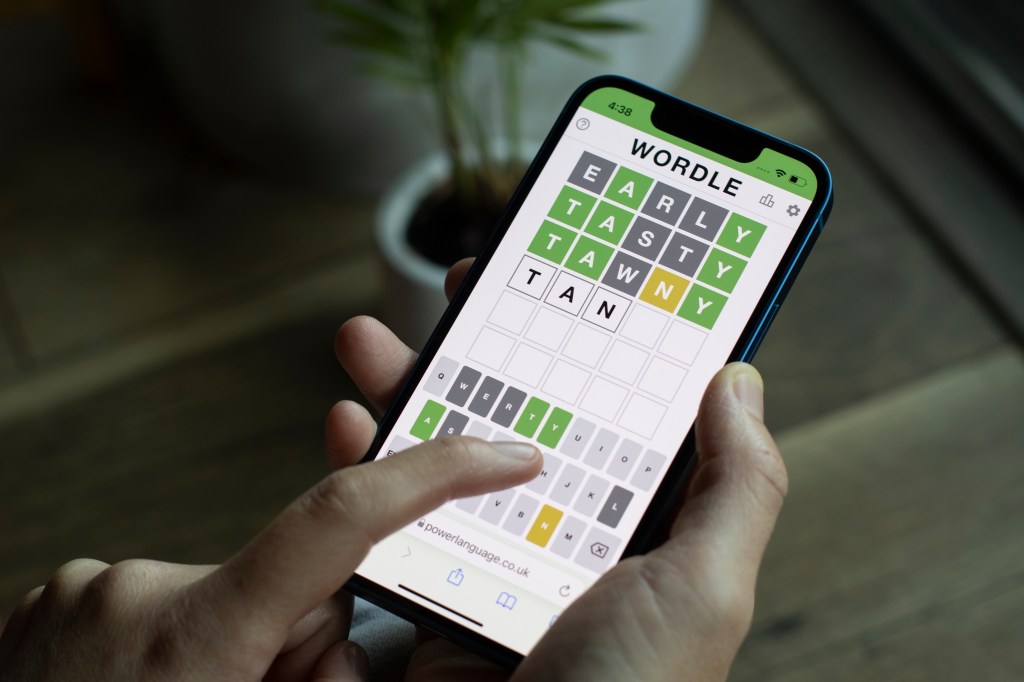
All right. I admit it. At last I’m doing what the cool kids do. I’m playing Wordle daily.

I resisted for as long as I could. I even wrote a blog post about how I was not going to succumb. I found it annoying when every day I saw people posting on Facebook what their scores were. That trend seems to have stopped, or at least pulled back. Now, most people only share their results when they get the word in two or three guesses.

My first brush with Wordle came when I was visiting friends in Michigan. Leslie was playing Wordle while someone else drove. She was having a hard time with one particular word and was down to her last try. I looked over her shoulder at the puzzle and said, “Prism.”

“That could work.”

It did.

“You’re good at this. You should be playing it.”

But I resisted. I’ve long been a fan of crossword puzzles and anacrostics. I’ve also done a lot of sudoku and right now I’m obsessed with jigsaw sudoku. (This is an insidious form of the puzzle in which, instead of neat little square blocks, each area is some other shape. A “U” or a snake or some unidentifiable blob. The rules are the same. Each shape contains nine little squares, which must contain the numbers from one to nine. Each row and column must also contain one through nine. But I digress.) (My husband’s famous quote regarding sudoku is, “I may not be able to spell, but goddamit, I can count to nine!” But I digress some more.)

Then one day, one of my writing buddies, Mary Jo, sang the praises of Wordle. “You should try it,” she said. “It takes less than five minutes a day.” (Jigsaw sudoku takes longer than that.)

So, okay. If Mary Jo recommended it, I decided I would try it. I’ve played it every day since, so it’s all her fault.

I have my routine. My first and second words are always the same. They give me all the vowels (including Y) and at least three of the most common consonants. I’ve solved it in three tries more times than six, but four is my usual. I’ve learned to hate words that have several possible choices for the missing letter, like STEA—it could be STEAM, STEAK, STEAD, or STEAL, and if I run out of guesses, I’m screwed. Then there was the time the word was PENNE. Two double letters. Only one letter was revealed by my first two guesses. But I got it!

When I reached a streak of 30 consecutive completions, I told Mary Jo. She admitted, faux-modestly, that her record was 390 days. (I’m sure it’s even more by now.)

Then I found out her secret: She cheats.

(Okay, technically, I guess you can’t call it cheating. She has Wordle buddies that consult with her daily and give each other hints. (I’m not one of them, [sob!].) She refers to the complete list of words that have been Wordle solutions, so that she won’t get hung up on STEA if STEAM has already been used. I didn’t even know the list existed until recently. But I digress again.)

I won’t say I’m addicted to Wordle, but if I’m up after midnight, I do go directly to the Wordle page on the NYT site and try my brain. I tell my husband my score daily. (I don’t do so well on Spelling Bee. Sometimes I can guess at least one word just by looking at it. Other times, I simply can’t, no matter how long I study it. So I don’t. But I digress some more.)

Anyway, I now expect my friends to laugh and point (insofar as you can point online). Especially Mary Jo.

Cat Songs

My husband and I have some silly traditions, some of which I’ve mentioned in the blog. There was naked cooking with Julia Child impressions, for instance. And we make up little nonsense songs. Well, Dan makes up most of them, mostly about me. (My nickname, which no one else may use, is Bunny, so they often have titles like “When Bunny Comes Driving Home Again.” They’re silly, as mentioned, but infinitely better than the NSFW song an ex-boyfriend once wrote describing my physical charms. But I digress.)

But this post is about cat songs. Not songs the cats sing, of course — their repertoire is pretty limited. Not songs about cats either (“Year of the Cat,” “Cat Scratch Fever,” “Stray Cat Strut,” “Honky Cat,” “Nashville Cats”). No, these are songs that we’ve made up about cats we’ve owned over the years.

Shaker’s song was really more of a poem or a chant than a song. It went:

Shaker in the park

Shaker in the pool

Shaker for dessert

Shaker after school.

Shake, shake, Shaker puddin’

Puddin’, puddin’, Shaker puddin’.

(Shaker was a very dignified tuxedo cat. She didn’t approve.)

The song will make no sense unless you remember a product from the 60s and its jingle (indeed, it doesn’t really make any sense at all, whether you remember it or not). The product was called Shake-a-Pudding. It was a brown plastic cup with a lighter brown plastic lid. If you put milk in the cup and added powder, then shook vigorously, hoping the top didn’t come off, what you got was something that at least resembled pudding. An interactive dessert. At the time, we thought it was neat-o.

Toby also has a song based somewhat on a commercial. It goes like this:

His name was Toby.

He used a Flowbee.

Obviously, this requires some explanation. First of all, it’s sung to the tune of Bary Manilow’s “Copacabana.” So far, so good. The Flowbee mentioned in the second line was one of those products you used to see on after-midnight infomercials from companies like Popeil or Ronco. Exercise equipment. Beauty products. That sort of thing.

Technically, I suppose you could call the Flowbee a beauty product. It was an attachment that you put on the end of your vacuum cleaner hose. It would make your hair stand on end so you could lop an inch or two off the end. I think it was mostly used on children who were too young to know any better and was responsible for the infamous bowl cut. It’s described by the company (yes, you can still buy them) as a “Vacuum Haircut System.” Need I tell you that we’ve never used one on ourselves, much less on Toby?

Louise had a song of a sort, or at least one line of one:

Every little breeze seems to whisper: LOUISE!

Naturally, the name was shouted.

Julia, the most beautiful cat in the world (she told me so) had a whole verse. Obviously, it was ttto “Julia” by John Lennon, which was written about his mother. Our Julia’s version went:

Julia, pinky nose

Pretty fur, naughty lips.

So I sing my song of love for Julia.

(No, I don’t know how the “naughty lips” part got in there. Cats barely have lips at all, and I don’t know how they could be naughty. That’s just the way the song went. So sue me. But I digress again.)

Dushenka had a tune that should be familiar to TV cartoon aficionados:

Shenka-Shenka-Doo

Where are you?

On your little kitty adventure.

Laurel’s song was melancholy.

Pooska-wooska-pooska

Pooska-wooska-pie

Pooska-wooska-pooska

It’s Laurel’s lullaby.

I even sang it at her funeral.

Of course, all the songs are doggerel (catterel?) and make us seem like idiots. But the cats don’t care. They’re used to us talking like idiots. (Does Toby want his noms? Pet, pet, pet, the incredible pettable pet. Mama loves kitty. Does kitty love mama? Ribbit.)

Deep Sighs and Facepalms

My husband and I have any number of catchphrases that we use frequently. Some of them come from movies (Have fun storming the castle! Your mother was a hamster and your father smelt of elderberries!), TV shows (I can’t promise I’ll try, but I’ll try to try. [humming the Jeopardy music]), songs (On the road again. Timing brought me to you.), and even books (Time is an illusion—lunchtime, doubly so.).

But not all our catchphrases are quotations. One of our traditions is that when one of us heaves a deep sigh, the other will say, “The Serenity Prayer.” (Not the whole prayer, just the phrase.) This started many years ago.

You may already know that the Serenity Prayer (“God grant me the serenity to accept what cannot be changed, the courage to change what can be changed, and the wisdom to know the difference.”), which has been attributed to St. Francis of Assisi but was actually written by theologian Reinhold Niebuhr, has been a mantra of Alcoholics Anonymous and other 12-step groups. They recite it at their meetings and remind each other of it in order to ground themselves.

(Totally irrelevant digression. Once when I was a waitress, a customer complained that the coffee tasted like mud. I replied, “That’s because it was ground this morning, and then we added water.” They didn’t get it. Just looked at me funny.)

(Slightly more relevant digression. St. Francis also didn’t write the “Lord, make me an instrument of your peace” prayer, as is commonly believed. It was written in 1912, long after the saint left this earthly plane.)

Anyway, Dan once worked in a facility where he had to engage with many addicts and alcoholics (no, that’s not where we met). One of them noticed that every now and then, Dan would sigh dramatically. “Why do you do that?” they asked. Dan thought quickly and replied, “It’s the Serenity Prayer. The short form.” That just seemed so apt that it has entered our own metaphoric vocabulary. We regularly say things that elicit a deep sigh from each other, so we use it all the time. We use it a lot since both of us are frequently exasperating.

Another common response to exasperation is not a quote, but a gesture: the facepalm. You see it in memes in which someone tells a really bad joke and the other one (usually Captain Picard or Commander Riker) places a hand over his face. One assumes that they also heave a great sigh at the same time, but don’t recite the Serenity Prayer, though they could, I suppose.

It isn’t only a response to a particularly appalling joke, however. There’s an AI image of the Statue of Liberty facepalming that comes around in response to some dire piece of political stupidity. You also see memes that say something to the effect that the poster’s guardian angel looks like this: [insert image of an angel, saint, or God facepalming].

Personally, I sometimes think of Jesus facepalming. The apostles said so many dopey things. Not the “Increase our faith” stuff, but at times such as when Jesus was transfigured and appeared in a vision with Elijah and Moses. “Shouldn’t we go put up three tents for the three of you?” the apostles James, John, and Peter asked, despite the unlikelihood of the long-dead Old Testament figures needing tents to rest in. That was worth a facepalm.

Then there’s the time when Jesus raised Lazarus from the dead. As the account goes, Jesus delayed going to Lazarus’s house, although everyone knew he was dying. He then told the disciples that Lazarus was asleep. The apostles, puzzled, replied that if Lazarus was asleep, he would awaken. Just the time for a Jesus facepalm. The apostles just didn’t get it.

(If you think this last part of the post is blasphemous, so be it. You can take it as just another of my many digressions gone wrong. I know a sense of humor is a dangerous thing to display when it comes to religion. My sister even objects to jokes regarding someone arriving at the pearly gates and bantering with St. Peter. If you have any complaints to make, I’ll be over here, hiding under this rock.)

A Marriage Made in the Kitchen

Flour, eggs and LoveI think it all started with the naked Julia Child impressions. We were newly married and everything was fun. We weren’t entirely naked while cooking, of course – aprons were a requirement and oven mitts (worn strategically) were allowed. There were other rules, too – no deep-frying, for example, for obvious reasons. Using plummy, authoritative voices we would do a fictitious play-by-play of dinner preparation: “Place the turkey in the oven for 350 minutes at 120 degrees. Oopsie! [take slug of wine].”

Of course, at that stage it wasn’t really a turkey. We were the newly married poor and subsisted on mac-n-cheese, frozen burritos, and anything else that cost $.27 or less. Cooking was simple, fun, and entertaining. Not that we could afford to entertain. All of our friends should be grateful for that.

We didn’t get serious about cooking until years later when friends of ours came up with a recipe they called “Experimental Chicken.” It was wonderful and was wonderfully different every time they cooked it. “By God,” I said, “if Tom and Leslie can cook, so can we!”

At the time, we weren’t foodies. Either they didn’t exist yet or hadn’t made their presence known to the likes of us. Our early attempts at cooking were really “modifying” existing products. We’d take Hamburger Helper “Beef Stroganoff,” substitute stew meat for hamburger, and use real sour cream instead of the packaged powder that was supposed to morph somehow into a sauce. It may not have been actual cooking, but it was an improvement over the boxed version. We also improved mac-n-cheese by adding tuna and peas to it. Protein and veggies! What a great idea!

Then we branched out into original one-pot meals. (We still prefer one-pot meals. Both of us hate to do dishes.) “Cowboy beans” was one of our specialties: ground beef, pork-n-beans, and cheese. Call it minimalist cooking if you want to be kind. As we became more adventurous we began to add ingredients like refried beans, tomatoes, chiles, green peppers, onions, and assorted spices, then serve them with tortillas and salsa for do-it-yourself burritos. We never went back to the $.27 frozen ones.

At last the Food Network came into our lives. Stuck at the time in severe depression, I watched the shows endlessly for the calm voices and helpful tips. I finally learned the term “flavor profiles.” Our cooking life was revitalized. I became the chef and my husband was the sous-chef.

We seldom used recipes. The experimental nature of the original chicken inspiration had stuck with us. We belonged to the look-in-the-fridge-and-pantry-and-go from-there school. “Cut that chicken into bite-sized pieces,” I would say. “No, my bite-sized, not yours. Now pass me the paprika, please. The smoky paprika. Now, everyone into the pool! Mixy-mixy!” We developed our food repertoire to include a killer ratatouille and something that resembled a quiche.

Then came a bigger change – my back wouldn’t allow me to stand at the stove and the tremor in my hands made me dangerous with a knife. So Dan took over as head chef, and I became the food consultant. His first attempts were a little sad. “A casserole needs some moisture in it – milk, stock, or something – to hold it together, especially if there’s rice or noodles involved,” I would gently suggest.

Gradually Dan came into his own. I only had to answer questions about whether I wanted my fish baked or broiled, or whether sage or lemon pepper was needed. Once I explained them, he instantly caught on to shepherd’s pie and frittata. They’re now his signature dishes, so lovely that we could post pictures on the Internet if we were into food porn, and tastier than many a restaurant meal.

I still fondly remember those days of naked Julia Child impressions, though I have no particular desire to recreate them. But since then, our cooking partnership has evolved just as our marriage has – for richer, for poorer, in sickness and in health, with laughter and spice, and a willingness to let each other take the lead at different times. All in all, a tasty recipe for two.

Fun With Dictionaries. No, Really.

When I was a kid, I had one of those small, plastic record players that came with small, plastic records of children’s songs. One yellow plastic disk had a song on it about dictionaries. I still remember it.

“Oh, the dic-dic-dictionary/is very necessary./Any word that you can cook up/you can look up./Pick the book up.” It also included a verse exhorting children to look up the words “dromedary” and “estuary.” Or maybe “actuary.” The sound reproduction was not that great. Neither word is one that I needed to know until much later in life, but I went through childhood with them stuck in my brain.  For that matter, they still are.

Also stuck in my brain is a dictionary adventure from slightly later in my childhood. Like many – perhaps most – of you, I ventured to the fount of all knowledge to look up “dirty” words. I didn’t find them all (I didn’t know them all at that point), but I found one that made a distinct impression on me. To this day, I can quote the definition of “fart” word for word: “an anal emission of intestinal gasses, especially when audible.” In other words, what was called a “poot” in our household, though that was not listed as a synonym.

There was one dictionary in history that caused quite an uproar, and it was largely (though not exclusively) caused by a different four-letter word: ain’t. Webster’s Third was not the first to include “ain’t” – even Webster’s Second did that. But Web3, notorious for downgrading (or I guess upgrading) usage labels, no longer listed the word as “illiterate” or “substandard,” but merely “colloquial,” or usable in regular conversation, though not in formal speech.

Headlines abounded: “Ain’t Ain’t Wrong, Says Webster’s.” Lexicographers were incensed and language mavens had the vapors. Not to mention the grammarians, who really got their undies in a bundle. The only people not freaking out were the linguists, who considered “ain’t” “nonstandard,” which was what they called a word that others called “substandard.”

(Lexicographers, linguists, and grammarians are different species, whose nether garments bunch at different sorts of things. Let me know if you want to know the difference. I’m lots of fun at parties. But I digress.)

Speaking of parties, there is a nifty party game that can be played with a dictionary, if you’re trapped at a party with no drinks, food, or music. It’s called Fictionary and bears no relation to Pictionary, which at least can get raucous.

For Fictionary, one person, acting as moderator, wields the Webster’s and selects a suitably obscure word. Each participant writes an imaginary definition on a slip of paper, while the moderator writes out the actual definition. The papers are then collected and read aloud. Participants vote on which is the correct definition. If a bogus definition wins out over the real one, that player gets a point. Hilarity ensues.

(The secret to winning a point is to start your fake definition with “of or pertaining to.”)

And speaking of word games, there’s Scrabble (aka Words with Friends if you’re among the techno-literate, which if you’re playing Fictionary you’re probably not).

A fascinating book (for those like me who are fascinated by such things) is Word Freak – not my autobiography, but instead a searing look into the dark underbelly of competitive Scrabble. For those who never thought competitive Scrabble was a thing or that it had a dark underbelly, it is and it does.

Now, of course, dictionaries have been replaced by the computer and particularly the internet. Among the most useful and colorful sites is the Urban Dictionary, where you can find the definition of words like “yeet,” though not its past tense, “yote.” (“Yeeted” seems to have become the past tense, though I’ll stick by “yote.” I still don’t know what the past participle is. “Yoten” is what I recommend, though I’ve never written or spoken a sentence where it was needed. But I digress again.)

The Urban Dictionary proved useful to me once when a character on House, M.D. (okay, it was House himself) used the term “squish mitten.” I pretty much got the meaning from context but felt a need to verify it, just for accuracy’s sake.

Actually, the internet is a good place to get your lexicography. The language changes constantly and rapidly, so the only place you can really keep up with it is online. Although I think it’s fair to say that “fart” hasn’t changed much, is still spelled and pronounced the same way, and still has the definition that made such an impression on me as a kid.

Songs Around the Campfire

I loved being a Girl Scout. I especially loved camping and sitting around the campfire singing. What I didn’t love were some of the songs they made us sing. (I also didn’t love wearing my uniform to school because our meeting was right afterward. I got called a “little green cookie pusher.” But I digress.)

There were good campfire songs, of course. Among our favorites were “Free to Be You and Me,” which was popular at the time, and “Let There Be Peace on Earth.” There were rounds such as “Make New Friends But Keep the Old,” “One Bottle of Pop,” and, of course, “Row, Row, Row Your Boat,” which I never quite got the hang of. There were songs that couldn’t be sung today (“The Poor Old Slave Has Gone to Rest”). And there were songs that were just plain fun or funny – “Ragtime Cowboy Joe” (the Chipmunks’ version) and, as we got older, “Seven Old Ladies Stuck in the Lavatory.” There were also folkish staples like “Take Me Home, Country Roads,” “If I Had a Hammer,” “Puff the Magic Dragon,” “Where Have All the Flowers Gone?” “500 Miles” (not the Proclaimers version), “Today While the Blossoms Still Cling to the Vine,” and “The Ash Grove,” as well as classics like “Taps” and “This Land Is Your Land.”

There were also just plain idiotic ones like “On Top of Spaghetti,” “B-I-N-G-O,” and “Be Kind to Your Web-Footed Friends,” plus recursive song/chants like “There’s a Hole in the Bottom of the Sea,” and “There Was an Old Lady Who Swallowed a Fly,” and memory test/games like “One Hen, Two Ducks” (which I actually sort of liked and can still remember most of).

What I didn’t like so much were the ones they made us do motions to. The old staples “Little Bunny Foo Foo” and “Kum Ba Yah” were among these. They were okay, I guess, if a bit predictable. Then there was “Gray Squirrel,” much less okay. The lyrics go “Gray Squirrel, gray squirrel/Swish your bushy tail/Wrinkle up your little nose/Put a nut between your toes/Gray squirrel, gray squirrel/Swish your bushy tail.” Not what I would call Grammy-quality lyrics, but hey, we were Girl Scouts. The motions that went with it were squinching up our noses, pantomiming putting a nut by our feet, and – you guessed it – waggling our asses. This wouldn’t have been quite so bad if we were five, but it continued into our tween years, when it was just embarrassing.

Even more embarrassing were the motions that went with “Running Bear,” that corny song of doomed Native American love (another one that’s almost certainly offensive these days). We mimed the lyrics as we sang – diving in the water, happy hunting ground, and so on. “Running Bear” (the male protagonist), unfortunately, was mimed as a homonym. We made a motion of running and then one of throwing open our shirts to expose our (or, in the context of the song, his) chest. It was stupid in the extreme, not to mention creepy. The thing is, I still can’t listen to the song without thinking of the motions. (Not that I listen to it often anymore. Or much. Or at all. But I digress again.)

Did they make Boy Scouts do this dopey kind of thing, acting out songs in pantomime? I don’t know. It could have been just us girls. I didn’t experience mixed-group camping until I was in college, when they took freshmen out, hoping to lose some of us in the woods and reduce overcrowding in the dorms. I managed to survive. And there was no singing. Or pantomime.

Tip Jar

Choose an amount

¤2.50
¤5.00
¤10.00

Or enter a custom amount

¤

Your contribution is appreciated.

Donate

You Deserve a Treat

Once I was visiting Joel, an old friend who had two young sons. After dinner and homework were done, he said they deserved a treat and asked what they wanted. He expected them to say ice cream or something similar.

Instead, they asked for a fire in the fireplace that evening. Joel was taken aback. He listed all the reasons that the treat they asked for was not a good idea – the fireplace would get dirty, they would only have it for a short time before bedtime, and so on. But the kids were adamant. Despite all their father’s protests, what they really wanted as a treat was a glowing, flickering fireplace. Joel gave in. They had their fire and then their usual story time once they were in bed.

Then there’s Teddy Hobbs, the British four-year-old with an IQ of 139 who became the youngest MENSA member ever. He can read at a Harry Potter level, though his parents try to steer him to books more at his emotional age level. “Teddy has done all of this himself,” his mother says. “When we go out and give him an option of a treat, he wants a book rather than chocolate.”

I’m on the kids’ side. While I love a good apple crisp, baking one with my husband is the real treat. When I get paid for finishing my writing, I treat myself to a new pair of jeans, lunch out, or a few books. (I sometimes do like a traditional treat for dessert when I eat out.) A treat for my husband is a hike in the woods or a day off to garden. A major treat for both of us is the couple’s massage I booked for later this month.

Perhaps the best kind of treat is giving a treat to someone else. From time to time, Dan and I spring for a box of donuts or cookies for his breakroom at work. Once I invited a mostly housebound friend to join us at a Vietnamese restaurant for lunch. We could tell it was an absolute treat for her to eat out and renew our friendship – even more so when we added on a bargain shopping spree after lunch. Another time, one of Dan’s friends in another state surprised us with a pizza he ordered from one of our local restaurants and had delivered.

I think we need to expand our definition of treats beyond the standard cake or candy. Anything that you love or find joy in but don’t often get can be a treat. Maybe you haven’t had coffee with a friend in far too long. That can be a treat – for both of you. (Even more of a treat if it’s Irish coffee.) Perhaps you haven’t found time to work on a hobby like painting or needlework for a while. Renew yourself by allowing yourself a treat of relaxation and creativity.

Treats for others are often the kind that a person would really like but never buy for themselves. Again, it doesn’t have to be a major, expensive purchase. My husband brings me little treats all the time – it helps that he works at Meijer. Right now I have five plushies on my desk that he brought me at various times (two bunnies, an elephant, a giraffe, and a fox). He also brings me plants for my desk in the spring and summer. They give me a lift whenever I look at them. I find songs online that he remembers only a few words of and give him a lift by playing the videos for him.

So no matter what you’ve accomplished – or just when you’re feeling blue – treat yourself or someone else. Either way, it really makes you feel better. Even if you feel you don’t deserve a treat, take it from me – you do!

Tip Jar

Choose an amount

¤2.50
¤5.00
¤10.00

Or enter a custom amount

¤

Your contribution is appreciated.

Donate

Unpuzzling Words

I’ve always said that, if there is a crossword gene, I inherited it from my maternal grandmother. Of course, it skipped a generation. My mother had no interest in crosswords. (I also inherited from my grandma a love of mystery novels. Not the red hair, though. That I had to acquire later. But I digress, already.) Here’s a look at some of my favorite puzzles and some of my favorite “puzzle-hacks.”

Yes, I was one of those obnoxious people who worked the New York Times crossword puzzle in ink. Now that the puzzle is online, that’s moot. But I haven’t been doing it lately, despite the fact that I pay for a subscription. NYT has other puzzles that I find more intriguing.

One of them is not Wordle. I never gave in to this trend, but I wrote about it (https://butidigress.blog/2022/02/06/what-the-cool-kids-do/). I have no objection to Wordle, really. I can just scroll past all the posts people put up about their daily scores. And once I helped a friend determine the target word (“prism”). I just don’t need a daily addiction.

No, what I really like are the acrostics, though they’re only featured every other week. Acrostics, for those not in the know, involve solving clues like crosswords do, but not crossing the answers. The letters transpose into a quotation and author’s name. (This is way better on the computer than it was when I did them on paper.) When I look at the quotation with some letters filled in, I can often guess a few words. The word “people” is in a lot of them, and the pattern of “it is” and “I think” (and other “th” words) are pretty easy to recognize. Those letters then bounce into the clue answers. Lather, rinse, repeat. I can solve one in about 20 minutes, which is a nice break from work.

Anagrams can be fun, too. These are easier to solve if you have a set of Scrabble tiles on hand so you can rearrange them. Working with paper and pencil is much more difficult, though it can be done. I never have Scrabble tiles because my husband refuses to play with me, so I work on paper. I start by alphabetizing the letters so I can see better what I have to work with.

I like cryptograms, too. They are simple substitution codes, usually a quotation or a group of words under a heading. Here, the way to start is to look for which letter is used most often. It’s probably “e.” In a phrase or quote, there’s usually “the” more than once, which is a pattern that gives you two more letters. If there’s a heading or topic, you can guess words and look for word patterns that might fit them.

Cryptic crosswords are British-style puzzles, which means that they don’t cross the same way that American ones do. Instead, they cross at only two or three letters per word. And the clues are – well, cryptic. They contain anagrams, but also words within words, backward words, and other sly tricks. “Capital of Egypt” might only mean the letter “E,” for example. My friend Leslie and I used to work them together, so we could fill in the blanks for each other, but occasionally we would have to leave a word unsolved. Sometimes, we still didn’t understand it even when we looked at the answers.

Back when I worked in an office, I used to take “puzzle breaks,” on the theory that I didn’t take smoke breaks, and I could take them without having to go outside. Unfortunately, my bosses didn’t see it that way. I can’t say that’s why I left that job, but I can say that now that I work for myself at home I can take breaks for whatever I want, whenever I want hahahahaha!

Life is good. Puzzles are good. Even work is good!

Tip Jar

Choose an amount

¤2.50
¤5.00
¤10.00

Or enter a custom amount

¤

Your contribution is appreciated.

Donate