Category Archives: mental health

The Ups and Downs of Positivity

The only thing making you unhappy are your own thoughts. Change them. 

When it rains, it pours…but soon, the sun shines again. Stay positive.

I see lots of posts and pass-alongs like these on Facebook: memes claiming that all our problems are in our heads and that we have the ability to change our circumstances by changing our thoughts.

With apologies to Norman Vincent Peale and Joel Osteen, I have trouble with the whole positive thinking movement. My back pain makes me unhappy. My brain chemistry won’t let me control my thoughts (I’m bipolar). Thinking about being rich does not attract money to me. Ordinarily I view positive thinking as wishful thinking.

But I know many people believe in positive thinking and its ability to change their lives. So I set up a little hypothetical dialogue. On one side is Barbara Ehrenreich, author of Bright-Sided: How Positive Thinking Is Undermining America. I have selected quotations from her book, particularly those dealing with health, and juxtaposed them with comments from Leslie Larkins, who embraces positive thinking.

Larkins, a former scientist, has always been extremely rational, so it surprised me that her outlook is informed by positive thinking. And she has plenty that she could be negative about. Larkins has been diagnosed with multiple sclerosis (MS), and had a bout with breast cancer and a surgical mistake that (if not caught) would have subjected her to a completely unnecessary mastectomy. At various times in her life, she has also been treated for depression.

Larkins says that her embrace of positivity came with her MS diagnosis: “When I realized that the problems I had been having at work – trouble with focus, forgetting things – had an actual cause and I accepted that I couldn’t continue to do my job, it was actually a little bit of a relief because I had been feeling out of control for a year or so and couldn’t understand why….I did a lot of research on MS and realized that I could end up in a wheelchair any time, so if I wanted to do something in my life, I shouldn’t put it off. That thought was actually quite empowering to me.”

Ehrenreich, in the first part of Bright-Sided, focuses on the breast cancer movement, particularly the pink-ribbon side of things: “Positive thinking seems to be mandatory in the breast cancer world, to the point that unhappiness requires a kind of apology….The cheerfulness of breast cancer culture goes beyond mere absence of anger to what looks, all too often, like a positive embrace of the disease….[I]t requires the denial of understandable feelings of anger and fear, all of which must be buried under a cosmetic layer of cheer.”

She quotes Cindy Cherry, who stated in The Washington Post: “If I had to do it over, would I want breast cancer? Absolutely. I’m not the same person I was, and I’m glad I’m not. Money doesn’t matter anymore. I’ve met the most phenomenal people in my life through this. Your friends and family are what matter now.”

Larkins responds: “Thankfully I did not have to have the ‘full cancer experience’ because I didn’t have chemo and therefore didn’t lose my hair, so I was kind of a stealth cancer patient and could only tell people who I wanted to know. I wasn’t forced into ‘breast cancer culture.’ I also was in a place where I could handle the emotional issues myself, so I didn’t encounter the support groups and such. I think the ‘Cheer up, it’s good for you’ comes from people who don’t know what to do or say, trying to help when they have no idea what’s going on.”

She adds, “I definitely would not want cancer and I would not want MS, but I do really understand this one. I sometimes joke that being diagnosed with MS was the best thing that ever happened to me. It forced/allowed me to focus on the present, not the sins of the past and not the possible mistakes or failed plans of the future. Once I started doing that and it became a habit, it became much less likely that I would fall into the despair of those worries. It was definitely a paradigm shift for my outlook.”

Larkins’s scientific rationality may have helped her as much as or more than the positive thinking movement. At least it gave her a logical base for embracing positivity. “I think having the medical background and a good handle on statistics and human psychological reactions to probability helped me think clearly about all of it, rather than letting it bury me in despair,” she says. “I think it mostly allowed me to stand back and see what I was doing in my head from an objective view.”

Larkins and Ehrenreich also disagree on the benefits of psychology and support groups. According to Ehrenreich, “Psychotherapy and support groups might improve one’s mood, but they did nothing to overcome [my] cancer.” Indeed, a claim that a psychological uplift can cause a remission in cancer seems (to me, at least) both unwarranted and unprovable.

Larkins, however, swears by Cognitive Behavioral Therapy, not for its cancer-killing results (if any), but for its influence on her ability to deal with her various diagnoses. She does see a distinction between “positive thinking” and CBT (don’t Google the acronym, she warns).

“Positive thinking can be a result of CBT,” she says, “but if you just say ‘I’m going to think positive thoughts’ you will end up frustrated. CBT is the method for changing how your brain functions, and it does, indeed, change your brain physically.”

She explains the process: “The more you think about something – an event or a problem – the stronger the neural connections that make up that memory become. My analogy is that it’s like carving a groove or rut in a path by going over and over it again and again …. As the groove gets deeper, it’s easier to fall into it any time you get close to it. By consciously stopping yourself from treading that same neural path, and actively carving another one that has more positive, pleasurable feelings associated with it, you allow that groove to smooth out and the new, positive one to take its place ….

“It’s not that I never fall into a repeating loop of self-recrimination, but if I catch myself there, I consciously tell myself to go down another path, one that I’ve predetermined so as to have it ready and at hand when I need it. It has gotten much easier with practice….”

Back over to Ehrenreich: “Breast cancer… gave me, if you want to call this a ‘gift,’ …  a very personal, agonizing encounter with an ideological force in American culture that I had not been aware of before – one that encourages us to deny reality, submit cheerfully to misfortune, and blame only ourselves for our fate.”

“[I]f you’re denying feelings, you’re doing psychotherapy wrong,” Larkins insists. “You’re also doing meditation and CBT wrong. It’s not about denying, it’s about experiencing them, evaluating them and deciding consciously if they are doing you good or harm.”

Nor is positive thinking the only method Larkins used for alleviating her depression. “Medication definitely helped!” she says. “When I’ve gone off the SSRIs [antidepressants] entirely, I found myself getting weepy and feeling out of control, even though I could see, objectively, that I was OK and even reasonably happy. The meds allow me to control my brain enough to take control of my brain, if that makes sense.”

What about other areas of life? Positive thinking has been touted as an answer for everything from poverty to relationship issues. Ehrenreich explains, “People who had been laid off from their jobs and were spiraling down toward poverty were told to see their condition as an ‘opportunity’ to be embraced, just as breast cancer is often depicted as a ‘gift.’…In fact, there is no kind of problem or obstacle for which positive thinking or a positive attitude has not been proposed as a cure.”

“This,” says Larkins, “I see as a struggle to make sense of and control an uncontrollable world. The same way that religious people call everything ‘God’s will’ or less religious folks say ‘[E]verything happens for a reason’ as a way to feel better about bad things….I think a lot of the ‘positive thinking’ rhetoric is more [a way] of actively distracting yourself from dwelling on the bad things. If you’re not predisposed to depression, that may be a workable method. If you already have malfunctioning brain chemistry, it’s not likely to help, but concentrated cognitive therapy can.”

As for me, I try to notice positive things in the world (which means not watching very much news); I try to add positivity to the world by thanking servers, clerks, cashiers, my husband – anyone who helps me in the course of a day; I appreciate things that make me laugh; I try to find some little thing I can agree with, even if I disagree with most of what a person says. I give myself permission to feel rotten when I feel rotten, but know that it won’t last forever. I do the best I can.
 

The Other Bipolar Disorder

I have bipolar disorder type 2. This is my story.

First, some background. Bipolar disorder used to be called manic-depressive illness, and many people still know and refer to it that way. The term “bipolar” reflects the concept that there are two extremes to the continuum of mood disorders, and some people swing dramatically from one to the other. According to this definition, clinical depression by itself is “unipolar” – occupying only one end of the spectrum.

Depression is to ordinary grief or sadness as a broken leg is to a splinter. Depression sucks the life from a person, mutes all emotions except misery, denies any possibility of joy or even contentment, makes life seem meaningless or impossible. This is hell.

Mania is to ordinary happiness as diving off a cliff is to diving off a diving board. Mania brings exhilaration, ambition, confidence, abandon, and invincibility, with no brakes. It is hell on wheels.

Oscillating between the two extremes – that’s bipolar disorder, type 1. It is a very serious illness. Left untreated, it can cause destruction of families, careers, and more. It can lead to psychosis or suicide.

The treatments for it are no picnic either. Bipolar disorder that severe often requires hospitalization. If the symptoms can be controlled with medication such as lithium or newer formulations, the patients must have frequent blood tests to assure that the drug is present in the right quantity. Electroshock is also a possibility, especially for deep, drug-resistant depression.

When I was (incorrectly) diagnosed with unipolar depression, I used to wish that I were bipolar, on the theory that at least then I could accomplish something. Boy, was I wrong about that. Plans made in mania never come to fruition. They are started, rethought, abandoned, exchanged for something grander, and ultimately fizzle out when the mania wears off.

My diagnosis actually made some sense at the time, as I never experienced anything like the manic highs. All I got were depressive lows.

This leads us at last to bipolar disorder, type 2. Some people think of bipolar 2 as “Bipolar Lite.” The mood swings are not as extreme, the lows less debilitating, the highs less overwhelming. The person with bipolar 2 stays closer to a baseline of normal mood, but still experiences swings back and forth.

Technically the mini-lows are called dysthymia and the mini-highs are called hypomania. In my case, the lows were just as low as in unipolar depression, but I never got the mini-jags of buoyancy that accompany hypomania. Instead, these feelings, came out sideways – as anxiety.

My brain was still racing with little control but in a different direction. Instead of elation and purpose, I was beset by in worries, fears, and catastrophizing.

One of the difficulties with treating bipolar disorder of either type is trying to find a medication or a combination of medications that will level out the person’s moods. Usually this requires more than one drug, and finding the right mix or cocktail of chemicals takes usually requires more than one drug. It takes a great deal of trial and error. In the meantime, the mood swings continue.

At this point, my bipolar 2 disorder is fairly well controlled on medication. I still have spells of depression, but now they last at most a week, and sometimes just a day or two. Untreated, they could last months or years. I still have anxiety too, but I have the medication I take for that, so that I don’t feel like I’m about to jump out of my own skin.

Most of the time I’m fairly high-functioning. I can write, work, earn a living. I have a great marriage and a number of friends, including some who are closer than family to me. I have never been hospitalized, nor have I had electroshock (though that was a near thing). Before I got my proper diagnosis and treatment, I would have not believed this to be possible. My goal in life was simply to stay out of a psychiatric hospital as long as I could, or at least until I qualified for Social Security Disability.

I’m sharing these experiences with you today because I believe that mental disorders should not be hidden or viewed with shame and horror, as they have been in the past and sometimes still are.

It’s undeniable that there is a stigma associated with having mental illness. Going public with it entails a risk. I’ve seen the fixed-smile-back-away-slowly reaction. I’ve seen sudden turn-arounds in my work performance evaluations. But I’ve also seen the “Me too!” response. There is strength in numbers. As more of us who live with psychiatric conditions talk about it, and share our stories, the more we build understanding and perhaps encourage those who are roller-coastering to seek treatment.

So that’s the nuts and bolts of it: Bipolar disorder type 2 is a mental illness. I have it and live with it every day. I do not go around shooting people or trying to jump off buildings. I take medication for it and know that I will likely have to for the rest of my life. And I’m okay with that. I hope that eventually the rest of the world will be too.


My In-Law and My Ink

I expected a total freak out. I really did. So I tried to work it into a phone conversation as naturally as I could.

“Say Mom, did Dan tell you I got a tattoo?”

Instead of the expected shriek, I got a fairly calm query.(1) “Where?”(2)

If I were being a smart ass I would have said “At Monkey Bones Tattoos.” But I took the sensible route for a change and said, “On the inside of my left wrist.”

Then she asked, “What did you get?”

Again, any number of possible responses crossed my mind. But I decided to play it straight and told her the truth: “I got a semi-colon.”(3)

The next obvious question was, “Why?”

I could have said because I’m a huge grammar nerd, which would have been the truth about me, but not about the tattoo.

I explained as best I could. The semi-colon tattoo is a symbol of mental health awareness and suicide prevention. I rushed through the grammatical part of the explanation: In writing a semi-colon is a place where the writer could have stopped, but chose to go on. The idea is that someone will see the tattoo (4) and ask about it. Then you can explain the symbolism and how you are trying to combat the stigma of talking about mental illness. Like I just did.

I wrote about this on my other blog, Bipolar Me (https://bipolarjan.wordpress.com/2015/08/09/a-tattoo-is-for-life/) when I first got the tattoo, so if you saw it there, I apologize for the repetition.

Actually, no I don’t. The message is one that bears repeating, as often as we can and in as many ways as we can. You know someone with a mental illness(5) and that person is afraid to talk about it because of the stigma that still exists around the subject. I have bipolar disorder, type 2, and I talk about it all the time on my Bipolar Me blog.

Talking about mental illness is risky. You often get one of the standard reactions: a fixed, awkward smile; unwelcome advice about cinnamon or apple cider vinegar; outright disbelief; a decrease in contact with that person; sudden bad reviews at work. Perhaps worst of all, you get, “Isn’t that what the guy who just shot up the shopping mall had?”

Ordinarily, I post to my blog on Sunday. But this is National Suicide Prevention Week, so I wanted to post now. You can find out more about the tattoos at http://www.projectsemicolon.com/.

As Mom R. said about my tattoo, “It’s for a good cause.”


(1) My father-in-law was a Navy man and sported a few of the more common nautical tattoos, so I guess Mom R. had had a while to get used to the idea. Anyway, at least she didn’t go all, “The body is the Temple of God” on me.

(2) Apparently this is the first required question if someone announces a tattoo. Unless it’s on your face, neck or other readily observable spot. I suspect that everyone who asks imagines that it is located some place at least mildly kinky.

(3) Monkey Bones is locally known for extreme, large, and disturbing tattoos, like zombie cows. (I’m not kidding, either.) I think they must have been so embarrassed at being asked to do a pitiful mark of punctuation that they hustled me in and out in ten minutes.

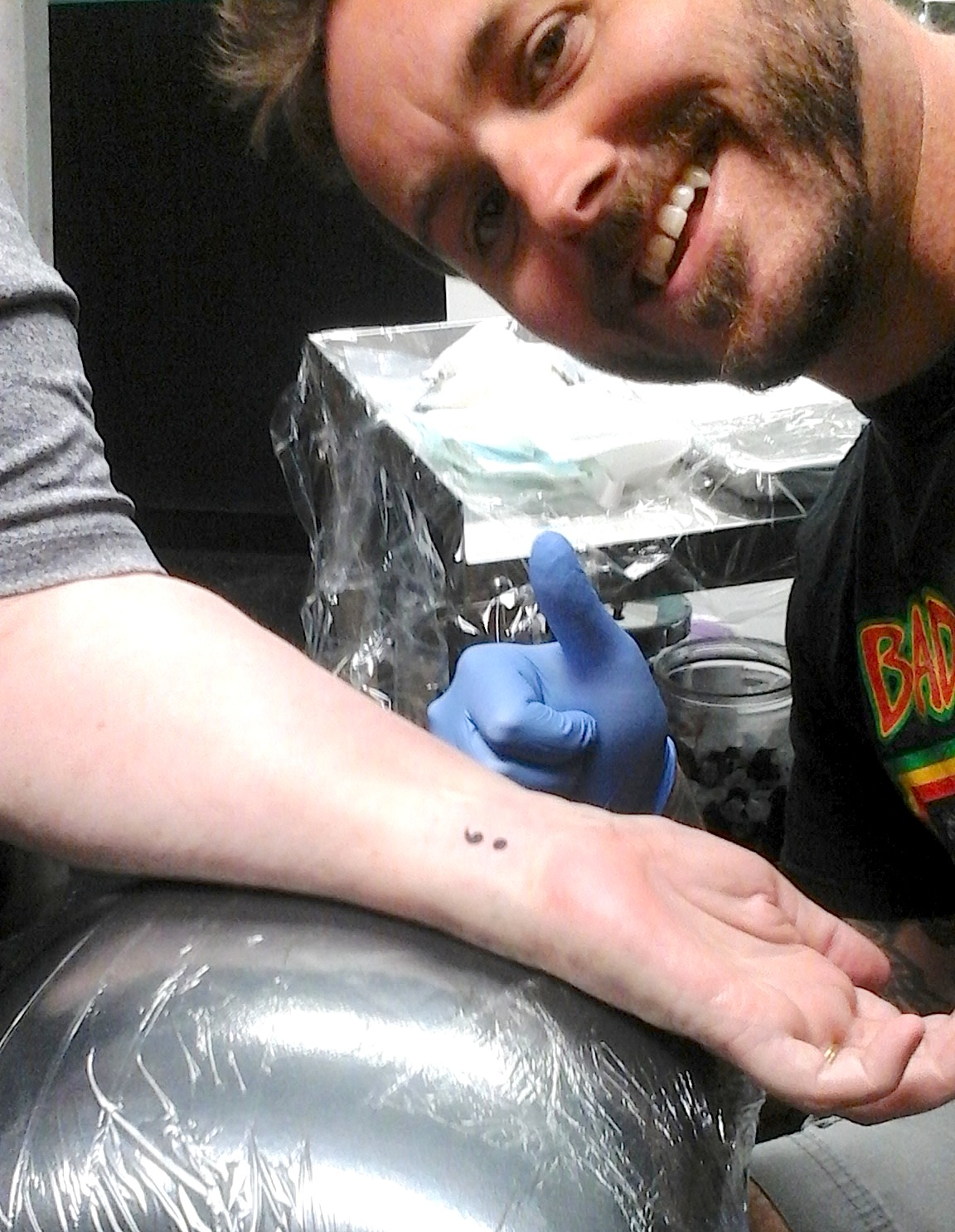
(4) And if we had been Skyping, Mom R. would have, but Skype has been glitchy lately since I changed browsers. So we have our weekly coffee chats over speakerphone. This prevents a lot of Dan handing me the phone and saying, “Here. Say hello to Mom.” Especially when I’m not prepared with any tidbits of conversation, like a new tattoo. Here’s a picture, if you’re curious:

finished
I guess Mike at Monkey Bones isn’t embarrassed after all.

(5) Depression, anxiety, OCD, ASD, whatever. I guarantee it. Someone you know is struggling, and may or may not be getting help for it. A semi-colon tattoo would show you care.

Mental Illness in the News: Some Questions

One of the notable headlines last week that wasn’t about a celebrity celebrity, ridiculous politician, or even the passing of a great and inspiring actor, concerned mental disorders and how society treats those who have them. Those of us who have or care about people with mental disorders may have noticed this story online:

http://www.rawstory.com/rs/2015/02/truly-barbaric-florida-deputy-drags-mentally-ill-woman-through-courthouse-by-shackled-feet/#.VOyTNKh2Gbc.facebook

For those of you who haven’t read it or seen the video, here’s the gist. A woman, Ms. Rios, was declared mentally incompetent at a hearing for a minor offense and not allowed to say goodbye to her mother. She wanted to sit on a bench and cry for a bit. When she did not go promptly with the officer, he dragged her through the courthouse by her shackled feet. A video was taken on a cellphone camera by a lawyer who happened to be present, but had nothing to do with Ms. Rios’s case. If you watch the video clip you can see and hear her distress.

As the headline says, this was barbaric.

But there’s lots neither the headline nor the story says. I have questions.

What is the woman’s mental illness? Or why is she mentally incompetent? The stories vary, usually calling her “mentally ill,” which is shorter for the headline writers, but so far I have seen nothing more specific. One could get the impression that in the mind of the media – and therefore their readers – that the two terms mean the same thing. Was she medicated or unmedicated or off her prescribed meds? Does she have a developmental disability? An autism spectrum disorder? An emotional or behavioral disorder? We don’t know. But does whatever label make her automatically suspected of potential violence? The woman did not behave like an animal even when she was treated like one.

I think we all know people who have mental disorders but are still mentally competent to conduct their own affairs, up to and including court proceedings. In fact, I know you know one – me. I have bipolar disorder, type 2. But who among us, even the sanest and most stable of the general public, wouldn’t have needed to sit on a bench and cry before going to wherever the officer thought we should go? Who wouldn’t yell and protest and try to hold on to a table if we were dragged anywhere by our shackled feet?

Is that the way to calm someone who’s upset?

No?

Why is the officer’s action called “truly barbaric”? I’m not saying it wasn’t barbaric. But how was it more barbaric than other things routinely done to the incarcerated mentally ill (or incompetent)? Could it be “truly” barbaric instead of just regularly barbaric because the officer’s actions were caught on tape? How many everyday barbaric actions aren’t? And putting aside simple human compassion (which he did), didn’t the officer’s actions create a larger, potentially more dangerous disturbance with someone being dragged and thrashing about?

Why did the other officers present do nothing? You can see them on the video. They are spectators. No one says, “Hey, do you have to do that?” or “Give her a minute to calm down” or “Here, let me take care of this” or “You know, there are other ways to handle this” or even “Are you sure you want to do that with the camera rolling?” Nothing. Nada. Zippety. Doo-dah.

Why weren’t the officers and other courthouse personnel trained to handle situations like that? They obviously happen occasionally. Officers are (supposedly) trained to handle situations involving dangerous felons (which Ms. Rios wasn’t), domestic violence, and how to restrain suspects properly. Some even get sensitivity training on race, sexual orientation, and ethnicity. Where’s the training for interacting with the mentally ill (or mentally incompetent)? For de-escalating a situation instead of throwing gas on the fire? How about anger management before incidents like this one happen instead of after? Shouldn’t every law enforcement official be able to control or channel his or her anger and not take it out on the public?

Why the hell aren’t police officers required to wear body cameras – and have someone whose job it is to, oh, I don’t know, review the tapes occasionally? Certainly when there’s been a complaint, but spot checks might also do some good. Why are civilians subject to increasing surveillance, while law enforcement personnel – who are also civilians, by the way – perform their jobs with minimal oversight.

And why is the Golden Rule suspended when the “others” have a mental disturbance? I’d really like to know.

We Don’t Do That Any More, Do We?

Here’s a story that caught my eye recently.

http://www.cnn.com/2014/03/08/us/mississippi-unmarked-graves/index.html?hpt=hp_bn1

It’s long, but worth reading. But for you busy people, I’ll summarize.

Two thousand unmarked graves were found on the grounds of an old hospital. Whose could they be? Civil war dead? Victims of an epidemic?

No. That section of the old hospital was an asylum, and the bodies were those of inmates. The insane. The developmentally delayed. The rebellious. Anyone the family wanted to hide and forget.

Of course, we don’t do that any more. No more locked, back wards. No more Snake Pits. No more Cuckoo’s Nests.

No, the asylums (pardon me, behavioral health residential facilities) have largely been closed and the inmates (pardon me, clients or residents or patients) released.

After their 30 days of insurance coverage run out.

To a group home that has a waiting list longer than the Mississippi.

To outpatient centers that hand out meds that may or may not have an effect or even be taken.

To the streets.

To a society that hates and fears them, lumps them all together as eyesores and NIMBYs, panhandlers, homeless and jobless, and spree killers.

Of course there are mentally ill people who are able to function in society on some level or another. They’re the ones who have likely never been in a locked ward. Those with understanding families, good insurance, nearby therapists, and a support system of friends. People who can hold a job. The ones who hardly ever shoot other people.

Still, the functional mental patients, your coworkers and neighbors and even family members are afraid to “come out” as needing help or getting help. They won’t even admit to taking Prozac, despite it’s being one of the most prescribed drugs in America.

Why is that? Because even if the asylums are gone, largely closed by lack of funding rather than obsolescence, the stigma remains. As a society, we have the impression that all people with mental disorders are psychotics or schizophrenics, lurking nearby just waiting for the chance to get their names in the papers and on TV.

We don’t lock up mental patients much any more. Now we’re humane. We give them apathy, invisibility, fear, and maybe a few drugs.

And the same old stigma.