Category Archives: music

Dan’s Only Friend

The phone rang and Dan picked it up. He held it out to me. “It’s your friend,” he said.

“Which friend? I replied. “My friend Robbin?”

“No, he replied.

“My friend Beth?”

“No.”

“My friend Tom?”

“No.”

“My friend Kim?”

“No.”

“My friend Jean?”

“No.”

“My friend Peggy?”

“No.”

“My friend Leslie.”

“Yes.”

“Geez,” I said, snatching the phone. “You make it sound like I only have one friend!”

The irony was that Dan worked in a place where friends were hard to come by. His hobbies are solitary, like working in the garden, reading about archaeology, and watching old movies on streaming services. He doesn’t like sports or going out drinking. Then he went to a support group, where he made one friend, John.

Whenever John called for Dan, I was truthfully able to say, “It’s your only friend.”

John caught on and was amused. Sometimes he would call and say, “Tell Dan it’s his only friend.”

(Dan also continued the joke with me. Someone would call for me and I would ask, “Who is it?” He would say, “It’s your only friend.” I would reply, “Is it my only friend Kathy?” “No.” “Is it my only friend Mary Jo?” “No.” And so on. But I digress.)

At one time, there were friends we shared. Beth, for example. Dan met her at a job they both worked at. One evening, however, we went to a work party and Dan introduced us. We got on the topic of science fiction.

“You’ve got to meet my husband,” Beth said. “He loves Isaac Asimov. He’s read everything he’s written.”

“Oh?” I replied, without thinking, “He’s written 200 books.” (Later, he wrote even more.)

Then we talked poetry and Beth, abashed, admitted that her favorite poet was Ogden Nash. (He’s considered pretty low-brow, but I can recite several of his poems, which I enjoy for his ingenious rhymes “platinum” and “flatten’em,” for example. But I digress some more.)

Beth was intimidated. (I have that effect on a lot of people for some reason.) But we became friends anyway. Once when Dan was lamenting that he had only one friend, I pointed out that he was friends with Beth before I was. “You stole her,” he replied.

There was a chance that I would steal John as well. He and I had a lot in common, like country music and murder mysteries, which we could talk about for long enough to make Dan feel left out. But instead of one of us claiming his friendship, we ended up sharing custody.

John and Dan would go off together on occasion without me. When I asked where they went, Dan would only reply, “That place.” They would never say where it was. (I figured it wasn’t a strip bar, since Dan had gotten them out of his system in his youth.)

Then John and I started going off on our own, just the two of us. (We called them our “hot dates.” A typical one would be thrift shopping, lunch at a diner, and a shared bag of M&Ms for dessert. We never told Dan what they consisted of. But I digress again.) (Once we went to a tobacconist (John smoked a pipe) and it was all I could do not to say to the proprietor, “My hovercraft is full of eels.” Yet another digression.)

All of us were cool with this arrangement. There was no jealousy or fighting over our outings. But John passed away a number of years ago, upsetting the balance of our friendships. We both still remember him fondly.

Now, I’m Dan’s only friend.

Music and Me: The Saga Begins (and Ends)

It all started with my sister’s cornet and sibling rivalry. My parents rented the instrument (probably already having an inkling of the outcome). She attempted to learn to play it for school band class. It was not a success and the next year, when I was old enough to be in band class, my parents did not rent an instrument for me. I never got over it, so when I graduated from high school, I saved up and bought myself a cheap guitar. (And a sword. I was deeply influenced by The Lord of the Rings.)

I started taking guitar lessons. Then I ran out of money after learning the “Cocaine” song by John Martyn (not the other one). (The sword lessons came much later when I was studying martial arts (ninjutsu, to be specific). We practiced with a wooden katana, so I wasn’t able to use the sword I had bought. But I digress.)

Later, I took guitar lessons from a guy who was the cousin of my rotten then-boyfriend. Later still I bartered with a guitar teacher who needed his dissertation proofread. (He actually learned some aspects of grammar rather than just letting me do all the heavy lifting. (He thought it was hilarious when I told him to “check your apparatus.”) He’s still a Facebook friend. But I digress again.)

I took a break from guitar lessons when I took singing lessons. I’m a terrible singer, and the lessons didn’t help. I also took piano lessons because the teacher gave a discount if you took both. Turns out I’m a terrible piano player too. (The pedals befuddled me just as badly as the pedals on the car when I was learning to drive stick. But I digress some more.)

Later still, I entered what was called a “Pick-a-Thon,” a marathon guitar-picking contest that lasted for days. You didn’t have to play actual songs, which was a good thing in my case, just keep making sounds with the guitar, which was a mercy when you had to visit the facilities—just squat and strum. By the time I had made it through 24 hours, my boss (who was also my friend) gave me time off. I made it to the final two pickers, but I finally gave in (I was hallucinating by that time). My final time was 68 hours and 7 minutes. The music store where this was held gave me a fantastic deal on a really excellent guitar as a second-place prize.

I still couldn’t play it much, though. More lessons ensued, this time with a woman who was: a twin, a former army officer, a pilot, and left-handed. I liked her a lot, but it was kind of weird trying to learn when she played her guitar upside down.

I finally figured out the reason for my lack of progress on the guitar (and the banjo). When I had the money for lessons, I didn’t have the time, and when I had the time, I didn’t have the money. (I briefly had a harmonica, which was inexpensive and didn’t require lessons. I learned the intro to Gordon Lightfoot’s “The Way I Feel” but it made my mouth hurt. But I digress yet again.)

I’m also trying to learn how to whistle. At least I don’t have to buy an instrument or take lessons for that. (So far I can whistle the sound that Wile E. Coyote makes as he’s plunging from a cliff to the ground. Not that there’s much call for that sort of thing. But I continue to digress.)

Right now, I’m in a time-rich and money-poor state. Plus, I don’t have a guitar or a banjo. I’ve never had a piano and still have a terrible singing voice. What I do have is iTunes (or Apple Music as I guess they call it now), 8,000 songs, a study I’m alone in all day, and a house far enough from the neighbors that I can’t be heard when I sing along off-key and loudly. And that’s enough to satisfy me.

Name That Tune

No one complains about Musak (aka elevator music) anymore. That’s because there is not, strictly speaking, any more Musak. Nowadays, elevators, stores, bars, and restaurants get their background music from a variety of services, which allow them to choose a specific type of music—smooth jazz, for example. Many locales choose oldies, which to me doesn’t mean the 2000s.

Recently, my husband and I went to a chain restaurant for lunch. We were there early, which means it wasn’t noisy yet, so we could actually hear the ambient music. When we walked in, we immediately heard Clapton’s “Lay Down, Sally,” and took this as a good omen for agreeable music.

Indeed it was. While we were there we heard some Whitney Houston (the early, pre-drug years), Sinatra singing “My Way,” and a bit of Fleetwood Mac, all of which were just fine. Then a song came on that puzzled us at first—Coolio’s “Gangster’s Paradise.” Or maybe it was “Gangsta’s Paradise.” At any rate, I eventually recognized the song, though Dan didn’t. I told him it was by Coolio. (“Kool and the Gang?” he said. That’s how stuck in the past he is. But I digress.)

Even more puzzling was an instrumental piece that came through the speakers. There were rhythmic trumpets and drums. At last I recognized it. “That’s the Imperial March. From Star Wars.”

“No,” Dan exclaimed. “It can’t be.” But it was. And the longer it played, the easier it was to recognize. It couldn’t have been any more recognizable unless it was the theme from Raiders of the Lost Ark. (Actually, that’s what I wanted for our wedding recessional. After all, we were embarking on an adventure, though it has seldom involved snakes. (Except for the time we were driving through Arizona and thought we saw a shed snakeskin on the side of the road. On closer inspection, it turned out to be a weathered piece of duct tape.) At any rate, the church organist balked and substituted the Love Theme from the movie Superman, which he probably figured was more appropriate but still a movie theme, though one that had no personal meaning for us. He was probably weirded out enough that I insisted on “Wildwood Flower” for the processional. But I digress at length.)

Returning to the aforementioned Coolio song, the reason I recognized it was that I knew the tune from Weird Al’s “Amish Paradise” and that it was Coolio because at the time there was confusion over whether he had given Al permission to use it.

Song parodies have sometimes proved even more confusing. I have friends who write song parodies, and sometimes the only way I know a tune is from their songs. My friend Tom Smith, for example, wrote a parody of “The Colors of the Wind” called “The Curlers of Delenn,” a Babylon 5 reference. I heard the original one day in a supermarket and wondered why they were playing a Tom Smith song. (I missed the Pocahontas movie.) Tom’s parody of The Proclaimers’s “500 Miles,” “500 Hats,” a Dr. Seuss tribute song, has affected me the same way.

(I have other friends who write parodies, too. Michael Longcor is one. He wrote a parody of the old folk tune “Lorena,” except about Lorena Bobbit, and one of Buck Owens’s “Act Naturally” called “Write Romantically.” He even wrote a parody of one of his own songs, a beautiful, tender love ballad called “Eternity’s Waltz.” He made it into “Eternity’s Polka.” But I digress some more.)

Of course, it’s not likely that I’ll hear “The Curlers of Delenn” or “Eternity’s Polka” as soothing background music anytime soon. But I like to imagine the kind of restaurant that would have them. I’m pretty sure there’d be a life-sized cardboard cutout of Weird Al right next to the hostess stand.

My Emotional Support Ambient Noise

I need lots of emotional support. I get it from my husband. I get it from my cat. I get it from my bed, my pillow, and my blankets. I get it from my computer and my writing. I get it from music.

But I also get it from my television.

I need noise—some kind of noise—to keep me functioning until I go to bed. After that, I need no noise at all. Even the fans bother me. (Once I had to tell my husband, “Please don’t use power tools after I’ve gone to bed.” It was something I never thought I’d have to say, but there you are. Or there I was. But I digress.)

You’d think that television would produce the kind of noise that wouldn’t let me write. This is true of music, except for instrumental music. Music with vocals is just too distracting. Half the time I want to sing along. The rest of the time, the vocals are just too intrusive. (My theory, supported by neuroscience, is that my brain uses two areas when I hear vocal music—the part that recognizes language and the part that processes music. Combine the two and I have no brain left over for writing. But I digress again. Pedantically.)

Television, however, provides vocals but not much music, at least not the kind that invades my brain. And I don’t even really listen to the voices either, which I turn down not quite to a subliminal level.

How can I avoid hearing the voices? I put on programs I’ve watched a million times before, like Buffy the Vampire Slayer, Inkmaster, Chopped, Mystery Diagnosis, or Forensic Files. They rattle around in the background, but not in my brain. (Occasionally, I glance over at the screen if something really interesting is going on such as the critiques on the episode of Inkmaster when everyone was supposed to tattoo someone’s ass and they all tattooed the flank/hip area. “Doesn’t anyone know where the ass is?” asked Dave Navarro. But I digress some more.)

This may be genetic (the need for ambient noise, not the location of the ass, though come to think of it, that’s genetic too). Anyway, my mother used to crochet a lot, and she often had a baseball game on in the background with the sound turned low. She didn’t even like baseball. I can only assume that it provided her with the kind of comforting background noise that I like. I imagine that football would be too raucous and basketball would be too frenetic. She could have chosen golf, I suppose, but baseball it was, at least during the season.

Anyway, I spend most of my time at home, alone in my study trying to write or edit. When Dan comes home, there’s plenty of noise and it’s attention-grabbing, not ambient. If I’m still writing, he’s quiet, except when he goes in the living room and watches TV there, usually the Screaming and Explosions Channel.

So, why do I think of my programs as emotional support? The house is pretty quiet when I’m alone here, except for the faint clicking of my keyboard and the cat, who pussy-foots and busy-noses when he’s not asleep. Ambient noise keeps me from feeling lonely and imagining that any tiny sound is an impending disaster. Loud sounds made by the cat signal actual disasters. My ambient noise grounds me and marks the passage of time. And it’s a whole lot more soothing than power tools.

What We Deserve

I saw a mattress commercial once that said something like, “You’ll get the good night’s sleep you deserve.” Or maybe it was good dreams. I was taken aback. Do we really deserve a good night’s sleep? The ad appears to not have taken into account new babies and new puppies, known destroyers of a good night’s sleep and neither one a problem solvable with a new mattress. If you’ve recently acquired either a baby or a puppy, a good night’s sleep is not so much something you deserve as something that you desire.

Especially in commercials, there seem to be many things that folks apparently deserve. The most recent one I’ve heard is toilet paper that tears off neatly in pretty scalloped lines. I don’t know about you, but I’ve never desired—or deserved—ass-wipe that made pretty patterns on the roll. I’m satisfied if there is a roll and not just a brown paper tube on the holder. After being stranded once or twice, I won’t even insist on it facing the right way (over the front) as long as it’s there when I need it.

When it comes to what we deserve, I generally think of the very basics. We all deserve to have shelter and food and physical safety. Maslow’s Hierarchy of Needs has these physiological needs as the foundation of its levels of development. Maslow’s theory is that we can’t move on to higher levels of the pyramid until we have completed the ones below. So, until we have our basic needs met, we can’t move on to higher needs like love and belonging, esteem, and self-actualization.

But apart from our basic needs, what do we deserve? Singer-songwriter Mary Chapin Carpenter has some thoughts (or rather Lucinda Williams, who wrote the lyrics). In her song “Passionate Kisses,” she lists “a comfortable bed that won’t hurt my back”—so maybe that mattress is something we deserve after all. Other needs she wants fulfilled are “pens that won’t run out of ink and cool quiet and time to think.” And of course, those passionate kisses. “Shouldn’t I have all of this?” she asks. Yes. Yes, you should, I find myself thinking. Especially the pens. (Those don’t appear on Maslow’s Hierarchy of Needs and neither do passionate kisses, except as a part of the love and belonging tier. But I digress.)

Williams was really onto something. While the comfortable bed and the pens cost money, the cool quiet and the time to think don’t, and neither do the passionate kisses.

I can think of a few other things we deserve as well. Healthcare that won’t bankrupt us. Enough food to stave off hunger, especially for children. Low-cost housing that the working poor can afford. Just to name a few. You know, stuff on the lowest level of Maslow’s Hierarchy.

Unfortunately, those do cost money, which really needs to be provided by social programs that require government funding, either national or local. Charitable organizations can help too, but they can’t shoulder the entire burden. And in the current political climate, funding for social programs is increasingly on the chopping block.

(And no, I’m not suggesting that there should be social programs that would offer funding for pens that don’t run out of ink or passionate kisses. That would be crazy. Maybe there should be a research effort to work on the pen thing, though. But I digress some more.)

For me personally, I think I deserve a mouse and keyboard that won’t run out of juice, a refrigerator that won’t run out of juice, and passionate kisses that won’t run out of juice. My old mattress works just fine.

Music From Hell!

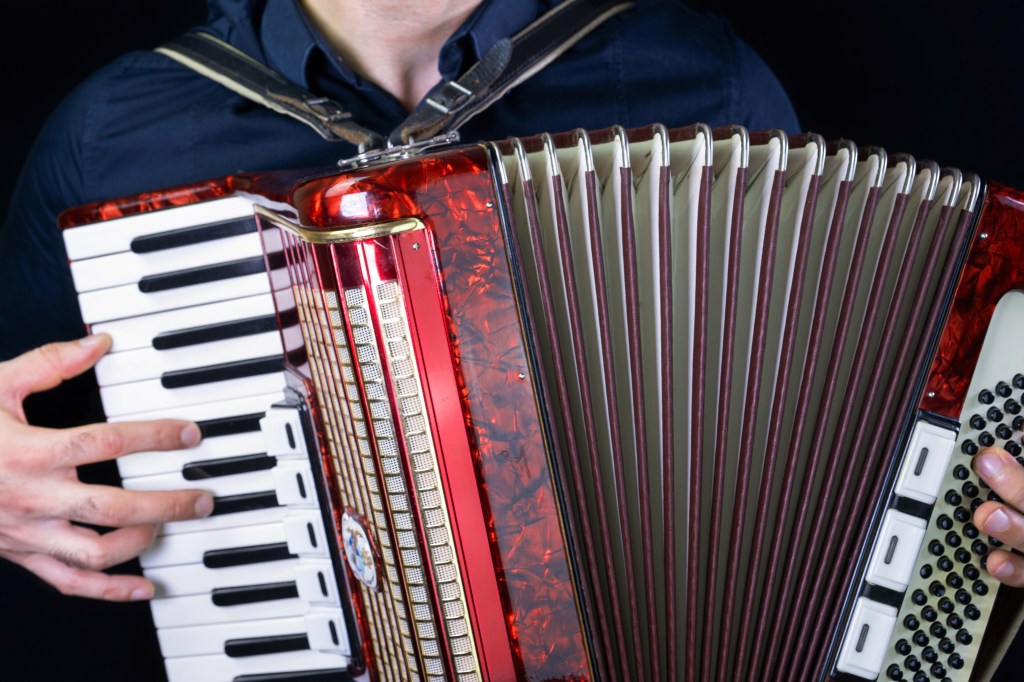
Whenever you see a cartoon about someone arriving in hell, they’re issued a musical instrument—almost invariably an accordion or bagpipes. Sometimes a banjo.

Why is that? Are they played badly every single time? Are there no tunes that they’re really the best instrument for? Why all the hate?

Let’s start with the accordion. Unquestionably, the virtuoso of the accordion is “Weird Al” Yankovic. He has made fun of the instrument by using it to mimic the sound of an iron lung in one of his early songs. (Not politically correct, I suppose, but very funny, which, now that I think about it, sums up a lot of Al’s repertoire. But I digress.)

The Weird One is particularly well known for his epic medleys of famous tunes played on the accordion. Among the tunes he’s given the polka treatment are “99 Red Balloons,” “Hey Jude,” “In-A-Gadda-Da-Vida,” “Hot Blooded,” “Jumping Jack Flash,” and “My Generation.” Just wrap your head around that.

Another much-maligned instrument is the bagpipes. About the only song that people will tolerate from a bagpipe is “Amazing Grace,” which is what was played every night when Dan and I were on a “barefoot cruise.”

But in general, the Scottish instrument is usually held in the same esteem as Scottish cuisine. (Never having been to Scotland, I can’t vouch for the accuracy of the slight on their cooking. I have been to England and Ireland, also often derided for their food, but I enjoyed eating both places. In England, I actually ordered a dessert called “spotted dick” and ate it, mostly so I could say, “I ate a spotted dick.” But I digress again.)

Yet another instrument that has a bad rep is the banjo. I think this is primarily due to that scene in Deliverance, where it became shorthand for mentally challenged Appalachian children and perverts. “Dueling Banjos” is the only banjo tune most people can name, and that’s half guitar.

But as Weird Al is to the accordion, Bela Fleck is to the banjo—a virtuoso, I mean, not a comic genius (though Fleck does have a tune called “Cheese Balls in Cowtown”). Fleck plays mostly jazz banjo, of which he is the only practitioner, to my knowledge. However, he has been known to dabble in classical banjo, recording an entire album that included the Keyboard Sonata in C Major, which can be heard here https://www.youtube.com/watch?v=Ych7SiJ1pjg.

(I actually tried to learn to play the banjo once, but I was caught up in my perpetual music loop—when I had time, I had no money for lessons; when I had money, no time. Eventually, when I was broke, I sold the banjo, which solved the problem. But I digress some more.)

Some of my favorite music stories involve an old friend of blessed memory, Bill Maraschiello, better known as Bill-of-Many-Instruments Maraschiello. If it had strings, keys, pipes, or anything else, Bill could play it. Guitar, mandolin, hammered dulcimer, lap dulcimer, and more. I swear if you put an old shoe in front of him, he could play it and make it sound wonderful. Once I once saw him play two pennywhistles at the same time—a different melody on each. It was nothing short of amazing.

Bill was short, just 5’2″, and sometimes he played miniature versions of accordion and bagpipes—concertina and uilleann pipes. (I suppose, since the haters often say that bagpipes sound like someone torturing a cat, the uilleann pipes would be blamed for abuse of kittens. Also, I couldn’t find a picture of them to go with this post. But I digress yet again.)

It’s said that music soothes the savage beast. I guess accordions, bagpipes, and banjos simply make them more savage. Perhaps it’s safest to avoid them, but I don’t think I can. Some of my musical heroes have played them. And I don’t think they’re going to hell for it.

Cat Songs

My husband and I have some silly traditions, some of which I’ve mentioned in the blog. There was naked cooking with Julia Child impressions, for instance. And we make up little nonsense songs. Well, Dan makes up most of them, mostly about me. (My nickname, which no one else may use, is Bunny, so they often have titles like “When Bunny Comes Driving Home Again.” They’re silly, as mentioned, but infinitely better than the NSFW song an ex-boyfriend once wrote describing my physical charms. But I digress.)

But this post is about cat songs. Not songs the cats sing, of course — their repertoire is pretty limited. Not songs about cats either (“Year of the Cat,” “Cat Scratch Fever,” “Stray Cat Strut,” “Honky Cat,” “Nashville Cats”). No, these are songs that we’ve made up about cats we’ve owned over the years.

Shaker’s song was really more of a poem or a chant than a song. It went:

Shaker in the park

Shaker in the pool

Shaker for dessert

Shaker after school.

Shake, shake, Shaker puddin’

Puddin’, puddin’, Shaker puddin’.

(Shaker was a very dignified tuxedo cat. She didn’t approve.)

The song will make no sense unless you remember a product from the 60s and its jingle (indeed, it doesn’t really make any sense at all, whether you remember it or not). The product was called Shake-a-Pudding. It was a brown plastic cup with a lighter brown plastic lid. If you put milk in the cup and added powder, then shook vigorously, hoping the top didn’t come off, what you got was something that at least resembled pudding. An interactive dessert. At the time, we thought it was neat-o.

Toby also has a song based somewhat on a commercial. It goes like this:

His name was Toby.

He used a Flowbee.

Obviously, this requires some explanation. First of all, it’s sung to the tune of Bary Manilow’s “Copacabana.” So far, so good. The Flowbee mentioned in the second line was one of those products you used to see on after-midnight infomercials from companies like Popeil or Ronco. Exercise equipment. Beauty products. That sort of thing.

Technically, I suppose you could call the Flowbee a beauty product. It was an attachment that you put on the end of your vacuum cleaner hose. It would make your hair stand on end so you could lop an inch or two off the end. I think it was mostly used on children who were too young to know any better and was responsible for the infamous bowl cut. It’s described by the company (yes, you can still buy them) as a “Vacuum Haircut System.” Need I tell you that we’ve never used one on ourselves, much less on Toby?

Louise had a song of a sort, or at least one line of one:

Every little breeze seems to whisper: LOUISE!

Naturally, the name was shouted.

Julia, the most beautiful cat in the world (she told me so) had a whole verse. Obviously, it was ttto “Julia” by John Lennon, which was written about his mother. Our Julia’s version went:

Julia, pinky nose

Pretty fur, naughty lips.

So I sing my song of love for Julia.

(No, I don’t know how the “naughty lips” part got in there. Cats barely have lips at all, and I don’t know how they could be naughty. That’s just the way the song went. So sue me. But I digress again.)

Dushenka had a tune that should be familiar to TV cartoon aficionados:

Shenka-Shenka-Doo

Where are you?

On your little kitty adventure.

Laurel’s song was melancholy.

Pooska-wooska-pooska

Pooska-wooska-pie

Pooska-wooska-pooska

It’s Laurel’s lullaby.

I even sang it at her funeral.

Of course, all the songs are doggerel (catterel?) and make us seem like idiots. But the cats don’t care. They’re used to us talking like idiots. (Does Toby want his noms? Pet, pet, pet, the incredible pettable pet. Mama loves kitty. Does kitty love mama? Ribbit.)

-Punk, -Core, and Portmanteaus

So you thought punk was something that had its vogue years ago and has disappeared since. Or maybe you just hope it has.

It’s true that you don’t hear much about punk music anymore, but punk is alive and well in the fictional world. As long as it’s combined with something else, that is. There is, as far as I know, no strictly punk genre of stories and books. But there are cyberpunk, steampunk, and even stonepunk and solarpunk.

(All of these are “portmanteau words,” squished-together words or sounds that combine two meanings to create a new one. Think smog, webinar, bromance, brunch, or spork (which I still call a runcible spoon). Or, given the time of year, spooktacular. But I digress.)

These varieties of fiction share the sensibilities of punk such as rebellion, individualism, social inequality, and unconventional thinking. (Less screaming, feedback, and safety pin piercings, though. Thank goodness.)

Most people’s introduction to the hyphenpunk world was a 1984 (appropriately) science fiction novel, Neuromancer, by William Gibson. It presented a dark, gritty, dystopian society in which a killer AI invaded people’s brains. At the time it served as a warning, which apparently we have not heeded. (Since then, almost all -punk fiction has been sci-fi or fantasy. At least I haven’t seen any romancepunk or mysterypunk. Again, thank goodness. But I digress again.)

Cyberpunk didn’t start any fashion trends the way punk music did (using the word “fashion” loosely). But another iteration of -punk has: steampunk. Steampunk combines Victorian-era technology and problems with a sense of adventure and invention and owes a lot to the writing of Jules Verne. You’ll find air battles between pirates in blimps, steam-powered robots pieced together from spare parts, and plots involving gaslighting (the streetlamp kind, not the manipulative kind). It’s a celebration of innovation, progress, and developing technology combined with nostalgia for a time when science was exciting, not threatening, and possibilities for advancement seemed limitless. Steampunk, unlike cyberpunk, is uplifting.

Nowadays, you can see steampunk aficionados at clubs and sci-fi conventions dressing in Victorian garb, embellished with brass gears, gauges, and wheels. One trendy accessory is the top hat with welding goggles as a hatband. Women can dress as aviators (aviatrixes? aviatrices?) with, obviously, aviator goggles. One would assume that the expected reaction from those not in the know is goggling at them. (Sorry, not sorry.)

(And that stonepunk and solarpunk I mentioned? Those refer to fiction that immerses the reader in a Flintstones-like past and a back-to-the-land agrarian setting respectively, with technology based on those eras. But I digress still more.)

Now on to -core, another element used in portmanteau words related to the music scene, rather than fiction. As you might guess, the word “hardcore” is the origin of the term. But instead of referring to pornography, -core applies to an extreme expression of any kind of music. Skacore. Thrashcore. Even emocore, unlikely as that sounds. (Theoretically, you could have punkcore music, but I’ve never heard that term used. Nor punkpunk fiction, for that matter. There is a subset of country music called cowpunk, so I guess you could have cowpunkcore. But I digress even more.)

Historical note: Lewis Carroll, author of Alice’s Adventures in Wonderland and Through the Looking Glass pioneered the creation of portmanteau words. (A portmanteau is “a case or bag to carry clothing in while traveling, especially a leather trunk or suitcase that opens into two halves.” So portmanteau, when it comes to words, is actually a metaphor.) Carroll’s epic poem “Jabberwocky” contained several. Slithy (as in “the slithy toves did gyre and gimble in the wabe”) is, he said, a combination of lithe and slimy; frumious, a mashing-together of furious and fuming; and chortle, a portmanteau of chuckle and snort that is still used today.

(Less historical note: Thanks to the book The Annotated Alice (annotations by Martin Gardner), which I highly recommend, I learned how to recite the first verse of “Jabberwocky” in French, a skill with no practical applications whatsoever. But I digress. My last digression for this post. I promise.)

(Just kidding. Bonus digression. Back to -punk and -core. There exists a series of books that combines steampunk, thriller, and fantasy. (A Study in Silks (The Baskerville Affair)). Steampunk-Holmes-demoncore, I guess you’d call it.)

Wrecks and Resurrection

Gordon Lightfoot died this week, which made me and many others sad. I remember listening to “Sundown” when I was in high school, which got me hooked on him. (The song had just come out. My friend Kathy was listening to Stevie Wonder and Elton John, so we heard a lot of them, too. And my friend Peggy and I were both listening to John Denver as well. Yes, I’m ancient. But I digress.)

One of Lightfoot’s best-known songs was “The Wreck of the Edmund Fitzgerald.” It was one of the longest popular songs ever played on AM radio. The rhythmic swells of sound mimicked the waves on Lake Superior, and the level tone of his voice perfectly conveyed the sorrowful atmosphere of the story.

I gained even more respect for Lightfoot when, in 2010, he changed some of the lyrics to the song to reflect new evidence about the wreck and the men who went down with the ship. That was classy.

But there’s another shipwreck song by another Canadian singer-songwriter that has probably had even more influence on my life – “The Mary Ellen Carter,” by Stan Rogers, who died in 1983. It’s a folk song that packs a powerful punch.

“The Mary Ellen Carter” is another story-song as well. It’s about a group of men determined to raise a sunken ship from her “sorry grave.” They know that the ship is still worth money if they can raise her, but really, it’s a labor of love. And the chorus says, “Rise again!”

It’s the final verses that really pack a punch, though. It talks about rising from all kinds of wrecks – “No matter what you’ve lost, be it a home, a love, a friend/Like the Mary Ellen Carter, rise again! Though your heart it be broken or life about to end/Like the Mary Ellen Carter, rise again!”

I’ve known the song to be deeply meaningful to any number of people – a woman going through an unexpected divorce, a cancer survivor, and more. When our house was destroyed by a tornado, it buoyed up my husband and me. (Sorry. Couldn’t help myself.) Whenever we’re having difficulties, we play the song. Sometimes we just play it when we need encouragement. And we always sing along at top volume. Sometimes we even put it on repeat and listen to it over and over.

The thing about the song is that, though the lyrics talk about all the rigors the sailors go through in trying to raise the ship, the song never says whether they actually accomplish it. In that way, it’s even more a song about hope than one about success. Hope, working together for a common goal, and persevering when everyone thinks you’re a fool for doing so.

I hope you listen to it. I hope it inspires you as much as it does me. Stan Rogers has lots of other songs, some of them humorous (“White Collar Holler”) and others heart-wrenching (“First Christmas Away From Home”) and still others slice-of-life ballads (“Lies,” which makes me and other of my friends cry every time we hear it), plus any number of folk songs.

Both “Edmund Fitzgerald” and “Mary Ellen Carter” are great. Both songwriters are phenomenal. One had a place on radio and the other at folk festivals. But I think they’re both worth a listen. Let me know if you agree.

Songs Around the Campfire

I loved being a Girl Scout. I especially loved camping and sitting around the campfire singing. What I didn’t love were some of the songs they made us sing. (I also didn’t love wearing my uniform to school because our meeting was right afterward. I got called a “little green cookie pusher.” But I digress.)

There were good campfire songs, of course. Among our favorites were “Free to Be You and Me,” which was popular at the time, and “Let There Be Peace on Earth.” There were rounds such as “Make New Friends But Keep the Old,” “One Bottle of Pop,” and, of course, “Row, Row, Row Your Boat,” which I never quite got the hang of. There were songs that couldn’t be sung today (“The Poor Old Slave Has Gone to Rest”). And there were songs that were just plain fun or funny – “Ragtime Cowboy Joe” (the Chipmunks’ version) and, as we got older, “Seven Old Ladies Stuck in the Lavatory.” There were also folkish staples like “Take Me Home, Country Roads,” “If I Had a Hammer,” “Puff the Magic Dragon,” “Where Have All the Flowers Gone?” “500 Miles” (not the Proclaimers version), “Today While the Blossoms Still Cling to the Vine,” and “The Ash Grove,” as well as classics like “Taps” and “This Land Is Your Land.”

There were also just plain idiotic ones like “On Top of Spaghetti,” “B-I-N-G-O,” and “Be Kind to Your Web-Footed Friends,” plus recursive song/chants like “There’s a Hole in the Bottom of the Sea,” and “There Was an Old Lady Who Swallowed a Fly,” and memory test/games like “One Hen, Two Ducks” (which I actually sort of liked and can still remember most of).

What I didn’t like so much were the ones they made us do motions to. The old staples “Little Bunny Foo Foo” and “Kum Ba Yah” were among these. They were okay, I guess, if a bit predictable. Then there was “Gray Squirrel,” much less okay. The lyrics go “Gray Squirrel, gray squirrel/Swish your bushy tail/Wrinkle up your little nose/Put a nut between your toes/Gray squirrel, gray squirrel/Swish your bushy tail.” Not what I would call Grammy-quality lyrics, but hey, we were Girl Scouts. The motions that went with it were squinching up our noses, pantomiming putting a nut by our feet, and – you guessed it – waggling our asses. This wouldn’t have been quite so bad if we were five, but it continued into our tween years, when it was just embarrassing.

Even more embarrassing were the motions that went with “Running Bear,” that corny song of doomed Native American love (another one that’s almost certainly offensive these days). We mimed the lyrics as we sang – diving in the water, happy hunting ground, and so on. “Running Bear” (the male protagonist), unfortunately, was mimed as a homonym. We made a motion of running and then one of throwing open our shirts to expose our (or, in the context of the song, his) chest. It was stupid in the extreme, not to mention creepy. The thing is, I still can’t listen to the song without thinking of the motions. (Not that I listen to it often anymore. Or much. Or at all. But I digress again.)

Did they make Boy Scouts do this dopey kind of thing, acting out songs in pantomime? I don’t know. It could have been just us girls. I didn’t experience mixed-group camping until I was in college, when they took freshmen out, hoping to lose some of us in the woods and reduce overcrowding in the dorms. I managed to survive. And there was no singing. Or pantomime.

Tip Jar

Choose an amount

¤2.50
¤5.00
¤10.00

Or enter a custom amount

¤

Your contribution is appreciated.

Donate