
“The single most important component of a camera is the twelve inches behind it.”
Ansel Adams said that when he was tired of hearing about people who liked a photograph say, “Wow! You must really have a great camera!”
Funny, nobody ever says to painters, “Wow! You must have an amazing brush!”
I have a story that involves both a camera and a brush. Here’s how it happened.
I wanted to give my husband a painting of his much-loved cat, Matches, for his birthday. I know a really great artist, Peggy McCarty, and asked her if she could do it.
“I’ll need a photo of him in natural light,” she said.
No problem, I thought. I took the cat outside, where the light is as natural as you can possibly get, and took a few pics of him wandering around the yard. (Including one with a super-blep, which was amazing, but just not right for a portrait.)
Those photos wouldn’t work, I was told. There was natural light, sure, but no contrast. This time Peggy gave me more explicit instructions. I should take the photo indoors, but somewhere that there was natural light, like by a window.
For those of you who think it would be hard to get a cat to pose by a window, well, you’re wrong. Matches was the most laid-back cat ever. I could pick him up, plop him down near a window where there was light shining through the slats of the blinds. He’d sit still, looking bored, while I snapped a few shots. Then he would get up and stroll away. I would follow him, pick him up again, plop him down by a window, and take a few more pics. We repeated this several times, and he never got annoyed.
I took the photos to Peggy and she deemed them all right in the lighting department. Then she surprised me. “Could I put some plants around his feet and lace over the window?” she asked.
“Sure,” I said. “As long as the cat looks like the cat, add anything you want to.”
It turns out that the plants were necessary because my photo didn’t show the cat’s adorable feet. And the lace curtain was because Peggy likes to play with textures in her paintings – and still does.
It was perhaps the best birthday present I ever got for my husband and, amazingly, it survived the tornado that hit our house, needing only a new frame.
As the years have gone by, Peggy has practiced her art until now she paints on commission regularly – and has regular calls for pet portraits.
And, as the years have gone by, I’ve learned to use a camera better, especially since they invented the kind that cancels out the tremors from my shaky hands. The problem is that my husband has improved at photography too, and every good photo we have he claims he took, even if I know I was the one who took it. Unless he’s in the photo, of course. Then he might be willing to admit I snapped it.
But he’s never tried to claim that he took the photo of Matches that turned into the painting of Matches. That would be absurd. The proof is hanging on the wall.
Peggy McCarty has a Facebook page https://www.facebook.com/Peggypaintings/, where you can see more of her amazing art and get in touch with her.
 No, this isn’t going to be a post about me and my husband, although it’s true that we’re growing older (every day) and we’re still together (after nearly 40 years).
 Last week I received an answer to a query. An agent I had contacted about my mystery novel had asked to review my complete manuscript.
 I gave Robbin the first cat she ever had (Norman), thus starting her on a long career as the local Crazy Cat Lady. We’ve supported each other and cried our way through many a feline illness and death, and reminisced about our little friends afterward. I know her cats and her little chihuahua Moochie are missing her too. (This cat would surely remind her of Sandy, or one of the many others she opened her heart and house to.)
 My cat has a magnet in her nose. My husband does not.
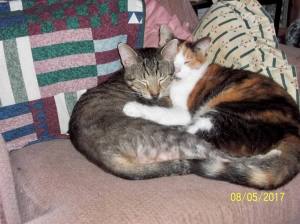 They look so innocent, don’t they? Of bank robbery and murder, as my Dad would have said. In actuality, these cats are naughty little fiends who try to get away with anything they can, including chicken bones if we don’t keep a sharp eye out and a lid on the garbage can.
 Our house felt remote, surrounded by trees and a small stream and prairie grasses and wildflowers. Our neighbors were remote enough that we could have become practicing nudists, were it not for the invention of telescopes. Actually, it was very close to everything required for modern life.
 Moving is always a challenge. Moving with cats doubly so. Yet, we have accomplished it thrice in a month. And all of us, feline and human, survived. Not necessarily happily, but we survived. The cats were the least happy of all and we tried our best to remedy that situation.
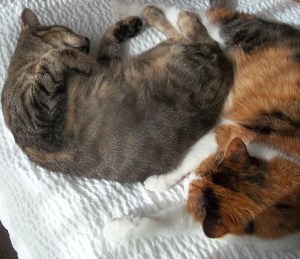 furniture. My husband put small potted plants on the windowsill where they could knock them off while admiring the fifth-floor view. And they loved the bed, where they took up residence. But all in all, there wasn’t much for an active cat to do.
 You know all those movies from the 30s where people live in hotels and call for strawberries and champagne and poof! they appear at their door? Well, life in a hotel is not exactly like that, but it does have its moments.
 But I Digress . . .