Who Controls the Remote Control?

“Where’s the clicker?” resounds through the room. (That’s what we call the remote control. Clicker is two syllables shorter than remote control and exactly as long as remote. But I digress.)

“I don’t know.”

“You had it last.”

“I thought I put it on the table.”

“Well, you didn’t, unless you put it under the peanut butter jar, and it’s not there.”

“Maybe it’s in your desk drawer.”

“I never put it there. Maybe it’s on the floor between your feet.”

“I don’t see it there.”

“Maybe it dove into the cushion of your chair. Fish for it!”

“Maybe Toby took it.” (Toby’s the cat.)

“No, he’s watching Bird TV.” (Looking out the window.)

This is an accurate account of a conversation that occurs nearly daily (nightly, too, sometimes on the same day). The seeking, scrambling, fishing, and fumbling. The recriminations. The prospect of an un-entertained evening stretching out before us.

(I look back fondly on the days when the remote was attached to the TV or VCR (yes, I’m old) by a long plastic leash. All you had to do was follow it like a trail of breadcrumbs and there the clicker was! You could also follow it the other way to find out where the TV was, not that we used it that way all that much. But I digress again.)

When Dan gets tired of the cooking, crime, and comedies I like, he says, “Can I see the clicker?” If I’m feeling puckish, I simply hold it up within his line of sight. He sighs and says, “Gimme that.” (I don’t really do that. Much, that is.)

I must say I don’t understand the way Dan uses the remote. Rather than selecting a program to watch, he goes to a movie channel and clicks through every film listed, muttering, “That’s a good one” or “Haven’t seen that in a while.” He never quite commits to a movie, even if I say I like one of them. He waits until I go to bed to select a movie and watch it or episodes of Quantum Leap. Or wakes up at 3:00 a.m. and goes downstairs to do the same.

(We do have different taste in movies. I like musicals, swashbuckler movies, and anything starring Kris Kristofferson. Dan likes war movies, Thin Man movies, and anything featuring Peter Sellars, none of which features Kris K. But I digress some more.)

But we were talking about remote controls. At least I was. I think.

Custody of the clicker passes back and forth during the day. When Dan’s at work, it’s mine, all mine. I spend most of the day with the TV on, even when I’m doing my writing. I usually have the live channels on and flip around when I get bored with one. On any given day, I may listen to a few episodes of Ink Master, a couple of Buffy, some Dr. Pimple Popper, and maybe Forensic Files, if they have an episode I haven’t already seen. I don’t generally pay attention to what’s on. It’s just my “emotional support noise.” I don’t like sitting in a completely quiet house, and the cat doesn’t make that much noise. Or if he does, there’s something very wrong.

(It was Dan who got me started on Dr. Pimple Popper. I was reluctant to watch it because it had such a dopey, repellent name. But after a few episodes, I found it tolerable. It was another medical show, kind of like Mystery Diagnosis or Monsters Inside Me, both of which I like, except with cysts and lipomas instead of parasites. But I digress even more.)

Then, when Dan comes home, we have to negotiate what to watch. Big Bang Theory or The Dirty Dozen? Dr. Strangelove or Forged in Fire? Beat Bobby Flay or Bell, Book, and Candle? The Three/Four Musketeers or Arsenic and Old Lace?

Finally we settle on something. It doesn’t really matter what. Inevitably, Dan falls asleep in the comfy chair. I grab the clicker and change the channel.

The Only Writing Advice You Need

If you want advice about writing, go to the pros for the prose (or verse, as it may be). They have helpful advice to offer.

“Fill your paper with the breathings of your heart,”  said noted poet William Wordsworth.

“The scariest moment is always just before you start,”
the best-selling Stephen King advised.

“Start writing, no matter what. The water does not flow until the faucet is turned on,” offered Western writer Louise L’Amour.

“Your intuition knows what to write, so get out of the way,”
said sci-fi great Ray Bradbury.

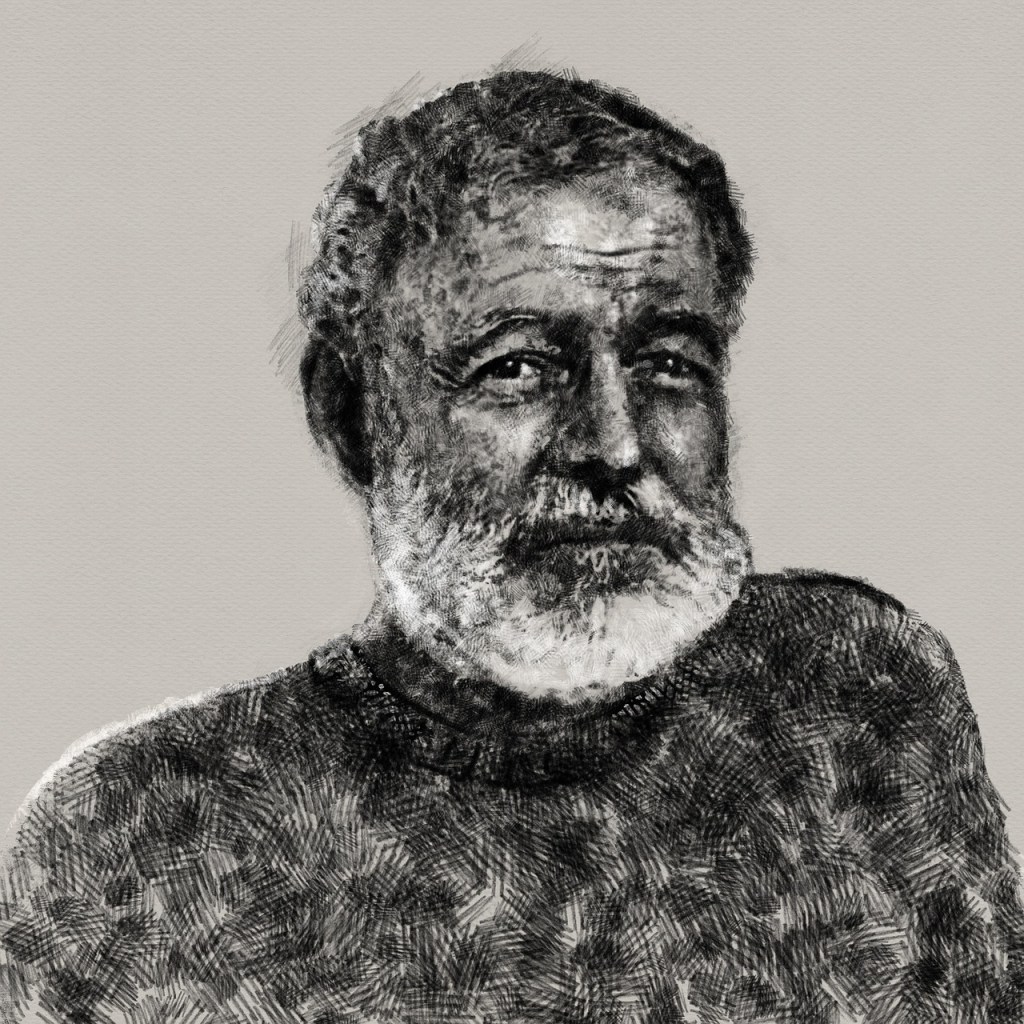
“My aim is to put down on paper what I see and what I feel in the best and simplest way,” advised Ernest Hemingway. Words to live (or write) by.

“It was the night before Christmas. The house was very quiet. No creatures were stirring in the house. There weren’t even any mice stirring….The children were in their beds. Their beds were in the room next to ours. Mamma and I were in our beds. Mamma wore a kerchief. I had my cap on. I could hear the children moving. We didn’t move. We wanted the children to think we were asleep.”

But Hemingway (the real one) gave what I consider the greatest piece of advice: “Write drunk. Edit sober.”

People have debated what he meant by that (a thing that English mavens do). However, as an English maven myself, I think that, like his writing, his advice was straightforward and clear. (I got a t-shirt with his famous saying on it. But I digress yet again.)

What are the advantages of writing drunk? you may ask. Think about what Stephen King said. (“The scariest moment is always just before you start.”) I can vouch for this, having committed to writing posts for two blogs every week. (Not that I actually get drunk every time I start a post. I have some other work I have to do that would not improve with a blast of bourbon. But I digress even more.) But words do tend to flow more easily when something intoxicating is flowing, too.

Then there’s editing sober. I advise that, too. You’ve most likely missed a few commas (at the least) when you were WUI (writing under the influence). Not to mention question marks, quotation marks, and apostrophes. When you’re sober, you are capable of noticing these flaws, as well as sentences that need to be shorter and punchier.

So, which is more difficult, writing or editing? Of course, editing is. You have to do it with a clear head. You can’t just go splashing words around. You have to be precise. You have to pay attention to style, narrative flow, repetition, characterization, and fixing everything you did while you were drunk. But for me, writing is the fun part, and not just because of the booze. You’re creating something, and that’s exhilarating!

For the last word on the subject, however, I’ll turn to playwright Lillian Hellman: “If I had to give young writers advice, I would say don’t listen to writers talking about writing or themselves.”

Except Hemingway, of course.

The Pet With No Personality

Once I was talking with Brenda, a coworker, about pets. She said she had a cat. Instantly, I started asking questions. What’s its name? Is it male or female? How old is it? Where did you get it? What does it look like? Has it bonded with anyone in the family? What’s its personality like?

“It’s a cat,” she replied. “It doesn’t have a personality.”

“What do you mean, it has no personality? Every cat has a personality,” I said.

“All it does is lay in my shoes.”

“That’s a personality if I ever heard of one,” I replied. “It likes you and wants to be close to you. Your scent makes it feel secure. It’s chosen you as its human. If you don’t pay attention to it, it will get lonely and turn to your shoes for comfort. You should pet it and cuddle it and love it.”

She scoffed at me.

But all cats have personalities, even if they’re peculiar.

We once had a kitten who caused a commotion. We heard a bump-bump-bump coming from the hallway but had no idea what it could be. Maggie solved the mystery when she came into the living room, dragging one of Dan’s hiking boots (larger than she was) by its long, red lace. Now there was a cat with a shoe fetish! (She also used to hide bits of kibble in the toes of his shoes. She was a rescue and hadn’t known where her next meal was coming from, so she’d stash some food just in case. I’m just glad we didn’t feed her wet food. But I digress.)

Maggie bonded with Dan. When she was around him, she behaved like a Gallic strumpet, writhing and meowing and presenting her backside. To her, I was chopped liver (or something less edible). I always said if Maggie and Dan were the same species, I wouldn’t have had a chance with him.

Another cat we had, Matches, also bonded with Dan. Matches would play catch with him. Dan would throw a crumpled-up piece of paper, and Matches would catch it between his paws and bring it back to Dan. When he tired of the game, he would drop the “ball” instead of returning it. (He also bit Dan’s ankle whenever he stepped out of the shower. As a sign of affection, it wasn’t as endearing as playing catch. But I digress again.)

Our other cats had personalities, too. Jasper came running up onto the bed most evenings, meowing urgently. “What is it?” we’d ask. “Has Timmy fallen down the well? And did Grandpa fall in after him? And did a school bus full of nuns fall after them both? And catch on fire?” He never told us, but he didn’t stop meowing either until we tugged his tail, which he loved.

We’ve had many cats over the years, and all of them had personalities. Louise liked to be held in my arms like a baby. Chelsea would get upset if Dan and I quarreled. Bijou slept across my throat the first night I brought her home.

However strange they (or we) sometimes acted, they socialized with us, bonded with us, and set up housekeeping in our hearts. Personalities? They had personality-plus.

(You may now applaud because I got all the way through this without giving in to the temptation to say “purr-sonality.” Until now.)

Codger the Codger

One summer, I took a trip with a group of friends. We went up north to enjoy some brisk weather and scenery. Instead, it rained the entire time, and we stayed in the hotel room playing word games. I like word games, but there are limits.

(My husband doesn’t object to my traveling without him, although he does tease me about going to meet my lover Raoul. I call him when I’m on my way home to tell him to make sure the dancing girls leave. But I digress.) When I do go away without my husband, I generally come back to a major appliance. (I like to comparison shop. He just wants to make a decision. But I digress again.)

This time, however, I came back to a new pet. A hedgehog.

I was just as glad not to have a new appliance (we didn’t need any), but a hedgehog? We’re a cat family. (With the occasional rescue dog.)

Obviously, I had questions about the hedgehog.

Why a hedgehog? (shrug)

Where’d you get it? (a guy at work)

What did you name it? (Codger)

Why? (shrug)

Dan set Codger up with a home in a large fish tank (which he had previously used for a snake and some hermit crabs that he claimed were building a secret missile base. But I digress yet again.). Dan acquired a small hut for Codger and a large, green plastic ball for him to play with.

Despite having a toy, Codger was not a joyous pet. He ate mealworms, so we went to the bugstore regularly to get some. Even with a constant supply of worms, he was cranky. I began to suspect how he got his name.

I have seen pictures on Facebook of adorable little hedgehogs reclining in muffin cups or wearing cunning little hats. Codger was not adorable and he did not go in for little hats, no matter how cunning. He snarled and rearranged his furniture. That was the extent of his repertoire.

After a while, Dan and I went away on vacation together. (We do that sometimes, when we don’t need any appliances. But I digress some more.) We left Codger with our friend John, who reported that the creature ate bugs, snarled, and rearranged his tank.

Codger also had a habit of sticking Dan with his spines. Wanting to understand our pet’s behavior, I looked up hedgehogs on Google. It said that you should socialize them when they’re young, or they grow up to be surly as well as pointy. Dan’s friend had evidently stuck him with an overage hedgehog.

(I told Dan that he should try to socialize with Codger. Dan poked him with a plastic fork. “That’s what he does to me,” he explained. (He didn’t want me to reveal this, for fear of being arrested for animal abuse. I convinced him the statute of limitations has expired.) But I digress even more.)

Eventually, Codger passed away. What can I say about the little guy? What he lacked in personality, he made up for in surliness. Perhaps he is now in a better place, feasting on mealworms and snarling at the angels. That’s how I like to picture him, anyway.

Bad Stuff I Learned in College

I went to a classy university—one so classy that they could (and did) boast about the vegetation that climbed their walls. There you could learn all kinds of useful stuff, such as how to be an engineer, a business maven, or a lawyer. So naturally, I went there to study poetry.

My education wasn’t wasted, however. I learned things that the university didn’t advertise as being part of the curriculum. Here are just a few of them.

Naughty Poetry

One of the more interesting poems I encountered was one by e. e. cummings (the poet who lost his Shift key). He wrote a poem that was considered so filthy that his publisher would only include it in his collected works on an onionskin paper insert in nine copies, handwritten by the author (and cummings had terrible handwriting). But that was in 1935. (The title is “the boys i mean are not refined,” and now you can find it on the internet (if you’re not easily offended, that is). (You just looked it up, didn’t you?) But I digress.)

Bad Wine

I took a class in my junior year called Wine Tasting for Non-Majors. The class met on Wednesday afternoons in an auditorium, and we sampled various wines. We passed bottles of wine and small plastic cups down the row like we were in church, only without the collection baskets. There was a spit bucket at the end of each row for those who didn’t drink (very few) or those who hated a particular wine.

There was lots to hate. We sampled the candy wines. (I was actually fond of Pear Ripple, which I don’t think you can get nowadays. But I digress some more.) We sampled wines that had gone bad in various ways so that we knew what to say to snooty wine stewards: “This wine is foxy,” for example, or “musty” or “oxidized.” That was where the spit bucket came into play.

(The university had, in addition to the usual schools of Arts and Sciences, Engineering, Agriculture, and the like, a Hotel School. Hotel majors had a very different wine class, the sort in which you took a sip and had to identify the country, the variety, and the name of the woman who stomped the grapes. It was not a jolly passing of bottles. It did not enliven Wednesday afternoons. But I digress even more.)

Smelly Animals

Carl Sagan taught us to avoid cow farts. (Yes, that Carl Sagan, the famous astronomer, also noted for appearing on the Johnny Carson show and the catchy phrase “billyuns and billyuns.” But I digress still more.)

So, how did cow farts get into Astronomy 102? Sagan, like me, was fond of digressions. He occasionally got onto topics such as greenhouse gases, which is where the cow farts (and burps) come in (or go out, really). He told us that greenhouse gases were produced in large quantities by “the rumen of ungulates,” which is delicate science-speak for cow farts.

How does that work, exactly? It all goes back to methane, a notoriously stinky gas. Human farts are largely nitrogen with just a soupçon of methane. Cow farts, on the other hand, produce enough methane per year to do the same greenhouse damage as four tons of carbon dioxide. We first-year students thought this was hilarious. That’s one hell of a lot of cow farts.

There were other things to learn at the university, only some of which I got around to sampling: sheep wrestling, bee dissection, and archery. (I took that twice, wearing a forest green cape and hat, because I was fixated on Robin Hood, setting me up for a later fixation on Katniss Everdeen. But I digress yet again.)

I could have spent far more than four years there, sampling the good and the bad. Sometimes, I wish I had. Not that I’m in shape to wrestle sheep these days.

Down the Rabbit Hole

Almost five years ago, I wrote a post about how memories from my (and likely your) childhood were being repurposed for political statements and propaganda.

This time I’m writing about a classic piece of literature being rewritten for other purposes. (Largely unobjectionable ones, it’s true, but it’s the principle of the thing. But I digress.)

The work in question is Alice’s Adventures in Wonderland (more often known as Alice in Wonderland). It’s one of my favorite pieces of literature and I have returned to it many times since I first read it (murfle) decades ago.

(I have a friend who despises Alice. He finds it to be nonsense (which it obviously is) and incomprehensible. This despite the fact that he has returned to it frequently to see if it makes any more sense. (He ought to like at least part of it because he’s a mathematician, like the author, Lewis Carroll. I recommended The Annotated Alice (edited by Martin Gardner), which explains the jokes, Briticisms, and outdated expressions. (It also includes “Jabberwocky” in French, German, and IIRC, Latin.) But I digress, pedantically and at length.)

The “quotations” in question are not political but psychological or philosophical. I’m not saying they’re invalid—merely that they are misquoted, misattributed, or completely made up.

One of the most common misquotes is attributed to the Cheshire Cat:

“You’re mad, bonkers, off your head. But I’ll tell you a secret. All the best people are.”

What the Cheshire Cat actually really said is much more complex. Here’s the context:

“But I don’t want to go among mad people’” Alice remarked.

“Oh, you can’t help that,” said the Cat: “we’re all mad here. I’m mad. You’re mad.” 

“How do you know I’m mad?” said Alice.

“You must be,” said the Cat, “or you wouldn’t have come here.” 

One quotation supposedly from the Mad Hatter is:

The secret, Alice, is to surround yourself with people who make your heart smile. It’s then, only then, that you’ll find Wonderland.

Unobjectionable if sappy, but not from the book. The same with this one:

But, said Alice, if the world has absolutely no sense, who’s stopping us from inventing one?

The most annoying fake dialogue is this one, between Alice and the White Rabbit.

“Do you love me?” Alice asked.

“No, I don’t love you!” replied the White Rabbit.

Alice frowned and clasped her hands together as she did whenever she felt hurt.

“See?” replied the White Rabbit. “Now you’re going to start asking yourself what makes you so imperfect and what did you do wrong so that I can’t love you at least a little. You know, that’s why I can’t love you. You will not always be loved Alice, there will be days when others will be tired and bored with life, will have their heads in the clouds, and will hurt you. Because people are like that, they somehow always end up hurting each other’s feelings, whether through carelessness, misunderstanding, or conflicts with themselves. If you don’t love yourself, at least a little, if you don’t create an armor of self-love and happiness around your heart, the feeble annoyances caused by others will become lethal and will destroy you. The first time I saw you I made a pact with myself: ‘I will avoid loving you until you learn to love yourself.’”

The White Rabbit was late to play croquet with the Queen of Hearts. He wouldn’t have had time to discourse on self-love.

Alice has been in the public domain since 1907, so one can misquote or invent all they want. (The Disney movie version only came out in 1951, The book was in the public domain, but the movie isn’t. I think we can expect a live-action film. I hope they lose the repellent pink-and-purple Cheshire Cat, though I doubt they will. But I digress again.)

Surely no one would do this kind of thing to The Wizard of Oz…or would they? [squints suspiciously]

New Love Languages

Noted author Gary Chapman has written that there are five “Love Languages.”

They are physical touch, quality time, words of affirmation, acts of service, and gift-giving. Others have suggested that there are seven love languages that add emotional support and intellectual sharing to the total. (These all sound just fine, but trouble arises when a couple speak different languages. If one offers physical touch and the other longs for quality time, they’re destined to clash. But I digress.)

I would like to suggest two more: baton twirling and cake decorating.

In general, I don’t care for cheerleaders, especially the ones for professional sports, who wear the skimpiest of outfits and do the lewdest of dances. That’s the stereotype, at least. I understand that nowadays, cheerleaders perform acrobatic moves and build themselves into complex pyramids. (Evidently, I need to rethink my prejudice regarding cheerleaders. But I digress again.)

Baton twirlers, on the other hand, I hold in higher esteem. They have a talent to show that involves a piece of equipment and dexterity. (Not completely unlike the tuba player in the marching band, who never gets the credit they deserve. But I digress some more.)

However, I discovered something when I talked to a coworker. Her daughter was a baton twirler, and Mom watched her practice in their yard, offered tips from her own twirling days, and came to every game she twirled at. What I realized was that it was her mother’s way of speaking love. If you define it in terms of the seven love languages, the eighth one (baton-twirling) could also be called consistency.

Consistency comes in any number of ways. The key element is being there. Someone who gives consistent attention is someone you can rely on. They’ll read your novel drafts (every time you rewrite them) and accompany you to all your dreadful office parties. You just know that when you need them, they’ll be there, whether that’s to remove a tick or (to choose an example not totally at random) open a letter from the IRS. Or watch you throw a stick in the air and catch it.

The other love language I learned about (cake decorating, in case you’ve lost track) was also inspired by a coworker. Every year, she created a cake for her son and decorated it in honor of one of his interests—cartoon or comic book character, motocross, whatever he happened to care about that year. These were elaborate decorations, not just a toy motorcycle popped on top of a bakery cake or something similar. They were elaborate, decorative, inspired, and personal. I’ve seen the pictures.

(It should be noted that this was in the days before everyone learned how to make buttercream roses, tempered chocolate, Swiss meringue, macarons, gelees, mousselines, molecular gastronomy, and all the other spiffy elements you can learn on YouTube or Food Network. But I digress yet again.)

I would call this the love language of creativity—making something special with your hands for a loved one. It doesn’t have to be something edible, though of course it can be. A flower you’ve grown yourself, a bookshelf you’ve crafted, or a refurbished treasure that’s been broken or forgotten are all examples of creative love. (My husband and my mother found a rag doll of mine (Raggedy Johnny, like Raggedy Andy, only John Denver) in disrepair after a move and fixed him up. That’s the sort of thing I mean. But I digress even more.)

I don’t expect baton twirling or cake decorating to appear in the next edition of the Love Languages book. But I do think that Consistency and Creativity deserve consideration. So does Consideration. After all, at heart, aren’t all love languages Consideration?

Paczki-Palooza

It’s Lent. So why are there three dozen paczki in my freezer?

As usual, this story begins with my husband.

(Actually, let’s start a little further back. If you’re not familiar with paczki (pronounced ponchkee, paunchkee, etc., depending on where you’re from), they’re Polish donut-like devices filled with cream, curd, or jam. They’re made and eaten in the lead-up to Mardi Gras (Fat Tuesday), the day before Ash Wednesday, the start of Lent. They were allegedly invented when an annoyed cook threw a ball of dough at her husband, and it landed in the fryer oil instead. I totally believe this origin story, knowing how annoying husbands can be. But I digress.)

The next thing to know is that Dan works in a store that has a bakery section. For the last few weeks, Dan has been bringing home boxes of paczki—blueberry, raspberry, lemon, and Bavarian cream.

But this week, as Lent rapidly approached, the bakery started marking down the paczki. And Dan can’t resist marked-down baked goods. He keeps me supplied with muffins (my usual breakfast). He’s the carb-peddler. He brings home French bread, Italian bread, sourdough bread, coffee cakes, apple caramel pies, and nearly anything else made with flour, eggs, and butter. (Fortunately, he doesn’t bring home game-day cookies shaped and decorated like little footballs. Or Jack-o-lantern cookies, for that matter. But I digress again.)

So, naturally, he brought home NINE boxes of paczki this week. (He did call and warn me, “I’m going to be bad,” which can mean nearly anything. But I digress some more.)

I’ve been stuffed with paczki for the last couple of weeks and couldn’t bear the sight of that many more. So we had a paczki party this week. Now, for most people, this would involve inviting over a bunch of people, making a huge pot of coffee, and chowing down.

But no. We couldn’t organize a party like that in the time it would take for the pastries to go stale. (When we do have a party (which isn’t very often), we have it at a Chinese restaurant. And paczkis would not really be welcome there. Still more digression.)

What we did have was a box of small plastic zipper bags. (We always have them on hand because Dan always takes peanut butter sandwiches to work with him, for his lunch and his breaks. I would get tired of peanut butter day after day, but he feels, as the old joke goes, “How can you ever get tired of food?” But I digress yet again.)

We sat down with our stack of paczki boxes and our box of bags and began stuffing, one paczki per bag. We licked the sugar off our fingers and stuffed all the bags in the freezer. When we get a craving for a paczki (which may not be until the run-up to next year’s Lent), we’ll just pull one out of the freezer and indulge. Or maybe Dan will take one for lunch. Or maybe I’ll give up on breakfast muffins.

I just hope there are no baked-goods-related holidays coming up for a while. I’m in sugar shock already.

Dan’s Only Friend

The phone rang and Dan picked it up. He held it out to me. “It’s your friend,” he said.

“Which friend? I replied. “My friend Robbin?”

“No, he replied.

“My friend Beth?”

“No.”

“My friend Tom?”

“No.”

“My friend Kim?”

“No.”

“My friend Jean?”

“No.”

“My friend Peggy?”

“No.”

“My friend Leslie.”

“Yes.”

“Geez,” I said, snatching the phone. “You make it sound like I only have one friend!”

The irony was that Dan worked in a place where friends were hard to come by. His hobbies are solitary, like working in the garden, reading about archaeology, and watching old movies on streaming services. He doesn’t like sports or going out drinking. Then he went to a support group, where he made one friend, John.

Whenever John called for Dan, I was truthfully able to say, “It’s your only friend.”

John caught on and was amused. Sometimes he would call and say, “Tell Dan it’s his only friend.”

(Dan also continued the joke with me. Someone would call for me and I would ask, “Who is it?” He would say, “It’s your only friend.” I would reply, “Is it my only friend Kathy?” “No.” “Is it my only friend Mary Jo?” “No.” And so on. But I digress.)

At one time, there were friends we shared. Beth, for example. Dan met her at a job they both worked at. One evening, however, we went to a work party and Dan introduced us. We got on the topic of science fiction.

“You’ve got to meet my husband,” Beth said. “He loves Isaac Asimov. He’s read everything he’s written.”

“Oh?” I replied, without thinking, “He’s written 200 books.” (Later, he wrote even more.)

Then we talked poetry and Beth, abashed, admitted that her favorite poet was Ogden Nash. (He’s considered pretty low-brow, but I can recite several of his poems, which I enjoy for his ingenious rhymes “platinum” and “flatten’em,” for example. But I digress some more.)

Beth was intimidated. (I have that effect on a lot of people for some reason.) But we became friends anyway. Once when Dan was lamenting that he had only one friend, I pointed out that he was friends with Beth before I was. “You stole her,” he replied.

There was a chance that I would steal John as well. He and I had a lot in common, like country music and murder mysteries, which we could talk about for long enough to make Dan feel left out. But instead of one of us claiming his friendship, we ended up sharing custody.

John and Dan would go off together on occasion without me. When I asked where they went, Dan would only reply, “That place.” They would never say where it was. (I figured it wasn’t a strip bar, since Dan had gotten them out of his system in his youth.)

Then John and I started going off on our own, just the two of us. (We called them our “hot dates.” A typical one would be thrift shopping, lunch at a diner, and a shared bag of M&Ms for dessert. We never told Dan what they consisted of. But I digress again.) (Once we went to a tobacconist (John smoked a pipe) and it was all I could do not to say to the proprietor, “My hovercraft is full of eels.” Yet another digression.)

All of us were cool with this arrangement. There was no jealousy or fighting over our outings. But John passed away a number of years ago, upsetting the balance of our friendships. We both still remember him fondly.

Now, I’m Dan’s only friend.

It’s All a Blur!

My history with eyeglasses goes way back—over 60 years, in fact. That being the fashion at the time and me being even then the opposite of a fashionista, I wore many pairs of cat-eye glasses.

My husband, Dan, was only a little older than I was when he got his first pair of glasses. Unlike me, he’s near-sighted. (I’m cross-eyed and far-sighted.) He always tells the story of how, once he had glasses, he said to his mother, “Look, Mommy. Those people on television have faces!” (Although we have different diagnoses, we both require Coke-bottle prescriptions. But I digress.)

By the time I was in high school (when I had at last graduated from cat-eye to aviator frames), all my classmates were wearing contacts, and losing them regularly. I was unable to follow suit because of being cross-eyed and, more importantly, because I can’t bear to even think about anything, including me, touching my eye. I recoil whenever there’s a commercial for a drug that requires an eye injection. (That’s true to this day—both the wireframes and the horror of anything touching my eye. But I digress again.)

When I was a child, I had an ophthalmologist, Dr. Saunders, who was the epitome of gentleness and kindness. When it was time for me to select my own eye doctor, I wanted someone with the same vibe. So of course, I went to Dr. Gary, whom I knew from being in the same martial arts class. (I figured that if he needed to touch my eye for any reason, he could at least subdue me first. But I digress yet again.) When I first visited his office, his partner glanced at me and exclaimed, “You’re a hyperope!” which is the technical term for far-sighted, I learned.

Over the years, both my husband and I have been through increasing thicknesses of eyewear and various styles of frames. After all these years, I still prefer wireframes and Dan has come around to my way of thinking. Bifocals were an eventual necessity and I opted for computer glasses as well, since I spend so much time online.

We’ve had a few eye-related emergencies over the years. Mine occurred when I set off a flea bomb in the house and accidentally bombed my face. Fortunately, my glasses offered some protection and there was a bottle of distilled water nearby. Suddenly, I wasn’t so worried about something touching my eyes as Dan held them open and poured.

Dan’s extreme eye occurrence happened when he was driving. All of a sudden, he saw a flash in his right eye, and the vision in that eye became blurry. The next day, he had small, dark pinpoints in his right eye’s field of vision.

A quick trip to Dr. Gary seemed necessary. Dan learned that he had experienced an age-related phenomenon that affects the vitreous fluid in his eye. This information gave me the willies, of course, but Dan took it all in stride. The flash didn’t return and Dan named the largest of the floating points in his eye. He called it “Freddie the Free-Floater.” (Any Red Skelton fans out there? But I digress even more.)

I’m preparing myself for the day when I also see that flash and the dark points in my vitreous fluid. I don’t think I can come up with a better name for them, though. Dan surely wins on that count.