
Art Is Love. Art Is Work. Art Is Football.
 What a long way we’ve come from the days of flying toasters! Now instead of using a prefab screensaver or lock screen, it’s easy to create one of your own – one that has a special meaning for you.
My husband is a talented amateur photographer, specializing in nature photos. He didn’t have confidence in himself, however,  and I wanted to do something that would let him know how much I appreciate his talent and how much I love the results.
When he started taking photos I had assisted by cropping and color-correcting them. But after he stopped using his camera phone and got a small,  inexpensive, but fairly good quality digital camera, the most his photos needed was a tiny tweak or crop. There was nothing else I could do to the photos that would improve them.
Without telling him, I arranged a dozen or so of his photos into a  slideshow with Ken Burns dissolves and used that as my screensaver. Then I invited him into my study and made conversation until the screensaver
kicked in. “Hey!” he said, “Those are my photos!” He was really touched that I had liked them enough to use them. 
Later that year I selected a number of the photos and had them made into a calendar as a surprise for him and Christmas gifts for our friends and family. It was my way of showing how much I thought of his photography and how much I love him. I don’t think I will ever find a better screensaver, though I may add slides to it as he continues to snap his way through nature.
Photos by Dan Reily
When any system grows too big, it begins to break down. This is evidenced all around us. The education system, various systems of religion, the healthcare system, the justice system, the banking system, the insurance system – all are too big to operate efficiently or effectively. Entropy and inertia win.
Let’s take the education system, because it’s the one I know best. I have taught at the college level, worked on magazines for teachers at all levels, and written and edited scripts for training videos intended to help school staff members from grades K through college.
Where to begin? Let’s start with curriculum. There is currently a great debate about what America’s children will learn. The pressure on textbook publishers to deliver something that can be approved by one or more states increases every day. Texas and California, the largest textbook buyers, have an outsized influence on what the rest of the nation’s school children will learn.
One major problem is that no one can agree on what the nation’s children should learn. Any attempt to standardize curriculum is shouted down from various directions. (Can you say “Common Core”?) Should we present a positive history of our country or one that discusses its missteps and flaws? Should we teach the facts of science or “teach the controversy.” (Or both?) Should we teach using whole language or phonics? Should we teach computer programming to everyone or just a few? Should we teach civics at all and if so from what perspective – left, center, middle, all of the above? (When I was in high school I took a course called Comparative Political Isms. Such a course could likely not be taught today in an American high school, but if it were at least citizens would understand the difference between fascism and socialism.)
Various attempts have been made to rectify these problems, but all they seem to lead to are more and more standardized tests. The teachers of necessity teach children what will appear on the test – what answers they should fill into the little bubbles and how to construct a three-paragraph essay.
Other subjects are much harder to test. Reading comprehension is nearly impossible when stories must be so bland that any student anywhere with any background can understand every word of the story. Try writing a story like that (I have) and you’ll end up with nonsense – and not the good, Lewis Carroll kind.
While larger systems are seldom the answer – indeed they are usually the problem – there is a lot to be said for standardized curriculum rather than standardized tests. In order for students to enter higher education and even business on a level playing field, it helps if all the graduates have a grasp of the same basic information. Since every state seems to have its own take on history, health, civics – even math and science – students are coming out of high school with wildly different ideas and significant gaps in their learning. When they get to college there’s no telling whether they will have an understanding of geology or American history or how to spot fallacies in an argument.
If states and local communities want to add to a basic curriculum, by exploring the history of their particular state or community, that’s just fine. Although with the way people move around from job to job these days, it seems a little odd that a child must learn about the history of Ohio when he or she is going to be living in Alaska.
Another worrying aspect of today’s schools is their switch from the agricultural model to the business model. It has for quite a while been evident that the agricultural model is no longer effective for schools. The business model is better in the respect as it allows for year-round schools and longer school days to mimic the environment that students will enter after they leave school.
However, there is more to life than business. Along the way art, music, physical education, and such frivolous amenities have been neglected dropped or ignored. Even recess for elementary students has become a casualty of the work ethic.
Entrepreneurship classes and STEM teaching are all very well, but not all students are going to become business and scientific leaders. The country also needs janitors, fry cooks, receptionists, and convalescent home caregivers who can balance a checkbook, read a newspaper, and understand our system of government. And where will we find the artists, the poets, the musicians, the writers, sculptors, woodworkers, and the craftspeople who provide us unique and spirit-uplifting experiences that can be found in no cubicle farm?
At this point you may well ask whether I have any solutions to offer. I have a few.
Our present system of education is too complicated, with every state, county, district, and city having a say about funding, curriculum, expenditures, and more. Simplify governance, establish a basic curriculum, and revamp the funding system and you will still have a large system, but a streamlined one better able to meet the needs of students.
Even if you don’t agree with one – or all – of the above points, please take them as intended: food for thought and debate. After all, thought and debate are important skills, too.
It’s all Jason’s fault, really.
First, some background.
My friend Jason Porath was a special effects animator at DreamWorks (perhaps everygeek’s dream job), until he quit to pursue his own projects. One of those projects went public on a Wednesday, had HUGE Internet buzz on Thursday, and is now being prepared for publication as a book. (You would cry if you knew how soon agents were flocking to him.)
What, you may well ask, is this Internet phenomenon (if you haven’t heard about it already). It’s called Rejected Princesses (subtitle: Women too awesome, awful, or offbeat for kids’ movies). Every Wednesday he posts an animated movie-heroine style illustration (think Ariel or Cinderella) and an astoundingly thoroughly researched biography, written in, let’s say, distinctive, memorable, and colorful language, complete with opinions on which sources were probably biased, a list of the sources used, and art notes on the period costumes and settings.
It’s also a riot.
So where do the Amazons and Martians come in, you may ask?
One week recently, Jason discovered an article about a Greek vase that was decorated with pictures of Amazon warriors and recently deciphered captions giving their battle names – such as Battle-Cry, Worthy of Armor, and (interestingly) Hot Flanks.
Occupied with the book project, Jason opened up rejectedprincesses.com to followers’ submissions of their own suggested Amazon names and illustrations. Here’s what he said: No restrictions. Do whatever art style you want. Genderbend. I don’t care if your personal Amazon is a pony or a piece of bread or a 7th-dimensional math equation.
Well, says I, I could probably draw a piece of bread. If I had to. And I like thinking up warrior names. So I sent a submission, along with this note:
I can’t draw worth crap (obviously). And my hands shake, so that makes my drawing even worse. I also can’t download a stock Amazon warrior and paste my face on it (less obviously, but I tried it). But I wanted to play too, mostly so I could think up names. So here is a drawing of me in some sort of helmet. You’re allowed to laugh at it because we’re friends, but I would really rather you didn’t post it on the site unless you have to. I guess if you do, the credit should be by “Word, Not Art, Person (Obviously)” or “Portrait of the Artist as an Amazon, in the style of a Third-Grader, or Maybe James Thurber.”
And here it is:
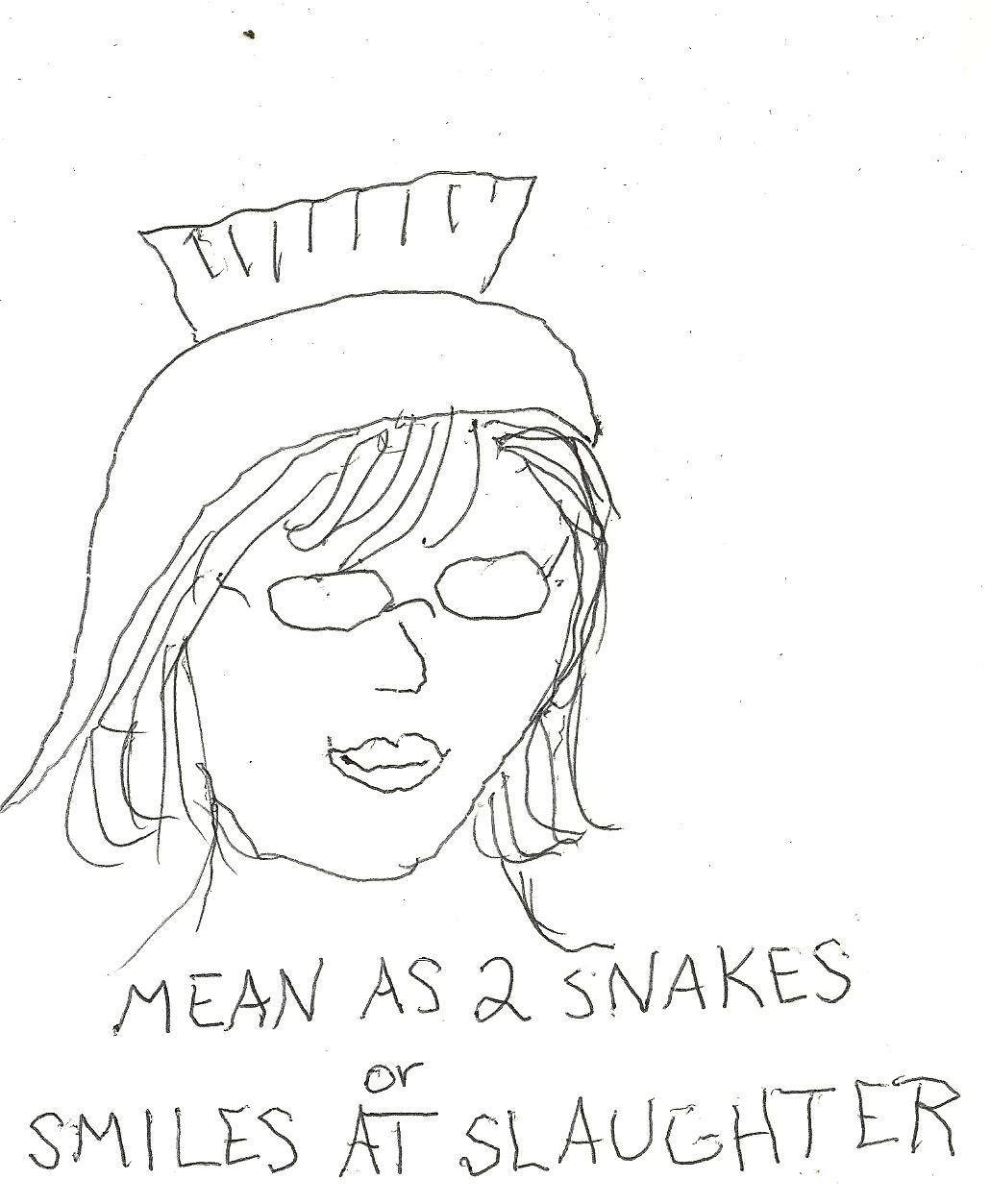
Later on I figured out that the helmet was actually Marvin the Martian’s.
So that’s the story, and now you’ve had a good laugh.
But watch out. I really am Mean as 2 Snakes.
The other day my husband came to me, despondent about his photography. “I don’t know what I can shoot that hasn’t already been done by someone else.”
Over the past couple of years, Dan has become a pretty decent nature photographer. He’s developed his eye, learned about S-curves and the two-thirds rule, and considers background and foreground more. When he first started, I would tinker with the contrast and saturation and shadows, but now all I have to do is maybe crop them a little. Sometimes not even that.
Here are a few of his photos. 


I liked them so much that I made them into a slide show for my screen saver. He was surprised and touched.
Then I decided to share them with friends and family. I had 15 calendars manufactured featuring the photos and sent them out as holiday gifts. They were a hit. A stranger saw one at the packing/shipping store and asked if he could buy one.
Then Dan started angsting about having no worlds left to conquer and I had to give him a pep talk. It’s the same with writers, I told him. There are only six plots in the world (around that number, anyway) and literature continues to happen. I told him that yes, every flower has been photographed by someone, but not by him, with his own unique sensibility.
And I suggested that if he was tired of doing flowers, he could start capturing other things that interest him, like textures and patterns. I showed him a few examples of similar photos that a friend had taken and reminded him that an artist friend liked to experiment with patterns of light and shadow.
(I did all this instead of snapping at him that if he really wanted something to worry about, he should look at our bank balance.)
So here’s what he came up with.
and

and even this.

I think there are many more worlds for him to explore and conquer. If he can get past the Photo Performance Anxiety.
 But I Digress . . .