Tag Archives: husband

Kiffles and Kugel, Facebook and Google

Dan was trying to remember the name of the holiday cookies he and his mother liked so much, but neither of them could recall it. “We used to have them at Uncle Rudy’s house,” Dan said. But no bells rang. Uncle Rudy was no longer available to provide any suggestions.

“What were they like?” I asked.

“They were rolled up and had walnuts in them.”

“Sounds a lot like rugelach,” I said. Strictly speaking, rugelach don’t have to be made with walnuts. They can have jam or other fillings inside. Along with hamentaschen, they’re a staple of Jewish baked goods. Dan had some Jewish relatives, so it seemed a good place to start the search.

“I think it began with a ‘k,'” he said.  “Maybe kugels?”

“No,” I said. “Kugel is a baked noodle dish. It’s not remotely like a cookie.”

So, as with most modern problems, we turned to Google. (At least it rhymes with kugel.) In fairly short order we found that the cookies in question were kiffles, and their origin was Hungarian. We found a recipe that sounded reasonably simple on Allrecipes.com.

https://www.allrecipes.com/recipe/235921/hungarian-kiffles/

I decided to check it out with a Hungarian friend to see if the recipe was authentic.  He said he didn’t remember them from childhood, but he added, “You had me at ‘a pound of butter.'” (Actually, they had me at “a pound of cream cheese.” The recipe made 36 cookies. It was clear that this was not a heart-healthy recipe, but what holiday baked goods are, really?)

Well, I suppose you can write the ending to this one. There is now half a batch of kiffle dough resting overnight in our fridge. Tomorrow we bake! And evaluate. And tweak if necessary for a second batch.

But the kiffle saga had me thinking. What other cookies or treats did people have in their childhood or from their heritage that they could no longer get or could barely remember? Naturally, this time I turned to Facebook. A quick post brought some interesting answers. And a lot of warm memories.

Jean remembered a cookie called Springerlies and thought they were Italian. “Mom’s friend made them. They were a real treat when we got them.”  Gwen replied that Springerlies are German, though most likely multicultural. “A friend spends days making them and other German cookies every year,” she said. “Awesome cookies!”

So here for you, Jean and Gwen, is a recipe:

https://www.allrecipes.com/recipe/9922/springerle-i/

Trish voted for Spritz cookies. “My mom used to make them, I think my Nana did too. I don’t have a recipe….” Well Trish, now you do! The recipe comes straight from Gold Medal Flour, so it ought to be authentic.

http://www.goldmedalflour.com/recipes/classic-spritz-cookies/ccd9d7f3-6075-4593-be61-7b0aeb02bc88

Lisa remembered, “My mom used to make these cookies called Spice of Life. They were a soft, dark molasses cookie, rolled in sugar. She’s lost the recipe, unfortunately, and I haven’t been able to recreate it.” Here you go, Lisa. This recipe actually appeared in a murder mystery by Diane Mott Davidson. It sounds fantastic! You had me at molasses and spices.

http://recipecircus.com/recipes/Stella/COOKIES/Spice-of-Life_Cookies.html

Jane’s favorite was date nut cookies.  They involved sweet dough, covered with dates and nuts, rolled like a jelly roll, sliced, and baked. “People are not into dates anymore, although about five years ago I saw the very same recipe in a magazine, and couldn’t believe it.” She also mentioned pizelles, very thin butter cookies, covered in powdered sugar. “They sell them in fancy shops, but you can make them pretty easily,” she added. They do require a special machine to make, which I’m guessing costs a packet at Williams Sonoma.

Melissa, whose background is Swiss-German, mentioned Mailänderli, Spitzbuebe, Basler Läckerli, and Züri Tirggel. “No one is ever going to make them like my grandmother did, and no place is ever going to be as comfortable as the chair in the tiny spot between the radiator and the kitchen table.” She’s been experimenting with recreating two of the cookies, but says she hasn’t got the texture quite right yet. Here’s a recipe for the Basler Läckerli:

https://www.epicurious.com/recipes/member/views/basler-leckerli-566387f7424bb12207dbef07

Gwen also told about a holiday cake – makowiac, or poppyseed roll, with filling 1/2″ thick. She says she has her grandmom’s recipe, but that it’s labor intensive. (I looked at a recipe and is she ever right!) Gwen ordered one from a specialty bakery and is hoping it lives up to the legendary dessert of memory.

Peggy said that her mom didn’t make cookies, instead making fudge and peanut butter balls for teacher gifts. Robbin makes rum balls that can knock you on your ass.

Other friends fondly remembered treats that are not uncommon nowadays but don’t always live up to memories. Michael mentioned Toll House cookies – the chewy kind. (I’m with him on that.) And Wendy was fond of Scooter Pies – Moon Pies, readily available, just aren’t the same, she says.

It was fun hearing the stories and chasing down recipes. To all my friends I wish fond memories and a lovely, treat-filled holiday! You’ve made mine a little bit sweeter.

Off-Duty Santa

My husband looks a lot like Jerry Garcia, at least in his “Touch of Grey” phase. Someone once said that if he were darker, he would look like Frederick Douglass. But most of the time, he gets mistaken for Santa Claus – even if it’s summer and he’s wearing his tie-dye shirt. Kids these days don’t know from Jerry Garcia.

Even without the red suit, Dan is perfectly Claus-esque. He has the white hair and beard, the red cheeks, the girth. I won’t compare it to a bowl of jelly, but it would shake when he laughs if he weren’t holding in his stomach.

Children recognize him everywhere he goes and react accordingly. Just yesterday we were sitting in a doctor’s waiting room and were facing the glass-paneled door to the hallway. Suddenly a little boy’s face with saucer-sized eyes appeared in one of the panes. He darted away and came back with his older brother. While they were staring and ducking, a younger sister appeared. Brave and uninhibited, she waved and blew kisses and tried to work the latch that opened the door. She banged on the glass panel and waved for all she was worth, while her brothers were content to play peek-and-hide. Everyone in the waiting room was enchanted, including us.

However, with great power comes great responsibility and Dan always uses his Santa powers for good. Once at a highway rest stop, he saw – and heard – a toddler screaming incessantly at the top of his small but surprisingly energetic lungs. He walked over to the child and said, “If you don’t calm down, I’ll have to put you on the naughty list.” The screaming stopped immediately and the mother silently mouthed “Thank you.” A job well done.

Although when it first happened Dan was annoyed, he has since become used to and often enjoys his year-round Christmas magic. Upon meeting two young boys in a restaurant (their mother asked permission first) the kids came up to him to verify that he was, indeed, Mr. Claus, who was apparently slumming at a diner during his off hours.

The boys asserted that they had been very good all year. Dan turned a stern if twinkling eye on them. “You could be a bit nicer to your little brother,” he told the elder. “And you could try a little harder in school,” he advised the younger. “We will, Santa! We will,” they promised. “Okay,” he said. “Now both of you do what your mother says!” as he strolled out of sight.

Being a random Santa actually suits Dan better than being a professional Santa. I understand that the gig pays well, but you can’t get one at a large store or mall without the proper credentials. Those red velvet suits are expensive. And so is professional Santa school, if you can find one in your area. Besides, all the fun might be taken out of it if it were a regular though seasonal job. There would be tragic kids – bring my father back, make my mother well. Dan’s an old softie, but there isn’t much to say to that. And there’d still be the everyday difficulties of dealing with terrified children, peeing children, and children who ask for a Lamborghini. A real one, not a model.

Besides, I’d make a terrible Mrs. Claus. I look ghastly in red.


The Tender-Hearted Carnivore

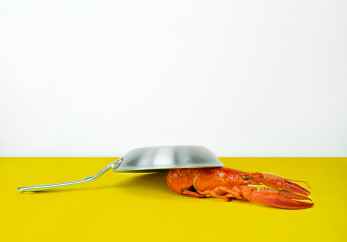
gray steel cooking pan near orange lobster

My husband is a carnivore, or actually an omnivore, like the bear that he resembles. But if he tried to live like a bear, he would never survive. He’s just too sensitive about what he eats.

He’s not a member of PETA, but he has certain qualities in common with them. He won’t eat veal or goose liver because he objects to the conditions in which the animals are raised – closely confined and force-fed. It’s no life for an animal, he says. Neither is being slaughtered, sauteed, and served for supper, for that matter, but let’s leave that aside for the moment. I can sympathize with his position.

When he’s forced to participate in said slaughter, he’s even more uncomfortable. My mother was raised in the country and delighted in fishing. She also delighted in frying and eating her catch. Dan can tolerate fishing if it’s catch-and-release (though just barely). And he would refrain from commenting when my mother served up her self-caught delights. But on the way home, he would look positively morose.

He had an even more extreme reaction when we were on a sailing vacation off the coast of Maine. We anchored at a tiny, uninhabited island and the ship’s cook started a fire.  A huge pot of seawater and seaweed sat ominously nearby. So did a container of live lobsters.

Now, Dan doesn’t even like to watch live lobsters being prepared on television. He began referring to Emeril Lagasse as “the Evil Cook” when he saw the TV chef throw live crayfish into a hot skillet and laugh about it.  If I’m watching a cooking show, I have to tell him to cover his eyes whenever a live crustacean is going to be sacrificed.

Anyway, when the cook in Maine got ready to drop the lobsters in the pot, Dan took a melancholy walk around the island. Mind you, when he returned and found the lobsters bright red and safely dead, he devoured three of them, banging their bodies against rocks to get them open, proper lobster-cracking tools not having been provided. Lobster juice ran down his face into his beard. He wasn’t squeamish about that.

I began to think he was carrying his sensitivity too far, however, when he started objecting to barbecue restaurants whose signs featured happy pigs serving up platters of ribs. “They’re showing smiling pigs serving themselves up to be devoured,” he asserted. No amount of reassurance that the signs were merely illustrations could suppress his uneasiness. It was the principle of the thing.

When I totally lost sympathy for his obsession, though, was when he started objecting to TV commercials that showed cereal squares eating other cereal squares (and licking their nonexistent lips). He objected to the cannibalistic element, which he found offensive.

“They’re cereal,” I pointed out. “And they’re animated. No grain suffered in the production of the cereal. Nothing alive was harmed in the production of the commercial.” It didn’t matter.

“They’re presented as sentient,” he said, “and they’re eating their own kind.”

Well, there’s really no way to argue with that, so I just roll my eyes and don’t even try.

Oddly, Dan loves movies and shows about mountain men who hunt and forage for their food under harsh, primitive conditions. He doesn’t like it when the animals get their paws caught in traps and suffer because of it, but he suddenly doesn’t object to the killing of a sentient being and the subsequent devouring of it.

Despite his affinity with mountain men, I try to point out that he would be lousy at it. “Not if I was hungry enough,” he replies. “Then I could do it.” He’s eaten venison, but personally, I can’t picture him shooting, skinning, and butchering a deer. He might have to become a vegetarian at that point and his career as a mountain man would be over.

Until a moose was magically transformed into moose steaks and presented to him wrapped in styrofoam and plastic at the local grocery, I doubt he’d survive.

Getting Closer to a Real Book

book chapter six
Photo by Kaboompics.com on Pexels.com

I’ve written before about publishing a book and how amazing it feels to get a response to a query from a publisher, a request for a complete manuscript, and an author contract.

There are even more joys to come, big things that make your book more and more real and smaller things that make you grin. Here are some of mine.

Being assigned an editor. Another person is now actually working on your book, helping to make it into something real and better.

Working with said editor. I’ve been an editor myself and know what it is like. It can be a game like chess by mail (or email, in this case). Your editor – in my case Aaron Smith from Eliezer Tristan Publishing – sends you a tracked manuscript with suggested changes and you accept them or not.

For my book, the great majority of editorial changes were right on, particularly in the matter of punctuation. I have a tendency to overuse commas, parens, and dashes. These are things that feel like my natural voice in writing but aren’t necessary or even correct. Aaron also helped me see where my writing needed to be fleshed out and where links to other sites were superfluous. Only one round of back-and-forth was needed before we both were satisfied.

Getting an ISBN number and barcode. If you’ve ever looked at the back of a real book, one you’ve bought at a store, you’ll notice the ISBN number and the barcode. The barcode, of course, allows someone to know the price and pay for the book. The ISBN number is what tells you you’re got a real book. Here’s an explanation from the International ISBN Agency: “An ISBN is essentially a product identifier used by publishers, booksellers, libraries, internet retailers and other supply chain participants for ordering, listing, sales records and stock control purposes. The ISBN identifies the registrant as well as the specific title, edition and format.” A real book!

The cover process. I understand that with large book publishers you simply take what you are given. My small, indie publisher, however, sent me a copy of what they came up with and allowed me to comment on it. It’s nice to be asked. They even gave me a do-over and a new designer when I didn’t like the first version.

The galleys. Or in this case, a copy of the documents laid out in spreads, like the open pages of the book it will be. I reminded the publisher that I wanted a dedication to my husband, suggested a way to make the table of contents a bit clearer, and pointed out when one essay title was in the wrong font. I don’t know if there will be final galleys after this, but if there are, I will read them thoroughly and promptly.

The bound books. I am not yet up to the point of this ultimate thrill, but I anticipate it with great incipient glee. When the box of 25 books arrives on my doorstep, I will, after my husband picks it up and brings it inside, rip it open, make high-pitched sounds of delight, and insist that many photos be taken of me posing with the books and in my Eliezer Tristan Publishing t-shirt and signing a book for Dan.

Then I will get to decide who gets an autographed copy and who has to wait for it to come to a bookstore near them.

The launch party. This is still theoretical at the moment, as I can’t afford to throw an actual party. Perhaps a local bookstore or library will let me do a reading and I can call that a launch party. Or maybe my friend Tom, who does online concerts, can coach me through an online launch.

The t-shirt. Completely optional. But my husband has said that he will take an image of the cover and have it printed on a t-shirt for us both to wear. Maybe we can call it advertising and take it off our taxes.

Then I can get to the really important stuff – promoting my book and selling it, which the publishers will also be doing. It takes a real book to be able to do that.

The Great Meal Kit Experiment

We have had trouble with our meals.  Well, that’s not quite true. We’ve had trouble with our grocery budget. Actually, both those things are true.


The first part of the problem is shopping. My husband works in a store that sells, among other things, groceries. And he just can’t resist meats which, while on special, are still so expensive I’m tempted to take out a meat loan to get them. Plus, he’s unable to resist the Manager’s Special, Close-Out, and Day Old tables.

That might seem like frugal shopping, but it results in a variety of bizarre foods that we would never otherwise have purchased. Vanilla butter. Bourbon-apple salsa. Snacks that taste like sesame-flavored cardboard. And the “reduced” prices don’t mean they’re cheap. You should have seen the price tags the week the store cleared out the “Imported from Italy” section. Imported pesto isn’t cheap, let me tell you.

Our next problem is waste. We waste a lot of food. Our refrigerator is so unreliable that it regularly freezes any produce we buy and turns it into unidentifiable slimy green goo. This is good neither for our budget nor for our appetites. We are reduced to buying prepared deli salads – which are hideously expensive but can be eaten the same day – or getting bags of cole slaw mix that are hideously expensive but can be eaten with my special slaw dressing (mayonnaise and pickle juice) which my husband loves. That we devour in a day or two. Frozen peas and corn and canned tomatoes are the most vegetable-like things we can keep on hand. And sometime V-8 juice.

Anyway, our food expenditures are outrageous. I’ve tried setting a budget, but my husband does the shopping and is unable to understand the concept. I’ve tried splitting the shopping with him, but every night when he gets off work he picks up a few more (or even more) items that he seems psychologically unable to resist.

So, in the hope of reducing both the amount we spend and the amount we waste, I have decided to try an experiment. Those meal kits we hear so much about on TV and online promise solutions to budget, preparation, shopping, and variety of meals. They are said to provide good nutrition, reduce waste, and be ever so yummy.

So each week for the next six weeks, I am ordering one of those yuppie, home-delivered meal kits. I am taking advantage of special promotional deals, as there is no way that paying the full price would produce any actual savings. I am not receiving any freebies or reduced prices by promising to blog about any of them.

The services I have chosen for this experiment are:

Home Chef

Blue Apron

Hello Fresh

EveryPlate

SunBasket

and Dinnerly.

Each week will receive three recipes and sets of appropriate ingredients for the making thereof. My husband is dubious of this experiment, as he claims (rightly) that the portion sizes they will deliver will not match the portion sizes of meals that he prepares. I try to point out that this is not necessarily a bad thing and that we can always supplement with appetizers, yogurt, pretzels, or popcorn should we feel unsatisfied.

I am trying to select a range of meals that will be filling yet different from our usual fare, involving ingredients we don’t usually have on hand and international cuisines we don’t make at home.

For the rest of the meals for the week, hubby can shop for whatever he chooses, though I fervently hope he will stick to staples like chicken, ground beef, fish, rice, beans, canned tomatoes, mushrooms, frozen vegetables, potatoes, pasta, eggs, bread, and the like. He makes an awesome frittata, an amazing shepherd’s pie, and a killer deconstructed mac-n-cheeseburger.

At the end of this experiment, I will report back on the results. My goals are variety in cuisine, reduced waste, lower grocery bills, and fewer odd ingredients that go with nothing else.

Our first delivery is arriving on our doorstep Tuesday.

Wish us luck.

Burn Down the “She Shed”!

photo of bonfire
Photo by Jason Villanueva on Pexels.com

At first it sounded like a good idea: a dedicated space where a woman could pursue her interests. Kind of like a Man Cave, but with curtains and flowers.

You’d think that as a writer, I’d love a She Shed where I could create and recreate to my heart’s content. Maybe have a friend over for a glass of wine or some tea and cookies.  But the more I thought about it, though, the more I kept asking myself: Do I really want a First-World, savings-sucking, sexually segregated hut that smells like mulch and motor oil to pursue my dreams in? I think not. And here’s why.

The She Shed Is Elitist

The only people who can have She Sheds are those who live in suburban or rural areas and own at least a quarter-acre of ground. Just imagine living in a three-room apartment in an urban center and asking the landlord if you can build a She Shed on the roof. It seems to me that the woman in that situation is the one who needs a She Shed the most.

Of course, this is true of the Man Cave as well. Small apartments just don’t have a garage or a spare room to devote to manly pursuits (whatever they may be).

The She Shed Is Expensive

You can certainly build a She Shed from scratch, but even the materials are pricey. The smallest pre-fab DIY shed kit I’ve seen runs over $1000. And that’s without furnishings, paint, amenities, and whatever equipment you need to pursue your hobbies or dreams.

The Man Cave is expensive too, with all those super-sized televisions, kegerators or mini-fridges, billiard tables, recliners, work-out equipment, and possibly power tools.

The She Shed Is Impractical

Many of the articles I’ve seen recommend repurposing an old shed you already have – say, a lawnmower shed – for your dream woman-friendly den. Never mind that most existing sheds either already serve a function (say, lawnmower storage), they are also too small for all the necessities and frills that Pinterest tells us are part of a proper She Shed. A potting shed, maybe – but who has a potting shed that they’re not using for actually potting? Or is that supposed to be the woman’s fun and fulfilling activity? If so, why build another shed for it?

Besides, tool sheds and potting sheds lack many of the necessaries for a properly inviting environment – electricity, say, for the writer’s computer or the reader’s lights, or even running water. Just to go to the bathroom, a woman must leave her She Shed, troop back into the “real” house and avail herself of the plumbing, then reverse the process. Unless, of course, there is another shed-like building outside – the kind with a crescent moon carved on the door.

Man Caves have the advantage here, since they’re usually located in an “unused” room or a garage, which usually have all the modern conveniences built in or within easy reach.

The She Shed Is Sexist

Which bring us to another point. Why should a man get to take over an entire room of a house, while a woman is relegated to an outside structure, which has the feeling of a children’s playhouse (not to say doghouse)? The house is hers too. Doesn’t she have as much right to that den or garage as anyone? A couple could also share that den, spending alternate days in it and leaving it empty one day a week.

Man Caves are sexist too. They imply that women are so awful or annoying that men must have a place where they can be alone or with other men. That a woman, if not forbidden to decorate a room, will fill it up with frou-frou furnishings and paint colors like daquoise and saffron and elderberry. That no woman enjoys sports and beer. That men are such boors that no one but other men can stand to be around them. It insults both sexes, which in its way is quasi-egalitarian, though not desirable.

The She Shed Is Ridiculous

We have a few sheds out by the driveway and around the side of the house. I suppose I could repurpose one of them into a writer’s retreat, except for the no-electricity thing and the trek to the bathroom thing. But these sheds are made by Rubbermaid. They have no windows for darling curtains or even fresh air. A person trapped inside would be overcome by a scent like the sole of a sneaker. Besides, they are full of lawn and gardening supplies, which means that if I took one over, we would need yet another shed. As far as I’m concerned, they’ve reproduced enough.

Besides, “She Shed”? The term is ridiculous. What do you keep in a shed? Gardening supplies. Chainsaws. Lawn tools. Cases of motor oil and washer fluid. Lumber. Chickens. Stuff you don’t know what else to do with.

“Man Cave” isn’t even alliterative like “She Shed.” At least call a woman’s retreat something dignified, like, well, a “Woman’s Retreat.” Personally, I call my study “My Study.” And my husband comes in regularly for conversation or to look up things on the computer. He doesn’t mind my collection of stuffed animals – he bought at least half of them for me. We write his appointments on my whiteboard along with my projects. And there’s a small TV and a sound system, plus iTunes on the computer.

And that’s what we do with our spare room. Make it inviting for both of us.

From Performance to the Pit

people at theater

Photo by Monica Silvestre on Pexels.com

Fiddler on the Roof is a good selection for a local theater group, with all its sentimental and well-known songs. But once when it was performed in my town, things didn’t go quite as planned.

My husband decided to join the cast and make use of his marvelous baritone for the first time in years. He said his one line (“It was a horse!”) clearly and at just the right time. He celebrated and fell off his barstool on cue and left Anatevka sorrowfully. He sang and danced in the chorus with gusto.

The only thing was, he played parts of his role a bit too convincingly. He fell off his stool, as required at a party scene, but he always landed so that half of his body stuck out past where the curtain fell. Since he wouldn’t break character, the other performers had to drag him back before they could reset for the next scene.

And he had trouble with the lyrics.

This was not a recent problem. He still thinks that CCR sang “There’s a bathroom on the right.” But with Fiddler, he was positively innovative. Sometimes, instead of “I Belong in Anatevka,” he sang, “I Belong Under Anesthesia.” Or “Anastasia,” which must have disrupted the chorus no end.

But the biggest problem was with his costume. Since it was a local amateur production, there was no budget for wardrobe. Everyone made do with what they had on hand. My husband had a pair of corduroy pants, some leather boots, and a baggy shirt that were deemed acceptable.

That left his glasses. Horn rims were not considered period. So he had to perform without vision correction for his extreme nearsightedness.

And so he acted and danced. There was a real danger when he danced; he hora’d his way not just past the curtain, but close to the edge of the stage. And closer. And closer. Another chorus member grabbed his sleeve and dragged him back, just before he landed unceremoniously but noisily right in the orchestra pit. That person was thereafter assigned to dance next to him, hold onto his sleeve, and drag him in the right direction if necessary. Likewise, someone had to guide him behind the scenes to make entrances from the other side of the stage so he didn’t wander into the parking lot.

It was actually quite a good production of the musical. At the end, when the townspeople left Anatevka, performers dressed as ghosts waved goodbye to them, which was a lovely touch. And no one, including Dan, was injured during the performance.

Afterward, at the cast party, Dan was singled out for particular recognition. He even received an award.

It read, “Best Portrayal of a Sighted Jew by a Blind Gentile.”

He had worked hard for it. He had earned it and he framed it. It still hangs on our wall. If he gets new glasses, maybe he can even read it.


How I Learned I Was a Cat Person

cat-pet-furry-face-162319.jpegI looked around at the rooms full of cats. Black cats, white cats, orange cats, gray cats. Cats sleeping, playing, hiding. But I wasn’t a cat person. Or was I?

When I was a kid, we never had cats – only dogs. Back in those days, dogs didn’t live in the house but also weren’t allowed to run loose. So they usually had a length of chain or a fenced yard to circumscribe their limits. Only tiny fluff-dogs such as Pomeranians had the run of the house. My mom, it turned out later, liked little fluff-dogs, but my dad didn’t. So our dogs, first Blackie then Bootsie, lived in the garage, with a chain to run on.

I never really bonded with either one. Another thing that was uncommon back then was dog obedience school, so when I went out to feed the dog, he would jump all over me with muddy paws. And when he got to ride in the car for long weekends away, he would drool, track mud on the towel we laid down for him, and vomit (until we learned to give him half a Dramamine before we started).

I longed for a cuddly pet and one that I could call my own. My next pet was a rabbit, which I named Christina, the most beautiful name I could think of. This was also in the days before rabbits became indoor pets, so Christina lived in a wood and chicken-wire cage, in the yard in summer and in the garage in winter. No real opportunities for cuddling or bonding.

So it went. No pets in my college dorm. No pets in the apartment complex where I lived after I graduated. But I began to think more and more that what I needed was a cat. My father had hated cats because one had once bit his mother. Perhaps it was time for generations of antipathy to stop.

At last I got an apartment which was four rooms on the second floor of a house. I asked the landlady if I could have a cat – just one – and was given permission (if unenthusiastically).

The obvious place to find a cat was at the local Society for the Improvement of Conditions for Stray Animals (SICSA). And the obvious person to bring along to help me was my fiancé.

SICSA had rooms full of cats (and other rooms full of dogs). Some were in individual cages and others shared larger rooms with other cats. I thought I might want a calico cat as I found them the most attractive, but there were none at the shelter that day. There were, however, a few tortoiseshell cats.

Tortoiseshells are a variety of calico with mostly black fur, mottled with some orange, thanks to the same genetic arrangement that causes the distinctive calico pattern. Some people find them unattractive, but I was drawn to a little tortie. She was shy and quiet and gentle, the opposite of the dogs my family had had.

But there were other cats that attracted me too, to the point that I was overwhelmed. “Which cat do you think I should get?” I asked my fiancé.

“I don’t know, honey. They’re all nice cats,” he replied, proving that I had indeed chosen the right man to marry.

I took the little tortie home and called her Bijou. (Her nametag said, “Bejeau,” but I assumed it was a typo.)  She spent the first night sleeping across my throat. She was otherwise so shy that she didn’t want to be picked up. But every day when I came home from work, I picked her up and gave her a kiss and set her back down. Eventually, she gained enough confidence to sit with me on the sofa and watch the Today Show and for me to carry her around.

Ever since, I have had up to five cats at a time, and almost always a calico or a tortie – or both – among them. Bijou, Anjou, Julia, Laurel, Louise, and Dushenka have fulfilled my need for a calico or tortie to call my own. Not that I haven’t loved the orange tabbies and gray tabbies that my husband favors and the tuxedo cat, the gray, and the black-and-white spotted cat we’ve also lived with.

But the calicos and torties hold a special place in my heart. They taught me that cats were what I really needed.

Weird Food Faves and Fails

I admire adventurous cooks. Especially ones who make something out of what’s already in the house instead of going to the store for a double rack or ribs, which requires taking out a meat loan. If it’s in the fridge, freezer, or pantry, it’s fair game. Unless it’s game in the pantry, in which case you have bigger problems than what to eat.

People who cook this way inspired me and my husband to start cooking again after a long spell of frozen, pre-cooked Useless People Meals™. Tom and Leslie had a dish called “Experimental Chicken,” which, as you can probably guess, never came out the same way twice. It did, however, have a consistent theory – chicken, salt, pepper, garlic, and some kind of sauce. Any kind of sauce. Chili. Thai. Mexican. Indian. Martian. (They are both science fiction fans.)

My husband and I were inspired. Our dishes were not just experiments; at times they seemed straight out of a mad scientist’s lab. The trend was encouraged by the fact that my husband likes the one-of-a-kind and slight-irregulars tables at the stores where he shops. He’ll bring home a “unique” ingredient and then try to build a dish around it.

For example, he recently brought home spaghetti sauce in two flavors: regular and chipotle. The only problem was, the sauces weren’t tomato-based. They used pumpkin as the main ingredient. And he decided to try them out not with regular spaghetti, but with spaghetti squash.

Now, I’m not a big fan of spaghetti squash, which I find watery and tasteless. And the pumpkin sauces looked, shall we say, dubious. I instantly knew why they had appeared on the “Manager’s Special” table. But there they were, so in the interest of science and encourage culinary courage, I agreed to try it.

Given the bland nature of spaghetti squash, I picked the pumpkin-chipotle sauce to go with it. We figured out how to solve the wet-noodle problem thanks to Google, which has replaced cookbooks in our kitchen. And Dan decided to add some bite-sized chunks of leftover pork chop because he feels that every meal should contain meat, unless he has to kill it himself.

The first forkful was not inspiring. It was definitely pumpkiny, with a brief finish of chipotle on the back of the tongue. The more we ate of it, the less odd it seemed to get. The result was what I like to call a “Work in Progress” – something that’s survivable but needs either tweaking or a major overhaul before it enters our regular repertoire. I still hope the manager never finds that sauce “special” again, though.

Another one-of-a-kind item that appeared in the grocery bag was apple-bourbon salsa. It struck me as an awful combination for salsa, though I do enjoy peach or mango salsa. But, valiantly, I dipped in a chip and made a discovery. “This is horrible salsa,” I said. It reminded me of all those weird new alcoholic drinks like cranapple schnapps and birthday cake tequila and whatever that liqueur is that comes in a bottle that looks like Oil of Olay.

“But,” I added, “it tastes like pretty good barbecue sauce.” We tried it out on a handy pork loin that had survived in our freezer, and declared it delicious. Now I wish we could find another jar of it.

Our best culinary invention came when my husband, disappointed by a frozen cheeseburger mac that contained only ground meat, macaroni, and cheese, declared, “We can do better than this!”

Our new, improved version included those basics, plus garlic, diced onion, diced tomatoes with green chiles, and diced dill pickles. And way too much cheese – our theory is that everything should come with way too much cheese. Occasionally we add mushrooms or bacon if some happens to be around.

But the ingredient that really makes the dish – and makes it taste like a real cheeseburger – is a drizzle of ketchup over the top. As over the top (sorry, not sorry) as that may sound, it brings the whole dish together. Even I, ketchup lover that I am, had my doubts, but once I tried it I loved it and we have never made this one-skillet meal without it since.

Unfortunately, not every experimental dish goes that well. A man I once knew had a “signature dish” that he regularly made. It started innocently enough, with ground beef and rice in a stew pot. Then it started to get weird. Knorr instant split-pea soup was the next ingredient. After that all cooked together to a porridge-y consistency, at the last moment before serving, he added pineapple chunks “for the contrast in flavor, texture, and temperature.”

And that wasn’t even the worst of it. He made huge batches of it and kept adding things as the days went by. The most, uh, memorable addition was leftover Chinese food. The actual “recipe” has not survived, and neither did the relationship.

The porridge may not have actually ended the romance, but it’s surely no accident that I ended up with a man who at least understands the concept of flavor profiles, even if he does shop from the quick-sale table.

For “Me Too” Women and “Not Me” Men

The “Me Too” campaign, in response to all the accusations, admissions, apologies, non-apologies, and political maneuvering, has had enormous effects. Women everywhere are opening up and sharing their stories of microagressions, unwanted attentions, assaults, and rape that many of them have never spoken of before. Most of the attention has gone to politicians and media figures, but the problem goes right down to every level of society.

I’m one of the women who has “Me Too” stories.

  • When I was delivering a job to a client at his home, he tried to kiss me on the lips. And my boss made light of it, wheedling me into saying I wasn’t afraid (I wasn’t) and that I wasn’t offended (I was), and telling the client that I wasn’t bothered by it. I suppose it came in the category of unwanted attentions, though technically it may have been at least battery.
  • Then there was the time that a different boss sat on my lap, just to make me uncomfortable. (He did.)
  • Another boss went around the business comparing the size of female employees’ breasts, including who should be in the “Itty Bitty Titty Club.”
  • And there was the guy who expected sex even though I was newly engaged at the time (one for the road, as it were), then stormed off in a huff after the “No.” (I’m glad that’s all he did.)

But I also have plenty of other stories – of men who were decent, gentlemanly, and reasonable, men who had my back when I needed it, men who respected my autonomy.

I don’t want to get into the “Not All Men” debate, or the “Now I can’t even make a pass” furor. I was challenged by my friend Diana to think about the good men in my life and celebrate them. And that’s what I’m doing here.

Let’s start with my father. One clear memory I have is of when I went to buy my first new car and he came with me. He looked at the cars with me, gave me advice on their mechanical soundness, and shared his experience of various models. I picked out my car (a blue Chevette) and he went with me to the sales office. The salesman asked my dad if he would co-sign the loan with me. And my dad said, “No.” Firmly but politely.

This was back in the day when young single women found it hard to get credit for a major purchase, especially if there was a man around who might take up the slack. But my father said, “No.” He believed that, since I had a job and was living on my own, it was my responsibility to make my own financial decision – and take responsibility for fulfilling it myself. Was I upset that he left the transaction up to me and the car dealer? I was proud.

Then there were the friends, male and female, in line with me at a restaurant. I objected to the racist and sexist decorations. The host replied, “If they really bother you that much, you could leave.” Did I just imagine the sneer in his voice?

“You’re right,” I said, turning on my heel and marching off down the street. When I finally looked back, every one of those in my party were following me, including the men. They literally had my back.

Or the work friend, whom I joined in after-hours putt-putt golf matches and card games at his house. He was a notorious horndog, but he never made a move on me – until the day that we were driving around and he confessed that he was interested. “But you haven’t even kissed me yet,” I replied. Then he did, once I had given him the go-ahead.

There have been men who accepted a “No,” without getting mad, or whining about the “friend zone,” or making me feel like dirt. There was even one, a big, tough guy who accepted a “No” when the interaction had reached the point of “heavy petting,” and held no grudge.

There have been men who accepted a “Yes,” without gloating or bragging or taking it for granted.

And then there’s my husband. We met under peculiar circumstances, in which I was stranded in a town miles from home (by a man who ran off with another woman, never giving a thought as to how I’d get home). Dan lent me money, drove me to the bus station, and gave me a bag of dried apples for snacking during the trip.

Since that time he has had my back every minute, under every circumstance, supporting me when I needed it, backing off when I needed to handle something myself. He has loved me when I was unlovable, cooperated when I was uncooperative. He’s literally supported me when I couldn’t work, and not resented when I could work and made more than he did. We’ve had our disagreements, but he always listened to my side – and sometimes changed his mind because of it. All in all, he’s an unusual man.

So either I’ve met a lot of unusual men and only a few jerks, or there are decent, reasonable, polite, and understanding men out there who get no publicity. Because where’s the newsworthiness (or entertainment value) in saying, “When I knew so-and-so, he treated me like a person. And I appreciated it”?