Tag Archives: rant

Hungry Children: A One-Act Play

Sharing food with the needy

[Setting: The Halls of Power]

Guy in Suit: The media keep saying that there are hungry children in America.

Other Guy in Suit: Let them eat dinner.

Bleeding-Heart: That’s the problem. They don’t have dinner to eat. Or even breakfast sometimes.

GIS: We already give them lunch at school. That’s five days a week.

B-H: Unless they’re absent or on vacation or a snow day. Or if they can’t pay for it.

OGIS: Then it’s the parents’ problem.

GIS: Why do schoolchildren have so many vacations, anyway? We don’t get all those vacations.

B-H: Uh, yes you do.

GIS: Oh. Well, never mind that now. We were talking about tax cuts…uh, job creators…uh, feeding children. That was it.

OGIS: Suppose the media are right?

GIS: The media are never right unless we tell them what to say.

OGIS: Well, just suppose. For a minute. OK? The problem I see is that it looks good for us to feed poor, hungry, starving American children. By the way, are they as pitiful-looking as poor, starving foreign children?

GIS: Probably not. You were saying?

OGIS: If there are hungry children, and we do need to feed them, how are we supposed to do that without feeding the lousy, lazy, good-for-nothing moochers at the same time?

GIS: Ah, yes, the parents. If we give the parents anything, it should be one bag of rice and one bag of beans. And — hey — they could feed their kids that too.

B-H: But children need good nutrition — fruits and vegetables and vitamins and minerals, and enough to keep them full and healthy.

OGIS: Hey, we have plenty of minerals left over after fracking. Won’t those do?

B-H: No.

GIS: But if we give kids all that fancy food, what’s to keep the parents from eating it?

OGIS: Or selling it for booze or cigarettes or drugs?

GIS: Think about that! The drug dealers would be getting all the good nutrition. Then they could run faster from the police.

OGIS: We can’t have that, now can we?

B-H: But…the hungry children? Remember? Eating at most one meal a day, five days a week, when school is in session?

GIS: That’s plenty. I heard American children are obese, anyway. They could stand to lose a little weight.

[Curtain]

This post, which I wrote a number of years ago, became relevant again. I wish it would stop being relevant.

Foot Plus Mouth Equals Disaster!

In the comic strip “Peanuts,” Linus says that one should never discuss “politics, religion, or the Great Pumpkin.” That’s good advice, as far as it goes, but the list of things you shouldn’t discuss in public goes much further. In fact, erase that bit about “in public.” They’re dangerous to discuss among friends and family, too.

These days, politics is strictly off the table. You never know who has a concealed carry license. And Linus was certainly right that it’s best to avoid religion. When someone says, “Bless you,” the right answer is “thank you,” even if you’re not a believer. After all, they meant the religious equivalent of “Have a nice day.” (Or “gesundheit,” maybe. By the way, “Bless your heart” should be used with caution when you’re in the South. It can be a verbal middle finger. But I digress some more.)

Another topic to avoid is any that leads to a near-death experience. My husband, Dan, has blundered that way more than a few times. For example, when we were preparing for a party, I washed my hair, blow-dried it, used a curling iron, moussed, and sprayed. As I came down the stairs, Dan asked, “Are you going to do anything with your hair?”

And stay far, far away from talk of pregnancy. Suggesting that a woman is pregnant based on her weight, her clothes, or the way she waddles can be deeply offensive, particularly if she isn’t. In fact, one expert advises that you not comment on a woman’s potential pregnancy unless you actually see a baby emerging from her vagina at that moment. Better safe than hopelessly embarrassed. (I was a victim of this faux pas when I walked into an office looking for a job, wearing a loose denim jumper and a nice blouse. Admittedly, it may not have been the best choice for filling out an application, but the receptionist didn’t have to ask how far along I was. Later, she repeated the story as an amusing anecdote, not realizing that I was in the room and was embarrassed all over again. But I continue digressing.)

Everyone knows by now not to comment on a woman’s anatomy on pain of getting fired or a punch in the mouth. Not even when you’re trying to make a joke. I once told an acquaintance that I wasn’t at a party “because I was home nursing a sick cat.” “Didn’t you get scratched about the breast?” he asked. He almost got scratched about the face.

Then there was the time a guy had two girlfriends and was invited to a wedding. I don’t think he clearly understood the concept of a plus-one. He suggested taking one lady to the ceremony and the other to the reception. He somehow survived the occasion with at least one of the relationships intact. How? I don’t know.

Speaking of weddings, one of Dan’s bigger faux pas was when he suggested that, since his family lived in Pennsylvania and mine lived in Ohio, we should have our wedding on the state line, to inconvenience both families equally. (He was serious. But I digress for the final time. I promise.)

Because you’re bound to offend or insult someone, somewhere, sometime, my best advice, no matter what you are about to blurt out, is to remember your mouth has a zipper. Use it!

AI Writing: Friend or Foe?

You may have heard that AI writing means the death of writing done by actual, live people. In a way that’s true, and in a way it isn’t. Let me explain.

Many—perhaps most—of the fiction books that you see for sale on Amazon and other outlets are AI-written and almost universally bad. Rotten, really. So bad that you want to throw them against the wall. (Unless you have a Kindle, Nook, or other e-reader, of course. Then you only want to delete them. But I digress.) They are too short, too filled with adjectives and adverbs, too lacking in a coherent plot, and too deficient in character development. Even the most potentially vivid genres are bland.

You may say to yourself, “I could write a better novel than this turnip.” And you very likely could. (So why don’t you?)

But AI has taken over most of the writing space. Even books that you yourself don’t write aren’t written by a human being. (I should know. I often freelance for a ghostwriting service that shall remain nameless because of the NDA I signed. They used to have lots of us human beings doing the writing. Now they largely have “writing packages” produced by AI. The only time a human being touches the book is to supervise the AI engine, which sometimes goes madly astray, and to “humanize” the results (it’s known in the trade as “polishing dogshit into gold”). But I digress again. At length.)

That’s the bad side of AI writing. What, I hear you ask, is the good side?

It can make you a better writer.

Hear me out.

Let’s think about the most basic AI writing tool that almost everyone is familiar with: Grammarly. Yes, it follows along behind you and corrects what you’ve written when you’re typing too fast (like “isfamiliar”). And it always changes your word choice to “ducking.” It’s never “ducking.” But, if you pay attention to it, Grammarly is a teaching tool.

Grammarly sends you reports that list your most common mistakes that week (or month, I don’t remember). If it says you have problems with subject-verb agreement, brush up on that. If you have trouble remembering whether commas introduce an independent clause or a dependent one, look it up and try to remember it the next time you write.

Teachers worry that their students will use AI to write their papers for them. (One of my friends now has her students write out their essays longhand, like I did in the Victorian era. But I digress some more.) They may indeed rely on AI. (A survey of students found that they considered it cheating, however.) But there are many AI detectors available to teachers that sniff out suspiciously smelly AI-created sentences and paragraphs and report on how much of a piece of writing seems to be human or AI.

This, of course, has led to ways to avoid the AI detectors. One I saw recently offered a series of prompts a student could give the AI program in order to produce a piece of writing that would appear to be human-written. The list of things the sneaky student should tell the AI program to avoid was comprehensive and long.

It told students to create a prompt that specified not only the topic and tone of the illicit paper, but also to avoid common signs of AI content that the AI checkers teachers use frequently will flag.

The list of things to tell the AI to avoid included: sentences more than 20 words long without one clear idea and paragraphs all the same length; passive voice; abstractions instead of concrete words; sentences of all one length; a lack of measurable facts; suspect punctuation (semi-colons and em dashes) (I disagree with this stricture. I love semi-colons and em dashes, as if you hadn’t noticed. But I digress yet again.); overused words and phrases (an extensive list, including last but not least, cutting-edge, delve, game changer, nonetheless, despite, moist, subsequently, furthermore, utilize, leverage (and any other biz-speak or tech jargon)); adverbs and adjectives; hedging; more than one prepositional phrase or verb phrase; all-caps or numbered lists; and metaphors involving landscapes, music, or journeys. (I once asked ChatGPT to write some poetry, and it really overdid those metaphors. But I digress even more.)

In other words, if you know what to tell the AI not to do, you already know for yourself what not to do—or keep that list handy and refer to it often—you’ll be able to write your own sparkling prose without Robby the Robot’s assistance. And the process of learning to tell the AI how to write undetectably will improve your own writing.

If you think of AI as a way to learn instead of a way to cheat, you’ll do well.

The Comeback of Bullying

TW: suicide, violence

Some people have suggested lately that bullying is a good thing. This flies in the face of most people’s understanding of the effects of bullying and years of anti-bullying campaigns in schools.

We all think we know what bullying is, or at least that we know it when we see it. But what is bullying, really?

Bullying can be physical, verbal, or psychological, just like other forms of abuse. It can happen face-to-face or online. Online bullying is increasingly common and more difficult to deal with because much of it happens after school hours and because of the speed and vast reach of bullying speech or images.

Joanna Schroeder, a media critic and author, says that “the word ‘bullying’ often stands in for plain old bigotry or discrimination.” She notes that a slur for people with intellectual disabilities (the “R-word”) has been making a comeback.

The Anti-Bullying Alliance provides a succinct definition. Bullying, they say, consists of four characteristics:

• the hurting of one person or group by another person or group

• repetitive hurtful speech or behavior

• intentional behavior

• a real or perceived imbalance of power.

So, bullying is hurtful, repeated, and intentional behavior. That’s easy enough to understand. Let’s examine the last characteristic, the imbalance of power.

An imbalance of power in the workplace of a superior and a subordinate is a clear example. In schools, principals and teachers would be one example, and teachers and students would be another. But how does this play out in terms of student versus student? Where’s the power and the imbalance?

The imbalance of power can be obvious, such as that between the quarterback of the football team and the other players or the imbalance between a senior and a first-year student. A perceived imbalance can exist because of students who are larger in size, more athletic, neurotypical, physically unimpaired, or belonging to a majority racial or ethnic proportion of a school. They are perceived as having more power than those children who do not possess those qualities. And a clique of “mean girls” or a group of “rich kids” has the perceived superior power of popularity. Any of these imbalances can play into bullying. The Centers for Disease Control and Prevention has reported that higher rates of bullying are directed at girls, LGBTQ students, and teenagers with developmental disabilities.

In the case against bullying, we have seen accounts that some children who die by suicide have been subjected to extreme bullying and others who perpetrate mass shootings have, too. (There are often other factors that contribute to their deadly actions. Bullying is rarely the whole answer.) Deaths have occurred during incidents of college hazing of pledges or recruits by the senior members of organizations. Mental health professionals view bullying as too serious a problem to be considered a character-building exercise.

So, if it’s so harmful, why is bullying losing its bad reputation? Some people think that society has gone too far in “coddling” children and that they need to toughen up or be less sensitive. The world they will live in is often harsh, and children must grow into adults who are aware of that and able to handle it. In this increasingly popular view, sensitivity is for the weak, and only the tough will succeed. There is anecdotal evidence to support this view. We can all think of bullies who have succeeded in politics, business, entertainment, or the media.

“If I’d never got bullied, I don’t think I’d be where I am today,” said one TikTok influencer. “I don’t think I would have the motivation to prove people wrong.” He believes that bullying “is not as bad as it is made out to be.” He has said, however, that it’s “never OK to turn to physical violence or pick on people based on their race, religion or disabilities.” But he maintains that at least some kinds of bullying are not as harmful. One wonders what his definition of bullying is and what the Anti-Bullying Alliance would say about it.

Just as the self-esteem programs of the 1980s, so popular at first, drew increasing criticism as leading to “participation trophies” and the devaluing of personal accomplishment, the idea of bullying may be undergoing a redefinition as a response to “wokeness” being seen as “weak.” It remains to be seen if this opinion will spread to society at large rather than just the bullies we already have.

Quotations in this post first appeared in the Oct. 6, 2025 edition of the New York Times in an article by Callie Holtermann.

Down the Rabbit Hole

Almost five years ago, I wrote a post about how memories from my (and likely your) childhood were being repurposed for political statements and propaganda.

This time I’m writing about a classic piece of literature being rewritten for other purposes. (Largely unobjectionable ones, it’s true, but it’s the principle of the thing. But I digress.)

The work in question is Alice’s Adventures in Wonderland (more often known as Alice in Wonderland). It’s one of my favorite pieces of literature and I have returned to it many times since I first read it (murfle) decades ago.

(I have a friend who despises Alice. He finds it to be nonsense (which it obviously is) and incomprehensible. This despite the fact that he has returned to it frequently to see if it makes any more sense. (He ought to like at least part of it because he’s a mathematician, like the author, Lewis Carroll. I recommended The Annotated Alice (edited by Martin Gardner), which explains the jokes, Briticisms, and outdated expressions. (It also includes “Jabberwocky” in French, German, and IIRC, Latin.) But I digress, pedantically and at length.)

The “quotations” in question are not political but psychological or philosophical. I’m not saying they’re invalid—merely that they are misquoted, misattributed, or completely made up.

One of the most common misquotes is attributed to the Cheshire Cat:

“You’re mad, bonkers, off your head. But I’ll tell you a secret. All the best people are.”

What the Cheshire Cat actually really said is much more complex. Here’s the context:

“But I don’t want to go among mad people’” Alice remarked.

“Oh, you can’t help that,” said the Cat: “we’re all mad here. I’m mad. You’re mad.” 

“How do you know I’m mad?” said Alice.

“You must be,” said the Cat, “or you wouldn’t have come here.” 

One quotation supposedly from the Mad Hatter is:

The secret, Alice, is to surround yourself with people who make your heart smile. It’s then, only then, that you’ll find Wonderland.

Unobjectionable if sappy, but not from the book. The same with this one:

But, said Alice, if the world has absolutely no sense, who’s stopping us from inventing one?

The most annoying fake dialogue is this one, between Alice and the White Rabbit.

“Do you love me?” Alice asked.

“No, I don’t love you!” replied the White Rabbit.

Alice frowned and clasped her hands together as she did whenever she felt hurt.

“See?” replied the White Rabbit. “Now you’re going to start asking yourself what makes you so imperfect and what did you do wrong so that I can’t love you at least a little. You know, that’s why I can’t love you. You will not always be loved Alice, there will be days when others will be tired and bored with life, will have their heads in the clouds, and will hurt you. Because people are like that, they somehow always end up hurting each other’s feelings, whether through carelessness, misunderstanding, or conflicts with themselves. If you don’t love yourself, at least a little, if you don’t create an armor of self-love and happiness around your heart, the feeble annoyances caused by others will become lethal and will destroy you. The first time I saw you I made a pact with myself: ‘I will avoid loving you until you learn to love yourself.’”

The White Rabbit was late to play croquet with the Queen of Hearts. He wouldn’t have had time to discourse on self-love.

Alice has been in the public domain since 1907, so one can misquote or invent all they want. (The Disney movie version only came out in 1951, The book was in the public domain, but the movie isn’t. I think we can expect a live-action film. I hope they lose the repellent pink-and-purple Cheshire Cat, though I doubt they will. But I digress again.)

Surely no one would do this kind of thing to The Wizard of Oz…or would they? [squints suspiciously]

The Good, the Bad, and the Others

The Wicked Witch used to be a villain. She tried to kill Dorothy and her companions. She enslaved flying monkeys. She wanted revenge for her sister’s accidental death.

Now she has her own musical and movie.

The elevation of villains is a thing now. Personally, I blame Star Wars. I was once visiting some friends who had a young son. He held up his Darth Vader action figure and said, “This is my friend.” (This was in the days before the proliferation of Star Wars movies culminated in Vader’s redemption at the last possible second. But I digress.)

My theory is that villains have power but few limits. It’s no wonder youngsters view them as positive influences. When Darth Vader is your friend and protector, you share in his power. You fear nothing.

Maybe this rise of the villain started with the rise of the anti-hero. Let me explain. And let me use Buffy the Vampire Slayer (one of my favorite TV classics) as my vehicle. (Actually, I’m going to do it whether you let me or not. So there. But I digress some more.)

Here’s the backstory, for those not familiar with the Buffyverse. Buffy’s first love was the vampire-with-a-soul Angel, and he was a Byronic hero, a type that became popular when Byron (duh) was writing poetry. Byronic heroes are tortured souls who waft around in black clothes and clouds of pain. They’re never cheerful. They don’t crack jokes. They suffer from existential angst. They have troubled pasts and isolate themselves from society. (Other Byronic heroes include Batman holed up in his Batcave, grieving over his dead parents. The Brontes knew their Byronic heroes, too. Mr. Rochester and Heathcliff are classics. But I digress yet again.)

In opposition to the Byronic hero, we have the anti-hero. They don’t behave according to the heroic model. They’re “bad boys” who manage to dominate the plot and achieve their goals despite being misunderstood or refusing to follow convention. Think Han Solo, Captain Jack Sparrow, or in the case of Buffy, Spike. He’s never going to be Buffy’s Great Love, but he has his uses in her world. (Deadpool and Robin Hood are two other examples who would never have a beer together but occupy similar literary spaces. I suppose Dexter would be the ultimate anti-hero. Still more digression.)

No, wait. Satan is the ultimate anti-hero. Take a look at Milton’s Paradise Lost. Lucifer has agency and is the more interesting character. At some level, the reader roots for him. They know God’s going to win. That’s a given. But Satan’s quest, while reprehensible, is also on some level noble. (I’m talking literary characters here, not theology. But I digress again. And as Jean Kerr said, in reference to the story of Adam and Eve, the snake has all the lines. But I continue digressing.)

So, what makes the bad guys more interesting guys? For one thing, they’re deeply misunderstood. They’ve often been victims of bullies or of an uncaring, unfair society. They touch the darkness, the “shadow self” that lives within each of us. We recognize ourselves in them, identify with them in ways we simply don’t with standard heroes. We’d like to identify with heroes, but we know they’re better than we are.

Standard heroes require supervillains to make them at all interesting. Without Lex Luthor, Superman just flies around foiling ordinary bank robbers. Without Moriarty, Sherlock Holmes is simply Columbo. (I could say that without elusive diagnoses and the looming specter of death, House is basically Doogie Howser, but I won’t. That would be ridiculous. There’s also misanthropy. But I digress some more.)

Personally, I respond more to anti-heroes than Byronic heroes. Pure villains don’t interest me, but neither do sanctimonious heroes like Galahad (“My strength is as the strength of ten because my heart is pure.”). But when it comes to the villains and heroes in the wrestling ring, I don’t give a fig for any of them. Besides, they change places so often that you need a scorecard to tell which is which. (Don’t assume that this means I watch “pro” wrestling. I learned about their ethical switches from the New York Times. Go figure. But I have finished digressing. For this week.)

Mixed Emotions

I know we cuss our computers with astounding regularity. I know the sound card stops working when you have a Zoom meeting or a file disappears in a cloud of mist or they suddenly, stubbornly stop working altogether. They haven’t ushered in a paperless society. They rat out your driving habits. They haven’t automated mundane tasks so that we all have the time to be creative. They blast blue light into our retinas, addict us to sites and games that actively lower our IQs, and listen to our conversations in hopes of hearing their names.

Rather than them working for us, we work for the obstreperous, silicon-infused creeps.

(I was introduced to computers in the eighth grade, when we shared time on a teletype-style computer that ate punched tape and could be made to respond to whistling. They weren’t much better then, but at least they didn’t screw up prescriptions at the pharmacy or go down when they should go up. But I digress.)

By now, you’ve decided that the headline of this post was deeply ironic. But no, I do love computers. Really. I couldn’t do without my desktop, my laptop, my tablet, and my e-reader. I plan to take them all with me to Florida when I go. (Well, obviously not my desktop. It would take up my entire luggage allowance. But I digress again.)

Mostly what I love about computers is their memory. My own memory is almost shot (and getting shotter every day) and my electronic friends pick up the miles of slack. They keep track of my appointments, bank balance, and correspondence. They allow me to send those all-important messages and memes to friends. I can like something without even nodding my head.

But what I love most about computers are Mr. Google and Mr. Wikipedia. Google provides intel (sorry, not sorry) on words that I can never remember how to spell. (Back in the day, I worked for a magazine and created a line of cover copy for a talking computer (which back then was a novelty). It was to say, “Unaccustomed as I am to public speaking.” I must have checked 20 times on the number of C’s and another 30 on the number of M’s. I still have to check that word or trust Grammarly (which isn’t all that trustworthy). But I digress some more.)

I also have to use my Google-fu to look up songs for my husband. It’s like a game. He gives me a single line from an obscure song and notes how long it takes me to discover what the song is, who sang it, who wrote it, who has covered it, what album it’s from, and the name of the drummer. Then I find a video of the song and play it for him.

Another game we play is “What else has she been in?” He points out a performer and I get to find out what her name is, who she’s married to, and whether she’s had any other roles in shows Dan might have seen. I also find pictures of her, what she’s done lately, and who she’s co-starred with that Dan might know. This requires not just Google and Wikipedia, but also IMDB, which I highly recommend. (I also like The Urban Dictionary for when I come across an unfamiliar word or phrase like “rizz” or “no cap.” But I digress even more.)

But there’s one thing I wish my computer would do for me. I wish that pressing Control-Z would correct my errors in meatspace as well as in cyberspace. Add too much paprika to the stew? Control-Z! Forget to add soap to the laundry? Control-Z! Take a wrong turn trying to get to my newest doctor’s appointment? That’s right—Control-Z!

But stubbornly, it won’t. Maybe on next year’s model…

P.S. Don’t even get me started on printers!

The Acceptable Addiction

Once upon a time (okay, it was in high school), when I still had aspirations of becoming a poet, I took a creative writing class. (The teacher, Mr. McKnight, was the school’s football coach, which gives you an idea of what esteem creativity was held in. When I graduated, he wrote in my yearbook that I was the “raison in his bowl of flakes.” I wanted to believe that he was making a pun based on the fact that “raison” is French for “reason,” but I couldn’t really convince myself. But I digress. Already.)

Anyway, to get back to my point (and I do have one), the teacher/coach was convinced that, like his father, he would die of heart problems at age 50. So, when he turned 49, he gave up coffee, the idea being that it was bad for his heart, which is true. We, the class, had to put up with his pacing, irritability, and generally jonesing for coffee. He was going through withdrawal. He was a caffeine addict.

We have 12-step groups for alcohol and drugs. There’s Gamblers Anonymous. There’s even an Overeaters Anonymous program. And while I don’t know of any 12-step programs for nicotine addicts, there are plenty of products that aim to curb the cravings. The power of negativity comes into play, too. Cigarettes have a warning on the package. (No one reads it, any more than they read “Drink responsibly” written in tiny type on the alcohol commercials or the 1-800 number for gambling addiction on the ads for betting services and casinos. But I digress. Again.)

Social disapproval also comes into play. We have M.A.D.D. to combat drunk driving, one of the most successful campaigns ever to change public opinion. Smoking is banned in public spaces and even frowned at outdoors. (There is still such a thing as smoke breaks at work although, I must say, no crossword breaks for those of us addicted to them. But I digress yet again.)

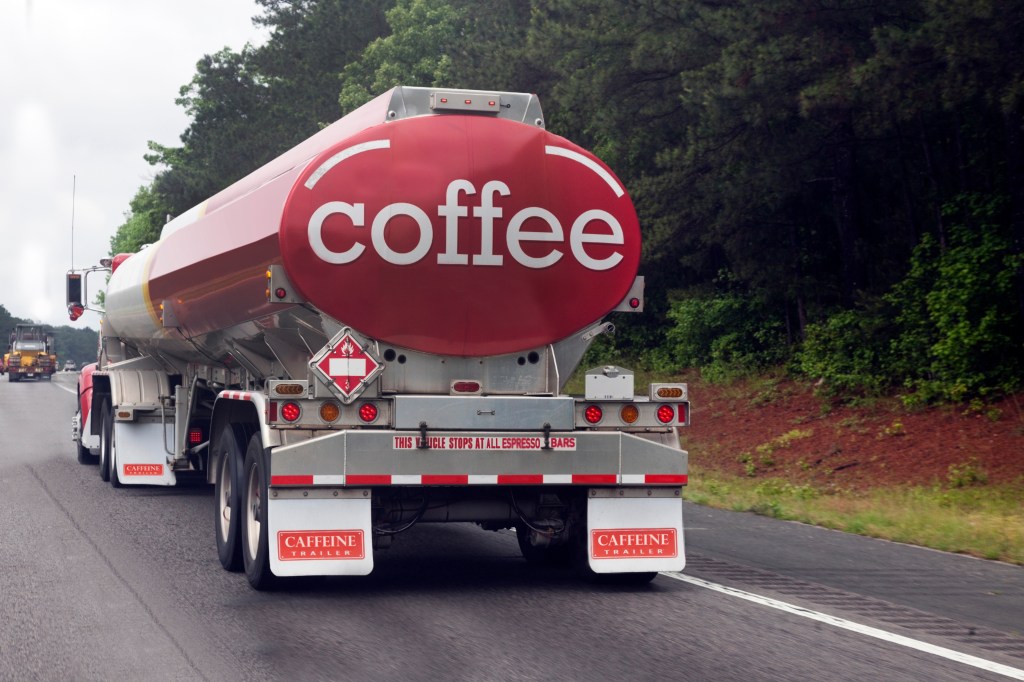
But there is no social disapproval, advertising, warning labels, or 12-step groups for caffeine addicts. In fact, people seem to pride themselves on how many cups they drink per day. Think about all the memes and cartoons you see about an absurdly giant coffee cup that says “I only drink one cup a day” or wishing you could get a coffee I.V. (Coffee I.V.s are a bad idea. There is such a thing as a coffee enema, but I really don’t want to know any more about it. But I digress some more.)

Personally, I get my caffeine through iced tea or Diet Coke. I drank coffee when I had a regular job and there was always a pot in the breakroom. And I will have coffee with cream and sugar—or an Irish coffee—for dessert once in a great while. (I do insist that the Irish coffee be made properly, with Irish whiskey. If the bartender thinks it means coffee with Bailey’s, I send it back. In fact, I’ve been known to ask bartenders how they make an Irish coffee before I order one. Not that coffee with Bailey’s is a bad thing. It’s just not an Irish coffee. But I digress even more.)

Should caffeine be regulated? Well, maybe. It does have hazardous physical effects: increased heart rate, high blood pressure, and heart palpitations among them. Mr. McKnight was right. He’s still alive today and one of my Facebook friends. But I can’t picture a 12-step group without the ubiquitous coffee urn, a warning label on Mr. Coffee machines, or a public campaign called Stop Coffee Addiction Now (SCAN). As far as I can see, coffee addiction is likely to remain nothing to rant about. (This is not a rant. It’s a calm, reasoned exploration of the topic. So there.)

Thoughts on Editing

When it comes to language, I used to be a prescriptivist, telling others how language ought to be used. Now I am a descriptivist, recording how language is used in practice.

Oh, I haven’t entirely given up my mission to get people to use proper grammar, spelling, and punctuation. I still feel that writing “correctly” can be important to the meaning of whatever it is you’re writing about. And I still cringe when someone (usually my husband) says “foilage” instead of “foliage” or “nucular” instead of “nuclear.” But that’s speech, which is very different than writing.

Of course, an editor can’t really edit spoken English aside from pronunciation. Well, there are malapropisms and misplaced modifiers.

Malapropisms occur when a speaker substitutes an incorrect word for a correct one. One headline that makes the rounds on Facebook is about an “amphibious” pitcher, when “ambidextrous” is meant.

Misplaced modifiers are descriptive phrases in the wrong place in a sentence. The classic misplaced modifier is Groucho Marx’s “Last night I shot an elephant in my pajamas. What it was doing in my pajamas I’ll never know.” (A misplaced modifier is often confused with a dangling modifier, which happens when an introductory phrase modifies the wrong subject in a sentence: “Painting for three hours, the portrait was finally finished.” Who is painting for three hours? We don’t know, but it certainly wasn’t the portrait. I once worked with a man who described any kind of grammatical mistake, even a subject-verb agreement error, as a dangling modifier. But I digress.)

One of the places I often encounter “faulty” grammar, spelling, and punctuation is on social media. I have to think twice before I share memes with errors in them because I’m afraid someone will think that I don’t know the difference. (I know Lizzie Borden’s name isn’t spelled “Bordon,” but I couldn’t resist the joke: “If you get any messages from my parents, don’t answer them. They’ve been hacked.” But I digress again.)

Speaking of memes, I once saw one that said one shouldn’t look down on someone who mispronounces less-familiar words. It means they learned them from seeing them in print rather than hearing them. One of my dear friends treated the word “sarcophagus” that way and came to me to learn the proper pronunciation. I was happy to oblige. (I’ve also heard of the phenomenon going the other way. Another guy I knew had only ever heard the name Sigmund Freud spoken. He wrote it down as “Froid,” a fair guess based on the sound, but outrageously inaccurate nonetheless. But I digress yet again.)

When it comes to language I do like, however, I love new additions to English. “Portmanteau” words are particularly fun. They’re made up of two words or parts of words smashed together to mean something new. One that everyone knows (but don’t realize is a portmanteau) is “smog,” which comes from “smoke” and “fog.” (I say I like them, but not the ugly portmanteau words that crop up, especially during the holidays. Nothing is simply a sale. It’s always an “aganza,” “palooza,” “bration,” or “thon.” The first million times someone did that, it may have been clever, but the shine has long worn off. But I digress some more.)

Anyway, back to editing. I hereby apologize to everyone whose infinitives I unsplit and whose prepositions I moved away from the end of sentences. I’m really sorry. My bad. Think of me as a recovering prescriptivist. Maybe not fully recovered yet, but I try.

Adventures in Writing: AI

I must admit I’ve had some experience with generative AI writing. I know I should be ashamed of this, but I’m not. Here’s what I learned about this tool or terror.

When ChatGPT was new, I was intrigued. I just had to try it out. I spent a couple of days feeding it some of my favorite topics and styles to see what it could do with them. What it produced was largely crummy.

For example, I asked it to write a haiku on the subject of sex. What it produced was: “Whispers in moonlight/Bodies weave an intimate/Haiku of passion.” Not exactly T.S. Eliot.

I asked it to write other kinds of poems. In almost every one, ChatGPT included the word “poetry” or the name of the style: “The poetry of passsion’s sweet romance” or “O sonnet of the flesh,” “Each line a brushstroke in the poet’s light,” “In every sonnet, life finds sweet peace.”

It also relied heavily on metaphors, many different ones in the same piece. For example, in a poem on writing, it offered “With verses woven like a tapestry. The writer’s heart, an open book” and “how the words, like melodies, entwine, In stanzas, whispers of a silent song.” Now that’s just bad.

It mixed metaphors atrociously: “The enigmatic tapestry…kaleidoscopic hues… orchestrated by unseen forces, paint the canvas of existence… a symphony of discordant notes, each mood a chapter in a cosmic novel.” All those in one paragraph. Another particularly egregious one was “etched into the fabric of one’s existence.”

It also got facts wrong. Recently, hoping that it had improved, I asked it to write a country song about horses in the style of Willie Nelson. “He’s a big ol’ bay with a coat dark as night” was one of the lyrics. (Bay horses are reddish brown.)

Later on, I had a chance to give a workout to a different AI program tasked with writing ten chapters of a novel. Then I was tasked with cleaning it up into human language. It was a lot of work.

AI couldn’t keep track of the characters, for one. It called a little boy Nicky, Billy, and Jamie and another character Henderson and Nelson in different chapters. It chose weird words (“thrummed”) and repeated phrases (“weight of the world”) in nearly every chapter. It forgot that a pivotal scene was supposed to take place in an abandoned warehouse, setting it instead in the woods. Once I had to have it produce a whole new chapter because the first one was so far off. Plot, characters, dialogue, narrative, backstory, continuity—all would be rejected by any competent editor.

AI nonfiction can be just as bad. There’s a tendency to be simply wrong about names, dates, and locations, for example. Flaws like that will seriously mislead readers. AI nonfiction has also been known to get things like herbal remedies drastically and dangerously wrong.

Once I toyed with an AI image generator, which did reasonably well with a human girl (though it couldn’t produce medium-length auburn hair), but couldn’t make a satisfactory alien to meet my criteria. It looked like one of those sad-eyed children in the old paintings.

I understand why special effects professionals hold AI in horror. Entire departments are being canned and replaced by larger, more sophisticated sorts of AI than the Tinkertoy ones I played with. But movies have been using CGI for years, so AI is the next logical extension. I’m not saying that the SpFX companies are right to abandon the people who have done so well for them over the years. Human imagination controlling the tools of creation will—or should—always have a place in the equation.

But generative AI has a long way to go before it can produce prose or poetry that can substitute for human works. I understand that publishers are being assailed with AI-produced novels, but I can’t imagine they can’t tell the difference. Readers of self-published novels, though, should watch out for AI books and avoid them.

Or, if you prefer, avoid all AI writing. I understand why you would.

(Note: Aside from the brief quotes, no AI was used to write this post.)