Tag Archives: reading

Zombie Novels That Aren’t About Zombies

Just in time for Halloween, Mira Grant (aka Seanan McGuire) has published Feedback, the latest in her series of zombie novels. The original books were Feed, Deadline, and Blackout, collectively known as the Newsflesh trilogy.

Sign of infected areaThe thing is, they’re zombie novels, but they’re not really about zombies. Oh, there are plenty of undead, infected creatures roaming through the novels, trying to bite the living, converting them to more zombies, or simply feeding on human flesh. There are brave zombie hunters who defend civilization against the shambling menace with intelligence, courage, and a vast amount of firepower. There are excitement, chase scenes, well-drawn characters, stunning surprises, and all the things that make a good horror-scifi-action-thriller.

So what are these books really about? Not Jane Austen, that’s for sure.

Fear. Okay, you probably expected this one. A zombie novel about fear. But in the Newsflesh books, fear of zombies is the least of it. There are alarming secrets that turn out to be symptoms of big, appalling conspiracies. One of the novels’ underlying messages is that fear can be – is – used to manipulate people and control them. If the threat is big enough, and scary enough, and relentless enough, people will do anything, give up anything, completely change their way of life to avoid the danger.

And people who know that can pull their strings.

Safety. Again, a fairly standard topic for a zombie book. But in this world (and ours), there is no guarantee of safety. All you can rely on are yourself and the few people around whom you can trust – and sometimes not even them. Mechanical defenses have holes; strategies have deficiencies; friends have their own agendas. In the end, you have only yourself and your principles, and maybe a few other people if you are very, very lucky.

Journalism. The main characters are bloggers, who form teams that gather the news, poke zombies with sticks, or write fiction. This gives the author plenty of room to explore how modern technologies have affected news-gathering, as well as the consumer’s desire for real-life action-adventure, poetry, and stories too. Large questions are explored: How far does the public’s right to know extend? Are there secrets that journalists shouldn’t reveal? What happens when the journalists become part of the news themselves? Have no fear (except of the zombies and conspiracies); these subjects operate in the background while the plot continues to rocket ahead.

Politics. The blogger-journalists are embedded with the campaign of a possible candidate for President, which makes the books all the more timely. Politics and zombies may not sound like a fascinating combination, but when the dead are rising everywhere in the world, people look to governments to address the problem. Whether those governments and the people in them make sound decisions, put responsible policies in place, and fund research can affect the outcome for individuals. Anyone who can’t make connections with the current political climate just isn’t paying attention.

I hope I haven’t scared you away from the novels. There are plenty of gore, ambushes, narrow escapes, heartbreaking deaths, and all the other accoutrements of your standard zombie novel, if that’s what you want. There’s even a zombie bear. You don’t have to pay attention to the various subtexts, though your reading experience will be richer if you do.

Not content to stop after writing the trilogy, Grant has revisited the near future, post-zombie-apocalypse world with short stories, novellas, and now the new stand-alone novel. (I say stand-alone, though its plot runs roughly parallel to Feed.) She explores interesting questions: What is this character’s backstory? What would happen in zombies got loose in a science fiction convention or a school? Who was responsible for starting the zombie plague? Is the zombie situation the same in Australia? Clearly, this is a fictional world with lots of room for expansion, despite the definitive ending of Blackout. It’s an impressive piece of world-building.

Grant is a gutsy writer (pun intended). Writing under the name Seanan McGuire, she has even written a novel in which one of the major plot points is Evil Pie. And for some reason, it works. (It’s in Chimes at Midnight, one of the October Daye series of urban fantasies.)

For more about Feedback, the other Newsflesh novels, short fiction, and Mira Grant, see miragrant.com.

Team Eating

I’ve never been any good at team eating. And I’m not referring to those idiotic competitions to see who can eat the most hot dogs in under a minute (which I believe are individual events anyway). Not that I think I would be any good at those, either. I belch too often to get any kind of rhythm going.

A group of friends eating at a restaurantNo, where I fail is at business dining. Oh, I can make it through an isolated lunch or even an occasional dinner. It’s the day-to-day eating events that leave me stymied.

The company lunchroom is as terrifying to me as a high school cafeteria. I never get to sit at the table with the cool kids or even the audiovisual club. And since a tuna sandwich takes approximately three minutes to eat – maybe five, if you have carrot sticks or yogurt, there’s no good way to stretch it out.

You’d think that my usual strategy – bringing along a book – would allow for some first-class work-related eavesdropping. But no. People get suspicious if you don’t turn the pages, and any book worth its tiny paper package of salt will prove distracting right before the team eaters get to the really juicy stuff – and I don’t mean ripe peaches.

If the lunch culture at the office (and here I’m not referring to yogurt) involves dining at local establishments, the problem is even worse. Even if you want to be a team eater, only the truly pathetic will attempt the “Can I come too?” ploy. It works, in the sense that hardly anyone has the meatballs to say no, but it only leads to groups of employees hustling out a fire door that’s not near your desk the next time.

If you’re a brave soul and decide to eat out alone, trusty book in hand, you may encounter the horror of sauntering into a restaurant where a tableful of your co-workers have already gathered. At that point the only thing to do is nod politely while the other diners pretend their mouths are full and wave a cordial fork in your direction. If you’re a grump, you can hope they flick salad dressing in someone’s eye.

But by far the worst team eating events are picnics, cookouts, pizza parties, and other mandatory frivolities put on by the company. These may be billed as voluntary events, but believe me, they aren’t. If you do decide to forego the games of water balloon volleyball or bingo (with prizes “donated” by your suppliers) in favor of retreating to a cool, dim nearby watering hole, you leave yourself open to being the object of whispered, eye-darting conversations in the lunchroom for at least the next month. Plus, you’ll have to avoid making eye contact with everyone else who slunk off to the same watering hole.

What’s the solution? Is there a solution? A number of people I know just read their books and ignore coworkers back. Some eat at their desks, though honestly, you’ve got to get out of that hell-cube sometime or you’ll grow corners.

Maybe the best solution is to take a large batch of brownies – they don’t even have to be home-made – and offer them around. Brownies are a kind of currency that buys you a place at the lunch table. Especially if they’re “special” brownies (depending on where you work, of course). Oh, and mix it up. Cupcakes, cookies, doughnuts – anything suitably sweet says, “Invite me!”

Then feel free to dish about someone else who isn’t there. You’ll be a team eater in no time.

Why Are YA Dystopias So Popular?

Dystopias – the opposite of utopias – come in a variety of styles and genres to meet the trends. For a while, science fiction post-apocalyptic dystopias such as A Canticle for Leibowitz (Walter M. Miller) and Mad Max movies were popular. Feminist dystopias, the most famous of which is The Handmaid’s Tale (Margaret Atwood), have had continuing appeal.

Now, however, we find that the dystopia is one of the most prominent trends in Young Adult (YA) literature, meant for ages 15-20. (Let it be noted that I and some of my friends are *cough*ahem* somewhat above 20 and still enjoy YA lit.)Concept of reading. MaConcept of reading. Magic book with door a

Two of the YA dystopias that have created the largest buzz in the literary or at least genre fiction world are The Hunger Games trilogy (Suzanne Collins) and the Divergent trilogy (Veronica Roth). Both create an oppressive, if implausible, society and feature protagonists the same age as the intended readers, who rebel against it.

This current in fiction, of course, taps into the phenomenon of teenage rebellion, but also channels it in a positive direction – these are societies that need to be rebelled against. The young adults are empowered, whether with weapons or mental or magical powers, to defy the status quo and try to bring about a new, better world.

There are certainly aspects of these books that older readers might object to, from teens wielding weapons to teens defying the powers that be, to teen sex. (Though the sex is nonexistent in some cases, minimal in others, and so non-graphic and off-stage as to be barely recognizable in other books. Apparently shooting heads of state with arrows or guns is still less alarming than 16-year-old characters having sex.)

But teens (and others) love them. Here are my opinions as to why.

Dystopias acknowledge that today’s society is dystopic. Maybe not rotten enough to choose teens to participate in televised killing sprees. But dysfunctional in a lot of ways, which teens can see and feel even if they don’t follow the news. They can hardly escape the sense that the world (or whatever part of it they live in) is unfair, unhealthy, and unjust, and many of the people in it are dangerous, vitriolic, scheming, and power-mad. Teens are smart enough to recognize that, no matter how many feel-good histories you feed them.

Dystopias say that teens can be active agents of change. The protagonists of these novels are certainly acted upon by society, but they also have the power to effect change at many levels, from personal defiance to regime change. However unlikely the plots, the idea that teens have power is, well, powerful.

Protagonists include strong female and male characters. And they acknowledge the possibility that males and females can work together. In The Hunger Games, Katniss is the clear lead, but Peeta is clearly no stick figure. The two have interactions that are complex and focus on the survival themes as much or more than the boy-girl angle. In Divergent, the relationship between Tris and Four (Tobias) is even more nuanced, with their personal and strategic goals often at odds. By the third novel, the narrative point of view even switches back and forth between them.

There are no pat endings. Appropriately, since the dystopian societies are in such abysmal shape to begin with, not everything is peaceful and peachy by the end of the story. Nor are dystopian novels simply about tearing down a bad society, but raising up a new, better one – and acknowledging the strength, courage, and intelligence that will take.

Few would deny that – at least in the U.S. – society is becoming more fractured, chaotic, and hate-filled – more dystopic. Truthers, birthers, factions that can imagine death panels and reeducation camps, blaming whole groups – the NRA, Wall Street,  liberals, conservatives, or whomever – for society’s ills cannot have escaped the notice of young adults. They’re still young enough to believe that solutions are possible, and old enough to see that the solutions will require commitment, struggle, and hard work.

Dystopic YA novels say, “More power to them!”


Mysteries Change, and So Do I

I grew up reading mysteries. I still remember a book of short mystery stories for children. One was set at a circus and involved a missing snake. After looking in baskets and anywhere a coiled snake might be, the children notice that an acrobat’s pole falls to the ground with a dull thud instead of a metallic clang. Suddenly they realize that the missing snake is stretched out full-length inside the pole! Ta-da! (I also remember that the book was missing a few pages, which made one of the stories even more mysterious,)

That of course lead to Nancy Drew, the go-to mysteries for tween girls at the time. So they were written decades before. So the characters were unbelievable stereotypes. They were mysteries and I read them anyway. And collected them relentlessly, out of order because I usually got them in used book stores.

Murder Letterpress

I got my first taste of the real thing at my grandmother’s house in Florida, when I was 11. DisneyWorld didn’t exist yet (yes, I’m old), and the attractions near Orlando were limited. There was the zoo in Kissimmee, St. Augustine, Busch Gardens, and an alligator farm. Not much else. In between road trips to the attractions, I discovered Grandma Rose’s shelf of real, grown-up murder mysteries. Agatha Christie and Rex Stout provided my introduction into the world of real mystery literature. (Recently I’ve reread a few Nero Wolfe classics like Some Buried Caesar. They still take me back.)

Over the years that followed, I came up with several categories of mystery authors – those whose books I would borrow from the library or buy used, those I would buy in paperback, and those rare, special authors whose work I would buy in hardback. Authors sometimes moved from one category to another, depending on whether the quality of the books stayed high.

Robert Parker, for example, started out as a paperback author, moved to hardback, then back to paperback when it seemed like he was only phoning them in – for example, when he spent too much time detailing what color athletic shoes and their swooshes Spenser and Hawk had on. When he branched out into other series with other lead characters, I stopped reading him altogether.

Since the advent of ebooks, I no longer buy hardbacks or paperbacks, but the categories still exist in terms of price. Sue Grafton is on my buy-immediately, read-immediately list. Sara Paretsky used to be, but I found the last two of her novels unsatisfying because of the endings – which involved silly stunts to trap the villain.

I’ve mostly given up on cozy mysteries, too. For a while I did read Diane Mott Davidson, Charlotte MacLeod, Rita Mae Brown, and a few others, but somehow I lost interest. Now I understand there is debate in the cozy mystery world over whether cat characters should talk or not. I prefer not to get involved.

I find that I am reading fewer mysteries these days, because many of them seem excessively formulaic – lead character is pursuing a serial killer who has targeted said character’s friends or relatives. Cozy mysteries have been really reaching for odd occupations for the detective character – librarians, innkeepers, golfers, crossword puzzle enthusiasts (are there really that many murderers who leave crossword clues?), and many, many cooks. It used to be interesting to get an inside peek at the workings of professions, but the thrill is gone.

I still like books in other genres that have mystery elements. One of these is the October Daye series by Seanan McGuire. Her lead character, who is part fairy, pursues quests usually involving stolen children or murdered fairies (or various other supernatural species).

Since I have cut back on reading mysteries and have been finding them less satisfactory lately, I’ve decided that what I need to do is write the kind of mystery that I want to read. I have begun to do so. I have 15,000 words already, plus a rough and fluid outline, which sometimes changes when my characters don’t do or say what I thought they would. (I’ve heard writers describe this phenomenon many times, but it’s interesting to see it happening in my own work.)

My working title is Cold as Stone. Wish me luck. Perhaps someday I will make it into someone else’s borrow, paperback, or hardback categories.

A Story From the Art

Slide3

Usually you think of a writer writing and then an artist creating illustrations or a piece of art for the cover – one on every page, if it’s a children’s picture book. And usually that’s the way it goes.

But every once in a while the natural order of things goes awry. Every now and then, a writer must take a piece of art and shape a story to fit it.

Once it happened to me, when I was writing and editing reading passages for children’s textbooks. The tasks assigned were annoying enough – stories that were required to have certain numbers of parts of speech or phonological items, with restricted vocabulary and very specific reading levels.

Then one day we were given an already existing children’s story, one that had seven or eight illustrations that had been drawn specifically to go with the text. We were told to select four or five of those pictures and write completely new text to go with them. We could rearrange the pictures – put them in a different order – and we could choose which ones to use or eliminate. But that was the assignment: Take the pictures and then write the story. If it seems totally backward to you, it did to us as well. Of course the stories still had to have certain lexical  components, be entertaining, and provide a message or lesson for the readers.

I remember the set of pictures I was given. The illustrations showed a young girl in a tropical setting, at one point with her sitting on a throne. In my story, the little girl claimed that she could speak to animals. No one believed her and she was thrown in jail for lying.

The little girl really could speak to animals, however, and she called upon jungle friends to rescue her. The people who had jailed her discovered that she really had this unusual ability all along. They apologized profusely and threw a big party for her and she sat in the seat of honor.

It was a particularly difficult story to write. The pictures did not lend themselves to any story other than the obvious one about a jungle princess and her animal-filled realm. It was even harder to think of a tale that would convey a message.

What I tried to show in my story was that just because something had never been done, that didn’t mean it was impossible. And if someone made a claim, it was better to test the claim than merely assume the person was lying. I thought the idea of speaking to animals and having the animals rescue the little girl would also appeal to children.

One thing that is particularly frustrating about writing for textbooks and  other sorts of publications is that one never knows what happens to the fruits of one’s labor (at least until the internet, with number of views and “like” buttons and comments fields). Was the story accepted by the higher-up textbook folks? Did it get changed in the editing process? Did they even like what I had done with the illustrations? Did it make it into print? Most of all, I wondered whether any children read my story, perhaps enjoyed it, or understood what I was trying to say. To this day, I have no clue.

Writing in those circumstances is like dropping your work down a well. You never hear the splash, or even know if there is a bottom to the well.

I like to think that somewhere, some child liked my little stories, whether or not they learned about diphthongs or consonant clusters from them.

I also wonder about the illustrations. Did they get passed along to yet another writer who had to invent yet another story to go with them? If they did, I would certainly like to have seen what they came up with. It was an interesting exercise. But did it result in something educational or entertaining or even interesting?

Personally, I believe that children’s books should be written first and illustrated later. I also believe that requiring writers to abide by rigid rules makes it less likely that the story will be appealing. And if the story isn’t appealing, I believe it is less likely that the children who read it (or are supposed to read it) will get anything from it.

To me that’s not the way children’s literature should be written. But then textbooks aren’t really literature, are they?

Sapiosexual Seeks Same

cropped-heartbrain.jpg

If I were ever to write a personals ad, this is what it would say:

Sapiosexual Seeks Same

for friendship and conversation. If you like literature, science, trivia, genre fiction, cats, humor, journalism, artistic pursuits, creativity, and above all intelligence, I’d like to meet you. Race, appearance, gender identity unimportant. Prefer non-smokers. I’m open-minded. Are you?

Of course, I’m not going to write a personals ad, since I’m married, have been for 30 years, and barely socialize as it is. Polyamory is not an option at this point.

But there you have it. I don’t care about muscles, status, income, or what kind of car a man drives. I want someone who is bright, witty, and creative. Preferably with facial hair, although I will let that slide if everything else meets my criteria.

That describes my husband, my past boyfriends (even the disastrous ones), and my male friends, past and present. We are all interested in, attracted to, aroused by intelligence. That’s what “sapiosexual” means.

(It once occurred to me that the qualities I look for in a man are all above the neck. In fact, three of them – the most important – are above the eyebrows.)

Female sapiosexuals sometimes have a hard time finding someone to socialize with, date, love, and even marry. Part of this, I fear, is due to the ruthless socializing of women in what makes a man desirable – no fatties, no baldies, all the things you regularly see in personals ads. There is less of that among sapiosexual women, as many of them have learned to look past the physical in the search for the intellectual.

Many men are intimidated by sapiosexual women. First, many of us don’t meet the media’s idealized standards of beauty. (Let’s face it, hardly anyone does, so if that’s what you’re looking for, you’re apt to be very lonely.) We have large vocabularies and wide interests, and probably know more than a prospective male friend does on at least one subject. Many of us can and do hold our own in arguments.

These traits lead us to be seen as know-it-alls – Hermione Granger types – who don’t know how to have fun and don’t want anyone else to have fun either. The know-it-all complaint can be true, I must admit, but sapiosexual women do indeed know how to have fun. It’s just that our opinions about what is fun, like so much else about us, diverges from the norm. We have fun in conversations. We enjoy variety and newness. We appreciate learning something new and being challenged. We even enjoy doing those things in bed.

I don’t however, fall for just anyone who is bright, witty, creative and has facial hair. I try to avoid intellectual bullies and nose-looker-downers, those who wield their intelligence as a weapon to intimidate, humiliate, or dominate. You know, those people who glare and shout, “It’s pronounced ‘dis-sect,’ not ‘dy-sect’! TWO esses!” when you’re still in the middle of your sentence.

No, in addition to the above-mentioned traits, I want someone who’s kind. Believe it or not, kindness can be compatible with intelligence.

And let’s not forget that there are different kinds of intelligence. Some people, like me, are word people, who gather information by reading. You often hear readers put down others who watch a lot of television. But some people process information visually or in other ways. Also, some people forego college degrees to practice and improve their creative skills. And some people, like my husband, are experts on people and how they interact. I’ve learned a lot from him.

Where do you find sapiosexuals? Nearly anywhere. If you limit yourself to colleges and think tanks, you’re missing a lot of possibilities. I have known sapiosexuals who work as tow truck or front loader drivers, parks and rec workers, and restaurant managers. I have met them at work and at science fiction conventions (always a place rife with sapiosexuals). I have found them at folk music concerts and house parties. I found my husband outside a food tent at a music festival.

Is there a sexual component to sapiosexual relationships? Absolutely. Despite the stereotype of the brainy nerd who never gets laid, a sapiosexual can be physically as well as intellectually stimulating. Many a relationship has started with a mutual interest in poetry and ended up in bed.

And that’s the point. Sapiosexuals may have a hard time finding fulfilling relationships – whether friends, flirtations, lovers, or marriage partners. But when they do, it’s something special.

What’s So Funny About Ohio?

If you’re a 3rd grader the funny thing about Ohio is that it’s the state that’s round on both ends and high in the middle.

If you’re near Columbus the funny thing about Ohio is the field of concrete corn that stands majestically by the roadside.

"CornhengeDublinOhio". Licensed under CC BY-SA 3.0 via Wikipedia - https://en.wikipedia.org/wiki/File:CornhengeDublinOhio.jpg#/media/File:CornhengeDublinOhio.jpg
“CornhengeDublinOhio”. Licensed under CC BY-SA 3.0 via Wikipedia

If you’re in Cincinnati the funny thing about Ohio is the Flying Pig statues, marathon, and assorted paraphernalia.

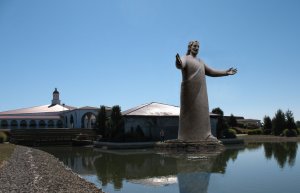
If you’re near Hamilton, Ohio, the funny thing about Ohio is the statue formerly known as Big Butter Jesus. (1)

King of Kings (aka Big Butter Jesus)

King of Kings (aka Big Butter Jesus)
Photo by Cindy Funk

There are undoubtedly other oddities and roadside attractions in Ohio that can be found in various books and websites about the peculiar and amusing sites to be found in various states.

The really funny thing about Ohio, however, is that the state has produced some of the best humor writers ever.

The one that all Ohioans study in school is James Thurber. I was surprised to learn that outside of Ohio he is not as well known. At the very least, Ohio students read “The Night the Bed Fell” and “The Catbird Seat.” (2) His loopy, scrawling cartoons of men, women, and dogs are classics not so much for their artistic merit but for the captions. My favorite is a man and woman in a lobby and the man says, “You wait here and I’ll bring the etchings down.” For some reason that always slays me.

Thurber managed to be funny despite his failing eyesight and rampant misanthropy.(3) He also wrote a series of essays on grammar – a parody of H.W. Fowler’s Modern English Usage – that is enormously amusing to those of us who are amused by that kind of thing. In particular his piece on the subjunctive and sex is worth the price of admission. (4)

The high points of Thurber’s work have been collected in an anthology called The Thurber Carnival. I highly recommend it.

The other native Ohioan who has made her mark in humorous writing is Erma Bombeck.(5) Beginning as a writer for the Dayton Daily News, Bombeck turned her suburban trials and tribulations into comic fodder for such national bestsellers as If Life Is a Bowl of Cherries, What Am I Doing in the Pits?

She is much more widely known than Thurber because of the near-universal appeal of her books and the fact that nobody makes schoolchildren read her.

Every two years there is an Erma Bombeck Writing Workshop held in her memory at the University of Dayton. Attendees work on humor writing, memoirs, and other forms of expression. There are events called “Pitchapalooza” and “Speed Dating for Writers,”(6) a writing contest, and even a showcase for stand-up comedians.

This year the faculty includes Jenny Lawson, the Bloggess; Kathy Kinney, “Mimi” from The Drew Carey Show; multi-talented writer Sharon Short; as well as other authors, speakers, agents, and literary mavens.

I will be there too, as an attendee.(7)  I hope that after this experience, which occurs at the beginning of April, I can use the knowledge, practice, and advice I receive to improve this blog.

Erma Bombeck and James Thurber set a high standard, but those of us who aspire to write need people of outstanding talent to inspire and instruct us. As well as flying pigs and rows of concrete corn to entertain us.


(1) Also known as “Touchdown Jesus.” I always called it “Kris Kristofferson Jesus.” Unfortunately that statue was hit by lightning and replaced by another statue of Jesus made from exactly the same materials. And that’s pretty funny too. I call it “Jesus-Needs-a-Hug Jesus.”

"Lux Mundi"
“Lux Mundi”

(2)”The Secret Life of Walter Mitty” is another well-known work. But the Danny Kaye movie of it has too much Kaye and not enough Thurber.

(3) Often mistaken for misogyny. But by the end of his life, he couldn’t stand anyone.

(4) You can find it online at http://grammar.about.com/od/classicessays/a/whichthurber.htm, but hardly anywhere else.

(5) After whom my armadillo purse, Erma (duh), is named.

(6) Not actually a venue for making dates, this consists of time-limited one-on-ones for aspiring authors to ask questions of pros.

(7) I was lucky to register in time – the workshop sold out in under six hours from the time registration opened. There is a FB page and the website is humorwriters.org.

Review: Furiously Happy

Buy this book!

Jenny Lawson, aka The Bloggess

Now I’ll tell you why.

First, despite what I wrote a previous post, Seven Reasons I Hate the Bloggess (http://wp.me/p4e9wS-56), I really respect and admire her and her writing.

Second, Furiously Happy is every bit as funny as Let’s Pretend This Never Happened, Lawson’s first book. It’s as raucous and uninhibited as her wildly popular blog.

Third, it’s something more.

Oh, there’s still plenty of weird taxidermy, ridiculous fights with her husband Victor, and even a bizarre travelogue of her trip to Australia. (She was not allowed to cuddle a koala, even when she dressed in a full-body koala suit, but consoled herself with the knowledge that koalas have chlamydia.)

But threaded through  her comic, idiosyncratic prose is a serious message about mental health: that we should speak up about it; acknowledge our struggles; and be determinedly, exuberantly, furiously happy when we can, in defiance of our illnesses.

Furiously Happy is a book for the millions of Americans – one in four – who struggle with mental illness, and for the millions more of their families, loved ones, and friends. It entertains and educates and defies the stigma that surrounds mental illness, without being preachy or mired in statistics.

Lawson has heard from people who have made it only as far as the parking lot of her signings because they too have severe anxiety disorders. Others have driven as much as five hours to attend one of her appearances. In her blog (thebloggess.com) and her new book, she lets people know that we are “alone together,” that even if we’re broken, we still have the capacity for magic.

At a recent book signing, Lawson was visibly nervous when she read two chapters aloud. One of these chapters was the one in which she and her mother discuss what is crazy and whether Jenny is. During the Q&A session at the signing, she took care to make the point that mental illness need not prevent people from being, as she says, furiously happy – if they keep on struggling, fighting, and trying, and especially if they have people around who understand and help.

After that she signed her book and anything else the audience brought until the entire group – which was quite large – was satisfied. No one was turned away from the signing line.

Lawson’s writing is not for everyone. Some people will be turned off by her use of profanity, and perhaps others may not appreciate the serious message that this second book contains. However, if you are looking for more rollicking, uninhibited, and unlikely (though largely true) stories, you will certainly find them here. But if that’s all you want, you may prefer to skip the serious chapters.

On the other hand, if you want to learn about mental illness with its attendant difficulties, and why it is so important to bring these topics out of the closet, as it were, then you may find the storytelling ridiculous, irreverent, or distracting. Personally, I enjoy the whole package, and it’s clear that many others do too.

Actually, the book hardly needs my endorsement. It’s been on the New York Times bestseller list for weeks now, and her book tour is drawing large and enthusiastic crowds. But I’ll recommend it anyway. You can start with her first book and find yourself drawn into the other. Or vice-versa.

You should also check out her blog, both for the content and the commenters, many of whom have found in Jenny an inspiration and in the other commenters a like-minded group of self-admitted weirdos, social outcasts, and yes, the mentally ill. That’s really been Lawson’s message all along. She just states it a little more directly in Furiously Happy.

Should Kids Be Taught to Read?

For years now, the debate has raged: How should children be taught to read? Some people are saying that the real question is whether children be taught to read.

What do we actually know about learning to read? How do children learn to read? The answer is a bit fuzzy at this point. Phonics, whole language, and natural reading all have their proponents.

But with brain imaging improving seemingly every day, neuroscience is starting to clue us in on how the brain processes language, in both speech and reading.  “A study in the Journal of Neuroscience,” testube tells us, “found that the area in the brain that reads words is right next to the part of the visual cortex that recognizes faces. So just as one area of the brain can quickly identify a face, another can quickly read a word.”

Not that that really helps solve the problem of reading instruction. It will likely be quite a while until info from brain imaging makes its way to the classroom.

The common wisdom is that speaking is a natural process that children learn automatically, for the most part. Reading, however, is another story. Learning to recognize meaning in squiggly marks on paper or a computer screen is much less intuitive. Not all children accomplish it. Not all adults have either. The Department of Education reports that 32 million American adults can’t read.

Naturally, not all children learn to read at the same rate. Some pick it up by age four and others not until the later elementary grades. Teachers suggest that students only really begin to read for meaning in about the 5th grade. Until then, the work of decoding words, sounding them out, or memorizing them has simply taken too much of the brain’s attention.

Still, everyone agrees that reading is important. Children who learn to read have distinct advantages over those who don’t, and adults who can’t read are at a real disadvantage in society.

Surprisingly, perhaps, the advantages of reading are not what you might expect. While reading certainly develops the vocabulary and entertains children with imaginative stories, some have suggested that reading offers other benefits as well. An article in Bustle says, “According to a the British Cohort Study, kids who read for pleasure at a young age tend to test better than their peers in all sorts of subjects… yes, including math.”

Other benefits include greater understanding and empathy for people of other lands, cultures, races, and so forth. If children read books or articles about people and cultures different from themselves, they have a better basis for openness and tolerance.

Now, however, some people are saying that children do not have to be taught to read: that they “pick it up” on their own. One name for this is the “unschooling” movement. Interesting articles on the subject, particularly by Dr. Peter Gray of Freedom to Learn, have appeared in Psychology Today‘s blogs.

As Gray describes it, “precocious readers appear to be children who grow up in a literate home and, for some unknown reason (unlike even their siblings in the same home), develop an intense early interest in reading.  Interest, not unusual brain development, is what distinguishes them from others.”

According to the theory, learning to read can best be done in a mixed age group where children can see the benefits that older students get from reading, get some informal help from those older students, and at some point discover that they need to read on their own in order to accomplish something they want to do.

Another of his suggestions is that, far from being detriments to reading, electronic devices and practices such as texting and emailing give children lots of practice and lots of motivation to develop their reading skills.

Most important is allowing children to learn to read at their own pace, in their own good time – not to push them. If a child likes phonics word games – great! If she doesn’t, find another way to make reading enjoyable and necessary, or, better yet, let her discover her own.

Admittedly, this version of learning to read does not fit in well with the current educational system. It is mostly being tried by homeschoolers and alternative schools. It is possible that it could work in today’s classrooms, but not without significantly modifying them.

Lots of various kinds of reading material – preferably high- interest – should be readily available and most likely chosen by the students rather than assigned. This would of course play hell with the teacher’s role, standardized textbooks with stories carefully calculated to introduce only certain letters or words at a time, and high-stakes testing for reading ability.

Given that, it’s unlikely that this new style of reading education will spread very far very fast. But schools are still turning out many adults – graduates or drop-outs – who are functionally illiterate. Until more is known, teaching reading may well remain guesswork in large part. but if you worry that your child is not learning to read quickly enough to suit you or the school system, the usual teaching methods may not be the answer.

Some children seem to need to follow their hearts and their interests when they are ready and have a need to read. This is not likely to be the solution for all children, just as phonics and whole language are not. If children are going to read as adults, for fun, for business, or just for daily life, they must develop the idea that reading is a worthwhile activity and not a chore.

And maybe formal teaching isn’t always the best way to do that.

References:

https://testtube.com/dnews/how-does-your-brain-learn-to-read/?

http://www.bustle.com/articles/111990-9-ways-people-who-read-as-kids-have-an-advantage-over-everyone-else

https://www.psychologytoday.com/blog/freedom-learn/201002/children-teach-themselves-read

https://www.psychologytoday.com/blog/freedom-learn/201311/the-reading-wars-why-natural-learning-fails-in-classrooms


Stemming the Tide of STEM

I’m generally in favor of STEM – Science, Technology, Engineering, and Math – education, especially when girls and young women are welcomed into the programs and treated with the same attention as males. (As long as they don’t junk it up with a pink color palette.)

But it’s being oversold.

(Typically, at this point I would produce a rant about how STEM is being glorified and promoted ahead of reading, writing, literature, art, music, social studies, and various other humanities. That’s a rant for another day, though. I’ll get back to it. I promise.)

To see all the STEM programs and magnet schools, you’d think Sputnik had been launched just this week. We’re not in the same kind of Cold War/space race with the Russians now, yet science is king in schools.

Admittedly, science and technology are vital today and will be for the future that our students are preparing for. But just as you don’t have to know how to program a computer to write using a word processor or play a video game, you don’t need to know engineering to fill one of the many service jobs; or banking, human resources, business management, or sales; or professional pursuits such as law or teaching, that will also be vital for tomorrow’s society.

Financial services and business management were the most recently hyped “hot careers” that students were being funneled into, with courses in entrepreneurship and leadership skills filling up the curriculum. They seemed to overlook the fact that only a few students would become business leaders, managers, or owners. With the middle class shrinking and the job market tightening, even the middle echelons of business have proved to be out of reach for millions of students.

The same will likely be true for many of the STEM students. How many research scientists can universities and the private sector afford to hire? Since the dot-com crash, how many openings are there for techno-wizards? What we need are more computer educators, who can teach hapless, hopeless adults how to use their home and business computers effectively and efficiently.

It’s profoundly ironic that schools are pushing science, when the Powers That Be are science deniers and proud of their scientific ignorance. Even if we give students an outstanding STEM education, who will listen to them? Not legislators. Not the general public, at least those that think TV shows about paranormal hunters, ancient aliens, and assorted prophecies are scientific.

What we need are science educators, and not just for the brainiest STEM students. We need teachers in elementary schools that can make science engaging and teach students that early humans did not live at the same time as dinosaurs. We need middle school teachers who can teach the foundation of all the sciences – the scientific method – and how to recognize bogus scientific and especially medical claims, how to examine evidence. And for high school science, we need teachers who keep up-to-date with their fields – and texts that do the same. Those kinds of learning are what the general public of the future needs.

We also need science popularizers. Though the scientific establishment sometimes looks askance at the likes of Carl Sagan and Neil Degrasse Tyson, they perform an invaluable service. They remind us that science isn’t just something you learn in school and then forget. That general understanding of the weather or earthquakes or DNA testing or vaccines is vitally important for more people than learning to build a robot is.

(And popularizing science demands outstanding communication skills – writing and speaking clearly and effectively. But I’ll get back to that another time.)

STEM is promoted for elementary students as a way to make science engaging. But is STEM really what does that? In “STEM: It’s Elementary!,” Erin McPherson says, “[K]ids who experience STEM early through hands-on learning are the ones who will be best equipped to develop a strong understanding of STEM concepts as they get older.”

It’s hard to argue with that. But isn’t hands-on learning what elementary students should be getting in writing, history, and art, too? McPherson does talk about art – “By adding art and music concepts like design, rhythm and movement to STEM education, students are able to fully visualize STEM concepts” – but only as an add-on to STEM, not subjects worthy in and of themselves.

Also, is STEM becoming a de facto gifted and talented program – and that only for brainy kids with a penchant for math and science? Do the less talented, less able students or the artistically gifted fall away and get less attention?

One purveyor of online STEM curricula touts that its offerings are “for all students based upon National Academies research with a strategic emphasis on gender, racial and socio-economic concerns.” But look at the “pathways” of courses they list: architecture, biotechnology, engineering, entrepreneurship, manufacturing, renewable energy, science, and technology. Do these really meet the needs of “all students”?

And what about those heavily emphasized future and futuristic jobs? Elaine J. Hom, LiveScience Contributor, claims that “STEM jobs do not all require higher education or even a college degree. Less than half of entry-level STEM jobs require a bachelor’s degree or higher.” (She doesn’t list any.) Meanwhile, the Department of Education reports that the STEM career with the most projected rate of growth (a whopping 62 percent) is biomedical engineering.

Want more telling statistics? J. Maureen Henderson, contributor to Forbes, says, “The future is already here and it brings with it low-wage temporary or contract work as a way of life….According to the Economic Policy Institute, almost 30% of American workers are expected to hold low-wage jobs – defined as earnings at or below the poverty line to support a family of four – in 2020. … Given that roughly 50% of recent college grads are unemployed or underemployed and those who do work are much more likely to hold these types of jobs, this is a particular grim prospect for young workers….”

Another member of the Forbes staff, Jacquelyn Smith, suggests, “If you want to ride a crest of increasing employment over the next 10 years [through 2022], get into health care, personal care, social assistance, or construction. That’s the advice you can glean from a report issued by the U.S. Bureau of Labor Statistics today [2/01/2012].”

After all, the future technocrats will still need baristas, day care workers, plumbers, chefs, massage therapists, pastors, firefighters, hairdressers, and sales clerks; and their companies will still need freelance and contract (read: low-paid) writers and designers and even accountants for their ever-tightening workforces. And I hope that society will still need works of literature, art, and music, and the people to create them.

So, is STEM education a valuable educational approach? Certainly, for some students. For all students? Maybe not so much.

References

http://www.weareteachers.com/blogs/post/2015/04/03/stem-it’s-elementary

http://www.livescience.com/43296-what-is-stem-education

http://www.ed.gov/stem

http://www.forbes.com/sites/jmaureenhenderson/2012/08/30/careers-are-dead-welcome-to-your-low-wage-temp-work-future/

http://www.forbes.com/sites/jacquelynsmith/2012/02/01/the-jobs-with-the-brightest-future/