Tag Archives: science

The Writers I Love and Why I Love Them

Last week, I wrote about why we should love writers—and how we should show it. This week, I’m going to take my own advice and write about writers whose work I love.

There are lots of writers I admire. Jon Krakauer, for example. I started with his book Into Thin Air and went on to read more of his work—Missoula, Under the Banner of Heaven, Eiger Dreams, Into the Wild, Where Men Win Glory, and his essays. (Many of his books are about mountain climbing. For some reason, I like true adventure books that describe things I will never do. Dramatic thrills, maybe, or a longing for experiences that I can only live vicariously. But I digress.)

But the writers I love most, the ones whose books I buy as soon as they are published and move instantly to the top of my TBR list, are Mary Roach, Sue Grafton, and Jenny Lawson.

Mary Roach

Stiff: The Curious Lives of Human Cadavers

Spook: Science Tackles the Afterlife

Bonk: The Curious Coupling of Science and Sex

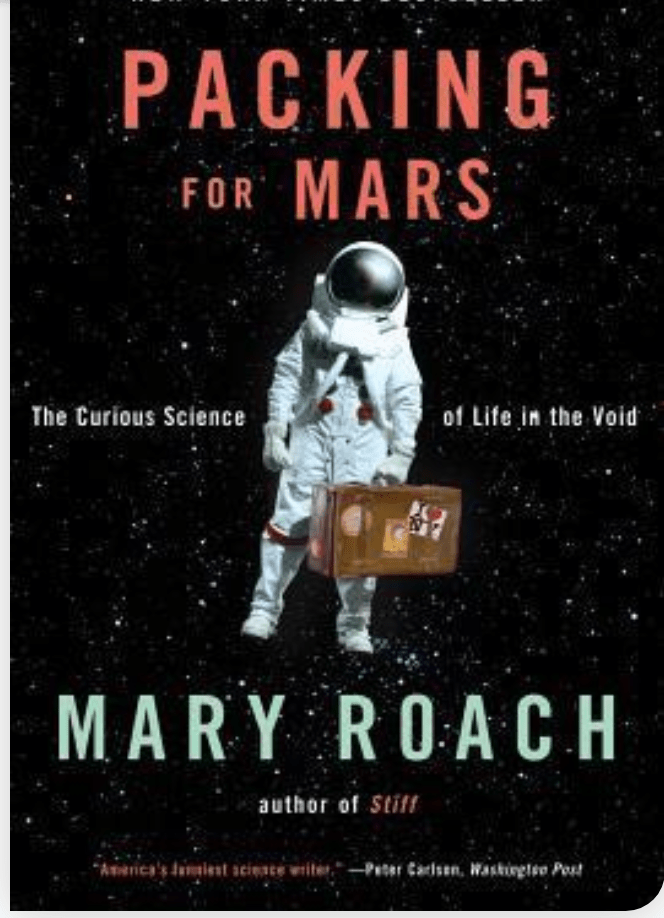
Packing for Mars: The Curious Science of Life in the Void

Gulp: Adventures on the Alimentary Canal

Grunt: The Curious Science of Humans at War

Fuzz: When Nature Breaks the Law

Replaceable You: Adventures in Human Anatomy

Mary Roach writes the least stuffy science books I know on an impressively wide variety of topics. She’s not afraid to insert herself into the narrative as she explores a wide range of topics. Her encounter with the space toilet, for example, is a riot. The thing I love most about her books, though, is the footnotes. They are copious, fascinating, and humorous, and add texture and interest with aspects of the topics that just don’t fit neatly into the narrative.

(I must admit that Roach’s footnotes were the inspiration for my digressions and thus the genesis of this blog. The footnotes for Packing for Mars, for example, include the story of Enos, the chimp that went to space. But I digress again.)

Sue Grafton
• The Alphabet Series

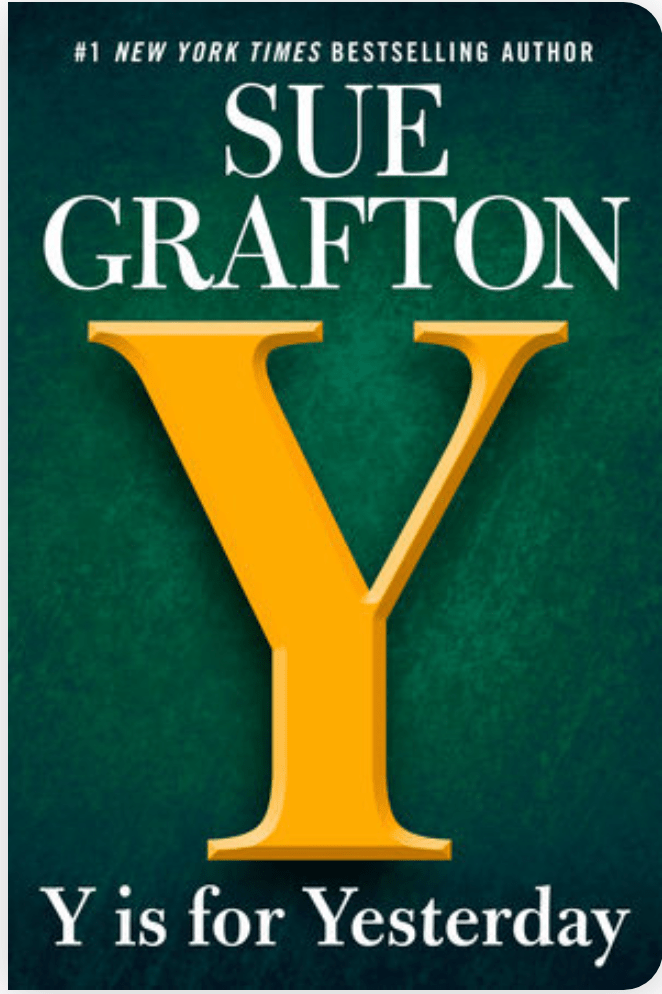
Sue Grafton is justly famous for her series of Kinsey Milhone mystery novels that begin with A Is for Alibi and end with Y Is for Yesterday. She died of cancer before she could write the last book in the series, which she intended to title Z Is for Zero. Mystery fans everywhere mourned her loss.

Grafton’s mysteries are often mentioned in the same breath as Sara Paretsky’s V.I. Warshawski series. They do share many qualities, such as strong female private investigators and a cast of interesting supporting characters. But, to me, Paretsky writes from anger (or rage), while Grafton writes from insight and bemusement. Over the years, I’ve gotten away from reading every one of Paretsky’s books that comes out (she’s still writing), but never tired of Grafton’s. I just wish she had lived to write more.

(When I was writing a mystery novel (which never got off the ground), I attended a writing conference where Sue Grafton was one of the speakers/instructors. She read the first 30 pages of my book and gave me some very good advice. But I digress some more.)

Jenny Lawson

Let’s Pretend This Never Happened: A Mostly True Memoir

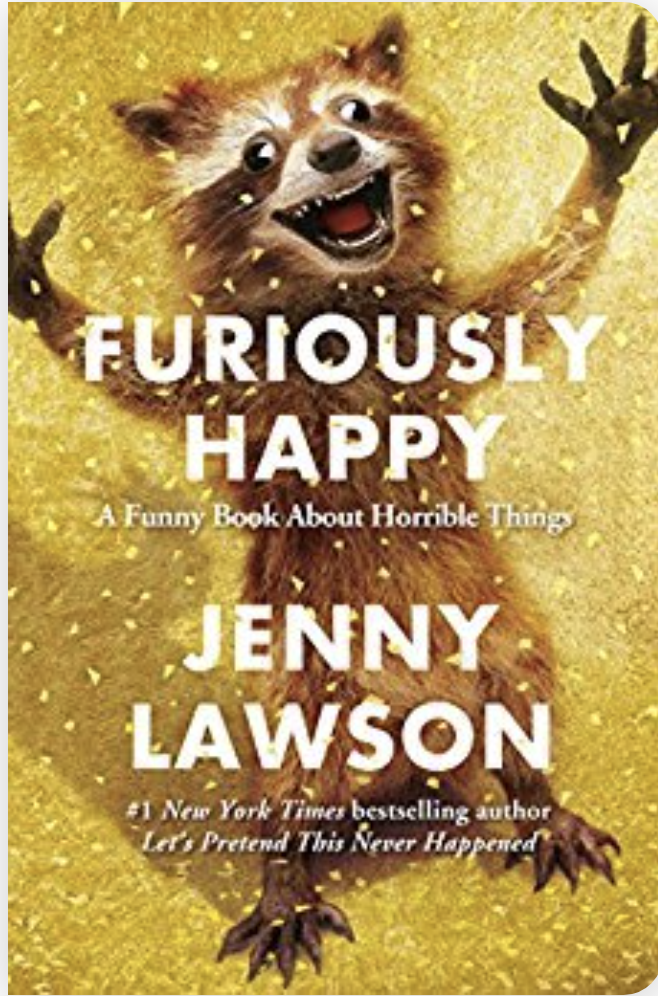
Furiously Happy: A Funny Book About Horrible Things

Broken (in the Best Possible Way)

How to Be Okay When Nothing Is Okay

Jenny Lawson, aka the Bloggess, writes wonderful books on some of my favorite topics. Her writing style is chaotic, wildly funny, and ultimately uplifting. I was reading her “Mostly True Memoir” and couldn’t stop laughing. My husband asked what the book was about. “I don’t really know,” I said, “but she talks a lot about her vagina.” For a long time, he called her “the vagina lady.” I haven’t told him that sometimes she talks about her labia.

There was plenty of other stuff too, a lot of it involving her bemused but steadfast husband Victor and the trouble they get into, separately or together—like the time she bought a six-foot metal chicken that she named Beyoncé and left outside Victor’s home office window.

Her later books contain essays with plenty of humor and anecdotes, but they are loosely on the subject of mental illness and coping with it (or not). How could I resist a book like that?

(I met Jenny Lawson twice, once at a book signing and once at a writer’s conference. At the book signing, there was a Q and A session. I asked, “If you could be any animal, what would you be? And why?” She replied, “A tapeworm. Because I could just lie there and someone would feed me.” But I digress even more.)

Of course, there are other books that I like a lot, including more mysteries, more science, science fiction, some history, some biographies (except ones about Prince Albert), books about shipwrecks, books by Lois McMaster Bujold, Dick Francis, Simon Winchester, Jared Diamond, and Steven Pinker, and true crime. (I don’t read as much true crime as I used to. The ones with atrocity photos no longer interest me. I like the ones involving forensics and legal maneuverings. But I digress yet again.)

Got any books/authors to suggest? My TBR pile (well, electronic shelf) only has 1,000+ books on it. There’s room for lots more!

Science Madness

The problem these days is not so much “mad scientists” as people who are mad at science.

Where did the Mad Scientist trope come from anyway? Arguably it was Mary Shelley’s horror novel Frankenstein, published in 1818. Science fiction classics like Jules Verne’s The Island of Dr. Moreau (1896) kept up the theme and the “Golden Age” of science fiction provided many more examples.

In these novels, scientists either tampered with things better left alone or succumbed to a lust for power. Death rays and the precursors of gene splicing abounded. The outcome was mostly dreadful, except for those few gallant hero scientists who managed to save Earth from a deadly plague/alien/monster/giant something.

While the ’30s, ’40s, and ’50s were the heyday of mad scientists in fiction, those years also constituted a time when real scientists were heroes. The atomic bomb ended WWII in the Pacific. Polio was conquered. The “Space Race” that led to many scientific breakthroughs began, thanks to the Soviets and their Sputnik (1957).

Back then, scientists were revered.

Later on, not so much.

The conflict between science and religion heated up. Of course, there was conflict going way back – before Mary Shelley warned us about “playing God.” Galileo and Kepler removed us from our “God-given place” in the center of the universe, and Darwin implied that we were just another animal. The Earth suddenly became billions of years old,  circling a mediocre star.

Then there was fallout, both literal and figurative, from the atomic bomb. Medical science gave us thalidomide. NASA used up billions of dollars, with no obvious monetary payoff down the line, and some people decried the space program for spending money that could be used for problems on Earth.

And all that led to changes in the general public’s attitude toward science.

By the ’60s. medicine was under fire from those who found Eastern philosophy and natural healing just as good or better. Physicists were condemned for the same atomic bomb for which they had been lauded. Science didn’t seem like such a good deal after all.

And there’s some truth to the complaints. Many scientists believed that math, physics, and chemistry were all. If it didn’t have numbers attached to it, forget it. Psychology, sociology, anthropology, and most other -ologies were “soft sciences,” barely sciences at all. Hard sciences ruled.

Slowly, the ground under science shifted. Now science has become to many people the enemy, the domain of elitists and narcissists and people who feel they are entitled by their intellect to run the world.

Of course, the stereotypes from early science fiction had something to do with that.

But the Average Man (and Woman) had a bone, or at least a fossil, to pick with science and scientists. Again, science was denying what the general public believed.

Increasingly, people believed in the efficacy of non-Western medicine, or at least the non-efficacy of Western medicine. Science believed in genetics and stem cells and cloning.

People believed in the spiritual realm. Scientists believed in the measurable.

People believed in religion. Science believed in science.

You can see where this is heading – right back to the days when people thought science meant the reanimation of corpses, invasions of bug-eyed monsters, and the creation of death rays. Because what, after all, is the distance between growing human organs and creating Frankenstein, between cloning a sheep and making a half-man-half-fly, between a laser-guided missile and a death ray?

And many scientists are arrogant, dismissive of popular opinion, and unwilling to engage in dialogue with opposing viewpoints. “Because I said so,” seems to be enough for them. “Real” scientists look down their noses at “popularizers” who look to educate the public about science.

Unfortunately, everyone is shouting and no one is listening.

Personally, I am a sometimes science geek as well as a word nerd, thanks to high school chemistry and physics, college astronomy, and lots of nonfiction reading. I don’t think science knows it all, and it’s a long way from figuring it all out. I also think that psychology and spirituality and art have a lot to teach us about the human condition and our place in the universe, STEM classes and careers notwithstanding.

But the pushback against science scares me. NASA is wasting its time chasing UFOs. Streaming channels that used to be devoted to science now feature ghost chasers and treasure hunters. I’m not saying that science never stumbles, but it provides the best answers we have to some of the problems that plague us, including plagues.

I don’t advocate returning to a time when science was the be-all and end-all of thought and education, or to the time when fictional science made scientists suspect. I just think science deserves more respect than it’s getting now.

Starstuff

Carl Sagan has been damned as a popularizer of science. Carl Sagan has been praised as a popularizer of science. Since the first time he put on his corduroy jacket and turtleneck to introduce the masses to the wonders of the universe in his ground-breaking TV series Cosmos, he has been many things to many people (and associated with the phrase “billyuns and billyuns”).

So. Is being a science popularizer a good thing or a bad thing? It’s a bad thing if you expect a scientist to remain in the lab and conduct research, without wasting her or his time appearing on Johnny Carson. It’s a good thing if you think science needs to be popular for society to survive.

That Sagan appeared on Carson’s show was not a fluke. Rather than being the epitome of an obsessive researcher, Sagan was an enthusiast and a promoter of science who could, at the same time, entertain as well as he explained.

Sagan was in the news a lot, too. He was the one that insisted that astronauts who had been to the moon be quarantined for a period to make sure they had brought back no alien germs. He was the one who demolished the theories of Immanuel Velikovsky, famous for his book In Search of Ancient Aliens, which purported that alien civilizations have visited Earth and left their mark on ancient astronomy, archaeology, and biblical studies. (Every year when he was teaching astronomy at Cornell University, Sagan devoted one whole lecture to debunking Velikovsky.)

Sagan’s astronomy class was swamped with auditors (particularly on Velikovsky day). To be officially registered for Sagan’s Astronomy 102 class, you had to sit through Astronomy 101, a deadly boring class taught by a deadly boring professor. (I had the great good fortune of taking Sagan’s class, and met him at department parties.) His teaching was compelling and his tests were far from regurgitating dry facts.

Sagan’s particular field barely existed: astrobiology. Since life has never been discovered on other planets, there wasn’t much to say about it, though he could, and did, do experiments on what circumstances and elements needed to be present for life to arise out of the “primordial soup.”

He memorably said, “The nitrogen in our DNA, the calcium in our teeth, the iron in our blood, the carbon in our apple pies were made in the interiors of collapsing stars. We are made of starstuff.” He was also famous for “Science is a way of thinking much more than it is a body of knowledge” and “The fact that some geniuses were laughed at does not imply that all who are laughed at are geniuses. They laughed at Columbus, they laughed at Fulton, they laughed at the Wright Brothers. But they also laughed at Bozo the Clown.”

Carl Sagan is now present on Facebook, despite the fact that he’s been dead for some years. Most of the quotes attributed to him are on the subjects of today’s culture of stupidity (though he didn’t live long enough to see how thoroughly correct he was), the lack of science education in the US (or at least rigorous science education), the dumbing-down of popular culture, and the need for both scientists and people like him to make science accessible.

Many of the Facebook quotations are influenced by the book Extraordinary Popular Delusions and the Madness of Crowds, which was required reading in his astronomy class, though it had nothing to say about astronomy. Instead, it was a work that denounced what came to be known as pseudoscience, such as belief in ghosts and witchcraft.

Losing Sagan was a profound blow both to science and to making science available and understandable to the masses. Others have attempted to carry on his work as popularizers of science, notably Neil deGrasse Tyson (who had a part in the “Is Pluto a planet?” debate) and Bill Nye (The Science Guy). Tyson has even starred in a reboot of Cosmos, though nothing can rival the fascination of the original series.

Neither one, helpful as they may be to the science-ignorant, has stepped into Sagan’s loafers as a teacher, a public figure, a prescient philosopher of science, an inspiration. I miss the heck out of him.