All posts by Janet Coburn

Stemming the Tide of STEM

I’m generally in favor of STEM – Science, Technology, Engineering, and Math – education, especially when girls and young women are welcomed into the programs and treated with the same attention as males. (As long as they don’t junk it up with a pink color palette.)

But it’s being oversold.

(Typically, at this point I would produce a rant about how STEM is being glorified and promoted ahead of reading, writing, literature, art, music, social studies, and various other humanities. That’s a rant for another day, though. I’ll get back to it. I promise.)

To see all the STEM programs and magnet schools, you’d think Sputnik had been launched just this week. We’re not in the same kind of Cold War/space race with the Russians now, yet science is king in schools.

Admittedly, science and technology are vital today and will be for the future that our students are preparing for. But just as you don’t have to know how to program a computer to write using a word processor or play a video game, you don’t need to know engineering to fill one of the many service jobs; or banking, human resources, business management, or sales; or professional pursuits such as law or teaching, that will also be vital for tomorrow’s society.

Financial services and business management were the most recently hyped “hot careers” that students were being funneled into, with courses in entrepreneurship and leadership skills filling up the curriculum. They seemed to overlook the fact that only a few students would become business leaders, managers, or owners. With the middle class shrinking and the job market tightening, even the middle echelons of business have proved to be out of reach for millions of students.

The same will likely be true for many of the STEM students. How many research scientists can universities and the private sector afford to hire? Since the dot-com crash, how many openings are there for techno-wizards? What we need are more computer educators, who can teach hapless, hopeless adults how to use their home and business computers effectively and efficiently.

It’s profoundly ironic that schools are pushing science, when the Powers That Be are science deniers and proud of their scientific ignorance. Even if we give students an outstanding STEM education, who will listen to them? Not legislators. Not the general public, at least those that think TV shows about paranormal hunters, ancient aliens, and assorted prophecies are scientific.

What we need are science educators, and not just for the brainiest STEM students. We need teachers in elementary schools that can make science engaging and teach students that early humans did not live at the same time as dinosaurs. We need middle school teachers who can teach the foundation of all the sciences – the scientific method – and how to recognize bogus scientific and especially medical claims, how to examine evidence. And for high school science, we need teachers who keep up-to-date with their fields – and texts that do the same. Those kinds of learning are what the general public of the future needs.

We also need science popularizers. Though the scientific establishment sometimes looks askance at the likes of Carl Sagan and Neil Degrasse Tyson, they perform an invaluable service. They remind us that science isn’t just something you learn in school and then forget. That general understanding of the weather or earthquakes or DNA testing or vaccines is vitally important for more people than learning to build a robot is.

(And popularizing science demands outstanding communication skills – writing and speaking clearly and effectively. But I’ll get back to that another time.)

STEM is promoted for elementary students as a way to make science engaging. But is STEM really what does that? In “STEM: It’s Elementary!,” Erin McPherson says, “[K]ids who experience STEM early through hands-on learning are the ones who will be best equipped to develop a strong understanding of STEM concepts as they get older.”

It’s hard to argue with that. But isn’t hands-on learning what elementary students should be getting in writing, history, and art, too? McPherson does talk about art – “By adding art and music concepts like design, rhythm and movement to STEM education, students are able to fully visualize STEM concepts” – but only as an add-on to STEM, not subjects worthy in and of themselves.

Also, is STEM becoming a de facto gifted and talented program – and that only for brainy kids with a penchant for math and science? Do the less talented, less able students or the artistically gifted fall away and get less attention?

One purveyor of online STEM curricula touts that its offerings are “for all students based upon National Academies research with a strategic emphasis on gender, racial and socio-economic concerns.” But look at the “pathways” of courses they list: architecture, biotechnology, engineering, entrepreneurship, manufacturing, renewable energy, science, and technology. Do these really meet the needs of “all students”?

And what about those heavily emphasized future and futuristic jobs? Elaine J. Hom, LiveScience Contributor, claims that “STEM jobs do not all require higher education or even a college degree. Less than half of entry-level STEM jobs require a bachelor’s degree or higher.” (She doesn’t list any.) Meanwhile, the Department of Education reports that the STEM career with the most projected rate of growth (a whopping 62 percent) is biomedical engineering.

Want more telling statistics? J. Maureen Henderson, contributor to Forbes, says, “The future is already here and it brings with it low-wage temporary or contract work as a way of life….According to the Economic Policy Institute, almost 30% of American workers are expected to hold low-wage jobs – defined as earnings at or below the poverty line to support a family of four – in 2020. … Given that roughly 50% of recent college grads are unemployed or underemployed and those who do work are much more likely to hold these types of jobs, this is a particular grim prospect for young workers….”

Another member of the Forbes staff, Jacquelyn Smith, suggests, “If you want to ride a crest of increasing employment over the next 10 years [through 2022], get into health care, personal care, social assistance, or construction. That’s the advice you can glean from a report issued by the U.S. Bureau of Labor Statistics today [2/01/2012].”

After all, the future technocrats will still need baristas, day care workers, plumbers, chefs, massage therapists, pastors, firefighters, hairdressers, and sales clerks; and their companies will still need freelance and contract (read: low-paid) writers and designers and even accountants for their ever-tightening workforces. And I hope that society will still need works of literature, art, and music, and the people to create them.

So, is STEM education a valuable educational approach? Certainly, for some students. For all students? Maybe not so much.

References

http://www.weareteachers.com/blogs/post/2015/04/03/stem-it’s-elementary

http://www.livescience.com/43296-what-is-stem-education

http://www.ed.gov/stem

http://www.forbes.com/sites/jmaureenhenderson/2012/08/30/careers-are-dead-welcome-to-your-low-wage-temp-work-future/

http://www.forbes.com/sites/jacquelynsmith/2012/02/01/the-jobs-with-the-brightest-future/


What’s in a Number?

The Top 5 Breakfast Sandwiches in L.A.

12 Reasons to Hire a Wedding Planner

11 Grammar Lessons From the CIA Stylebook

10 Fun Uses for Old Card Catalogs

9 Bizarre New Snacks to Try

5 Weirdest Gins and Vodkas You Can Buy

4 Words Parents and Kids Should Never Say

What do all these headlines have in common? That’s right – numbers.(1) Now read them again without the numbers. Are the headlines any better or worse? Reasons to Hire a Wedding Planner. Fun Uses for Old Card Catalogs. Weirdest Gins and Vodkas You Can Buy. What’s wrong with those?(2)

I never understand number-crunching headlines.(3) I always find myself asking, “Why 10 fun uses and not 9 or 11? And couldn’t the Wedding Planner have stopped at 10? Or bumped it up to a baker’s dozen?”(4) Someone somewhere must have done a study revealing that if a headline has a number, more people will read it.(5)

Maybe it helps people plan their day: “5 breakfast sandwiches and I’m done! That should be just about right for my morning dump. I’ll save the CIA grammar one for lunch hour.”

There are a few things I know after years of editing, and one of them is this:(6) If you mention a number in the headline, it is a solemn vow to the reader. There should be that many fun uses for old card catalogs – no more, no less. All the readers with OCD are checking.(7)

Even more annoying are the headlines that combine letters and numbers: The 3 Cs of Forklift Safety.(8) Or worse, the ones that try to help you remember the number of points with a stupid acronym: The CHILD Plan for Preventing Tantrums. Invariably, one of the letters is an Elastic Man Stretch (I – Invent something for the child to do.), or the author calls it the CHiLD Plan because she can’t think up an I any better than “Invent something for the child to do.” (9)

Maybe this fixation with numbers began with David Letterman’s top 10 lists. Maybe it was Keith Olbermann’s Countdown. Maybe it was even pop music’s Top 20 or childhood’s Ten Little Indians rhyme (or, I suppose, Agatha Christie’s mystery novel).(10)

However it started, it doesn’t look to be going away anytime soon. There are probably 5 or 14 or 600 reasons for that. I’m sure I’ll be reading about them all by next month, if not sooner.(11)

(1)  Also, they’re all real headlines, even the one about the CIA Stylebook.

(2) Nothing. Except the gin and vodka one. The only flavored gin you need is lime and the only flavor to add to vodka is more vodka. A friend once wrote a song in which he mentioned “cranapple schnapps.” He had no idea how prophetic he was being.

(3) Though I am fond of numbers. I even celebrate Pi Day, March 14, yearly.

(4) 2 Reasons No One Says “Baker’s Dozen Anymore.” No one knows that it means 13, and bakers don’t give away free cupcakes anyway, especially if they’re for a gay wedding. Plus, the bakery boxes are all made to hold 12. Oops. I guess that would be 3 reasons.

(5) There’s probably also a study that says whether the number should be odd or even, though our sample headline writers don’t seem to have read it. I know that in graphic design, odd numbers are preferred – 3 bubbles filled with text, 7 scallops in the top border, and so on. I think it’s a rule invented by the same people who insist on 3-letter acronyms: LOL, FTW, AAA, WWW, TIL, RLS, IBS, OCD, ADD, WTF? I’m just glad there’s a website where I can look up what they all mean.

(6) Another one is this: Those hyper-annoying cards that fall out on your feet when you’re thumbing through magazines? They have a name. They’re blow-in cards. No one knows who invented them, so you can’t send hate mail. The kind that don’t fall out on your feet are called bind-in cards. No one knows who invented those either, so you can’t send a thank-you card.

(7) With any luck, the editors, nearly all of whom are at least a little OCD, will be checking.

(8) Conceal the keys. Conceal the keys. Conceal the keys.

(9) Invest in a sugarless candy’s stock. Insist your spouse take your child to the grocery. Instruct your child in anger management. Increase your dosage of Xanax.

(10) Although I expect that today’s children recite more politically correct counting rhymes and no mystery editor would let such a title through these days.

(11) Sorry about all the footnote numbers. They probably made this post more complicated than necessary.

Books, etc.: Creating a Lifelong Reader

The other day I saw an article on the web, “Raise Lifelong Readers With These Handy Tips.” (http://blog.theliteracysite.com/raising-readers/?utm_source=social&utm_medium=trnfan&utm_campaign=raising-readers&utm_term=20150713)

It was a good article, and I had to admire the author’s pseudonym, Paige Turner. She (or he) said:

Booklovers are not born. An interest in reading and a delight for stories found within the pages of a book is something that has to be carefully fostered.

For kids who learn an early appreciation for reading, the benefits can be extraordinary … readers have a huge advantage from early on!


The advice in the article was all good: Read to your children, take them to libraries, be a role model, etc.

My mother didn’t know how to teach reading. But she read to me and my sister, as far as I can recall, every day, one on each side of her, nestled on the sofa. We went on frequent trips to the “bookmobile,” a library outreach trailer, and on special occasions to the library itself – even the big one downtown. This ample supply of reading material was supplemented with trips to a favorite used book store. We grew up surrounded by print.

Paige offered good advice, as far as it went, but it omitted one important point, in my opinion:

Love of reading starts before a child can read.

If you wait for your child to learn to read before you share reading experiences with him or her, it may be too late. It takes reading together to make a non-reading child into a reader.

I honestly can’t remember a time when I was a non-reader. Despite Paige Turner’s statement, I was very nearly a born booklover.

My mother didn’t follow all Paige’s good advice. I never remember either her or my father reading for pleasure. (My father did, much later, when he was ill with bone cancer and couldn’t get out of bed. Again the library outreach stepped in, and a dear friend who worked for them, brought him stacks of Zane Grey and Louis L’Amour.)

To me, print is important. Picture books are good, but I think one thing (among many) that my mother did right, was to expose us to print at an early age. Even though we couldn’t read the black marks on the white paper, she read them for us. One thing this promoted was consistency. The story was the same every time, and that lead to the idea that the little black letters had something to do with how the story went.

Without being told, we were learning what reading was, even if we weren’t yet being taught how to do it. The words stood for something – something familiar and delightful, a magic so enticing I couldn’t wait to learn how to create it myself. So I didn’t wait.

Many years later I worked in a bookstore. Often a parent would come in and ask, “How can I get my child to read?”

“How old is the child?” I would ask.

If the child was a teenager, I would offer some suggestions, but inwardly shake my head. For most of them, I knew, it was too late.

That’s one of the reasons I adore the Harry Potter books, flawed as they are – they made reading cool, provided an experience so enthralling that even non-readers, pre-teen, teen, or even adult, would make the effort for a chance to experience the wonder.

(It’s also why I’m glad that the movies didn’t come out until years after the books began their epic sweep.)

Alas, reading is growing more difficult for me. I’ve had eyeglasses since the age of three and my eyes are now on a definite downswing. All the books I collected when my vision was more reliable are becoming blurs to me now.

I certainly need new glasses, and as soon as I can afford them, I will get some. (That’s another thing my parents did right that Paige didn’t mention – regular vision checkups and new glasses as needed.) And I’m intensely grateful that e-readers let you change the type size all the way up to humongous.

But if I’m truly going to be a lifelong reader, I probably ought to start learning braille now.


Cats, etc.: The Grooming Salon

I do so love to watch cats grooming themselves. I find it hypnotic and soothing – the smooth play of muscles as they twist and stretch, the sensual splayed toes, the darting little pink tongue, the occasional glimpse of the cat’s nethers.

My husband does not find it nearly so soothing. That’s because Dushenka takes a pause (1) from grooming herself, she starts grooming him. This could keep her busy all day, since he has a lot to groom.

She usually starts with a brief lick to the nose, which I assume is to let him know what’s coming. Then she starts in on his beard.(2) When she’s had her fill of that, she moves on to his eyebrows, though she occasionally misses and grooms his forehead.

Whenever Dan’s shirtless, which is usual in summer and not unknown even in winter, she goes for his prodigious chest hair.(3) I have never seen her miss and accidentally lick his nipple, though I’m pretty sure if she did, he wouldn’t tell me. And I won’t even speculate about her grooming his nethers.(4) They may engage in these pursuits when I’m not around, for which I’m mostly thankful, but about which I’m perversely curious.

I remember a Robin Williams routine in which he said, “If you think cats are so clean, you go eat a can of tuna fish and lick yourself all over.” By that theory, my husband is coated with a thin layer of Super Supper and cat spit, which I must block from my mind when I hug him.

Dushenka occasionally gives my nose a lick, but that’s as far as she goes.(5) Cats in general find no pleasure in grooming me, although I once had a cat, Julia, who was irresistably drawn to roll on my head whenever I had my hair done at a salon. I think she was enamored of the coconut-scented mousse my stylist used, though I know of no of no other cat attracted to coconut.(6)

I also once knew a cat who, when I was sitting on a sofa, was drawn to my curly-permed ponytail.(7) But she did not slurp. She pounced, apparently believing that my ‘do was some sort of rodent or other cat toy.

The only time I experienced a lengthy cat-grooming attempt was when Dan rubbed catnip on my leg. (Thankfully, I was wearing jeans.) Lick, lick, slurp, slurp ensued, until I had a round, damp spot on my thigh.(8)

But ultimately, this post is not about cat spit, or tongue-prints, or even pants-licking. The take-away from this is: Cats groom their kittens. My husband’s mother, therefore, is the cat Dushenka, and he is her child. Please don’t tell the woman who birthed and raised him. Her claim has been challenged. And we all know what happens when you engage in a war of wills with a cat.

The cat wins.

Mama Dushenka and Her Baby

(1) Yep. I went there. Tell me you’re surprised.
(2) Here’s a probably-not-real study that is nevertheless awesome.
“Cats were exposed to photographs of bearded men. The beards were of various sizes, shapes, and styles. The cats’ responses were recorded and analyzed […] 214 cats participated in the study. Three cats died during the study, due to causes unrelated to the bearded men. Fifteen cats gave birth while viewing the photographs.”
For the full story, see: http://www.shinyshiny.tv/2011/01/useful_scientific_research_cats_reacting_to_bearded_men.html
(3) I recently blogged about men’s chest hair, including Dan’s. See: https://janetcobur.wordpress.com/2015/06/14/what-belongs-o…st-if-anything/
(4) Except I just did, didn’t I?
(5) Of course my hair situation is unlike Dan’s. Thank goodness.
(6) Pumpkin, yes. And corn. Neither of which is usually featured in hair products.
(7) Hey. It was the 80s.
(8) Incidentally, I understand that cats’ tongue-prints are as unique as humans’ fingerprints. I don’t know if that’s true, but I do know that if you leave the butter out, you will find tiny but disgusting furrows in it from kitty’s tastebuds. I guess you could scrape off the affected area of butter, if you’re frugal, but I think most people would prefer to replace it. Especially if there are also little tell-tale hairs clinging to it.

Post-Feminist Follow-Up

This morning I received the following comment on this week’s post and just had to share it:

Great blog about the Equal Rights Amendment – We couldn’t agree more. In fact, in 2009, we submitted the proposal for what has become HJR 51 and SJR 15 to remove Congress’s deadline for ratification of the Equal Rights Amendment!

We figured that since the women’s movement seemed to have abadoned the ERA to the next generation that we were going to answer the call.

First things first. If you don’t want the remaining three ratifications overturned by the Supreme Court then we need you and your hubby and your followers help to persuade Congress that this single action to jumpstart the process again is what women want because it will have an amazing impact for generations to come!

For simple instructions of locating your members of Congress, who to ask for and what to say, see our homepage at http://www.united4equality.com.

Keep up the great work for women!

How about it? Let’s get behind this!

Post-Feminism: Back to the Future

Now that we’ve got the marriage equality question settled for all time (1), I think it’s time we turned to a brand-new, never-before-contemplated issue of social concern – women’s rights.

That’s right. We women want rights.

What rights, you ask?

Well, I dunno. There are so many.

The right to fair wages. The right to be believed when reporting a rape. The right not to be abused by a partner and to get something more than a restraining order that doesn’t work. The right to affordable, good-quality child care. The right to be represented in groups that make decisions about women. The right to have children or not, as we decide. The right to health care, mental health care, places in homeless shelters. The right not to be assaulted by fellow service members.

I could go on. So could you, I bet.

But, just as we’re now living in a post-racial society (2), I’m told we’re living in a post-feminist society.(3)

I’ve also heard that one of the reasons the Terrifying Gay Agenda (4) is having such current success is that they found a specific issue to organize around – marriage equality. Not “Treat Us Like Human Beings” or “Don’t Discriminate in Jobs and Housing” or “We Want Equal Rights.”

And those are some of the problems with the women’s movement – we’re not organized, we don’t have just one issue that we can knock off the list above, and “Change Society” is too vague.

So let’s narrow it down to one. For myself, I’d like to be mentioned in the U.S. Constitution. And that means the Equal Rights Amendment.(5) All we have to do, according to the experts at http://www.equalrightsamendment.org/, since the one proposed in 1972 was passed (6), is just get enough states to ratify it to put us over the top – three whole states.

The ones that haven’t ratified are Alabama, Arizona, Arkansas, Florida, Georgia, Illinois, Louisiana, Mississippi, Missouri, Nevada, North Carolina, Oklahoma, South Carolina, Utah, and Virginia. I figure Illinois is a good place to start. Then, I don’t know – Nevada? North Carolina? Virginia? What do you think?

But let’s do it. Then see what happens with all those other issues. I’m betting the ERA will have a good effect on many of them, and more besides.(7)

What’s that? It isn’t a good time to bring up women’s rights? The climate in the country isn’t conducive to the issue? There’s no chance of it happening?

Well, was it a good time to bring up marriage equality? Was the climate of the public discussion in favor of that? Was the country ready for it? Take a look at all the strict constitutionalists scrambling to figure out a way to defy the Constitution (8), and you tell me.

And to those who say that it’s an empty gesture, that an Equal Rights Amendment will make no real difference in women’s lives, think about what happened once black people were mentioned in that foundational document. No, it didn’t change everything for the better right away. But it sure got the ball rolling.

And I don’t know about you, but I sure would like to see some ball-rolling on behalf of women.(9)

(1) *snerk*
(2) *snerk* again
(3) I had a t-shirt that said “I’ll be post-feminist in the post-patriarchy.” My husband and I both wore it until you couldn’t see the letters anymore. I’d get another one if I could remember what catalog we found it in.
(4) As the joke goes, it includes brunch at 11:30, decorating committee at 4:00, and a dance at 9:00. It’s probably the dance that terrifies people.
(5) Here’s the full text:

Section 1. Equality of rights under the law shall not be denied or abridged by the United States or by any State on account of sex.
Section 2. The Congress shall have the power to enforce, by appropriate legislation, the provisions of this article.
Section 3. This amendment shall take effect two years after the date of ratification.

Fifty-two whole words. Scary, isn’t it?
(6) Yes, the ERA actually passed, although almost no one remembers this. It was the ratifying that did it in.
(7) Back in the day, when the ERA came around the last time, it was sneeringly referred to by some as the Equal Restrooms Amendment. Which is actually a topic that still needs addressing. Women’s bathrooms in public buildings need more stalls than men’s to achieve parity. Women need a stall for each excretory (and hygiene) function. Men conserve space using urinals; for some unfathomable reason, they’re willing to pee without walls and doors.
(8) And/or the Supreme Court. And/or the President, for that matter. Anything mentioned in the Constitution, really, except the Second Amendment.
(9) yet more *snerk*

Pets, etc.: Alternatives to Cats

I write a lot about cats. They are the most entertaining of animals, with the most befuddling actions, the most expressive facial and body language, and the most comforting presence. But we’ve had experiences with other sorts of pets too. They’re not as endlessly fascinating as cats, especially our new little guy, Toby, but here are a few stories so they (well, their owners, really)(1) don’t feel left out.

My husband is a cat person (and a dog person too), but he’s really responsible for most of the other kinds of pets who’ve lived with us. When we got married, he came with a set of hermit crabs that lived in a terrarium. They were a little disconcerting because they made odd clicking and scrabbling noises at night. Dan claimed they were constructing a secret missile base, and I can’t prove he was wrong.

That’s about all there is to say about hermit crabs. They’re really not all that interesting as pets go, though if they ever completed that missile base, I would have liked a tour.

Another terrarium-based acquisition was a hedgehog which he named Codger for his sparkling personality.(2) I believed Dan got him to punish me for taking a vacation to Michigan without inviting him along.(3)

On the internet hedgehogs are cute and wear adorable hats or curl up in muffin tins.(4) Codger was not adorable. He was a surly little bastard. His entire repertoire consisted of growling, snarling, and rearranging the furniture. He had a little hedgehog house and a ball to amuse himself with, but all he seemed to do was push them around.

Dan claimed that his spiky pet was so unlovable because he had not raised Codger from a baby. Apparently hedgehogs do better if you socialize them to humans when they’re young. I suggested that Dan try to interact with him, but Dan’s idea of interaction was poking him with a plastic fork. Dan explained that Codger had poked him enough times, so it was only fair.

Once our family included the hedgehog it became more difficult to find someone who would care for the animals if we went away for a few days. It’s relatively easy to find someone to feed and water and play with cats and dogs. It’s a little tougher to find someone who will feed a surly bastard live worms and clean out his habitat while threatened with poking.(5)

And now for the other most popular pet in America – dogs. Perhaps surprisingly, Dan and I both had dogs while growing up. Ours was really the family dog, not anyone’s personal dog. First there was Blackie, and then there was Bootsie.(6) They lived in the garage, exercised on a chain attached to the garage, and ate Gainesburgers. They saw the vet once a year for a rabies vaccination.

I know that nowadays this would be considered animal abuse.(7)

Dan and I once had a dog named Karma, a stray German shepherd mix.(8) We decided it would be karma if his owners found him and karma if they didn’t and we kept him. Hence the name.

Two of my favorite memories of Karma are the time he needed to go to the vet and we needed to provide a urine sample. Dan, always inventive, attached a glass jar to the end of a long stick and walked the dog, strategically placing the jar under Karma’s pizzle at the apropos moment. It worked beautifully.(9) My mother said that she would have paid to see that.

Karma’s other notable behavior was burying bones. You might think this is quite an ordinary thing for dogs to do, but Karma buried rawhide bones straight up and down, with one knobby end sticking up out of the ground, presumably so he could find it later. Our back yard looked like a rawhide graveyard full of tomb-bones.(10)

Our next, and current, dog is Bridget. She was a feral stray puppy that Dan rescued from his workplace when she was trapped and scheduled for extermination. We always tell people that her mother was a golden retriever and her father was a traveling salesman.

She never quite got over being feral. She prefers to live on our deck, where she can see into the house, but not have to interact with anyone inside.(11) (She has a dogloo with cozy blankets, a sun awning and a basement condo, which she hates, for icy weather.)

Dan tried walking her once, but when she saw another dog, she cowered and peed all over Dan’s shoe. We are the only people who can get near her.(12) Bridget once came within sniffing distance of Dan’s friend John, who was a master of the Zen technique of standing on the deck, smoking a cigarette, and Pretending There Is No Dog.

Bridget is getting old now, and has already had one operation for cancer.(13) When she goes, I don’t think we’ll get another dog, though of course that’s up to the universe. Karma, if you will.

What other pets might we have someday? I guess if I take another solo trip to Michigan, I’ll find out.

(1) Don’t get me started on whether we own our pets or they own us or they are family members or we are pet parents with fur babies and similar semantics. I would probably vote with Jackson Galaxy (https://en.wikipedia.org/wiki/Jackson_Galaxy) that we are “pet guardians,” though I have been known to address various felines, even full-grown ones, as “Baby-cat.” Just not around people who have human children, unless I know them well.
(2) I would put a footnote here about pets resembling their owners – uh, guardians – but Dan wouldn’t appreciate it.
(3) I don’t quite know why I think a hedgehog is punishment for a solo vacation, but there you have it. I never said my thinking was always rational.
(4) It may or may not surprise you to learn that baked hedgehog was considered a delicacy by noted jazz guitarist Django Reinhardt. We did not try this with Codger.
(5) In point of fact, Dan’s friend John was the only volunteer ever. I think they had snarling contests, or maybe decorating competitions. We had to supply the live worms, which I always liked to claim we got at the bugstore.
(6) Hey, we were kids at the time. Think of all the cats there are named Miss Kitty. I got better at naming later.
(7) Although I think the pendulum has swung a little too far the other way, now that we have refrigerated gourmet pet food and Kitty Caps toe covers.
(8) Mixed breeds now are just getting silly. “Labradoodle” is a funny word, but there is no earthly reason for a shih tzu-poodle cross, except someone wanted to call it a shitz-poo. (Which is actually pretty great when I think about it.)
(9) Okay. “Beautifully” isn’t quite the right word. Maybe “effectively.”
(10) Sorry. (Not really.)
(11) When the deck door is open a bit, she and the cats will play a round or two of “I’ve Got Your Ear.”
(12) Her ferocious-sounding bark scares off meter-readers, but if they come into the yard, she hides under the deck.
(13) We did have another pet once, a parakeet named J. Alfred Prufrock (see “The Bird Who Spoke Cat.” https://janetcobur.wordpress.com/2015/01/11/the-bird-who-spoke-cat/) We once got an operation for him when he was sick. Try to find a vet that will do that. There aren’t many.

Books, etc.: Revisiting the Old School

Sarah Seltzer recently wrote on Flavorwire that, as the title of her article says, “We re-read our favorite books as kids and why do we stop as adults?” (http://flavorwire.com/518840/why-do-we-re-read-our-favorite-books-as-kids-and-why-do-we-stop-when-we-get-older)

She says, “[A]ll the reading I do is for a different homework — the social kind. Even popular series like The Hunger Games and the Sookie Stackhouse series make my reading list at least partly to keep me ‘up on the conversation.’”

My experience has been different.

Reading is never homework for me, and really wasn’t when I was a child either. If a friend has read a book that I haven’t, I simply ask what it’s about and what they thought of it. Voilà – conversation.

I certainly did re-read more as a child than as a grown-up. My mother had to insist that when I went to the library, I take out something new in addition to Green Eggs and Ham.

But I – and many of my adult friends – continue to re-read books. Sometimes it’s books we loved as children, and other times it’s children’s literature we’ve just discovered, and still others it’s books we’ve recently encountered. Without even a book group to keep us up to date, my friends and I pass around recommendations. Right now I’m reading Libriomancer on a friend’s advice. Do I care if it’s less trendy than Grey? I do not. Will it make my re-reading list? I won’t know until I finish it.

A while back, I wrote in this blog about “comfort books” – books we return to again and again, for familiarity, for memories, for new insights, for reminders, for nostalgia, or for just plain fun.

We each have our own list of comfort books. My friend Leslie and I both go back to anything by Lois McMaster Bujold (at least yearly) and Catherynne Valente’s Fairyland series. I go back to Mira Grant’s Newsflesh trilogy and Jenny Lawson’s Let’s Pretend This Never Happened, and David Sedaris, and even nonfiction like The Hot Zone and Angela’s Ashes None of these are beloved books from my childhood, but touchstones of my adult life. (Some of them don’t fit the usual definition of “comfort,” but it is, in a way, comforting to me that they retain that spark of awe when revisited.)

When my tastes change (as they have over the years), my re-reading list changes too, though my old favorites remain there for me. Recently I’ve grown tired of the mediocre memoirs and formulaic novels that sell for $1.99 on B&N, and gone looking for books that fill me with wonder when I first read them and are worth a second – or third or fifth – reading. And I’ve found some. Life of Pi (which I just re-read). The Book Thief. Egg and Spoon.

(Do you have any suggestions for books of similar quality? Please, please leave them in the comments section.)

Not that revisiting one’s childhood reading is a bad thing, for as Seltzer notes, there lurk new insights and a mature appreciation of the author’s craft.

Two books from my earlier reading days recently crossed my path again. These are books that endured multiple readings in my teen years – To Sir, With Love and Up the Down Staircase – both tributes to my enduring interest in education (as I would now say) or (at the time) my desire to become a teacher.

Neither book was a waste of time to re-read, and neither, although familiar, spoke to me in the same way it did all those years ago. Re-reading them was both comforting and newly challenging. They stood up to their repeat performances.

Both startled me by their references to high school students as “children.” I suppose to the school system they may be, but I think of many if not most of them as young adults, or at least kids or teens. (I also was taken aback by the word “pupil.” Is that still used in some parts of the country? To me, they are students.)

Some aspects were new to me. As a teen (raised in a lily-white suburb and attending a lily-white school), I noticed but missed the depth of the comments on race in To Sir, With Love. While I understood that Up the Down Staircase highlighted the bureaucracy of the education system in a large city high school, I was clueless about the application of that to all schools, even mine.

“Re-reading offers something that few other cultural experiences do, really: a mix of gentle stability and sharp new insight,” Seltzer says. “Taking the time to re-experience the art we loved best in our past can be a way of spending time with ourselves, and though its rewards are mostly unseen, that may make them all the more important to seek out.”

Now that I can’t argue with.

But I would add that my re-read list keeps growing longer as I grow older. It’s not just childhood favorites that are worth re-reading, but any book that has become beloved to me. And falling in love with a book is definitely not something I’ve left behind. New love can happen at any age.

Now where did I put my copy of Green Eggs and Ham? Ah, there it is – right next to the Lois Bujold.

What Belongs on a Man’s Chest? (If Anything)

No, settle down. I’m not going to address the question of why men have nipples. Just Google it if you really want to know.(1)

My topic for this week is male body hair, which, being a secondary sex characteristic for men, ought to be a popular thing. In fact, a healthy crop of chest hair used to be considered one of the most attractive manly attributes.

Now we see male chests unadorned (except for the aforementioned nipples). If it is adorned, it is generally with oil.

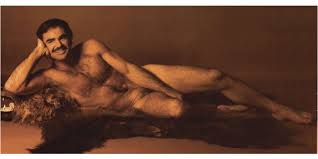
Think back, if you can, to the ancient days of yore when Burt Reynolds caused a stir by appearing naked on a bearskin (ahem) rug in the pages of Playgirl. He sported an abundance of chest hair, dark and luxuriant, flaunted for all the world to see. Besides, it went nicely with all the rest of his body hair, which you could see most of.
imgres

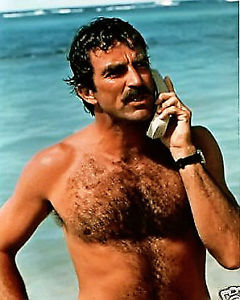
Think Tom Selleck as Magnum, P.I. Now there was some chest fur to fantasize about running your fingers through.
$T2eC16d,!y0E9s2S7)mtBRbd8EoETw--60_35

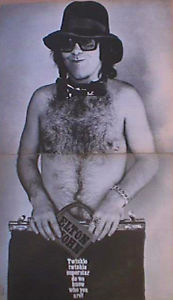
Even Elton John fer-gosh-sakes was willing to show off a chestful of abundant curls back in the day.

$(KGrHqJHJC4E8+3UtUlhBPb17R(DQ!--60_35

Of course, those were the days when it was fashionable to wear one’s shirts open practically to the waist, so that one could show off a silver coke spoon, but hide it in the follicular thicket when the cops rolled by.

Personally, I blame Tom Cruise.

From the first time his blank chest appeared on the big screen, useless nipples accentuated by pale skin and lack of other adornment, hairless chests were in.(2)

Enter the grooming industry. They had already made an investment – and a pile of money – by convincing women that body hair was disgusting and needed to be eliminated. That led to underarm shaving, mustache waxing, shaved legs, bikini zone waxes, and those weird red lights that will kill the hair off your arms or anywhere else.(3)

Now they’ve started in on men. They’ve done the best they can with men’s hair and mustache coloring, manly scented soaps, assorted shaving products – and suddenly the “manscaping” has started. Mostly it’s confined to the male chest, but there is also, I understand, what’s known as the “full Brazilian.” This is the male equivalent of women shaving their pubes into fancy shapes or dispensing with them entirely.(4) Men don’t get to do the cute shapes.

Where was I? Oh, yeah. What’s so bad about a rugged, hairy chest, anyway? You’d think men would be proud to show off their testosterone that way. Apparently not. It’s not “civilized.”(5)

But you don’t have to be Grizzly Adams to show off your chest hair. Some errant curls peeking coyly above the top button of a shirt can make a gal long to start undoing the rest of them. Only those with a measly two or three weedy strands need to worry.(6)

On the other side, hairy backs, we are given to understand, are a different matter entirely – gross, disgusting, and laughable. Yet we only hear of men waxing their chests – never their dorsal regions. Why is that? Because movie stars are reluctant to turn their backs to the camera? Women see real men’s backs all the time. They go to bed with such hirsute men. They even like to snuggle up to them and at such times a layer of thick, warm fur can be a pleasure. Especially on a chill winter’s night.

As for me, I snuggle up at night to a man so fuzzy that he is known as “Dan, the Human Loofah,” the second-hairiest man I’ve ever seen.(7) Do you think he cares if I shave my legs and underarms? Do you think he notices?

Between the two of us, we may just drive the grooming industry to despair, if not bankruptcy. I imagine they’ll manage to console themselves with all the Tom Cruise wannabes.

(1) It’s not all that interesting. All developing fetuses start out as female. Some of them later become male, but by that point the nipples are already there.
(2) Noah Michelson, writing in the Huffington Post, remarked, “Even the werewolves on ‘Teen Wolf’ are hairless.” Werewolves with no chest hair? Dafuq?
(3) I don’t know why overarm hair has suddenly become a problem, but I’m sure one of the fashion magazines will tell me.
(4) The wily grooming industry, along with the porn people, sell women the desire to look younger, prepubescent even. And don’t tell me there is no link between that and pedophilia. Making grown, sexually available women resemble girls who have not yet endured puberty cannot be a healthy thing. I don’t think the trend toward waxed male chests and crotchal areas has anything to do with looking pre-pubescent. I could be wrong, but I don’t want to think about it if I am.
(5) Writing for Bustle, Erin McKelle Fischer references the film The 40-Year-Old Virgin and calls the memorable chest-waxing scene “the taming of the beast before our eyes and his implied transformation from wild man into gentleman.”
(6) Those men should be the clients for waxers. But their waxing sessions wouldn’t take long or generate much revenue.
(7) The first-hairiest was a co-worker who came to the office Halloween party dressed as Fred Flintstone. Didn’t get a picture. Sorry.

When Life Gives You Daughters…

Dad wanted sons, it’s clear in hindsight. What he got was me and Lucy.(1)

Being a good dad, he never said – at least within my hearing – that he really wanted sons. He never said it to my mother within my hearing either.

But there were subtle signs. He gave us boys’ nicknames, for example. Lucy was Buddy and I was Cubby, after the cute little boy Mouseketeer.(2)

Dad would roughhouse with us. He took us to the rifle range and taught us to shoot. He wanted me to grow up to be an engineer. Lucy was determined to be either a jockey or a veterinarian neither of which was a realistic goal, but he left her to her fantasies and decided that I should follow in his footsteps.(3) My mother finally convinced him not to try talking me out of my goal of being a teacher, but by the time she succeeded I had already given it up.(4)

Dad was no feminist though.(5) He just wanted children that he could engage in his guy pursuits with. He wasn’t a sports fan, but he encouraged – no, positively enabled – any interests or hobbies I had that were even quasi-military.(6) I liked archery, fencing, and martial arts. He would buy me all the equipment or accessories I needed. One Christmas he even gave me a Black Widow model slingshot. It had a spiffy wrist brace so that you could get a steady aim and a stronger pull. I don’t think I ever used it, but if I had wanted to I could have put a ball bearing through the side of the garage.

Lucy and I were what they called tomboys back then – me more than Lucy.(7) My mother still got a chance to indulge girlier whims. Every Easter would find us dressed in ruffled pink organdy with frills and itchy headbands adorned with fruit or flowers. Little white patent leather shoes and little white ankle socks were also required, as was the taking of pictures in front of the house.(8)

Despite the occasional attempt at girliness, Lucy and I were not indoctrinated into the prevailing feminine ideals. For example, neither of my parents ever even hinted that I should hide my brains so as not to scare off the boys. In fact, they encouraged me to show off my smarts in some fairly obnoxious ways. I always knew college was my destiny, but I never got the impression that marriage and motherhood were also expected. It came as a surprise to everyone – most of all me – when I did acquire a husband.

Perhaps not surprisingly, that husband turned out to have a combination of male and female traits himself. He bonded with my father by replacing his shocks and with my mother by gardening. He has a background in private-duty nursing and has often had women for bosses.(9) I don’t know that much about his upbringing, but I do know it left him flexible and understanding about the limits of gender roles. I know even less about Lucy’s husband, but I think it’s probably significant that he drives for Meals on Wheels, another sort of caretaking.

In a way I feel sorry for the girls I see who are raised to be princesses in pink. It’s so limiting. We were raised not as girls, not as boys, not as girly boys or boyish girls, but as children (10), who came from male and female, and carried bits of both inside us. And I can’t speak for Lucy, but I think the experience has served me well.

(1) That’s not her real name, but I may occasionally say unflattering things about her and want to cover my bets. And my ass.
(2) Admittedly these were better than the nicknames one guy on a reality show gave his little daughters – Truck and Tank. But ours were still just a wee bit butch.
(3) He was an industrial engineering technician, and since I was destined for college, that made me the obvious choice. I suppose I could have become an engineer, but I would have been a very unhappy one.
(4) There were much more exciting things to be, like a bus driver, a chemist, an FBI agent, or a poet.
(5) When I decided to keep my own name – well, his name, really – after marriage, he quoted that bit to me about the man is head of the woman as Christ is head of the Church (Ephesians 5:23).
(6) He considered “The Caissons Go Rolling Along” to be a fun, catchy children’s song.
(7) I don’t know what they call tomboys now. Just girls, I think. Or maybe children with non-conforming gender identity norms. If you’re a sociologist, I mean.
(8) Some of these pictures may still exist, but you’re not going to see them here.
(9) Not to imply I’m bossy or anything.
(10) It could have been worse. When we were out and about in the neighborhood Dad would whistle to call us back home. I suppose we could have turned out to be dogs.