All posts by Janet Coburn

An Investment in the Future

My investments are not stocks and bonds and they’re not biological, but they affect the future anyway.

I don’t have any children—I’m the proverbial cat lady—and because of that some people are saying that I’m not contributing to the future of our country or that I shouldn’t get an equal say in how our country is run. And I think that’s just plain wrong.

Some families have no children because they can’t have any. Others don’t want children, for whatever reason. But making the most fundamental right of our society dependent on whether a person has a child is a profound violation of the foundations of our democratic society. Even if you’re a strict constitutional constructionist, there’s absolutely nothing in there about voting being contingent on offspring. (That voting was originally limited to white male property owners is another issue that hasn’t yet been brought up.)

This proposal is billed as “pro-family,” but it’s nothing of the kind. It defines family as only one kind of family and denies rights—not privileges—to the rest. Granting those privileges to children, to be exercised by their parents, contradicts the basic principle of one person, one vote. When those children turn 18, they are welcome, even encouraged, to cast their votes for themselves. But allowing parents extra votes per child is nonsensical.

I wonder how long it will be before the definition of a family is a two-parent (heterosexual) couple with children. Will single mothers get to vote more than once, considering their children? Single fathers? If a family doesn’t include two parents living together, does the voting right automatically go to the mother? The father? These matters are far from clear. And unless I’m mistaken, they would require a constitutional amendment to go into effect. In other words, it’s grandstanding.

But leaving that political nonsense aside, what are the rights that childless people have, or should have, regarding children?

Well, first of all, our taxes pay for schools, parks, lunch programs, Head Start, child tax credits, nutrition programs, Social Security survivors and dependents, Social Security Disability, Medicaid and health insurance, and of course schools, among others. I’m paying into those whether I have children or not.

I don’t resent that. I think such programs are necessary and I’m glad to help fund them. The children and families they help impact me directly and indirectly. They will be my congressional representatives, my nursing home aides, the inventors of devices that will improve my life—every slot that must be filled to make society run, if not smoothly, then at least adequately.

Of course, not all children have the same start in life or pursue noble or necessary functions. I would like to help them do so. The way I can do this is to vote. These issues and functions affect me in very real ways that I have the right and the privilege to vote for.

And I do vote.

Now, let’s talk about schools. Because I don’t have children, many people think I should have no say in what happens in schools. I disagree. What happens in the schools affects me too. I want doctors who have a firm grounding in accepted science. I want bankers who have a keen grasp on economics. And I want government people who have a thorough understanding of civics. That means I have an investment in what goes on in schools and what children learn.

I’ll never be on a school board or even a member of the PTA, but I do get to vote for who’s on the school board and I pay attention to what they do. Now, I’ve got no problem if people want to homeschool their children or send them to private schools, as long as my tax dollars go to the public schools. Public money, public schools.

But don’t try to take away my rights as a citizen or come up with some hare-brained scheme to make my vote count for less. You can say the children are our future all you want.

But they’re my future too. Whether I’ve given birth to any or not.

Kneecapped!

It began with a cat, of course. No, it didn’t. It started with an Arabian horse. Either way, it was the beginning of the end for my body.

(Technically, it started with a bucket of wood. At one time, I annoyed my back by carrying the wood up two flights of stairs, the other option being freezing to death. But what I didn’t realize at the time is that an annoyed back will never allow you to forget. But I digress.)

Anyway, there I was at the vet with a sick cat. I bent forward maybe 15 degrees to put the cat on the examining table. And my back did more than complain. It stabbed. (“How big was the cat?” asked everyone who heard the story. It was a normal, eight-pound cat. But I digress some more.)

That led to my first experience with back surgery. After trying unsuccessfully to ignore the pain and treat it with drugs, I had what was called a micro-laminectomy. Basically, they delved into the small of my back and scooped out little bits of bone from between the discs, or maybe bits of disc from between the bones. It helped.

Enter the Arabian horse. A friend owned it and offered to let me ride it. Bareback. I knew it was a dicey proposition with my back’s former lack of cooperation, but it was an Arabian horse, so I took a chance. Shortly thereafter came another round of stabbing and another micro-laminectomy. I was pronounced good to go, until, the surgeon said, I wanted a metal rod up my spine. I didn’t. (Favorite quote: “Bone on bone.”) So I gave up on horses, however Arabian they might be.

(Dan and I were talking the other night. He said, “There comes a time when you try to do something and realize, no, I can’t do that anymore.” I replied that I hadn’t had to try turning a cartwheel to realize I could no longer do it. “Not since the Arabian horse,” I said. He admitted that I had a point. But I digress again.)

But all that’s in the past. What I have to deal with now owes nothing to carrying wood, escorting cats to the vet, horseback riding, or back surgery. Now I’ve found that I’ve been kneecapped. And not by a Mafioso. By my own knees, which apparently I’ve had for far too many years.

A few years back, I told my doctor that my knees made crackling sounds when I climbed stairs. “Come back when they hurt,” he said. They did, and I did. After a little while fooling around with Tylenol and ointments, he decided I should have steroid shots in my knees. With a huge syringe and a long needle. (It actually didn’t hurt that much. There was just a weird sense of pressure inside my knees.)

I got a referral to another doctor who gave the steroid shots more frequently. (Favorite quote: “Bone on bone.”) “When they don’t work anymore, we’ll talk knee replacement,” he said. I think he meant the shots not working. Maybe he meant my knees.

I don’t particularly want to get bionic knees, but I also don’t want to keep limping and stumbling. Never mind a “Good Hair Day.” I’m satisfied when I have a “Good Knee Day.”

My Emotional Support Ambient Noise

I need lots of emotional support. I get it from my husband. I get it from my cat. I get it from my bed, my pillow, and my blankets. I get it from my computer and my writing. I get it from music.

But I also get it from my television.

I need noise—some kind of noise—to keep me functioning until I go to bed. After that, I need no noise at all. Even the fans bother me. (Once I had to tell my husband, “Please don’t use power tools after I’ve gone to bed.” It was something I never thought I’d have to say, but there you are. Or there I was. But I digress.)

You’d think that television would produce the kind of noise that wouldn’t let me write. This is true of music, except for instrumental music. Music with vocals is just too distracting. Half the time I want to sing along. The rest of the time, the vocals are just too intrusive. (My theory, supported by neuroscience, is that my brain uses two areas when I hear vocal music—the part that recognizes language and the part that processes music. Combine the two and I have no brain left over for writing. But I digress again. Pedantically.)

Television, however, provides vocals but not much music, at least not the kind that invades my brain. And I don’t even really listen to the voices either, which I turn down not quite to a subliminal level.

How can I avoid hearing the voices? I put on programs I’ve watched a million times before, like Buffy the Vampire Slayer, Inkmaster, Chopped, Mystery Diagnosis, or Forensic Files. They rattle around in the background, but not in my brain. (Occasionally, I glance over at the screen if something really interesting is going on such as the critiques on the episode of Inkmaster when everyone was supposed to tattoo someone’s ass and they all tattooed the flank/hip area. “Doesn’t anyone know where the ass is?” asked Dave Navarro. But I digress some more.)

This may be genetic (the need for ambient noise, not the location of the ass, though come to think of it, that’s genetic too). Anyway, my mother used to crochet a lot, and she often had a baseball game on in the background with the sound turned low. She didn’t even like baseball. I can only assume that it provided her with the kind of comforting background noise that I like. I imagine that football would be too raucous and basketball would be too frenetic. She could have chosen golf, I suppose, but baseball it was, at least during the season.

Anyway, I spend most of my time at home, alone in my study trying to write or edit. When Dan comes home, there’s plenty of noise and it’s attention-grabbing, not ambient. If I’m still writing, he’s quiet, except when he goes in the living room and watches TV there, usually the Screaming and Explosions Channel.

So, why do I think of my programs as emotional support? The house is pretty quiet when I’m alone here, except for the faint clicking of my keyboard and the cat, who pussy-foots and busy-noses when he’s not asleep. Ambient noise keeps me from feeling lonely and imagining that any tiny sound is an impending disaster. Loud sounds made by the cat signal actual disasters. My ambient noise grounds me and marks the passage of time. And it’s a whole lot more soothing than power tools.

Lost Kitty Tale

Once there was a kitty who chose us as her family. My husband had seen her around the neighborhood, and one day she came trotting through the flowerbed up to our door and asked to be let in.

Dan instantly wanted to keep her. She was a young-ish calico, and he knew how much I love calicos. But I wasn’t sure. Our most recent calico, Julia, who was the most beautiful cat in the world (or so she told us) had died just a little while before, and I didn’t think I was ready to give my heart to another one.

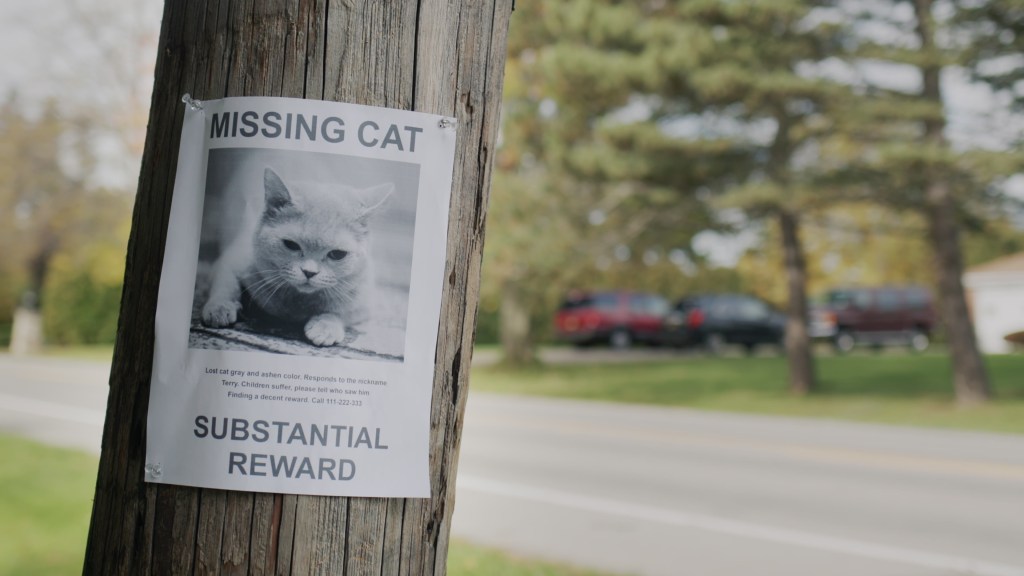
Then fate stepped in. We saw a flyer in our neighborhood for a missing calico cat. The address was very close to us. So we called the people who put up the flyer and invited them over to check out the stray.

At this point, any normal person would have held out the cat and said, “Is this her?”

But I’m not (as you probably have noticed) a normal person. I left the cat in the bathroom, which is where we keep stray cats until they pass a vet check.

I approached the guy, the putative owner. “So you’ve lost your cat.”

“Yes,” he said.

“A calico.”

“Yes.”

“Is she thin or chonky?”

“Medium, I guess.”

“What color are her eyes?”

“Yellow.”

I continued the interrogation.

“What color is her nose?”

“Pink.”

“What’s her chin look like?”

“I don’t know. Nothing special, I guess.”

“What color are her feet?”

“White….” (He was beginning to catch on to the not-normal thing.)

He was batting less than 50 percent. Her nose was pink and her feet were white, which could have been true of any cat. But there were telltales. The stray was slender, not medium. There was a slight gray smudge on her chin. She had one green eye and one yellow, which was a dead giveaway.

At that point, I brought the cat out.

“No,” the neighbor said, disappointed. “That’s not her.” And he sadly left.

That was the moment that I knew that not only had she chosen us, but I had chosen her too.

We named her Dushenka (Russian for “Little Soul”) and she stayed with us for 12 years. She still escaped and went walkabout on occasion, just to keep her hand—er, her paw—in, but she always came back to us. We were hers.

Cran-Apple Schnapps and Other Atrocities

My friend Tom Smith wrote a funny song containing the phrase “cran-apple schnapps” as an idea for a repellent beverage. Then Ocean Spray came up with Cran-Apple drink and suddenly, the whole thing seemed a bit less ridiculous. (Linguists used to have a thing called a cranberry morpheme, a part of a word that could only be used with one other word part. Cran only went with berry. Then Ocean Spray got creative and now the cranberry morpheme is a thing of the past. I guess now they call it a huckleberry morpheme. But I digress. Pedantically.)

Now Ocean Spray has even more flavors, including white-cran-strawberry, white-cran-peach, cran-lemonade, cran-tangerine, cran-pomegranate, cran-pineapple, cran-raspberry, cran-blueberry, cran-blackberry, cran-grape, cran-mango, cran-ruby-red-grapefruit, cran-citrus-mango-pineapple, cran-cherry, cran-lime, and cran-iced-tea. To me, they all sound like okay flavors for nonalcoholic beverages, but lousy flavors for schnapps.

Schnapps ought to come in regular flavors like peppermint and peach. (While doing my research for this post, I came across Cactus Juice Schnapps. My initial reaction was bleh, but I don’t really know and have no desire to find out. But I digress again.)

Vodka is another liquor that comes in an alarming variety of flavors: lemon, lime, lemon-lime, orange, tangerine, grapefruit, raspberry, strawberry, blueberry, teaberry, vanilla, black currant, chili pepper, cherry, apple, green apple, coffee, chocolate, cranberry, peach, pear, passion fruit, pomegranate, plum, mango, white grape, banana, pineapple, coconut, mint, melon, rose, herbs, bacon, honey, cinnamon, kiwifruit, whipped cream, tea, root beer, caramel, marshmallow, and many more.

I think I understand the fruit-flavored ones since vodka drinks often include limes, cranberries, or other fruits. But bacon vodka is just weird. Whipped cream and marshmallow flavors just sound abominable and an occasion for projectile barfing. (I understand that flavored vodkas were invented to entice more women to drink more vodka. Hasn’t worked on me. But I digress some more.)

Whiskey hasn’t escaped the flavor-fying either. Now there are whiskeys subtly or not-so-subtly tasting of spiced apple, cinnamon, cherry peach, apple, vanilla, peanut butter, blackberry, salted caramel, chocolate, caramel turtle, cookie dough, honey, jalapeno honey, chocolate cherry cream, banana, praline, gingerbread, black cherry, maple, strawberry, chocolate mint, ruby red grapefruit, salty watermelon, mango habanero, peanut butter jalapeno, marshmallow chocolate, coconut, birthday cake, whipped cream, pineapple, kettle corn, barbecue, butterscotch, s’mores, rocky road, espresso martini, pumpkin pie, lemon pepper, candy cane, blood orange, strawberry banana, and grilled pineapple. There’s even one called Elvis Midnight Snack whiskey with flavors of peanut butter, banana, and bacon.

(I sort of understand coffee whiskey, because there’s a wonderful whiskey drink called Irish Coffee. Chocolate mint, however—I love chocolate mints and I like whiskey, and I may or may not have eaten a chocolate mint while sipping whiskey, but as far as making the two one, I’ll pass. But I digress yet again.)

Soda flavors are getting more inventive too. I’ve recently encountered Spiced Coke, which is supposed to have an undertone of raspberry, but the only flavor I get when I drink it is cinnamon. I rather like it. There’s also Strawberries and Cream Dr. Pepper, which Dan likes; Cherry Lime Sprite; Baja Blast Mountain Dew (tropical lime, colored blue for some reason); vanilla, cherry, peach oolong tea, and mango Pepsi; Coke black cherry, lime, lemon, raspberry, mango or Coke marshmello (their spelling); 7-up cherry, citrus, orange, raspberry, tropical twist, pink grapefruit, pomegranate, and mixed berry; Dr. Pepper cream soda and cherry vanilla; and Mountain Dew cherry, lime, orange, raspberry, watermelon, lemonade peach, citrus cherry, and blackberry. Some of those are limited-time flavors or ones sold only overseas.

I don’t resent the fact that companies are introducing new flavors. Some of them I even like, and others my husband likes. And I know that adding new flavors is a way for them to attract new buyers who haven’t been satisfied with the usual choices.

But, for heaven’s sake, guys. Too much of a good thing is not necessarily a good thing. You’re taking up too much space on the shelves, and they’ll run out of the flavors I want. Use some restraint!

The Tyranny of SEO

There’s a phenomenon called “search engine optimization,” or SEO for short. And I’ve grown to hate it.

The idea of SEO is to increase the chances of your post, article, book, or whatever being at the top of the responses to a Google search. Writers and publishers in particular are invested in making sure that their wares gain the attention of Google and then potential readers.

SEO works by focusing on keywords. There are certain words and phrases that people search for more than others. If your work contains these words, it will appear further up the Google results and, presumably, increase sales. It’s all about “search visibility” and marketing strategies. There are plenty of books and websites that teach you how to improve your SEO game.

What are some of the best, top keywords that people search for? Well, best and top show up high on the lists. Everyone wants to know the best places to eat or the top-rated appliances, so those words show up a lot. “How to” is another search term that gets top results.

There are lists of keywords for any number of fields. If you have a book or article on health and fitness, your SEO keywords include “weight loss,” “lifetime fitness,” and “health tips.” Business keywords include “money” (of course), “opportunity,” “income,” and “profitability.” There are lists of keywords for coffee, dog training, and poker, among many, many others. For one of my areas of interest, mental health, keywords include “symptoms,” “medication,” and “side effects.” There are companies that specialize in giving you a list of keywords for your project—for a price.

What really ticks me off is what this has done to book subtitles. (Yes, I know that there are much more important things to be ticked off about, especially these days. However, I work in the publishing field, so I get to see a lot of subtitles. But I digress.)

Let’s start with one that isn’t all that annoying: How to Sustain Personal and Organizational Excellence Every Day. Eight words only. But look at the SEO keywords. We have Personal and Organizational Excellence. Sustain may be a keyword too, and so might Every Day. What could the author have done instead? Organizational Excellence ought to do it. Combined with a title like Habits for Success, that ought to do it. Still plenty of SEO words. Or just have a title: Success and Organizational Excellence. No subtitle. But that goes against every publishing rule, evidently.

Here’s another subtitle that’s been reined in just a bit: Reflections on Death, Rebirth, and Hunger for a Faith. Nine words. It says what you’ll find in the book without going on and on. Just enough to pique the potential readers’ interest. (While we’re on the subject of things that tick me off (and I think we were), I cringe whenever I see “peak” someone’s interest, or, God help me, “peek.” But I digress again.)

Now here’s a subtitle that goes a little further overboard: Dynamic Techniques for Turning Fear, Indecision, and Anger into Power, Action, and Love. Thirteen words. Dynamic Techniques, Power, Action, and Love are obvious self-help SEOs. I can imagine the title that would go with it: Transform Your Life.

Let’s keep going. Next on my list of terrible subtitles is Stop People Pleasing, Staying Silent, & Feeling Guilty… And Start Speaking Up, Saying No, Asking Boldly, And Unapologetically Being Yourself. Twenty words, one of them a mouthful by itself: unapologetically. Honestly, I think you could read the first chapter in the time it takes to read the subtitle.

Finally, here’s a subtitle that really grates: Transform Your Body in 28 Days with Illustrated Exercises. Lose Belly Fat, Sculpt Glutes, and Feel More Energized in Just 10 Minutes a Day! Twenty-four words, four verbs, and a plethora of nouns and adjectives. And a promise with an exclamation point. What is there left to say in the book? Whoever wrote that subtitle ought to have their thyroid checked.

On the other hand, maybe I’m just jealous. I wrote two books before SEO took off. (I still get royalties. I’m saving up for a pizza. But I digress some more.) Maybe I should have called them Bipolar Me: The True Story of One Woman’s Journey Through Mental Illness, Depression, and Hypomania, Based on Her Weekly Journal of the Same Name and Bipolar Us: A Deep Dive into Bipolar Disorder and Its Devastating Effects on Sufferers and Society, the Highs and Lows That Come With It, and How to Find Peace and Stability.

Of course, if I did that, the subtitles would have had to be printed in little tiny type, another aspect of publishing that really ticks me off. With my bad eyesight, I wouldn’t even be able to read my own subtitles. I can’t win.

The Cat Burglars

I used to live in a drafty log cabin on a windy hill. There were plenty of odd noises, especially at night. Now I live in a regular home in a windy valley, with lots of clutter. There are still plenty of odd noises, especially at night.

It’s been my policy to blame the cats (usually from three to five of them) for any noises – rattling, thumping, skittering, whining, tapping, crashing, howling, et endless cetera. Even if every cat in the house is occupying my lap at the time, I still try to find a way to blame alarming noises on them.

One night, however, my husband and I were peacefully sleeping when I thought I heard a noise in the living room.

It sounded like whispering.

Whatever else they do, cats don’t whisper. For once I couldn’t blame them. It had to be burglars, I thought, discussing what they wanted to take or which house to hit next or why we had such crappy stuff and was any of it worth anything.

I didn’t want to wake my husband, because then I’d have my N.O.W. card taken away, so I tried to remember where we put the baseball bat and extended my hearing as far as it would go. I crept closer to the bedroom door, where I could hear the sounds better.

Then I realized that the noise was indeed people whispering. In French.

Even in my fearful, dazed state, I couldn’t believe that there were actually burglars in my house, in Ohio, speaking French.

So I tiptoed into the living room. If for some unlikely reason, there were French-speaking burglars, I could astound them with my knowledge of French, threaten to call the gendarmes, or at least ask them for directions to the bibliothèque. (That’s most of what I remember of my high school and college French. I also remember some of my college Russian, in which I can say useful things like “Excuse me, please. Where do they sell books on history?” and “Yes, cabbage is a good thing.” (At least I would never be bored or starve.) But I digress.)

When I tentatively poked my head into the living room, however, I found the French speakers were on the television. A foreign film was playing. Funny. I hadn’t left the TV on when I went to bed.

Hm. My husband doesn’t watch foreign films or know any French or other foreign languages. (Actually, that’s not quite true. He knows a song in high school German that goes “My hat has three corners. Three corners has my hat. If it doesn’t have three corners, it’s not my hat.” But I digress some more.) Besides, he was asleep in bed.

Then I realized what had happened. Someone had activated the remote and selected a film channel. With the sound very low. Although I couldn’t name the culprit, it was clearly Matches or Maggie or Chelsea or Shaker, all of whom were giving me the “Who, me?” look. One of them had done it, or they had all cooked up the plot together. There was no use dusting for paw-prints. No doubt they had wiped them off with their floofy tails.

So the one time I knew it couldn’t be the cats, it was. Now I blame them for everything. Always.

Who Owns the Rainbow?

I can’t believe that a rainbow is controversial, but there you have it. These days it is. The problem is that the rainbow means many different things to many different people.

This being Pride Month, we see a lot of pride flags, shirts, coffee cups, buttons, posts, memes, etc. with rainbows on them. They are brightly colored rainbows, not the more pastel kind you see in the sky after a rain. They’re meant to symbolize sexual diversity and visibility. The rainbow flag was first flown in 1978 at the San Francisco Gay Freedom Day parade. Now the rainbow flag stands for gay pride. You also see flags with white, pink, and blue, and black and brown added in some configuration for trans visibility and POC intersectionality.

There’s pushback, though. There’s the question of whether—and how much—rainbow merchandise should be displayed in mass-market retail stores during Pride Month. The manufacturers and sellers, whether they actually support the LGBTQIA+ community or not, naturally want to make money, and their first instinct is that people supportive of gay pride will buy rainbow-themed products. The pushback comes from some in the heterosexual community who feel that too much square footage and prominence have been given over to gay pride merchandise. Fearing that they would lose money if the complaining heterosexuals shopped elsewhere, some retailers cut down on the stock of rainbow merchandise or put it in the back of stores so it would be, if not back in the closet, at least less in-your-face.

Some Christians also push back against the rainbow-as-gay-pride concept by invoking religion. The rainbow, they say, belongs to God and is not to be associated with what they see as sin. It was a sign of God’s promise never to destroy the world with a flood again and so symbolizes holiness, faithfulness, and salvation. I’ve seen Facebook posts and memes promoting this understanding of rainbows and an attempt to “take back” the rainbow for God.

Call me pedantic, but no one seems to talk about what a rainbow actually is. It’s a product of refraction, which Sir Isaac Newton explained in 1665 when sunlight hit a prism and produced a color spectrum that resembled a rainbow. National Geographic defines a rainbow this way: “a multicolored arc made by light striking water droplets.” The controversy over rainbows, however, is not about what they are but what they symbolize.

Symbols, to get pedantic again, are not absolutes. They mean what we put into them, what we believe about them. And they change meanings over time. The Don’t Tread on Me flag (technically called the Gadsden Flag) was once a symbol of Colonial America’s resistance to the British. More recently, it became associated with the Tea Party movement and other right-wing causes. What does it symbolize now? Independence (though not from the British)? No taxation? Anti-government sentiment in general? Objections to one particular political party? All of the above? None of the above? When there’s that little agreement, the symbolic meaning fades out and the flag simply means “I’m angry” or perhaps “I’m defiant.”

The same is true of the American flag as a symbol. To some people, it represents the United States itself. To others, it means American ideals like liberty and justice for all. To still others, it stands for the US military. So if you disrespect the flag (in whatever way) who or what you’re disrespecting—the nation, the ideals, or the military—depends on how you interpret the symbol. (There’s no pushback at all against flag-themed clothing. At one time that was thought to be disrespectful too. It’s part of the US Flag Code that the flag shouldn’t be worn as clothing, but hardly anyone knows that anymore, much less abides by it.)

So, back to the rainbow. Going on the principle that a symbol means what you put into it, there’s no use fighting over what it means. It means different things to different people in different circumstances. Everyone is entitled to associate it with any meaning they prefer, whether that be gays or God. Or, as I prefer, refracted light in the sky that looks pretty. That’s a lot less contentious.

Now I wait for the comments that I’m disrespecting gays, God, or America (though probably not Sir Isaac Newton). You’re entitled to your symbolism. But no one owns the rainbow.

The Horse I Rode In On

It all started with a vulgar radio ad and turned into an adventure. ([sultry female voice: I wanna ride!])

I really hated the ads, but the premise was intriguing—a weekend horseback camping trip, complete with guide. So Dan and I gathered up Sheila and Harold—another couple who had an interest in horses—and signed up.

(All this was in the days before I abused my back by riding an Arabian horse bareback. The first time I annoyed it was when I had to carry wood up two flights of stairs or freeze to death. But I digress.)

Anyway, we met Larry, our guide, who showed up with four horses and all manner of camping equipment. He set up two tents for us and even found a way to connect my husband’s CPAP machine to power. Then we went out on the trail.

I didn’t have any trouble managing my horse at that point. But Sheila couldn’t get her horse to giddy-up no matter how she kicked, shook the reins, and verbally encouraged it along. It remained stubborn. (Later in life, Sheila and Harold bought horses of their own. Sheila even taught her horse dressage. But I digress again.)

The woods we rode through were as scenic as could be. There were trees that provided cool shade in the heat of the summer day. Unfortunately, Dan’s horse made a game of bumping into tree trunks and whacking his knees. The horses proceeded at a walk or a trot and occasionally broke into a canter. Frankly, I preferred the walk and the canter. The walk gave me time to look around and the canter was exhilarating and didn’t involve bumping up and down quite as much as the bruising trot.

We rode deep into the woods and then the nature, which was all around us, called. Dan had no problems with this (aside from getting down off his horse) and neither did Harold, but Sheila and I had to pee al fresco. (Fortunately, this was a skill I acquired in my youth on backpacking trips. I knew enough to carry tissues and avoid poison ivy. This is one of the only times I can truly be said to have had penis envy. But I digress some more.)

When we returned to camp in the evening, we learned that Larry was also our cook and an old hand at producing good meals over a wood fire. Not to say gourmet meals. This was before glamping was a thing.

Larry also rustled up a fine breakfast as we crawled out of our tents. We ached not just from the (admittedly) less-than-strenuous riding, but also from sleeping on thin tarps that only emphasized the pebbles beneath. We were all more interested in having several cups of very good coffee than getting back on the horses. This, of course, would cause a recurrence of the peeing problem later in the day.

Around the campfire that night, Larry told us how he had started his business and how other campers spent the whole time galloping their horses from one end of a field to the other and back again. No marauding trees or recalcitrant steeds for them.

The next day, we were back to our regular lives and jobs. There were some mementos of our experience. Dan had bashed-up knees. And you should have seen my inner thighs. (Well, no, you shouldn’t.)

While it was a memorable experience, we seriously doubted that we would be repeat customers. We were just too candy-ass. All in all, the adventure was like the Tower of Terror ride at DisneyWorld. It’s not that the horseback adventure was terrifying. It’s just that I’m glad I went on it once, but I’d hesitate to try it again, especially since my back won’t let me.

I Can’t Commit

Of course, that’s not completely true. There are things I can commit to—my husband, for example. We’ve been married for 41 years, which I think is proof aplenty.

What I can’t commit to are things that go on too long. (The marriage does not fit into that category.)

Let me explain.

Movies

In the evenings, when my husband and I have finished dinner, he often wants to watch a movie, but I don’t often agree to it. I hate leaving a movie in the middle, but I also hate staying up past my bedtime to finish one. It’s a delicate balance.

For example, after the recent eclipse, we decided on Ladyhawke, which was relevant, but I couldn’t make it all the way through. We had to watch the second half the next day and that upset my internal clock, not to mention my sense of continuity. If a movie starts at 8:00, it’s pretty much out of the running for me. I’m a little old lady and don’t like staying up past 9:00. (And you can get off my lawn. If I had one, I mean. Dan is aiming for a pollinator garden. But I digress.)

TV Series

When it comes to TV, I hate to start a series because I realize I’ll never keep up with it every week. This doesn’t apply to series that have already finished. Often, old episodes of House, Buffy the Vampire Slayer, Castle, Inkmaster, Chopped, or Bones are shown for several hours a day, and those I can tolerate multiple episodes of. (That may sound counterintuitive. The difference seems to be that I don’t have to pay attention to them. I usually have them on when I’m doing something else like writing. They’re just my emotional support background noise. But I digress again.)

Books

I used to be able to tolerate series of books. I devoured The Lord of the Rings, Asimov’s Foundation trilogy, Lloyd Alexander’s Prydain series, Sue Grafton’s Alphabet books, and other long-running written endeavors. Not anymore. I buy many of my e-books from discount sites for $1.99 or $2.99 (because I’m cheap). Many of them, as you might suppose, are not exactly scintillating. Some of them are so dreadful I give up on them well before I reach the denouement.

(One of the first ones I ever committed libris interruptus on was a horror novel that started by introducing the protagonists. They were perfect. Perfect looks. Perfect jobs. Perfect house. Perfect marriage. Perfect kids. By the end of the first chapter, I was rooting for the monster, which hadn’t even shown its tentacles, fangs, slime, or whatever. But I digress some more.)

I recently discovered that even book series I love can be too much of a commitment. I recently reread the three volumes of The Lord of the Rings, but couldn’t jump right into The Silmarillion. I love Lois McMaster Bujold’s Vorkosigan series and set out to reread them all, but pooped out after book ten. I needed a break (a la Friends) and haven’t come back to finish the other four. Yet. I have a feeling that after 600 pages of Midnight in Chernobyl, my current good read, I’ll be ready. (I hate the phrase “a good read.” It sounds too much like saying someone is a “good lay.” But I digress yet again.)

I haven’t even reread my own books (Bipolar Me and Bipolar Us). They don’t constitute much of a series and would make a terrible movie. But that’s not the reason. There’s a terrible typo in the first one, and I’m afraid I’ll find one in the second as well. If I weren’t depressed about the slim sales, that would do it.