A little-remembered Christmas carol starts out: “Christmas is coming/The geese are getting fat.” In “The Twelve Days of Christmas,” there are six geese the first time around, with more to come, based on their a-laying and the repetition of all the presents ad nauseam.
But you hardly ever see a goose baked and broiled sunny-side-up on people’s Christmas tables, or as part of turgooducken. Turkey and ham are the popular choices. (Me, I go for something nontraditional, such as sushi, lasagna, ratatouille, or Chinese take-out. The Chinese food, I guess, is more traditional for Jewish people, pagans, Pastafarians (who might prefer the lasagna), and others with unconventional tastes. But I digress.)
Why does no one sing the carol about the fat geese anymore? Probably because the rest of the song is about charity to the poor—”Please to put a penny in the old man’s hat./If you haven’t got a penny, a ha’penny will do./If you haven’t got a ha’penny, God bless you.” Carolers these days hardly ever accept a penny for their services, and ha’pennies went out with farthings. Carolers might get a cup of cocoa or a cookie with red and green sprinkles, but that’s about it. Maybe they need a union.
Modernizing the carol wouldn’t come easily either. “Please to put a penny in the Salvation Army Kettle” doesn’t fit the meter, and nobody carries around ha’pennies these days. (Indeed, soon, they won’t carry pennies, either, what with the mint doing away with them, and possibly the nickel, too. You’d be left with putting a quarter in the kettle and settling for a dime. But I digress again.)
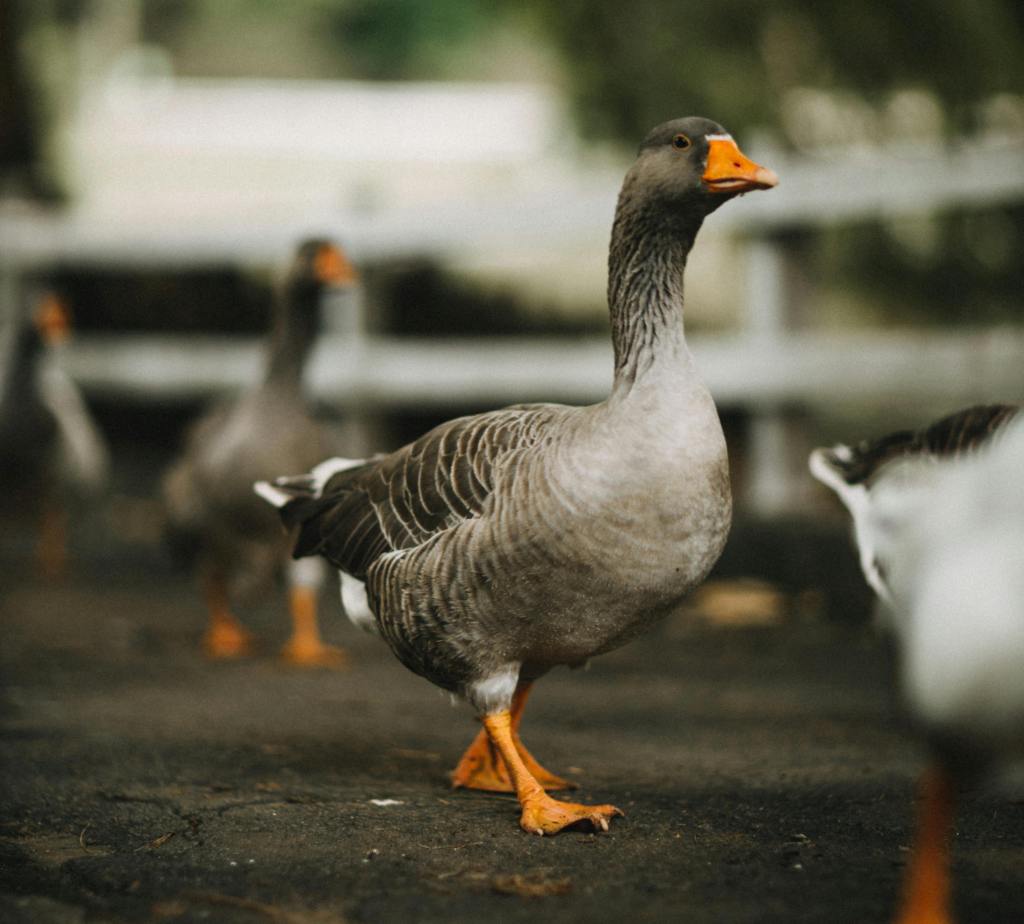
But back to geese. I don’t think I’ve even seen them on the menu at a restaurant. Perhaps it’s because they’re fatty (hence “The geese are getting fat”). Maybe it’s because they’re big. No one would order a whole goose. A smaller party might order slices of goose, but that would leave the kitchen with a lot of extra goose. What to do with it? Serve goose hash the next morning? I somehow doubt that would be a big seller.
Live geese aren’t any prize, either. They’re mean. Big ones can weigh up to 20 pounds. Just imagine an easily enraged, 20-pound bird with a loud cry, a hard knob on the top of its head, a large beak, and much given to pecking, chasing you around the yard. (It’s my theory that the fad of concrete dress-up geese on the front step (which I hope has passed) was thought up by someone from an ad agency who had been hired to improve geese’s image. But I digress some more.)
(For that matter, swans are also not candidates for the Beast Congeniality crown. Yes, they’re stunning—at a distance—and (it’s said) monogamous. But they are geese with an even better ad agency. They’re really savage. The Stratford Canada Shakespeare Festival warns visitors to avoid the killer swans that roam the grounds. (Despite the swans, the Stratford Shakespeare Festival is well worth a visit. They present theater-in-the-round and frequently stage works not written by The Bard of Avon. The 2026 season includes Death of a Salesman, Waiting for Godot, and Guys and Dolls. But I digress yet again.))
Anyway, we started this ramble with geese and Christmas carols. Every year, I ask friends what their favorite and least favorite Christmas songs are in both religious and secular categories. My favorite religious one is “Mary, Did You Know?” Least favorite: “The Little Drummer Boy.” My favorite secular song is “I’ll Be Home for Christmas.” Least favorite: “The Twelve Days of Christmas.” (Though there are some interesting parodies like “The Twelve Days of Star Wars” (https://www.youtube.com/watch?v=hHSEUAXDucw, if you want a change of pace. But I digress musically.)
In the comic strip “Peanuts,” Linus says that one should never discuss “politics, religion, or the Great Pumpkin.” That’s good advice, as far as it goes, but the list of things you shouldn’t discuss in public goes much further. In fact, erase that bit about “in public.” They’re dangerous to discuss among friends and family, too.
These days, politics is strictly off the table. You never know who has a concealed carry license. And Linus was certainly right that it’s best to avoid religion. When someone says, “Bless you,” the right answer is “thank you,” even if you’re not a believer. After all, they meant the religious equivalent of “Have a nice day.” (Or “gesundheit,” maybe. By the way, “Bless your heart” should be used with caution when you’re in the South. It can be a verbal middle finger. But I digress some more.)
Another topic to avoid is any that leads to a near-death experience. My husband, Dan, has blundered that way more than a few times. For example, when we were preparing for a party, I washed my hair, blow-dried it, used a curling iron, moussed, and sprayed. As I came down the stairs, Dan asked, “Are you going to do anything with your hair?”
And stay far, far away from talk of pregnancy. Suggesting that a woman is pregnant based on her weight, her clothes, or the way she waddles can be deeply offensive, particularly if she isn’t. In fact, one expert advises that you not comment on a woman’s potential pregnancy unless you actually see a baby emerging from her vagina at that moment. Better safe than hopelessly embarrassed. (I was a victim of this faux pas when I walked into an office looking for a job, wearing a loose denim jumper and a nice blouse. Admittedly, it may not have been the best choice for filling out an application, but the receptionist didn’t have to ask how far along I was. Later, she repeated the story as an amusing anecdote, not realizing that I was in the room and was embarrassed all over again. But I continue digressing.)
Everyone knows by now not to comment on a woman’s anatomy on pain of getting fired or a punch in the mouth. Not even when you’re trying to make a joke. I once told an acquaintance that I wasn’t at a party “because I was home nursing a sick cat.” “Didn’t you get scratched about the breast?” he asked. He almost got scratched about the face.
Then there was the time a guy had two girlfriends and was invited to a wedding. I don’t think he clearly understood the concept of a plus-one. He suggested taking one lady to the ceremony and the other to the reception. He somehow survived the occasion with at least one of the relationships intact. How? I don’t know.
Speaking of weddings, one of Dan’s bigger faux pas was when he suggested that, since his family lived in Pennsylvania and mine lived in Ohio, we should have our wedding on the state line, to inconvenience both families equally. (He was serious. But I digress for the final time. I promise.)
Because you’re bound to offend or insult someone, somewhere, sometime, my best advice, no matter what you are about to blurt out, is to remember your mouth has a zipper. Use it!
It’s Lent. So why are there three dozen paczki in my freezer?
As usual, this story begins with my husband.
(Actually, let’s start a little further back. If you’re not familiar with paczki (pronounced ponchkee, paunchkee, etc., depending on where you’re from), they’re Polish donut-like devices filled with cream, curd, or jam. They’re made and eaten in the lead-up to Mardi Gras (Fat Tuesday), the day before Ash Wednesday, the start of Lent. They were allegedly invented when an annoyed cook threw a ball of dough at her husband, and it landed in the fryer oil instead. I totally believe this origin story, knowing how annoying husbands can be. But I digress.)
The next thing to know is that Dan works in a store that has a bakery section. For the last few weeks, Dan has been bringing home boxes of paczki—blueberry, raspberry, lemon, and Bavarian cream.
But this week, as Lent rapidly approached, the bakery started marking down the paczki. And Dan can’t resist marked-down baked goods. He keeps me supplied with muffins (my usual breakfast). He’s the carb-peddler. He brings home French bread, Italian bread, sourdough bread, coffee cakes, apple caramel pies, and nearly anything else made with flour, eggs, and butter. (Fortunately, he doesn’t bring home game-day cookies shaped and decorated like little footballs. Or Jack-o-lantern cookies, for that matter. But I digress again.)
So, naturally, he brought home NINE boxes of paczki this week. (He did call and warn me, “I’m going to be bad,” which can mean nearly anything. But I digress some more.)
I’ve been stuffed with paczki for the last couple of weeks and couldn’t bear the sight of that many more. So we had a paczki party this week. Now, for most people, this would involve inviting over a bunch of people, making a huge pot of coffee, and chowing down.
But no. We couldn’t organize a party like that in the time it would take for the pastries to go stale. (When we do have a party (which isn’t very often), we have it at a Chinese restaurant. And paczkis would not really be welcome there. Still more digression.)
What we did have was a box of small plastic zipper bags. (We always have them on hand because Dan always takes peanut butter sandwiches to work with him, for his lunch and his breaks. I would get tired of peanut butter day after day, but he feels, as the old joke goes, “How can you ever get tired of food?” But I digress yet again.)
We sat down with our stack of paczki boxes and our box of bags and began stuffing, one paczki per bag. We licked the sugar off our fingers and stuffed all the bags in the freezer. When we get a craving for a paczki (which may not be until the run-up to next year’s Lent), we’ll just pull one out of the freezer and indulge. Or maybe Dan will take one for lunch. Or maybe I’ll give up on breakfast muffins.
I just hope there are no baked-goods-related holidays coming up for a while. I’m in sugar shock already.
I can’t believe that a rainbow is controversial, but there you have it. These days it is. The problem is that the rainbow means many different things to many different people.
This being Pride Month, we see a lot of pride flags, shirts, coffee cups, buttons, posts, memes, etc. with rainbows on them. They are brightly colored rainbows, not the more pastel kind you see in the sky after a rain. They’re meant to symbolize sexual diversity and visibility. The rainbow flag was first flown in 1978 at the San Francisco Gay Freedom Day parade. Now the rainbow flag stands for gay pride. You also see flags with white, pink, and blue, and black and brown added in some configuration for trans visibility and POC intersectionality.
There’s pushback, though. There’s the question of whether—and how much—rainbow merchandise should be displayed in mass-market retail stores during Pride Month. The manufacturers and sellers, whether they actually support the LGBTQIA+ community or not, naturally want to make money, and their first instinct is that people supportive of gay pride will buy rainbow-themed products. The pushback comes from some in the heterosexual community who feel that too much square footage and prominence have been given over to gay pride merchandise. Fearing that they would lose money if the complaining heterosexuals shopped elsewhere, some retailers cut down on the stock of rainbow merchandise or put it in the back of stores so it would be, if not back in the closet, at least less in-your-face.
Some Christians also push back against the rainbow-as-gay-pride concept by invoking religion. The rainbow, they say, belongs to God and is not to be associated with what they see as sin. It was a sign of God’s promise never to destroy the world with a flood again and so symbolizes holiness, faithfulness, and salvation. I’ve seen Facebook posts and memes promoting this understanding of rainbows and an attempt to “take back” the rainbow for God.
Call me pedantic, but no one seems to talk about what a rainbow actually is. It’s a product of refraction, which Sir Isaac Newton explained in 1665 when sunlight hit a prism and produced a color spectrum that resembled a rainbow. National Geographic defines a rainbow this way: “a multicolored arc made by light striking water droplets.” The controversy over rainbows, however, is not about what they are but what they symbolize.
Symbols, to get pedantic again, are not absolutes. They mean what we put into them, what we believe about them. And they change meanings over time. The Don’t Tread on Me flag (technically called the Gadsden Flag) was once a symbol of Colonial America’s resistance to the British. More recently, it became associated with the Tea Party movement and other right-wing causes. What does it symbolize now? Independence (though not from the British)? No taxation? Anti-government sentiment in general? Objections to one particular political party? All of the above? None of the above? When there’s that little agreement, the symbolic meaning fades out and the flag simply means “I’m angry” or perhaps “I’m defiant.”
The same is true of the American flag as a symbol. To some people, it represents the United States itself. To others, it means American ideals like liberty and justice for all. To still others, it stands for the US military. So if you disrespect the flag (in whatever way) who or what you’re disrespecting—the nation, the ideals, or the military—depends on how you interpret the symbol. (There’s no pushback at all against flag-themed clothing. At one time that was thought to be disrespectful too. It’s part of the US Flag Code that the flag shouldn’t be worn as clothing, but hardly anyone knows that anymore, much less abides by it.)
So, back to the rainbow. Going on the principle that a symbol means what you put into it, there’s no use fighting over what it means. It means different things to different people in different circumstances. Everyone is entitled to associate it with any meaning they prefer, whether that be gays or God. Or, as I prefer, refracted light in the sky that looks pretty. That’s a lot less contentious.
Now I wait for the comments that I’m disrespecting gays, God, or America (though probably not Sir Isaac Newton). You’re entitled to your symbolism. But no one owns the rainbow.
Despite what you may have heard, there is prayer in public schools. It’s totally legal.
You don’t think so? The government forbids it?
Not true! Students and even teachers pray in school every day. They always have and they always will. Pray all you want.
A student can pray before a test or just because. Groups that meet for that purpose can pray—during a free period, for example. (There was a group in my high school that did this. I attended a few times but left when they started planning a book burning.) There’s absolutely nothing stopping you from praying like this.
The only thing that’s not permitted in schools is requiring anyone else to pray with you or telling them how they have to pray. A principal or teacher can’t start class with a prayer. You can’t insist that students pray over lunch. You can’t base grades on whether or not a student prays. If a student chooses to pray, you can’t tell them which prayer to use. All those things fly in the face of the Establishment Clause of Freedom of Religion in the First Amendment to the US Constitution.
“Congress shall make no law respecting an establishment of religion, or prohibiting the free exercise thereof” is what it actually says. That means that there can’t be a law that makes one religion the official religion of the US. And it means that, if you do have a preferred religion, the government can’t prevent you from practicing it. It’s left up to the individual what religion—if any—they practice.
The problem comes when we’re discussing public institutions, which include public schools. (Obviously, students in religious schools can pray whatever the school says to.) The first part of the clause says that the public institution can’t declare an official religion. That’s why there’s no compulsory prayer in schools. The second part, “prohibiting the free exercise thereof,” says that everyone is free to worship in their own way. That’s why students are able to pray in schools during their free time, by choice, without an official such as a teacher or the principal leading it. The government can’t forbid it.
If prayer were to be required in schools, there would be any number of cans of worms opened. Let’s take a basic Christian prayer—The Lord’s Prayer.
Which version of the prayer would everyone be required to say? There’s a difference between the Catholic version and the Protestant version. But the wording also differs among the Protestant denominations and individual congregations. Debts and debtors? Trespasses? Sins? Many churches specify in the church bulletin which wording to use so that they can pray in unison.
Another can of worms is that not all Americans are Christians. Increasingly, children from other faiths are entering the public schools. Why should they be required to pray a Christian prayer? But what’s the alternative? Couldn’t they just sit quietly while everyone else prays or pray their own prayer silently to themselves? No. That establishes the prayer of one religion as the official classroom prayer to the exclusion of the others. Anyone who doesn’t share that religion gets treated differently. Their prayer is not the one being said for everyone. That’s the establishment clause again.
Then, think about what it would be like if Christians weren’t in the majority in a school. (For the moment, let’s suppose that the majority rules, which is many people’s assumption.)
But Christians aren’t always in the majority in a public school. I always think of the example of the followers of the Bhagwan Rashneesh. A religious community in Oregon, they incorporated as a city, Rajneeshpuram, which had around 7,000 people. Nearby Antelope, Oregon, had a population of about 60.
The State School Superintendent visited the district’s high school and found that it was “permeated with religious symbolism” and “did not look, sound, or feel like a public school.” The religious symbolism was Rajneeshee, of course.
Now imagine those people from nearby Antelope. If their kids had to attend the Rajneeshpuram school, which was officially a public school, how would their parents have liked it if the students were required to say the Rajneeshee prayers? Not so fond of required prayer in public schools now? Ready to take the Rajneeshees to court to prevent their prayers as unconstitutional? That would be my guess.
Last week I wrote about our trials and tribulations getting to and from Ireland. This week, I’m going into the more enjoyable parts of the vacation. And there were many.
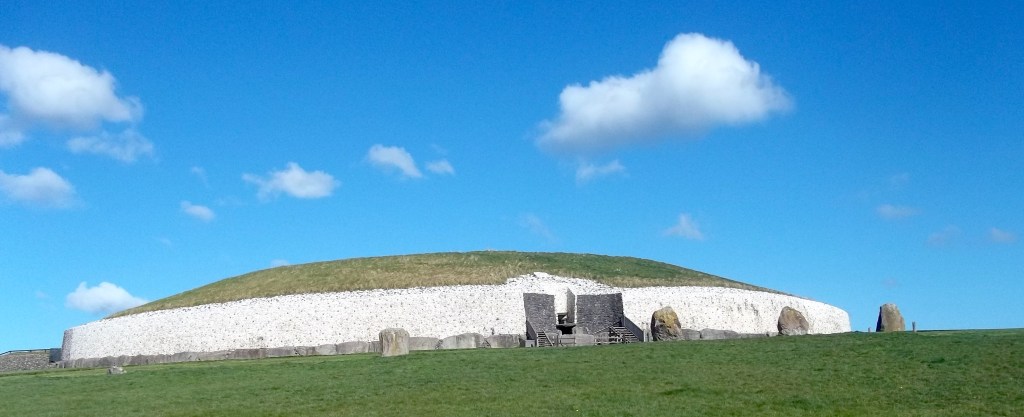
Newgrange. We saw the outside, but not the inside.
In the Boyne Valley, we wanted to see Newgrange and Knowth, two ancient stone tombs. We had booked a tour in advance. Unfortunately, we got lost on the way there and missed our appointed time. Dan was able to get a picture of the Newgrange monument from the road. When we go back to Ireland (whenever that may be), we want to spend several days just in the Boyne Valley so we can see everything at our leisure. We could also take a bus into Dublin to see the Book of Kells and other historic sights and sites.
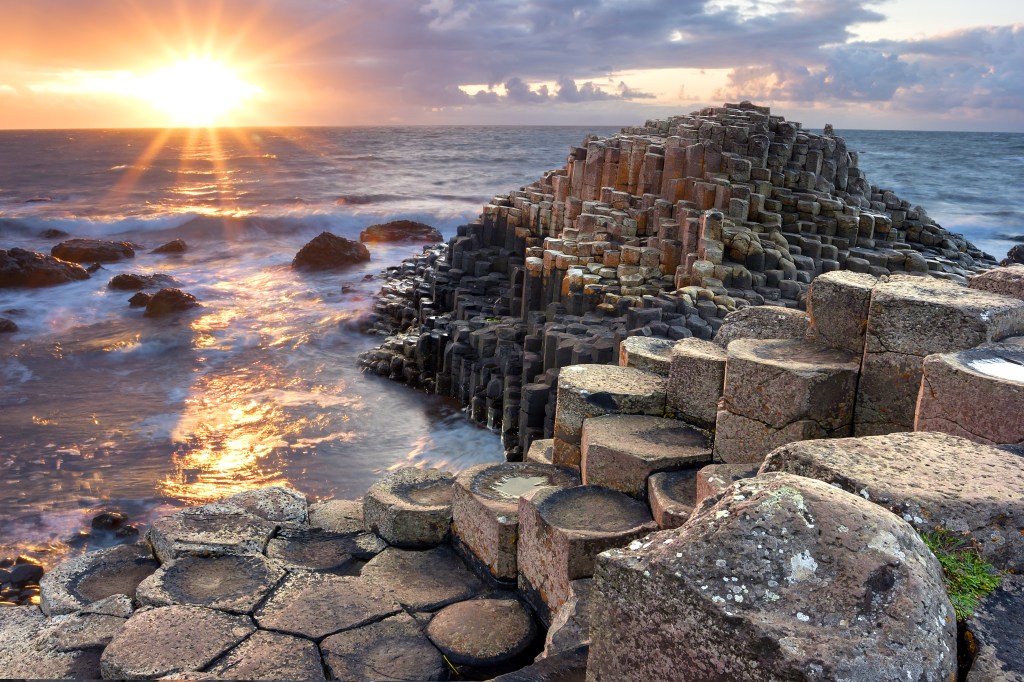
Here’s a picture of the Giant’s Causeway, which we didn’t actually get to see. This is a stock photo.
(We also never made it to the Giant’s Causeway for the same reason. We had a drive into Northern Ireland, though, where they take pounds and pence instead of euros. Someone told us it wasn’t all that great or interesting anyway. I would have liked to see for myself. The pictures of it are pretty spectacular. But I digress.)
After the Boyne Valley, we stayed at Brook Lodge in Donegal, probably my favorite of the hotels and bed-and-breakfasts that we were booked into by our travel company. It was a very homey place, where we could sit at the dining table and watch the host make us an Irish breakfast while she and Dan discussed gardening.
Off to Arranmore Island.
One of our excursions while we were staying in Donegal was to Arranmore Island. We drove to Burtonport and took the ferry over. Once we were on the island, I wanted to find a pub and get lunch, but Dan insisted that he wanted to see something, such as the lighthouse on the island. We got thoroughly lost again. What we saw were sheep, one of which ran ahead of our car down a one-lane, rocky road. (In addition to sheep and lambs, many of them apparently newborn, we saw cows and some horses in fields throughout the country. We also saw a lot of wind farms, which makes sense because Ireland is usually windy and rainy, though we had excellent weather for the first six days or so of our trip. Even the locals remarked on it. But I digress again.)
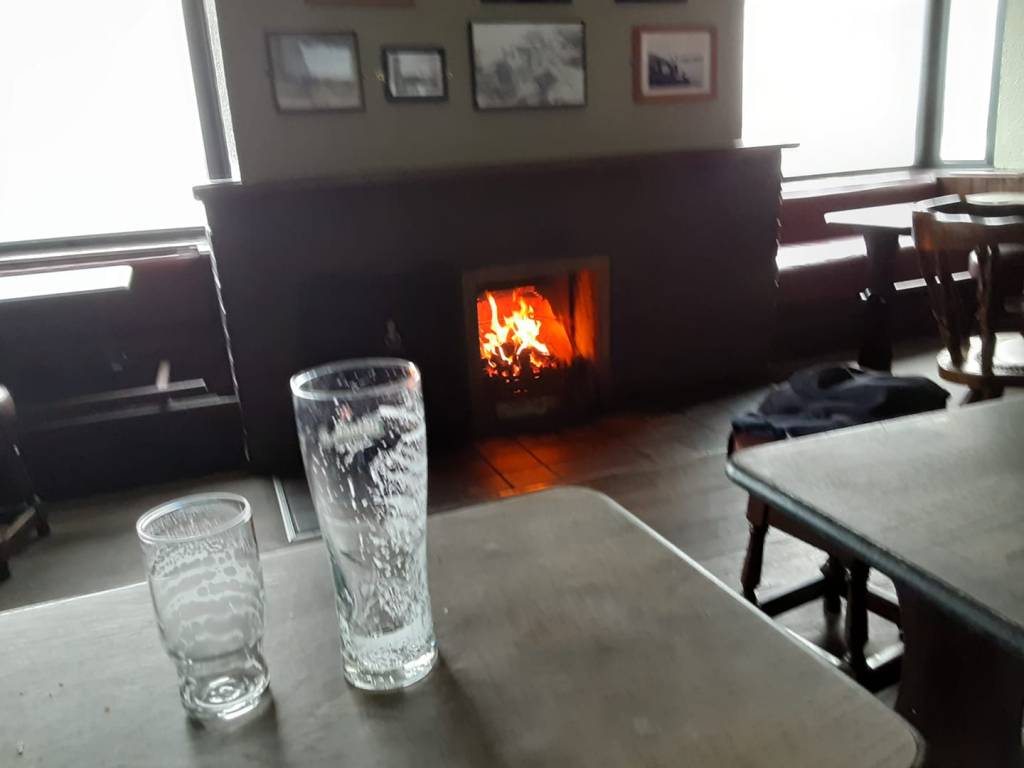
In a welcoming pub on Arranmore Island.
We never did find the lighthouse that allegedly existed on Arranmore Island, but we did find our way back to the landing in time to have a drink and a snack in a pub and catch the last ferry back to the mainland. I considered the jaunt a success for those reasons, lighthouse or no.
Our next stop, on the way to Galway, was in the small town of Cong. You may never have heard of it, but it was the place where the John Wayne-Maureen O’Hara movie The Quiet Man was filmed. That’s one of my husband’s favorite movies, so I made sure we would have time to see the place, and on his birthday too. Dan tramped around the town and took pictures of the commemorative statue. While I checked out a local inn, he went shopping. He had sworn that while in Ireland he was going to buy a walking stick and a clock.
Scene from The Quiet Man, immortalized.
(Dan has a history of buying clocks while abroad and managing to pack them well enough in dirty clothes to get them safely back to the States. He brought a clock back from England once. But I digress some more.) He found his walking stick in Cong, and a nice tweed Irish cap. (Getting the walking stick out of the country was another matter. It had to be inspected for insect life at the airport and stowed in the overhead compartments on the planes, which was a challenge. But I digress yet again.)
Dan busking at the Cliffs of Moher. (The real busker is observing him.)
The Cliffs of Moher, about an hour from our b-n-b in Galway, was one of the scenic locations we didn’t get too lost to see. It’s a spectacular set of cliffs with a great view of the Atlantic Ocean. (It was a foggy day, so we didn’t get good pics. We bought t-shirts and mugs instead.) Being somewhat mobility-challenged, we were able to get a ride to the viewing area in a golf cart type of vehicle, cunningly called “The Lift of Moher.” Our guide told us that scenes from one of the Harry Potter and the Deathly Hallows movies were filmed at a cave at the base of the Cliffs and that the Cliffs themselves were featured as the “Cliffs of Insanity” in The Princess Bride.
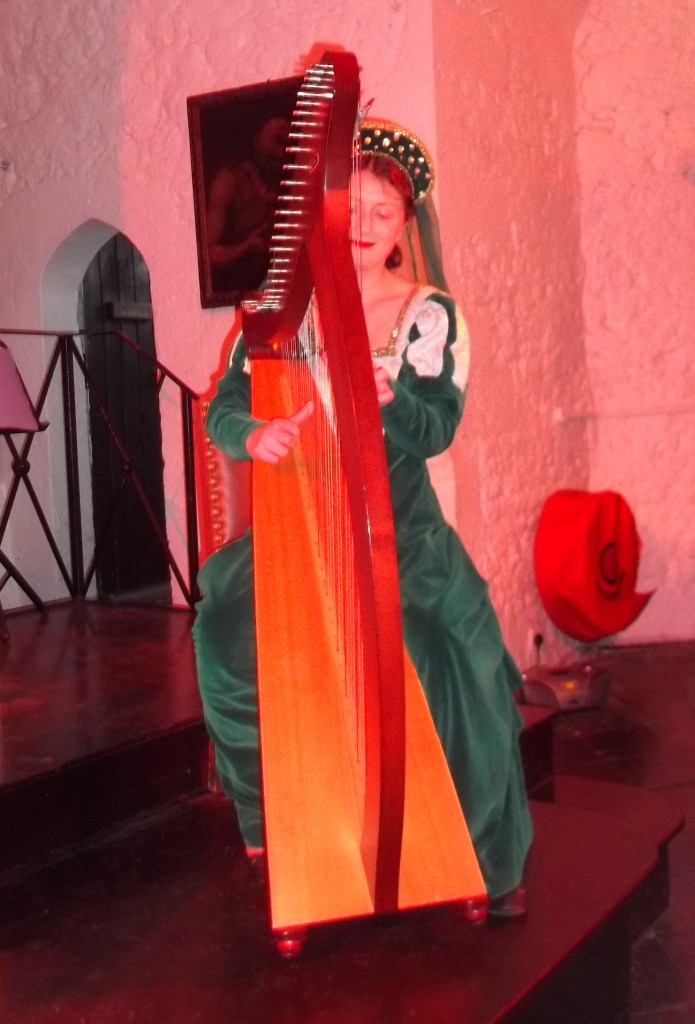
Next we stopped in Shannon, about half a mile from Bunratty Castle and Folk Park. We had booked the Medieval Banquet at the castle and saw part of the park while on our way to that. It featured replicas of thatched-roof cottages and other relics of Irish ways of life in the olden days.
At Bunratty.
I knew the banquet was sort of hokey and definitely touristy, but I had been to it on a previous trip to Ireland and also knew that it was a lot of fun. They welcome you with a cup of mead (honey wine) and present you with a lavish dinner that you have to eat with only a knife and your fingers. And one of the dishes was ribs. (They did let us have actual utensils for the dessert, but it was apple cobbler, so they kind of had to.)
Dingle’s harbor.
Our visit to Ireland wouldn’t have been complete without a stay in Dingle, thought by many to be the most beautiful place in Ireland, or maybe in the world, according to National Geographic Traveler. Dingle is another seaside town and had some of the best seafood we had in Ireland. There was a little hole-in-the-wall looking place across from the plaza in this photo, but I had an enormous bowl of amazing mussels there. Actually, the seafood was terrific all through Ireland, which makes sense given that it’s an island. Fish and chips were served at nearly every restaurant and you could have smoked salmon every morning for breakfast if you wanted to (which we sometimes did).
Uragh Stone Circle on a misty day.
We also went to see the Uragh Stone Circle, which we had high hopes for. But it turned out to be not nearly as impressive as Stonehenge, which we saw on our trip to England a number of years back. The stone circle was only eight feet in diameter and the standing stone only ten feet tall. Still, we had an enjoyable day tooling around the countryside and chatting with a couple who were collecting stones and shells in Dingle. We didn’t do the entire Ring of Kerry because it takes five hours, plus stops for photos, and by that time we weren’t enthusiastic about driving for five more hours, no matter how scenic the trip.
The view from the window of our last swanky hotel room in Athlone.
Then it was on to Athlone, not a well-known city, but one I remembered from a previous trip. We were put up there in another swanky hotel. The view out our window of Lough Ree was spectacular. There was a small island that contained a stone said to mark the exact center of Ireland. Athlone gave us access to some of the most beautiful ruins, one of my must-see stops, and one of the most historic establishments in all Ireland. It was a perfect way to round out our trip.
Graveyard at Clonmacnoise.
Clonmacnoise is one of those sites where churches, monasteries, and other sacred buildings were erected, attacked, destroyed, rebuilt, raided, destroyed again (and again). Because of that, there are a number of impressive ruins. There is also a great museum with examples of imposing Celtic crosses and stone carvings, and the history of Clonmacnoise. I waited there while Dan tramped around the site because the day was very cold and windy and I hadn’t worn enough warm or waterproof clothes. We also toured Athlone Castle, another historic site.
Near Athlone was one of the destinations I most wanted to visit – the town of Tullamore. It has historic connections with a canal that linked the town to the rest of Ireland in the 1700s. It was also the site of perhaps the first aviation disaster, when a hot air balloon crashed and started a fire that resulted in 130 houses burning down.
The distillery where my favorite whiskey is made. We took the tasting tour. (Of course we did!)
But what really made me want to go to Tullamore was the fact that it’s the location of the distillery of my favorite whiskey – Tullamore Dew. (Sorry, Jack Daniels. For some reason, Tully is the preferred spirit of many attendees at science fiction conventions, which is where I learned to appreciate it. Yet another digression.)
Of course we took the tasting tour. They welcomed us with an Irish coffee made with the local tipple, and then it was on to view the fermentation tanks and the aging barrels. Along the way, there were more tasting sessions, including one of the various styles of the whiskey that I never even knew existed. The gift shop was also impressive. I now have a Tullamore Dew t-shirt and a Tully shot glass. Dan bought a ceramic crock of Tully, which he also managed to pack and transport safely to the US, and which we’re saving for a special occasion, or maybe another science fiction convention.
Sean’s Bar and the antiques shop. You can tell which one impressed Dan the most.
Also in Athlone is Sean’s Bar, which bears the title of the oldest continuously operating pub in all of Ireland. I had a pint of lager while Dan went to the antiques shop next door. There he purchased his clock for the trip, a really lovely Art Deco piece which also made it home safely. (I was dragged over to the shop to see it and to help Dan bargain down the price.)
That was our last real stop in Ireland if you don’t count the Dublin airport and a Dublin airport hotel, which I don’t.
There are certain sayings I hate. Many of them are affirmations. Others are platitudes. Some are just nonsense.
Affirmations, for example. The one in the picture, for example, is provably untrue. There’s a lot in my average day that I don’t choose – whether I oversleep, whether that package from Amazon arrives when I need it to, whether I’ll trip over my cat and break my arm. There are some who say that I can choose how I feel about any of that, but I don’t believe it. Human beings are wired to feel annoyed when they trip over the cat and in pain when they break their arm. Right after that, they may choose to forgive the cat or feel lucky that they didn’t break both arms, but feelings, at the moment they happen, are not chosen. We may be able to choose how we react afterward and what we do about it, but even that is iffy.
Or take the expression “What doesn’t kill me makes me stronger.” There are lots of things that don’t kill me: ice cream, paintings, spatulas. None of them will make me stronger.
And if you tell me (as I’m sure you will) that the saying really means that adverse events that don’t kill me will make me stronger, I have to disagree. Think about someone who is fortunate enough to survive a train wreck. Is he stronger? No. More likely he is considerably weaker, owing to assorted broken bones and ruptured internal organs.
Ah, you say, but he is spiritually stronger, thankful that he survived. Maybe not. Not all people with catastrophic injuries are content with their fate. Some are even bitter and resentful. But we don’t like to think about those cases, so we say something that makes us feel better, even if it bears absolutely no relation to what the person it happened to actually feels.
I feel the same way about “Everything happens for a reason.” One day I heard about a news helicopter that crashed, killing everyone on board. Someone contended that it happened for a reason. “Sure,” I said. “The mechanic failed to tighten the thingamabob on the rotor. Or the pilot had the shakes. Or the passenger distracted the pilot. Of course, there was a reason.”
“That’s not what I meant,” my friend replied. I knew what she did mean – that there was a reason unknown to us and ultimately unknowable. That the passenger was secretly a child molester and now would never molest another child. That the pilot’s wife was about to poison him and this death saved him from a worse one. That if the helicopter hadn’t crashed when and where it did, an innocent child on the ground would have been squashed by it. Something like that. Cosmic justice prevailed.
In all these excuses, blame is never involved. Neither is chance. (The part on the rotor just failed. No one is to blame.) It’s too frightening to think that the actions of another person, our own actions, or the randomness of the universe is “responsible” for a tragedy. So we say there must be a reason, but we can’t – or aren’t able to – know it.
This is a lot like what is meant when someone says, “It was all part of God’s plan.” If you can’t pin the blame on a single person and you’re not willing to admit it “just happened that way,” there’s always God. If I were God (and thank God I’m not), I would be more than a little miffed at being held responsible for all these accidents, not to mention the plagues and disasters that are considered “acts of God.” (Did God send the tornado that destroyed my house because I’m sinful? We’re all sinners, but not all of us get tornados.)
To me, the worst saying is, “God doesn’t give us more than we can handle.” To begin with, it pins the blame on God for all the things that go wrong in our lives. And ultimately, it simply isn’t true. Plenty of people can’t handle the things that happen in their lives. Those with serious mental illness, for example, sometimes can handle it, but sometimes they can’t – for example, a woman who drowns her children obviously can’t handle post-partum depression. The mass shooter can’t handle the stress, hatred, fear, or disappointment in his life. (Not to mention that I don’t believe God hands out these trials.)
That’s when talk of God’s plan gives way to the workings of Satan, or abstract Evil in general. We call people who do things that seem inexplicable to us “monsters.” This is another easy saying that simply isn’t so. Whatever motivated such heinous acts, the people who committed them are still human beings. Making them “The Other” – a monster, a minion of Satan, an animal – is more comfortable, because it negates the fact that human people (and that includes all of us) have the potential to do cruel things. That most of us don’t doesn’t negate the fact that we share a species with those who do.
And then there’s death. I won’t argue with the saying “At least he’s in a better place,” because my father’s death was excruciatingly painful and long, and release from that surely was better than continuing in it. But then there’s “It was his time.” Again, this assumes that God has a plan that’s so detailed that He has appointed a time for each of us to die. Or Fate has, if you prefer. Someone or something, anyway, that controls the minutiae of our lives so completely that every instant of it is out of our hands.
If any of those ideas bring you comfort, good. But they make me more than a little uncomfortable.
Here’s the thing. It didn’t sound like a freight train to me. I was on the second floor, in bed, when the tornado hit. I remember the crash of the lightning and the bangs, like bombs going off as the trees in our wooded area exploded. Then half the roof came off. I was caught in a blizzard of insulation and dirt. I put my pillow over my head and hoped for the best.
When the wind died down, I got up and took a look around. In the hallway, a bookcase had fallen over and I was trapped upstairs. My husband was at work and I had no idea where the cats were. My cell phone worked, so I called Dan and let him know about the roof and all.
He left work and headed straight for the house despite the branches and debris in the road, driving over people’s lawns to avoid downed trees. He made it to within about a half mile of the house before he was halted by downed power lines. It took him another hour, in the dark and with no landmarks left, to get to the house. But he made it He came for me. Together we waited amid the piles of insulation for rescue.
Help arrived in the form of fire/police/medics, who yelled at us to grab our medications and come with them. It was a mandatory evacuation – not that we wanted to stay put – and they guided us step by step through the obstacle course of trees, branches, wires, roofing, shingles, boards, and other debris till we got to an ambulance.
Neither of us was hurt, so were taken to a local shopping center where we were given water and loaded on a bus for the Red Cross shelter in the gymnasium at the First Baptist Church. It was about 4:00 a.m., but there was food and there were cots. People kept arriving – mostly not tornado victims, but people bringing enormous amounts of food and water. Soon a hot breakfast was ready.
And then, miracle of miracles, we got hot showers. And clean clothes. The helpers even bought us packages of clean underwear and a glucose meter for Dan. They brought him shoes, as he was wearing bedroom slippers when we were evacuated. Food and water and volunteers kept coming, handing out bags of toiletries, and big bags of nonperishable foods when we left.
We stayed only a few hours at the shelter, as we had dear friends, Robbin and Stu, who staked us to a motel room. There was one with a vacancy only a few miles from our house. It’s funny how those tornadoes skip around.
Since then, we’ve been working the phones, getting in touch with our insurance providers (Farmers, by the way, who have helped in every conceivable way. We’ve been back to the house, which is a total loss and keeps deteriorating with the rain and other stresses. I would have guessed that the stresses would have gotten to us, too, but we are taking things slowly, one phone call or errand at a time. We’ve rescued our cats, who are now boarding at the vet, and a few clothes and other things. (There’s a laundromat right down the road.)
I am blogging this from the computer in the lobby of the motel. In a couple of days we will move to a residence hotel that is pet-friendly so we can have our little family all back together. Insurance is picking that up too, and the pet boarding as well.
We have experienced nothing but kindness and understanding from the people around us. Family, friends, and total strangers are all doing what they can. People along the roadside offering free food, free water, and free hugs. Ministers of various denominations have been through the area, dispensing bottled water and prayer. Burly young men with chain saws have begun clearing paths to people’s houses, though it will likely be a week or two till we get full access to ours.
We are mostly numb right now, carrying on with all that still needs to be done, one thing at a time. Sometime in the near future, when things have settled down a bit, I expect the emotions will catch up with us and we’ll have a bit of a breakdown.
But for now, we are working together and thinking about how to rebuild our lives and eventually our house, our home.
Quick quiz: What do Jesus and the poop emoji have in common? They both are associated with Easter, silly!
Don’t believe me? Just go to the Easter display in your local store. There you can find cross-shaped tins of candy with the saying “Jesus Saves” and the offer “Jesus Jelly Bean Prayer Inside.” Then there’s the ever-so-seasonal pastel plastic poop emoji that, well, poops candy. (It also has whimsical bunny ears. As you can see.)
Now I don’t mind the mash-up of Christian Easter with its pagan roots. That practice has been around long enough to make it into a tradition. The pagan symbols of Easter are relatively easily adapted from their earlier symbolism of fertility and renewal to their Christian identification with resurrection. New life, and all of that. Eggs. Lambs. Chicks. Even bunnies, that most suggestive of symbols for burgeoning life.
But lately, there’s something … odd about the merchandise that’s offered for consumption on Easter. It’s not just that the pagan roots are showing. It’s more like Easter is getting confused with Christmas. Or maybe Halloween. Easter is getting to be yet another occasion for retailers to make a buck in the name of wretched excess.
Look at the Easter displays in your local supermarket or department store. You’ll find baskets, all right, but many of them look more like trick-or-treat pails than things a seasonal rabbit would deliver. Now you can find them shaped like a Troll head or Mickey Mouse, and adorned with Guardians of the Galaxy, Batman, Despicable Me Minions, Spiderman, and other characters more often associated with Halloween costumes. There are even felt “baskets” adorned with pictures of dinosaurs and volcanos.
(Dinosaurs have theological implications, of course, as reminders of evolution. When pressed, some Christians will claim that dinosaur bones were put into rocks by Satan, to test the belief of the faithful. But I digress.)
Obviously, these assorted characters are meant to appeal to media-obsessed kids, and so are the trinkets the Easter baskets are loaded with. Barbies. Water guns. Chocolate soccer eggs. Posters and stickers and PJ Masks toys. Any gimcrack fancy that can pull in a few bucks, whether or not it’s related to Jesus or Oestre.
When did superhero, sports, and other fashionable toys become symbols of Easter? Back in the day, we got plush rabbits. Of course, we also had a limited choice of sweets – jelly beans, gum drops, and chocolate bunnies (which occasioned the eternal question of whether to bite off the ears or the tail first). Christmas candy consisted largely of candy canes and “books” of Life-Savers. Halloween candy was much more varied.
Halloween has already surrendered its place as a Christian celebration (the eve of All Saints’ Day) to being a childhood ritual of door-to-door sugar-laden extortion. Sugar skulls for Día de Los Muertos may be gaining on fun-size Snickers.
Now both the commercialism of Christmas and the pop culture iconography of Halloween have made their way into children’s Easter baskets. The hell of it (sorry not sorry) is that it’s most likely too late to turn back now.
Mash-ups of Christian and pagan holidays are par for the course. We get the Druidic Christmas trees and the Coke-ified Santa (originally a Christian Saint Nicholas) and the exchange of gifts on Saturnalia melded with of the celebration of a quiet birth.
I’m not saying that cultural mash-ups aren’t fun or happy or festive. I’m just saying it’s all gotten a little out of hand. We now have the ubiquitous image of Santa kneeling at the manger. How long until we have Mickey Mouse rolling away the stone?
The U.S has long been uneasy with the idea of the occult, from Harry Potter to Halloween parties. But the most extreme form of fear occurred in the 1980s, when panic swept America. “Stranger Danger” and “Good-Touch/Bad-Touch” were taught in schools. Someone – many someones – were after America’s kids.
But these weren’t ordinary pedophiles the nation learned to fear. They were occultists. Satanic. Devil-worshippers. And they wanted our children for acts that were unholy as well as sexual. Black masses. Ritual killings. And of course there were the run-of-the-mill child pornography rings, made up of community leaders.
The center of the “Satanic Panic” was daycare centers. As Vox magazine pointed out:
Although it was a time of economic growth and financial prosperity, the Reagan Era was also a time of unease centered on population growth, urbanization, and the rise of the double-income family model, which necessitated a sharp rise in the need for daycare services. As a result, anxiety about protecting the nuclear family from the unknown dangers of this new era was high.
Uneasy with the idea of women of child-bearing age entering the workforce, society seemed bent on convincing them that leaving their children in the care of others was fraught with danger. Unspeakable danger. The worst anyone could envision. So bad that no one could be trusted.
The only safe thing to do was to stay home and keep your children under your own eyes at all times. The ultimate expression of this was the McMartin Preschool case and the ensuing trial.
Rumors of sexual abuse at the daycare center run by the Buckey family mushroomed into florid accounts of ritual abuse. Arrests were made. The community was outraged.
The Institute for Psychological Therapies explained it thus:
The formal charges were wrapped in a conspiracy theory that portrayed the defendants as satanists who used the preschool as headquarters for a vast kiddie porn/prostitution empire that produced millions of child sex photos. The children were allegedly drugged and forced to participate in satanic rituals and sex games with teachers and strangers at both on and off campus locations. During those episodes the children encountered turtles, rabbits, lions, a giraffe, a sexually abusive elephant, dead and burned babies, dead bodies in mortuaries and graveyards, goat men, flying witches, space mutants, a movie star, and local politicians.
The allegations seemed literally unbelievable, impossible in fact, but arrests were made and a years-long trial began. The call to action took the form of “Believe the Children!”
The result? Reports of similar atrocities around the nation and indeed around the world. More and more daycare owners and workers accused.
But the bottom line? Few convictions – none in the McMartin case – and many elsewhere that were later overturned. A new focus on how therapists should interview children for forensic purposes. And perhaps some women frightened out of the workplace, but no end to the profound need for daycare (although funding for that was another matter entirely).
By 1992, reported Vox, “the Department of Justice thoroughly debunked the myth of the ritualistic satanic sex abuse cult.” But the panic didn’t end there.
Flash forward to the 21st century – the run-up to the 2016 presidential elections. Then there was “Pizzagate.” According to Salon, “this bizarre pizza-pedophilia piece of make-believe seems to have struck the right kind of nerve in this simultaneously gullible and paranoid time to become a lasting, serious concern.”
Accusations focused on a Washington pizza parlor called Comet Ping Pong. It was another theory based on dreadful, unthinkable threats to children.
There were rumors of human trafficking and child abuse in a seemingly innocent pizza place. Again the allegations veered into absurdity, such as emails contained code words – “cheese pizza” for “child pornography” because they have the same initials. Salon noted: “If ‘pizza’ is code for pedophilia, the rumor mongers reasoned, clearly a pizza restaurant is the dungeon where all the horrors go down.” The crimes were said to take place in the pizzeria’s basement. Unfortunately for the conspiracy theorists, the shop had no basement. (It’s perhaps notable that one of the accusations in McMartin was that much of the abuse occurred in underground tunnels, which didn’t exist either.)
As compared to the “Satanic Panic,” it didn’t gain much traction, except with one sorry citizen who believed it so wholeheartedly that he showed up at Comet Ping Pong Pizza with a rifle.
But, like the “Satanic Panic,” Pizzagate had a political subtext. Well, not even a subtext, really. The thing that made Pizzagate special was that it was an attack on presidential candidate Hillary Clinton, who had only a vague connection to someone who knew someone who visited the pizzeria. It was unclear what her involvement in the supposed human trafficking/pedophile ring might have been, but it was clear from emails, the conspiracy theorists claimed, that she knew all about it.
Again, Salon nailed it:
Hoaxsters and the deranged collaborated to create a compelling and nonsensical story about depraved, satanic elites operating with impunity. This struck a chord with people who have long seen the mainstream media and politically powerful and well-connected people as manipulative and evil.
Especially if those implicated are people the theorists don’t like, such as working mothers, daycare center workers, or Hillary Clinton. Does it seem odd to anyone else that, while pedophilia is statistically a predominately male crime, women seem to be at the bottom of the dogpile, the subtext, the unseen movers?








 Quick quiz: What do Jesus and the poop emoji have in common? They both are associated with Easter, silly!
 But I Digress . . .