Category Archives: education

Hungry Children: A One-Act Play

Sharing food with the needy

[Setting: The Halls of Power]

Guy in Suit: The media keep saying that there are hungry children in America.

Other Guy in Suit: Let them eat dinner.

Bleeding-Heart: That’s the problem. They don’t have dinner to eat. Or even breakfast sometimes.

GIS: We already give them lunch at school. That’s five days a week.

B-H: Unless they’re absent or on vacation or a snow day. Or if they can’t pay for it.

OGIS: Then it’s the parents’ problem.

GIS: Why do schoolchildren have so many vacations, anyway? We don’t get all those vacations.

B-H: Uh, yes you do.

GIS: Oh. Well, never mind that now. We were talking about tax cuts…uh, job creators…uh, feeding children. That was it.

OGIS: Suppose the media are right?

GIS: The media are never right unless we tell them what to say.

OGIS: Well, just suppose. For a minute. OK? The problem I see is that it looks good for us to feed poor, hungry, starving American children. By the way, are they as pitiful-looking as poor, starving foreign children?

GIS: Probably not. You were saying?

OGIS: If there are hungry children, and we do need to feed them, how are we supposed to do that without feeding the lousy, lazy, good-for-nothing moochers at the same time?

GIS: Ah, yes, the parents. If we give the parents anything, it should be one bag of rice and one bag of beans. And — hey — they could feed their kids that too.

B-H: But children need good nutrition — fruits and vegetables and vitamins and minerals, and enough to keep them full and healthy.

OGIS: Hey, we have plenty of minerals left over after fracking. Won’t those do?

B-H: No.

GIS: But if we give kids all that fancy food, what’s to keep the parents from eating it?

OGIS: Or selling it for booze or cigarettes or drugs?

GIS: Think about that! The drug dealers would be getting all the good nutrition. Then they could run faster from the police.

OGIS: We can’t have that, now can we?

B-H: But…the hungry children? Remember? Eating at most one meal a day, five days a week, when school is in session?

GIS: That’s plenty. I heard American children are obese, anyway. They could stand to lose a little weight.

[Curtain]

This post, which I wrote a number of years ago, became relevant again. I wish it would stop being relevant.

Foot Plus Mouth Equals Disaster!

In the comic strip “Peanuts,” Linus says that one should never discuss “politics, religion, or the Great Pumpkin.” That’s good advice, as far as it goes, but the list of things you shouldn’t discuss in public goes much further. In fact, erase that bit about “in public.” They’re dangerous to discuss among friends and family, too.

These days, politics is strictly off the table. You never know who has a concealed carry license. And Linus was certainly right that it’s best to avoid religion. When someone says, “Bless you,” the right answer is “thank you,” even if you’re not a believer. After all, they meant the religious equivalent of “Have a nice day.” (Or “gesundheit,” maybe. By the way, “Bless your heart” should be used with caution when you’re in the South. It can be a verbal middle finger. But I digress some more.)

Another topic to avoid is any that leads to a near-death experience. My husband, Dan, has blundered that way more than a few times. For example, when we were preparing for a party, I washed my hair, blow-dried it, used a curling iron, moussed, and sprayed. As I came down the stairs, Dan asked, “Are you going to do anything with your hair?”

And stay far, far away from talk of pregnancy. Suggesting that a woman is pregnant based on her weight, her clothes, or the way she waddles can be deeply offensive, particularly if she isn’t. In fact, one expert advises that you not comment on a woman’s potential pregnancy unless you actually see a baby emerging from her vagina at that moment. Better safe than hopelessly embarrassed. (I was a victim of this faux pas when I walked into an office looking for a job, wearing a loose denim jumper and a nice blouse. Admittedly, it may not have been the best choice for filling out an application, but the receptionist didn’t have to ask how far along I was. Later, she repeated the story as an amusing anecdote, not realizing that I was in the room and was embarrassed all over again. But I continue digressing.)

Everyone knows by now not to comment on a woman’s anatomy on pain of getting fired or a punch in the mouth. Not even when you’re trying to make a joke. I once told an acquaintance that I wasn’t at a party “because I was home nursing a sick cat.” “Didn’t you get scratched about the breast?” he asked. He almost got scratched about the face.

Then there was the time a guy had two girlfriends and was invited to a wedding. I don’t think he clearly understood the concept of a plus-one. He suggested taking one lady to the ceremony and the other to the reception. He somehow survived the occasion with at least one of the relationships intact. How? I don’t know.

Speaking of weddings, one of Dan’s bigger faux pas was when he suggested that, since his family lived in Pennsylvania and mine lived in Ohio, we should have our wedding on the state line, to inconvenience both families equally. (He was serious. But I digress for the final time. I promise.)

Because you’re bound to offend or insult someone, somewhere, sometime, my best advice, no matter what you are about to blurt out, is to remember your mouth has a zipper. Use it!

AI Writing: Friend or Foe?

You may have heard that AI writing means the death of writing done by actual, live people. In a way that’s true, and in a way it isn’t. Let me explain.

Many—perhaps most—of the fiction books that you see for sale on Amazon and other outlets are AI-written and almost universally bad. Rotten, really. So bad that you want to throw them against the wall. (Unless you have a Kindle, Nook, or other e-reader, of course. Then you only want to delete them. But I digress.) They are too short, too filled with adjectives and adverbs, too lacking in a coherent plot, and too deficient in character development. Even the most potentially vivid genres are bland.

You may say to yourself, “I could write a better novel than this turnip.” And you very likely could. (So why don’t you?)

But AI has taken over most of the writing space. Even books that you yourself don’t write aren’t written by a human being. (I should know. I often freelance for a ghostwriting service that shall remain nameless because of the NDA I signed. They used to have lots of us human beings doing the writing. Now they largely have “writing packages” produced by AI. The only time a human being touches the book is to supervise the AI engine, which sometimes goes madly astray, and to “humanize” the results (it’s known in the trade as “polishing dogshit into gold”). But I digress again. At length.)

That’s the bad side of AI writing. What, I hear you ask, is the good side?

It can make you a better writer.

Hear me out.

Let’s think about the most basic AI writing tool that almost everyone is familiar with: Grammarly. Yes, it follows along behind you and corrects what you’ve written when you’re typing too fast (like “isfamiliar”). And it always changes your word choice to “ducking.” It’s never “ducking.” But, if you pay attention to it, Grammarly is a teaching tool.

Grammarly sends you reports that list your most common mistakes that week (or month, I don’t remember). If it says you have problems with subject-verb agreement, brush up on that. If you have trouble remembering whether commas introduce an independent clause or a dependent one, look it up and try to remember it the next time you write.

Teachers worry that their students will use AI to write their papers for them. (One of my friends now has her students write out their essays longhand, like I did in the Victorian era. But I digress some more.) They may indeed rely on AI. (A survey of students found that they considered it cheating, however.) But there are many AI detectors available to teachers that sniff out suspiciously smelly AI-created sentences and paragraphs and report on how much of a piece of writing seems to be human or AI.

This, of course, has led to ways to avoid the AI detectors. One I saw recently offered a series of prompts a student could give the AI program in order to produce a piece of writing that would appear to be human-written. The list of things the sneaky student should tell the AI program to avoid was comprehensive and long.

It told students to create a prompt that specified not only the topic and tone of the illicit paper, but also to avoid common signs of AI content that the AI checkers teachers use frequently will flag.

The list of things to tell the AI to avoid included: sentences more than 20 words long without one clear idea and paragraphs all the same length; passive voice; abstractions instead of concrete words; sentences of all one length; a lack of measurable facts; suspect punctuation (semi-colons and em dashes) (I disagree with this stricture. I love semi-colons and em dashes, as if you hadn’t noticed. But I digress yet again.); overused words and phrases (an extensive list, including last but not least, cutting-edge, delve, game changer, nonetheless, despite, moist, subsequently, furthermore, utilize, leverage (and any other biz-speak or tech jargon)); adverbs and adjectives; hedging; more than one prepositional phrase or verb phrase; all-caps or numbered lists; and metaphors involving landscapes, music, or journeys. (I once asked ChatGPT to write some poetry, and it really overdid those metaphors. But I digress even more.)

In other words, if you know what to tell the AI not to do, you already know for yourself what not to do—or keep that list handy and refer to it often—you’ll be able to write your own sparkling prose without Robby the Robot’s assistance. And the process of learning to tell the AI how to write undetectably will improve your own writing.

If you think of AI as a way to learn instead of a way to cheat, you’ll do well.

The Comeback of Bullying

TW: suicide, violence

Some people have suggested lately that bullying is a good thing. This flies in the face of most people’s understanding of the effects of bullying and years of anti-bullying campaigns in schools.

We all think we know what bullying is, or at least that we know it when we see it. But what is bullying, really?

Bullying can be physical, verbal, or psychological, just like other forms of abuse. It can happen face-to-face or online. Online bullying is increasingly common and more difficult to deal with because much of it happens after school hours and because of the speed and vast reach of bullying speech or images.

Joanna Schroeder, a media critic and author, says that “the word ‘bullying’ often stands in for plain old bigotry or discrimination.” She notes that a slur for people with intellectual disabilities (the “R-word”) has been making a comeback.

The Anti-Bullying Alliance provides a succinct definition. Bullying, they say, consists of four characteristics:

• the hurting of one person or group by another person or group

• repetitive hurtful speech or behavior

• intentional behavior

• a real or perceived imbalance of power.

So, bullying is hurtful, repeated, and intentional behavior. That’s easy enough to understand. Let’s examine the last characteristic, the imbalance of power.

An imbalance of power in the workplace of a superior and a subordinate is a clear example. In schools, principals and teachers would be one example, and teachers and students would be another. But how does this play out in terms of student versus student? Where’s the power and the imbalance?

The imbalance of power can be obvious, such as that between the quarterback of the football team and the other players or the imbalance between a senior and a first-year student. A perceived imbalance can exist because of students who are larger in size, more athletic, neurotypical, physically unimpaired, or belonging to a majority racial or ethnic proportion of a school. They are perceived as having more power than those children who do not possess those qualities. And a clique of “mean girls” or a group of “rich kids” has the perceived superior power of popularity. Any of these imbalances can play into bullying. The Centers for Disease Control and Prevention has reported that higher rates of bullying are directed at girls, LGBTQ students, and teenagers with developmental disabilities.

In the case against bullying, we have seen accounts that some children who die by suicide have been subjected to extreme bullying and others who perpetrate mass shootings have, too. (There are often other factors that contribute to their deadly actions. Bullying is rarely the whole answer.) Deaths have occurred during incidents of college hazing of pledges or recruits by the senior members of organizations. Mental health professionals view bullying as too serious a problem to be considered a character-building exercise.

So, if it’s so harmful, why is bullying losing its bad reputation? Some people think that society has gone too far in “coddling” children and that they need to toughen up or be less sensitive. The world they will live in is often harsh, and children must grow into adults who are aware of that and able to handle it. In this increasingly popular view, sensitivity is for the weak, and only the tough will succeed. There is anecdotal evidence to support this view. We can all think of bullies who have succeeded in politics, business, entertainment, or the media.

“If I’d never got bullied, I don’t think I’d be where I am today,” said one TikTok influencer. “I don’t think I would have the motivation to prove people wrong.” He believes that bullying “is not as bad as it is made out to be.” He has said, however, that it’s “never OK to turn to physical violence or pick on people based on their race, religion or disabilities.” But he maintains that at least some kinds of bullying are not as harmful. One wonders what his definition of bullying is and what the Anti-Bullying Alliance would say about it.

Just as the self-esteem programs of the 1980s, so popular at first, drew increasing criticism as leading to “participation trophies” and the devaluing of personal accomplishment, the idea of bullying may be undergoing a redefinition as a response to “wokeness” being seen as “weak.” It remains to be seen if this opinion will spread to society at large rather than just the bullies we already have.

Quotations in this post first appeared in the Oct. 6, 2025 edition of the New York Times in an article by Callie Holtermann.

Music and Me: The Saga Begins (and Ends)

It all started with my sister’s cornet and sibling rivalry. My parents rented the instrument (probably already having an inkling of the outcome). She attempted to learn to play it for school band class. It was not a success and the next year, when I was old enough to be in band class, my parents did not rent an instrument for me. I never got over it, so when I graduated from high school, I saved up and bought myself a cheap guitar. (And a sword. I was deeply influenced by The Lord of the Rings.)

I started taking guitar lessons. Then I ran out of money after learning the “Cocaine” song by John Martyn (not the other one). (The sword lessons came much later when I was studying martial arts (ninjutsu, to be specific). We practiced with a wooden katana, so I wasn’t able to use the sword I had bought. But I digress.)

Later, I took guitar lessons from a guy who was the cousin of my rotten then-boyfriend. Later still I bartered with a guitar teacher who needed his dissertation proofread. (He actually learned some aspects of grammar rather than just letting me do all the heavy lifting. (He thought it was hilarious when I told him to “check your apparatus.”) He’s still a Facebook friend. But I digress again.)

I took a break from guitar lessons when I took singing lessons. I’m a terrible singer, and the lessons didn’t help. I also took piano lessons because the teacher gave a discount if you took both. Turns out I’m a terrible piano player too. (The pedals befuddled me just as badly as the pedals on the car when I was learning to drive stick. But I digress some more.)

Later still, I entered what was called a “Pick-a-Thon,” a marathon guitar-picking contest that lasted for days. You didn’t have to play actual songs, which was a good thing in my case, just keep making sounds with the guitar, which was a mercy when you had to visit the facilities—just squat and strum. By the time I had made it through 24 hours, my boss (who was also my friend) gave me time off. I made it to the final two pickers, but I finally gave in (I was hallucinating by that time). My final time was 68 hours and 7 minutes. The music store where this was held gave me a fantastic deal on a really excellent guitar as a second-place prize.

I still couldn’t play it much, though. More lessons ensued, this time with a woman who was: a twin, a former army officer, a pilot, and left-handed. I liked her a lot, but it was kind of weird trying to learn when she played her guitar upside down.

I finally figured out the reason for my lack of progress on the guitar (and the banjo). When I had the money for lessons, I didn’t have the time, and when I had the time, I didn’t have the money. (I briefly had a harmonica, which was inexpensive and didn’t require lessons. I learned the intro to Gordon Lightfoot’s “The Way I Feel” but it made my mouth hurt. But I digress yet again.)

I’m also trying to learn how to whistle. At least I don’t have to buy an instrument or take lessons for that. (So far I can whistle the sound that Wile E. Coyote makes as he’s plunging from a cliff to the ground. Not that there’s much call for that sort of thing. But I continue to digress.)

Right now, I’m in a time-rich and money-poor state. Plus, I don’t have a guitar or a banjo. I’ve never had a piano and still have a terrible singing voice. What I do have is iTunes (or Apple Music as I guess they call it now), 8,000 songs, a study I’m alone in all day, and a house far enough from the neighbors that I can’t be heard when I sing along off-key and loudly. And that’s enough to satisfy me.

Serving Society

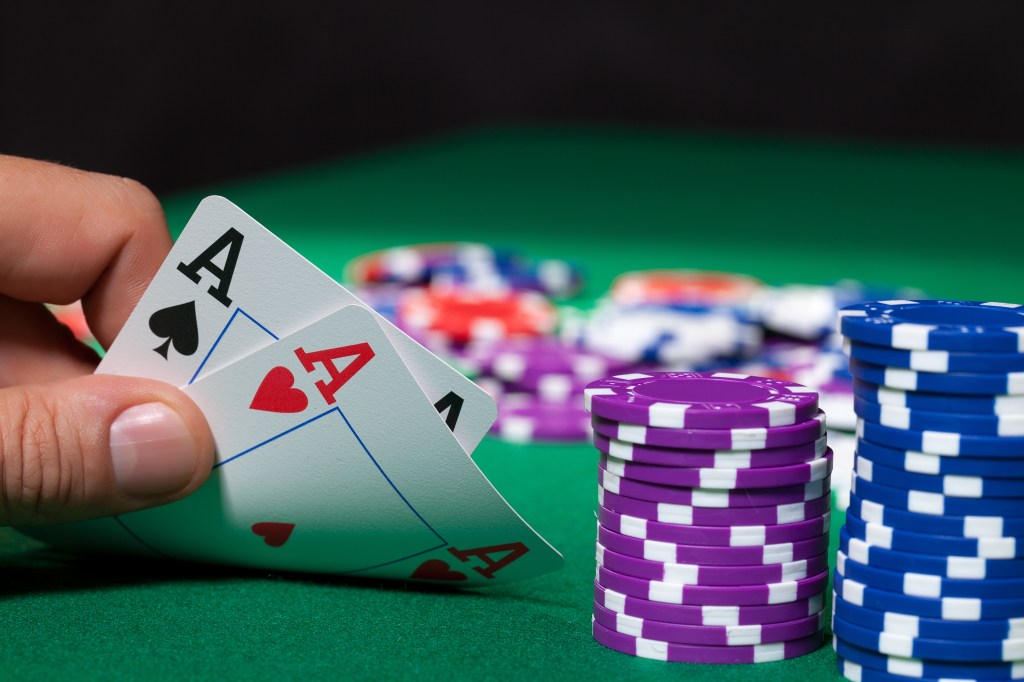
It all started with a game of Texas Hold’Em held in a bookstore to raise money for charity. I had pocket aces (as shown), a very strong hand. I should have slow-played them and let others raise the pot, but I was a newbie and all excited, so I didn’t make the most of the opportunity. Shortly thereafter, I left the game.

(Texas Hold’Em became trendy and popular in 2004 with the publication of Jim McManus’s Positively Fifth Street. It led to such oddities as the World Series of Poker (yes, there is one) being televised. The title of the book came from the arcane but intriguing insider terminology used to describe the various parts of the game, such as the flop, the turn, and the river (aka Fifth Street), which refer to when the communal cards are exposed. Naturally, I was drawn to a game that had its own language. But I digress.)

After I left the poker table, I was drawn into a conversation with a woman who was watching the game. She wanted to know whether I did anything besides play poker. (Yes, there are professional poker players.) When I told her that I was in educational publishing, she relaxed. Her point was that professional poker playing served society not at all, but educational publishing filled a valuable niche in service to education, a worthy goal.

That got me thinking. Who exactly serves society and in what capacity?

I think we all agree on some of the basics: teachers, medical personnel, police, religious figures, volunteer workers, and firefighters. But are they the only ones who perform worthwhile services?

Politicians are not held in high regard these days, and neither are lawyers. But when they act on principles (if they ever do), they serve society by making laws and administering justice.

I’m less open to the idea that entertainers serve society by entertaining us. Of course, some entertainers (and I’m including professional athletes in that) donate large sums of money to assorted worthy causes or start charities or foundations that serve some segments of society, usually the underserved. But those people, it seems to me, are philanthropists (good-deed-doers) who also entertain.

(Speaking of entertainers, I can’t abide most reality shows, particularly the kind that might be called “Famous for Being Famous” (I’m looking at you, Kardashians) or “Rich People Behaving Badly” (I’m looking at you, Real Housewives). I do like the ones where fairly normal people actually make or do something like cooking or baking, designing clothes, forging knives, and so on. I can’t say whether they technically serve society, but at least they’re creative. But I digress again.)

But what (to get back to my much-neglected point) about sanitation and maintenance workers? Without them, our streets would be awash in litter and worse. Our offices would be grubby and perhaps disease-ridden. Our school corridors would be besmirched by vomit. I think taking care of all these problems serves society in a very real way. (And there are never reality shows featuring them. Probably something to do with the vomit. But I digress some more.)

I’ll admit that poker players don’t do anything to serve society, but I think we have a limited view of those who do. Public servants are held up as examples, and they should be. But farmers don’t get mentioned, and they feed us all. Train engineers and truck drivers serve society by delivering that food, as we learned during the pandemic. Psychiatrists and therapists serve members of the public who have mental illnesses. Meteorologists serve society when storms happen. Anyone from architects to bus drivers, yoga instructors to zookeepers. Even burger flippers and pizza delivery people serve society or at least individual members of it.

Let’s expand our definitions of who serves society. There are a lot of people who don’t get recognition and should.

An Investment in the Future

My investments are not stocks and bonds and they’re not biological, but they affect the future anyway.

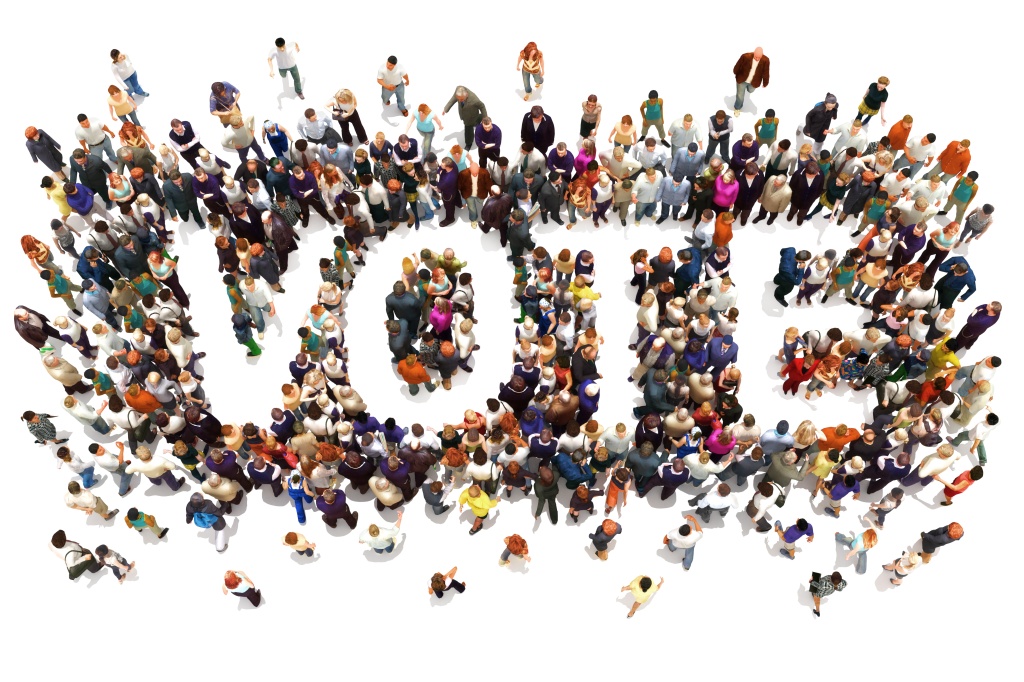
I don’t have any children—I’m the proverbial cat lady—and because of that some people are saying that I’m not contributing to the future of our country or that I shouldn’t get an equal say in how our country is run. And I think that’s just plain wrong.

Some families have no children because they can’t have any. Others don’t want children, for whatever reason. But making the most fundamental right of our society dependent on whether a person has a child is a profound violation of the foundations of our democratic society. Even if you’re a strict constitutional constructionist, there’s absolutely nothing in there about voting being contingent on offspring. (That voting was originally limited to white male property owners is another issue that hasn’t yet been brought up.)

This proposal is billed as “pro-family,” but it’s nothing of the kind. It defines family as only one kind of family and denies rights—not privileges—to the rest. Granting those privileges to children, to be exercised by their parents, contradicts the basic principle of one person, one vote. When those children turn 18, they are welcome, even encouraged, to cast their votes for themselves. But allowing parents extra votes per child is nonsensical.

I wonder how long it will be before the definition of a family is a two-parent (heterosexual) couple with children. Will single mothers get to vote more than once, considering their children? Single fathers? If a family doesn’t include two parents living together, does the voting right automatically go to the mother? The father? These matters are far from clear. And unless I’m mistaken, they would require a constitutional amendment to go into effect. In other words, it’s grandstanding.

But leaving that political nonsense aside, what are the rights that childless people have, or should have, regarding children?

Well, first of all, our taxes pay for schools, parks, lunch programs, Head Start, child tax credits, nutrition programs, Social Security survivors and dependents, Social Security Disability, Medicaid and health insurance, and of course schools, among others. I’m paying into those whether I have children or not.

I don’t resent that. I think such programs are necessary and I’m glad to help fund them. The children and families they help impact me directly and indirectly. They will be my congressional representatives, my nursing home aides, the inventors of devices that will improve my life—every slot that must be filled to make society run, if not smoothly, then at least adequately.

Of course, not all children have the same start in life or pursue noble or necessary functions. I would like to help them do so. The way I can do this is to vote. These issues and functions affect me in very real ways that I have the right and the privilege to vote for.

And I do vote.

Now, let’s talk about schools. Because I don’t have children, many people think I should have no say in what happens in schools. I disagree. What happens in the schools affects me too. I want doctors who have a firm grounding in accepted science. I want bankers who have a keen grasp on economics. And I want government people who have a thorough understanding of civics. That means I have an investment in what goes on in schools and what children learn.

I’ll never be on a school board or even a member of the PTA, but I do get to vote for who’s on the school board and I pay attention to what they do. Now, I’ve got no problem if people want to homeschool their children or send them to private schools, as long as my tax dollars go to the public schools. Public money, public schools.

But don’t try to take away my rights as a citizen or come up with some hare-brained scheme to make my vote count for less. You can say the children are our future all you want.

But they’re my future too. Whether I’ve given birth to any or not.

You Haven’t Changed a Bit

Well, yes I have. More than a bit. I’m going to a high school reunion this year (one of the big ones), and I don’t expect to hear that I haven’t changed.

Of course, most of us have changed. In addition to our age, our weight, hair color, careers, and family are not likely to be the same as they were in high school. (I would say, like the old joke, that I can still wear the earrings I wore in high school. But that’s not true. I didn’t get my ears pierced until I was in my 20s. But I digress.)

Many things have happened in my life that I’m fairly sure will surprise the other alums. Here’s a list of the sort that some reunions publish in a handy booklet in order to re-introduce ourselves. Instead of places I’ve traveled and impressive career milestones, I offer for your consideration these changes I’ve gone through.

  1. I’m married and have been for 41 years, which I never expected back then. No children. (Or, obviously, grandchildren, which I know many of my former classmates have. I anticipate having many pictures offered to me for oohs and ahs. I’ll start practicing now. But I digress again.)
  2. I kept my birth name. (I don’t like the term “maiden name” because it implies that all brides are virgins, and we know this is not the case. I wore an ivory dress so no one would snicker. But I digress some more.)
  3. I now swear like a highly educated sailor. I learned how when I was a waitress, working my way through college.
  4. I have bipolar disorder. I talk about it openly. When I was in high school (and after), I had a reputation for being moody, difficult, and weird, which there was also no hiding. So at least now there’s an explanation for that.
  5. Despite the fact that I majored in English in both undergrad and grad school, I have never become a burger-flipper or a retail worker. I’ve managed to stay employed more or less in my field, having been an editor/writer, college teaching assistant, and now, ghostwriter. (I’ll skip right over my tenure as a meeting transcriptionist (even though I’m the world’s worst typist, never having taken it in school, which proved to be a big mistake when I had to write all those papers in college) and a security system monitor. I also once had a job inventorying hardware stores at night after they closed. One does what one has to in order to keep cat food in the bowl. But I digress yet again.)
  6. I have tattoos. Two of punctuation, one of books, one for my mother (a compass rose and a yellow rose), and one for my husband (heart locket and key; he has a matching one).

The last time I had a big reunion to go to, I was beyond anxious. My high school days were not happy ones. I asked my hairstylist to make me look sane and successful. My friend Mary Jo, who worked for the local paper (now retired), wrote a column about my pre- and post-reunion experiences. This time, I’m encouraged by the number of my former classmates who’ve said they would like to see me there.

I’ve said I’d go to at least the casual drinks get-together (oh, yes, I also drink alcohol now, at least to the extent of a couple of beers). And I’ll bring my husband, who’s entertaining because he looks like Jerry Garcia. More than that, I can’t promise. I believe I’ll skip the picnic/dance. My knees are shot— bionic knees to come. In that, I know I resemble some of my former classmates. However, just sitting there while everyone else dances doesn’t appeal.

As for the rest of it, I’m no longer so worried about appearing sane and successful. This time, I’d rather appear happier and more interesting.

What I Love About Election Season

I’m tempted to say “Nothing,” but that would be too obvious.

I’m tempted to say “Watching the debates,” but that would be a lie. (I do enjoy the Bad Lip Reading versions, which are truly hysterical. But I digress.)

I’m not tempted to say “The engaging political discourse and the spirited exchange of ideas,” because that would be a big, fat lie.

However, if there’s a woman candidate, I do like to watch and see how many times the media comments on her fashion sense and grooming and calls her voice shrill and her personality unlikeable. I can keep score and see which outlets do the best and worst jobs. But that seems somewhat unlikely this year, though there may, of course, be female VP nominees—most likely will be unless Joe decides to ditch Kamala, which he shows no sign of doing.

No, what I love about the election season is the opportunity to view rhetorical fallacies in the wild. Slippery slope? Got it. Moving the goalposts? You bet. False equivalence? You know it. Appeal to the common man? All over the place. The places to see them are the debates and the TV commercials. Again, it’s fun to keep score. Keep a checklist handy. It’ll keep you distracted from your outrage.

(One year during election season I was teaching freshman English at a university, and I had a grand time introducing rhetorical fallacies through the above-mentioned method. It wasn’t around at that time, but now there’s a card game called Fallacy, which would have been a dandy teaching aid. But I digress again.)

Of course, there are classic political ads. (Some would say notorious.) The king of them all was Ronald Reagan’s “Morning in America” ad. It starts with a daisy and ends with a mushroom cloud. It was a classic slippery slope fallacy (also called the camel’s nose). The subtext was “Give the Soviets an inch and they’ll scorch the earth.” (This was back when Russia was our enemy.) It was also a notable campaign because it introduced the phrase, “Let’s Make America Great Again,” though no one wore hats that said that. And for a little more nostalgia, let’s remember that Reagan was 69 when he was elected. Back then, we thought that was old. (An underground slogan was “Reagan in ’80. Bush in ’81.” But I digress some more.)

Speaking of Bush (H.W., in this case), he took a vivid and vicious swipe at Michael Dukakis with his “revolving door prison” ad. This was the heyday of attack ads, which I think we’ll see a resurgence of this year. It could be both entertaining and appalling, as well as full of rhetorical flaws. (Also, Dukakis didn’t help himself with a commercial showing him driving a tank, which was supposed to be patriotic, but just looked silly. It was described as “The Photo Op That Tanked,” which I have to admit was a clever headline, unlike so many others that try to be witty. But I digress even more.)

I also love seeing how many times the candidates use the words “patriotic” and “freedom” without ever defining them and whether they refrain from talking about re-education camps or death panels. What I really love about election season, though, is one when there’s no violence. May it be so.

What I’ve Learned About My Writing From Writing

I’ve been writing since I was in second grade. Back then, and through college, I wrote poetry, most of it pretty terrible. (Pretty depressing, actually. I was bipolar but undiagnosed. Thus begin my day’s digressions.) Gradually, my poetry turned into prose and I went where my muse took me. Maybe it was all those papers I had to write for college English that reinforced my love of prose. (I still write some poetry, but mostly to experiment with different forms like haiku, sonnets, and villanelles. I’m on my second digression already.)

But on to lessons learned.

• My ability to handle distractions has increased. It used to be that I had to write in complete silence, which helped me concentrate. But, as writing became more routine and natural, I experimented with music for writing. Instrumental music was okay with me, but anything with lyrics took me out of the zone. Now I prefer to write with the TV on in the background. I’m not really listening to it. It’s just ambient noise and I tune it out. (My mother used to put on baseball games, which she was not really interested in, just to have some noise in the house. But I digress again.)

• I can keep a schedule. The ghostwriting company I work for bases its deadlines on writers producing 1,500 words a day. I’ve fallen into a routine. I write 750 words for about two hours in the morning and another 750 for around two hours in the afternoon. If I don’t make my 1,500 because of an appointment or something, I write 1,000 words, morning and afternoon, until I’m caught up. (If only I had had this kind of discipline when I was writing my failed mystery novel! Of course, for ghostwriting, I work from an outline, which I didn’t have for my fiction. But I digress some more.) I have to work my two weekly blog posts in there somewhere, but I’ve given myself a deadline for them as well. I post them every Sunday at 10:00 a.m.

• I seem to be specializing in self-help books. I gave up on reading self-help decades ago, but now it’s about all I write. (I did ghostwrite one short piece of fiction, but it was pure smut. So I guess I learned that I can write smut as well as self-help. But I digress yet again.)

• Ghostwriting suits me. Yes, it’s playing in someone else’s sandbox. And no, I don’t get a byline or royalties. But it’s steady work and keeps me from stealing hubcaps. Also, it supplements my Social Security nicely—not bountifully, but nicely. I don’t know what I’d do all day if I didn’t write. Become even more sedentary than I already am, no doubt. Or steal hubcaps.

• I can pivot. I write humor. I write about social issues. I write about mental illness. I write about language. I write about writing (you may have noticed). I’ve written about flesh-eating diseases, pandemics, and baseball heroes. I’ve written prayer services and stories about nuns. I’ve written about poverty in Jamaica. I’ve written about playgrounds and childcare. I’ve written lesson plans for textbooks. (My nickname is 1,000-words-on-anything. I suppose I’ll have to change that to 1,500-words-on-anything. But I digress even more.)

• I can call on my husband to help me brainstorm topics. He also keeps an eye (and ear) for news stories he thinks might interest or inspire me. And he has plenty of quirks that are fun to write about.

• And I’ve learned that cats are no help at all when it comes to writing (especially one named Ow-Toby), except as subjects. Which I’m sure will come as no surprise to you, but I put it out there anyway.