
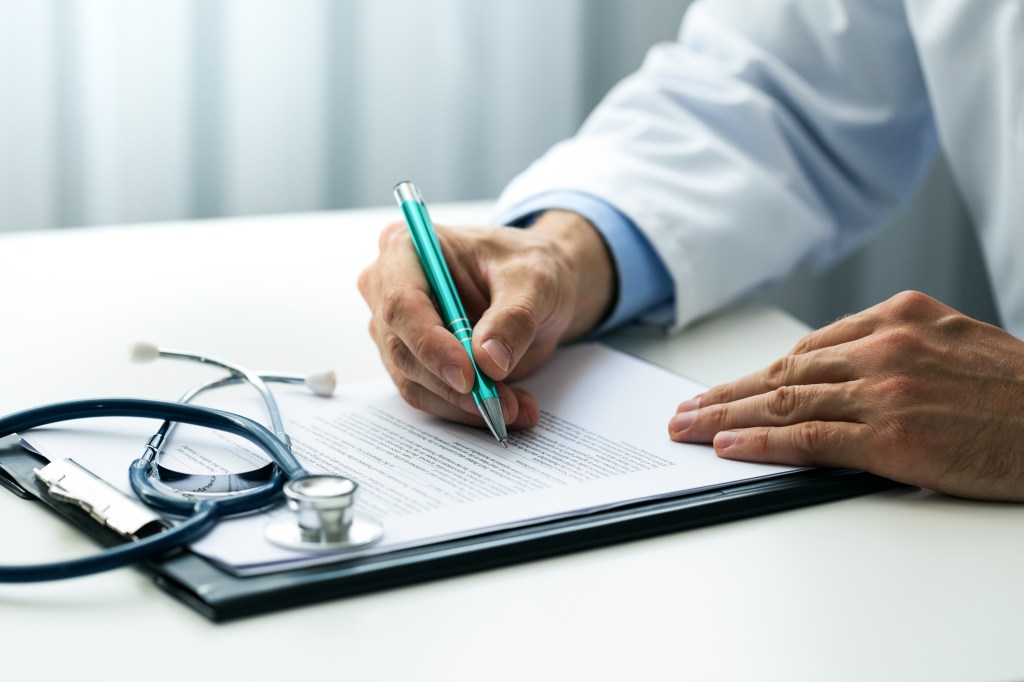
I read a post yesterday written by a pathologist who was recounting his most alarming discovery ever. He told of a woman who went to many doctors over many years, complaining of a bloated, painful abdomen. The doctors seem all to have focused on the word “complaining” and dismissed her as mistaken, not that sick, or a “hypochondriac,” which is another way of calling her crazy. (Which happens disproportionately to women and to fat people, I believe.)
When the pathologist performed the autopsy, however, the found that the woman’s entire abdomen was virtually destroyed by endometriosis, a not uncommon “complaint” among women and one that can be detected by a simple test and then treated. It certainly need not expand to the point of death.
Fortunately, I have a doctor who listens to me. Two weeks ago, when I had an appointment with him, I started the conversation with, “I know you’re going to tell me that I’m just getting old and have to live with it.”
“You’re not getting old,” he replied. “You’re getting older.”
“But I think I’m getting older faster than I ought to,” I said. “Other people my age don’t have all these problems.” He asked me to tell him my symptoms.
“My arms and legs are weak. You know I fall sometimes. Well, sometimes I can get back up, but sometimes I can’t. My husband calls me three times a day from work to make sure I’m not on the floor with my head bashed in. If I don’t answer the phone, sometimes he rushes home from work just to see if I’m all right. I love it that he cares that much, but I wish he didn’t have to do it.
“I use a cane to walk – not around the house, but whenever I go out. Can I get a handicapped sticker for the car? My back hurts a lot, too. In addition, my knees hurt all the time. In fact, if there weren’t a vanity there to lever myself up, I most likely couldn’t get off the toilet.” (Damn it, I should have led with this. Doctor: Why are we seeing you today? Me: I can’t get off the toilet. Imaginary doctor: Then how did you get here? But I digress. )
“And my hair is thinning. I look like an old granny-woman. And I always feel cold.” He listened patiently, even to the part about the thinning hair.
“I’d like a bone scan to see if my osteopenia is getting worse, and I know I should get a colon test too,” I said. “Make it one of the poop-in-the-box kind. Colonoscopy prep is the sickest I’ve ever been in my entire life.”
“You need a mammogram, too,” he commented. Then he put me in touch with scheduling for all the tests and had my blood collected. He even gave me a prescription for the handicapped sticker. (And the nurse gave me a cool bandaid for the needle-stick, after I requested it. I guess not all of me is old.)
All the blood test came back with fine results, I thought. Then the doctor said something I hadn’t expected. “I’m going to double your thyroid medication.”
Of course, I Googled the Mayo Clinic website, which I consider pretty darn trustworthy. I was shocked to find all my symptoms listed there – muscle weakness, joint pain, sensitivity to cold. Plus fatigue, weight gain (which I had also mentioned), thinning hair, and depression. Check, check, check, check, check, check, check.
The Mayo clinic also noted that many people attributed all the symptoms to age. Mega-check.
I’m so glad that I have a doctor who listened to my “complaints” and didn’t fob me off with some lame-ass excuse. I’ve been taking the jacked-up thyroid med for a bit over a week now. I can’t swear that it’s having the effects I hope for, but I like to think there’s a little more pep in my step and that getting off the toilet is no longer the obstacle it was.
My husband still calls three times a day, but it’s my hope that, before long, he won’t have to.


 No, this isn’t going to be a post about me and my husband, although it’s true that we’re growing older (every day) and we’re still together (after nearly 40 years).
 This week I got my first shot of the Moderna vaccine, which was the kind they had at Walmart, where I was able to get an appointment for me and my husband. I don’t really know the difference between that and the Pfizer one, but I do know the Johnson & Johnson one (also called Janssen, for some reason) requires only one shot to be effective and requires less refrigeration than the others.
 Last week I received an answer to a query. An agent I had contacted about my mystery novel had asked to review my complete manuscript.
 I gave Robbin the first cat she ever had (Norman), thus starting her on a long career as the local Crazy Cat Lady. We’ve supported each other and cried our way through many a feline illness and death, and reminisced about our little friends afterward. I know her cats and her little chihuahua Moochie are missing her too. (This cat would surely remind her of Sandy, or one of the many others she opened her heart and house to.)
 The pandemic has changed lots of peoples’ lives. They’ve taken up new hobbies, learned new skills, and bonded more closely with family and friends. They’ve learned what things mean the most to them and what they miss the most. Some have lived in fear and others have found new strength.
 Unfortunately, as the saying goes, “Gravity is not just a good idea; it’s the law.” That may be true, but I am seriously considering a career as a lawbreaker, an avocation as a scofflaw. I might even argue the point as a lawyer.
 Big Pharma has a bad rep. And there are certainly valid reasons for that. Recent accounts of price gouging, particularly on common, life-saving drugs like insulin, have had consumers fuming. The cost of newer drugs is sky-high. And there have been an awful lot of drugs that were apparently sent to market too early, leading to a lot of dire side effects and drug recalls. Add to that the dubious practice of advertising prescription medications direct-to-consumer, and Big Pharma has abused the trust of the American people. The drugs they develop and sell may be – indeed, often are – beneficial and even life-saving, but that doesn’t seem to dissipate much of the cloud of bad feeling surrounding American pharmaceutical manufacturing.
 I am sick of all the coronavirus blog posts and memes. But there are a few that I’m particularly sick of, especially the defiant ones and the conspiracy theories. Here’s what I think, for what it’s worth.
 But I Digress . . .