Category Archives: Uncategorized

What Were They Thinking? (Toilet Edition)

I keep having these dreams. I understand they’re pretty common.(1) In them, I can never find a bathroom. If I do find one it’s unusable – disgustingly filthy, or with no doors or paper, or in the middle of a men’s locker room, or always in the next hall over, or a bucket, or just a circular pipe with no toilet on top of it.

I wake up thinking I’m going to wet the bed. (I haven’t. Yet.)

Unfortunately, I’ve encountered a fair number of potty nightmares in real life too.

Ohio’s Rest Stops
Ohio likes to think of itself as a northern sort of midwestern state – even fought for the Union in the Civil War.(2) But they were tragically far behind in embracing modern (non-outhouse) technology. They didn’t even require flush toilets and running water, not to mention cleanliness and sanitation until 1989. Literally. Legally.(3)

Think about it. From the time I was able to use the grown-up toilet until I was over 30, Ohio was not legally required to provide me with anything other than a latrine. Which often attract bees. Which I am phobic about.

Because of my superior bladder control, I was able to “hold it till we get to Grandma’s.”

Pay Toilets
Yes, children, you used to have to pay to piss.(4) At some point, someone realized this was a discriminatory practice and decided there must be a stall for those without pocket change. These were invariably the stuff of my nightmares.(5)

In fact, I include pay toilets in this stall-of-infamy recital so I can include a terrible joke. What is a synonym for a pay toilet? Johnny Cash.(6) I refuse to include the graffiti “poem,” because everyone knows it already. You don’t? Go ask your crazy aunt.

Kiddie Toilets for Grown-ups
A recent “innovation” I’ve noticed is for all public toilets to be the size of those in elementary schools. Is it a least-common-denominator thing?(7) A water-conserving measure? Purchases from all the schools that are closing? I don’t know.

What I do know is that for a person with aging knees (me), they are damnably hard to get up from. They make me think I am trapped in a verse of “Seven Old Ladies Were Locked in the Lavatory.”(8)

Which brings to the other toilet terror:

Squat Toilets
I was traveling in Croatia and stopped in Istria to see a Roman ruin. Feeling the call of nature, I asked for the facilities. When I found them, I found a stall with a hole in the ground. There was a helpful diagram of where to place your feet.

I used it of course. I had no choice by that point.(9)

And I realize that I’m being totally a first-world, ethnocentric, pampered, ugly-American tourist-type, and that millions of people every day (several times a day, really) use squat toilets and are grateful that they have them, as there are those who cannot avail themselves of even that luxury.

But what I want to know is:

Where do their grannies go?

When I was able to travel I was also able to stand up from a squatting position, but now it would take two healthy young lads to hoist me to the vertical. I’m fairly sure such restroom attendants are not available everywhere. I doubt even a handicapped-access bar would help me now. And I’m not even totally old and decrepit. If I make it to 90, I’ll be in real trouble.

Perhaps after years of practice, squatting grannies have exceptionally strong and supple knee joints. Or some secret knee-rejuvenating treatment that they are saving for themselves and their posterity.(10)

In the words of one of the most awful commercials for ass-wipe today, how in the hell can they “enjoy the go”? I can’t even enjoy dreaming anymore.

(1) I wish the hot-n-juicy variety of dreams were more common, but, sadly, they aren’t.
(2) The first one, I mean.
(3) Here’s the statute: The director of transportation shall develop and implement a program for improving the roadside rest area system along highways of the interstate system and the primary system. Each sanitary facility in the roadside rest area system on the interstate system and at selected locations on the primary system that is upgraded shall have potable water, water flush toilets, and wash basins equipped with running water for the use of the traveling public… Effective Date: 07-01-1989 (Emphasis added.)
(4) Or anything else.
(5) See above.
(6) My apologies to Mr. Cash and all his relatives and friends. I respect and admire him a lot. But that’s how the joke really goes.
(7) Which I don’t remember addressing until later in school.
(8) This was a favorite at Girl Scout camp. In addition to being scatological, it’s sexist and ageist, which would have probably been why we liked it, if any of those things other than scatology were a thing yet. Now there’s a stop-motion animated video. Not kidding. See for yourself. https://www.youtube.com/watch?v=bQx1OcIlFqE
(9) Though I did have perhaps my only bout ever of penis envy.
(10) Sorry. Couldn’t help it.
Mental Illness in the News: Some Questions

One of the notable headlines last week that wasn’t about a celebrity celebrity, ridiculous politician, or even the passing of a great and inspiring actor, concerned mental disorders and how society treats those who have them. Those of us who have or care about people with mental disorders may have noticed this story online:

http://www.rawstory.com/rs/2015/02/truly-barbaric-florida-deputy-drags-mentally-ill-woman-through-courthouse-by-shackled-feet/#.VOyTNKh2Gbc.facebook

For those of you who haven’t read it or seen the video, here’s the gist. A woman, Ms. Rios, was declared mentally incompetent at a hearing for a minor offense and not allowed to say goodbye to her mother. She wanted to sit on a bench and cry for a bit. When she did not go promptly with the officer, he dragged her through the courthouse by her shackled feet. A video was taken on a cellphone camera by a lawyer who happened to be present, but had nothing to do with Ms. Rios’s case. If you watch the video clip you can see and hear her distress.

As the headline says, this was barbaric.

But there’s lots neither the headline nor the story says. I have questions.

What is the woman’s mental illness? Or why is she mentally incompetent? The stories vary, usually calling her “mentally ill,” which is shorter for the headline writers, but so far I have seen nothing more specific. One could get the impression that in the mind of the media – and therefore their readers – that the two terms mean the same thing. Was she medicated or unmedicated or off her prescribed meds? Does she have a developmental disability? An autism spectrum disorder? An emotional or behavioral disorder? We don’t know. But does whatever label make her automatically suspected of potential violence? The woman did not behave like an animal even when she was treated like one.

I think we all know people who have mental disorders but are still mentally competent to conduct their own affairs, up to and including court proceedings. In fact, I know you know one – me. I have bipolar disorder, type 2. But who among us, even the sanest and most stable of the general public, wouldn’t have needed to sit on a bench and cry before going to wherever the officer thought we should go? Who wouldn’t yell and protest and try to hold on to a table if we were dragged anywhere by our shackled feet?

Is that the way to calm someone who’s upset?

No?

Why is the officer’s action called “truly barbaric”? I’m not saying it wasn’t barbaric. But how was it more barbaric than other things routinely done to the incarcerated mentally ill (or incompetent)? Could it be “truly” barbaric instead of just regularly barbaric because the officer’s actions were caught on tape? How many everyday barbaric actions aren’t? And putting aside simple human compassion (which he did), didn’t the officer’s actions create a larger, potentially more dangerous disturbance with someone being dragged and thrashing about?

Why did the other officers present do nothing? You can see them on the video. They are spectators. No one says, “Hey, do you have to do that?” or “Give her a minute to calm down” or “Here, let me take care of this” or “You know, there are other ways to handle this” or even “Are you sure you want to do that with the camera rolling?” Nothing. Nada. Zippety. Doo-dah.

Why weren’t the officers and other courthouse personnel trained to handle situations like that? They obviously happen occasionally. Officers are (supposedly) trained to handle situations involving dangerous felons (which Ms. Rios wasn’t), domestic violence, and how to restrain suspects properly. Some even get sensitivity training on race, sexual orientation, and ethnicity. Where’s the training for interacting with the mentally ill (or mentally incompetent)? For de-escalating a situation instead of throwing gas on the fire? How about anger management before incidents like this one happen instead of after? Shouldn’t every law enforcement official be able to control or channel his or her anger and not take it out on the public?

Why the hell aren’t police officers required to wear body cameras – and have someone whose job it is to, oh, I don’t know, review the tapes occasionally? Certainly when there’s been a complaint, but spot checks might also do some good. Why are civilians subject to increasing surveillance, while law enforcement personnel – who are also civilians, by the way – perform their jobs with minimal oversight.

And why is the Golden Rule suspended when the “others” have a mental disturbance? I’d really like to know.

I Arched Before Arching Was Cool

Sorry, Katniss Everdeen. Sorry, Merida Whatever-your-last-name-was.

You may be role models for today’s girls who, it is said, are taking up archery in record numbers.(1) But I was there first.

It all started in a 5,000-watt radio station in Fresno, California…. No wait, it didn’t. That was Ted Baxter.(2) Rewind. Push play.

It all started down the street from our house, where one of our neighbors set up an archery target by his garage, stood at the end of his driveway, and practiced his Errol Flynn Zen.

All the neighbor kids gathered round. After all, it was way more interesting than watching the other neighborhood dads mow their lawns or build concrete birdbaths.

When I showed interested, my father, who approved of all things martial (if not artsy), bought me a kid’s bow.

And what a bow it was! What’s called a traditional longbow (though a very, very short one). It was made of pink and white fiberglass, swirled in a candy mint pattern, with a red grip and arrow rest. It was a girlie bow, but it was a real, honest-to-goodness functioning one.

I spent many happy hours taking potshots at a gun target(3) taped to he side of the garage(4). And walking back and forth to collect the arrows. This is what passed for exercise in my youth, and is more than I get these days.

Dad got me accessories too, like the arm guard and the shooting glove. The arm guard is an absolute necessity. Just whang the inside of your left arm with the bowstring once because you weren’t holding the bow properly, and you’ll know what I mean. At least six inches of burning, stinging scrape-bruise. If you don’t have an arm guard, keep lots of ice packs handy.

I .

Fast forward a decade or so, and there I was at college, in the field for my second time through a class in Intermediate Archery. (There was no Advanced Archery, so I had to keep cycling through Intermediate to make my required number of gym credits.(5))

“Who has never shot a bow before?” the instructor shouted.

I raised my hand. She rolled her eyes.

There had been a fair amount of eye-rolling on her part. One day I showed up for class wearing a forest green wool cape and a matching Robin Hood hat.(6) I did not bring the pink bow, as it would have clashed hideously. (I would still have my candy-ass pink bow today, except that over the years, the fiberglass shredded.) The school had better bows, in sensible colors.

On rainy days we stayed inside and learned to fletch. (Fletching means putting the feathers on the arrow’s rear end (the non-pointy end, right in front of the nock, which is the little notch that the bowstring fits into). (Isn’t vocabulary fun!)

We even learned to make “frou-frou” arrows(7), which a 1958 Boy’s Life magazine says have “air brakes.” What they really had were big, fluffy, silly-looking feathers. The advantage of frou-frou arrows was that they would fly a certain distance, then stop abruptly, point directly down, and impale themselves in the ground. The perpendicular shaft and fancy feathers made the arrows easy to find when you missed the target. Which we did. Often. We didn’t have those fancy modern bows with bowsights and scopes and assorted sniper-rifle attachments in those days. Which is definitely a good thing, or I might have become an arrow-sniper instead of a writer/editor.

And if that didn’t work out for some reason, at least I could always survive in a post-apocalyptic dystopia or cartoon Scotland. Who else do you know that can say that?

(1) Record numbers are not necessarily big numbers, you understand.
(2) Bonus points for identifying this reference. Double points if you don’t have to Google.
(3) We could have bought archery targets, but honestly, there were a lot of gun targets lying around our garage, just waiting for holes to be made in them.
(4) Later in life, my husband practiced with shuriken by sailing them at the side of our garage. He broke a window.
(5) In those days, universities could still force you to take gym. We had to take at least four semesters, and by the end of it, you had better know how to swim, unless you already knew how to swim and tested out of it. This was actually a reasonable requirement, since sliding downhill on cafeteria trays was a popular recreational activity, and at the bottom of the hill was a large lake.
(6) My mother made them for me. She had a definite whimsical side. Once she made me a camouflage flannel nightgown (neck-to-toes style). I wore it to the office Halloween party and claimed I was dressed as “Granny Rambo.”
(7) I am not making this up. There really are such things and they really are, or at least were, called that. Modern archers may have decided to butch up the name.

Language Police and the Grammar Nazis

For most of my life I’ve been a grammar nazi. For part of my life I was a member of the language police. At one point, my business cards even identified me as punctuation czar.

I now have regrets.

In general, I hate the language police. However, I do understand their philosophy, and it’s not wrong. The implementation of it is sometimes questionable and heavy-handed, but the theory is sound. How we speak and the words we choose to use do affect our thinking. The reverse is also true. Our thinking determines our language choices. If you want to change one, changing the other one is one of the easiest routes. You can see its effectiveness in the fact that n-word is no longer acceptable not just in polite society, but in any context. The next to go will be the r-word, a much-used schoolyard taunt in my childhood. The world is better off without both of them.

Does eliminating the terms mean that people no longer think them or think of people in those terms? That’s a tough question, but we hope the change is real and positive. If there’s a chance that it is, the effort is worth it, even if restrictions of language choices seem foolish, feel dictatorial, and are easy to mock.

Indeed they are easy to mock. Hence the term “politically correct,” now a code-word for any words or phrases you think are unnecessary, clunky, or purely propaganda. Who hasn’t laughed at the saying, “I’m not overweight; I’m under-tall”? Who hasn’t winced when nouns (“slaves”) become long phrases (“person who is enslaved”). (The point of that one is to make the hearer think of the person first, and then the condition – slavery – and realize that slaves are not intrinsically slaves and not automatically slaves forever. They may have been free in the past or will be free in the future. I’m not sure that example will be successful. But “person with dyslexia” is, I think, better than “a dyslexic.”)

Textbooks these days are rife with examples, and when I wrote for and edited textbooks, I had to police the language. We couldn’t talk about birthday parties or vacations because some kids had never had one. We couldn’t talk about dragons, even in fiction because that might imply magic and hence Satanism. I once spent hours trying to think of a breakfast food that would be recognizable in most cultures. The best I could come up with was “juice.” Our joke was that the only acceptable words in the title of Hemingway’s The Old Man and the Sea were “the” and “and.”

Being a grammar nazi is a different matter. I used to take delight in knowing all the rules and enforcing them ruthlessly. Gradually I have gotten away from that practice. I felt it was impolite to go around correcting people unless they had asked for my help. I still corrected my family because – hey – it was mentally painful to be around people who misused hopefully or split infinitives. Or who mispronounced “nuclear” or “foliage,” for that matter. But I would keep my cringes inside when my boss mispronounced “sarcophagus,” until he finally asked me, “Is that how you say that?”

Over time, though, I’ve loosened up my standards a little bit. Before I was a prescriptivist (believing in and enforcing rules), but the older I get, the more I am moving in the direction of descriptivism (accepting the way people really talk). (Except in writing, which is more formal. And don’t tell me I just used a sentence fragment and started a sentence with a conjunction. That is the sort of thing up with which I will not put.)

I can thank linguistics for this shift in perspective. In one of my linguistics classes, I disputed with another student about whether a certain usage was sub-standard or non-standard. I was firmly on the side of non-standard. How I reconciled that with my insistence on the Oxford comma, I’ll never know.

The watershed moment in the prescriptivist/descriptivist debate came when one of the major dictionaries decided not to include usage labels like “vulgar” and “slang.” Essentially they were declaring that all words were equal in the eyes of the lexicographers. This caused quite an uproar. If there were no standards for usage, how could we prove that we were better than the people who spoke sloppily or incorrectly?

My soul was torn.

The change that came over me was due in part to a stunning revelation – that the English language and the Latin language are two separate animals. The old bugaboo about not splitting infinitive, to which I was passionately devoted, has its source in the fact that in Latin it is impossible to split an infinitive. Latin infinitives are all one word. It makes no sense to transfer that rule to English. “To boldly go” would not be possible in Latin but now is perfectly acceptable – to me – in terms of grammar as well as rhythm and meter.

I still can’t abide weather forecasters, though. “Rain shower precipitation activity”? What? Do they get paid by the word?

Whitewashing: Where’s the Line?

Native American Iron Eyes Cody touched the conscience of America when he appeared in the iconic “crying Indian” anti-litter campaign.

One problem: He wasn’t a Native American named Iron Eyes Cody. He was Tony Corti, a white American born of Sicilian parents.

Nowadays we call that “whitewashing” – hiring white actors to portray Asians, Native Americans, or other races or ethnicities. It is a practice that has outlived its day and is decried as an insult as grievous as blackface and minstrel shows.

Take Mr. Yunioshi, the character in Breakfast at Tiffany‘s, played by Mickey Rooney – he’s not funny and is offensive to everyone of Japanese ancestry.

But where do we draw the line?

When Jennifer Lawrence was hired to play Katniss Everdeen in the film The Hunger Games, there was grumbling that she required makeup to darken her skin to the olive shade specified in the book.

Was that whitewashing? Couldn’t they have hired an actor with naturally olive skin to play the role? Almost certainly.

But where’s the offense? Actors wear makeup all the time to perform their roles on stage and screen. Also wigs, hair color, padding, breast implants, cotton balls in their cheeks, prosthetics, and digital edited everything. David Carradine (6’1″) played Woody Guthrie (5’7″) in Bound for Glory, before the days when camera angles and special effects could make Legolas taller than Gimli.

Couldn’t the casting agents have found actors that had the “right” hair color, breast size, facial contours, height, plus the requisite acting talent?

Sure they could.

I mean, I get it. Height, hair color, and so forth are superficial physical traits, not cultural or racial identities. Halloween costume that misappropriate cultures (“Seductive Squaw,” “Harem Girl”), ethnicities (“Tequila Shooter Dude”), and even religion (“Rasta Imposta”) are just another appalling example of insensitivity and racism as inaccurate as stereotypical or whitewashed portrayals on film.

Opinions may be changing, though race in movies is still controversial. Black American actor Louis Gossett, Jr., played Anwar Sadat (half-black, half-Arab) on film and the only notable complaints were from Egyptians. But there was pushback against lighter-skinned Afro-Latina actor Zoe Saldana playing the very dark-skinned black singer Nina Simone in a biopic.

(Surprisingly, I found during my research that Sir Ben Kingsley was not a totally inappropriate choice for the title role in Gandhi. He’s part-Indian and his birth name is Krishna Pandit Bhanji.)

While, we’re on the subject, what about voice-washing? Does it exist under somewhat the same umbrella as whitewashing? Isn’t there a real Polish-speaking actress who could have played in Sophie’s Choice? A Danish woman for Out of Africa? Meryl Streep is the go-to actress for “foreign” accents. Maybe you get a pass if you’re a mega-star.

And how about a little accuracy in accents, while we’re at it? Not all Southern accents are alike. The speech of a Texan, a Georgian, and a Louisianan are not interchangeable, yet we see movies all the time set in the southern U.S. with actors speaking in a hodgepodge of different “Southern” accents.

Listen, I’m just saying that the conversation over whitewashing may not be as simple as it at first seems. Terrible things have been done to Native American persons and culture on film, from farcical stereotypes to accepting Italian or Hispanic substitutes for Native actors under the theory, I suppose, that brown skin is brown skin, and even olive isn’t too far off with a little help from Maybelline.

Admitting that Katniss Everdeen and Mr. Yunioshi represent opposite ends of a spectrum would be a place to start, though.

Books, etc.: Remembering Suzette Haden Elgin

A few days ago a friend informed me that Suzette Haden Elgin had died. This was not unexpected. She was almost 80, and had been in ill health for a while, and suffering with dementia, along with other disabilities.

I never met her, except through her work, but I mourn her passing.

Suzette was a trained linguist, a language maven, and a writer. She is perhaps best known for her books in the Gentle Art of Verbal Self-Defense series. Though not as well-known as Deborah Tannen’s or John Gray’s works, Suzette’s are practical, straightforward, and supremely useful.

She was interested in many aspects of language. She thought and wrote about language and religion, language and politics (especially framing), language and women’s issues, language and perception, language and culture, and more.

For many years she kept up a Live Journal and two newsletters. Under the LJ name Ozarque, she stimulated thought and discussion of her many fields of interest. These were lively, educational, interactive, and fascinating forums in the way that Live Journal blogs are meant to be and seldom are.

She was a writer of science fiction novels, stories, and poetry. I was astounded by her Native Tongue series. (Who besides me could possibly be interested in feminist linguistic science fiction? Many people, it turns out.)

In the Native Tongue series, Suzette described a newly created “women’s language” called Láadan. She and others pursued the idea and constructed a grammar, a dictionary, and lessons available online – way before anyone tried to do the same with Klingon.

She worked on new fiction until the dementia descended. In her LJ, she would sometimes post poems and songs (particularly Christmas carols) and solicit feedback from her audience, sometimes incorporating their suggestions into the piece. The Science Fiction Poetry Association’s Elgin Awards are given in her memory.

She attended science fiction conventions, where she could meet and interact with her readers. One she often attended was WisCon in Madison, WI, the premier feminist science fiction convention, and in 1986 was one of their Guests of Honor.

On a more personal note, she once took the time to give me feedback on a piece I was writing about bullying, also a concern of hers.

She was a kind, humane, quirky, quick-witted, creative, varied, engaged, humorous, brave lady and a brilliant scholar and writer. I will miss her and her work. The world is poorer for her passing, but richer for her legacy.

The Worst Sex-Ed Book. Ever.

Dr. Seuss is my all-time favorite author of children’s rhyming books. He did not write a sex education book.(1)

Shel Silverstein took over from Seuss as my favorite children’s poet. He did not write a sex-ed book either.(2)

IMHO, no one has equaled those two in writing rhyming books for children, though many have tried. Lord, how they’ve tried. And for the most part, failed miserably.

I once edited a magazine called Early Childhood News, which was intended for an audience of child care center owners, directors, and possibly staff. It was occasionally entertaining.(3) I got a lot of children’s books to review.(4)

Which is where the sex-ed and the poetry come in.(5)

One day an amazing book came across my desk. It was titled How Dad and Mother Made Your Brother, which should have been my first clue.

The book was obviously self-published. To say that it lacked the services of a professional editor and a professional illustrator would be a charming understatement.

The text was written (and illustrated) by a real medical doctor, so I guess that was one up on Dr. Seuss, but it didn’t help. The main characters were – I’m not kidding – Stanley Sperm and Essie Egg.

One memorable illustration(6) showed Stanley and Essie sitting on a bench, courting, I suppose. As I recall Essie had long eyelashes and Stanley had either a top hat or a bow tie. Maybe both. Behind them was the gate to a park, with a sign identifying the location as “Cervix.”

You can probably tell from the bow tie and the park bench that scientific accuracy was not the author’s primary concern. Also, Essie and Stanley were the same size.(7)

And now we get to the poetry. Here’s a sample. The author was attempting to tell where Stanley Sperm had lived, before he met the coy and comely Miss Essie. Somewhat confusingly, it seemed that Stanley had come from one or the other of two towns:

The towns are both named “Testicle”
and they look like two round eggs.
They’re not located on a map,
but between your Daddy’s legs.(8)

Do I have to say I did not review the book? (I thought not.)

I kept it for a time, though, to show disbelieving friends. And possibly as the basis for a party game, with each person reading aloud from it until exploding with laughter, when it would be passed on to the next reader.(9)

Of course, given the sex-ed books currently used in schools, there may be other texts out there that are just as bad, or at least as inaccurate. But for sheer unintentional awfulness, How Dad and Mother Made Your Brother has won its place in the annals of scary books that will make kids never want to have sex. Ever. That being the point of most sex education in schools anyway, as far as I can tell.

(1) That we know of. He did write advertising, so who really knows where he drew the line?
(2) Though he certainly could have. He’s the author/artist of Different Dances and the songwriter of “Don’t Give a Dose to the One You Love Most.”
(3) The ad sales department once insisted I add a column about food, as they desperately wanted to attract Lunchables as a client. Yeah, right. Lunchables. For child care centers. I had no choice in the matter, except for the title of the column, which I made as repulsive as possible – “Food Digest.” Well, it amused me, anyway, even if no one else noticed.
(4) Also, sometimes companies sent me samples of toys they hoped I would promote in the magazine. Not sex toys, though. I also received, for some reason, an anti-circumcision newsletter. I used to count the number of times the word “foreskin” appeared in it, just to look busy.
(5) You were starting to wonder, weren’t you? Go on, admit it.
(6) I’ve been told that only shock treatment will erase it from my memory.
(7) Reminder: The author went to medical school and, presumably, graduated.
(8) I hope that’s enough of a sample, since it is the only verse I memorized. I do recall that the conception scene would have been a real production number, had the book ever made the transition to film.
(9) With bonus points awarded for imitating the voice of Bullwinkle the Moose or possibly Daffy Duck.

Egg Sauce, Ted

Fatigue, flu, or both (1) are making it difficult for me to blog today. But I’ve got a doozy for you next week: Worst Sex-Ed Book. Ever.

1. aka I’m sick and tired of waking up sick and tired.

The Day I Brought Bullets to School

I grew up in a house surrounded by guns and bullets.1 After we moved to Ohio, squirrels were no longer on the menu, but in my youth, my Kentucky uncles would shoot squirrels and rabbits and the occasional woodchuck. So I had tasted all of those, usually fried in lard by my maiden aunt, who was for some reason called “Pete,” rather than “Edna Mae,” which was her real name.2

So steeped in gun culture was my family that my father gave my mother a single-shot rifle, which was nicknamed “Grandma,” for their first anniversary. Both of them later became certified rifle and pistol instructors. At age 12 my sister and I both received .22 rifles. We were a well-regulated little militia – three generations worth, if you count “Grandma.”

As if guns weren’t enough of a hobby, Dad also had a thing for bullets. And when I say “thing,” I mean a reloading tool. He would collect spent .38 cartridges (known as “brass”) from the rifle range. He would then put them on a machine operated by a lever that would, depending on the setting, straighten out the cartridges, seat a primer in the bottom, add the appropriate amount of gunpowder, and grease and seat a bullet,3 which was then ready to repeat its journey and reincarnate as empty brass. It was an early form of recycling that for some reason environmentalists never talked about.

Dad also had a hand tool that would reload a single bullet. It looked something like a Bedazzler, only more butch and greasier.

As I entered my teen years, I became more reluctant to spend my Saturdays on the father-daughter bonding experience of going to the rifle range. The smell of cordite in the morning was no longer so alluring. Guns were his hobby, and I was finding my own. Admittedly, crossword puzzles and Star Trek reruns would be less useful than target shooting after the zombie apocalypse, but the prematurely resurrected were not yet on the horizon.

When I was solidly ensconced in my teens and encountered high school, one of the educational exercises they inflicted on us was doing demonstration or “how-to” speeches in front of our English classes. It was a more sophisticated version of show-and-tell, with fewer goldfish. I don’t remember any of the other demonstrations, but mine was reloading bullets. It did nothing to lessen my reputation for oddity.

I took the hand reloading hand tool, an empty cartridge, a spent primer, and powder. I Bedazzled my way through all the steps, happy in the knowledge that, though I gave an entirely valid how-to demonstration, it would be utterly useless to the class.4

It’s worthwhile noting that I did not bring actual gunpowder to school. Instead I substituted iced tea powder.5

It got me an A. These days it would get me handcuffed and tasered.

1. The house was not surrounded by commandos with guns and ammo. The guns and bullets were in the house.
2. She got riled up if anyone called her Edna Mae. Admittedly, that still doesn’t explain the Pete. It caused some confusion when a neighborhood friend went visiting with us and in telling her mother about it, casually mentioned, “I slept with Pete.” She then had to explain (and quickly), “Oh, mother, Pete’s a girl!”
3. He made the bullets himself, too. He had a big chunk of lead, and he would melt it down and pour it into molds. (My mother made him do this outside, which was a Good Thing, because of the fumes and our tender, growing brains.) For those bullet-techies out there, what my Dad made were “wad-cutters,” a flat-nosed bullet used for target shooting. He sometimes substituted wax for lead and made lighter loads for starter pistols.
4. Maybe some of them are Doomsday Preppers now and wish they’d paid attention.
5. Which is ironic, considering how much I loathe the Tea Party and open-carry enthusiasts.

Cats, etc.: The Candy Bar of Cats

All my life I’ve admired calico cats. The lovely contrast of tricolor fur is like nothing else in the cat world – and indeed a rarity in the animal kingdom.(1)

But I had never thought twice about the variety of calico called tortoiseshell, “torties” for short. Torties are a brindled variety of calico with little to no white fur – black, brown, red, russet, and multiple, mixed variations of black and orange.

This is a calico.
This is a calico.

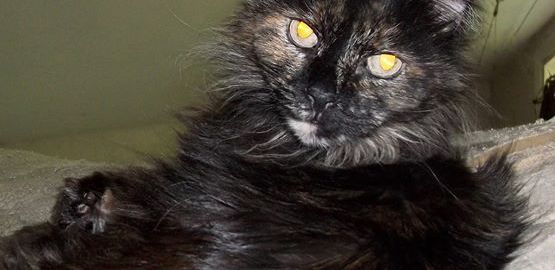
This is a tortie.
This is a tortie.

When I went to the shelter to get my first cat, they had no traditional calicos, only tortoiseshell calicos, among the tabbies, bi-colors, solid colors, and just about every other color pattern – except calico.

I pondered the many choices, and found myself drawn to the torties. After all, they were a kind of calico. I asked my fiancé’s advice. He was studiously and purposely unhelpful. “Gee, I don’t know, honey, they’re all nice cats.”(2)

I found a little tortie whose elastic name band said “Bejeau.” “Aha!” I said. “Someone can’t spell Bijou. That’s the one.”(3) I took her home. And made her a new name band with the proper spelling.

A few days later, the shelter called to see how we were getting along. “Fine,” I said, “except she wants to sleep across my throat.”

“Oh, dear,” said the shelter lady. “She’ll probably stop that when she feels more secure.” And so she did.

Bijou was the first of my torties, but there have been others since – Anjou, Laurel, and Louise.(4)

________________________________

Once I was sent to New York City on business and had an extra day to spend (because of the ridiculous way airlines charged for business travelers).

I decided to make it an all-cats day. First I went to see the musical Cats, and then I went to the cat show at Madison Square Garden.
The musical was awesome, but the cat show was fun.

I saw varieties and breeds of cats that I had never heard of. I saw pampered cats that looked like princesses in elegant pink silk beds, their likewise-silky long hair flowing around them and a look on their faces that said, “You peasant! Move along now that someone else may adore me.”(5)

At one of the judging stations, the man doing the judging was willing to chat with me. He told me how to tell the difference between Norwegian Forest Cats and Maine Coons by the shape of the face. Then he told me about tortoiseshells.

With all his years of cat-judging experience backing him up, he authoritatively informed me, “All torties have a screw loose.”

Maybe that was why Bijou slept on my throat and Anjou carried a tampon applicator though one of my parties, and Laurel curtsied to everything, and Louise was known in her youth as “Naughty Baby Fek’lhr.”(6) A screw loose indeed.

One of my friends put it better, though: “Torties are the candy bar of cats: a little bit sweet and a little bit nuts.”

(1) There are calico guinea pigs, which are kind of cute, but nowhere near as compelling. Guinea pigs just don’t have a lot of personality.
(2) Smart man.
(3) I had studied French for years. My second torte, named Anna by the shelter, became Anjou.
(4) And some traditional calicos: Julia and Dushenka.
(5) I later saw one of those uppity cats turn pure kitten when a feather on a string was dangled before her. She caught it and proudly sat there with it sticking out of her mouth for the rest of the judging. “It’s mine!” she seemed to say. “I caught it and you can’t have it.”
(6) A joke that almost no one gets.