Monthly Archives: July 2023

R-E-S-P-E-C-T: Find out What It Means to Everyone

“Hello, Marvin,” I said, as I stepped to the front of the line at the polling place.

“Hello,” he said, looking puzzled. “Let’s see if I can remember your name.” He thought a minute.

“Janet,” I said. No light went on in his eyes. “Coburn,” I added.

“I know I must have seen you around somewhere.”

“Actually, no. I just read your name off your name tag and wanted to be friendly.”

“I forgot I was even wearing it,” he said.

* * *

My husband was working in the electronics department of the store. He saw a customer looking at the merchandise. She was apparently transexual or in transition.

“Hello,” Dan said, with a friendly expression on his face. “Is there something I can help you with?”

The woman seemed taken aback.

* * *

Dan also sees many customers from Arabic-speaking countries. He greets them the same way, then helps them as best he can, holding up items and doing his best at understanding heavily accented English.

Those customers always come back. Sometimes, late at night, they talk to Dan, compliment him on his full, lush beard, and introduce him to their friends.

* * *

I was walking through the university’s Student Union building, leaning on my cane. Tired, I tried to take a seat on a convenient chair, but missed my landing and fell to the floor.

Instantly, a group of young women appeared at my side, expertly hoisted me into the chair, and offered to get me juice or a hot, comforting beverage. (I was a bit shaky after my tumble.)

When I assured them I was fine, they returned to the juice bar or went off to class, with no fuss or fussing. It was a big deal to me, but seemed just another event to them.

* * *

Not so long ago, there was a vogue for “random acts of kindness” – helping unknown recipients by putting a coin in an expiring parking meter or paying for the next person in line at the toll booth. And these were indeed nice things to do. They did add a little kindness to the world. Largely, they were anonymous.

What I would like to see in the world, however, are random acts of respect – using a person’s name, waiting on all customers with an attentive expression and welcoming word, helping a fallen stranger.

In fact, these shouldn’t be random acts of respect. Ideally, they should be everyday occurrences, practiced by everyone. We know that’s not going to happen, or at least not anytime soon.

So for now, let’s concentrate on “random.” Just try it whenever you think about it, or once a day. Use a person’s name – even if it annoys you when a server tells you hers, don’t summon her by saying, “Hey, waitress!” Say “Thank you” to the baggage attendant that just lifted your 50-lb. suitcase, even if you’re furious that you had to pay extra for it. Smile and nod at the worker who cleans your hotel room as you pass her in the hall. Shake hands when you’re introduced to the young person with blue hair and sleeve tats.

Do it because it will surprise someone. Do it because it will make someone feel good. Do it because you’re a good person. Do it because your mother told you to be polite. Do it because it’s the only lift a person may get all day. Do it because the people you meet every day deserve respect and too often don’t get it. Do it because we’re all human beings, sharing the planet.

And say “thanks” or nod and smile when someone shows respect to you. You deserve it too. Then keep the chain going.

Practice won’t make perfect. But it will make better. Help. Greet. Smile. Thank. Look at someone when you talk to them. To quote a well-known song, “Little things mean a lot.”

A Marriage Made in the Kitchen

Flour, eggs and LoveI think it all started with the naked Julia Child impressions. We were newly married and everything was fun. We weren’t entirely naked while cooking, of course – aprons were a requirement and oven mitts (worn strategically) were allowed. There were other rules, too – no deep-frying, for example, for obvious reasons. Using plummy, authoritative voices we would do a fictitious play-by-play of dinner preparation: “Place the turkey in the oven for 350 minutes at 120 degrees. Oopsie! [take slug of wine].”

Of course, at that stage it wasn’t really a turkey. We were the newly married poor and subsisted on mac-n-cheese, frozen burritos, and anything else that cost $.27 or less. Cooking was simple, fun, and entertaining. Not that we could afford to entertain. All of our friends should be grateful for that.

We didn’t get serious about cooking until years later when friends of ours came up with a recipe they called “Experimental Chicken.” It was wonderful and was wonderfully different every time they cooked it. “By God,” I said, “if Tom and Leslie can cook, so can we!”

At the time, we weren’t foodies. Either they didn’t exist yet or hadn’t made their presence known to the likes of us. Our early attempts at cooking were really “modifying” existing products. We’d take Hamburger Helper “Beef Stroganoff,” substitute stew meat for hamburger, and use real sour cream instead of the packaged powder that was supposed to morph somehow into a sauce. It may not have been actual cooking, but it was an improvement over the boxed version. We also improved mac-n-cheese by adding tuna and peas to it. Protein and veggies! What a great idea!

Then we branched out into original one-pot meals. (We still prefer one-pot meals. Both of us hate to do dishes.) “Cowboy beans” was one of our specialties: ground beef, pork-n-beans, and cheese. Call it minimalist cooking if you want to be kind. As we became more adventurous we began to add ingredients like refried beans, tomatoes, chiles, green peppers, onions, and assorted spices, then serve them with tortillas and salsa for do-it-yourself burritos. We never went back to the $.27 frozen ones.

At last the Food Network came into our lives. Stuck at the time in severe depression, I watched the shows endlessly for the calm voices and helpful tips. I finally learned the term “flavor profiles.” Our cooking life was revitalized. I became the chef and my husband was the sous-chef.

We seldom used recipes. The experimental nature of the original chicken inspiration had stuck with us. We belonged to the look-in-the-fridge-and-pantry-and-go from-there school. “Cut that chicken into bite-sized pieces,” I would say. “No, my bite-sized, not yours. Now pass me the paprika, please. The smoky paprika. Now, everyone into the pool! Mixy-mixy!” We developed our food repertoire to include a killer ratatouille and something that resembled a quiche.

Then came a bigger change – my back wouldn’t allow me to stand at the stove and the tremor in my hands made me dangerous with a knife. So Dan took over as head chef, and I became the food consultant. His first attempts were a little sad. “A casserole needs some moisture in it – milk, stock, or something – to hold it together, especially if there’s rice or noodles involved,” I would gently suggest.

Gradually Dan came into his own. I only had to answer questions about whether I wanted my fish baked or broiled, or whether sage or lemon pepper was needed. Once I explained them, he instantly caught on to shepherd’s pie and frittata. They’re now his signature dishes, so lovely that we could post pictures on the Internet if we were into food porn, and tastier than many a restaurant meal.

I still fondly remember those days of naked Julia Child impressions, though I have no particular desire to recreate them. But since then, our cooking partnership has evolved just as our marriage has – for richer, for poorer, in sickness and in health, with laughter and spice, and a willingness to let each other take the lead at different times. All in all, a tasty recipe for two.

Political Noise

USA Flag Man YellingThis was written seven years ago. Unfortunately, it’s just as relevant today.

A friend of mine started a Facebook page called Political Noise. I wish he hadn’t.

Oh, I don’t mind that he (mostly) keeps his political rants on a separate page from his puns, movie reviews, and discussions of pop culture. What I mind is the title. There’s already too much noise in politics.

So much noise that the signal can’t get through.

Wikipedia defines signal-to-noise ratio (or SNR) as “a measure … that compares the level of a desired signal to the level of background noise.” Think of an old-fashioned television set or radio.  When there’s too much static, you can’t get a clear picture or clear sound. At most, you get a snowstorm of non-information or a meaningless buzz.

That’s what’s happening in interpersonal communication these days. It’s worse because of upcoming elections, of course. It seems that whoever shouts the loudest gets the most attention. The content – the message – has become irrelevant.

In fact, the content has dwindled to nothing. Words that no longer retain any meaning are flung at the heads of those who are supposed to be recipients of the message. Patriot, citizen, terrorist, liberal, fascist, tyrant, and other, cruder, forms of common words no longer have denotations (agreed-upon definitions), but only connotations (emotional content). Linguist S. I. Hayakawa nailed it back in 1941:

[W]e discover that these utterances really say “What I hate (‘liberals,’ ‘Wall Street’), I hate very, very much,” and “What I like (‘our way of life’), I like very, very much.” We may call such utterances snarl-words and purr-words.

Then there’s the problem of who’s supposed to be receiving the message, the snarls and purrs. Sadly, the answer seems to be, only those who already agree with you. Try as they might, nay-sayers’ voices will not be heard – certainly not understood. Multiple viewpoints are not welcome.

We are all shouting across an abyss and can neither hear nor be heard. The only response is an echo.

If ideas are not in play, surely facts must be. Alas, not. Facts are fungible and loaded with political opinions. Want a fact about climate change or voter suppression or welfare, or, god help us, guns? People on both sides can rustle up some statistics from somewhere. There is always a scientist who’s an outlier, or is funded by someone with an agenda. Cherry-picking and rhetorical fallacies (strawman, slippery slope, post hoc ergo propter hoc, appeal to the common man or to authority, etc.) have become Olympic-level sports.

Not only is this cacophony damaging, it is counterproductive. No one convinces anyone of anything by shouting at them. The goal isn’t really persuading anyone else – you can’t do that by telling people they’re evil and stupid. The only goal is reinforcing oneself and one’s own worldview – intellectual masturbation.

I do not think that the situation will change for the better once the elections are over. I can’t believe that people will stop, take a step back, and lower their voices or the heat of their rhetoric. The only solution offered for noise is louder noise.

Some of us wish for clearer signals, less interference, a volume knob that begins at less than 11. Less shouting and more hearing. Listening. Thinking. Considering. Compromising. Maybe the secret is asking questions instead of yelling slogans. What do you suggest? Why do you think that will work? Whom will that help? How can we best use our time, our resources, our selves?

I’m not a little old-fashioned lady asking for a little old-fashioned civility here. Empty politeness is not the solution. Real work is – the extremely hard work of true communication. Sharing ideas, not screaming them. Trying solutions, instead of dismissing them. The mental work of trying to understand; the physical work of acting locally; the emotional work of finding common ground; the spiritual work of valuing one another. These are ways to get signals through the noise.

If what we really want to do is communicate, not pat ourselves on the back and vilify others, that is. But all I hear are snarls and purrs.

Fish Tales From the Midwest

It’s not as hard as it used to be to find sushi here in the Midwest. It can be hard finding good sushi. Fortunately, I live in a community that contains an Air Force base and a university with programs such as bioengineering that draw a diverse and sophisticated population. It is no longer impossible to find good sushi. The variety may be less than what’s available on either coast or in bigger cities, but someone (like me) with a taste for the Japanese delicacy can find satisfaction, along with sashimi, sunomono, and low-sodium soy sauce.

But it hasn’t always been easy. Here are some fish tales from my journey from doubter to aficionado.

___

The first time I tried sushi was in one of those social situations where it is simply impossible to refuse. (Not unlike the time I first ate egg salad, which I loathe, at my sister’s mother-in-law’s. Since then, I’ve come to tolerate my husband’s version of egg salad. But I digress.)

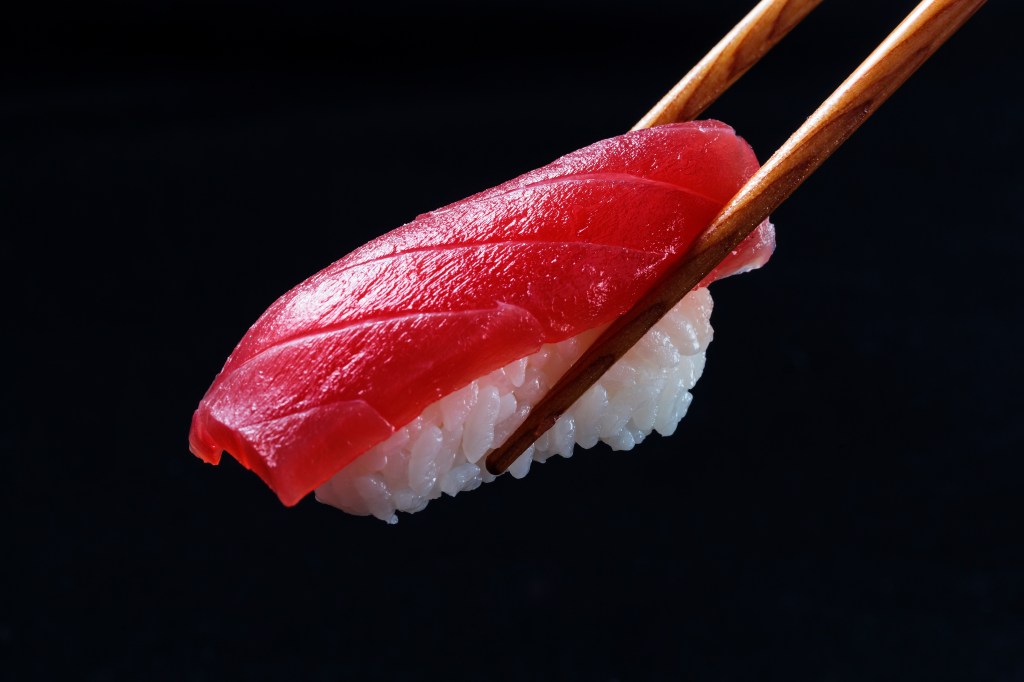
I belonged to a martial arts club, and one weekend we were invited to the sensei’s house to help answer mail and do some other dojo-related paperwork chores. His wife, a lovely Japanese lady, served up a plate of sushi. That she had made by hand. Using seaweed from her family’s farm in Japan. Short of a deadly fish allergy, there is no conceivable way to refuse such an offer. So we all gulped a little and then gulped a little.

I don’t know what everyone else thought, but I found it odd yet somewhat pleasant. I believe I acquitted myself well. And I decided that if the opportunity ever came up again, I would certainly indulge.

___

That opportunity came on our fifth wedding anniversary. We got dressed up and went to a tony Japanese restaurant about 45 minutes away. (Sushi had not yet penetrated the local market. Now it’s available in the local supermarket and we have a standing order for Wednesdays. But I digress again.)

We ordered a sushi appetizer and tempura entrees. I informed my husband that under no circumstances was he allowed to ask for a knife and fork. The sushi portion of the meal went swimmingly until Dan noticed the little pile of green paste on his plate and scooped up a healthy mouthful. Of course, it was wasabi, and of course, the top of his head blew off. A fan of horseradish in all its forms, he still likes wasabi, but now in more judicious quantities. The pickled ginger is much more forgiving.

(Later in the dinner I complimented him on how well he was doing with the chopsticks, despite his lack of practice. He replied, “Honey, I’m a compulsive overeater. I’d eat with my elbows if I had to.” But I digress some more.)

___

Not everyone is enthusiastic about their first encounter with sushi, or compelled by circumstance to try it. But sometimes another person can be convincing and compelling.

I once dined with a husband and wife at a Japanese restaurant. The wife passed on the sushi.

The husband turned to her and said:

“Do you really want me to tell the children that you wouldn’t even try it?”

Bam! Emotional judo for the win. She had no response possible, aside from the most profound of dirty looks and a small bite of the sushi.

___

I have no problem with people who actually don’t care for sushi – once they’ve tried it. My friend Tom was a case in point. We were dining at an excellent sushi bar and he expressed a desire to give it a try.

It was beautiful sushi. Gloriously dark red tuna reposed on a pillow of sticky rice. Of course, when Tom asked to try a piece, I had to say yes. If he was ever going to like sushi, this was the piece he would like (aside from oshinko or other non-raw-fish varieties, of course).

And he didn’t like it. But I was so proud of him for trying. Without even the threat of disappointed kids.

___

My husband’s coworkers were not so brave. They had a tradition on birthdays of letting the celebrant choose the restaurant. Dan chose a local sushi bar and had to put up with the disgusted faces and the gagging noises they made as he ate his way through a platter of assorted delights.

Of course, when sushi became trendy a few years later, all the fellows were bragging about how much they loved it. Dan refrained from reminding them that they were raving over what they had once considered – and derided – as bait.

___

And what of fugu fish, the potentially deadly blowfish that, unless properly prepared, can kill with an insidious neurotoxin? Am I brave enough to try that?

Fortunately, I don’t have to answer. There are, to the best of my knowledge, no properly qualified fugu masters in our area and so no fugu on the menu anywhere around.

But suppose I ever get into a social situation where eating fugu is the only possible option. In that case, I like to think I would smile, say, “Domo arigato gozaimasu,” and dig in. It might be the last thing I ever did, but I would die politely.

Romancing the Body

Romance novels have changed since I used to read them. (Yes, I am here publically admitting that I did once read what I called “tempestuous” novels because the cover blurbs always started, “The tempestuous saga of an innocent young woman and the pirate she couldn’t live without.” Hey, I was 16. But I digress.)

The covers of the novels, which were also called “bodice-rippers” back then, usually featured a picture of a man and a woman, with him ripping open her bodice (duh). The man always looked like the king of book covers, Fabio (a famous cover model) or a fair imitation, with lovely flowing locks, a square chin, an intent gaze, and an irresistible (apparently) sneer. The woman was slim, beautiful, and wearing a dress with a bodice (again, duh). She could be soft and yielding or, more often, fiery and tempestuous. If you knew about such things, you could sometimes guess the era in which the tempest played out by the details of the clothing, but usually not. An open, puffy-sleeved shirt and a ripped bodice don’t really convey that much information.

The point is, the cover art generally featured two figures, a man and a woman, with some indication of conflict and/or passion between them.

Not anymore.

I’ve noticed that these days, romance novels tend to have cover art that features a man only.

And not just any sort of man. He will have the physique of a bodybuilder, a hairless chest, no shirt (or one that exposes the entire torso), tight jeans, and not much else. He could be a bodybuilder or a cowboy or a firefighter or a musician or (I suppose) a beach bum, or even, since Fifty Shades, a business tycoon on his day off.

But he has no face.

Where a face should be, there is a shadow or a hat. Or the picture is simply cropped so that the cover doesn’t involve even a hint of a face.

What does this say about women and the men they are attracted to?

In sexual politics, there is a thing called “the male gaze.” It refers to how television and movies and advertising and just about everything else present females that will be pleasing to a man who is looking at them. How women react to the images doesn’t matter. (This can also be called “heteronormative,” but you didn’t come here for a sociology lesson.) The “male gaze” reinforces the idea that stereotypical males value women only for what’s between their neck and their navel, as the saying goes. (Or their neck and their knees, to be more accurate.)

Now, on the covers of romance novels, we have images that are meant to appeal to the female gaze. And what do they show? Besides torsos, I mean?

They show that publishers – or at least their marketing departments – are trying to appeal to the “female gaze.” And they think that gaze rests on the same areas as men’s gazes – neck to knees. To appeal to the romance reader, they think, men should be manscaped and body-sculpted, physical as all get-out. And anonymous.

It may be true that some women do long for anonymous sex these days and that romance novels increasingly sell sex. And it may be that the female gaze is as superficial and body-conscious as the male gaze. Maybe that’s the way it is for women who read romance novels. Maybe the publishers know their audience.

As for me, the things I look for in a man are all above the neck – bright, witty, creative men with facial hair. (In fact, three of those qualities are not just above the neck, but above the eyebrows. And I’ll disregard a guy’s lack of facial hair if the other three qualities are strong. But I digress again.)

That’s what’s romantic as far as I’m concerned. And sexy. But I suppose it doesn’t sell books.