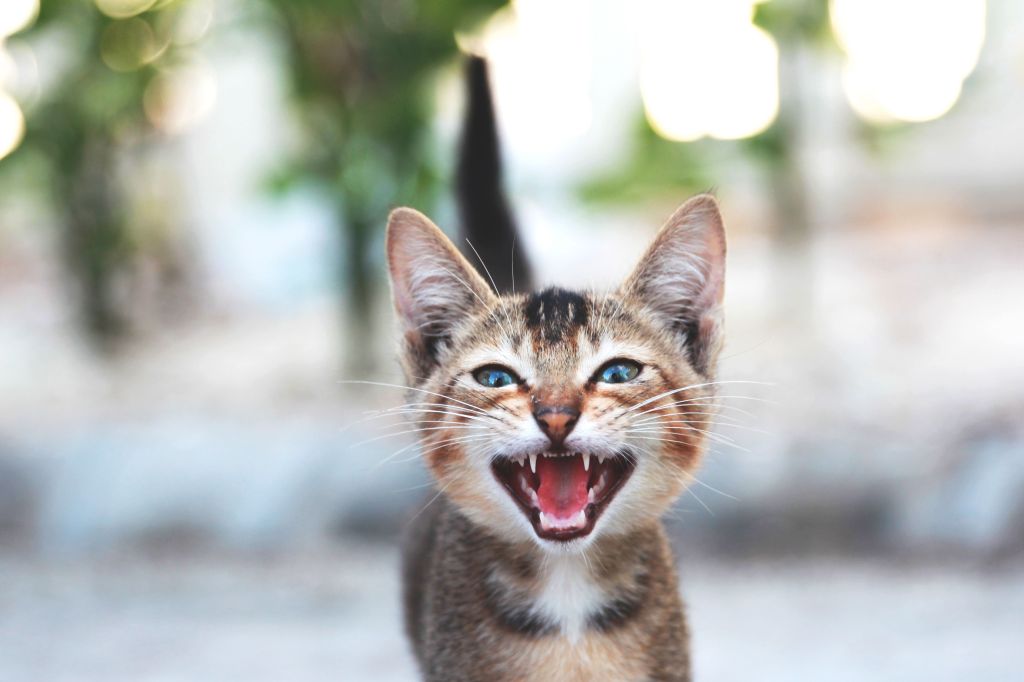
If the question is “Can cats learn to speak like humans?” the answer is “obviously not.” Cats have a very limited vocabulary, though they make the most of what they’ve got. Mostly, they say “meow” or some variation thereof, like “mew.” Most cats purr and occasionally hiss.
(I’ve had or known cats that had more extensive vocabularies. One of them could say “now.” Our present cat, Toby, often says “meep,” though it’s unclear what he means by it. Other cats make odd little bleating noises. Then there are cats that are capable of mouthing words, or at least one word. The silent meow happens when a cat moves its lips but doesn’t make an actual sound. But I digress.)
Cats expect their humans to interpret their vocalizations, and for the most part, we do. Generally, whatever they say means “Feed me,” or occasionally, “Pet me.” I say, for the most part. You can get some nasty scratches if you misinterpret a certain meow or purr as “pet me” when it really means “Stay away from me, human.” It’s difficult or impossible to tell the difference unless the cat also has the power of vocal inflection, which most don’t. (I did have one cat who was able to make her needs known by telepathy and another who was able to express the equivalent of “Don’t fight. It stresses me,” using both voice and actions. But I digress again.)
But if you mean, “Can cats understand what human speech means?” the answer is “not always.” Toby understands “Do you wanna eat?” or its variations and pays rapt attention when you say it.
He doesn’t understand “Get down,” or if he does, he simply ignores it. When Toby gets on my desk, which he is absolutely forbidden to do, no amount of “Get down” will work. Neither will “Get off the desk ” or “Get down from there, you horrible, naughty beast!” I can understand why he wouldn’t comprehend “bad kitty.” He deserves it so often that it has lost its meaning.
(Cats are supposedly able to learn a few simple commands like “Get down.” I’m supposed to give the command calmly but firmly, and then point to where I want him to go. If he doesn’t get the idea, I should put my hand on his backside and give a gentle push while saying “Get down.” Finally, if nothing else works, I should physically relocate him and then pretend that it was his idea all along, petting him and saying “good kitty,” which simply isn’t true. He’s been coerced, not cooperative. (I’ve heard of cat agility competitions where cats must navigate an obstacle course and have clearly learned to respond to commands in order to participate. But I digress even more.))
Cats can also learn and respond to their names. They just sometimes choose not to. Humans give their cats nicknames, and sometimes cats’ names are changed when they’re adopted, and the cats adapt accordingly. We once took in a stray and called her Dushenka. Only later did we learn that in her previous life, she had been known as Carmen. The change appeared to bother her not at all, and we kept calling her Dushenka after we found out. (I did know of a cat that would respond immediately to “Hey, you! You with the fur!” It was no doubt clear to the cat that he was the only one in the household who fit that description. But I digress still more.)
I hate to admit it, but understanding human speech is one area where dogs are actually superior to cats. Dogs can learn dozens of commands, even relatively complex ones. They can respond appropriately to voice commands, hand signals, whistles, and other forms of training and communication. Cats are simply no good at performing complex tasks such as being service animals or rescuing lost hikers. It’s all they can do to make it to the food bowl when obviously they’re perishing from hunger.
Dogs even have devices that allow them to press buttons corresponding to messages they want to give their humans. These include “Feed me,” “I need to go potty,” and “Play with me,” of course, but they can also combine two different buttons to indicate their wants or needs, such as the combination of “outside” and “potty” versus “outside” and “play.” (It’s been noted that dogs don’t use the button that corresponds to “I love you” as often as their humans say it to the dogs. Cats would, I suppose, need an “I tolerate you” button. But I digress even more.)
But I am, after all, one of those crazy cat ladies who holds entire one-sided conversations with Toby. I know he doesn’t understand, but I chalk it up as another way that being a pet parent gives me satisfaction. Not that I wouldn’t feel even more satisfaction if he would just stay off my desk!
 This was written seven years ago. Unfortunately, it’s just as relevant today.
