All posts by Janet Coburn

Writing Advice From an Editor

Want to know more about the writing and editing process? I’ve been a writer and an editor for most of my life. Of the two, editing is easier – looking at a piece of writing and seeing what it needs, rather than producing something worthwhile from scratch.

I’ve learned a lot about editing from other editors, but I’ve also learned a lot about writing from them. Here is some advice, primarily about writing for magazines, which is where I spent most of my career.

Every piece of writing needs editing. Without exception. There is nothing that cannot be improved. I don’t care if you’re Hemingway (who said, “Write drunk. Edit sober.”). Many times pieces of writing don’t get the editing they need, whether because the editor is too lazy or the writer is too famous. I cringed when I heard that an unedited version of Stephen King’s The Stand was going to be released. The original version was seriously overwritten and needed a good editing. I gave up reading King after that. Every piece of published writing gets edited. Or should, anyway.

There are different kinds of editing. Many people think that editing is all about putting the commas in the right place. They’re right, but they’re also wrong. Editing comprises several levels: acquisitions editing (choosing or commissioning pieces of writing for publication); content editing (preparing a piece of writing for publication, including additions and deletions, errors of fact or grammar, and more); copy editing (correcting grammar and punctuation errors and making suggestions regarding style). What most people think of as editing is either proofreading or copy editing. Of course, at a small magazine, an editor may perform more than one of these functions.

There are many reasons a piece of writing gets changed. Not all of them imply that the writing is bad. The editor is not your enemy. Sometimes editing makes a good piece of writing better – or more in line with what the publication needs. A piece can be edited because it’s too long or too short for the space allotted. Cuts may be a word or two here and there, or entire paragraphs.

Work with your editor. If he or she requests revisions, it’s best not to argue. Magazine editors won’t have the time for much back-and-forth. A request for revisions means the editor trusts you enough to fix your own work. Most of the time the editor just goes ahead and makes the changes. If you’re difficult about revising, you likely won’t be asked back.

The first and last paragraphs of a piece of writing often need the most editing. Too many writers write “In the beginning” first paragraphs that start too far in the background. The first paragraph should answer the question, “Why should I read this article?” The last paragraph should tie back to the first paragraph, ask a relevant question, or do anything but say, “Time will tell.”

Your own work is the most difficult to edit. It’s hard to gain enough distance from your own writing to analyze it. One thing you can try is to put the piece away for a day or two, or at the very least a few hours. Work on something else, preferably something entirely different. Then come back to the first piece with a clear mind and more perspective. You could also try reading your writing aloud. If a sentence is difficult to say, if it rambles, or if you lose the thread of it, it probably needs shortening or rewriting.

Don’t spend too long trying to fix a stubborn sentence. Make it into two shorter sentences, or reframe the thought and write it a different way. There’s always more than one way to express a thought. You can express a thought in many ways. Thoughts are adaptable to many grammatical forms. If a sentence doesn’t work, find some other way to say it. Your first attempt at a sentence doesn’t have to be your last. Stay open to alternate modes of expression. Your sentences aren’t chiseled in granite.

(See what I did there?)

Editing is a process. If you edit your own work, you may want to make more than one editing pass. The first time, read for meaning. The second time, read for grammar and style. Then read for punctuation. If you try to do all of them at once, you’re sure to miss something – especially if you’ve already found an error on a page.

Do not trust spelling or grammar checkers. A spell checker can’t tell whether you meant “form” or “from” and accepts either as a valid word. You may have used a sentence fragment on purpose, to achieve a particular effect. That’s why you need a human editor as well as a machine.

Love them or hate them, editors are not going to go away. They are the gatekeepers of published writing and, at their best, they are resources to help you make your writing more effective, more correct – and more publishable.


Christmas Comes Creeping

It’s that time of year again – the time when we all bitch about Christmas Creepage. You know – how Christmas decorations and other fol-de-rol appear earlier every year, so that now they practically impinge on Halloween.

You get no sympathy from me. Here’s why.

First, it’s not going to change. Some businesses have decided to close on Thanksgiving “to be with family,” despite the fact that the only thing anyone buys on Thanksgiving are the dinner rolls you forgot to pick up when you bought the fried onions and mushroom soup for the traditional, little-beloved green bean casserole. But that’s a different matter.

Christmas creepage is purely a matter of the bottom line. If starting the decorating and selling didn’t make a difference in profits, the stores wouldn’t do it. But they both expect and get the Pavlovian response – reminding people of Christmas reminds people that they haven’t finished (or perhaps even started) shopping yet.

Therefore, creeping Christmas tut-tutting belongs in the same category as “You know as soon as they finish paving this road it’ll just be time to pave it again” and “Why do the hot dogs and buns never come out even?” Ritual plaints with no hope of resolution. So if we stop worrying about when the bells start jingling, we can expend our nerve endings on really important matters like “Forget universal health care. Why is there no universal law about where we can buy booze on Sundays?”

That said, there is another reason that angsting over the continual push-back of Christmas starting dates is an exercise in futility. Just as with starving orphans, there is always someone who is worse off than you are.

Consider the employees who work in those stores that commence holiday frivolities sooner than you would like. The clerks and stockers and servers have to put up with hearing the same Christmas tunes every shift, every hour, every day. Mostly involving the colors red (-nosed reindeer) and silver (bells), or speculations on what Santa may or may not be doing (checking lists, kissing Mommy, delivering hippopotami). Because, let’s face it, there are only so many Christmas songs in existence, especially secular ones appropriate to be associated with commerce.

You may not realize it, but there are professions in which preparations for Christmas start even earlier. Religious publishing, for example. So much lead time is required to put out a monthly magazine that editors must start planning their back-to-school issue before school adjourns for the summer. The Christmas issue has to be in process before Labor Day, at least. By the time Christmas actually arrives, the employees threaten to have a breakdown if one more person says, “the reason for the season” or puts up a display of a kneeling Santa.

Craft stores, I think, have it the worst of all. They not only have to sell kits and supplies for making Christmas decorations, they have to sell them in time for crafters to finish them before Thanksgiving (or earlier). Roughly the Fourth of July.

As for me, I’ve pushed Christmas preparations all the way back to January 1st. I once worked in an office in which all the women wore Christmas sweaters, and non-ironically at that. Some even wore Christmas sweatshirts on Casual Fridays, but that leads us back to the craft store dilemma.

I refused to give in to the price-gouging that ensued in December, not to mention the fact that I felt most of the sweaters fell into the category of Ugly Christmas Sweaters. So I waited till January and bought the leftovers at bargain prices. I thought the leftover sweaters were by far the nicest, since they didn’t feature the gung-ho-ho-ho excess of the more popular ones.

I finally acquired a respectable collection (you need four or five, at least, because of course you can’t wear the same one again and again). Then I left that job to go freelance. The Christmas sweaters now reside on shelves in my closet, longing for the day when I get invited to a holiday party. Which doesn’t happen often, probably because no one trusts me not to show up in a Grinch sweater.


Frog Hair, Gunga Din, and an Old Cow

My father had his own peculiar way of speaking.

It wasn’t just his Kentucky accent, which can actually be found throughout most of southern Ohio where we lived, and even up into Michigan.(1)

Because we lived in Ohio since I was three, my dad was concerned that I might start “talking like a Yankee.” When we would go back to Kentucky (which we did frequently) he called it “getting elocution lessons.”(2)  I ended up able to speak what was known as “Network Standard,” and also to lapse back into a Kentucky accent when it would annoy my sorority sisters.(3)

So my father was not alone in his manner of speech, but he did have his own peculiar vocabulary. I suppose that somewhere amid the hills and hollers there are people who still speak like this, but in suburban Ohio, he was near-incomprehensible.(4)

Here are some of my father’s favorite expressions and what a normal person would say in the same circumstances.

“Finer’n frog hair split four ways” = “I’m great, thanks, and you?”

“Hangin’ in like Gunga Din”= “I’m great, thanks, and you?”(5)

“Like an old cow pissing on a flat rock” = “My, it’s raining hard.”(6)

“A real frog strangler” = “My, it’s raining hard.”

“Give me a box of Band-aids and a bottle of Mercurochrome and I’ll have this cow back up on her feet and giving milk in ten minutes” = “Gosh, this steak is too rare.”

“If he had another nickel, he’d have bought a red car.” = “My goodness, that car is certainly bright red.”(7)

Most of my father’s odd expressions came from his upbringing in rural Kentucky, but some of them he borrowed from the Old West. This habit only increased when he retired from civil service on a disability and went back to his roots. He started wearing flannel shirts, cowboy hat and boots, or sometimes sneakers. He abandoned the Vitalis and Aqua Velva for chewing tobacco and small, disgusting cans of pemmican he ordered through the mail.

Young children were fascinated by his cowboy persona. Once while in a restaurant wearing his Wild West get-up, and crutches owing to his disability, a young lad asked whether he had been shot by an Indian, much to the embarrassment of his mother. My dad loved it. On another occasion, he addressed a young boy as “little pard,” (short for “partner,”) only to have the child respond indignantly, “I am NOT a little fart.”

My mother was tolerant of his idiosyncrasies.(8)  She had to be. His pet name for her was “Old Squaw,” which these days, of course, would be politically incorrect for oh-so-many reasons.(9)

All in all, my father’s language was in some way reassuring. It was a family thing. It didn’t matter if the rest of the world understood him. We did.

(1) This is a result of the southern migration up I-75, also known as the “Hillbilly Highway.” Thousands left the southern states for industrial jobs in Ohio and Michigan car plants.

(2) My high school speech and debate teachers disagreed with him on the necessity of this, or at least his definition of same.

(3) My college membership in Delta Phi Epsilon is one of my darkest secrets and I hesitated to reveal it. In fact, just pretend you never read this footnote.

(4) Once at a party he fell into conversation with a shy, soft-spoken young lady. The next day we learned that each had thought the other must be from a foreign country.

(5) Very few people know where this expression comes from. You may recognize “Gunga Din” as the title of a poem by Rudyard Kipling, but that’s not where my father got it. Early rock and roller and country superstar Jerry Lee (“The Killer”) Lewis used to use the phrase in some of his songs. No one knew what he meant by it then, and no one knew what my father meant by it either.

(6) People often ask, but there is no real reason that it has to be an old cow. It just is.

(7) I occasionally use this one myself, once totally confusing a friend’s Puerto Rican boyfriend.

(8) Though once in a while even she didn’t get what he was talking about. Once, when getting ready for a trip, he told her, “Pack and tie,” which had something to do with loading a covered wagon (I think). She thought he said, “Pack a tie,” and she did, though she had no idea why he wanted one.

(9) Some say girls marry their fathers. I don’t know about that, but I did marry a man whose term of endearment for me is “Old Boot.” Not usually in public, though.

Review: Furiously Happy

Buy this book!

Jenny Lawson, aka The Bloggess

Now I’ll tell you why.

First, despite what I wrote a previous post, Seven Reasons I Hate the Bloggess (http://wp.me/p4e9wS-56), I really respect and admire her and her writing.

Second, Furiously Happy is every bit as funny as Let’s Pretend This Never Happened, Lawson’s first book. It’s as raucous and uninhibited as her wildly popular blog.

Third, it’s something more.

Oh, there’s still plenty of weird taxidermy, ridiculous fights with her husband Victor, and even a bizarre travelogue of her trip to Australia. (She was not allowed to cuddle a koala, even when she dressed in a full-body koala suit, but consoled herself with the knowledge that koalas have chlamydia.)

But threaded through  her comic, idiosyncratic prose is a serious message about mental health: that we should speak up about it; acknowledge our struggles; and be determinedly, exuberantly, furiously happy when we can, in defiance of our illnesses.

Furiously Happy is a book for the millions of Americans – one in four – who struggle with mental illness, and for the millions more of their families, loved ones, and friends. It entertains and educates and defies the stigma that surrounds mental illness, without being preachy or mired in statistics.

Lawson has heard from people who have made it only as far as the parking lot of her signings because they too have severe anxiety disorders. Others have driven as much as five hours to attend one of her appearances. In her blog (thebloggess.com) and her new book, she lets people know that we are “alone together,” that even if we’re broken, we still have the capacity for magic.

At a recent book signing, Lawson was visibly nervous when she read two chapters aloud. One of these chapters was the one in which she and her mother discuss what is crazy and whether Jenny is. During the Q&A session at the signing, she took care to make the point that mental illness need not prevent people from being, as she says, furiously happy – if they keep on struggling, fighting, and trying, and especially if they have people around who understand and help.

After that she signed her book and anything else the audience brought until the entire group – which was quite large – was satisfied. No one was turned away from the signing line.

Lawson’s writing is not for everyone. Some people will be turned off by her use of profanity, and perhaps others may not appreciate the serious message that this second book contains. However, if you are looking for more rollicking, uninhibited, and unlikely (though largely true) stories, you will certainly find them here. But if that’s all you want, you may prefer to skip the serious chapters.

On the other hand, if you want to learn about mental illness with its attendant difficulties, and why it is so important to bring these topics out of the closet, as it were, then you may find the storytelling ridiculous, irreverent, or distracting. Personally, I enjoy the whole package, and it’s clear that many others do too.

Actually, the book hardly needs my endorsement. It’s been on the New York Times bestseller list for weeks now, and her book tour is drawing large and enthusiastic crowds. But I’ll recommend it anyway. You can start with her first book and find yourself drawn into the other. Or vice-versa.

You should also check out her blog, both for the content and the commenters, many of whom have found in Jenny an inspiration and in the other commenters a like-minded group of self-admitted weirdos, social outcasts, and yes, the mentally ill. That’s really been Lawson’s message all along. She just states it a little more directly in Furiously Happy.

Memories for Sale

What cretin thought “Try a Little Tenderness” would be a good theme song for toilet paper?

What ad agency madman imagined that “Human” – a song about infidelity and confession and forgiveness – would be just peachy for an insurance company commercial featuring an air conditioner dropped on a car?

There are too many examples to list here: Quaker Oats “Put a Little Love in Your Heart”; Fiber One “Total Eclipse of the Heart”; Yoplait “All Day and All of the Night.”

I’ll tell you who thinks these up. Young people.

They count on their targeted demographic being too young to remember the songs as a part of their life, one that brings backs memories and feelings and events. High school. First love. First sex. Who cares if the lyrics don’t match the product? If a single word from the title remotely relates to the product, or the melody is pretty or energizing or attention-grabbing, that’s fine.

It was bad enough when all you had to fear was hearing The Rolling Stones’ “Ruby Tuesday” or “I Can’t Get No Satisfaction” strangled with strings while you were riding an elevator or shopping for groceries. (Yes, that was me gagging in the elevator.) But now even the songs of the 80s are “oldies” and considered fair game. The pitches invade every home that has a TV or computer. Which means pretty much everyone except the Amish.

I know that past a certain date the songs are public domain and the writers/singers get no royalties. I know that even if the company does have to pay royalties, they are but the tiniest drop in the bucket labeled “marketing expenses.” I know that sex – the underlying content of most popular songs – sells.

But what they’re selling are my memories and yours. Try to pick your favorite from the days when you related strongly to a song. Then imagine that singer going door to door peddling something. Gordon Lightfoot selling encyclopedias. Janet Jackson selling make-up. Hootie and the Blowfish selling patio awnings. Pink selling food storage devices.

You can’t. For one thing, no one sells door-to-door anymore except those guys that sell questionable steaks. Many people order everything from underwear to financial advice over the Internet. But you get the idea.

Of course the youngsters’ uppance will come. Years from now they will hear Lady Gaga or Nicki Minaj or Fall Out Boy being used to hawk hoverboards or maple bacon vodka or tampons. And they will cringe. Deservedly. And the ghosts of their elders will rub their wizened hands and cackle with glee.

Until that time, however, when faced with The Who’s “Who Are You?,” the only answer is, apparently, “I’m a shoe.”


C’mon. Share the outrage. What slices of your life have been trivialized by advertising? What memories have been reduced to background noise or crass commercialism? What songs would you like to take back from the hucksters and reclaim as the soundtrack to your life?

Should Kids Be Taught to Read?

For years now, the debate has raged: How should children be taught to read? Some people are saying that the real question is whether children be taught to read.

What do we actually know about learning to read? How do children learn to read? The answer is a bit fuzzy at this point. Phonics, whole language, and natural reading all have their proponents.

But with brain imaging improving seemingly every day, neuroscience is starting to clue us in on how the brain processes language, in both speech and reading.  “A study in the Journal of Neuroscience,” testube tells us, “found that the area in the brain that reads words is right next to the part of the visual cortex that recognizes faces. So just as one area of the brain can quickly identify a face, another can quickly read a word.”

Not that that really helps solve the problem of reading instruction. It will likely be quite a while until info from brain imaging makes its way to the classroom.

The common wisdom is that speaking is a natural process that children learn automatically, for the most part. Reading, however, is another story. Learning to recognize meaning in squiggly marks on paper or a computer screen is much less intuitive. Not all children accomplish it. Not all adults have either. The Department of Education reports that 32 million American adults can’t read.

Naturally, not all children learn to read at the same rate. Some pick it up by age four and others not until the later elementary grades. Teachers suggest that students only really begin to read for meaning in about the 5th grade. Until then, the work of decoding words, sounding them out, or memorizing them has simply taken too much of the brain’s attention.

Still, everyone agrees that reading is important. Children who learn to read have distinct advantages over those who don’t, and adults who can’t read are at a real disadvantage in society.

Surprisingly, perhaps, the advantages of reading are not what you might expect. While reading certainly develops the vocabulary and entertains children with imaginative stories, some have suggested that reading offers other benefits as well. An article in Bustle says, “According to a the British Cohort Study, kids who read for pleasure at a young age tend to test better than their peers in all sorts of subjects… yes, including math.”

Other benefits include greater understanding and empathy for people of other lands, cultures, races, and so forth. If children read books or articles about people and cultures different from themselves, they have a better basis for openness and tolerance.

Now, however, some people are saying that children do not have to be taught to read: that they “pick it up” on their own. One name for this is the “unschooling” movement. Interesting articles on the subject, particularly by Dr. Peter Gray of Freedom to Learn, have appeared in Psychology Today‘s blogs.

As Gray describes it, “precocious readers appear to be children who grow up in a literate home and, for some unknown reason (unlike even their siblings in the same home), develop an intense early interest in reading.  Interest, not unusual brain development, is what distinguishes them from others.”

According to the theory, learning to read can best be done in a mixed age group where children can see the benefits that older students get from reading, get some informal help from those older students, and at some point discover that they need to read on their own in order to accomplish something they want to do.

Another of his suggestions is that, far from being detriments to reading, electronic devices and practices such as texting and emailing give children lots of practice and lots of motivation to develop their reading skills.

Most important is allowing children to learn to read at their own pace, in their own good time – not to push them. If a child likes phonics word games – great! If she doesn’t, find another way to make reading enjoyable and necessary, or, better yet, let her discover her own.

Admittedly, this version of learning to read does not fit in well with the current educational system. It is mostly being tried by homeschoolers and alternative schools. It is possible that it could work in today’s classrooms, but not without significantly modifying them.

Lots of various kinds of reading material – preferably high- interest – should be readily available and most likely chosen by the students rather than assigned. This would of course play hell with the teacher’s role, standardized textbooks with stories carefully calculated to introduce only certain letters or words at a time, and high-stakes testing for reading ability.

Given that, it’s unlikely that this new style of reading education will spread very far very fast. But schools are still turning out many adults – graduates or drop-outs – who are functionally illiterate. Until more is known, teaching reading may well remain guesswork in large part. but if you worry that your child is not learning to read quickly enough to suit you or the school system, the usual teaching methods may not be the answer.

Some children seem to need to follow their hearts and their interests when they are ready and have a need to read. This is not likely to be the solution for all children, just as phonics and whole language are not. If children are going to read as adults, for fun, for business, or just for daily life, they must develop the idea that reading is a worthwhile activity and not a chore.

And maybe formal teaching isn’t always the best way to do that.

References:

https://testtube.com/dnews/how-does-your-brain-learn-to-read/?

http://www.bustle.com/articles/111990-9-ways-people-who-read-as-kids-have-an-advantage-over-everyone-else

https://www.psychologytoday.com/blog/freedom-learn/201002/children-teach-themselves-read

https://www.psychologytoday.com/blog/freedom-learn/201311/the-reading-wars-why-natural-learning-fails-in-classrooms


The Education Argument

When any system grows too big, it begins to break down. This is evidenced all around us. The education system, various systems of religion, the healthcare system, the justice system, the banking system, the insurance system – all are too big to operate efficiently or effectively. Entropy and inertia win.

Let’s take the education system, because it’s the one I know best. I have taught at the college level, worked on magazines for teachers at all levels, and written and edited scripts for training videos intended to help school staff members from grades K through college.

Where to begin? Let’s start with curriculum. There is currently a great debate about what America’s children will learn. The pressure on textbook publishers to deliver something that can be approved by one or more states increases every day. Texas and California, the largest textbook buyers, have an outsized influence on what the rest of the nation’s school children will learn.

One major problem is that no one can agree on what the nation’s children should learn. Any attempt to standardize curriculum is shouted down from various directions. (Can you say “Common Core”?) Should we present a positive history of our country or one that discusses its missteps and flaws? Should we teach the facts of science or “teach the controversy.” (Or both?) Should we teach using whole language or phonics? Should we teach computer programming to everyone or just a few? Should we teach civics at all and if so from what perspective – left, center, middle, all of the above? (When I was in high school I took a course called Comparative Political Isms. Such a course could likely not be taught today in an American high school, but if it were at least citizens would understand the difference between fascism and socialism.)

Various attempts have been made to rectify these problems, but all they seem to lead to are more and more standardized tests. The teachers of necessity teach children what will appear on the test – what answers they should fill into the little bubbles and how to construct a three-paragraph essay.

Other subjects are much harder to test. Reading comprehension is nearly impossible when stories must be so bland that any student anywhere with any background can understand every word of the story. Try writing a story like that (I have) and you’ll end up with nonsense – and not the good, Lewis Carroll kind.

While larger systems are seldom the answer – indeed they are usually the problem – there is a lot to be said for standardized curriculum rather than standardized tests. In order for students to enter higher education and even business on a level playing field, it helps if all the graduates have a grasp of the same basic information. Since every state seems to have its own take on history, health, civics – even math and science – students are coming out of high school with wildly different ideas and significant gaps in their learning. When they get to college there’s no telling whether they will have an understanding of geology or American history or how to spot fallacies in an argument.

If states and local communities want to add to a basic curriculum, by exploring the history of their particular state or community, that’s just fine. Although with the way people move around from job to job these days, it seems a little odd that a child must learn about the history of Ohio when he or she is going to be living in Alaska.

Another worrying aspect of today’s schools is their switch from the agricultural model to the business model. It has for quite a while been evident that the agricultural model is no longer effective for schools. The business model is better in the respect as it allows for year-round schools and longer school days to mimic the environment that students will enter after they leave school.

However, there is more to life than business. Along the way art, music, physical education, and such frivolous amenities have been neglected dropped or ignored. Even recess for elementary students has become a casualty of the work ethic.

Entrepreneurship classes and STEM teaching are all very well, but not all students are going to become business and scientific leaders. The country also needs janitors, fry cooks, receptionists, and convalescent home caregivers who can balance a checkbook, read a newspaper, and understand our system of government. And where will we find the artists, the poets, the musicians, the writers, sculptors, woodworkers, and the craftspeople who provide us unique and spirit-uplifting experiences that can be found in no cubicle farm?

At this point you may well ask whether I have any solutions to offer. I have a few.

  1. Read Jonathan Kozol’s Savage Inequalities. It’s every bit as true today as it was in 1991, when it was written. Then after you’ve read it, work to change the ridiculous system of funding K-12 education.
  2. Have a little faith in teachers. English teachers do not assign readings in hopes of changing a child’s religion or traumatizing them with challenging topics. Teachers cannot be expected to give everyone As. They are not the problem. Bad teachers are often the result of a flawed system and good teachers often leave the field, frustrated and disheartened. And they don’t make great money, despite what you may have heard.
  3. Remember that athletics, while important, are not the reason schools exist. Getting into a power-house college with an exceptional sports record is not the best preparation for life. Even pro athletes need to be able to do something else after their sports careers are over.
  4. Spend money on school infrastructure, including computers, up-to-date textbooks, and adequate supplies. No money? See point 1, above.
  5. Make sure children are ready to learn. Educational preschool programs and affordable or free breakfasts and lunches will go a long way. No money? See point 1, above.

Our present system of education is too complicated, with every state, county, district, and city having a say about funding, curriculum, expenditures, and more. Simplify governance, establish a basic curriculum, and revamp the funding system and you will still have a large system, but a streamlined one better able to meet the needs of students.

Even if you don’t agree with one – or all – of the above points, please take them as intended: food for thought and debate. After all, thought and debate are important skills, too.

When I Say Shoes…

When I’m out and about, I often say that I need to go home and take off my shoes. And when I say “shoes” I mean “bra.”(1)

I know that bras are necessary (2) and that they have improved over the years. No longer do you need to have the torpedo tits that restrictive, pointy bras of the 40s and 50s produced.(3)

Modern bras give you lots of choices. There are sports bras (4); ones with privacy petals and others with cut-outs for your nipples; padded and push-up; plain and fancy (5); cotton and satin and nylon and leather; emphasizers and minimizers, strapless or racer-backed, front-closing or back-closing or slip-ons, maternity bras and nursing bras, underwired and torture-free.(6)

There are even training bras, which I totally don’t get the point of. They can’t be training breasts, which don’t exist yet, or if they do are hardly in need of support or restraint. Are they for training girls never to let the straps show, which would be an Occasion of Sin for young boys? Or just training girls to be uncomfortable the rest of their lives?

Because bras are simply not comfortable, not even the ones that lack threats of being impaled. Don’t tell me that if a bra fits properly, it will be comfortable and that I’m just Doing It Wrong. I measured myself in the approved manner, including that silly bent-at-the-waist position where your boobs point at your toes.(7) I rounded down to the smaller band as the manufacturer’s website recommended and the ridiculous cup size involving letters of the alphabet I never knew existed.(8)

I still ended up with something that impaired my breathing and felt like a boob straitjacket. The band was so tight that I had to ask my husband to help me get it on and properly hooked. This is not his natural skill set, given his teenage experiences with the opposite procedure.

Of course, for us busty gals, free-boobing isn’t really an option.(9) I always keep a loose jacket near the door so that if I have to greet proselytizers or run after an escaping cat I won’t present the spectacle of flapping and jouncing tits making the important message on my nightshirt (10) impossible to read.

I remember the days when I could free-boob. Back when my tits were pert and perky, even if I wasn’t. That particular ship sailed long ago, I’m afraid. While gaining weight increased my boobage, gravity was not my friend.(11)

I understand that small, cupcake-like breasts have their advantages. You don’t have to fear button-front shirt gaps. There’s a better chance that you won’t have to buy different-sized bikini tops and bottoms and don’t have to worry about your tits flopping out of your strapless cocktail dress when you enter a twist contest, creating a scandal.(12) But I also hear that it’s more painful to have a mammogram when you have less tissue to squish.

Since we’re talking about breasts, for some reason I’ll let a gay man have the last word.

Here’s a excerpt from an interview with David Sedaris, which is posted on pastemagazine.com (http://www.pastemagazine.com/articles/2013/07/drinks-with-david-sedaris.html). For some reason it just resonated with me.

A woman the other night—she came to the reading and she said, “You got me to put my bra back on.” And I said, “I beg your pardon?” And she said, “Someone put it on Facebook that you were gonna be here. I’d gotten home from work and I’d taken my bra off. And when I take my bra off, it’s off for the night.” She said, “But this time I put it back on so I could come out.” She said, “NO ONE does that.” So I started asking women “When your bra is off, is it off for the night?” And they were like, “Hell yeah.” And that’s just something I never knew about women. It never occurred to me that women would have a “bra policy.” That they’d be like, “Sorry. I can’t. It’s off for the night.” It’s like, “You called me. You need a sober driver to pick you up from the bar?” And they’d have to say, “My bra’s off. I can’t. You have me mistaken for someone else…”


(1) Shoes too, actually. My feet have an unfortunate tendency to swell and give me cankles.

(2) At least for me, at this stage of my life.

(3) Unless you’re Madonna or one of her wanna-bes. Another bad look for most women is “tits on a platter,” facilitated by corsets and bustiers, that you sometimes see at renfairs.

(4) Made memorable by soccer player Brandi Chastain.

(5) I understand leopard prints and zebra prints, stripes, polka dots and little hearts. What I do not understand is a bra-and-panties set embellished with Marvin the Martian. I saw this in a retail store, not a science fiction convention.

(6) To me, an underwire feels like an upside-down guillotine, ready to lop off my breasts if I move wrong.

(7) I mean, really – the point, er, purpose of a bra is to prevent your nipples from pointing at your toes.

(8) I knew the letters existed, just not the cup sizes.

(9) Except that I work at home, in my nightshirt, so really I do it practically every day. I might wear even less, but my study is on the ground floor and the blinds are up because the cats like to look out and pretend they can catch birds.

(10) “I ❤ my bed”

(11) Gravity is not our friend in so many ways as we age. Just to mention one, getting multi-packs of bottled water off the bottom shelf in the grocery.

(12) That actually happened to me. The strapless dress and the twist contest. Not the flopping out. I practiced at home.


Love, Hate, and Food Fights

I don’t watch much sports. Except on the Food Network. Those competitions are the sports I both love and hate.

I love them because they are eerily involving. Even my husband, not a big fan of cooking shows, gets caught up in the action. “Chop the woman!” he’ll yell. “She left off the Japanese eggplant! Aw, I thought the old hippie was going to win!” (1)

I love them because people actually have to do something real to win, unlike many “reality” shows. There’s no prize for snagging a millionaire or pressuring small girls to dress like floozies and perform.(2)

I love them because people get the chance to try again. Many of the shows have “Redemption” episodes, or let eliminated contestants return as surprise competitors or sous-chefs. And many of the chefs appear on more than one of the shows. I’m sure I saw the Ukrainian woman from Beat Bobby Flay on Chopped and the uppity blonde with a posh accent from Chopped on Next Food Network Star.

But I hate the food competitions for the same reasons I hate most sports.(3)

The bragging, for one. Over-inflated self-confidence is so unappealing. And you hear the same inane platitudes from food competitors that you do from professional athletes. It makes me contrary.(4)

Just once I want someone to be realistic or unexpected or at least modest:

I brought my B- game today!

I’m going to give 75 percent!

I came to prove to my family I’m mediocre!

I’m not going to settle for anything less than 4th place!

I came to lose!

The war and violence metaphors. Most of these are clearly borrowed from the vocabulary of professional sports, and most of them just sound silly. Cupcake Wars – now there’s an oxymoron! Chopped. Cutthroat Kitchen.(5) Can we please have food without blood and mayhem? At least Guy has Grocery Games, and the violence is limited to (mostly) accidental ramming of shopping carts.

The snot factor. Settle down, now. Not in the food – in the contestants. One Top Chef contestant was so bad we took to calling him Snothead the Sommelier for his incessant unwelcome lectures on wine, whether the dish called for it or not.(6) One Next Food Network Star contestant got bounced because he smirked when he was pronounced safe. A judge changed her vote and we all cheered.

Sabotage. We’ll leave Cutthroat Kitchen out of this, since sabotage is its whole raison d’être. But honestly, there’s a lot of throwing people under the bus, especially when the chefs are supposed to work in teams.(7)  Then there’s plain pettiness – keeping all of an ingredient, refusing to clean the ice cream machine, pointing out that your dish doesn’t have the flaw the judges just dinged someone for.

One last general gripe: Food Network used to show you how to cook things.(8) Now such actually useful shows are relegated to daytime hours, while prime time is filled with competitions, road shows, and “Please Save My Business” shows.(9)

Still, with all their flaws, I can’t stop watching food sports. They’re addictive, like potato chips or cookies. Mmmm, cookies. ::drools::


(1) Unless my husband isn’t watching because they have to prepare live seafood. Then he goes all Buddhist until the crustaceans are cooked, when he’ll dig right in. (He still calls Emeril Lagasse “The Evil Cook” and refuses to watch him since he threw live crayfish into a hot pan and laughed about it.)

(2) Think Jon-Benet Ramsey. (What narcissist father names his daughter after him like that anyway, without adding “ette,” “ine,” or “le”?) And don’t tell me that pageants build self-esteem. Only for the winners.

(3) Except the Olympics. I don’t usually hate the Olympics. Just the media coverage of them. And the bikinis they make the women beach volleyball players wear while the men wear baggy shorts. At least on the Food Network, everyone wears chef jackets and aprons.

(4) Okay. Contrarier. (I like the sound of that word. Trademark!)

(5) I actually like Cutthroat Kitchen. Goofy and evil at the same time, like most of my friends. Although the Camp Cutthroat episodes were just over-the-top WRONG! I could barely watch them.

(6) Marcel Vigneron was a close second for sheer annoyance factor – so much so that the other Top Chef contestants tried to shave his head – but he improved with a little perspective and less extreme hair styling. Now he’s engagingly weird without pissing everyone off. Still has ego issues, but for chefs, TV personalities, and sports figures, that’s practically a requirement.

(7) Hosts make this worse when they set up the contestants by asking “Who do you think should go home?” or “Why do you deserve to win?”

(8) Not that I actually ever made any of the recipes from them. Except once I tried to make The Barefoot Contessa’s triple ginger cookies. I actually learned something from that experience, too: When she says, “jumbo eggs,” she really means jumbo eggs. Medium ones don’t work at all.

(9) Here again, there’s one I like – Restaurant Impossible. Part cooking, part decorating, part group (or family) therapy. Not to mention the theatrical sledgehammer scenes, which may be a metaphor for the whole show.


My In-Law and My Ink

I expected a total freak out. I really did. So I tried to work it into a phone conversation as naturally as I could.

“Say Mom, did Dan tell you I got a tattoo?”

Instead of the expected shriek, I got a fairly calm query.(1) “Where?”(2)

If I were being a smart ass I would have said “At Monkey Bones Tattoos.” But I took the sensible route for a change and said, “On the inside of my left wrist.”

Then she asked, “What did you get?”

Again, any number of possible responses crossed my mind. But I decided to play it straight and told her the truth: “I got a semi-colon.”(3)

The next obvious question was, “Why?”

I could have said because I’m a huge grammar nerd, which would have been the truth about me, but not about the tattoo.

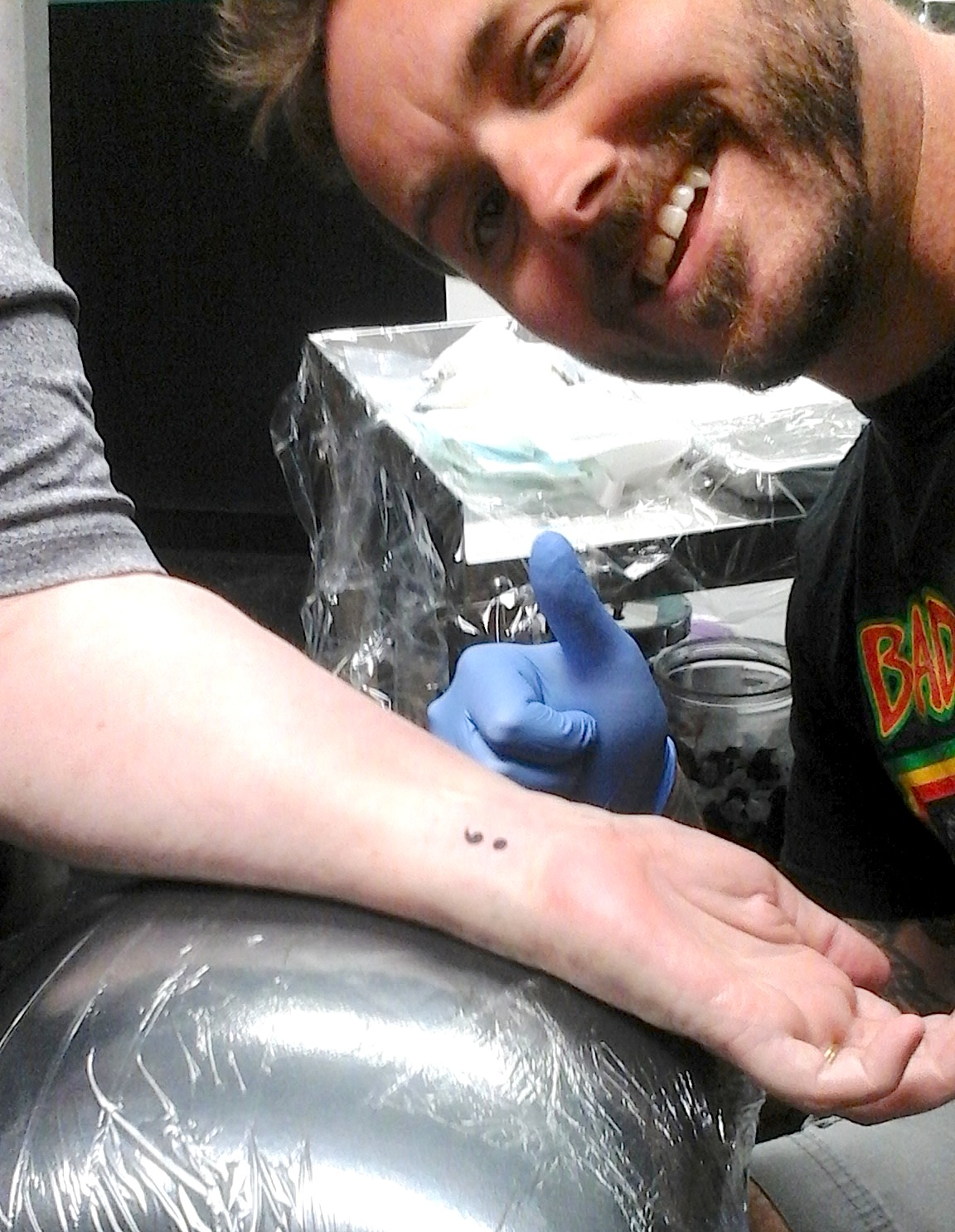
I explained as best I could. The semi-colon tattoo is a symbol of mental health awareness and suicide prevention. I rushed through the grammatical part of the explanation: In writing a semi-colon is a place where the writer could have stopped, but chose to go on. The idea is that someone will see the tattoo (4) and ask about it. Then you can explain the symbolism and how you are trying to combat the stigma of talking about mental illness. Like I just did.

I wrote about this on my other blog, Bipolar Me (https://bipolarjan.wordpress.com/2015/08/09/a-tattoo-is-for-life/) when I first got the tattoo, so if you saw it there, I apologize for the repetition.

Actually, no I don’t. The message is one that bears repeating, as often as we can and in as many ways as we can. You know someone with a mental illness(5) and that person is afraid to talk about it because of the stigma that still exists around the subject. I have bipolar disorder, type 2, and I talk about it all the time on my Bipolar Me blog.

Talking about mental illness is risky. You often get one of the standard reactions: a fixed, awkward smile; unwelcome advice about cinnamon or apple cider vinegar; outright disbelief; a decrease in contact with that person; sudden bad reviews at work. Perhaps worst of all, you get, “Isn’t that what the guy who just shot up the shopping mall had?”

Ordinarily, I post to my blog on Sunday. But this is National Suicide Prevention Week, so I wanted to post now. You can find out more about the tattoos at http://www.projectsemicolon.com/.

As Mom R. said about my tattoo, “It’s for a good cause.”


(1) My father-in-law was a Navy man and sported a few of the more common nautical tattoos, so I guess Mom R. had had a while to get used to the idea. Anyway, at least she didn’t go all, “The body is the Temple of God” on me.

(2) Apparently this is the first required question if someone announces a tattoo. Unless it’s on your face, neck or other readily observable spot. I suspect that everyone who asks imagines that it is located some place at least mildly kinky.

(3) Monkey Bones is locally known for extreme, large, and disturbing tattoos, like zombie cows. (I’m not kidding, either.) I think they must have been so embarrassed at being asked to do a pitiful mark of punctuation that they hustled me in and out in ten minutes.

(4) And if we had been Skyping, Mom R. would have, but Skype has been glitchy lately since I changed browsers. So we have our weekly coffee chats over speakerphone. This prevents a lot of Dan handing me the phone and saying, “Here. Say hello to Mom.” Especially when I’m not prepared with any tidbits of conversation, like a new tattoo. Here’s a picture, if you’re curious:

finished
I guess Mike at Monkey Bones isn’t embarrassed after all.

(5) Depression, anxiety, OCD, ASD, whatever. I guarantee it. Someone you know is struggling, and may or may not be getting help for it. A semi-colon tattoo would show you care.