 Labor Day is the day when we don’t have to work. Instead, we have picnics and barbecues and sit on our lawn chairs drinking beer. There might be a parade with classic cars for the grown-ups and clowns for the kids. Some businesses close their doors for the holiday. Others run special Labor Day sales and back-to-school specials, and deck their stores and commercials with red, white, and blue. It’s a national holiday, so someone must have once thought it was a good idea to give everyone a day off to mark the end of summer. In fact, it was such a great idea that someone made a whole weekend of it.
All of that may be true now, but it wasn’t how Labor Day started. It began as a holiday to celebrate the labor movement, trade unions, and the ways workers have contributed to building the United States. Take a closer look at that. It means the little guys – workers – who dared to pit themselves against Big Business – the bosses – and march, protest, and yes, sometimes riot in pursuit of ideals such as a living wage, weekends off, the eight-hour day, pensions, the ability to strike, and other changes.
(May 1st was also a candidate for “International Workers’ Day,” but conservative president Grover Cleveland felt that May 1st would celebrate a bloody confrontation in Chicago called the Haymarket Affair; socialism; and anarchy. In the fashion industry, Labor Day is considered the date past which one should not wear white or seersucker. But I digress.)
The labor movement and trade unions have fallen on hard times, what with politicians trying to gut their effectiveness, minimal concessions from bosses regarding rights, and the prevailing sentiment that “unions were useful once, but now have gone too far or been taken over by the mob.”
One of the heroes of the labor movement in the 1960s and 70s was César Chavez, a leader of the United Farm Workers’ trade union, which used nonviolent tactics such as strikes, pickets, and boycotts to advocate for better conditions for agricultural workers. He was posthumously given the Presidential Medal of Freedom.
Other people have been associated with the labor movement and conditions of workers, nearly all of them leftists in their politics. In 1974, U.S. author “Studs” Terkel wrote Working, subtitled People Talk About What They Do All Day and How They Feel About What They Do. And Barbara Ehrenreich’s gritty 2001 book Nickeled and Dimed: On (Not) Getting By in America chronicled her three-month journalistic experiment of working at minimum-wage jobs like waitress, hotel maid, house cleaner, nursing-home aide, and Walmart clerk.
This year’s COVID crisis has caused us to focus on who really are the essential workers in our society. To many people’s surprise, it turned out to be manufacturing workers, truck drivers, shelf stockers, and nursing home workers. Whole industries suffered from the lack of waitstaff, bartenders, cleaners, and cooks. Mom-and-pop shops took a bad hit. And of course, police, doctors, nurses, EMTs, and other hospital workers were deemed the most essential of all. Some workers were offered “hazard pay” if they continued to stay at their posts during the first months of the pandemic. Many, if not most, workers, unless they were working from home, wore masks and were abused by those who did not. Masks and other personal protective equipment were in short supply in many hospitals, clinics, and nursing homes.
This year’s Labor Day celebrations should be a celebration of these essential workers, not just an end-of-summer opportunity for beer, parades, and speeches about how workers are the backbone of the country and, oh, yeah, what a great country it is, with the stock market (i.e., the bosses) doing so well.
At the very least, we should thank the people who keep society rolling in good times and bad, who manufacture and provide us with the necessities of daily living, and who remain largely unsung until a crisis forces us to pay attention to them – the workers. The laborers for whom this holiday is named.
 I hate Halloween.
 Quick quiz: What do Jesus and the poop emoji have in common? They both are associated with Easter, silly!
 There are plenty of New Year’s Eve and New Year’s Day customs out there. A lot of the traditions don’t work for us. Over the years, we’ve kept a few but mostly arrived at our own.
 My husband looks a lot like Jerry Garcia, at least in his “Touch of Grey” phase. Someone once said that if he were darker, he would look like Frederick Douglass. But most of the time, he gets mistaken for Santa Claus – even if it’s summer and he’s wearing his tie-dye shirt. Kids these days don’t know from Jerry Garcia.
 Don’t get me wrong. I love Dr. Seuss. But I think the latest adaptation of the Grinch makes two too many.
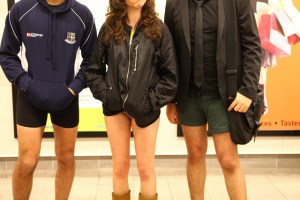 Believe it or not, there is a holiday on which people walk around with no pants. (This year it’s celebrated on May 4 – the first Friday in May.) There are no official rules, other than not wearing pants and pretending that nothing is out of the ordinary. For the shy men, skirts or kilts may be worn. The traditional way to celebrate No-Pants Day is to ride the subway, but we don’t have one around here, so the idea hasn’t really caught on.
 “How far away is Massachusetts?”
 Occasionally, one of us would cook. That year I felt ambitious. Not Martha-Stewart-huge-turkey ambitious, but I thought I could manage a one-pot meal – ratatouille. I was in the habit of preparing non-traditional holiday meals because they annoyed my sister, who was old-school in her thinking: Thanksgiving and Christmas must feature turkey, Easter is for ham, Fourth of July is for hamburgers and hot dogs, and Earth Day is for, I don’t know, mud pies? She wasn’t present that year, but it’s the principle of the thing.
