A little-remembered Christmas carol starts out: “Christmas is coming/The geese are getting fat.” In “The Twelve Days of Christmas,” there are six geese the first time around, with more to come, based on their a-laying and the repetition of all the presents ad nauseam.
But you hardly ever see a goose baked and broiled sunny-side-up on people’s Christmas tables, or as part of turgooducken. Turkey and ham are the popular choices. (Me, I go for something nontraditional, such as sushi, lasagna, ratatouille, or Chinese take-out. The Chinese food, I guess, is more traditional for Jewish people, pagans, Pastafarians (who might prefer the lasagna), and others with unconventional tastes. But I digress.)
Why does no one sing the carol about the fat geese anymore? Probably because the rest of the song is about charity to the poor—”Please to put a penny in the old man’s hat./If you haven’t got a penny, a ha’penny will do./If you haven’t got a ha’penny, God bless you.” Carolers these days hardly ever accept a penny for their services, and ha’pennies went out with farthings. Carolers might get a cup of cocoa or a cookie with red and green sprinkles, but that’s about it. Maybe they need a union.
Modernizing the carol wouldn’t come easily either. “Please to put a penny in the Salvation Army Kettle” doesn’t fit the meter, and nobody carries around ha’pennies these days. (Indeed, soon, they won’t carry pennies, either, what with the mint doing away with them, and possibly the nickel, too. You’d be left with putting a quarter in the kettle and settling for a dime. But I digress again.)
But back to geese. I don’t think I’ve even seen them on the menu at a restaurant. Perhaps it’s because they’re fatty (hence “The geese are getting fat”). Maybe it’s because they’re big. No one would order a whole goose. A smaller party might order slices of goose, but that would leave the kitchen with a lot of extra goose. What to do with it? Serve goose hash the next morning? I somehow doubt that would be a big seller.
Live geese aren’t any prize, either. They’re mean. Big ones can weigh up to 20 pounds. Just imagine an easily enraged, 20-pound bird with a loud cry, a hard knob on the top of its head, a large beak, and much given to pecking, chasing you around the yard. (It’s my theory that the fad of concrete dress-up geese on the front step (which I hope has passed) was thought up by someone from an ad agency who had been hired to improve geese’s image. But I digress some more.)
(For that matter, swans are also not candidates for the Beast Congeniality crown. Yes, they’re stunning—at a distance—and (it’s said) monogamous. But they are geese with an even better ad agency. They’re really savage. The Stratford Canada Shakespeare Festival warns visitors to avoid the killer swans that roam the grounds. (Despite the swans, the Stratford Shakespeare Festival is well worth a visit. They present theater-in-the-round and frequently stage works not written by The Bard of Avon. The 2026 season includes Death of a Salesman, Waiting for Godot, and Guys and Dolls. But I digress yet again.))
Anyway, we started this ramble with geese and Christmas carols. Every year, I ask friends what their favorite and least favorite Christmas songs are in both religious and secular categories. My favorite religious one is “Mary, Did You Know?” Least favorite: “The Little Drummer Boy.” My favorite secular song is “I’ll Be Home for Christmas.” Least favorite: “The Twelve Days of Christmas.” (Though there are some interesting parodies like “The Twelve Days of Star Wars” (https://www.youtube.com/watch?v=hHSEUAXDucw, if you want a change of pace. But I digress musically.)
Despite what you may have heard, there is prayer in public schools. It’s totally legal.
You don’t think so? The government forbids it?
Not true! Students and even teachers pray in school every day. They always have and they always will. Pray all you want.
A student can pray before a test or just because. Groups that meet for that purpose can pray—during a free period, for example. (There was a group in my high school that did this. I attended a few times but left when they started planning a book burning.) There’s absolutely nothing stopping you from praying like this.
The only thing that’s not permitted in schools is requiring anyone else to pray with you or telling them how they have to pray. A principal or teacher can’t start class with a prayer. You can’t insist that students pray over lunch. You can’t base grades on whether or not a student prays. If a student chooses to pray, you can’t tell them which prayer to use. All those things fly in the face of the Establishment Clause of Freedom of Religion in the First Amendment to the US Constitution.
“Congress shall make no law respecting an establishment of religion, or prohibiting the free exercise thereof” is what it actually says. That means that there can’t be a law that makes one religion the official religion of the US. And it means that, if you do have a preferred religion, the government can’t prevent you from practicing it. It’s left up to the individual what religion—if any—they practice.
The problem comes when we’re discussing public institutions, which include public schools. (Obviously, students in religious schools can pray whatever the school says to.) The first part of the clause says that the public institution can’t declare an official religion. That’s why there’s no compulsory prayer in schools. The second part, “prohibiting the free exercise thereof,” says that everyone is free to worship in their own way. That’s why students are able to pray in schools during their free time, by choice, without an official such as a teacher or the principal leading it. The government can’t forbid it.
If prayer were to be required in schools, there would be any number of cans of worms opened. Let’s take a basic Christian prayer—The Lord’s Prayer.
Which version of the prayer would everyone be required to say? There’s a difference between the Catholic version and the Protestant version. But the wording also differs among the Protestant denominations and individual congregations. Debts and debtors? Trespasses? Sins? Many churches specify in the church bulletin which wording to use so that they can pray in unison.
Another can of worms is that not all Americans are Christians. Increasingly, children from other faiths are entering the public schools. Why should they be required to pray a Christian prayer? But what’s the alternative? Couldn’t they just sit quietly while everyone else prays or pray their own prayer silently to themselves? No. That establishes the prayer of one religion as the official classroom prayer to the exclusion of the others. Anyone who doesn’t share that religion gets treated differently. Their prayer is not the one being said for everyone. That’s the establishment clause again.
Then, think about what it would be like if Christians weren’t in the majority in a school. (For the moment, let’s suppose that the majority rules, which is many people’s assumption.)
But Christians aren’t always in the majority in a public school. I always think of the example of the followers of the Bhagwan Rashneesh. A religious community in Oregon, they incorporated as a city, Rajneeshpuram, which had around 7,000 people. Nearby Antelope, Oregon, had a population of about 60.
The State School Superintendent visited the district’s high school and found that it was “permeated with religious symbolism” and “did not look, sound, or feel like a public school.” The religious symbolism was Rajneeshee, of course.
Now imagine those people from nearby Antelope. If their kids had to attend the Rajneeshpuram school, which was officially a public school, how would their parents have liked it if the students were required to say the Rajneeshee prayers? Not so fond of required prayer in public schools now? Ready to take the Rajneeshees to court to prevent their prayers as unconstitutional? That would be my guess.
My husband and I have any number of catchphrases that we use frequently. Some of them come from movies (Have fun storming the castle! Your mother was a hamster and your father smelt of elderberries!), TV shows (I can’t promise I’ll try, but I’ll try to try. [humming the Jeopardy music]), songs (On the road again. Timing brought me to you.), and even books (Time is an illusion—lunchtime, doubly so.).
But not all our catchphrases are quotations. One of our traditions is that when one of us heaves a deep sigh, the other will say, “The Serenity Prayer.” (Not the whole prayer, just the phrase.) This started many years ago.
You may already know that the Serenity Prayer (“God grant me the serenity to accept what cannot be changed, the courage to change what can be changed, and the wisdom to know the difference.”), which has been attributed to St. Francis of Assisi but was actually written by theologian Reinhold Niebuhr, has been a mantra of Alcoholics Anonymous and other 12-step groups. They recite it at their meetings and remind each other of it in order to ground themselves.
(Totally irrelevant digression. Once when I was a waitress, a customer complained that the coffee tasted like mud. I replied, “That’s because it was ground this morning, and then we added water.” They didn’t get it. Just looked at me funny.)
(Slightly more relevant digression. St. Francis also didn’t write the “Lord, make me an instrument of your peace” prayer, as is commonly believed. It was written in 1912, long after the saint left this earthly plane.)
Anyway, Dan once worked in a facility where he had to engage with many addicts and alcoholics (no, that’s not where we met). One of them noticed that every now and then, Dan would sigh dramatically. “Why do you do that?” they asked. Dan thought quickly and replied, “It’s the Serenity Prayer. The short form.” That just seemed so apt that it has entered our own metaphoric vocabulary. We regularly say things that elicit a deep sigh from each other, so we use it all the time. We use it a lot since both of us are frequently exasperating.
Another common response to exasperation is not a quote, but a gesture: the facepalm. You see it in memes in which someone tells a really bad joke and the other one (usually Captain Picard or Commander Riker) places a hand over his face. One assumes that they also heave a great sigh at the same time, but don’t recite the Serenity Prayer, though they could, I suppose.
It isn’t only a response to a particularly appalling joke, however. There’s an AI image of the Statue of Liberty facepalming that comes around in response to some dire piece of political stupidity. You also see memes that say something to the effect that the poster’s guardian angel looks like this: [insert image of an angel, saint, or God facepalming].
Personally, I sometimes think of Jesus facepalming. The apostles said so many dopey things. Not the “Increase our faith” stuff, but at times such as when Jesus was transfigured and appeared in a vision with Elijah and Moses. “Shouldn’t we go put up three tents for the three of you?” the apostles James, John, and Peter asked, despite the unlikelihood of the long-dead Old Testament figures needing tents to rest in. That was worth a facepalm.
Then there’s the time when Jesus raised Lazarus from the dead. As the account goes, Jesus delayed going to Lazarus’s house, although everyone knew he was dying. He then told the disciples that Lazarus was asleep. The apostles, puzzled, replied that if Lazarus was asleep, he would awaken. Just the time for a Jesus facepalm. The apostles just didn’t get it.
(If you think this last part of the post is blasphemous, so be it. You can take it as just another of my many digressions gone wrong. I know a sense of humor is a dangerous thing to display when it comes to religion. My sister even objects to jokes regarding someone arriving at the pearly gates and bantering with St. Peter. If you have any complaints to make, I’ll be over here, hiding under this rock.)
The problem these days is not so much “mad scientists” as people who are mad at science.
Where did the Mad Scientist trope come from anyway? Arguably it was Mary Shelley’s horror novel Frankenstein, published in 1818. Science fiction classics like Jules Verne’s The Island of Dr. Moreau (1896) kept up the theme and the “Golden Age” of science fiction provided many more examples.
In these novels, scientists either tampered with things better left alone or succumbed to a lust for power. Death rays and the precursors of gene splicing abounded. The outcome was mostly dreadful, except for those few gallant hero scientists who managed to save Earth from a deadly plague/alien/monster/giant something.
While the ’30s, ’40s, and ’50s were the heyday of mad scientists in fiction, those years also constituted a time when real scientists were heroes. The atomic bomb ended WWII in the Pacific. Polio was conquered. The “Space Race” that led to many scientific breakthroughs began, thanks to the Soviets and their Sputnik (1957).
Back then, scientists were revered.
Later on, not so much.
The conflict between science and religion heated up. Of course, there was conflict going way back – before Mary Shelley warned us about “playing God.” Galileo and Kepler removed us from our “God-given place” in the center of the universe, and Darwin implied that we were just another animal. The Earth suddenly became billions of years old, circling a mediocre star.
Then there was fallout, both literal and figurative, from the atomic bomb. Medical science gave us thalidomide. NASA used up billions of dollars, with no obvious monetary payoff down the line, and some people decried the space program for spending money that could be used for problems on Earth.
And all that led to changes in the general public’s attitude toward science.
By the ’60s. medicine was under fire from those who found Eastern philosophy and natural healing just as good or better. Physicists were condemned for the same atomic bomb for which they had been lauded. Science didn’t seem like such a good deal after all.
And there’s some truth to the complaints. Many scientists believed that math, physics, and chemistry were all. If it didn’t have numbers attached to it, forget it. Psychology, sociology, anthropology, and most other -ologies were “soft sciences,” barely sciences at all. Hard sciences ruled.
Slowly, the ground under science shifted. Now science has become to many people the enemy, the domain of elitists and narcissists and people who feel they are entitled by their intellect to run the world.
Of course, the stereotypes from early science fiction had something to do with that.
But the Average Man (and Woman) had a bone, or at least a fossil, to pick with science and scientists. Again, science was denying what the general public believed.
Increasingly, people believed in the efficacy of non-Western medicine, or at least the non-efficacy of Western medicine. Science believed in genetics and stem cells and cloning.
People believed in the spiritual realm. Scientists believed in the measurable.
People believed in religion. Science believed in science.
You can see where this is heading – right back to the days when people thought science meant the reanimation of corpses, invasions of bug-eyed monsters, and the creation of death rays. Because what, after all, is the distance between growing human organs and creating Frankenstein, between cloning a sheep and making a half-man-half-fly, between a laser-guided missile and a death ray?
And many scientists are arrogant, dismissive of popular opinion, and unwilling to engage in dialogue with opposing viewpoints. “Because I said so,” seems to be enough for them. “Real” scientists look down their noses at “popularizers” who look to educate the public about science.
Unfortunately, everyone is shouting and no one is listening.
Personally, I am a sometimes science geek as well as a word nerd, thanks to high school chemistry and physics, college astronomy, and lots of nonfiction reading. I don’t think science knows it all, and it’s a long way from figuring it all out. I also think that psychology and spirituality and art have a lot to teach us about the human condition and our place in the universe, STEM classes and careers notwithstanding.
But the pushback against science scares me. NASA is wasting its time chasing UFOs. Streaming channels that used to be devoted to science now feature ghost chasers and treasure hunters. I’m not saying that science never stumbles, but it provides the best answers we have to some of the problems that plague us, including plagues.
I don’t advocate returning to a time when science was the be-all and end-all of thought and education, or to the time when fictional science made scientists suspect. I just think science deserves more respect than it’s getting now.
Last week I wrote about our trials and tribulations getting to and from Ireland. This week, I’m going into the more enjoyable parts of the vacation. And there were many.
Newgrange. We saw the outside, but not the inside.
In the Boyne Valley, we wanted to see Newgrange and Knowth, two ancient stone tombs. We had booked a tour in advance. Unfortunately, we got lost on the way there and missed our appointed time. Dan was able to get a picture of the Newgrange monument from the road. When we go back to Ireland (whenever that may be), we want to spend several days just in the Boyne Valley so we can see everything at our leisure. We could also take a bus into Dublin to see the Book of Kells and other historic sights and sites.
Here’s a picture of the Giant’s Causeway, which we didn’t actually get to see. This is a stock photo.
(We also never made it to the Giant’s Causeway for the same reason. We had a drive into Northern Ireland, though, where they take pounds and pence instead of euros. Someone told us it wasn’t all that great or interesting anyway. I would have liked to see for myself. The pictures of it are pretty spectacular. But I digress.)
After the Boyne Valley, we stayed at Brook Lodge in Donegal, probably my favorite of the hotels and bed-and-breakfasts that we were booked into by our travel company. It was a very homey place, where we could sit at the dining table and watch the host make us an Irish breakfast while she and Dan discussed gardening.
Off to Arranmore Island.
One of our excursions while we were staying in Donegal was to Arranmore Island. We drove to Burtonport and took the ferry over. Once we were on the island, I wanted to find a pub and get lunch, but Dan insisted that he wanted to see something, such as the lighthouse on the island. We got thoroughly lost again. What we saw were sheep, one of which ran ahead of our car down a one-lane, rocky road. (In addition to sheep and lambs, many of them apparently newborn, we saw cows and some horses in fields throughout the country. We also saw a lot of wind farms, which makes sense because Ireland is usually windy and rainy, though we had excellent weather for the first six days or so of our trip. Even the locals remarked on it. But I digress again.)
In a welcoming pub on Arranmore Island.
We never did find the lighthouse that allegedly existed on Arranmore Island, but we did find our way back to the landing in time to have a drink and a snack in a pub and catch the last ferry back to the mainland. I considered the jaunt a success for those reasons, lighthouse or no.
Our next stop, on the way to Galway, was in the small town of Cong. You may never have heard of it, but it was the place where the John Wayne-Maureen O’Hara movie The Quiet Man was filmed. That’s one of my husband’s favorite movies, so I made sure we would have time to see the place, and on his birthday too. Dan tramped around the town and took pictures of the commemorative statue. While I checked out a local inn, he went shopping. He had sworn that while in Ireland he was going to buy a walking stick and a clock.
Scene from The Quiet Man, immortalized.
(Dan has a history of buying clocks while abroad and managing to pack them well enough in dirty clothes to get them safely back to the States. He brought a clock back from England once. But I digress some more.) He found his walking stick in Cong, and a nice tweed Irish cap. (Getting the walking stick out of the country was another matter. It had to be inspected for insect life at the airport and stowed in the overhead compartments on the planes, which was a challenge. But I digress yet again.)
Dan busking at the Cliffs of Moher. (The real busker is observing him.)
The Cliffs of Moher, about an hour from our b-n-b in Galway, was one of the scenic locations we didn’t get too lost to see. It’s a spectacular set of cliffs with a great view of the Atlantic Ocean. (It was a foggy day, so we didn’t get good pics. We bought t-shirts and mugs instead.) Being somewhat mobility-challenged, we were able to get a ride to the viewing area in a golf cart type of vehicle, cunningly called “The Lift of Moher.” Our guide told us that scenes from one of the Harry Potter and the Deathly Hallows movies were filmed at a cave at the base of the Cliffs and that the Cliffs themselves were featured as the “Cliffs of Insanity” in The Princess Bride.
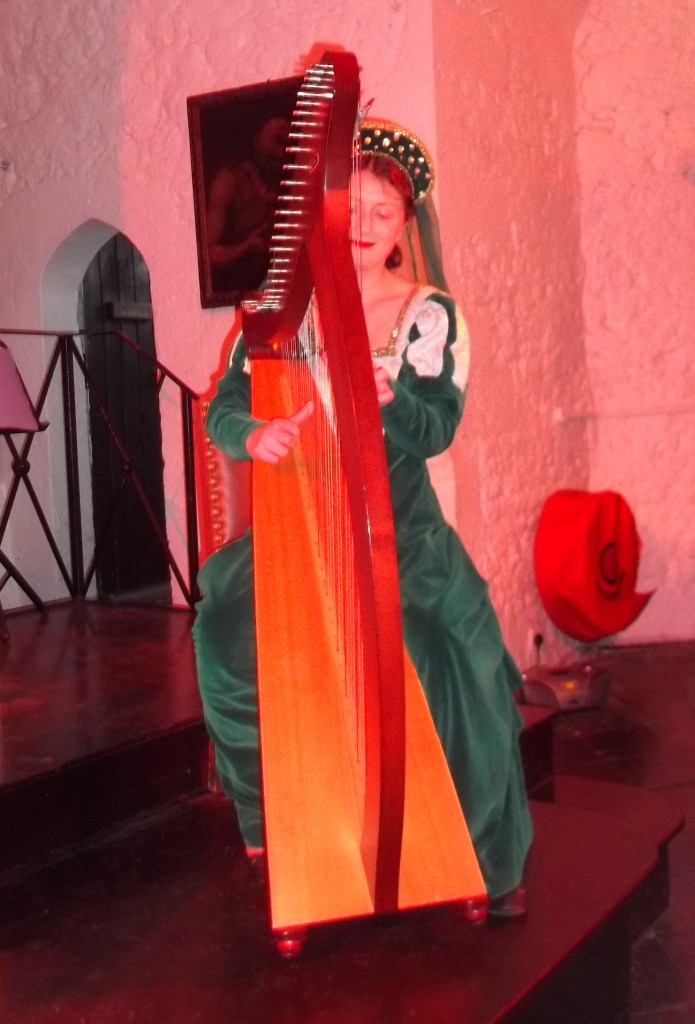
Next we stopped in Shannon, about half a mile from Bunratty Castle and Folk Park. We had booked the Medieval Banquet at the castle and saw part of the park while on our way to that. It featured replicas of thatched-roof cottages and other relics of Irish ways of life in the olden days.
At Bunratty.
I knew the banquet was sort of hokey and definitely touristy, but I had been to it on a previous trip to Ireland and also knew that it was a lot of fun. They welcome you with a cup of mead (honey wine) and present you with a lavish dinner that you have to eat with only a knife and your fingers. And one of the dishes was ribs. (They did let us have actual utensils for the dessert, but it was apple cobbler, so they kind of had to.)
Dingle’s harbor.
Our visit to Ireland wouldn’t have been complete without a stay in Dingle, thought by many to be the most beautiful place in Ireland, or maybe in the world, according to National Geographic Traveler. Dingle is another seaside town and had some of the best seafood we had in Ireland. There was a little hole-in-the-wall looking place across from the plaza in this photo, but I had an enormous bowl of amazing mussels there. Actually, the seafood was terrific all through Ireland, which makes sense given that it’s an island. Fish and chips were served at nearly every restaurant and you could have smoked salmon every morning for breakfast if you wanted to (which we sometimes did).
Uragh Stone Circle on a misty day.
We also went to see the Uragh Stone Circle, which we had high hopes for. But it turned out to be not nearly as impressive as Stonehenge, which we saw on our trip to England a number of years back. The stone circle was only eight feet in diameter and the standing stone only ten feet tall. Still, we had an enjoyable day tooling around the countryside and chatting with a couple who were collecting stones and shells in Dingle. We didn’t do the entire Ring of Kerry because it takes five hours, plus stops for photos, and by that time we weren’t enthusiastic about driving for five more hours, no matter how scenic the trip.
The view from the window of our last swanky hotel room in Athlone.
Then it was on to Athlone, not a well-known city, but one I remembered from a previous trip. We were put up there in another swanky hotel. The view out our window of Lough Ree was spectacular. There was a small island that contained a stone said to mark the exact center of Ireland. Athlone gave us access to some of the most beautiful ruins, one of my must-see stops, and one of the most historic establishments in all Ireland. It was a perfect way to round out our trip.
Graveyard at Clonmacnoise.
Clonmacnoise is one of those sites where churches, monasteries, and other sacred buildings were erected, attacked, destroyed, rebuilt, raided, destroyed again (and again). Because of that, there are a number of impressive ruins. There is also a great museum with examples of imposing Celtic crosses and stone carvings, and the history of Clonmacnoise. I waited there while Dan tramped around the site because the day was very cold and windy and I hadn’t worn enough warm or waterproof clothes. We also toured Athlone Castle, another historic site.
Near Athlone was one of the destinations I most wanted to visit – the town of Tullamore. It has historic connections with a canal that linked the town to the rest of Ireland in the 1700s. It was also the site of perhaps the first aviation disaster, when a hot air balloon crashed and started a fire that resulted in 130 houses burning down.
The distillery where my favorite whiskey is made. We took the tasting tour. (Of course we did!)
But what really made me want to go to Tullamore was the fact that it’s the location of the distillery of my favorite whiskey – Tullamore Dew. (Sorry, Jack Daniels. For some reason, Tully is the preferred spirit of many attendees at science fiction conventions, which is where I learned to appreciate it. Yet another digression.)
Of course we took the tasting tour. They welcomed us with an Irish coffee made with the local tipple, and then it was on to view the fermentation tanks and the aging barrels. Along the way, there were more tasting sessions, including one of the various styles of the whiskey that I never even knew existed. The gift shop was also impressive. I now have a Tullamore Dew t-shirt and a Tully shot glass. Dan bought a ceramic crock of Tully, which he also managed to pack and transport safely to the US, and which we’re saving for a special occasion, or maybe another science fiction convention.
Sean’s Bar and the antiques shop. You can tell which one impressed Dan the most.
Also in Athlone is Sean’s Bar, which bears the title of the oldest continuously operating pub in all of Ireland. I had a pint of lager while Dan went to the antiques shop next door. There he purchased his clock for the trip, a really lovely Art Deco piece which also made it home safely. (I was dragged over to the shop to see it and to help Dan bargain down the price.)
That was our last real stop in Ireland if you don’t count the Dublin airport and a Dublin airport hotel, which I don’t.
Quick quiz: What do Jesus and the poop emoji have in common? They both are associated with Easter, silly!
Don’t believe me? Just go to the Easter display in your local store. There you can find cross-shaped tins of candy with the saying “Jesus Saves” and the offer “Jesus Jelly Bean Prayer Inside.” Then there’s the ever-so-seasonal pastel plastic poop emoji that, well, poops candy. (It also has whimsical bunny ears. As you can see.)
Now I don’t mind the mash-up of Christian Easter with its pagan roots. That practice has been around long enough to make it into a tradition. The pagan symbols of Easter are relatively easily adapted from their earlier symbolism of fertility and renewal to their Christian identification with resurrection. New life, and all of that. Eggs. Lambs. Chicks. Even bunnies, that most suggestive of symbols for burgeoning life.
But lately, there’s something … odd about the merchandise that’s offered for consumption on Easter. It’s not just that the pagan roots are showing. It’s more like Easter is getting confused with Christmas. Or maybe Halloween. Easter is getting to be yet another occasion for retailers to make a buck in the name of wretched excess.
Look at the Easter displays in your local supermarket or department store. You’ll find baskets, all right, but many of them look more like trick-or-treat pails than things a seasonal rabbit would deliver. Now you can find them shaped like a Troll head or Mickey Mouse, and adorned with Guardians of the Galaxy, Batman, Despicable Me Minions, Spiderman, and other characters more often associated with Halloween costumes. There are even felt “baskets” adorned with pictures of dinosaurs and volcanos.
(Dinosaurs have theological implications, of course, as reminders of evolution. When pressed, some Christians will claim that dinosaur bones were put into rocks by Satan, to test the belief of the faithful. But I digress.)
Obviously, these assorted characters are meant to appeal to media-obsessed kids, and so are the trinkets the Easter baskets are loaded with. Barbies. Water guns. Chocolate soccer eggs. Posters and stickers and PJ Masks toys. Any gimcrack fancy that can pull in a few bucks, whether or not it’s related to Jesus or Oestre.
When did superhero, sports, and other fashionable toys become symbols of Easter? Back in the day, we got plush rabbits. Of course, we also had a limited choice of sweets – jelly beans, gum drops, and chocolate bunnies (which occasioned the eternal question of whether to bite off the ears or the tail first). Christmas candy consisted largely of candy canes and “books” of Life-Savers. Halloween candy was much more varied.
Halloween has already surrendered its place as a Christian celebration (the eve of All Saints’ Day) to being a childhood ritual of door-to-door sugar-laden extortion. Sugar skulls for Día de Los Muertos may be gaining on fun-size Snickers.
Now both the commercialism of Christmas and the pop culture iconography of Halloween have made their way into children’s Easter baskets. The hell of it (sorry not sorry) is that it’s most likely too late to turn back now.
Mash-ups of Christian and pagan holidays are par for the course. We get the Druidic Christmas trees and the Coke-ified Santa (originally a Christian Saint Nicholas) and the exchange of gifts on Saturnalia melded with of the celebration of a quiet birth.
I’m not saying that cultural mash-ups aren’t fun or happy or festive. I’m just saying it’s all gotten a little out of hand. We now have the ubiquitous image of Santa kneeling at the manger. How long until we have Mickey Mouse rolling away the stone?
According to the definition of “terrorism,” we have some pretty half-assed terrorists out there.
Merriam Webster defines terrorism as “the systematic use of terror especially as a means of coercion.” Another definition says: “a surprise attack involving the deliberate use of violence against civilians in the hope of attaining political or religious aims.”
And the word terrorist is defined as “a person, group, or organization that uses violent action, or the threat of violent action, to further political goals….”
What’s missing from terrorism as spoken of by the media, politicians, and the general public? The goal. The coercion. Especially when discussing “domestic terrorism,” most of the examples have no goal. When no goal can be accomplished or even named, what you have is crime, not terrorism.
Oh, certainly some of them have goals – pointless, ineffective ones. The 9/11 attacks had a goal of destabilizing U.S. political, military, and financial structures. In that sense, it was terrorism. But as a goal, it was poorly thought-out. Political, military, and financial power in the U.S. are simply too complex and decentralized to be destroyed or even much hindered by destroying a symbol of that power.
Destroy the Pentagon and military power remains (not that the bombers succeeded in destroying the Pentagon). Destroy the World Trade Center and American capitalism carries on. Eliminate the White House and structures exist for the government to continue. While those events were powerful as symbols, as attempted coercion, they had the opposite of the effect intended. They did not weaken U.S. power; if anything, they increased it.
Goals of more “successful” terrorist actions have been more precise, and more effective. The terrorist acts of the Irish Republican Army resulted in the release from prison of members of their organizations. The domestic Islamic terrorism of the Taliban caused women in Afghanistan to abandon jobs and other freedoms for fear of violence against them. The violence and threat of more violence coerced them into altering their behavior.
Compare the lack of effectiveness of “Islamic terrorism” in the U.S. Any Sharia law enacted? No. Any convicted prisoners freed? Any populations so terrorized that they abandon former freedoms and daily routines? These shootings and bombings have been crimes, but not actual terrorism. Or at least not terrorism successful in its objectives.
And what of “lone-wolf” terrorism in the U.S.? (Let’s remember that Timothy McVeigh was not a lone wolf. He had accomplices. And they caused terrible death and destruction, but not terror in the sense of attempted coercion.) David Koresh’s Branch Davidians did not have an apparent goal. They caused fear for the people held hostage and for the lives of the government representatives trying to remove them from their compound. But they posed no real threat to the ATF, the U.S. government, or the population of Waco, TX – only to themselves and their children. The Unabomber’s schizophrenic efforts seemed random to anyone who could not follow his demented logic, because they were, indeed, random and unhinged.
The anthrax scare was perhaps the most ineffective of all. While ostensibly targeting the media and the Congress (again, to what supposed effect?), they primarily caused terror among tabloid mailroom employees and assistants who open mail for higher-ups. Fear, maybe. Terror, no. There were no demands, no goals, no proposed change in potential victim behavior.
In the U.S., the most “successful” terrorist actions have been those against abortion clinics and gay meeting places. Abortion clinics have not been eliminated (at least by bombings and shootings), but employees have in response to the death and destruction quit their jobs or instituted complex and expensive security measures. Bombings and shootings at gay night clubs and hate crimes against individuals, for example, have not eliminated the gay population, of course, but they may have had a chilling effect on the gay community and their willingness to speak up, gather in public, and feel secure in public spaces.
And what of other “terrorist” attacks like the Boston Marathon bombing? Did that event have its desired effect of bringing attention to the situation in Chechnya? No. What does the citizen-on-the-street know about Chechnya? Any more than before? That bombing and other attacks have been expressions of impotent rage, futile protests, and deadly crimes, but they have not been terrorism.
Calling these actions “terrorism” gives them a power they do not have. Terrorism is meant to alter the everyday behavior of people or institutions. To some small extent, they have done that. Americans are more vigilant, more suspicious, more angry, but not more ready to give in to the goals (if any) of the terrorists. That suspicion and anger are in many cases too widespread and likewise devoid of specific achievable goals, but they are certainly not effects that supposed terrorists intended.
The terrorists have not won. Yes, they’ve killed and maimed and destroyed property and lives, strained our resources, and made us unreasonably fearful. But they’ve hardly accomplished anything.
Now that we’ve got the marriage equality question settled for all time (1), I think it’s time we turned to a brand-new, never-before-contemplated issue of social concern – women’s rights.
That’s right. We women want rights.
What rights, you ask?
Well, I dunno. There are so many.
The right to fair wages. The right to be believed when reporting a rape. The right not to be abused by a partner and to get something more than a restraining order that doesn’t work. The right to affordable, good-quality child care. The right to be represented in groups that make decisions about women. The right to have children or not, as we decide. The right to health care, mental health care, places in homeless shelters. The right not to be assaulted by fellow service members.
I could go on. So could you, I bet.
But, just as we’re now living in a post-racial society (2), I’m told we’re living in a post-feminist society.(3)
I’ve also heard that one of the reasons the Terrifying Gay Agenda (4) is having such current success is that they found a specific issue to organize around – marriage equality. Not “Treat Us Like Human Beings” or “Don’t Discriminate in Jobs and Housing” or “We Want Equal Rights.”
And those are some of the problems with the women’s movement – we’re not organized, we don’t have just one issue that we can knock off the list above, and “Change Society” is too vague.
So let’s narrow it down to one. For myself, I’d like to be mentioned in the U.S. Constitution. And that means the Equal Rights Amendment.(5) All we have to do, according to the experts at http://www.equalrightsamendment.org/, since the one proposed in 1972 was passed (6), is just get enough states to ratify it to put us over the top – three whole states.
The ones that haven’t ratified are Alabama, Arizona, Arkansas, Florida, Georgia, Illinois, Louisiana, Mississippi, Missouri, Nevada, North Carolina, Oklahoma, South Carolina, Utah, and Virginia. I figure Illinois is a good place to start. Then, I don’t know – Nevada? North Carolina? Virginia? What do you think?
But let’s do it. Then see what happens with all those other issues. I’m betting the ERA will have a good effect on many of them, and more besides.(7)
What’s that? It isn’t a good time to bring up women’s rights? The climate in the country isn’t conducive to the issue? There’s no chance of it happening?
Well, was it a good time to bring up marriage equality? Was the climate of the public discussion in favor of that? Was the country ready for it? Take a look at all the strict constitutionalists scrambling to figure out a way to defy the Constitution (8), and you tell me.
And to those who say that it’s an empty gesture, that an Equal Rights Amendment will make no real difference in women’s lives, think about what happened once black people were mentioned in that foundational document. No, it didn’t change everything for the better right away. But it sure got the ball rolling.
And I don’t know about you, but I sure would like to see some ball-rolling on behalf of women.(9)
(1) *snerk*
(2) *snerk* again
(3) I had a t-shirt that said “I’ll be post-feminist in the post-patriarchy.” My husband and I both wore it until you couldn’t see the letters anymore. I’d get another one if I could remember what catalog we found it in.
(4) As the joke goes, it includes brunch at 11:30, decorating committee at 4:00, and a dance at 9:00. It’s probably the dance that terrifies people.
(5) Here’s the full text:
Section 1. Equality of rights under the law shall not be denied or abridged by the United States or by any State on account of sex.
Section 2. The Congress shall have the power to enforce, by appropriate legislation, the provisions of this article.
Section 3. This amendment shall take effect two years after the date of ratification.
Fifty-two whole words. Scary, isn’t it?
(6) Yes, the ERA actually passed, although almost no one remembers this. It was the ratifying that did it in.
(7) Back in the day, when the ERA came around the last time, it was sneeringly referred to by some as the Equal Restrooms Amendment. Which is actually a topic that still needs addressing. Women’s bathrooms in public buildings need more stalls than men’s to achieve parity. Women need a stall for each excretory (and hygiene) function. Men conserve space using urinals; for some unfathomable reason, they’re willing to pee without walls and doors.
(8) And/or the Supreme Court. And/or the President, for that matter. Anything mentioned in the Constitution, really, except the Second Amendment.
(9) yet more *snerk*
A few days ago a friend informed me that Suzette Haden Elgin had died. This was not unexpected. She was almost 80, and had been in ill health for a while, and suffering with dementia, along with other disabilities.
I never met her, except through her work, but I mourn her passing.
Suzette was a trained linguist, a language maven, and a writer. She is perhaps best known for her books in the Gentle Art of Verbal Self-Defense series. Though not as well-known as Deborah Tannen’s or John Gray’s works, Suzette’s are practical, straightforward, and supremely useful.
She was interested in many aspects of language. She thought and wrote about language and religion, language and politics (especially framing), language and women’s issues, language and perception, language and culture, and more.
For many years she kept up a Live Journal and two newsletters. Under the LJ name Ozarque, she stimulated thought and discussion of her many fields of interest. These were lively, educational, interactive, and fascinating forums in the way that Live Journal blogs are meant to be and seldom are.
She was a writer of science fiction novels, stories, and poetry. I was astounded by her Native Tongue series. (Who besides me could possibly be interested in feminist linguistic science fiction? Many people, it turns out.)
In the Native Tongue series, Suzette described a newly created “women’s language” called Láadan. She and others pursued the idea and constructed a grammar, a dictionary, and lessons available online – way before anyone tried to do the same with Klingon.
She worked on new fiction until the dementia descended. In her LJ, she would sometimes post poems and songs (particularly Christmas carols) and solicit feedback from her audience, sometimes incorporating their suggestions into the piece. The Science Fiction Poetry Association’s Elgin Awards are given in her memory.
She attended science fiction conventions, where she could meet and interact with her readers. One she often attended was WisCon in Madison, WI, the premier feminist science fiction convention, and in 1986 was one of their Guests of Honor.
On a more personal note, she once took the time to give me feedback on a piece I was writing about bullying, also a concern of hers.
She was a kind, humane, quirky, quick-witted, creative, varied, engaged, humorous, brave lady and a brilliant scholar and writer. I will miss her and her work. The world is poorer for her passing, but richer for her legacy.
I wrote this over a year ago, but it still seems relevant.
Time to choose sides again, folks. There’s a war on Christmas, says Bill O’Reilly. No there isn’t, says Jon Stewart. Christians are being persecuted. Christians are the ones persecuting. “Merry Christmas” is forbidden. “Merry Christmas” is mandatory. The Constitution forbids manger scenes. The First Amendment protects manger scenes.
I hate war metaphors. There are too many of them and they encourage a martial mindset. War on Terror. War on Poverty. War on Drugs. Cupcake Wars. My least favorite hymn is “Onward, Christian Soldiers.”(1) So let’s dispense with the whole “War on Christmas” thing. Until automatic rifles and tactical nukes are involved. Then I’ll be willing to call it a war.
What side am I on, I hear you ask? To quote Tolkien’s Treebeard, “I am not altogether on anyone’s side because nobody is altogether on my side….” (If you promise not to say “the reason for the season,” I will admit that crass commercialism and greed are, I believe, the real forces that threaten Christmas.) So, for what it’s worth, here’s my two cents.(2)
Christians are being persecuted. Yes, they are, and it’s appalling, indecent, and shameful. Christians are being persecuted in Iraq. In North Korea. In India. In China. In other countries around the world. They are being killed or driven out of their homes and towns. They are jailed for preaching and handing out Bibles.
None of that is happening in the U.S., most likely because Christians are in the majority here. Christians are persecuted in places where they are in the minority. If you think you’re being persecuted by being asked to say, “Happy Holidays,” think again.
Christians aren’t allowed to say “Merry Christmas.” Well, sure you can say “Merry Christmas.” Say it to your friends and relatives. Say it to passersby and people in the streets. Say it to Jews and Muslims and Buddhists if you want. The one place saying “Merry Christmas” is frowned on is in the workplace.
Let’s think about this a minute. There are all sorts of things that employers don’t want employees to do in the workplace. Some of them don’t allow facial hair. Some insist that tattoos be covered. No one wants you to come to work with dirt under your fingernails.(3) They don’t allow you to call customers granny or bro or stink face. Why? They want you to show respect, so that customers will keep returning and spending money. Flip it. If every store that Christians went into greeted them with “Happy Hannukah” or “Joyous Eid,” would they feel welcome and respected and want to come back? No?
America is a Christian nation and should follow Christian laws. Here’s where things get sticky. It’s true that many of the founders were Christians.(4) And many of them were getting the hell out of countries that told them what kind of Christians they had to be – Catholics or Protestants. Or Calvinists or Presbyterians. Or nonbelievers.
So it shouldn’t be any surprise that in the U.S. Constitution, the very first Right in the Bill of, it says, “Congress shall make no law respecting an establishment of religion or prohibiting the free exercise thereof.”(5)
Simply, the government can’t tell you what religion to be – Christian, Baha’i, Sikh, Jewish, or none of the above. And the government can’t stop you from practicing that religion, or none.(6)
And that’s it. The government can’t show preference to ANY religion, because the founders knew personally how easy it is for that to be abused.
My Freedom of Speech means I can say “Merry Christmas” if I want to. Yes, it does. The government can’t tell you not to, or punish you if you do. But the government also can’t forbid people to say “Joyous Kwanzaa” or “Enjoy the holiday of your choice.”(7) But, as noted, while the government can’t do that, many businesses ask employees not to. Blame them or boycott them if such be your inclination. Just don’t drag the government into it.
But we can’t put up manger scenes in public places. Sure you can. Have the biggest one you want in front of your house or your church or your private school or even your restaurant (if you don’t mind driving away non-Christian customers). But, again, the government wants to stay hands-off. No manger scenes in front of public buildings that everyone of every religion gets to use. Yes, all are welcome at the court building, the IRS offices, and the public schools.(8)(9)
So, that’s the story. It’s government places that have to call things “holiday” this-and-that. Many people and businesses think that’s a good idea and do likewise. Others object, and the government can’t tell them not to. It’s got enough headaches.
But it’s also the government that can’t say a thing about how you choose your holiday or celebrate it or decorate for it or speak about it. And if anyone tries to stop you, the government will tell them to cut out that nonsense.
So when former Sen. Rick Santorum (R-Pa.) decried anti-Christian persecution in America, comparing it to Nazis and the Holocaust, you can just ignore him. No one here is heating the ovens, and he probably just wanted to get his name in the papers, or votes, or something. Besides, whoever mentions Nazis first, loses the argument. That’s a rule.(10)
Peace, everyone. Can we all agree on that?
(1) We’ll leave the Salvation Army out of this. For now. Except I have to say that I like the ones that play saxophones instead of ringing bells.
(2) Two cents. It’s worth exactly two cents. Duh.
(3) Except for mechanics. They can probably get away with it.
(4) Or at least deists.
(5) In this sentence, “respecting” means “about.” No law about establishment of religion.
(6) Unless you break fundamental laws, like about not beheading people. They get kinda cranky about that.
(7) My favorite. It offends either no one or everyone.
(8) You know, the ones that local, state, and federal governments (that aren’t allowed to mess with religion) let you send your children to for free.
(9) A personal plea: If you do set up a manger scene somewhere, PLEASE don’t do the kneeling Santa thing. It was thought-provoking the first 7,000 times, but now it’s merely provoking.
(10) Godwin’s Rule of Nazi Analogies. It’s in the Third OED, which is authority enough for me.



 The problem these days is not so much “mad scientists” as people who are mad at science.







 Quick quiz: What do Jesus and the poop emoji have in common? They both are associated with Easter, silly!
 But I Digress . . .