Love, Hate, and Food Fights

I don’t watch much sports. Except on the Food Network. Those competitions are the sports I both love and hate.

I love them because they are eerily involving. Even my husband, not a big fan of cooking shows, gets caught up in the action. “Chop the woman!” he’ll yell. “She left off the Japanese eggplant! Aw, I thought the old hippie was going to win!” (1)

I love them because people actually have to do something real to win, unlike many “reality” shows. There’s no prize for snagging a millionaire or pressuring small girls to dress like floozies and perform.(2)

I love them because people get the chance to try again. Many of the shows have “Redemption” episodes, or let eliminated contestants return as surprise competitors or sous-chefs. And many of the chefs appear on more than one of the shows. I’m sure I saw the Ukrainian woman from Beat Bobby Flay on Chopped and the uppity blonde with a posh accent from Chopped on Next Food Network Star.

But I hate the food competitions for the same reasons I hate most sports.(3)

The bragging, for one. Over-inflated self-confidence is so unappealing. And you hear the same inane platitudes from food competitors that you do from professional athletes. It makes me contrary.(4)

Just once I want someone to be realistic or unexpected or at least modest:

I brought my B- game today!

I’m going to give 75 percent!

I came to prove to my family I’m mediocre!

I’m not going to settle for anything less than 4th place!

I came to lose!

The war and violence metaphors. Most of these are clearly borrowed from the vocabulary of professional sports, and most of them just sound silly. Cupcake Wars – now there’s an oxymoron! Chopped. Cutthroat Kitchen.(5) Can we please have food without blood and mayhem? At least Guy has Grocery Games, and the violence is limited to (mostly) accidental ramming of shopping carts.

The snot factor. Settle down, now. Not in the food – in the contestants. One Top Chef contestant was so bad we took to calling him Snothead the Sommelier for his incessant unwelcome lectures on wine, whether the dish called for it or not.(6) One Next Food Network Star contestant got bounced because he smirked when he was pronounced safe. A judge changed her vote and we all cheered.

Sabotage. We’ll leave Cutthroat Kitchen out of this, since sabotage is its whole raison d’être. But honestly, there’s a lot of throwing people under the bus, especially when the chefs are supposed to work in teams.(7)  Then there’s plain pettiness – keeping all of an ingredient, refusing to clean the ice cream machine, pointing out that your dish doesn’t have the flaw the judges just dinged someone for.

One last general gripe: Food Network used to show you how to cook things.(8) Now such actually useful shows are relegated to daytime hours, while prime time is filled with competitions, road shows, and “Please Save My Business” shows.(9)

Still, with all their flaws, I can’t stop watching food sports. They’re addictive, like potato chips or cookies. Mmmm, cookies. ::drools::


(1) Unless my husband isn’t watching because they have to prepare live seafood. Then he goes all Buddhist until the crustaceans are cooked, when he’ll dig right in. (He still calls Emeril Lagasse “The Evil Cook” and refuses to watch him since he threw live crayfish into a hot pan and laughed about it.)

(2) Think Jon-Benet Ramsey. (What narcissist father names his daughter after him like that anyway, without adding “ette,” “ine,” or “le”?) And don’t tell me that pageants build self-esteem. Only for the winners.

(3) Except the Olympics. I don’t usually hate the Olympics. Just the media coverage of them. And the bikinis they make the women beach volleyball players wear while the men wear baggy shorts. At least on the Food Network, everyone wears chef jackets and aprons.

(4) Okay. Contrarier. (I like the sound of that word. Trademark!)

(5) I actually like Cutthroat Kitchen. Goofy and evil at the same time, like most of my friends. Although the Camp Cutthroat episodes were just over-the-top WRONG! I could barely watch them.

(6) Marcel Vigneron was a close second for sheer annoyance factor – so much so that the other Top Chef contestants tried to shave his head – but he improved with a little perspective and less extreme hair styling. Now he’s engagingly weird without pissing everyone off. Still has ego issues, but for chefs, TV personalities, and sports figures, that’s practically a requirement.

(7) Hosts make this worse when they set up the contestants by asking “Who do you think should go home?” or “Why do you deserve to win?”

(8) Not that I actually ever made any of the recipes from them. Except once I tried to make The Barefoot Contessa’s triple ginger cookies. I actually learned something from that experience, too: When she says, “jumbo eggs,” she really means jumbo eggs. Medium ones don’t work at all.

(9) Here again, there’s one I like – Restaurant Impossible. Part cooking, part decorating, part group (or family) therapy. Not to mention the theatrical sledgehammer scenes, which may be a metaphor for the whole show.
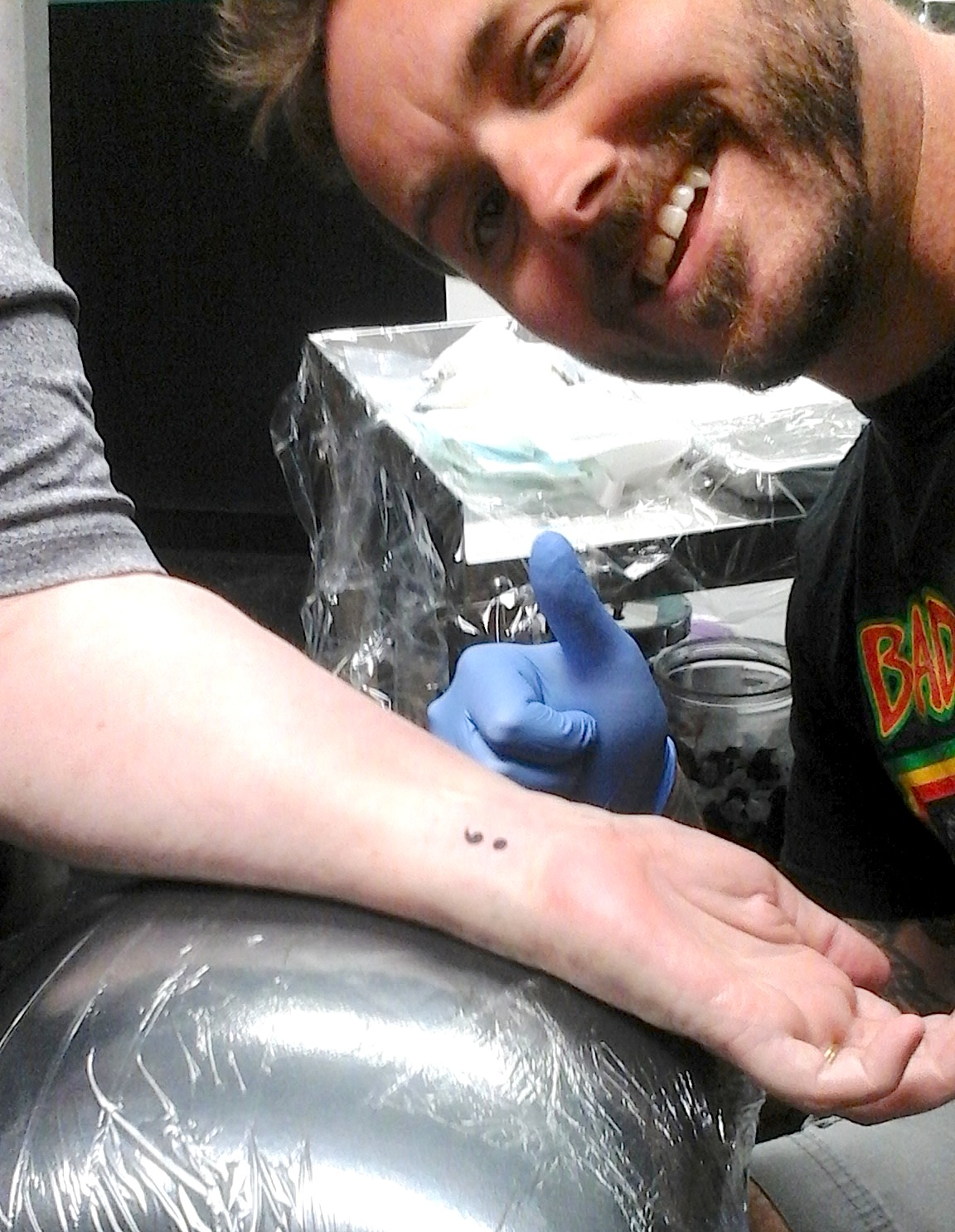
 

My In-Law and My Ink

I expected a total freak out. I really did. So I tried to work it into a phone conversation as naturally as I could.

“Say Mom, did Dan tell you I got a tattoo?”

Instead of the expected shriek, I got a fairly calm query.(1) “Where?”(2)

If I were being a smart ass I would have said “At Monkey Bones Tattoos.” But I took the sensible route for a change and said, “On the inside of my left wrist.”

Then she asked, “What did you get?”

Again, any number of possible responses crossed my mind. But I decided to play it straight and told her the truth: “I got a semi-colon.”(3)

The next obvious question was, “Why?”

I could have said because I’m a huge grammar nerd, which would have been the truth about me, but not about the tattoo.

I explained as best I could. The semi-colon tattoo is a symbol of mental health awareness and suicide prevention. I rushed through the grammatical part of the explanation: In writing a semi-colon is a place where the writer could have stopped, but chose to go on. The idea is that someone will see the tattoo (4) and ask about it. Then you can explain the symbolism and how you are trying to combat the stigma of talking about mental illness. Like I just did.

I wrote about this on my other blog, Bipolar Me (https://bipolarjan.wordpress.com/2015/08/09/a-tattoo-is-for-life/) when I first got the tattoo, so if you saw it there, I apologize for the repetition.

Actually, no I don’t. The message is one that bears repeating, as often as we can and in as many ways as we can. You know someone with a mental illness(5) and that person is afraid to talk about it because of the stigma that still exists around the subject. I have bipolar disorder, type 2, and I talk about it all the time on my Bipolar Me blog.

Talking about mental illness is risky. You often get one of the standard reactions: a fixed, awkward smile; unwelcome advice about cinnamon or apple cider vinegar; outright disbelief; a decrease in contact with that person; sudden bad reviews at work. Perhaps worst of all, you get, “Isn’t that what the guy who just shot up the shopping mall had?”

Ordinarily, I post to my blog on Sunday. But this is National Suicide Prevention Week, so I wanted to post now. You can find out more about the tattoos at http://www.projectsemicolon.com/.

As Mom R. said about my tattoo, “It’s for a good cause.”


(1) My father-in-law was a Navy man and sported a few of the more common nautical tattoos, so I guess Mom R. had had a while to get used to the idea. Anyway, at least she didn’t go all, “The body is the Temple of God” on me.

(2) Apparently this is the first required question if someone announces a tattoo. Unless it’s on your face, neck or other readily observable spot. I suspect that everyone who asks imagines that it is located some place at least mildly kinky.

(3) Monkey Bones is locally known for extreme, large, and disturbing tattoos, like zombie cows. (I’m not kidding, either.) I think they must have been so embarrassed at being asked to do a pitiful mark of punctuation that they hustled me in and out in ten minutes.

(4) And if we had been Skyping, Mom R. would have, but Skype has been glitchy lately since I changed browsers. So we have our weekly coffee chats over speakerphone. This prevents a lot of Dan handing me the phone and saying, “Here. Say hello to Mom.” Especially when I’m not prepared with any tidbits of conversation, like a new tattoo. Here’s a picture, if you’re curious:

finished
I guess Mike at Monkey Bones isn’t embarrassed after all.

(5) Depression, anxiety, OCD, ASD, whatever. I guarantee it. Someone you know is struggling, and may or may not be getting help for it. A semi-colon tattoo would show you care.

Where Music and Politics Meet

This land is your land,
This land is my land,
From California to the New York Island,
From the Redwood Forest to the Gulf Stream waters,
This land was made for you and me.

This, the chorus of Woody Guthrie’s famous American ballad, is all that most people know of the song. It is repeatedly sung at patriotic events, civic occasions, and celebrations of American holidays.

According to Wikipedia, Guthrie wrote the song “in critical response to Irving Berlin‘s ‘God Bless America,‘ which Guthrie considered unrealistic and complacent.”

If people know any more of the song, then they know one or two of these verses:

As I went walking that ribbon of highway
I saw above me that endless skyway,
I saw below me that golden valley,
This land was made for you and me.

I roamed and I rambled, and I followed my footsteps
To the sparking sands of her diamond deserts,
All around me a voice was sounding,
This land was made for you and me.

When the sun came shining, then I was strolling,
And the wheat fields waving, and the dust clouds rolling,
A voice was chanting as the fog was lifting,
This land was made for you and me.

There are other verses, though, that aren’t commonly sung or even remembered. In them Guthrie spoke of the plight of ordinary people caught in the aftermath of the Dust Bowl and the economic crisis that afflicted the whole nation. These verses are usually left out because of their political/economic message, which were deemed sympathetic to communism.

One bright sunny morning, in the shadow of the steeple,
By the relief office I saw my people,
As they stood there hungry, I stood there wondering if,
This land was made for you and me.

Was a big high wall there that tried to stop me,
Was a great big sign that said, “Private Property,”
But on the other side, it didn’t say nothing,
That side was made for you and me.

Nobody living can ever stop me,
As I go walking my freedom highway,
Nobody living can make me turn back,
This land was made for you and me.

Another verse, added by Guthrie’s friend, folksinger Pete Seeger, takes the political/social message even further, and includes a Bible reference:

Maybe you’ve been working as hard as you’re able,
But you’ve just got crumbs from the rich man’s table,
And maybe you’re thinking, was it truth or fable,
That this land was made for you and me.

With the political season heating up, Woody Guthrie has been much on my mind lately. Politicians have been quick to use popular songs in their campaigns based on their titles, but ignoring the lyrics. “This Land Is Your Land” was used in 1988 by George H.W. Bush. Guthrie, being long dead, couldn’t complain.

Other choices have been, well, problematic. In 1992, independent candidate Ross Perot used Patsy Cline’s version of “Crazy,” a song about hopeless love. In 2000, George W. Bush was threatened with a lawsuit by Tom Petty to stop the candidate from using the singer’s “I Won’t Back Down,” and was criticized by other performers for using their tunes. (Primary candidate Mike Huckabee was also asked in 2008 to stop using Boston’s “More Than a Feeling.”)

As The Washington Post reported,

The most famously misread song may have been Bruce Springsteen’s “Born in the U.S.A.” During his 1984 reelection campaign, President Reagan praised Springsteen’s “message of hope” during a stop in New Jersey. It wasn’t clear which song, or songs, Reagan meant (and there’s no record of Reagan’s campaign actually playing the song), but many assumed he was referring to “Born,” the title track of Springsteen’s best-selling album at the time. The song, of course, is about the opposite of hope; it’s the anguished cry of a Vietnam veteran, returning home to bleak prospects (“I’m ten years burning down the road/Nowhere to run ain’t got nowhere to go”). Springsteen later expressed irritation at being made an implicit part of Reagan’s morning-in-America reelection rhetoric.

Nor is this a phenomenon whose time has passed. Although the election season has barely started, there has already been at least one controversy. Canadian singer/songwriter Neil Young (who of course can’t vote in American elections) can still express his opinions of them.

Young objected when Donald Trump’s crew played “Rockin’ in the Free World” during Trump’s trip to the podium to announce his campaign for President. As breitbart.com noted (http://www.breitbart.com/big-hollywood/2015/06/23/after-shaming-trump-neil-young-allows-bernie-sanders-to-use-campaign-song/), “an official statement from Young’s camp immediately responded, “Neil Young, a Canadian citizen, is a supporter of Sen. Bernie Sanders (I-VT) for President of the United States of America.” He had not authorized Trump’s use of the song, though the candidate’s campaign manager asserted that they had paid for the rights to do so. (Rights to use a song can usually be purchased from the music publisher.)

Back in the ’60s and ’70s, folksingers wrote songs specifically about the various issues that arose in elections (“The Draft-Dodger Rag,” “Blowin’ in the Wind,” CSNY’s “Ohio,” “National Brotherhood Week”). That song trend was satirized in Tom Lehrer’s “The Folk Song Army” and is rarely seen these days, except perhaps on open mic nights at local bars and coffee shops. The day of protest songs sung by thousands at rallies or played on the radio has largely given way to the shouting or chanting of slogans (“Feel the Bern”) or general feel-good patriotic pop or country-pop songs. “God Bless the U.S.A.” might just replace “The Star-Spangled Banner” as our national anthem. (It is easier to sing.)

God, I miss Woody Guthrie! I bet he’d have a thing or two to sing about this election cycle.

By the way, what do you suggest? Let me know what you think would be a good campaign song – for either side.

Dodging Nosy Questions

“So, when are you and Janet going to give your mother grandchildren?”

“Why spend $300 per hour on a shrink when it’s not going to do any good anyway?

“Why do you always eat junk food when you know you have high blood pressure?”

“Are those boobs real?”

Questions you can’t answer. Questions you don’t want to answer. Questions you want to slap a person for asking. Questions that are just begging to start a fight. We all hear them, sometimes from our nearest and dearest, and sometimes from total strangers.

There is an answer – other than “Shut up and leave me alone,” which may indeed be your initial reaction, but usually isn’t the best solution. (Except maybe to the boobs question.)

Noted linguist and author of The Gentle Art of Verbal Self-Defense Suzette Haden Elgin recommended a technique called the “Boring Baroque Response.” It’s not a skill everyone has at the ready, but with a little practice, you can expand your ability to deflect the nosy and the belligerent.

The essence of the Boring Baroque Response (or BBR) is storytelling. No matter the question, you stare off into space and launch into the longest, most rambling story you can. Here’s an example:

Idiot: “Why do you always eat junk food when you know you have high blood pressure?”

You: “That’s interesting you should ask. It reminds me of when my parents and I were visiting Cousin Jim and Cousin Addie – you know, the ones that lived near Natural Bridge and had that kitchen that was painted all black. And whenever we visited my sister and I played in the hayloft. But it didn’t have hay, it was really bales of straw. Dried-out corn cobs, too, which they fed to the animals, like the mule. I rode that mule once, bareback, and you wouldn’t believe how bony its backbone was! Anyway, Cousin Addie was making biscuits and gravy – sawmill gravy with milk, not red-eye gravy with coffee – and Cousin Jim always said….”

Keep going as long as necessary until the questioner gives up and goes away. As Elgin noted, “A response like this delivers the following message: ‘I notice that you’re here to pick a fight. Do that if you like, but it’s not going to be much fun for you, because I won’t play that game.'”

According to Elgin, the secret of the BBR is to deliver it with a straight face and a thoughtful, reminiscing tone. Sounding sarcastic or snotty will give away the game. And although the example was (vaguely) related to food, as the question was, it doesn’t have to be. The story can be about your sister and how she wanted to be a veterinarian, which she would have really been terrible at because….Well, you get the idea.

My husband had a version of the BBR that he used when he worked in community-based corrections. He would regale the “clients” with stories full of analogies – “You know when they make steel how they forge it first in really high heat and then plunge it into cold water. Well, that’s kind of like….” He could rarely get out more than a sentence before the listener would edge away, saying, “No stories, please, Mr. R. I’ll behave. I’ll be good. Just no story!”

I don’t know if Elgin ever heard it, but the best BBR I know is the monologue that Grampa Simpson produced when asked to break up a union meeting:

“We can’t bust heads like we used to. But we have our ways…. Like the time I caught the ferry to Shelbyville. I needed a new heel for m’shoe. So I decided to go to Morganville, which is what they called Shelbyville in those days. So I tied an onion to my belt, which was the style at the time. Now, to take the ferry cost a nickel, and in those days, nickels had pictures of bumblebees on ’em. ‘Gimme five bees for a quarter,’ you’d say. Now where were we… oh yeah. The important thing was that I had an onion on my belt, which was the style at the time. I didn’t have any white onions, because of the war. The only thing you could get was those big yellow ones….”

Now that’s classic TV! Just like the episode of WKRP when Mr. Carlson had an idea for a promotion and Les was supposed to report on it live from the shopping center, but the one store didn’t want him standing in front of it because customers couldn’t get in, so then….


Weeding Followers, Friends, and Fans

Name-calling. Shaming. Trolls. Hate speech. Threats. Doxxing. These are increasingly common on the internet.

They are also problems I don’t have, given the relatively few Facebook friends I have, the relative civility of most of them, and the relatively slow growth of my blogs.

Personally, I have only ever blocked a couple of people on Facebook, one for use of the “n-word.” I don’t often post about controversial topics on my timeline, though I’m sure people can figure out my general leanings from the things I do post and the comments I make on others’ posts. I accept friend requests from people I know, who are on all points of the political and social continuum. Some of my friends and I disagree totally on, and stay away from discussing, sensitive issues.

But I thought it would be worthwhile to take a look at how other people handle such problems.

First, let’s look at someone whose situation is similar to mine: a private citizen, Georgianna, who has unfriended and been unfriended. She says that what has pushed her over the edge at times is situations like this:

On posts I made about shootings of unarmed blacks by cops, [the person in question] kept commenting things like why do they riot and why do they run if they’re not guilty. I ignored those. The final straw was when I posted about Cecil the Lion and he commented what about all the babies murdered by abortion. His posts were off topic, annoying, and displayed stupidity. I was done.

I guess I just got tired of folks highjacking my posts for their own purposes and not adding substance.

Fair enough. I think that sums up most people’s experiences. But what about more public figures who regularly discuss – indeed, argue about, promote, or decry – volatile topics?

Tom Smith is a professional singer/songwriter with a modest-by-national-standards but impressive-in-certain-circles following. His songs and his Facebook posts clearly show a progressive/liberal bent. Among his friends and followers are a rather large number of highly opinionated people (I am one of them), and the comments on his posts can run into the hundreds.

Because he began fearing for his blood pressure, Tom established Rules covering comments and what would get a person blocked.

1: BE POLITE DAMMIT. You don’t have to be polite to whatever person or persons are the subject(s) of the original post, although I will not tolerate name-calling or crude sexual insults or fat-shaming or anything like that. But, by damn, you WILL be polite to your fellow commenters. You are all guests at a party at my place, and I don’t like it when my friends fight, especially IN MY FRONT ROOM.
2. Facts. Back up any assertions with facts — to credible sources, please. Breitbart.com, anything associated with Fox “News”, The Weekly Standard, anything by Rush Limbaugh, Ann Coulter, Pam Geller, Michelle Malkin, Michael Savage, Sean Hannity, or Bill O’Reilly are ESPECIALLY right out. They are known, proven liars and nutbar conspiracy theorists. If you got it off Reddit or Free Republic or Townhall or someplace like that… get some confirmation from the damn New York Times or Washington Post or CNN or BBC.
3. I reiterate: no sexual shaming. No fat “jokes”. No ethnic jokes. (Yeah, I know a shitload of ’em. Some people just take them wrong). Nothing that you think might be triggery. You can swear your head off, if that’s your style — it certainly is my style sometimes. But, basically, if you have to stop and ask yourself if it might really offend someone, there’s a decent chance it will. Use your words, and find a different way to phrase it.
4. Did I mention facts? Whatever you think you know about climate change, Planned Parenthood, Benghazi, Obama’s birth certificate, or the wonderful benefits of fracking, there’s a good chance you have at least some misinformation. No, not that site. No, not that one either. Science denial will get you Blocked faster than two days of eating peanut butter.

Recently, Tom has (quite sensibly, in my opinion) moved his political postings to a separate page called Political Noise (https://www.facebook.com/politicalnoise?pnref=story), where he has basically the same rules as above, but has also articulated this:

If conversations go off the rails, if people are snarling at each other and no one’s going to change each other’s minds, I will step in and say ENOUGH. When that happens, THE THREAD IS CLOSED AND I EXPECT YOU TO STOP COMMENTING. We’ve reached the loud, circular phase of the argument, and it’s time to let it go and move on.

If someone is being a particular jerk about things, I may hit you with the Ban Hammer and say BUH-BYE. Usually, this is just for a couple of days. If you’re a really special snowflake, however, it may be permanent.

He adds: “Anybody got a problem with that? Tough. My wall, my rules. Now. Go forth and play nice.”

As of a few days ago, Tom’s main Facebook page is reserved for personal updates and musings, his professional page (https://www.facebook.com/tomsmithonline?fref=ts)  for his music, and the new page for political/social opinions.

Then there’s Jim Wright, widely known writer, blogger, Navy veteran, and unrepentant curmudgeon, whose website Stonekettle Station (http://www.stonekettle.com/) and Facebook page are platforms for his strongly worded and often iconoclastic views. He has maxed out the number of Facebook friends allowed. His rules (which I asked permission to quote, so don’t bother reporting me to him):

Things that get you booted off my Facebook page:
1. Acting like an asshole.
2. Acting like an ignorant asshole.
3. Acting like an asshole to other commenters.
4. Acting like a condescending asshole by explaining to other commenters “what Jim ‘really’ meant.”
If you act in this manner, you will be summarily removed. Period. There will be no warning given ….
_________
Addendum: You get booted, DON’T email me begging an explanation, forgiveness and/or reinstatement. I already gave your slot away. If you don’t want to get booted, don’t act like an asshole. If you’re not sure what I consider acting like an asshole is, then err well on the side of caution. I am not going to argue about this.

Jim has also been known to publicly mock any truly and/or amusingly stupid comments, tweets, or messages, and, under certain circumstances, to send forth his “minions” to do likewise.

Another Famous Writer weeds out friend requests in advance. Apparently he goes to your home page and looks at whether you post cat photos and pass-alongs from Upworthy and Buzzfeed. I quit trying. I like cat photos and sometimes find Upworthy and Buzzfeed interesting. If that rules me out for his roster of friends, so be it. I have plenty of friends who follow things that I consider dopey. Then again, I’m not even within shouting distance of the Facebook friend limit.

All things considered, I am glad not to be even a semi-public figure (except insofar as my blogs make me one, which is not very far at all) – and glad to have non-troll friends, however opinionated.

Stemming the Tide of STEM

I’m generally in favor of STEM – Science, Technology, Engineering, and Math – education, especially when girls and young women are welcomed into the programs and treated with the same attention as males. (As long as they don’t junk it up with a pink color palette.)

But it’s being oversold.

(Typically, at this point I would produce a rant about how STEM is being glorified and promoted ahead of reading, writing, literature, art, music, social studies, and various other humanities. That’s a rant for another day, though. I’ll get back to it. I promise.)

To see all the STEM programs and magnet schools, you’d think Sputnik had been launched just this week. We’re not in the same kind of Cold War/space race with the Russians now, yet science is king in schools.

Admittedly, science and technology are vital today and will be for the future that our students are preparing for. But just as you don’t have to know how to program a computer to write using a word processor or play a video game, you don’t need to know engineering to fill one of the many service jobs; or banking, human resources, business management, or sales; or professional pursuits such as law or teaching, that will also be vital for tomorrow’s society.

Financial services and business management were the most recently hyped “hot careers” that students were being funneled into, with courses in entrepreneurship and leadership skills filling up the curriculum. They seemed to overlook the fact that only a few students would become business leaders, managers, or owners. With the middle class shrinking and the job market tightening, even the middle echelons of business have proved to be out of reach for millions of students.

The same will likely be true for many of the STEM students. How many research scientists can universities and the private sector afford to hire? Since the dot-com crash, how many openings are there for techno-wizards? What we need are more computer educators, who can teach hapless, hopeless adults how to use their home and business computers effectively and efficiently.

It’s profoundly ironic that schools are pushing science, when the Powers That Be are science deniers and proud of their scientific ignorance. Even if we give students an outstanding STEM education, who will listen to them? Not legislators. Not the general public, at least those that think TV shows about paranormal hunters, ancient aliens, and assorted prophecies are scientific.

What we need are science educators, and not just for the brainiest STEM students. We need teachers in elementary schools that can make science engaging and teach students that early humans did not live at the same time as dinosaurs. We need middle school teachers who can teach the foundation of all the sciences – the scientific method – and how to recognize bogus scientific and especially medical claims, how to examine evidence. And for high school science, we need teachers who keep up-to-date with their fields – and texts that do the same. Those kinds of learning are what the general public of the future needs.

We also need science popularizers. Though the scientific establishment sometimes looks askance at the likes of Carl Sagan and Neil Degrasse Tyson, they perform an invaluable service. They remind us that science isn’t just something you learn in school and then forget. That general understanding of the weather or earthquakes or DNA testing or vaccines is vitally important for more people than learning to build a robot is.

(And popularizing science demands outstanding communication skills – writing and speaking clearly and effectively. But I’ll get back to that another time.)

STEM is promoted for elementary students as a way to make science engaging. But is STEM really what does that? In “STEM: It’s Elementary!,” Erin McPherson says, “[K]ids who experience STEM early through hands-on learning are the ones who will be best equipped to develop a strong understanding of STEM concepts as they get older.”

It’s hard to argue with that. But isn’t hands-on learning what elementary students should be getting in writing, history, and art, too? McPherson does talk about art – “By adding art and music concepts like design, rhythm and movement to STEM education, students are able to fully visualize STEM concepts” – but only as an add-on to STEM, not subjects worthy in and of themselves.

Also, is STEM becoming a de facto gifted and talented program – and that only for brainy kids with a penchant for math and science? Do the less talented, less able students or the artistically gifted fall away and get less attention?

One purveyor of online STEM curricula touts that its offerings are “for all students based upon National Academies research with a strategic emphasis on gender, racial and socio-economic concerns.” But look at the “pathways” of courses they list: architecture, biotechnology, engineering, entrepreneurship, manufacturing, renewable energy, science, and technology. Do these really meet the needs of “all students”?

And what about those heavily emphasized future and futuristic jobs? Elaine J. Hom, LiveScience Contributor, claims that “STEM jobs do not all require higher education or even a college degree. Less than half of entry-level STEM jobs require a bachelor’s degree or higher.” (She doesn’t list any.) Meanwhile, the Department of Education reports that the STEM career with the most projected rate of growth (a whopping 62 percent) is biomedical engineering.

Want more telling statistics? J. Maureen Henderson, contributor to Forbes, says, “The future is already here and it brings with it low-wage temporary or contract work as a way of life….According to the Economic Policy Institute, almost 30% of American workers are expected to hold low-wage jobs – defined as earnings at or below the poverty line to support a family of four – in 2020. … Given that roughly 50% of recent college grads are unemployed or underemployed and those who do work are much more likely to hold these types of jobs, this is a particular grim prospect for young workers….”

Another member of the Forbes staff, Jacquelyn Smith, suggests, “If you want to ride a crest of increasing employment over the next 10 years [through 2022], get into health care, personal care, social assistance, or construction. That’s the advice you can glean from a report issued by the U.S. Bureau of Labor Statistics today [2/01/2012].”

After all, the future technocrats will still need baristas, day care workers, plumbers, chefs, massage therapists, pastors, firefighters, hairdressers, and sales clerks; and their companies will still need freelance and contract (read: low-paid) writers and designers and even accountants for their ever-tightening workforces. And I hope that society will still need works of literature, art, and music, and the people to create them.

So, is STEM education a valuable educational approach? Certainly, for some students. For all students? Maybe not so much.

References

http://www.weareteachers.com/blogs/post/2015/04/03/stem-it’s-elementary

http://www.livescience.com/43296-what-is-stem-education

http://www.ed.gov/stem

http://www.forbes.com/sites/jmaureenhenderson/2012/08/30/careers-are-dead-welcome-to-your-low-wage-temp-work-future/

http://www.forbes.com/sites/jacquelynsmith/2012/02/01/the-jobs-with-the-brightest-future/


What’s in a Number?

The Top 5 Breakfast Sandwiches in L.A.

12 Reasons to Hire a Wedding Planner

11 Grammar Lessons From the CIA Stylebook

10 Fun Uses for Old Card Catalogs

9 Bizarre New Snacks to Try

5 Weirdest Gins and Vodkas You Can Buy

4 Words Parents and Kids Should Never Say

What do all these headlines have in common? That’s right – numbers.(1) Now read them again without the numbers. Are the headlines any better or worse? Reasons to Hire a Wedding Planner. Fun Uses for Old Card Catalogs. Weirdest Gins and Vodkas You Can Buy. What’s wrong with those?(2)

I never understand number-crunching headlines.(3) I always find myself asking, “Why 10 fun uses and not 9 or 11? And couldn’t the Wedding Planner have stopped at 10? Or bumped it up to a baker’s dozen?”(4) Someone somewhere must have done a study revealing that if a headline has a number, more people will read it.(5)

Maybe it helps people plan their day: “5 breakfast sandwiches and I’m done! That should be just about right for my morning dump. I’ll save the CIA grammar one for lunch hour.”

There are a few things I know after years of editing, and one of them is this:(6) If you mention a number in the headline, it is a solemn vow to the reader. There should be that many fun uses for old card catalogs – no more, no less. All the readers with OCD are checking.(7)

Even more annoying are the headlines that combine letters and numbers: The 3 Cs of Forklift Safety.(8) Or worse, the ones that try to help you remember the number of points with a stupid acronym: The CHILD Plan for Preventing Tantrums. Invariably, one of the letters is an Elastic Man Stretch (I – Invent something for the child to do.), or the author calls it the CHiLD Plan because she can’t think up an I any better than “Invent something for the child to do.” (9)

Maybe this fixation with numbers began with David Letterman’s top 10 lists. Maybe it was Keith Olbermann’s Countdown. Maybe it was even pop music’s Top 20 or childhood’s Ten Little Indians rhyme (or, I suppose, Agatha Christie’s mystery novel).(10)

However it started, it doesn’t look to be going away anytime soon. There are probably 5 or 14 or 600 reasons for that. I’m sure I’ll be reading about them all by next month, if not sooner.(11)

(1)  Also, they’re all real headlines, even the one about the CIA Stylebook.

(2) Nothing. Except the gin and vodka one. The only flavored gin you need is lime and the only flavor to add to vodka is more vodka. A friend once wrote a song in which he mentioned “cranapple schnapps.” He had no idea how prophetic he was being.

(3) Though I am fond of numbers. I even celebrate Pi Day, March 14, yearly.

(4) 2 Reasons No One Says “Baker’s Dozen Anymore.” No one knows that it means 13, and bakers don’t give away free cupcakes anyway, especially if they’re for a gay wedding. Plus, the bakery boxes are all made to hold 12. Oops. I guess that would be 3 reasons.

(5) There’s probably also a study that says whether the number should be odd or even, though our sample headline writers don’t seem to have read it. I know that in graphic design, odd numbers are preferred – 3 bubbles filled with text, 7 scallops in the top border, and so on. I think it’s a rule invented by the same people who insist on 3-letter acronyms: LOL, FTW, AAA, WWW, TIL, RLS, IBS, OCD, ADD, WTF? I’m just glad there’s a website where I can look up what they all mean.

(6) Another one is this: Those hyper-annoying cards that fall out on your feet when you’re thumbing through magazines? They have a name. They’re blow-in cards. No one knows who invented them, so you can’t send hate mail. The kind that don’t fall out on your feet are called bind-in cards. No one knows who invented those either, so you can’t send a thank-you card.

(7) With any luck, the editors, nearly all of whom are at least a little OCD, will be checking.

(8) Conceal the keys. Conceal the keys. Conceal the keys.

(9) Invest in a sugarless candy’s stock. Insist your spouse take your child to the grocery. Instruct your child in anger management. Increase your dosage of Xanax.

(10) Although I expect that today’s children recite more politically correct counting rhymes and no mystery editor would let such a title through these days.

(11) Sorry about all the footnote numbers. They probably made this post more complicated than necessary.

Books, etc.: Creating a Lifelong Reader

The other day I saw an article on the web, “Raise Lifelong Readers With These Handy Tips.” (http://blog.theliteracysite.com/raising-readers/?utm_source=social&utm_medium=trnfan&utm_campaign=raising-readers&utm_term=20150713)

It was a good article, and I had to admire the author’s pseudonym, Paige Turner. She (or he) said:

Booklovers are not born. An interest in reading and a delight for stories found within the pages of a book is something that has to be carefully fostered.

For kids who learn an early appreciation for reading, the benefits can be extraordinary … readers have a huge advantage from early on!


The advice in the article was all good: Read to your children, take them to libraries, be a role model, etc.

My mother didn’t know how to teach reading. But she read to me and my sister, as far as I can recall, every day, one on each side of her, nestled on the sofa. We went on frequent trips to the “bookmobile,” a library outreach trailer, and on special occasions to the library itself – even the big one downtown. This ample supply of reading material was supplemented with trips to a favorite used book store. We grew up surrounded by print.

Paige offered good advice, as far as it went, but it omitted one important point, in my opinion:

Love of reading starts before a child can read.

If you wait for your child to learn to read before you share reading experiences with him or her, it may be too late. It takes reading together to make a non-reading child into a reader.

I honestly can’t remember a time when I was a non-reader. Despite Paige Turner’s statement, I was very nearly a born booklover.

My mother didn’t follow all Paige’s good advice. I never remember either her or my father reading for pleasure. (My father did, much later, when he was ill with bone cancer and couldn’t get out of bed. Again the library outreach stepped in, and a dear friend who worked for them, brought him stacks of Zane Grey and Louis L’Amour.)

To me, print is important. Picture books are good, but I think one thing (among many) that my mother did right, was to expose us to print at an early age. Even though we couldn’t read the black marks on the white paper, she read them for us. One thing this promoted was consistency. The story was the same every time, and that lead to the idea that the little black letters had something to do with how the story went.

Without being told, we were learning what reading was, even if we weren’t yet being taught how to do it. The words stood for something – something familiar and delightful, a magic so enticing I couldn’t wait to learn how to create it myself. So I didn’t wait.

Many years later I worked in a bookstore. Often a parent would come in and ask, “How can I get my child to read?”

“How old is the child?” I would ask.

If the child was a teenager, I would offer some suggestions, but inwardly shake my head. For most of them, I knew, it was too late.

That’s one of the reasons I adore the Harry Potter books, flawed as they are – they made reading cool, provided an experience so enthralling that even non-readers, pre-teen, teen, or even adult, would make the effort for a chance to experience the wonder.

(It’s also why I’m glad that the movies didn’t come out until years after the books began their epic sweep.)

Alas, reading is growing more difficult for me. I’ve had eyeglasses since the age of three and my eyes are now on a definite downswing. All the books I collected when my vision was more reliable are becoming blurs to me now.

I certainly need new glasses, and as soon as I can afford them, I will get some. (That’s another thing my parents did right that Paige didn’t mention – regular vision checkups and new glasses as needed.) And I’m intensely grateful that e-readers let you change the type size all the way up to humongous.

But if I’m truly going to be a lifelong reader, I probably ought to start learning braille now.


Cats, etc.: The Grooming Salon

I do so love to watch cats grooming themselves. I find it hypnotic and soothing – the smooth play of muscles as they twist and stretch, the sensual splayed toes, the darting little pink tongue, the occasional glimpse of the cat’s nethers.

My husband does not find it nearly so soothing. That’s because Dushenka takes a pause (1) from grooming herself, she starts grooming him. This could keep her busy all day, since he has a lot to groom.

She usually starts with a brief lick to the nose, which I assume is to let him know what’s coming. Then she starts in on his beard.(2) When she’s had her fill of that, she moves on to his eyebrows, though she occasionally misses and grooms his forehead.

Whenever Dan’s shirtless, which is usual in summer and not unknown even in winter, she goes for his prodigious chest hair.(3) I have never seen her miss and accidentally lick his nipple, though I’m pretty sure if she did, he wouldn’t tell me. And I won’t even speculate about her grooming his nethers.(4) They may engage in these pursuits when I’m not around, for which I’m mostly thankful, but about which I’m perversely curious.

I remember a Robin Williams routine in which he said, “If you think cats are so clean, you go eat a can of tuna fish and lick yourself all over.” By that theory, my husband is coated with a thin layer of Super Supper and cat spit, which I must block from my mind when I hug him.

Dushenka occasionally gives my nose a lick, but that’s as far as she goes.(5) Cats in general find no pleasure in grooming me, although I once had a cat, Julia, who was irresistably drawn to roll on my head whenever I had my hair done at a salon. I think she was enamored of the coconut-scented mousse my stylist used, though I know of no of no other cat attracted to coconut.(6)

I also once knew a cat who, when I was sitting on a sofa, was drawn to my curly-permed ponytail.(7) But she did not slurp. She pounced, apparently believing that my ‘do was some sort of rodent or other cat toy.

The only time I experienced a lengthy cat-grooming attempt was when Dan rubbed catnip on my leg. (Thankfully, I was wearing jeans.) Lick, lick, slurp, slurp ensued, until I had a round, damp spot on my thigh.(8)

But ultimately, this post is not about cat spit, or tongue-prints, or even pants-licking. The take-away from this is: Cats groom their kittens. My husband’s mother, therefore, is the cat Dushenka, and he is her child. Please don’t tell the woman who birthed and raised him. Her claim has been challenged. And we all know what happens when you engage in a war of wills with a cat.

The cat wins.

Mama Dushenka and Her Baby

(1) Yep. I went there. Tell me you’re surprised.
(2) Here’s a probably-not-real study that is nevertheless awesome.
“Cats were exposed to photographs of bearded men. The beards were of various sizes, shapes, and styles. The cats’ responses were recorded and analyzed […] 214 cats participated in the study. Three cats died during the study, due to causes unrelated to the bearded men. Fifteen cats gave birth while viewing the photographs.”
For the full story, see: http://www.shinyshiny.tv/2011/01/useful_scientific_research_cats_reacting_to_bearded_men.html
(3) I recently blogged about men’s chest hair, including Dan’s. See: https://janetcobur.wordpress.com/2015/06/14/what-belongs-o…st-if-anything/
(4) Except I just did, didn’t I?
(5) Of course my hair situation is unlike Dan’s. Thank goodness.
(6) Pumpkin, yes. And corn. Neither of which is usually featured in hair products.
(7) Hey. It was the 80s.
(8) Incidentally, I understand that cats’ tongue-prints are as unique as humans’ fingerprints. I don’t know if that’s true, but I do know that if you leave the butter out, you will find tiny but disgusting furrows in it from kitty’s tastebuds. I guess you could scrape off the affected area of butter, if you’re frugal, but I think most people would prefer to replace it. Especially if there are also little tell-tale hairs clinging to it.

Post-Feminist Follow-Up

This morning I received the following comment on this week’s post and just had to share it:

Great blog about the Equal Rights Amendment – We couldn’t agree more. In fact, in 2009, we submitted the proposal for what has become HJR 51 and SJR 15 to remove Congress’s deadline for ratification of the Equal Rights Amendment!

We figured that since the women’s movement seemed to have abadoned the ERA to the next generation that we were going to answer the call.

First things first. If you don’t want the remaining three ratifications overturned by the Supreme Court then we need you and your hubby and your followers help to persuade Congress that this single action to jumpstart the process again is what women want because it will have an amazing impact for generations to come!

For simple instructions of locating your members of Congress, who to ask for and what to say, see our homepage at http://www.united4equality.com.

Keep up the great work for women!

How about it? Let’s get behind this!