Books, etc.: Remembering Suzette Haden Elgin

A few days ago a friend informed me that Suzette Haden Elgin had died. This was not unexpected. She was almost 80, and had been in ill health for a while, and suffering with dementia, along with other disabilities.

I never met her, except through her work, but I mourn her passing.

Suzette was a trained linguist, a language maven, and a writer. She is perhaps best known for her books in the Gentle Art of Verbal Self-Defense series. Though not as well-known as Deborah Tannen’s or John Gray’s works, Suzette’s are practical, straightforward, and supremely useful.

She was interested in many aspects of language. She thought and wrote about language and religion, language and politics (especially framing), language and women’s issues, language and perception, language and culture, and more.

For many years she kept up a Live Journal and two newsletters. Under the LJ name Ozarque, she stimulated thought and discussion of her many fields of interest. These were lively, educational, interactive, and fascinating forums in the way that Live Journal blogs are meant to be and seldom are.

She was a writer of science fiction novels, stories, and poetry. I was astounded by her Native Tongue series. (Who besides me could possibly be interested in feminist linguistic science fiction? Many people, it turns out.)

In the Native Tongue series, Suzette described a newly created “women’s language” called Láadan. She and others pursued the idea and constructed a grammar, a dictionary, and lessons available online – way before anyone tried to do the same with Klingon.

She worked on new fiction until the dementia descended. In her LJ, she would sometimes post poems and songs (particularly Christmas carols) and solicit feedback from her audience, sometimes incorporating their suggestions into the piece. The Science Fiction Poetry Association’s Elgin Awards are given in her memory.

She attended science fiction conventions, where she could meet and interact with her readers. One she often attended was WisCon in Madison, WI, the premier feminist science fiction convention, and in 1986 was one of their Guests of Honor.

On a more personal note, she once took the time to give me feedback on a piece I was writing about bullying, also a concern of hers.

She was a kind, humane, quirky, quick-witted, creative, varied, engaged, humorous, brave lady and a brilliant scholar and writer. I will miss her and her work. The world is poorer for her passing, but richer for her legacy.

The Worst Sex-Ed Book. Ever.

Dr. Seuss is my all-time favorite author of children’s rhyming books. He did not write a sex education book.(1)

Shel Silverstein took over from Seuss as my favorite children’s poet. He did not write a sex-ed book either.(2)

IMHO, no one has equaled those two in writing rhyming books for children, though many have tried. Lord, how they’ve tried. And for the most part, failed miserably.

I once edited a magazine called Early Childhood News, which was intended for an audience of child care center owners, directors, and possibly staff. It was occasionally entertaining.(3) I got a lot of children’s books to review.(4)

Which is where the sex-ed and the poetry come in.(5)

One day an amazing book came across my desk. It was titled How Dad and Mother Made Your Brother, which should have been my first clue.

The book was obviously self-published. To say that it lacked the services of a professional editor and a professional illustrator would be a charming understatement.

The text was written (and illustrated) by a real medical doctor, so I guess that was one up on Dr. Seuss, but it didn’t help. The main characters were – I’m not kidding – Stanley Sperm and Essie Egg.

One memorable illustration(6) showed Stanley and Essie sitting on a bench, courting, I suppose. As I recall Essie had long eyelashes and Stanley had either a top hat or a bow tie. Maybe both. Behind them was the gate to a park, with a sign identifying the location as “Cervix.”

You can probably tell from the bow tie and the park bench that scientific accuracy was not the author’s primary concern. Also, Essie and Stanley were the same size.(7)

And now we get to the poetry. Here’s a sample. The author was attempting to tell where Stanley Sperm had lived, before he met the coy and comely Miss Essie. Somewhat confusingly, it seemed that Stanley had come from one or the other of two towns:

The towns are both named “Testicle”
and they look like two round eggs.
They’re not located on a map,
but between your Daddy’s legs.(8)

Do I have to say I did not review the book? (I thought not.)

I kept it for a time, though, to show disbelieving friends. And possibly as the basis for a party game, with each person reading aloud from it until exploding with laughter, when it would be passed on to the next reader.(9)

Of course, given the sex-ed books currently used in schools, there may be other texts out there that are just as bad, or at least as inaccurate. But for sheer unintentional awfulness, How Dad and Mother Made Your Brother has won its place in the annals of scary books that will make kids never want to have sex. Ever. That being the point of most sex education in schools anyway, as far as I can tell.

(1) That we know of. He did write advertising, so who really knows where he drew the line?
(2) Though he certainly could have. He’s the author/artist of Different Dances and the songwriter of “Don’t Give a Dose to the One You Love Most.”
(3) The ad sales department once insisted I add a column about food, as they desperately wanted to attract Lunchables as a client. Yeah, right. Lunchables. For child care centers. I had no choice in the matter, except for the title of the column, which I made as repulsive as possible – “Food Digest.” Well, it amused me, anyway, even if no one else noticed.
(4) Also, sometimes companies sent me samples of toys they hoped I would promote in the magazine. Not sex toys, though. I also received, for some reason, an anti-circumcision newsletter. I used to count the number of times the word “foreskin” appeared in it, just to look busy.
(5) You were starting to wonder, weren’t you? Go on, admit it.
(6) I’ve been told that only shock treatment will erase it from my memory.
(7) Reminder: The author went to medical school and, presumably, graduated.
(8) I hope that’s enough of a sample, since it is the only verse I memorized. I do recall that the conception scene would have been a real production number, had the book ever made the transition to film.
(9) With bonus points awarded for imitating the voice of Bullwinkle the Moose or possibly Daffy Duck.

Egg Sauce, Ted

Fatigue, flu, or both (1) are making it difficult for me to blog today. But I’ve got a doozy for you next week: Worst Sex-Ed Book. Ever.

1. aka I’m sick and tired of waking up sick and tired.

The Day I Brought Bullets to School

I grew up in a house surrounded by guns and bullets.1 After we moved to Ohio, squirrels were no longer on the menu, but in my youth, my Kentucky uncles would shoot squirrels and rabbits and the occasional woodchuck. So I had tasted all of those, usually fried in lard by my maiden aunt, who was for some reason called “Pete,” rather than “Edna Mae,” which was her real name.2

So steeped in gun culture was my family that my father gave my mother a single-shot rifle, which was nicknamed “Grandma,” for their first anniversary. Both of them later became certified rifle and pistol instructors. At age 12 my sister and I both received .22 rifles. We were a well-regulated little militia – three generations worth, if you count “Grandma.”

As if guns weren’t enough of a hobby, Dad also had a thing for bullets. And when I say “thing,” I mean a reloading tool. He would collect spent .38 cartridges (known as “brass”) from the rifle range. He would then put them on a machine operated by a lever that would, depending on the setting, straighten out the cartridges, seat a primer in the bottom, add the appropriate amount of gunpowder, and grease and seat a bullet,3 which was then ready to repeat its journey and reincarnate as empty brass. It was an early form of recycling that for some reason environmentalists never talked about.

Dad also had a hand tool that would reload a single bullet. It looked something like a Bedazzler, only more butch and greasier.

As I entered my teen years, I became more reluctant to spend my Saturdays on the father-daughter bonding experience of going to the rifle range. The smell of cordite in the morning was no longer so alluring. Guns were his hobby, and I was finding my own. Admittedly, crossword puzzles and Star Trek reruns would be less useful than target shooting after the zombie apocalypse, but the prematurely resurrected were not yet on the horizon.

When I was solidly ensconced in my teens and encountered high school, one of the educational exercises they inflicted on us was doing demonstration or “how-to” speeches in front of our English classes. It was a more sophisticated version of show-and-tell, with fewer goldfish. I don’t remember any of the other demonstrations, but mine was reloading bullets. It did nothing to lessen my reputation for oddity.

I took the hand reloading hand tool, an empty cartridge, a spent primer, and powder. I Bedazzled my way through all the steps, happy in the knowledge that, though I gave an entirely valid how-to demonstration, it would be utterly useless to the class.4

It’s worthwhile noting that I did not bring actual gunpowder to school. Instead I substituted iced tea powder.5

It got me an A. These days it would get me handcuffed and tasered.

1. The house was not surrounded by commandos with guns and ammo. The guns and bullets were in the house.
2. She got riled up if anyone called her Edna Mae. Admittedly, that still doesn’t explain the Pete. It caused some confusion when a neighborhood friend went visiting with us and in telling her mother about it, casually mentioned, “I slept with Pete.” She then had to explain (and quickly), “Oh, mother, Pete’s a girl!”
3. He made the bullets himself, too. He had a big chunk of lead, and he would melt it down and pour it into molds. (My mother made him do this outside, which was a Good Thing, because of the fumes and our tender, growing brains.) For those bullet-techies out there, what my Dad made were “wad-cutters,” a flat-nosed bullet used for target shooting. He sometimes substituted wax for lead and made lighter loads for starter pistols.
4. Maybe some of them are Doomsday Preppers now and wish they’d paid attention.
5. Which is ironic, considering how much I loathe the Tea Party and open-carry enthusiasts.

Cats, etc.: The Candy Bar of Cats

All my life I’ve admired calico cats. The lovely contrast of tricolor fur is like nothing else in the cat world – and indeed a rarity in the animal kingdom.(1)

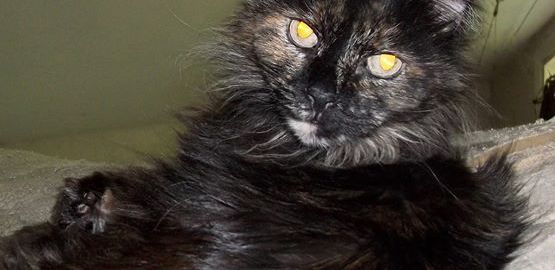
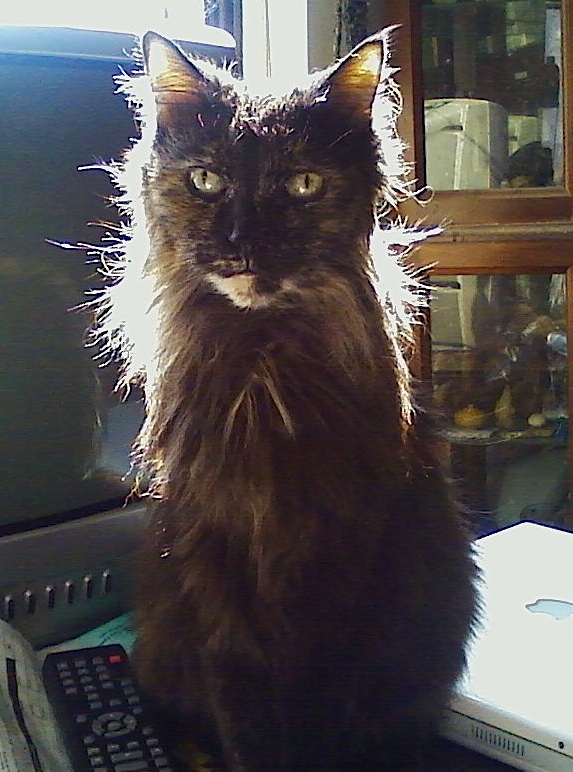
But I had never thought twice about the variety of calico called tortoiseshell, “torties” for short. Torties are a brindled variety of calico with little to no white fur – black, brown, red, russet, and multiple, mixed variations of black and orange.

This is a calico.
This is a calico.

This is a tortie.
This is a tortie.

When I went to the shelter to get my first cat, they had no traditional calicos, only tortoiseshell calicos, among the tabbies, bi-colors, solid colors, and just about every other color pattern – except calico.

I pondered the many choices, and found myself drawn to the torties. After all, they were a kind of calico. I asked my fiancé’s advice. He was studiously and purposely unhelpful. “Gee, I don’t know, honey, they’re all nice cats.”(2)

I found a little tortie whose elastic name band said “Bejeau.” “Aha!” I said. “Someone can’t spell Bijou. That’s the one.”(3) I took her home. And made her a new name band with the proper spelling.

A few days later, the shelter called to see how we were getting along. “Fine,” I said, “except she wants to sleep across my throat.”

“Oh, dear,” said the shelter lady. “She’ll probably stop that when she feels more secure.” And so she did.

Bijou was the first of my torties, but there have been others since – Anjou, Laurel, and Louise.(4)

________________________________

Once I was sent to New York City on business and had an extra day to spend (because of the ridiculous way airlines charged for business travelers).

I decided to make it an all-cats day. First I went to see the musical Cats, and then I went to the cat show at Madison Square Garden.
The musical was awesome, but the cat show was fun.

I saw varieties and breeds of cats that I had never heard of. I saw pampered cats that looked like princesses in elegant pink silk beds, their likewise-silky long hair flowing around them and a look on their faces that said, “You peasant! Move along now that someone else may adore me.”(5)

At one of the judging stations, the man doing the judging was willing to chat with me. He told me how to tell the difference between Norwegian Forest Cats and Maine Coons by the shape of the face. Then he told me about tortoiseshells.

With all his years of cat-judging experience backing him up, he authoritatively informed me, “All torties have a screw loose.”

Maybe that was why Bijou slept on my throat and Anjou carried a tampon applicator though one of my parties, and Laurel curtsied to everything, and Louise was known in her youth as “Naughty Baby Fek’lhr.”(6) A screw loose indeed.

One of my friends put it better, though: “Torties are the candy bar of cats: a little bit sweet and a little bit nuts.”

(1) There are calico guinea pigs, which are kind of cute, but nowhere near as compelling. Guinea pigs just don’t have a lot of personality.
(2) Smart man.
(3) I had studied French for years. My second torte, named Anna by the shelter, became Anjou.
(4) And some traditional calicos: Julia and Dushenka.
(5) I later saw one of those uppity cats turn pure kitten when a feather on a string was dangled before her. She caught it and proudly sat there with it sticking out of her mouth for the rest of the judging. “It’s mine!” she seemed to say. “I caught it and you can’t have it.”
(6) A joke that almost no one gets.

I Was a Teenage Ninja

Well, no I wasn’t. I wasn’t a mutant, either. When I was a teenager, no one in America had heard of ninjas.(1) At that point, they hadn’t even heard of Ninja Turtles.(2)

But let’s back this train up. It all started (for me, not the ninjas) in Philadelphia (for the ninjas, it started in Japan), and ironically, because of trains. I was staying in Hatfield and wanted to visit some friends across town.

“I don’t think you should do that,” said my then-fiancé (now-husband). “You have to change trains. And you have to walk through a scary, dark, underground tunnel in a bad section of town, at night, to get to the other train.”

Needless to say(3), I stuck out my lower lip so far you could stand on it; crossed my arms in front of me like the Great Wall of China,; and glared my special, patented, death-to-you glare. Dan, who is adept at reading body language, correctly interpreted this as, “You can’t tell me what scary, dark, underground tunnels I can or can’t walk through.”

I was going to explain that several times I had spent the night in the Cleveland bus terminal (midnight to six) and survived, but I would have had to admit that I sat in the roped-off area for women and children only(4), so it wasn’t all that scary and I wasn’t all that brave.

Anyway, not being an idiot, I postponed the visit, and made a solemn oath that as soon as I got home, I was going to take a self-defense class, which is what you did back then instead of simply packing heat, which self-defense classes at the time did not recommend.

I checked out the offerings in the local adult education catalog from our local school district. One of the classes listed was Ninjutsu Self-Defense. Hm. Interesting. It was not a “sport” martial art and didn’t require a gi, so I signed up. The instructor was Stephen K. Hayes.(5)

After six weeks of learning various kinds of punching and kicking, plus falling and rolling, I decided to continue training. The only problem was, there was no follow-up course. What there was, was an informal training group that met weekly behind an apartment complex and next to a cemetery.(6) (Later the group became a more formal organization and met in a rented space underneath a strip mall. Very stealthy.) We were early adopters of the butch camo look, with “tiger-stripe” (Vietnam jungle) camo being considered the sexiest variety.(7)

As self-defense, ninjutsu was very practical. It also made a lot more sense to me than the usual women’s self-defense advice and tips so prevalent then (and perhaps even now). You know the kind: Poke your attacker in the eyes. Carry your keys protruding between your fingers for use as a weapon. Go for the gonads. Well. The eye-poke and car keys will ensure a pissed-off attacker and guys expect you to target their junk, so they automatically defend against that. And they don’t have to take classes about protecting the ol’ gonies.

No, the concept was “body weight in motion.” I can easily describe this philosophy. The human knee is a delicate structure that does not willingly go in very many directions. Drop 100+ pounds of anything – sack of potatoes, log, female human – on it in one of those non-standard directions, and the knee will no longer function well. You have not merely a pissed-off attacker, but one that probably cannot limp as fast as you can run screaming for help. Plus, you can make it look like you just slipped and fell on him, which is a good thing if it ever goes to court.(8)

Every summer there was a camp, which was nothing like what they air now on TV “reality” shows. We learned interesting Japanese weapons, such as the bo, hanbo, tanto, shuriken(9), kusari fundo, and (my favorite) the kyoketsu shogei. None of which I tend to carry around, but all of which use principles transferable to modern, everyday items like mops and steak knives and even large-caliber dog leashes. We also learned pressure points and other painful techniques, which are fun, and also work fine against a larger attacker. One year at camp I had the pleasure of watching Masaaki Hatsumi, the little, old Grandmaster, easily maneuver an assistant sensei into the ground and feed him grass while apologizing profusely but insincerely.

Yes, we learned lots of useful things. For me, the most practical technique proved to be editing the club newsletter. It was more of a 16-page non-glossy magazine, and when I applied for my first real editing job, it was prominent among the samples of my work I had to show.

I got the job. And I didn’t even have to feed the interviewer grass.

Now I edit like a ninja. I wield my sword of strikethrough and the red font trails across the screen like pooling blood. I leave sliced paragraphs in my wake, still alive and considerably shorter.

(1) Unless they read James Bond novels, but everyone just went to the movies. Well, not everyone. I didn’t. So I don’t know whether the ninjas played any part in the movies. But they were mentioned in one of the books, which was really my point.
(2) An artist friend of mine said, “You mean children are going to hear the names Donatello and Michelangelo, and think they’re turtles?!!!?”
(3) But I’m going to anyway.
(4) Really.
(5) http://en.wikipedia.org/wiki/Stephen_K._Hayes
(6) And you can bet there were many jokes made about that.
(7) See http://www.spoonflower.com/fabric/1678959 for an example. No, I don’t know why an outfit called spoonflower sells camo. Other varieties of camo include woodland (summer or fall), which looks really stupid if you wear it in the desert, which two characters in a movie once did, desert camo, and international orange camo, which sounds really stupid but is actually the best for hunters of color-blind animals like elephants and deer.
(8) It most likely won’t.
(9) Which are nothing like you see in the movies. You cannot kill someone with a shrunken to the forehead (though my husband did once break a garage window with one). They are more for distraction, or, if they’re good and rusty, able to cause death by tetanus, at least back when they were invented and tetanus vaccine wasn’t.

Cats, etc. – The Little Soul Who Strayed, Then Stayed

The slim calico prowled the neighborhood, checking out the opportunities. This house? That one? There was a nice culvert in the cul-de-sac where she could both hide and find water.

The big, dark car stopped beside her and the door opened. The cat froze, waiting to see what came next. The human made cooing and chirping sounds, and the ones she’d learned to recognize as “here, kitty, kitty.” But she ignored him and sauntered on. You don’t get into a strange car with just any old human, after all.

Still, the human hadn’t appeared threatening. Maybe she’d check out this area again.

Carefully, the calico watched and waited. The big car went by several times a day. If she was hidden well, it passed by. If she allowed the human a glimpse of her bright eyes and sleek tri-colored fur, she might also listen to the low, comforting sounds that spoke of invitation.

Sometimes she strolled past the place she had lived before, just to check it out. Loud dogs barking in the house. In the yard. Not worth trying right now. Maybe some day the dogs would go away, just as she had.

______________________________________

“I’ve seen this little calico around lately,” my husband said. “Doesn’t look like anyone owns it.”

“Her,” I said. “Calicos are almost always female. They need two X chromosomes to get that color pattern.” I knew I was being pedantic, but I wanted to keep the conversation out of emotional realms. Our big gray and white cat Django had died not long before, and I wasn’t ready to give my heart to another feline companion.

______________________________________

A few days later, the calico saw the sign above our door, visible only to cats: SUCKERS LIVE HERE. FREE FOOD. Casually, she picked her dainty way through the garden and up to the front door. Just as the sign had revealed, the man from the car opened the door and brought her an offering of food. She started hanging around the house more. She could smell that there were other cats there. One dog in the back yard, but not a very noisy one. She allowed the man to take her inside.

He gave her a room to herself, with a constantly filled food dish and a container of litter. The man, and sometimes the woman, would visit her and pet her and give her a lap to sit on. There was a window to look out of and a comfy chair and lots of shelves and bins and boxes to explore.

No barking.

slpdush
________________________________________

“If we’re going to keep her, we need to take her to the vet for a check-up,” Dan said.

I was still trying to resist. “But are we going to keep her? I’m not ready yet. It’s too soon.”

“Even if we don’t keep her, she needs a vet-check before we can let her mix with the other cats. We can’t leave her in your study. If we do try to find her owner, it could take a while.”

“There was a sign up a couple of streets over about a missing calico. It’s probably this one,” I said.

The neighbor came to see the little calico. I made him describe her before I brought her out. She might not put up with being held very long and turn into a clawed tornado. He neglected to mention the sooty smudge on her chin or her crazy eyes, one gold, one green, and when I did bring her out for inspection, he shook his head sadly. No.

“Good luck,” I said, holding the cat firmly against my chest.

_____________________________________________

“We’ve got to name her something, if only for the vet records. And we can’t keep calling her Li’l Bit. She’s not so little any more now that she’s eating regularly,” Dan said as we prepared to put her in a carrier. “Do you have any good ideas?”

“Well, there’s Dushenka,” I offered. “It’s Russian and means ‘little soul.’ On Babylon 5, Ivanova’s father called her that as a term of endearment.”

“That’s it, then. She’s Dushenka.”

___________________________________________

All Dushenka’s tests were fine. She did seem like she hadn’t been on the street too long – glossy coat, not malnourished, definitely not feral. Just as we were about to take her home for another round of “Should We Keep Her?” the vet said, “I should probably scan her. Lots of cats have ID chips these days.

The quick wave of a wand over her shoulders and – BEEP. Somewhere Dushenka had an owner. And it wasn’t us.

The vet called the chip registry service and the phone number they gave her, but had to leave a message. A few days later, she gave us the address and phone number too. The cat’s registered name was Carmen, and she had lived one street behind us.

__________________________________________

We tried. We really did. We called, left messages, even put a note on the door.

And I tried not to love her. I really did. But, truth be told, she had me as soon as I saw the crazy eyes and the smudgy chin.

updush

So we got the vet to write a letter to the chip registry about what awesome pet guardians we are and how all of us had tried to contact the registered owner. And we sent in the $25 re-registration fee. The paperwork done, her ownership officially changed hands. To this day, we’ve never heard a squeak from the neighbors who used to have her.

We’ve seen this meme since, and except for the pronouns, it’s perfect.

catpost

She’s OURS now. And we LOVE her.

Books, Etc. – Books as Mashed Potatoes

Books are like mashed potatoes.(1)

Some books are like mashed potatoes.(2)

Mashed potatoes are warm and creamy, oozing with butter or redolent with garlic, or chunky with fiber-filled shreds of skin, if that’s your thing. They’re yummy and atavistic, a taste that tugs at the link between memory and taste and smell and emotions.

For me, a used bookstore taps into the sensory-emotional link – the scent of dust and aged paper, the warmth of an old heater, the motion of a rocking chair, the calming voice of the owner of a store I went to in my childhood and teens.

Books themselves and the act of reading are less sensory and more intellectual. But just as mashed potatoes are comfort food(3), some books are comfort books.

When I’ve been on a serious reading jag(4), engaging with books that leave me pondering or wrung out, or even sobbing(5), when I’ve overdosed on nonfiction that punches me in the gut or heart(6) I need reading material that’s familiar and soul-satisying without being overwhelming.

I need a comfort book.

I’ve had comfort books since I learned to read – books I’ve returned to again and again, that I never feel I’ve had too much of.(7) My first were Dr. Seuss’s immortal Green Eggs and Ham in my childhood and Bel Kaufman’s Up the Down Staircase, in my early teens.

Later, my go-to comfort books were the Mrs. Pollifax series by Dorothy Gilman – fairly lowbrow adventure/cozy mysteries starring a little old lady working undercover for the CIA. Each book took place in a different country and served up a travelogue more intriguing than the plot and as appealing as the quirky characters and the practicality of the heroine.(8) Also, I know that nothing really bad is going to happen to any of the main characters – none of this “relative dies at the hands of a serial killer” or “best friend is kidnapped and tortured” or “haunting memories of the main character’s dreadful past,” the stuff of much modern crime or spy fiction.

Nowadays my comfort books are largely those by Lois McMaster Bujold. She writes intelligent, witty, engrossing science fiction and fantasy novels, the best-known being the Miles Vorkosigan series. The Vorkosigan books take on sf genres including military sf, space opera, interstellar intrigue, and more, all with solid backgrounds in fields as disparate as biology and engineering.(9)

Of Bujold’s fantasy books, I find most comforting the Chalion trilogy (The Curse of Chalion, Paladin of Souls, and The Hallowed Hunt) or the first of The Sharing Knife series (Beguilement). Falling Free, a mostly stand-alone novel, is also a comfort book, nicely blending the possibilities of technology and humans.

And then there’s Tolkien. Don’t get me started on Tolkien. I’ve read Lord of the Rings dozens of times. My husband, a more visual person than I, has seen the movies dozens of times. As with comfort books, comfort movies no doubt exist. But we won’t get into those. Unless you really, really want to.(10)

Nonfiction comfort books are harder to come by. Familiar but dramatic stories (The Right Stuff), biographies of interesting people (
Catherine the Great: Portrait of a Woman

by Robert K. Massie)(11), and accounts or diaries of exploration do it for me. Ernest Shackleton’s diaries are particularly comforting in the summer. The vivid polar prose actually seems to lower my body temperature.

Your comfort books may be entirely different; in fact, they are almost certain to be, given our differing experiences and reading histories. My friend Leslie returns to the Catherynne Valente Fairyland series (The Girl Who Circumnavigated Fairyland in a Ship of Her Own Making is the first), an excellent choice, but also joins me in nearly yearly Bujold binges.

The best thing about comfort books is that I can curl up with them in bed, on rainy or snowy days, with a cat, and lose myself. After eating a big bowl of mashed potatoes.

Now, that’s comfort!

(1) No. No, they’re not. Let’s try again.
(2) There. That’s better. Let’s continue until the analogy breaks down.
(3) Mac-n-cheese. Fried rice. Club sandwich. Grilled cheese with tomato soup, the way my mother used to make it.
(4) Trying to remind myself that I was once an English major and an aspiring member of the literati.
(5) Markus Zusak’s The Book Thief and Melanie Benjamin’s The Autobiography of Mrs. Tom Thumb were the most recent to make me cry.
(6) Last Man Out: The Story of the Springhill Mine Disaster by Melissa Faye Greene or And the Band Played On by Randy Shilts, for example.
(7) Hence mashed potatoes = comfort.
(8) There are only a few I could probably read now – the first of the series (The Unexpected Mrs. Pollifax) and a couple of ones from the middle of the series that featured characters or settings that appealed to me (Bulgaria and Turkey come to mind).
(9) Of the series, the most comforting is A Civil Campaign, described as A Comedy of Biology and Manners. Memory is the best of the novels, but isn’t always comforting, given my experiences with memories and memory lapses.
(10) Hint, hint.
(11) Avoid Prince Albert, unless you suffer from insomnia. The dullest book ever about the dullest person ever was a biography of Prince Albert. Comfort books are soothing, not boring.

Currently Reading:
Fosse, by Sam Wasson
Captain Vorpatril’s Alliance, by Lois McMaster Bujold

The Great Linguini Divot

Dan is not a doctor.(1) But once he did take a scalpel to my tender flesh and excise a horror I had lived with for years.

Here’s how it happened: I had a recurring cyst that would appear on my torso from time to time, like a giant zit that just wandered off to be alone. Swollen, bright red, tight skin, pain – the whole works. Usually it went away after a few days.(2)

But it always came back. The timing was random, but the zit was not.

A friend saw it when we were changing clothes to go out. She didn’t take it seriously, though, so I told her that I had been to the doctor, who diagnosed it as “polymammia,” which meant I was growing a third breast.(3) It fooled her for a moment. But just a moment. A brief one.

Eventually, it bothered me enough to really see a doctor. He never said a word about “polymammia,”(4) but called it a recurring cyst. “Come back in a couple of days and I’ll lance it,” he said.

So I did. He looked at it and poked at it with a (gloved) finger and said, “It’s not ready yet.”

“You mean it’s not ripe?” I said. “Couldn’t you at least try to lance it? It hurts a lot.”

He allowed as how he could try. And did. And found a pocket of pus lurking underneath. “Wow! That must have hurt!” he said.

I gave him the sideways squint.

“Not that I didn’t believe you,” he stammered. Then he changed the subject. “Let’s put a drain in there.”

Here’s where the linguini enters the story.(5)

I had never had anything on or in my body drained before, so I thought maybe he would draw out the gunk with a hypodermic or at least take a tiny rubber hose and stick it into the cyst so the pus would just run out.

But no. It turns out a “drain” is an object that looks like a piece of knit linguini. He stuffed it in there and bandaged it and it healed nicely (after bleeding through the bandage and my shirt for a while).

Some time later, though, I noticed a slightly raised black dot, about the size of the roller from a roller ball pen, where the cyst used to be. Oh great, I thought. I’ve exchanged a wandering zit for a wandering blackhead.

The darned thing itched at times. It looked like I could squeeze it like the blackhead it resembled, or if I could get my fingernails under it, it would pop right out. I never could manage it, though, perhaps because I bite my fingernails off and spit them across the room as soon as they grow an eighth of an inch.(6)

Here’s where my husband and the scalpel come in. To be truthful, it wasn’t a scalpel. It was an Exacto knife. He sterilized it with flame and alcohol, and swabbed all around the blackhead with more alcohol. Then, since we were both just a wee bit nervous, we both applied even more alcohol(7). Internally.

Wielding the Exacto with surprising delicacy, given the size of his bear-like paws, Dan cut around the blackhead and began to lift it out.

It kept coming. This alarmed us both.

When the Thing was finally extracted, it proved to be several inches of drain, wadded up and solid. The doctor had neglected to remove all of it, the blood had dried and turned it black(8), and there it had resided in my torso for several years.

We goggled at it for a moment, then applied more alcohol(9), and slapped a Band-aid on it. I never heard from it again.(10)

Dan had thought that the skin would heal over smoothly, without a trace. And it did. Mostly. There was no scar, just a teeny little roller-ball-pen-ball-sized depression where first the cyst, then the linguini had been. A linguini divot, if you will.

Which I have to this day. Viewings by appointment only.

(1) Nor does he play one on TV. He has been a medical orderly, back when that job existed. Now he’s just disorderly.
(2) Or wandered off again to someplace or someone else where it didn’t bother me.
(3) I don’t think there is a medical term for growing a third breast. If there isn’t, I would like to suggest “polymammia.”
(4) Which, now that I think about it is a Good Thing. I would have had to throw out all my bras and get new ones custom-made. I assume that’s expensive. Plus I’d probably have to send a picture of the third breast* to the manufacturer and it would be leaked to the Internet, go viral, and I could never be on the Supreme Court.
*I was once presented a serving of shepherd’s pie that had three scoops of mashed potato on top. Guess what it looked like.**
**Three breasts, that’s what. Stay with me here, people.
(5) You were wondering, weren’t you? I can tell.
(6) I grew them out exactly once, for my wedding. The salon used a nail color called “Pepperoni,” which was probably the only time they used it for a wedding manicure.
(7) Rum.
(8) Cooking tip: If your linguini turns hard and black, it’s overdone.
(9) Both kinds.
(10) For all I know, Dan may have kept it. He always wants the scans from our colonoscopies and the time they took pictures inside my bladder. He wanted to keep his own appendix, but they wouldn’t let him. Unless it’s that thing in the back of the freezer. I don’t really want to know.

New Features Coming!

What are the new features?

Books, etc. and Cats, etc.

Where do I find them?

Right here on this blog, Et Cetera, etc.

When will they appear?

Whenever I feel like it or have something to say on either topic.

Can you describe them?

Yes.

Okay, smart-ass, describe them.

Books, etc., will contain book reviews, books I’m reading now or have loved in the past, musings on trends in fiction and nonfiction, the writing life. Etc.

Cats, etc., will contain true tales about my life with cats, plus occasional posts on cat care, health, behavior, and cats in the news. And cat pictures. Yours, too, if you want to send them.

Why are you qualified to write these features?

I read a lot, write some, and edit more. I have a B.A. in English from Cornell and an M.A. in English from University of Dayton.

I have been owned by at least a dozen cats (no, not all at once) and lived with more. They have all been shelter cats or ones that found us. No purebreds, so you’ll have to go somewhere else if that’s what you want.

But what about the posts, stories, and general crankiness we’ve grown to know and love?

They’ll still be here. Books and Cats will be post titles, followed by subtitles.

Can you give us examples?

Well, sure! Blog: Et Cetera, etc. (same old address); Books, etc.: Why Haven’t I Heard of Melanie Benjamin before?; Cats, etc.: Stupid Cat Tricks.

Can we suggest topics?

Absolutely. Go right ahead. I might even write about them.

When will these new features start?

See above, where I said, “Whenever I feel like it or have something to say.”

How often will they appear?

See above, where I said, see above, where I said, “Whenever I feel like it or have something to say.”

When do you…?

Don’t make me say it again.