Tag Archives: education

AI Writing: Friend or Foe?

You may have heard that AI writing means the death of writing done by actual, live people. In a way that’s true, and in a way it isn’t. Let me explain.

Many—perhaps most—of the fiction books that you see for sale on Amazon and other outlets are AI-written and almost universally bad. Rotten, really. So bad that you want to throw them against the wall. (Unless you have a Kindle, Nook, or other e-reader, of course. Then you only want to delete them. But I digress.) They are too short, too filled with adjectives and adverbs, too lacking in a coherent plot, and too deficient in character development. Even the most potentially vivid genres are bland.

You may say to yourself, “I could write a better novel than this turnip.” And you very likely could. (So why don’t you?)

But AI has taken over most of the writing space. Even books that you yourself don’t write aren’t written by a human being. (I should know. I often freelance for a ghostwriting service that shall remain nameless because of the NDA I signed. They used to have lots of us human beings doing the writing. Now they largely have “writing packages” produced by AI. The only time a human being touches the book is to supervise the AI engine, which sometimes goes madly astray, and to “humanize” the results (it’s known in the trade as “polishing dogshit into gold”). But I digress again. At length.)

That’s the bad side of AI writing. What, I hear you ask, is the good side?

It can make you a better writer.

Hear me out.

Let’s think about the most basic AI writing tool that almost everyone is familiar with: Grammarly. Yes, it follows along behind you and corrects what you’ve written when you’re typing too fast (like “isfamiliar”). And it always changes your word choice to “ducking.” It’s never “ducking.” But, if you pay attention to it, Grammarly is a teaching tool.

Grammarly sends you reports that list your most common mistakes that week (or month, I don’t remember). If it says you have problems with subject-verb agreement, brush up on that. If you have trouble remembering whether commas introduce an independent clause or a dependent one, look it up and try to remember it the next time you write.

Teachers worry that their students will use AI to write their papers for them. (One of my friends now has her students write out their essays longhand, like I did in the Victorian era. But I digress some more.) They may indeed rely on AI. (A survey of students found that they considered it cheating, however.) But there are many AI detectors available to teachers that sniff out suspiciously smelly AI-created sentences and paragraphs and report on how much of a piece of writing seems to be human or AI.

This, of course, has led to ways to avoid the AI detectors. One I saw recently offered a series of prompts a student could give the AI program in order to produce a piece of writing that would appear to be human-written. The list of things the sneaky student should tell the AI program to avoid was comprehensive and long.

It told students to create a prompt that specified not only the topic and tone of the illicit paper, but also to avoid common signs of AI content that the AI checkers teachers use frequently will flag.

The list of things to tell the AI to avoid included: sentences more than 20 words long without one clear idea and paragraphs all the same length; passive voice; abstractions instead of concrete words; sentences of all one length; a lack of measurable facts; suspect punctuation (semi-colons and em dashes) (I disagree with this stricture. I love semi-colons and em dashes, as if you hadn’t noticed. But I digress yet again.); overused words and phrases (an extensive list, including last but not least, cutting-edge, delve, game changer, nonetheless, despite, moist, subsequently, furthermore, utilize, leverage (and any other biz-speak or tech jargon)); adverbs and adjectives; hedging; more than one prepositional phrase or verb phrase; all-caps or numbered lists; and metaphors involving landscapes, music, or journeys. (I once asked ChatGPT to write some poetry, and it really overdid those metaphors. But I digress even more.)

In other words, if you know what to tell the AI not to do, you already know for yourself what not to do—or keep that list handy and refer to it often—you’ll be able to write your own sparkling prose without Robby the Robot’s assistance. And the process of learning to tell the AI how to write undetectably will improve your own writing.

If you think of AI as a way to learn instead of a way to cheat, you’ll do well.

Music and Me: The Saga Begins (and Ends)

It all started with my sister’s cornet and sibling rivalry. My parents rented the instrument (probably already having an inkling of the outcome). She attempted to learn to play it for school band class. It was not a success and the next year, when I was old enough to be in band class, my parents did not rent an instrument for me. I never got over it, so when I graduated from high school, I saved up and bought myself a cheap guitar. (And a sword. I was deeply influenced by The Lord of the Rings.)

I started taking guitar lessons. Then I ran out of money after learning the “Cocaine” song by John Martyn (not the other one). (The sword lessons came much later when I was studying martial arts (ninjutsu, to be specific). We practiced with a wooden katana, so I wasn’t able to use the sword I had bought. But I digress.)

Later, I took guitar lessons from a guy who was the cousin of my rotten then-boyfriend. Later still I bartered with a guitar teacher who needed his dissertation proofread. (He actually learned some aspects of grammar rather than just letting me do all the heavy lifting. (He thought it was hilarious when I told him to “check your apparatus.”) He’s still a Facebook friend. But I digress again.)

I took a break from guitar lessons when I took singing lessons. I’m a terrible singer, and the lessons didn’t help. I also took piano lessons because the teacher gave a discount if you took both. Turns out I’m a terrible piano player too. (The pedals befuddled me just as badly as the pedals on the car when I was learning to drive stick. But I digress some more.)

Later still, I entered what was called a “Pick-a-Thon,” a marathon guitar-picking contest that lasted for days. You didn’t have to play actual songs, which was a good thing in my case, just keep making sounds with the guitar, which was a mercy when you had to visit the facilities—just squat and strum. By the time I had made it through 24 hours, my boss (who was also my friend) gave me time off. I made it to the final two pickers, but I finally gave in (I was hallucinating by that time). My final time was 68 hours and 7 minutes. The music store where this was held gave me a fantastic deal on a really excellent guitar as a second-place prize.

I still couldn’t play it much, though. More lessons ensued, this time with a woman who was: a twin, a former army officer, a pilot, and left-handed. I liked her a lot, but it was kind of weird trying to learn when she played her guitar upside down.

I finally figured out the reason for my lack of progress on the guitar (and the banjo). When I had the money for lessons, I didn’t have the time, and when I had the time, I didn’t have the money. (I briefly had a harmonica, which was inexpensive and didn’t require lessons. I learned the intro to Gordon Lightfoot’s “The Way I Feel” but it made my mouth hurt. But I digress yet again.)

I’m also trying to learn how to whistle. At least I don’t have to buy an instrument or take lessons for that. (So far I can whistle the sound that Wile E. Coyote makes as he’s plunging from a cliff to the ground. Not that there’s much call for that sort of thing. But I continue to digress.)

Right now, I’m in a time-rich and money-poor state. Plus, I don’t have a guitar or a banjo. I’ve never had a piano and still have a terrible singing voice. What I do have is iTunes (or Apple Music as I guess they call it now), 8,000 songs, a study I’m alone in all day, and a house far enough from the neighbors that I can’t be heard when I sing along off-key and loudly. And that’s enough to satisfy me.

Serving Society

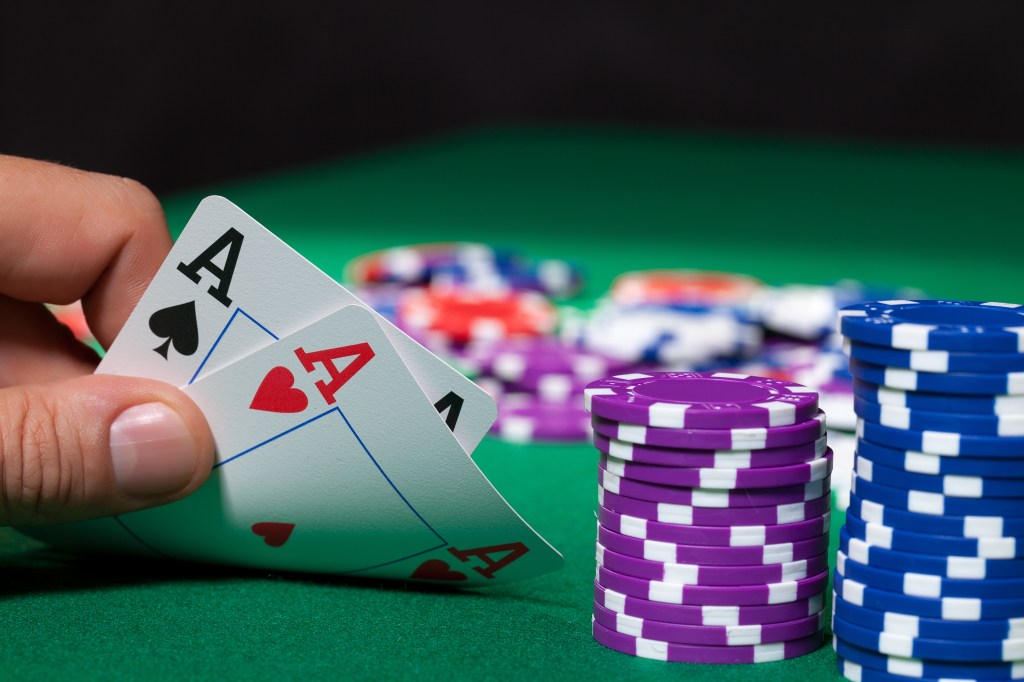
It all started with a game of Texas Hold’Em held in a bookstore to raise money for charity. I had pocket aces (as shown), a very strong hand. I should have slow-played them and let others raise the pot, but I was a newbie and all excited, so I didn’t make the most of the opportunity. Shortly thereafter, I left the game.

(Texas Hold’Em became trendy and popular in 2004 with the publication of Jim McManus’s Positively Fifth Street. It led to such oddities as the World Series of Poker (yes, there is one) being televised. The title of the book came from the arcane but intriguing insider terminology used to describe the various parts of the game, such as the flop, the turn, and the river (aka Fifth Street), which refer to when the communal cards are exposed. Naturally, I was drawn to a game that had its own language. But I digress.)

After I left the poker table, I was drawn into a conversation with a woman who was watching the game. She wanted to know whether I did anything besides play poker. (Yes, there are professional poker players.) When I told her that I was in educational publishing, she relaxed. Her point was that professional poker playing served society not at all, but educational publishing filled a valuable niche in service to education, a worthy goal.

That got me thinking. Who exactly serves society and in what capacity?

I think we all agree on some of the basics: teachers, medical personnel, police, religious figures, volunteer workers, and firefighters. But are they the only ones who perform worthwhile services?

Politicians are not held in high regard these days, and neither are lawyers. But when they act on principles (if they ever do), they serve society by making laws and administering justice.

I’m less open to the idea that entertainers serve society by entertaining us. Of course, some entertainers (and I’m including professional athletes in that) donate large sums of money to assorted worthy causes or start charities or foundations that serve some segments of society, usually the underserved. But those people, it seems to me, are philanthropists (good-deed-doers) who also entertain.

(Speaking of entertainers, I can’t abide most reality shows, particularly the kind that might be called “Famous for Being Famous” (I’m looking at you, Kardashians) or “Rich People Behaving Badly” (I’m looking at you, Real Housewives). I do like the ones where fairly normal people actually make or do something like cooking or baking, designing clothes, forging knives, and so on. I can’t say whether they technically serve society, but at least they’re creative. But I digress again.)

But what (to get back to my much-neglected point) about sanitation and maintenance workers? Without them, our streets would be awash in litter and worse. Our offices would be grubby and perhaps disease-ridden. Our school corridors would be besmirched by vomit. I think taking care of all these problems serves society in a very real way. (And there are never reality shows featuring them. Probably something to do with the vomit. But I digress some more.)

I’ll admit that poker players don’t do anything to serve society, but I think we have a limited view of those who do. Public servants are held up as examples, and they should be. But farmers don’t get mentioned, and they feed us all. Train engineers and truck drivers serve society by delivering that food, as we learned during the pandemic. Psychiatrists and therapists serve members of the public who have mental illnesses. Meteorologists serve society when storms happen. Anyone from architects to bus drivers, yoga instructors to zookeepers. Even burger flippers and pizza delivery people serve society or at least individual members of it.

Let’s expand our definitions of who serves society. There are a lot of people who don’t get recognition and should.

An Investment in the Future

My investments are not stocks and bonds and they’re not biological, but they affect the future anyway.

I don’t have any children—I’m the proverbial cat lady—and because of that some people are saying that I’m not contributing to the future of our country or that I shouldn’t get an equal say in how our country is run. And I think that’s just plain wrong.

Some families have no children because they can’t have any. Others don’t want children, for whatever reason. But making the most fundamental right of our society dependent on whether a person has a child is a profound violation of the foundations of our democratic society. Even if you’re a strict constitutional constructionist, there’s absolutely nothing in there about voting being contingent on offspring. (That voting was originally limited to white male property owners is another issue that hasn’t yet been brought up.)

This proposal is billed as “pro-family,” but it’s nothing of the kind. It defines family as only one kind of family and denies rights—not privileges—to the rest. Granting those privileges to children, to be exercised by their parents, contradicts the basic principle of one person, one vote. When those children turn 18, they are welcome, even encouraged, to cast their votes for themselves. But allowing parents extra votes per child is nonsensical.

I wonder how long it will be before the definition of a family is a two-parent (heterosexual) couple with children. Will single mothers get to vote more than once, considering their children? Single fathers? If a family doesn’t include two parents living together, does the voting right automatically go to the mother? The father? These matters are far from clear. And unless I’m mistaken, they would require a constitutional amendment to go into effect. In other words, it’s grandstanding.

But leaving that political nonsense aside, what are the rights that childless people have, or should have, regarding children?

Well, first of all, our taxes pay for schools, parks, lunch programs, Head Start, child tax credits, nutrition programs, Social Security survivors and dependents, Social Security Disability, Medicaid and health insurance, and of course schools, among others. I’m paying into those whether I have children or not.

I don’t resent that. I think such programs are necessary and I’m glad to help fund them. The children and families they help impact me directly and indirectly. They will be my congressional representatives, my nursing home aides, the inventors of devices that will improve my life—every slot that must be filled to make society run, if not smoothly, then at least adequately.

Of course, not all children have the same start in life or pursue noble or necessary functions. I would like to help them do so. The way I can do this is to vote. These issues and functions affect me in very real ways that I have the right and the privilege to vote for.

And I do vote.

Now, let’s talk about schools. Because I don’t have children, many people think I should have no say in what happens in schools. I disagree. What happens in the schools affects me too. I want doctors who have a firm grounding in accepted science. I want bankers who have a keen grasp on economics. And I want government people who have a thorough understanding of civics. That means I have an investment in what goes on in schools and what children learn.

I’ll never be on a school board or even a member of the PTA, but I do get to vote for who’s on the school board and I pay attention to what they do. Now, I’ve got no problem if people want to homeschool their children or send them to private schools, as long as my tax dollars go to the public schools. Public money, public schools.

But don’t try to take away my rights as a citizen or come up with some hare-brained scheme to make my vote count for less. You can say the children are our future all you want.

But they’re my future too. Whether I’ve given birth to any or not.

Remembrance

I saw a post on social media yesterday that showed Native children dressed in school uniforms. Their image, wearing Native garb, was reflected in a pool of water. The words “Never Forget” were printed in between the two images. It made me stop and think how few of us remember what happened to Native children who were taken from their families and sent to government schools. It wasn’t taught in the schools I went to and isn’t likely to be taught now in a number of states. How can we remember what we never even knew?

In the spirit of remembrance, though, here is a glimpse at what we at least try not to forget.

Never Again

The Holocaust is the most famous event that we are exhorted never to forget—and never to allow again. As time goes on, there are increasingly fewer people who remember its horrors for themselves. There are movies, books, newsreels, and other media that have kept the memories alive, however. These days, we’re more aware of the concept of genocide, though there are those who deny that the Holocaust happened. January 27 is Holocaust Remembrance Day. It’s worth noting that German schoolchildren are taught not to forget. They learn about the horrors and even visit the sites of concentration camps, which are preserved as memorials to the dead.

Attack on Pearl Harbor

National Pearl Harbor Remembrance Day is observed every year since 1994 on December 7, the “day that will live in infamy” to remember and honor the Americans who were killed in the Japanese surprise attack on Pearl Harbor in Hawaii. More than 2,000 people died and many more were injured. Remembrance Day is not an official national holiday, but flags are flown at half-staff. There are several memorials, the most famous of which is over the site where the USS Arizona was sunk. There is also a memorial to the USS Missouri, the ship where Japan surrendered to the US, ending WWII.

Hiroshima and Nagasaki

The US’s use of the atomic bomb on two cities in Japan is another event that bears remembrance—and avoidance in the future. Japan has designated a church that was nearest the center of the blast at Hiroshima as the official Peace Memorial. There are also a park and a museum at that location. At the Children’s Peace Memorial in the park, thousands of colorful origami cranes, a Japanese symbol of peace, can be seen. Nagasaki has also designated a memorial and a museum. As threats of nuclear war grow increasingly plausible, it’s worth reflecting on the damage done and the lives lost.

NASA’s Day of Remembrance

This year, January 25 has been designated NASA’s Day of Remembrance honoring the astronauts who have died in the process of space exploration. Three crew members died in a fire on the launch pad in 1967, and 14 crew members, including “Teacher in Space” Christa McAuliffe, were lost in the crashes of the Space Shuttles Challenger and Columbia. Kennedy Space Center has a Space Mirror Memorial where workers and visitors often leave flowers.

9/11

This is the most recent event that needs to be remembered. Where we were when it happened is burned into those of us old enough to be aware of it. (It amazes me that I have to write that sentence.) Memorials at Ground Zero as well as in Pennsylvania and Washington have been built—parks and plaques and a 9/11 museum. Actually, countries around the world have memorials for the event as well. There have been solemn ceremonies such as the reading of the names of the dead on the first anniversary of the attack. There have been lots of other changes that remind us of 9/11 in less inspiring ways, such as increased security in airports and a greater awareness of terrorism in the US from a number of other sources.

It’s sad—tragic—that these remembrances involve so much death. And there are more tragedies that I haven’t even mentioned, like President Kennedy’s death (which some of us are old enough to remember for ourselves). Celebrations of people’s lives don’t seem to last that long.

Maybe it’s because the tragedies arouse in us deeper levels of feeling than lives lived well and examples that inspire. Maybe it’s because we hope something good will rise from the ashes.

Science Madness

The problem these days is not so much “mad scientists” as people who are mad at science.

Where did the Mad Scientist trope come from anyway? Arguably it was Mary Shelley’s horror novel Frankenstein, published in 1818. Science fiction classics like Jules Verne’s The Island of Dr. Moreau (1896) kept up the theme and the “Golden Age” of science fiction provided many more examples.

In these novels, scientists either tampered with things better left alone or succumbed to a lust for power. Death rays and the precursors of gene splicing abounded. The outcome was mostly dreadful, except for those few gallant hero scientists who managed to save Earth from a deadly plague/alien/monster/giant something.

While the ’30s, ’40s, and ’50s were the heyday of mad scientists in fiction, those years also constituted a time when real scientists were heroes. The atomic bomb ended WWII in the Pacific. Polio was conquered. The “Space Race” that led to many scientific breakthroughs began, thanks to the Soviets and their Sputnik (1957).

Back then, scientists were revered.

Later on, not so much.

The conflict between science and religion heated up. Of course, there was conflict going way back – before Mary Shelley warned us about “playing God.” Galileo and Kepler removed us from our “God-given place” in the center of the universe, and Darwin implied that we were just another animal. The Earth suddenly became billions of years old,  circling a mediocre star.

Then there was fallout, both literal and figurative, from the atomic bomb. Medical science gave us thalidomide. NASA used up billions of dollars, with no obvious monetary payoff down the line, and some people decried the space program for spending money that could be used for problems on Earth.

And all that led to changes in the general public’s attitude toward science.

By the ’60s. medicine was under fire from those who found Eastern philosophy and natural healing just as good or better. Physicists were condemned for the same atomic bomb for which they had been lauded. Science didn’t seem like such a good deal after all.

And there’s some truth to the complaints. Many scientists believed that math, physics, and chemistry were all. If it didn’t have numbers attached to it, forget it. Psychology, sociology, anthropology, and most other -ologies were “soft sciences,” barely sciences at all. Hard sciences ruled.

Slowly, the ground under science shifted. Now science has become to many people the enemy, the domain of elitists and narcissists and people who feel they are entitled by their intellect to run the world.

Of course, the stereotypes from early science fiction had something to do with that.

But the Average Man (and Woman) had a bone, or at least a fossil, to pick with science and scientists. Again, science was denying what the general public believed.

Increasingly, people believed in the efficacy of non-Western medicine, or at least the non-efficacy of Western medicine. Science believed in genetics and stem cells and cloning.

People believed in the spiritual realm. Scientists believed in the measurable.

People believed in religion. Science believed in science.

You can see where this is heading – right back to the days when people thought science meant the reanimation of corpses, invasions of bug-eyed monsters, and the creation of death rays. Because what, after all, is the distance between growing human organs and creating Frankenstein, between cloning a sheep and making a half-man-half-fly, between a laser-guided missile and a death ray?

And many scientists are arrogant, dismissive of popular opinion, and unwilling to engage in dialogue with opposing viewpoints. “Because I said so,” seems to be enough for them. “Real” scientists look down their noses at “popularizers” who look to educate the public about science.

Unfortunately, everyone is shouting and no one is listening.

Personally, I am a sometimes science geek as well as a word nerd, thanks to high school chemistry and physics, college astronomy, and lots of nonfiction reading. I don’t think science knows it all, and it’s a long way from figuring it all out. I also think that psychology and spirituality and art have a lot to teach us about the human condition and our place in the universe, STEM classes and careers notwithstanding.

But the pushback against science scares me. NASA is wasting its time chasing UFOs. Streaming channels that used to be devoted to science now feature ghost chasers and treasure hunters. I’m not saying that science never stumbles, but it provides the best answers we have to some of the problems that plague us, including plagues.

I don’t advocate returning to a time when science was the be-all and end-all of thought and education, or to the time when fictional science made scientists suspect. I just think science deserves more respect than it’s getting now.

How I Faced My Fear … And Failed

This is my idea of hell:

A semitruck rolled early Friday, spilling a load of honeybees on the Interstate 5 median at the Interstate 405 interchange near Lynnwood….As temperatures warmed and the bees became more agitated, firefighters sprayed a mixture of foam and water on the hives to slow down or kill some of the bees. Television reporters swatted at swarms of the insects surrounding their cameras and clumps of bee carcasses littered the roadway.

Yes, I am an apiphobe, also known as a melissophobe. (No, I don’t fear apes. That would be pithecophobia. No, not fear of people named Melissa, either. Seriously? Apis mellifera is the scientific name of the bee. But I digress.)

In actuality, I’ve only been stung by a bee once. I was in my early teens and given to going barefoot whenever possible. While walking through someone’s yard, I happened to step sideways and the outside of my baby toe brushed up against the backside of a bee.

I know the bee had no intention of stinging me. It was an accidental encounter on both our parts. A little baking soda and a bandaid and I was fine. Physically. My lack of reaction to the sting proved that I was not allergic – except in my own mind. Although I hadn’t panicked during the actual stinging, now panic is my instant reaction to the approach of any bees, wasps, or other stinging insect. (Ticks, too. Anything that impinges on my bodily boundaries. It’s a wonder I’m able to have sex at all. But I digress. Again.)

I tried to overcome this fear. I really did.

During my college years, I had a relationship (Mistake!) with a man who intended to keep bees. Somehow I thought that if I studied beekeeping, it might be beneficial to the relationship. (Mistake!) As it happened, the college I was attending had on its faculty Roger Morse, one of the world’s most noted authorities on bees. He did mostly research, but also taught two courses, Anatomy of the Honeybee (which was highly technical) and Beekeeping 101.

I signed up for the beekeeping course – this despite the fact that I was an English Major in the College of Arts and Sciences and the courses on bees were in the College of Agriculture. The university insisted we broaden our minds by enrolling in several classes unrelated to our majors. The beekeeping class consisted of lectures and a lab component. Lectures were sort of nice, and quite interesting. We passed around samples of honeycomb and honey made from the pollen of various flowers and plants – buckwheat honey, orange blossom, and the like. Since then I’ve also had lavender honey, which has to be my favorite.

Lab was something else again. I was OK when we were dissecting honey bees. (When I got to the bee’s wee intestine, I learned that bee poop is bright orange-yellow, which makes sense, because pollen. Everyone poops, and that’s how bees do. But I digress, yet again.) But when we got to tending beehives and interacting with live bees, my old fears came to the fore.

At first, we were given netted helmets, heavy gloves, and smokers, which were supposed to calm the bees. (I still don’t get why spraying smoke into their homes would calm them. It would panic almost any other animal. Although capnophobia, fear of smoke, seems to mean only cigarette smoke. But I digress. As if you haven’t noticed.) The rest of the class gradually got away from using these crutches, but I clung to them the entire time, along with a dose of Valium before lab. I would even eat almond cookies before lab, because I had heard that bees don’t like the scent of almonds. (Which presents the question: Why do they like the scent of almond flowers, but not the nuts? But I digress some more.)

I managed to pass the course, but failed at the relationship and at conquering my fear. To this day, when a stinging insect appears anywhere in my vicinity, even if it is paying no attention whatsoever to me, I freeze, try my best not to scream, and wait in terror for someone braver to shoo the thing away. My husband always tries to convince me that it was not a bee, but a dragonfly or a hummingbird. This does not fool me for a second, but I suppose he’s trying to be helpful.

And now, National Geographic tells us that bee enthusiasts and scientists are trying to create artisanal bees (artisanal honey, okay. But artisanal bees?), in what they call “The Quest for a Superbee.”

Great. Now I get to be a superapiphobe.

Teachers Under Fire

I was going to say that the title of this post was metaphorical, but anymore, it may not be.

Putting that aside for now, however, teachers today face any number of other difficulties they don’t deserve, some of which have existed for decades and others that have come to the forefront in recent times.

My respect for teachers is immense. I wanted to be a teacher when I was a child. My father, though, wanted me to be an engineer. My mother finally got him to stop trying to channel me away from teaching, but by that time he already had. Not that I ever became an engineer, however. (I might have been able to become one, but I think I would have been a very unhappy engineer.)

Still, even though I never became a teacher (unless you include two years of teaching English to first-year college students while going to grad school), I became involved with education throughout much of my life as a writer. I worked for magazines that included Today’s Catholic Teacher, Early Childhood News, Private School Administrator, School Planning and Management, and Technology and Learning. I edited textbooks on religion, English, and social studies. Education was in front of me at every turn.

The obstacles that teachers face these days, though, can’t be alleviated by articles on classroom decoration tips or advice on self-care (important as that is).

Teachers put up with low pay and out-of-pocket expenses for supplies that they shouldn’t have to buy. They put up with crumbling schools that lack basic necessities like heating and air conditioning. They put up with old textbooks or newer ones that are prescribed by committees who have few choices, thanks to the power of states like California, New York, and Texas. They have to teach in school buildings that may have lead in the drinking water or lack ADA-compliant facilities. (Two years ago, a report said that 2/3 of US schools weren’t up to ADA standards.)

Not enough people going into education – and why would they? The pay is low (and staying low) and respect is not a given. The general public does not understand the process of education, or they think that the way it was in their day is the way it should always be. They place too much emphasis on test scores, meaning that teachers must “teach to the test” instead of allowing children to learn in more fruitful, organic ways such as project-based learning.

There is scientific evidence that small class sizes are better for student learning, but finding the money and the number of educators required for that is not forthcoming. In fact, subjects that aren’t considered “academic” enough, such as art, music, and drama, are being sacrificed. Even recess for grade-school children is no longer guaranteed in order to spend more time in the classroom, despite the fact that physical activity is vital to a child’s health and development.

Many of the difficulties facing teachers were recently highlighted when approximately 4,500 teachers, librarians, counselors, school nurses, and other support personnel in Columbus, Ohio, went on strike. It was the first time since 1975 – nearly 50 years – that they had done so. The teachers’ demands included pay raises of 8% (they were granted only 4%, despite a much higher rate of inflation). But many of the issues they brought forward related to infrastructure issues such as the lack of functioning heating and cooling systems in the schools, particularly since the weather has been so hot and continues to be. And the teachers went back to school after a week on strike, despite the fact that only a “conceptual agreement” was reached. It included no promises of spending on infrastructure, though that was the cause that received the most complaints and publicity.

And what were the repercussions of the strike? The district hired 600 substitute teachers to replace the 4,000 or so teachers and fill in for online classes. In addition, the movement to allow public, taxpayer-supported funds to be used for private school tuition was enhanced, which would leave even fewer dollars in the public system to effect changes. An official for the Center for Christian Virtue, which placed billboards around Columbus promoting private schools, castigated the striking teachers: “These schools are hitting kids while they are down. After all kids have been through, being blocked out of their schools for years [a reference to the COVID crisis], and having just failed attempts at remote teaching, the fact that they would strike now is the ultimate blow to kids,” Baer said.

The Twitterverse reacted as well. While many tweets supported the strike, there were also ones that decidedly didn’t. “For the 2nd time in 3 years, Columbus City Schools athletics have been paused for all Fall sports. Both sets of soccer teams looking to have off campus workouts while the teachers are on strike. Pray for all CCS students and athletics during this difficult time” was one opinion. Another said, “Give them 48 hours and fire them. Their PR is mindless, the kids would rather be in school and their extracurricular activities. If the teachers cared about the kids, they’d still be teaching.”

Nor is Columbus the only place where these battles are playing out. New York City is engaged in a court case over proposed slashed budgets advocated by the mayor, who is a proponent of charter schools that sap funds from the public schools.

I could also mention the flack that teachers are now receiving from lawmakers and parents who want to control what teachers teach, what books they have in their libraries, and even what they’re allowed to say. And don’t get me started on the let’s-arm-the-teachers thing. There’s not enough room here for my outrage. Maybe another time.

So, here’s the bottom line. Teachers have continued to work with purpose, care, intelligence, and dedication. They have also continued to be underpaid, overworked, under-respected, and over-criticized. That they have continued to do so is a tribute to their strength and resilience. But how long must we expect them to do so? Sure, our kids deserve better than what they are getting through our broken education system – but our teachers deserve better too. When teachers get what they need to do their jobs as well as they are able, it’s a win-win. I don’t know why that should be controversial.

As John Steinbeck said, “I have come to believe that a great teacher is a great artist and that there as few as there are any other great artists. Teaching might even be the greatest of the arts since the medium is the human mind and spirit.”

Teachers are indeed the artists and architects of the future. We owe them a little more slack and a lot more support.

Tip Jar

Choose an amount

¤2.50
¤5.00
¤10.00

Or enter a custom amount

¤

Your contribution is appreciated.

Donate

Librarians’ Choices

Librarians are the gatekeepers of civilization. Perhaps I should say “guardians.” “Gatekeepers” implies that librarians decide what to admit and what to keep out.

In a way, though, librarians do have to make choices about what books reside in their libraries. They must make decisions based on space, for example, although through interlibrary loans that are now available to patrons, a wider selection of books is available than can be stored in a single building. But interlibrary loans take a while to get to the ordering library. Patrons would prefer it if the book in question were available on the shelves of their nearest branch, and right away, with no queues for bestsellers.

Librarians must go through a selection process to determine what books (and CDs and DVDs and magazines and newspapers, etc.) they will stock on their shelves. Not even the Library of Congress has every book ever printed. (My two books, for example, are not in their collection.) In order to make room for new books, librarians will “weed” their collections, consult their computers to determine what books haven’t been checked out with any regularity, and then get rid of them, often by holding library book sales. That’s one part of the selection process. (Books about making fondue, for example, likely haven’t been checked out in decades and would have been weeded years ago. Besides, people can and do now share fondue recipes online. But I digress.)

At the rate that books are being published, no library can keep up. Librarians consult references like the Ingram Spark catalog, and reviewers like Kirkus and Booklist to find new books that fill a hole in their collection – both fiction and nonfiction. Of course, these new selections are limited by budget, a factor largely dependent on tax dollars and voters these days. Publishers don’t just send libraries free copies of newly published books. Libraries buy books from library “jobbers” or distributors for more than the price they’re sold for at bookstores. Libraries have to pay extra because of the special library binding.

You might think that authors don’t like having their books available in a public library, but you’d be wrong. Library sales can total even more than bookstore or online sales. And reading a library copy of an author’s book can inspire a reader to buy their own copy or seek out other works by the same author. And the author does receive royalties for sales to libraries.

Now, however, there is much talk of censorship and what ought to be included in a library. Librarians have always stood against censorship and kept numerous copies of “forbidden” books on their shelves. Not that they’ve always been successful at keeping them on the shelves. Patrons routinely steal books from libraries, and when the subject is controversial, they sometimes take the book in question into the bathroom and deface it.

Schools and other institutions have more stringent rules for what they select for their libraries. A K-6 school, for example, would not own copies of graduate-level tomes. Their selection process would favor topics that are covered in the school curriculum and books that are likely to be interesting or useful to the age group served by the school. Sometimes parents become involved, petitioning schools or school boards to remove controversial books from school libraries. Sometimes they succeed and sometimes they don’t. But librarians tend to come down on the side of inclusion rather than exclusion, and have a differing opinion on what books might be interesting or useful or controversial. All of them are against book banning.

Then there are special-purpose libraries that have even more stringent selection criteria. A library in a correctional facility will have law books and even Shakespeare, but no books about gangs, Nazis, or drug use, for obvious reasons. (My husband once worked in a community-based correctional facility, which is how I know this. And no, that’s not where we met.) Prisons are also likely to include books at less-than-high-school reading levels, to take into account the population they serve. That is to say, they don’t discriminate against the minimally literate, but give them what they need and want.

It’s sad when a library closes, even if it’s just to merge with another one to offer more resources than either has individually. It still means that people who live in the catchment area of the smaller library have a harder time getting access to books and other media. But to bibliophiles and library-lovers, there was almost no historical event as tragic as the destruction of the Library of Alexandria and the murder of library guru Hypatia in 415 BC. After all these years, that still hurts.

Librarians are often stereotyped as repressed spinsters who delight in shushing people who dare make noises louder than the faint rustle of pages within their domain. In reality, they are, like the libraries where they work, upholders of the tradition of free, public access to learning. I can’t imagine life without them.

Tip Jar

Choose an amount

¤2.50
¤5.00
¤10.00

Or enter a custom amount

¤

Your contribution is appreciated.

Donate

Starstuff

Carl Sagan has been damned as a popularizer of science. Carl Sagan has been praised as a popularizer of science. Since the first time he put on his corduroy jacket and turtleneck to introduce the masses to the wonders of the universe in his ground-breaking TV series Cosmos, he has been many things to many people (and associated with the phrase “billyuns and billyuns”).

So. Is being a science popularizer a good thing or a bad thing? It’s a bad thing if you expect a scientist to remain in the lab and conduct research, without wasting her or his time appearing on Johnny Carson. It’s a good thing if you think science needs to be popular for society to survive.

That Sagan appeared on Carson’s show was not a fluke. Rather than being the epitome of an obsessive researcher, Sagan was an enthusiast and a promoter of science who could, at the same time, entertain as well as he explained.

Sagan was in the news a lot, too. He was the one that insisted that astronauts who had been to the moon be quarantined for a period to make sure they had brought back no alien germs. He was the one who demolished the theories of Immanuel Velikovsky, famous for his book In Search of Ancient Aliens, which purported that alien civilizations have visited Earth and left their mark on ancient astronomy, archaeology, and biblical studies. (Every year when he was teaching astronomy at Cornell University, Sagan devoted one whole lecture to debunking Velikovsky.)

Sagan’s astronomy class was swamped with auditors (particularly on Velikovsky day). To be officially registered for Sagan’s Astronomy 102 class, you had to sit through Astronomy 101, a deadly boring class taught by a deadly boring professor. (I had the great good fortune of taking Sagan’s class, and met him at department parties.) His teaching was compelling and his tests were far from regurgitating dry facts.

Sagan’s particular field barely existed: astrobiology. Since life has never been discovered on other planets, there wasn’t much to say about it, though he could, and did, do experiments on what circumstances and elements needed to be present for life to arise out of the “primordial soup.”

He memorably said, “The nitrogen in our DNA, the calcium in our teeth, the iron in our blood, the carbon in our apple pies were made in the interiors of collapsing stars. We are made of starstuff.” He was also famous for “Science is a way of thinking much more than it is a body of knowledge” and “The fact that some geniuses were laughed at does not imply that all who are laughed at are geniuses. They laughed at Columbus, they laughed at Fulton, they laughed at the Wright Brothers. But they also laughed at Bozo the Clown.”

Carl Sagan is now present on Facebook, despite the fact that he’s been dead for some years. Most of the quotes attributed to him are on the subjects of today’s culture of stupidity (though he didn’t live long enough to see how thoroughly correct he was), the lack of science education in the US (or at least rigorous science education), the dumbing-down of popular culture, and the need for both scientists and people like him to make science accessible.

Many of the Facebook quotations are influenced by the book Extraordinary Popular Delusions and the Madness of Crowds, which was required reading in his astronomy class, though it had nothing to say about astronomy. Instead, it was a work that denounced what came to be known as pseudoscience, such as belief in ghosts and witchcraft.

Losing Sagan was a profound blow both to science and to making science available and understandable to the masses. Others have attempted to carry on his work as popularizers of science, notably Neil deGrasse Tyson (who had a part in the “Is Pluto a planet?” debate) and Bill Nye (The Science Guy). Tyson has even starred in a reboot of Cosmos, though nothing can rival the fascination of the original series.

Neither one, helpful as they may be to the science-ignorant, has stepped into Sagan’s loafers as a teacher, a public figure, a prescient philosopher of science, an inspiration. I miss the heck out of him.