Category Archives: etc.

BOLO: The Word Crimes Just Keep Coming!

“Word Crimes” was a big hit for Weird Al Yankovic, ttto “Blurred Lines,” a song that needed the Weird Al treatment if one ever did. But there are lots more word crimes that never made it into the song, likely because to get radio play, a song has to be under four minutes long. In my life as an editor, I see word crimes that are 182 pages long.

Now back to that “ttto.” It may be fairly easy to decode that as “to the tune of,” just from context. IMHO, AFAIK, BTW, and IIRC are becoming common enough online acronyms, but what are we to do with TH:TBotFA? Or THGttG (sometimes written as THHGttG). I know we all could sit here for hours and make up things that they could stand for, but there are better things to do, like petting the cat or helping the needy.
If you are at all familiar with geek culture, you may know that these acronyms are movie and book titles – The Hobbit: The Battle of the Five Armies and The Hitchhikers’ Guide to the Galaxy, respectively. It’s bad enough that you sound like a noob (newbie) (neophyte) if you ask what ST:TOS means (Star Trek: The Original Series – you know, the one with Captain Kirk). But we fancy literary types don’t inflict acronyms on others. We don’t say FftMC when we mean Far from the Madding Crowd or TCoL49 for The Crying of Lot 49.

Perhaps the most annoying acronym of all is STFUATMM (or more politely, SUATMM. STFU is familiar to all but the most genteel, who abbreviate it as SU, but ATMM is more problematic, since this time no one bothers with lowercase letters to help you guess articles, conjunctions, and the like. No, this phrase is “Shut (the fuck) Up And Take My Money,” which means, “You don’t have to say another word; you had me at ‘buy.'”

Full disclosure: I must admit that in my other blog (bipolarjan.wordpress.com), I do use the acronym YMMV, or “Your Mileage May Vary,” to indicate that my experiences should not be generalized to everyone.

Another language trend which has gotten out of hand is “portmanteau words” –two words squashed together to make a new word with a meaning that combines them both.  (A portmanteau is a cross between a trunk and a suitcase.) Lewis Carroll, author of Alice in Wonderland, was, if not the inventor, surely a most prolific coiner of portmanteaus. The appear everywhere in his classic poem “Jabberwocky” – “slithy,” meaning “lithe” and “slimy,” for instance, or one that the English language has retained: “chortle,” from “chuckle” and “snort.” It’s just so damn useful.

“Brunch” and “motel” are useful portmanteaus too, but advertising has taken such words too far. I suppose it’s too late to kill off “sale-a-bration,” but can we call a moratorium on “transfarency” (airline usage) and “unjection” (prescription medicine)? Bon appe-cheese? Trucksicle?  And anything that ends in “-licious” or “-tastic”?

And while we’re on the subject of advertising, can we please stop having Washington and Lincoln dancing around for Presidents Day sales? It’s undignified, first of all, and there is no known connection between the leaders of our country and linens, unless you credit the rumors that Washington slept virtually everywhere.

You could, I suppose, make a connection between Washington and nurseries that sell cherry trees, but even that would be bogus and nurseries’ advertising budgets are not huge. (They spend it all on catalogues.)

Not to worry, though. Even if we manage to eliminate these heinous crimes, there are plenty of others in existence and soon to be created. Among the ones that make me shudder are weather-related portmanteaus like “Snowpocalypse” and “Snowmageddon”; “gifted” to mean “gave someone a present”; and most words that end in “ize.” And don’t even get me started on the way my husband pronounces “foliage” when he reads those nursery catalogues. Or how “catalogue,” “dialogue,” and “doughnut” are spelled these days. Or…or…or…


Survival Tips for Deadly Boring Meetings

Deadly boring meetings are one of the hazards of office life. They don’t actually take your life (most of the time), but they can make you wish they would. (There have been stories about office workers who died in their cubicles and went undiscovered for days, but these are largely untrue. No matter how rancid the office refrigerator smells, a decomposing body surely out-ranks it. Though too-energetic air conditioning can delay the process. But I digress.)
One meeting that I was in was so memorably boring that I became fascinated with the ear hair of the man sitting next to me. I couldn’t imagine how the individual fibers got so long while escaping his notice as well as his ears. They weren’t just protruding from inside his ears; they had migrated to his earlobes and whatever the technical term is for those folds and channels of the ear. I thought that he might be turning into a werewolf and that, being within chomping range, I would be his first victim. Needless to say, I didn’t pay much attention to the agenda.

Aside from werewolf-watching, though, there are plenty of activities to keep you alert – or, more importantly – looking alert during those agenda-setting meetings, pre-meeting meetings, meetings, and post-mortem meetings (especially appropriate if someone actually has died of boredom), not to mention stand-up meetings, which will be mercifully short if there is a quorum of women wearing high heels. (I mistakenly typed “high hells” there, which is a slip you don’t have to be Sigmund Freud to figure out.)

So what can I recommend to keep you breathing in and out while that guy from IT rattles on about bandwidth and the CEO decides bandwidth actually means how much work she can get out of each of you? Take up a new career. Here are some suggestions.

Take up poetry. This has the added advantage that you look like you are actually taking notes. Of course, you can always draw boxes and weapons on your legal pad or play Candy Crush with the sound off on your tablet, but your arm and hand motions will give you away. No, you should be writing down actual words. Pay attention to the office smarty-pants and write down words he uses like “deleterious” (and other words of three or more syllables). By the end of the meeting, you’ll have some serious free verse. Maybe you can even get it published!

Take up sculpture. There are usually paper clips and coffee stirrers available at every meeting. If not, BYO. Then twist and sculpt away. This has the advantage of keeping your hands busy so you don’t strangle anyone. After a bit of practice, one man I know was able to make a recognizable figure of Don Quixote and a windmill. (OK, we were in a bar and they were margarita stirrers, but the idea is the important thing.) As the meeting ends, subtly slide your sculpture in front of someone else’s chair. If you’re caught, claim that you have a more appalling nervous habit (I recommend rhinotillexomania) and your therapist suggested you try this instead.

Take up musical theater. This is one of my favorites, and can also be made to look like you’re taking notes. Take any musical you’re particularly fond of (I like The Mikado), and recast it using only the people sitting at the table. Would the CFO make a good Pooh-Bah? Would the comptroller do well as Katisha? Then imagine them playing the roles. Afterward, you can recast it with the worst possible employee playing each role. (A variant of this is to recast an old musical with current actors – Kevin Kline and Catherine Zeta-Jones in Man of La Mancha, for example.)

Take up psy ops. This is just plain fun, although it doesn’t result in any notes on your pad or tablet, so perhaps you might combine it with one of the other techniques. Stare attentively at whoever’s speaking, but focus your gaze not on her eyes, but slightly above her left ear (aim for the tip). Or at the knot on the marketing manager’s tie. This can cause distraction – even actual twitching – and no one can tell that you are doing anything. (I understand this is an actual interrogation technique meant to throw the subject off balance.)

You could, I guess, go back to Office Bingo and mark off squares when anyone says “synergistic” or “incentivized” or “skate to where the puck will be,” but when you all yell “Bingo!,” at the same time, the game is over.

Coloring: Inside or Outside the Lines?

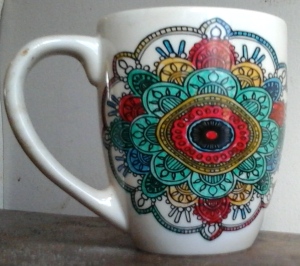
The other day, my husband gave me a little gift with which to amuse myself while he was out of town – a paint-n-bake coffee mug with an intricate mandala sort of design on both sides and a set of four special markers. The idea is that when you finish coloring it, you bake it for 45 minutes and the color becomes permanent. (More or less. You are advised to hand-wash the mug.)cup3

A while back, Dan had given me several coloring books and assorted colored pencils, the latest fad in relaxation techniques. Presumably, focusing on the coloring keeps your mind off your troubles. One of the coloring books I later obtained let you color a bunch of swear words, which are very satisfying to contemplate. (I think the book is English, because it contains epithets like “wank stain,” which I guess is equivalent to American “jerkwad.”)

Anyway, I wrote about the coloring craze some time ago in a blog post (“Color My World” http://wp.me/p4e9wS-jP), in which I said,

I don’t know anyone who admits to coloring within the lines when they were kids. Coloring outside the lines … was a badge of freedom and creativity and, for some, poor fine motor skills. It was how the more inhibited of us let our freak flags fly.

The coffee mug, however, was clearly intended to be colored within the lines, unless done as an art project by a five-year-old for Father’s Day.

This presented a little problem for me. I have “essential tremor,” which is doctor-speak for “We don’t know why your hands shake; they just do.” With coloring books, this wasn’t much of an issue, because the pages never even made it as far as the refrigerator door. A coffee mug, however, is meant to be used, though, so conceivably other people might see it. (Not that I’m a great one for having koffee klatches, except by phone with my mother-in-law.)

As I started coloring the first side of the mug, I discovered something useful – until baked, the colors were far from permanent. They could be rubbed away easily with a fingertip or a Kleenex. Or the heel of your hand as you rested it on the mug, trying to get the top half colored. Finally, I decided that the teensy white spaces within the itty-bitty black lines were just suggestions, and colored the larger shapes, staying vaguely between the lines and leaving those little accents of white, just for contrast.

By the time I had accomplished that, my hands were well and truly shaking. I could have stopped there and finished the mug later, on a day when my tremor was less troublesome. (It comes and goes, aggravated by fatigue or stress.) But I wanted to get the damned thing over and done with.cup1

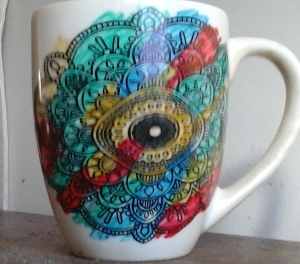
I decided that I would purposely let my freak flag fly on the other side. I would not even try to stay within the lines. Instead I took the markers and colored in bright diagonal streaks of different lengths and widths, with reckless disregard for any and all black lines. It was, in its own way, very satisfying, even if it did resemble the aforementioned Father’s Day gift. It was bright and cheery, and it looked absolutely nothing like the mandala pattern or the other side’s more constrained coloring.

I had warned Dan that I didn’t intend both sides of the mug to look the same, but I think he just supposed I would use different colors for the different parts of the identical design. We’ll see what he says when he gets home. As a child of the sixties, he should appreciate my rebelliousness, and as a fan of the Impressionists, he ought to admire my emotionally free style.

And if he doesn’t, I’ll just use the mug myself. It’s quite a large one, big enough to contain both my outer adult and my inner child. And lots of coffee.


P.S. Thanks to Ellen Kollie, friend and former coworker, for suggesting I turn this Facebook post into a blog post. If it doesn’t work, it’s all your fault.

Why Don’t Conservatives Support the Right to Privacy?

Privacy lawThe right to privacy, as defined by the historic Roe v. Wade decision, ought to be something that conservatives could get behind.

Okay, not when it comes to abortion, marriage equality, transgender persons in bathrooms, and other sex-loaded topics. There conservatives appear solidly anti-privacy. As they so often point out, the right to privacy is never mentioned in the Constitution. (Neither is education, which leads some to say that the Department of Education is not legitimate.)

But think about other issues near and dear to conservatives’ hearts and minds. At least to some degree, many of them can be framed as privacy issues.

Gun Ownership. Certainly the main argument here rests on the Second Amendment to the Constitution in the Bill of Rights. But if you look past the basic right to bear arms, matters of privacy begin to be involved.

Take gun registration. Many gun owners fear that registration of firearms is a prelude to confiscation of guns at some future date. Opposition to gun registration can be seen as a right to privacy in that context – gun owners want to have privacy regarding the number and kinds of firearms they own, and they believe the government has no business knowing that information.

Property Rights. Land owners, particularly in the Western states, feel they are entitled to make their own decisions about land use privately, without government interference and regulation. Water use, mineral rights, livestock conditions, and other factors, they feel, should be up to the individual farmer or rancher. In these days of drought, for example, why should anyone else get a say in how much water (that exists on his or her own land) the family farmer should be able to use? Who has the right to put restrictions on that and other practices? Aren’t those private decisions?

Medical Decisions. Leaving abortion aside for the moment, conservatives had major problems with “Obamacare” (aka the Affordable Care Act) because they believed that the government should not come between a patient and his or her physician. Of particular concern were the so-called “death panels,” which, if any had been implemented, might have led to government personnel having a say in “when to pull the plug on grandma,” or whether a disabled child was ever going to be a “productive citizen.”

Surely end-of-life decisions and those regarding the amount of treatment a person receives are sacrosanct, the ultimate in discussions that should occur privately between physician and patient.

Looking at topics on which conservatives might wish for a right to privacy, many are usually framed as “freedom from government regulation,” or “freedom from government.” In other words, the conservative position is that government should have no say in private decisions made by private citizens. In these and other cases, freedom from government interference is basically a variation on the right to privacy.

Some religious families, for example, believe that they have the right to privacy when it comes to how – or whether – to treat their children with conventional medicine. Is that freedom of religion? Or is it also freedom from government interference – that is, privacy – in decision-making?

Education, corporal punishment, divorce, and even Social Security numbers and other forms of ID are also seen by some as matters of privacy, and calls for freedom from government intrusion are heard.

Matters get murky, however, when we turn to issues of sex and family. You’d think that what happens in the bedroom (or motel or wherever) ought to be the most private moments there are. But until recently, specific sex acts and even the use of contraceptives were matters in which the government had its say.

Now complicated modern sexual issues are under discussion. The line between public and private behavior is less clear when you think about marriage equality, public bathrooms, HIV status, and gender identity.

The problem is, of course, that the reproductive rights movement has already laid claim to the phrase “right to privacy,” and it has become the basis of their political and social position. The doctor and patient, according to Roe, have the right to privacy when making decisions about the medical procedure of terminating a pregnancy.

And, however much they value privacy, that’s something that conservatives can’t or won’t include in their definition.


Pepping Up a Blog Post With Visuals

When I started my blogs (janetcobur.wordpress.com and bipolarjan.wordpress.com), I chose simple, clean themes and layouts, with no large pictures or fancy frills – just nice, clear, readable fonts that I liked, with a tiny splash of color. I didn’t want anything that would pull the reader’s focus away from the text. I mean, the words are the important thing, right?

Then one day I did a guest post for my friend Bradley on the subject of cognitive dissonance in bipolar disorder. You’d think that would be a pretty hard concept to illustrate. But to my surprise, Bradley changed the title to “Brain vs. Brain,” which was perfect, and added an illustration of two brains fighting with boxing gloves, which was also perfect.

“Where did you get that illustration?” I asked.

“There’s a service I use,” he replied. “I pay a few bucks for royalty-free photos and illustrations.”

photo by Dan Reily
photo by Dan Reily

Excited at the idea of adding images, I tried inserting one of my husband’s photos into a blog post and discovered that it was easy to do – just click Add Media, upload the image, position it, and voilà! Here’s that first attempt: http://wp.me/p4e9wS-7H.

I was so pleased with the result that I started looking around for an image service. The one I chose was Fotolia (https://us.fotolia.com/), but there are many others such as Adobe, iStock, Dreamstime, and Shutterstock. My subscription entitles me to a set number of images per month, and the price averages out to a little over $2 per image, since I download medium-sized images instead of full-sized ones. I have never yet gone over my monthly quota, and the unused credits roll over.

What do I get for my $2-and-a-fraction? I enter a keyword and instantly see a selection of photos and/or illustrations, then place ones I like in a virtual lightbox. Then I think them over, tinker with my headlines the way Bradley did, ask my husband’s opinion, download an image to my desktop and upload it to my blog. There are various ways to sort the images, but I like to use “undiscovered,” so my blogs don’t look the same as everyone else’s.

Generally, I prefer illustrations to photos. I find that they are more striking and easier to use to reinforce blog post titles or content. Sometimes, however, only a photo will do, if the subject – like ratatouille – is a difficult concept to illustrate. Most of the websites I submit my posts to (SheKnows, Red Tricycle, The Mighty, Medium) prefer photos, though, so I’ve been increasing my use of them to make my posts more appealing to those sites.

Helpless Woman Holding RopeAnother lesson I learned is to choose horizontally oriented images rather than vertical ones. Most of the sites I share to or submit to, like Facebook, present images in landscape (horizontal) mode, often cutting off the top and bottom of an image. That makes it a little harder to select images, and sometimes I have to crop an image to make it more compatible, but I get better, more understandable images that way. (Once I chose this vertically oriented illustration of a woman clinging to the end of her rope. It was perfect for the blog post topic, but it showed up on Facebook as only the middle part – the rope.)

Is my strategy working? It’s hard to tell – but my views and followers have been steadily increasing. And I enjoy the process and the way my blogs look with visuals. It may be extravagant to spend money on pictures when my blogs aren’t monetized, but I’ve spent more money on less satisfying things lots of times. Call this my little indulgence.

Who Needs the Department of Education?

Once when I was traveling with my mother, we met a woman from Australia and discovered that, despite the fact that we all spoke English, we still had cultural differences. My mother told her about this wonderful vest I had with all the pockets so I could keep my money, passport, photo equipment, maps, bus schedules, brochures, snacks, and other gear handy. (It was from Banana Republic.) Slowly I realized that to the Australian woman, “vest” meant “undershirt,” and she was getting a very odd idea of how I carried around my travel supplies.

She also said that she couldn’t understand how there could be a different speed limit in every state, especially since we had 50 of them. (Australia has six.)

“That’s nothing,” I said. “You should see the liquor laws. Those can vary by county or even city or township – when and where you can buy beer, wine, and liquor, if they allow it at all; what days and times liquor stores can be open; and so on.”

That’s not unlike how the education system in the United States works. “Local control” of education is held sacred in many schools and districts, even if it means that students in one state learn about evolution while others don’t, or that school boards have control of curriculum instead of states, or that children in certain states use textbooks the content of which is dictated by people in other states.

It’s a patchwork and a hodge-podge, and a big mess. Attempts to make school funding more fair, to eliminate de facto segregation, and to standardize curriculum are loudly and effectively resisted.

Betsy DeVos, the new U.S. Secretary of Education, is at best a loose cannon. Her nomination was confirmed by only the slimmest of margins – hardly a ringing endorsement for her agenda. And what is that agenda likely to contain?

More patchwork, more hodge-podge, more mess. In addition to waving the banner of local control, Ms. DeVos is a proponent of private and charter schools, which suck students and money away from the public schools. And she promotes the practice of home-schooling, which can be beneficial or not, depending on the skill and oversight of the home-schoolers, and what they teach their children.

Fortunately or unfortunately, we may not have to deal with whatever changes Ms. DeVos would like to make, since shortly after her confirmation it was announced that the entire Department of Education was slated for destruction.

Why do we even have a Department of Education? It was broken off as a separate Cabinet-level department from the Department of Health, Education, and Welfare (now called Health and Human Services). For over 35 years, its function has been to “establish policy for, administer and coordinate most federal assistance to education, collect data on U.S. schools, and to enforce federal educational laws regarding privacy and civil rights.” It had almost no influence on curriculum or standards until 2001’s No Child Left Behind Act. It has been opposed since its inception as being unconstitutional because education is not mentioned in that document.

Most of the Department of Education’s mission has been related to ensuring equal access to education, promoting legislation that particularly addresses access to education for children with disabilities. Under the Department’s aegis, these children have been determined to be entitled to a “free, appropriate, public education.”

Ms. DeVos has expressed opinions at odds with the laws that guarantee these rights for disabled students, especially IDEA, the Individuals with Disabilities Education Act. Parents of children with disabilities and educators who work with those populations were particularly vocal opponents of her confirmation.

What this all means for education is a profoundly unsettled question. What will Ms. DeVos be able to accomplish before the Department disappears out from under her? Will the laws regarding access to education be weakened or even repealed? It’s almost certain that more and more matters will revert to local control, with all the confusion and inequities that system fosters. Will parents who want specific educational outcomes for their children be forced out of public schools and into home-schooling or private schools (if they can afford them)? Will families have to relocate to districts or even states with compatible educational programs and goals?

Increasingly, it’s going to be difficult to call the U.S. system of education a system at all.

My (Lame) Attempts at Babytalk

First, let it be noted that I have no idea how to talk to babies. They stare at me like I’m from Mars and I stare back or read them the newspaper or something. Once in a restaurant a woman handed me her baby while she went to the restroom. Said baby and I had a staring contest, as there was not a newspaper handy. I jiggled it a little, which the baby didn’t object to, though I felt ridiculous. My husband took a picture, which I made sure no longer exists.

But with cats, it’s a different story. One conducted almost exclusively in babytalk. (I say “almost” because I do not use babytalk for communications like, “Get down off that shelf before you break the vase we bought in Italy!”)

toby2
Toby (aka Baby Boo)

The rest of the time, I sound like a blithering idiot. The blithering starts with their names. “Dushenka” becomes “Shenka-doodle” and “Toby” becomes “Toto-Booboo” or even “Toto-Booboo Baby.” (And we can’t overlook the geek-inspired “Toby-Wan Kenobi.” Sometimes Dushenka is even “Shenka-doodle-doo.” I knew you were wondering about that.)

I know there are those who feel these are not dignified things to call a cat, but the fact is that cats have no use for dignity. Despite their reputation, cats do the most un-dignified things, from licking their nethers to sneezing in my face. (One cat did this while I was blithering, “Sugar for mama?”)

Then comes feeding. “Does kitty want some noms? Nice noms for the kitty! Om-nom-nom!” And to think I used to make fun of my mother-in-law, who used to call her cat to the food bowl by yelling, “Pussy-Woo! Chickie!” (At least it’s not just me.)

For some reason, babytalk must be delivered in an unnaturally high-pitched voice. Of course, people talk that way to babies, too, but with cats it just adds to the absurdity. Maybe babies process language better at higher pitches, but I’m not really sure cats process language at all. Although I did once know one that would respond appropriately to a cry of, “Hey, you! You with the fur! Get down from there!” That was delivered in a regular, rather than squeaky, tone of voice, which is probably why it was effective.

Maybe the reason that I can babytalk cats but not babies is the fact that I have been around cats for years and years, while that encounter in the restaurant constituted most of the sum of my experience with tiny humans. It can’t be that only babies look at me like I’m from Mars, because the cats do too, when they aren’t just ignoring me.

Somehow, though, I feel that babies judge me and cats don’t. When your sole comment on anything is “mmma-weep!” (that’s a direct quote from Toby), you can’t afford to cop an attitude. (Dushenka has a wider vocabulary, including an assortment of purrs, trills, sighs, and snores. Dainty snores, but definitely different from the purrs.)

It’s ludicrous, I know, and one more sign that I may be turning into an official Crazy Cat Lady. Sometimes it’s even so bad that I make myself want to retch. (Does ittle Toto want snuggles from mama? Can I get the floofy white belly, Shenka-Doo? Does oo want to play with the nice mousie?) I mean, gag me. In either sense of the word.

Of course, it’s my belief that talking babytalk to babies sounds like blithering too. It’s just more socially acceptable. But since I’m seldom out in public with my cats, only my husband and closest friends know my little secret. And another little secret – I sometimes catch my husband cooing at the kitties as well.

Why I Should Get a Say About Raising Your Children

I know that childless people (of which I am one) like to bitch about how parents are raising their kids. I feel confident in saying that virtually every parent has had the experience of going out in public and being chastised for your children’s manners and behavior, your discipline, or the latest theories of child-raising. (Or for that matter, the good ol’ theories of child-raising.)

You’ve heard it all, from praise of Dr. Spock to “Dr. Spock is the root of all evil”; from “those kids could do with a good spanking” to “spanking is child abuse”; from “children should be seen and not heard” to “you’re stifling their creativity.”

The automatic reaction is, “You don’t have children, so you don’t know what it’s like.” And that statement is entirely true.

I don’t – and shouldn’t – have a thing to say about discipline, behavior, and manners (although I do wish your children wouldn’t fingerpaint with the salsa at a Mexican restaurant, especially when it’s at our table and you’ve assured me that the children know how to behave in a restaurant, to choose one example not completely at random).

Unless I see your child actually pocketing the server’s tip or harming an animal, I will keep my big mouth shut. And if I do see those things, I will do my best to respond in a polite, calm, and constructive manner.

What I can’t stand by and see without commenting is children not receiving a proper education. Even though I don’t have children, I still care deeply about – and will act upon – my notion of what is good for your children in school.

Part of this is selfish, I will admit. Your children will be the workers of their generation who will be affecting the quality of life for my generation. I don’t want to be governed by politicians who don’t understand civics, treated by doctors who don’t know the facts about human reproduction, or “informed” by scientists who have not had a chance to encounter the varied opinions of their field.

I also want my health aides, restaurant servers, mechanics, computer programmers, hair stylists, tour guides, garment workers – all workers – to be able at least to read and write basic English and do basic math. This is not entirely selfish – workers who do not have basic literacy and numeracy skills are more likely to be cheated by their employers and less able to negotiate the treacherous paths of bureaucracy that every American, without exception, must deal with. I want these things for children with disabilities as well, or at the very least the presence of well-educated aides and advocates.

For that matter, I want some of your children to grow up to be painters, musicians, singers, dancers, actors, athletes, craftspeople, writers, and animators who will make my future richer and more sustaining as I age.

In order to achieve these things, I have a vested interest in the education system. Just because I have no school-aged children – or any children at all – does not mean I should keep away from school boards, community volunteer programs, decision-making bodies, etc. I will support good education issues with my tax dollars and my votes. I will oppose any that limit a child’s access to good-quality, thorough, well-informed, factual, adequately funded, modern education.

I want your children to be smart, motivated, curious, skilled, artistic, problem-solving, conscientious, well-adjusted, healthy, helpful, effective, competent, confident adults, both for my sake and theirs.

The best way for me to contribute to that is to support, fund, and, yes, influence both the local and national system of education. I will help all you parents who want the same things for your children, and I will oppose those who settle for second best (or worse, given the international statistics).

Give me a well-educated world of your grown-up children and I’ll even overlook the salsa fingerpainting.


Crashing Political Parties

By the time this post is up, President Trump will have been inaugurated and many parties will have held many parties. And a lot of people have a lot to say about that, on both sides.

Because that’s what there are – two sides. Apparently, this is one situation in which there is no middle ground. For or against. Admiring or appalled. People who attempt to take a middle position – wait and see – are derided as “the problem” themselves, or apologists, or pie-in-the-sky dreamers. Any suggestion that we try to understand the other side (whichever that is) and their problems is met with a resounding “No! Why should I?”

I have been steering clear of the fray. I voted, and I have an opinion regarding the outcome. Those who know me well probably have no trouble guessing for whom I voted and what I think of the outcome. But I have avoided posting about it on my Facebook timeline or here (though I did write a few quasi-political posts – http://wp.me/p4e9wS-ol, http://wp.me/p4e9wS-qv, http://wp.me/p4e9wS-o2). I knew that my opinions were not likely to change anyone else’s opinions. I have used sources to refute some misconceptions and fake news, but since the threads went on without anyone noticing my contributions, that hardly counts.

I refused to get involved in the ugliness before the inauguration, and I refuse to now. My decision to stay out of the – I hesitate to call it a discussion –  may have cost me friends. There has certainly been a lot of if-you’re-not-for-us-you’re-against-us thinking, and if I do not declare myself, I become, in some minds, against everyone else.

Many people use the argument that a person’s blog or Facebook page is like a party the person is hosting, and the host is entitled to say anything he or she wants. This is as good an analogy as many others. But its corollary is that I do not have to remain at the party, or accept invitations to future parties. (I do agree that a person who behaves boorishly at a party can or should be ejected, but that tends to lead to really boring parties, with everyone nodding and shouting the same thing.)

When most of the invitations I see are to ad hominem parties (attacking a person instead of her or his relevant behavior, statement, stance, or action) and ones where only one opinion may be shouted, I prefer to play online bingo. I have taken a break from social media (except to post my blogs) a couple of times last year, and I feel another such fit coming on.

I don’t have a problem with online “parties” that involve sharing verifiable information or organizing to oppose a perceived injustice by legal means. But have you noticed how many suggestions are of the “hang ’em high” variety? I’m not talking about just one end of the political spectrum, either. One may be more likely to invoke firearms as a solution, but both are “sharing” in the gloating and finger-pointing and obscene memes and vulgar nicknames. I refuse to engage in dialogue with anyone who says either “rethuglicans” or “libtards.”

I understand the need to vent when one is disillusioned, outraged, insulted, ignored, or otherwise upset. Doing that venting in public, or even at one’s own party (which the virtual neighbors can “hear”) is no doubt satisfying, especially if one is particularly clever at inventing epithets. But it does no good, and only makes the divisions wider.

Yes, yes, I know I can just keep scrolling, but not without seeing hateful memes and pictures at the very least. I feel the same way about them as I do about photos of abused animals: I don’t want to see the carnage even if I support the cause. But I digress.

Blogger Jim Wright (www.stonekettle.com) often says,”If you want better government, be better citizens.”

I would add, “If you want better parties, be a better host. Or guest.”

Why Does Everything Have to Be Fun?

My husband used to accuse me of not knowing how to have fun. And he was right, sort of, in the sense that his ways of having fun and mine were (and are) very different. Now, as I stumble toward the age when the only fun consists of waving my cane at children and telling them to stay off my lawn, I have begun to rethink the whole concept of fun.

And I think fun is overrated. Or at least what is passed off as fun in popular culture.

Brushing your teeth is brushing your teeth. There’s nothing inherently fun about it. It’s just necessary, boring, and repetitive. But apparently we think that if we put Star Wars characters on the toothbrush handles, toothbrushing becomes FUN (how, I don’t know) and kids “may be brushing longer,” a claim that is never backed up by statistics.

Fun flavors like bubble gum also seem to be preferable to good old mint. I enjoy the flavor of mint, but I don’t think it’s fun. And I suspect that associating the act of brushing one’s teeth with the flavor of bubble gum is counterproductive. Just sayin’.

Likewise, there is nothing intrinsically fun about eating a salad, especially if you’re a female and alone. Yet there is a whole meme dedicated to “woman laughing alone with salad,” and now even a play based on the concept. Eating a salad by oneself can be tasty, pleasant, unpleasant, boring, or any number of other feelings. Why then are there so many photos of women laughing (or at least grinning idiotically) while eating salad?

And why are there so few photos of men doing the same thing? Do men not eat salads? Only in the company of others? Only stoically? It seems eating a salad alone is FUN only for solitary females. Poor, poor men, who must find their fun elsewhere.

Men having FUN get to drive cars, not eat salad. Cars provide particular enjoyment when the driver is breaking traffic laws or driving on a closed course where he can’t hit anything no matter how he speeds. This one I get a little bit. Fun is equated with breaking the rules, and without consequences. Fun is being sexy and dangerous. It’s hard to make toothbrushing or salads sexy and dangerous, so we’re left with men risking life and limb, while women and children guffaw and grin, browse and brush.

I know, I know. These are tricks of the advertising trade. FUN equals more sales, If ordinary activities are lifted above the ordinary, they will have more appeal to consumers. This is especially true of children who influence purchase decision-making – which is basically all of them. And fun is apparently the only value that kids value. What other satisfactions are there? Except companionship, warmth, friendship, accomplishment, health, adventure, and satisfaction itself, I mean. But all of those have more than three letters.

But FUN rules not just in advertising. Education is another field rife with fun. Multiplication tables aren’t much fun by themselves, so let’s add clowns and elephants. Then students can put their final reports into their Ninja Turtle backpacks and take them home.

I’m not advocating going back to the days of skill, drill, and kill, but I am of the opinion that genuinely engaging activities such as project-based learning will teach students skills in a manner that is genuinely satisfying, memorable, and indeed fun, without the need for stickers, banners, and class parties.

Preparing students, young adults, and even older adults for constant FUN is unrealistic. Taking out the trash isn’t fun. Polishing the floors isn’t fun (unless you’ve got a roomba and a cat). Creating spreadsheets isn’t fun. Taking out appendices isn’t fun (I assume).

Much of adult life and work will turn out to be not-fun. Especially for those women, eating salads alone. And for those of us who don’t care to wear bright yellow, and sing and dance while taking our vitamins. For us, it’s just a gulp, a swallow, and gone.