Category Archives: fashion

Rearranging the Furniture in My Head

I knew a woman once who, when she was at business conventions and besieged by requests, saturated with meetings, and overwhelmed by the exhibit hall, stated that she had to retreat to her hotel room “to rearrange the furniture in my head.” I thought that was a great way to put it. We all have furniture in our heads and sometimes it’s necessary to place it in areas where we won’t trip over it and bruise ourselves. Or there may be more furniture than we need and we must jettison some of it.

Now, however, rearranging the furniture in my head has become more literal. I’m basically in the position of having to furnish an entire house, and indeed to be involved in planning the shapes as well as the contents of the rooms, since our house was destroyed by a natural disaster.

This is challenging. We loved our house the way it was, with only a couple of changes that we could envision making. We have an architect working on it and he’s made some pretty fine suggestions. He has told us that we can add amenities such as skylights and bay windows, plus making what had been a deck into a screened porch or “catio.” We’re also willing to trade some storage space to have a larger downstairs bathroom. But even if we left the floor plan basically the way it was, there are still a lot of decisions to be made.

It’s the furniture that has me puzzled. All our life, our house has been decorated in what my parents liked to call “Early Married Junk.” (We’ve been married for more than 30 years and that’s still our decor.) Now, having to pick out things that actually go together is stressing me out.

Choosing color schemes is no picnic, for example. We barely had a color scheme for our wedding, starting with off-white so the guests wouldn’t snicker. This was in the days before weddings had themes or groom’s cakes or favors for the guests or designer cocktails. We had a cake decorated in our colors and called it a wedding day.

But now it seems that every room must have a color scheme and a “look.” Boho? Country? Modern? Classic? Retro? Anything but ’50s, no matter what my husband says.

Saying goodbye to our original kitchen decor will not be a hardship. The house was designed in the ’70s and the kitchen was done in orange. Countertops so orange you could lose a pumpkin if you placed it on one of the surfaces. Psychedelic patterned indoor-outdoor orange carpeting that caused hallucinations if you stared at too long. I don’t know what we’ll settle on, but that’s not it. Generally speaking, I think carpeting in the kitchen is a Bad Idea, psychedelic orange or not. Linoleum, tile, press-n-stick “wood” – nearly anything else.

Once I tried to decorate a bedroom. I was going for a travel theme with bright, yellow-gold walls and our assorted souvenirs as accents, with jungle print or brown, rust, and gold bedding. I managed to talk my husband into light oak for the bed, but couldn’t convince him to ditch his cherry chest-on-chest. It was an antique, but also a dark, hulking presence against one wall. We had compromised on each of us decorating one half of the room’s edges. My half had a rattan teacart and etagère. His had classical paintings of naked nymphs, plus brooding African masks that seemed to follow your every move. Admittedly, they did complement the travel theme, but they were still unnerving.

Now we will have a master bedroom, two baths, two studies, a great room, and a kitchen/dinette to deal with. By the time the house is built, I may just decorate every room with padded walls. Until we actually have rooms to put things in, I’ll keep browsing decorating websites and rearranging the furniture-to-be in my head.

Dressing Up and Dressing Down

Recently, there was quite a flap in Houston, TX, that quickly went viral. It seems that the administration of James Madison High School had issued a dress code. For parents. Apparently, there had been a problem with parents who came to the school inappropriately dressed.

I had my own experience with restrictive dress codes, though it was not at school (once the administration decided that girls could wear slacks). No, this was at a job I once held.

One day Doris, the HR/accounting person, sent around a memo that prohibited the wearing of shorts or tops that did not cover the hips, as with leggings.

I immediately demanded clarification.  “What about skorts?” I asked. “And culottes? How do you tell when something is baggy shorts or an actual culotte?” (I had no intention of wearing shorts, skorts, or culottes.)

“And what is this about your top must cover your hips? Don’t you mean it must cover your ass?” I inquired. Doris protested that the two meant the same thing.

“I don’t know about you,” I replied, “but my ass is a lot lower than my hips.” (It’s even lower now.)

Doris shooed me out of her office.

But I was not to be thwarted. I kept running back to her all day with requests for clarification. “Pedal pushers? Are those allowable? Gaucho pants? How about palazzo pants?” I kept it up all day, much to the amusement of my coworkers. As far as I could tell, no one changed their style of dress based on Doris’s admonitions. It was not really a concern for me, as I habitually keep my ass, as well as my hips, securely covered. And I don’t even know anyone who owns palazzo pants.

The brouhaha in Texas was a different sort of dress code, however. The school prohibited trespassing on their sacred precincts wearing a variety of attire including satin caps or bonnets, hair rollers, pajamas, leggings, low-cut tops, sagging pants, short-shorts, and “dresses that are up to your behind.”

But these were not rules for the students (although I imagine they had to follow similar ones). These strictures were for parents. In point of fact, moms. Except for the sagging pants, dads were unlikely to appear at school in any of the banned clothing. Probably.

Although it sounds amusing, this was a very serious thing. One mother was even reported to the police when she showed up at the school wearing a t-shirt dress and a headscarf. She naturally asked to see a copy of the dress code in writing, and the following day one was sent out.

Some viewed this policy as an affront to African-Americans, who evidently see nothing wrong with headscarves or satin caps. And I have no information on whether the rules were as strictly enforced on white moms as well. (I do know that bandanas, aka headscarves, have been traditional bad hair day accessories for all races for decades. Maybe even centuries.)

I can perhaps see a school not wanting visitors to enter the actual building wearing pajamas and bathrobes. But for all those moms who must get their kids to school at some ungodly hour, then return home and get dressed and ready for work, the temptation to cut corners must indeed be great. I picture the crossing guards at the drop-off car parade scrutinizing drivers and issuing citations for unapproved curlers.

It’s a good thing most moms don’t have to get out of their cars to deliver their kids to school. There might be a Doris waiting to measure the altitude of their ass and debate the propriety of palazzo pants.

And I Thought Placenta Cream Was Weird!

Of course, I was right. Placenta cream is weird. But not that long ago, it was touted as the latest beauty secret and sold to millions of women (skin care for men was not a thing back then). Made from the placentas of sheep, horses, or oceanic creatures, the products were available as skin creams, hair gels or conditioners, and facial masks.
Why placentas? Wisegeek reports: “Sheep placenta has been used for many years to promote general health. It is also typically used by consumers to produce clear and healthy skin, free of wrinkles and blemishes.” They add: “Every placenta produced by pregnant mammals contains vitamins and nutrients, but sheep placentas tend to be more accessible and more nutrient-rich.” Personally, I don’t want to think about that “accessible” part, although I suppose they are, compared to horse placentas.

Women have also been advised to eat their placentas, much as cats and other animals do. Well, not exactly as animals do. Humans tend to dry their placentas, grind them up (preferably not in the coffee grinder that they use for, say, coffee), and put them in capsules before they ingest them. Top Chef host and judge Padma Lakshmi did this, but I’m not sure that’s much of a recommendation.

In recent years, charcoal has been touted as the miracle beauty product. I’m pretty sure putting charcoal on your face for any reason other than skin care is nowadays considered offensive and likely to get you kicked out of any political office you might hold. But it seems that if you rinse it off before anyone sees you, it’s okay.

Beautifying charcoal comes in many forms: masks, toothpaste and toothbrushes, acne treatments, and various anti-aging products. It appears on every shelf of the health-and-beauty sections of your local drugstore. Some health effects are real: Charcoal has long been used in hospitals to treat cases of poisoning and by overindulgers to treat hangovers. But how charcoal is supposed to whiten your teeth remains one of the unsolved mysteries of the universe, at least to me. It’s counterintuitive at the very least.

The most horrifying recent beauty trend, though, is snail gel, which is better known as snail slime or mucus, except not on product labels. Let’s think about that for a moment. There’s a trail of slime that snails leave everywhere they go about their little snail business and now women are supposed to rub it on their faces.

(A lot of people think that eating snails is gross, so they call them escargot. I can report from experience that escargot have the texture of a chicken gizzard and are usually served cooked in garlic butter. Think of them as gizzard scampi and you’ve got the right idea. I ate them once at a business dinner and did not disgrace myself. But I digress.)

Apparently, the snail slime beauty trend started when snail breeders (that’s a real job) noticed how wonderfully soft the skin on their hands became. The appeal of snail mucus seems to be that it holds moisture in the skin, presumably by providing a slimy layer to trap it. Talk all you want about the glycoproteins, hyaluronic acid, and glycolic acid in snail mucus, but the main idea is that it makes your skin look dewy by hydrating you, something that can also be accomplished by drinking several glasses of water a day. But evidently holding the moisture right next to your skin with gastropod mucus is somehow preferable.

As beauty trends go, the one I get is exfoliation. Dead skin cells on the face and body are not a good look. My skin regimen (which I’m told every woman should have) consists of rubbing my face with a rough towel, washing my face, then drying it with another rough towel. I like to think my skin glows afterward.

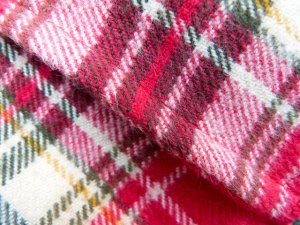
Why I Wear Plaid Flannel to Work

If you guessed that I’m a lumberjack, you’re wrong.

Photo by Kelly

I am a writer, editor, and proofreader, and I work at home. In my pajamas.

It’s great. My commute to work is from upstairs in the bed to downstairs at my desk. I have a coffee maker in my study and a box of cold cereal under my desk. That takes care of everything from breakfast to my mid-morning break. Lunch is only a kitchen away and the sofa is in the next room for TV watching. Then voilà, I’m all ready for bed again.

Of course, there are other choices than plaid flannel, but I like to stick with the basics. (And, hey, lumberjacks can be beefy and hunky and… stop that, Janet, get back to work! Try to think of Sheldon Cooper instead.)

Personally, I buy men’s flannel pajamas, as women’s have the curse of all women’s clothing – no pockets. At least men’s pajamas have a pocket or two where I can stash my cell phone or a snack for later. And I like my pajamas loose and comfortable. If you can’t be comfortable, there’s no sense in working in your pajamas.

In the summer, I prefer nighties that are basically long t-shirts for comfort and clever sayings and graphics (I ❤ My Bed, It’s Meow or Never, a kitten in an astronaut helmet). Or plain men’s big-n-tall t-shirts, again because of the comfort and the pocket.

It’s true that my study is on the first floor, and has a window that faces the street. Fortunately, there is a strategic shrub in front of it and a set of blinds so that I can keep my pajama-clad work habits to myself. But I live on a little-traveled cul-de-sac and my neighbors already think I’m weird, so it’s really not that much of a problem.

Another problem I don’t have is business meetings. Most are handled by telephone conference calls, so there’s no problem there. But even if I must Skype, all I have to do is keep a respectable top in my study (and not allow the cats to sit on it). No one will ever notice – or even see – my pajama-clad legs. (Or bare legs in the summer.) It gives me a nice rebel feeling too, like I’m getting away with something, which of course I am.

On-site business meetings are something I can well do without. Suit or dress, pantyhose (if anyone still wears those), shoes (instead of fuzzy slippers, part of my usual ensemble), coiffed ‘do (did I mention I can have bedhead or at most a simple ponytail at work?).

To tell the truth, I’ve even worked in my underwear on really hot summer days. You can conduct a phone interview in your delicates (especially if you have plaid panties) with no one the wiser (except maybe the neighbors, see above). Just imagine you have a suit on; people can hear it in your voice. They really can.

Of course, there is one drawback to working at home in your pajamas – cats. Besides sitting on your one respectable blouse, they may try to sit on your lap, keyboard, or papers; or nuzzle your screen; or try to capture your mouse. You can shut the door if you have one, but that will only lead to a lot of meowing, hissing, squabbles, and thumps. (What happens if you have kids, I don’t know. Probably more meowing, hissing, squabbles, and thumps. Plus the kids are likely to want to go to school in their pajamas, citing parental precedent.)

By the way, men can join the work-from-home-in-your-pajamas club too, but since I wear men’s pjs, I think it only fair that they wear women’s.


This post was inspired by a comment thread in the Erma Bombeck Writer’s Workshop (EBWW) attendees Facebook page.


Better Than Gold and Diamonds

It is a truism that women love gold and diamonds (and are even BFFs with an arrangement of carbon subjected to great heat and pressure). As a truism, of course, it is not always true.

So, as far as other friends go, there are always rubies, sapphires, and emeralds, the other precious stones. And topazes and opals, the hangers-on.

But for me, semi-precious stones and minerals are my best buds. And the only BFF I can choose is amber, which I’ve written about before. (https://wp.me/p4e9wS-pO)

photo by Bob Richmond

My next favorites have to be malachite, lapis lazuli, and azurite, which is like a combination of the other two, visually at least. (I think the chemical composition may differ.)

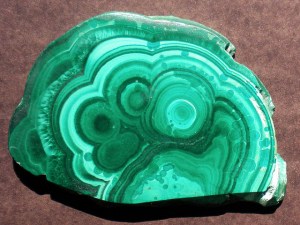
Malachite, as you can see, is a mineral of varying shades of green, all swirled together. Lapis is a dark blue stone, often with flecks of golden pyrite.

photo by Deidre Woollard

Blend them together and you’ve got azurite, an excellent stone for dramatic jewelry. (I have earrings that look almost exactly like these.)

Looking more like traditional gemstones, because they are translucent, are garnets and amethysts. Garnets are red, though sometimes with a purple or brown tinge that, along with their greater availability, makes them much less valuable than rubies.

photo by Warren Barker

Amethysts are those purple crystals often found inside geodes (round-ish rocks that when split open reveal gorgeous crystals inside). Amethyst comes in a variety of shades, from pale violet to deep purple, with the darker shades being more valuable. Huge crystal amethyst specimens make great coffee table decorations, but again I prefer them for jewelry. Similar in color to pale amethyst is iolite, which has more of a bluish tinge to it.

After the amethysts and similar colored stones, I like many of the minerals, which can also be used in personal ornaments. There are different forms of these stones as well. The agate and quartz families are good examples. Tree agate sports threads and vines of a deep evergreen against an off-white background, while blue lace agate and rose quartz make a lovely combination as beads in necklaces.

Photo by Renee Ford

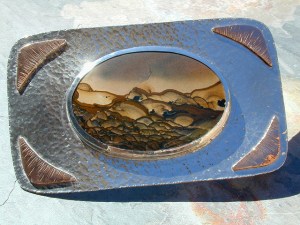
The jaspers are interesting too. They are usually named for what they resemble. Leopard jasper has dark spots on a yellowish background that makes it look, well, like a leopard’s skin. My favorite of the jaspers in picture jasper, which forms in layers that often resemble southwestern landscapes. It’s not unusual to see picture jasper cut into cabochons (stones that are rounded on top rather than faceted like most of the precious stones) and used as dramatic belt buckles.

photo by PresidenciaRD

Lately, another of my favorite stones is larimar. It is found only in the Dominican Republic (and a few other spots in the Carribean), so it is fairly rare. Larimar resembles turquoise, except that its color is a light, sky blue with occasional swirls of even lighter blue or white. Set in silver, it makes quite a striking appearance. It certainly attracts attention, the most common comment being, “What is that? And where did you get it?”

Of course you can order semi-precious stones and minerals on the internet, but it’s better to find a place where you can examine the pieces closely for flaws, exact color, and even authenticity. Small rock, fossil, and mineral shops, often in the southwestern U.S., are good places to look, as are gem and mineral shows for hobbyists in your local area.

Surprisingly, another good place to look is at science fiction conventions and Renaissance fairs. In both those venues, the desire to decorate oneself combined with lower budgets results in private dealers and hobbyists who display their wares in these locales. (I’ve bought a fair number of my semiprecious stones and mineral jewelry while dodging Klingons and orcs.)

And while you’re at it, don’t overlook the even lesser-known stones, like unakite, which is a dusky green and rose mixture, and zoisite, darker green than malachite and mottled with black, often with ruby inclusions. And aventurine, pale green and translucent. And watermelon tourmaline, which looks like what it sounds like. And hematite, shiny like black chrome. And…and…and….

Is Today a Pants Day?

Believe it or not, there is a holiday on which people walk around with no pants. (This year it’s celebrated on May 4 – the first Friday in May.) There are no official rules, other than not wearing pants and pretending that nothing is out of the ordinary. For the shy men, skirts or kilts may be worn. The traditional way to celebrate No-Pants Day is to ride the subway, but we don’t have one around here, so the idea hasn’t really caught on.

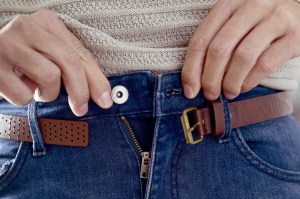
(It is a day, I suppose, to work out those dreams you have when you show up at work with no pants on. My problem is that I dream about showing up naked AND NO ONE NOTICES.)

Having a day to celebrate no pants is all well and wonderful. But what about people who wear no pants year-round? People like me.

As a freelance writer and editor, whose only commute is from upstairs to downstairs, I don’t really have to worry about pants. Other writers I know like to wear pants (or skirts) because it gives them a feeling of being at work officially, even if they’re doing that work in the privacy of their own home.

Not me. I relish the freedom of being a work-from-home person and I almost never wear pants while I work. Oh, in the winter I break out the Sheldon-esque plaid flannel jammies and work wearing those. But when the weather is warmer, I settle for a nightshirt or a t-shirt, sans pants.

Really, I could work in even less, except my study is on the ground floor and there’s a window. There’s a shrub in front of it, but still, I find it best not to encourage the neighbor boys.

I find nightshirts soothing and relaxing and completely conducive to work. They also make it easier for me to take naps in the middle of the day, which is one of the other perks of being a freelancer.

But there’s another aspect of the pants vs. no pants dilemma to be considered. A friend of mine and I refer to days when we actually have the energy to go outside and run errands or be social as “pants days,” because we have to put on pants to do so. He’s a writer too and has as much right to work in his bathrobe as I do.

Plus, both of us are given to spells of depression when we can scarcely get out of bed, much less out-of-doors. So we report, “I’ve had three pants days this week” or “I finally had a pants day yesterday,” and congratulate ourselves and each other for having the stamina to insert legs and zip.

I suppose I could wear a skirt or a dress and call it a pants day, but if I do go out, I almost always wear jeans – unless I’m going to a job interview or a meeting with the IRS. I’d be much more relaxed in pajama pants, but there you are. Society has dumb rules. And please don’t tell me that there are things called pajama jeans. That’s cheating.

And by the way, in case you wondered, for me, no-pants days are also no-bra days – but that’s a subject for another time. (https://wp.me/p4e9wS-c8)


Why Do Models Look So Mean?

“Fierce!”

You hear it on Project Runway and America’s Next Top Model.

Apparently, that’s the “look” that designers and fashion models and photographers want to portray. Do they really think it will sell clothes?

Someone must think so. But why? Why would I take fashion advice from someone who looks surly and disagreeable and fierce? Whatever happened to models that smiled, like they were enjoying their clothes and knew they looked good in them?

Actually, I think the models in ads that appear in “women’s” magazines and online sites and TV ads may smile from time to time. It’s a question of who buys the product. If women are buying a product – say a pair of jeans – they’d like to think that they will be delighted by them. They will smile.

(Maybe the women in SI‘s swimsuit issue smile too, but I’m not going to do the research on that. It’s doubtful that many of the men who read it are thinking, “I think I’ll buy that for my significant other. That’ll make her happy.” What they’re selling isn’t bathing suits.)

But when it comes to high fashion – and Valentine’s day perfume ads – the women pout at the least, and more likely snarl and glare, directly at the camera.

I don’t get high fashion (or haute couture, if you want to be classy). I don’t mean just that I don’t buy or wear it (which, you may have guessed, I don’t). I don’t get the psychology of it.

Are the fashion shows and ads trying to appeal to the “male gaze”? Obviously, they are, with the boobs and butts prominently displayed. But what about the faces? I understand that men are supposed to fantasize about having sex with these women. But don’t most men prefer a partner who looks happy about the encounter? Apparently, ad execs and fashion show coordinators believe that men prefer what they think is a sultry gaze, but more often looks like a man-eater who’s been dieting for a month.

Again, man-on-the-street men aren’t the target audience for high fashion. Seemingly, neither are non-independently-wealthy women. Who does that leave? Androgynous buyers for high-end department stores? Art directors of expensive, glossy magazines that cater to the glamour set? Other fashion designers?

In other words, people to whom the clothes may be important, but the women wearing them aren’t. The models are walking clothes hangers, so who cares whether they’re happy? And the fashion purveyors have convinced themselves that fierce is fashionable, as long as you’re not really trying to sell a product.

Of course, the smiling, laughing, dancing model isn’t all that accurate either. “Women laughing alone with salad” is the stereotype. But it appears in other forms – women dancing over how good their probiotics make them feel, frolicking playfully at the thought of new lipsticks and blow dryers, or singing about their favorite brand of cottage cheese. I roll my eyes at them until I’m afraid I’ll get stuck staring at the inside of my skull. Other times, I just assume they’re all on amphetamines.

Male models, now. No smiles there either, but the word for them is “aloof.” Half the time they don’t even look at the camera. If this is supposed to be attractive to the female gaze, again I don’t get it or must not have it.

The stereotype here is that women want cool, unapproachable men whom they can arouse and then domesticate. Think Mr. Spock, for example. Only with better abs.

Again, I’d prefer a partner who seems to enjoy being with me.

But maybe that’s just me.

The Big and Tall Blues

While I am pleased to see that “curvy” (plus-size) women are being featured in clothing and retailer ads on TV, and encouraged to accept – nay, celebrate – their figures, I have noticed a certain lack.

Where are all the plus-size men?

Well, we all know the answer to that. They’re on TV commercials as the butt of every joke, the loser in every office, the fall guy in every set-up. Or they’re dancing in a manner destined to spark derision. (Never mind that Drew Carey proved on the intro to his sitcom that hefty guys can bust a move.)

But in clothing commercials or ads for retailers that carry clothing? Nary a big guy to be found.

It should be noted that this merely reflects the reality of shopping. If a store has a “big and tall” section, it usually caters to tall and defines “big” as topping out at 3X (and those are always sold out, which should tell retailers something).

Then there are the b-and-t shops, which charge a hefty (sorry) premium for larger sizes. C’mon, it’s not like a few extra inches of fabric costs that much. If shoe manufacturers can afford the extra leather, canvas, or whatever for wide sizes, why do larger Dockers cost $50-75? (And that’s the last time I shopped. It could be even higher now.)

And while we’re on the subject, think of the difficulty I had finding a stock photo to illustrate this post. What I got when I searched were images of Santa; rednecks with shotguns; and men eating giant, dripping burgers or pizza. (Most of them had beards, too, which apparently are correlated with weight in someone’s mind.)

But let’s get back to real life. The plus-size men I know don’t even have a clue where they can find underwear that fits. They go from Target to Penney’s to Sears, only to find a dearth of options. It’s like large men are being urged to go commando. And if they do find undies that fit, they invariably are plain white. (Though this is a flaw in women’s undergarments as well. What, do you run out of flowers and stripes at size 10?)

What does this leave? Internet shopping, of course. And the price and selection problems persist there as well. At least women have sites like eShakti where we can have fashionable styles tailored to our dimensions, at only a nominally higher cost, and can find ready-made plus sizes in flattering and diverse designs (and by flattering, I don’t mean just vertical stripes).

Wait. Where was I? Oh, yes. Plus-size men’s clothing. The men’s rights movement has appeared not to have noticed the lack of clothing choices and the insulting ads, being more vigilant about custody decisions and uppity feminists, but they perhaps ought to take a lesson from the women who are working for body-positive fashion choices.

Until large men (let’s be clear here – fat boys https://www.youtube.com/watch?v=QkTJTAS7ePE) get aware and vocal about their limited choices, unequal representation, and demeaning depictions, they will have to live with the choices that the fashion and retailing industries give them. And that’s a meager diet.

I have known, and admired, and lusted after large men. I just wish they had something decent to wear.

Who Is a Lady?


Lately there have been a lot of memes portraying Michelle Obama and Melania Trump. Among the many questions raised, along with personal style, charitable activity, physical grace, and styles of dress, is this: Which one is a true lady? If I remember correctly, one specific meme asked about “showing skin” vs. “class.”)

Since this is a problem of definition and I am a former English major, I felt compelled to jump right in. Here are some definitions I’ve heard for the term “lady.”

“A lady never wears white after Labor Day.” As far as I can tell, all prohibitions regarding fashion have, praise be, flown out the window. Here’s what wisegeek.org has to say about the white/Labor Day rule:

In many parts of the United States, a rule about not wearing white after Labor Day . . . is heavily ingrained. The roots of the idea . . . appear to be shrouded in mystery, and the rule has been greatly relaxed since the 1950s and 1960s, when it was more heavily enforced. People who choose to wear white into the fall are no longer heavily criticized for the choice, and are sometimes embraced as fashion forward trendsetters.

Originally, the restriction applied only to white dress shoes and pumps, which are typically unsuitable for winter weather anyway.

“A lady is never unintentionally vulgar.” My friend Doreen said this, though she was paraphrasing Lillian Day, who said, “A lady is one who never shows her underwear unintentionally.” (The gender-flipped equivalent of this is Oscar Wilde’s “A gentleman is one who never hurts anyone’s feelings unintentionally.” I have also been informed that there is a version that goes “A gentleman is one who, when he pisses in the sink, removes the dishes first.”)

“A lady only accepts countertop appliances.” This idiosyncratic rule was voiced by my friend Karen upon learning that a male acquaintance had offered to buy a mutual friend a dishwasher. I’m sure there must be a rule somewhere about gifts of jewelry (“A lady only accepts semi-precious stones”), and if there isn’t, I’m inventing it now. One has to be more than just good friends with a man to accept diamonds.

“A lady has modest and maidenly airs and virtue a blind man could see that I lack.” Uh-oh. Now I’m quoting from Man of La Mancha. Someone stop me. It takes us into Madonna/whore territory, where I suppose this discussion has been heading all along. Or Lady/Tramp. No wait, that’s Disney.

Notice that in all but the first and last instances, the qualities of a lady can be seen only by her actions and not by her appearance. A lady is as a lady does, as it were. That’s one reason that Michelle/Melania memes are ridiculous. You can’t tell whether either woman is a lady simply by her appearance. It is her actions (not showing underwear, not accepting large appliances) that are better at separating ladies from women.

And after all, isn’t that what we’re talking about here? Having rules that separate women from other women and making a judgment on who is the better person? This dichotomy has assorted male versions as well (sperm donor/daddy, gentleman/jerk, redneck/anyone else), but it’s the woman/lady rules that carry a real bite. Ladies are worthy of respect; mere women are not, is the implication. There are even further distinctions: lady/slut is the most common and most invidious.

It’s my belief that these comparisons are frivolous and ridiculous, meant to divide (and conquer) women by pitting them against one another instead of paying attention to issues and distinctions that really matter. Then another person is entitled to hoist his (yes, his) nose in the air and say,”Women will never be able to hold power when they’re always sniping at each other and obsessing about shoes.”

Apologies to Doreen and Karen, who I think were being ironic rather than sniping, but if we want other people to stop judging us, we should give ourselves a break too. “Lady” is a term with little meaning. It essentially says only, “I like and approve of this woman but not that one.” It’s not worth mud-slinging about. Or wasting our time on insulting memes.

Shame, Shame, Shame!

When I was a child and had done something wrong, my mother would shake her finger at me. I hated that pointing, wagging finger more than I hated getting yelled at. The gesture conveyed shame, even if my mother’s words didn’t.

Nowadays we seem to see a lot of pointing and shaking fingers, pronouncing blame or shame on the offending parties. Here are some that you are likely familiar with and others that you may not be.

Fat-shaming This is probably most common kind of shaming and comes in various forms. One of the most noticeable kinds is fat-shaming actresses for carrying a few extra pounds – or even ounces. Increasingly stringent and nearly impossible standards are held up. Who the hell notices whether the woman in the supermarket or on the soccer field has a thigh gap anyway? Are the rest of us supposed to try to achieve this dubious standard? Thigh jiggle was bad enough. And 99% of those “People of Walmart” photos? Fat people in outfits that don’t even have the “decency” to try to hide it.

Body-shaming There are other types of body-shaming. Skinny-shaming. Have you ever heard someone pass a thin woman and call, “Eat a sandwich”? Fashion models are held to unrealistic standards of thinness, then mocked when they do. Women at science fiction conventions are shamed for having the “wrong” body type to wear a She-Hulk or Slave Girl Leia costume. And forget black Supergirls and Wonderwomen. You’d think we’d be over this by now. But no.

Slut-shaming Even the term makes my skin crawl. It contains the assumption that there is such a thing as a slut who can be recognized on sight. Or if you’re not going strictly on clothing, hair, and makeup, it becomes sexual-behavior-shaming. It’s a thin line between that and blaming rape victims for the crime.

Mommy-shaming Suddenly, everyone’s an expert. Underprotective mothers, overprotective mothers, breastfeeding mothers, bottle-feeding mothers, mothers of “free-range children,” “helicopter moms” and “tiger moms.” Worst of all, people feel entitled to comment on their behavior, not just on social media, but face-to-face with the mothers themselves. Oh, there’s plenty on social media too. Recently a celebrity was caught giving her child the wrong sort of toy, which apparently viewers could see had eyes that were a choking hazard. There’s nothing like 100,000 people telling you you’re killing your child.

Age-shaming This started in Hollywood too, it seems. Feminists have long noted that female actors’ careers are over when they hit 40 – or long before, especially if they play romantic leads. Meanwhile, male actors star in such films long into their 60s or 70s – with ingenues young enough to be their granddaughters. Body-shaming is also involved. When it was announced that Meryl Streep was starring in the action-adventure film The River Wild, critics couldn’t help sniping that no one would want to see the 45-year-old Streep in shorts or a bathing suit. But this insidious trend isn’t limited to LaLa-Land. Think about all those articles you’ve seen that tell women over 40 what they shouldn’t wear – even women over 30, for God’s sakes! I’m not throwing away my leopard-print flats just for them!

Poverty-shaming Again, think about those “People of Walmart” photos. Who shops there? Not the rich. So the poor are targets for shaming. Now think of the “Welfare Queen” stereotype – a woman on public assistance who drives a Cadillac, has her hair and nails done weekly, smokes and drinks and drugs, never works, dines out on steak and lobster while feeding her kids junk food. You’ve seen it in memes and rants on social media and even heard it from elected officials. This is particularly hurtful, because it affects public policy. And it’s simply untrue. Most people on public assistance have jobs and close-to-the-bone lives. But even school lunches for their kids are politically controversial. Life is hard enough without the shaming.

Am I just ranting that shaming is shameful and wrong? Of course I am. It’s mean-spirited and insulting and unnecessary. But look at who gets shamed the most – women. And often, it’s other women who do the shaming. From the time when fashion magazines covered the eyes of women committing clothing “crimes” to nowadays when women can be shamed for how they look – no matter how they look – and for what they do and how they behave.

And people wonder why women have low self-esteem and doubt their every decision, and why poverty is seen as a moral failing. Shaming is a nastier form of gossiping, which is nasty already, but it is worse than that. All those pointing, wagging fingers are pointing the wrong direction. What we need is a little more shame-shaming.