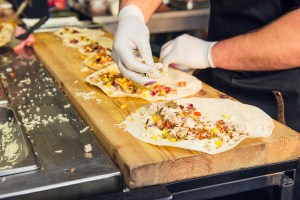
 Food trucks are big business now – or at least a lot of small businesses. A far, far step up from the “roach coaches” that used to deliver pedestrian sandwiches to large businesses with numerous workers, food trucks now provide everything from street food, to gourmet offerings, to not-so-humble cupcakes.
There may not be a taco truck on every corner, but you can find food trucks singly everywhere from tattoo studios to churches, or a whole flock of them at local festivals, colleges, parks, and parking lots. Long lines, few places to sit, and weather conditions can make food trucks not so easy to access and enjoy, but their many temptations keep the people coming back.
Sometimes these mobile purveyors of good food and gluttonous goodies even turn into brick and mortar shops. Our local Zombie Dogz is a good example. A truck offering all-beef hotdogs with outrageous toppings and creepy names (“The Waking Dead” for a breakfast dog, for example) recently reached the end of its useful days and had enough of a following to open a very popular shop in an advantageous downtown location.
Even the food trucks with more humble offerings are tech-savvy. With Facebook and Twitter they let their fans know where they’ll be and when. Groups of such mobile food purveyors even band together in food truck rallies which they advertise widely on social media.
But lest you think that food trucks are modern inventions, way back in the 70s, there was a food truck that staked out Cornell, the university I attended. Operated by a local bar and grill, The Johnnie’s Big Red food truck appeared regularly at locations in North Campus and West Campus. Weary and hungry students could get sandwiches and subs to take back to their dorms and chow down.
When I learned of this phenomenon, which was advertised by word-of-mouth, I had to try it. One evening I walked up to the window and ordered a sub. To my surprise, the man behind the counter asked, “What kind?”
What we had was a failure to communicate. Growing up as I did in a Midwestern suburb, a sub meant only one thing: a lunch meat sub, which varied only slightly by whether it included ham, pimento loaf, or salami with the bologna and whether it had mayo. They usually had slices of American cheese, though that was not necessarily a requirement. Other amenities such as lettuce and tomato were conspicuously absent, making the sell-by date harder to pinpoint (they didn’t mark them back then). The subs were wrapped in clear plastic and served cold. Selling them was often an activity to raise money for sports teams, marching bands, and the like.
The Johnnie’s trucks sold any kind of sub you could imagine, with dozens of choices of meat, cheese, toppings, and accouterments, wrapped in foil and served hot or cold. I had to step out of the line, look at the menu board that I hadn’t expected or noticed, and figure out what I really wanted.
There was a trick to ordering at the truck, too. If you picked up on the lingo, you could get your made-to-order sandwich faster. It was sort of like the old diners where you told them to “run it through the garden” for a burger with everything. Once I got it down pat, my usual order was “RBC on wet garlic with mush” (roast beef and cheese on garlic bread with pizza sauce and mushrooms).
A far cry from bologna, ham, and pimento loaf. Or hot dog with diced green apples, blue cheese, bacon and drizzled with bbq sauce, for that matter.
 Our house felt remote, surrounded by trees and a small stream and prairie grasses and wildflowers. Our neighbors were remote enough that we could have become practicing nudists, were it not for the invention of telescopes. Actually, it was very close to everything required for modern life.
 I knew a woman once who, when she was at business conventions and besieged by requests, saturated with meetings, and overwhelmed by the exhibit hall, stated that she had to retreat to her hotel room “to rearrange the furniture in my head.” I thought that was a great way to put it. We all have furniture in our heads and sometimes it’s necessary to place it in areas where we won’t trip over it and bruise ourselves. Or there may be more furniture than we need and we must jettison some of it.
 There we were, bedding down on sleeping bags in our tents, the cold, hard ground only a layer of canvas or plastic away. When we sprang out the next morning, our lithe teen forms dressed in green shorts and Vibram-soled boots, we hoisted our backpacks and hiked over hill and dale and rocky trails, singing optimistic songs and breathing deep of the fresh air. We ate granola as we walked.
 Actually, I am probably not the world’s very crappiest typist. I don’t use two fingers in the style called “hunt-and-peck.” (Except the one time I had to use a Cyrillic typewriter to write our Russian vocabulary lists. But I digress.) However, I am certainly among the worst.
 I officially retired last year, when my birthday hit the federal standards, and I’m here to tell you, it’s not all it’s cracked up to be.
 I had a public speaking engagement coming up. In fact, my publisher had arranged to have me do a reading/signing of my first book, Bipolar Me, at the local Barnes & Noble.
 Of course, I was right. Placenta cream is weird. But not that long ago, it was touted as the latest beauty secret and sold to millions of women (skin care for men was not a thing back then). Made from the placentas of sheep, horses, or oceanic creatures, the products were available as skin creams, hair gels or conditioners, and facial masks.
 Lots of bars have darts leagues. But increasingly, a
